
The Research Excellence Framework Assessment framework guidance on


- Slides: 24
The Research Excellence Framework Assessment framework, guidance on submissions and panel criteria
Presentation outline • • • Overview REF panels Impact
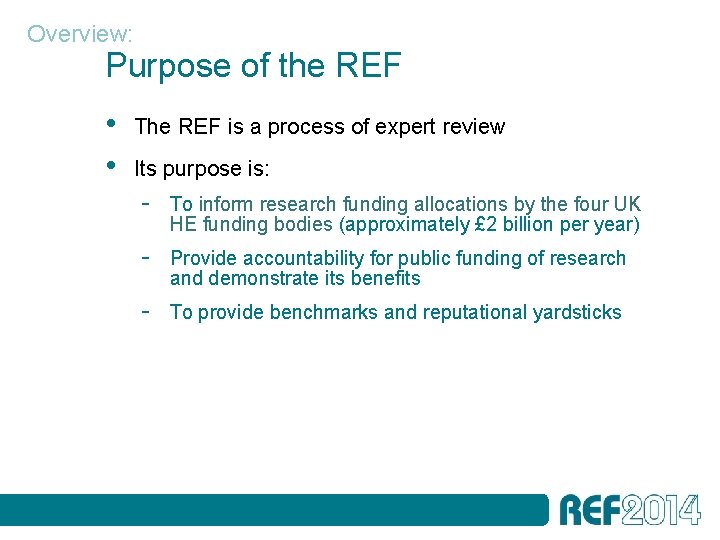
Overview: Purpose of the REF • • The REF is a process of expert review Its purpose is: - To inform research funding allocations by the four UK HE funding bodies (approximately £ 2 billion per year) - Provide accountability for public funding of research and demonstrate its benefits - To provide benchmarks and reputational yardsticks
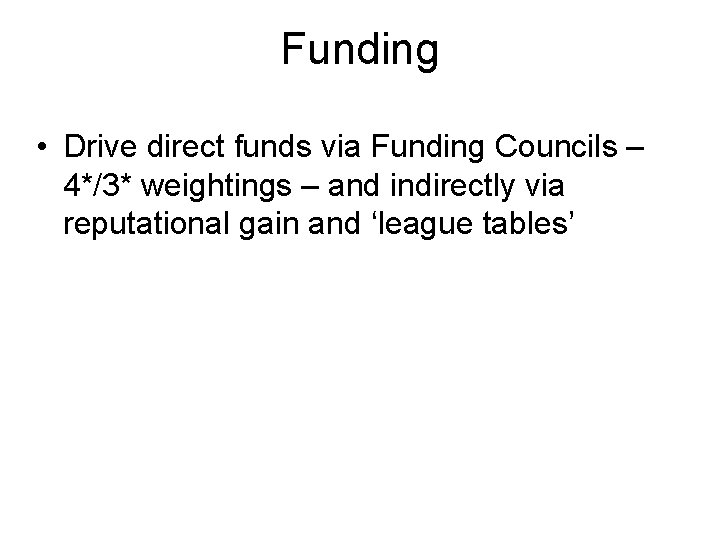
Funding • Drive direct funds via Funding Councils – 4*/3* weightings – and indirectly via reputational gain and ‘league tables’
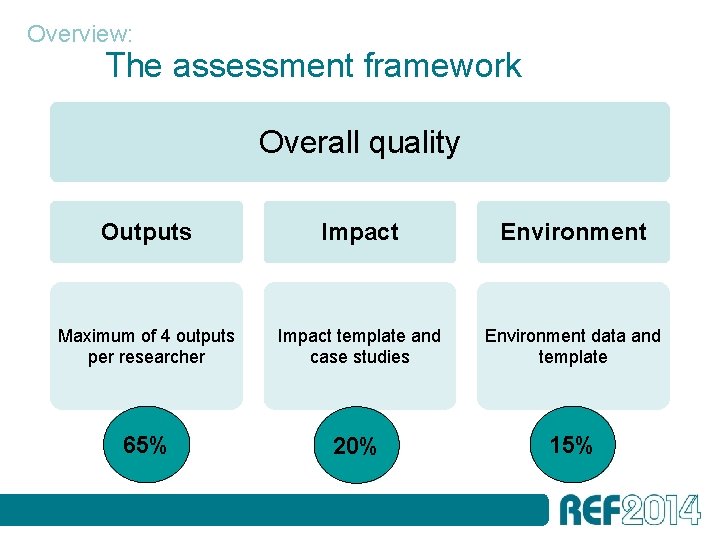
Overview: The assessment framework Overall quality Outputs Impact Environment Maximum of 4 outputs per researcher Impact template and case studies Environment data and template 65% 20% 15%
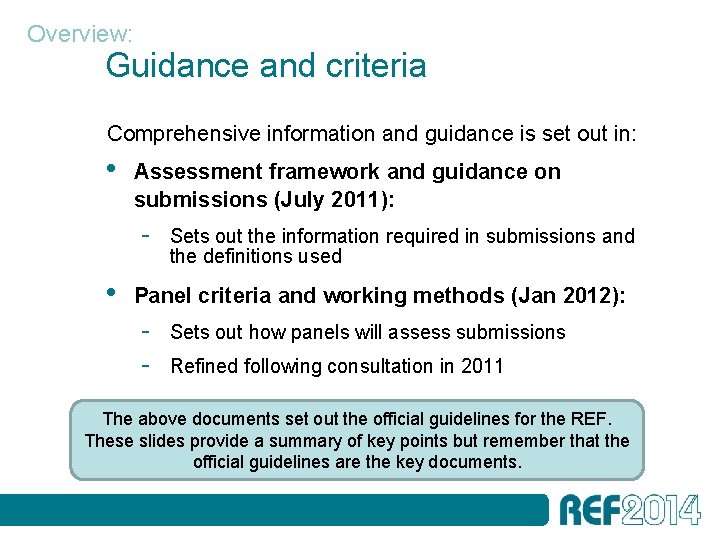
Overview: Guidance and criteria Comprehensive information and guidance is set out in: • Assessment framework and guidance on submissions (July 2011): - • Sets out the information required in submissions and the definitions used Panel criteria and working methods (Jan 2012): - Sets out how panels will assess submissions Refined following consultation in 2011 The above documents set out the official guidelines for the REF. These slides provide a summary of key points but remember that the official guidelines are the key documents.
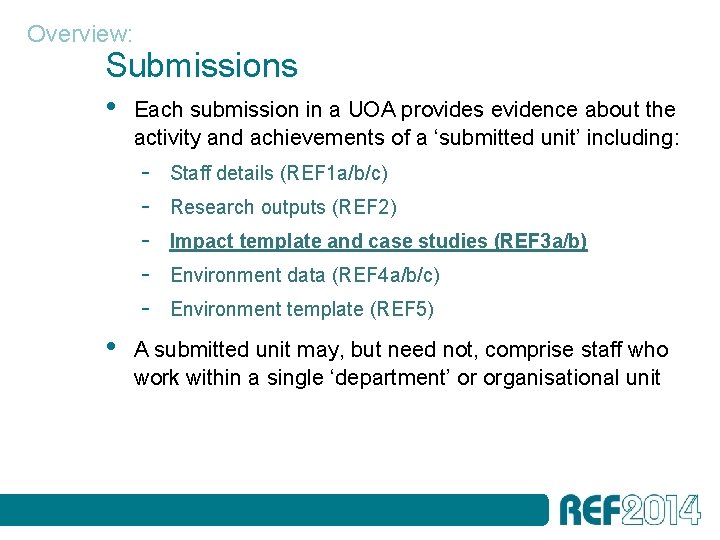
Overview: Submissions • Each submission in a UOA provides evidence about the activity and achievements of a ‘submitted unit’ including: - • Staff details (REF 1 a/b/c) Research outputs (REF 2) Impact template and case studies (REF 3 a/b) Environment data (REF 4 a/b/c) Environment template (REF 5) A submitted unit may, but need not, comprise staff who work within a single ‘department’ or organisational unit
REF panels
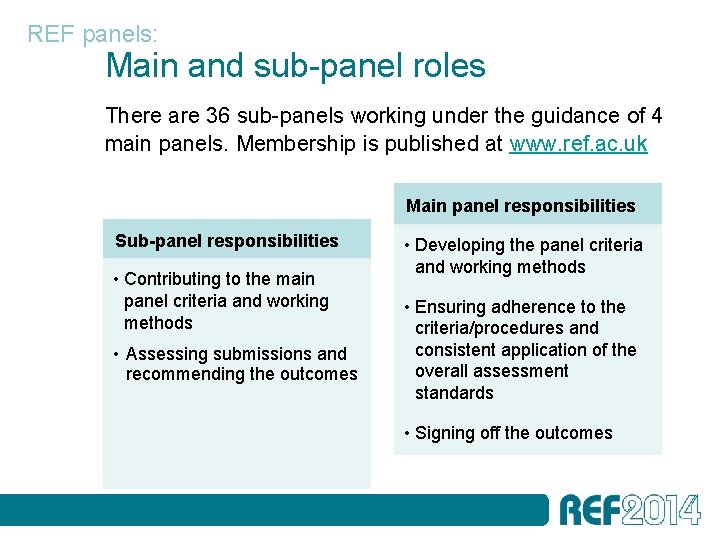
REF panels: Main and sub-panel roles There are 36 sub-panels working under the guidance of 4 main panels. Membership is published at www. ref. ac. uk Main panel responsibilities Sub-panel responsibilities • Contributing to the main panel criteria and working methods • Assessing submissions and recommending the outcomes • Developing the panel criteria and working methods • Ensuring adherence to the criteria/procedures and consistent application of the overall assessment standards • Signing off the outcomes
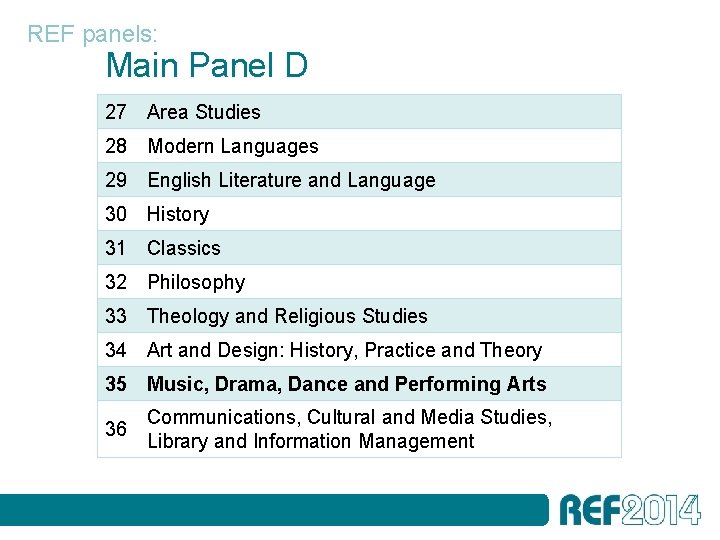
REF panels: Main Panel D 27 Area Studies 28 Modern Languages 29 English Literature and Language 30 History 31 Classics 32 Philosophy 33 Theology and Religious Studies 34 Art and Design: History, Practice and Theory 35 Music, Drama, Dance and Performing Arts 36 Communications, Cultural and Media Studies, Library and Information Management
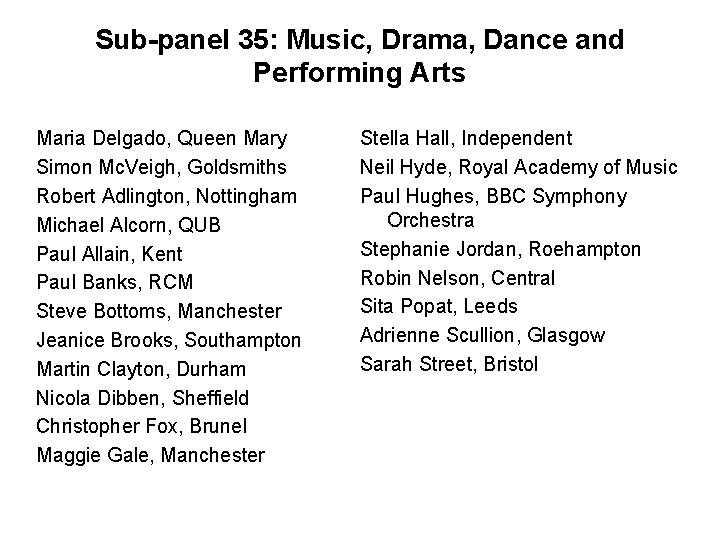
Sub-panel 35: Music, Drama, Dance and Performing Arts Maria Delgado, Queen Mary Simon Mc. Veigh, Goldsmiths Robert Adlington, Nottingham Michael Alcorn, QUB Paul Allain, Kent Paul Banks, RCM Steve Bottoms, Manchester Jeanice Brooks, Southampton Martin Clayton, Durham Nicola Dibben, Sheffield Christopher Fox, Brunel Maggie Gale, Manchester Stella Hall, Independent Neil Hyde, Royal Academy of Music Paul Hughes, BBC Symphony Orchestra Stephanie Jordan, Roehampton Robin Nelson, Central Sita Popat, Leeds Adrienne Scullion, Glasgow Sarah Street, Bristol
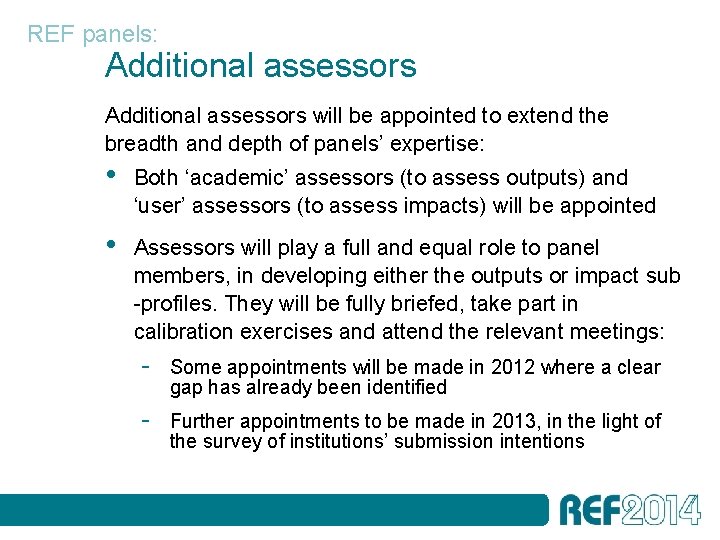
REF panels: Additional assessors will be appointed to extend the breadth and depth of panels’ expertise: • Both ‘academic’ assessors (to assess outputs) and ‘user’ assessors (to assess impacts) will be appointed • Assessors will play a full and equal role to panel members, in developing either the outputs or impact sub -profiles. They will be fully briefed, take part in calibration exercises and attend the relevant meetings: - Some appointments will be made in 2012 where a clear gap has already been identified - Further appointments to be made in 2013, in the light of the survey of institutions’ submission intentions
Impact
Impact: Definition of impact • Impact is defined broadly for the REF: an effect on, change or benefit to the economy, society, culture, public policy or services, health, the environment or quality of life, beyond academia • Panels recognise that impacts can be manifest in a wide variety of ways, may take many forms and occur in a wide range of spheres, in any geographic location • Panels provide examples of impact relevant to their disciplines, intended to stimulate ideas - not as exhaustive or prescriptive lists
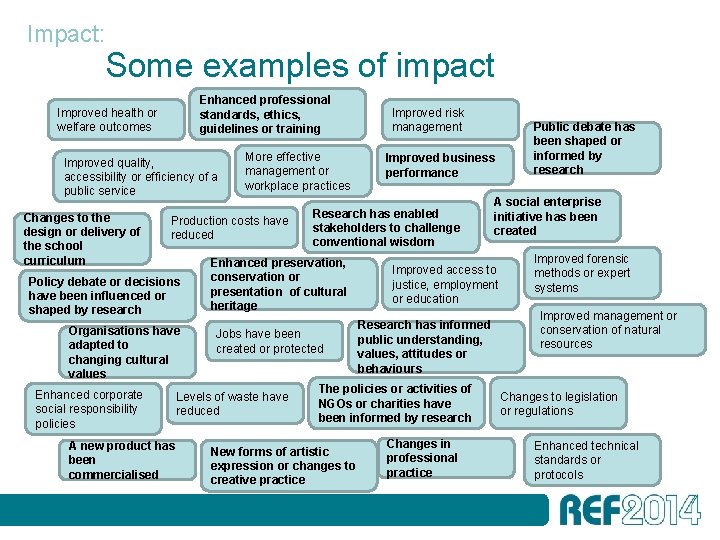
Impact: Some examples of impact Enhanced professional standards, ethics, guidelines or training Improved health or welfare outcomes Improved quality, accessibility or efficiency of a public service Changes to the design or delivery of the school curriculum More effective management or workplace practices Production costs have reduced Policy debate or decisions have been influenced or shaped by research Organisations have adapted to changing cultural values Enhanced corporate social responsibility policies A new product has been commercialised Improved business performance Research has enabled stakeholders to challenge conventional wisdom Enhanced preservation, conservation or presentation of cultural heritage Jobs have been created or protected Levels of waste have reduced Improved risk management The policies or activities of NGOs or charities have been informed by research New forms of artistic expression or changes to creative practice A social enterprise initiative has been created Improved access to justice, employment or education Research has informed public understanding, values, attitudes or behaviours Changes in professional practice Public debate has been shaped or informed by research Improved forensic methods or expert systems Improved management or conservation of natural resources Changes to legislation or regulations Enhanced technical standards or protocols
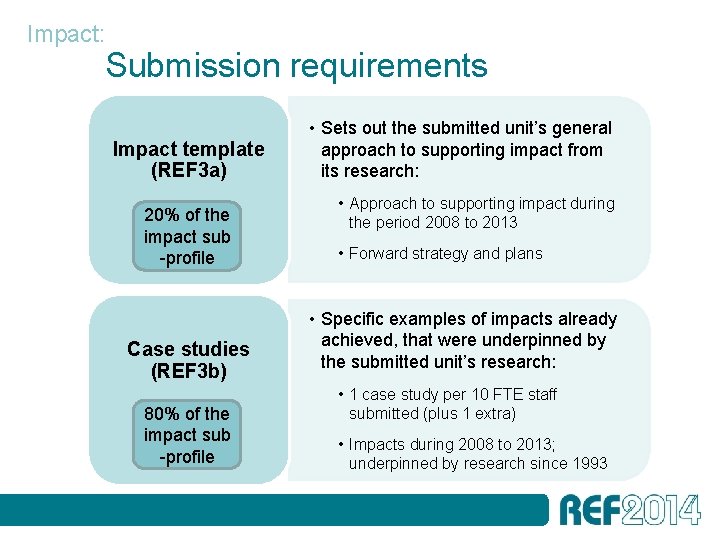
Impact: Submission requirements Impact template (REF 3 a) 20% of the impact sub -profile Case studies (REF 3 b) 80% of the impact sub -profile • Sets out the submitted unit’s general approach to supporting impact from its research: • Approach to supporting impact during the period 2008 to 2013 • Forward strategy and plans • Specific examples of impacts already achieved, that were underpinned by the submitted unit’s research: • 1 case study per 10 FTE staff submitted (plus 1 extra) • Impacts during 2008 to 2013; underpinned by research since 1993
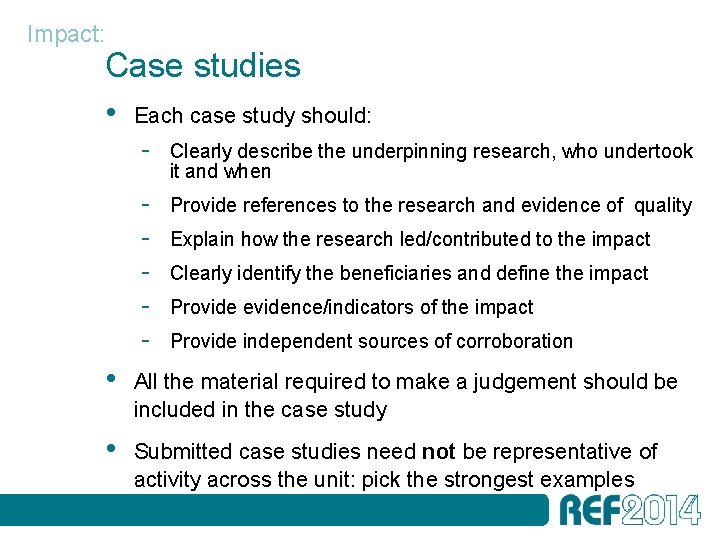
Impact: Case studies • Each case study should: - Clearly describe the underpinning research, who undertook it and when - Provide references to the research and evidence of quality Explain how the research led/contributed to the impact Clearly identify the beneficiaries and define the impact Provide evidence/indicators of the impact Provide independent sources of corroboration • All the material required to make a judgement should be included in the case study • Submitted case studies need not be representative of activity across the unit: pick the strongest examples
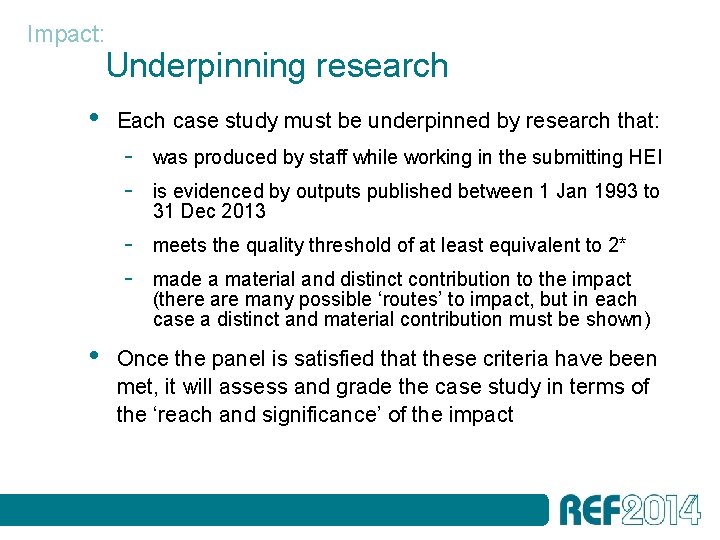
Impact: Underpinning research • • Each case study must be underpinned by research that: - was produced by staff while working in the submitting HEI - meets the quality threshold of at least equivalent to 2* is evidenced by outputs published between 1 Jan 1993 to 31 Dec 2013 made a material and distinct contribution to the impact (there are many possible ‘routes’ to impact, but in each case a distinct and material contribution must be shown) Once the panel is satisfied that these criteria have been met, it will assess and grade the case study in terms of the ‘reach and significance’ of the impact
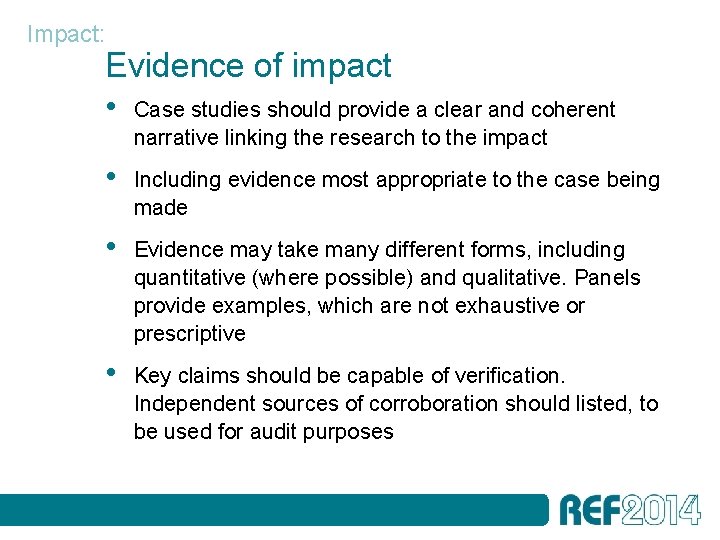
Impact: Evidence of impact • Case studies should provide a clear and coherent narrative linking the research to the impact • Including evidence most appropriate to the case being made • Evidence may take many different forms, including quantitative (where possible) and qualitative. Panels provide examples, which are not exhaustive or prescriptive • Key claims should be capable of verification. Independent sources of corroboration should listed, to be used for audit purposes
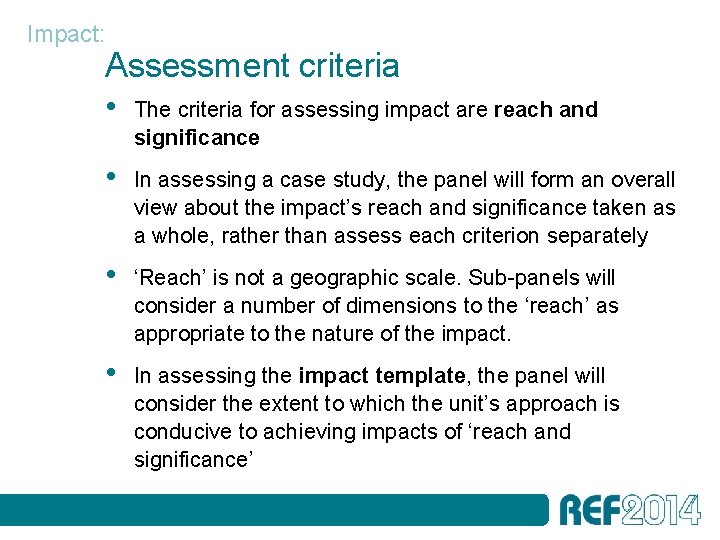
Impact: Assessment criteria • The criteria for assessing impact are reach and significance • In assessing a case study, the panel will form an overall view about the impact’s reach and significance taken as a whole, rather than assess each criterion separately • ‘Reach’ is not a geographic scale. Sub-panels will consider a number of dimensions to the ‘reach’ as appropriate to the nature of the impact. • In assessing the impact template, the panel will consider the extent to which the unit’s approach is conducive to achieving impacts of ‘reach and significance’
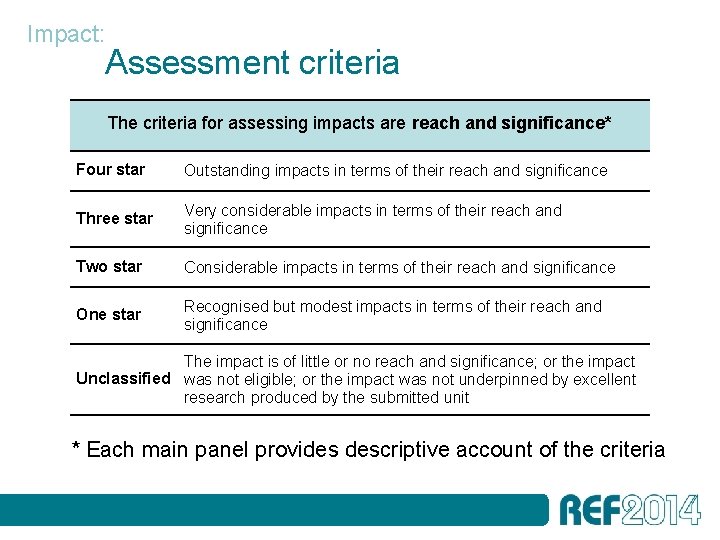
Impact: Assessment criteria The criteria for assessing impacts are reach and significance* Four star Outstanding impacts in terms of their reach and significance Three star Very considerable impacts in terms of their reach and significance Two star Considerable impacts in terms of their reach and significance One star Recognised but modest impacts in terms of their reach and significance The impact is of little or no reach and significance; or the impact Unclassified was not eligible; or the impact was not underpinned by excellent research produced by the submitted unit * Each main panel provides descriptive account of the criteria
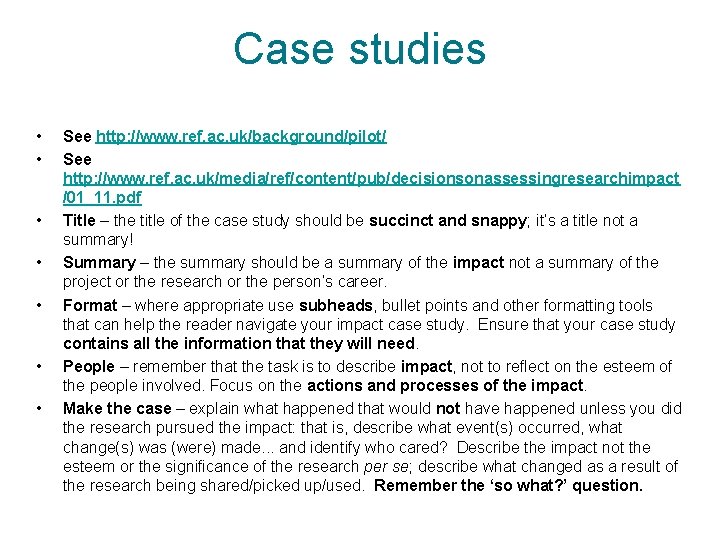
Case studies • • See http: //www. ref. ac. uk/background/pilot/ See http: //www. ref. ac. uk/media/ref/content/pub/decisionsonassessingresearchimpact /01_11. pdf Title – the title of the case study should be succinct and snappy; it’s a title not a summary! Summary – the summary should be a summary of the impact not a summary of the project or the research or the person’s career. Format – where appropriate use subheads, bullet points and other formatting tools that can help the reader navigate your impact case study. Ensure that your case study contains all the information that they will need. People – remember that the task is to describe impact, not to reflect on the esteem of the people involved. Focus on the actions and processes of the impact. Make the case – explain what happened that would not have happened unless you did the research pursued the impact: that is, describe what event(s) occurred, what change(s) was (were) made. . . and identify who cared? Describe the impact not the esteem or the significance of the research per se; describe what changed as a result of the research being shared/picked up/used. Remember the ‘so what? ’ question.
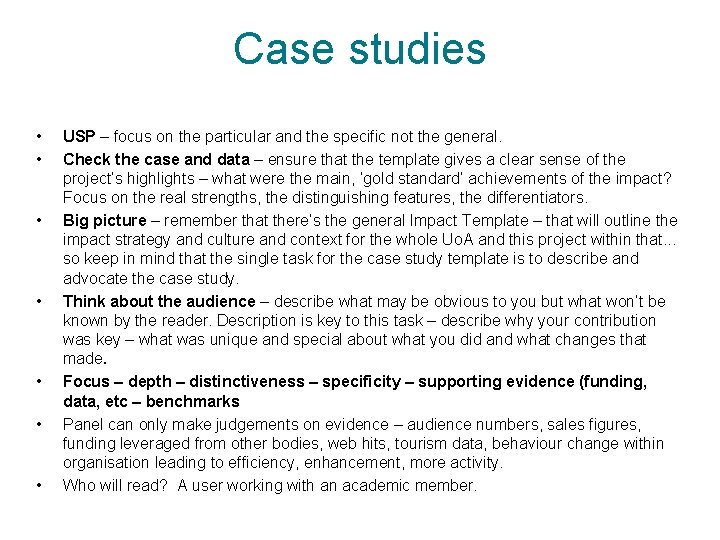
Case studies • • USP – focus on the particular and the specific not the general. Check the case and data – ensure that the template gives a clear sense of the project’s highlights – what were the main, ‘gold standard’ achievements of the impact? Focus on the real strengths, the distinguishing features, the differentiators. Big picture – remember that there’s the general Impact Template – that will outline the impact strategy and culture and context for the whole Uo. A and this project within that. . . so keep in mind that the single task for the case study template is to describe and advocate the case study. Think about the audience – describe what may be obvious to you but what won’t be known by the reader. Description is key to this task – describe why your contribution was key – what was unique and special about what you did and what changes that made. Focus – depth – distinctiveness – specificity – supporting evidence (funding, data, etc – benchmarks Panel can only make judgements on evidence – audience numbers, sales figures, funding leveraged from other bodies, web hits, tourism data, behaviour change within organisation leading to efficiency, enhancement, more activity. Who will read? A user working with an academic member.
Further information www. ref. ac. uk (includes all relevant documents)