
The Reproductive System Part 1 Puberty Question box
The Reproductive System Part 1: Puberty

Question box Sometimes when we learn about a subject we have questions that we may not always feel comfortable asking in front of the class. There will be a question box available and you can write down any serious questions you are wondering about. It will be answered next class.
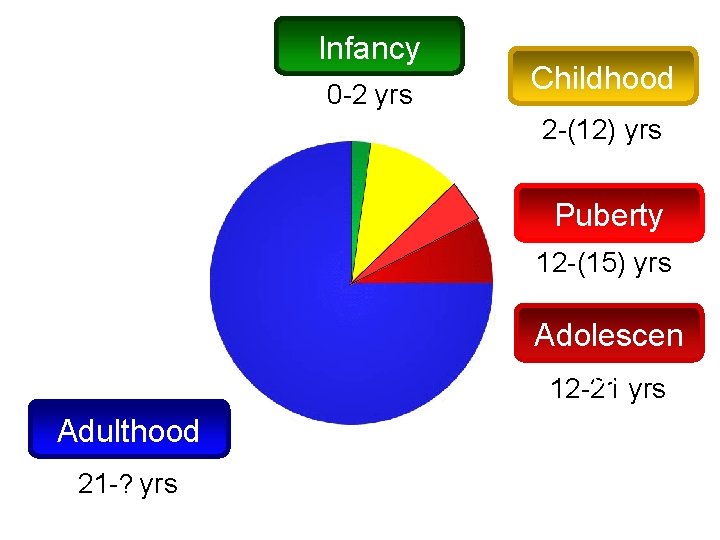
Infancy 0 -2 yrs Childhood 2 -(12) yrs Puberty 12 -(15) yrs Human Life Cycle Adulthood 21 -? yrs Adolescen ce yrs 12 -21
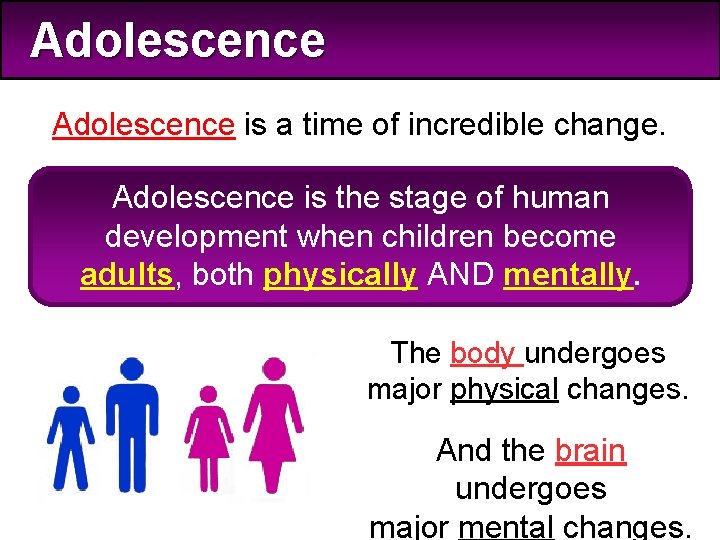
Adolescence is a time of incredible change. Adolescence is the stage of human development when children become adults, both physically AND mentally. The body undergoes major physical changes. And the brain undergoes major mental changes.
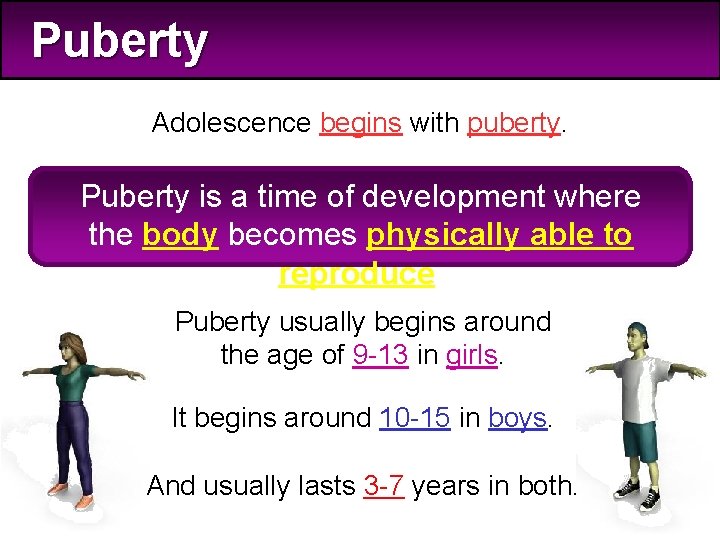
Puberty Adolescence begins with puberty. Puberty is a time of development where the body becomes physically able to reproduce. Puberty usually begins around the age of 9 -13 in girls. It begins around 10 -15 in boys. And usually lasts 3 -7 years in both.
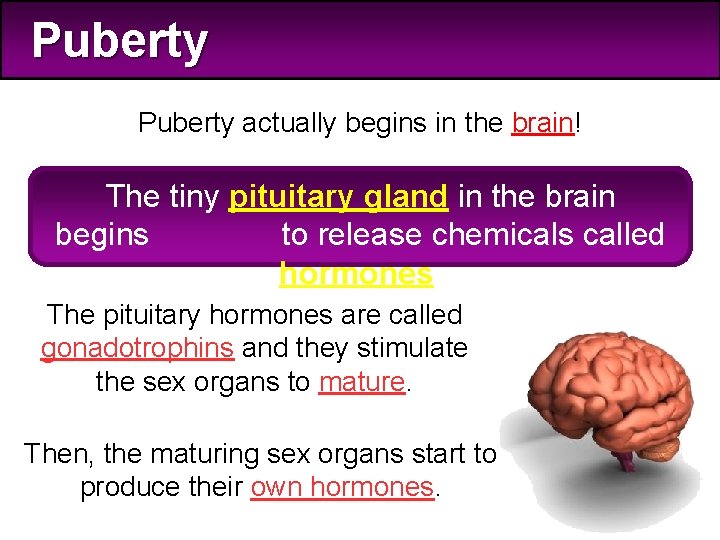
Puberty actually begins in the brain! The tiny pituitary gland in the brain begins to release chemicals called hormones. The pituitary hormones are called gonadotrophins and they stimulate the sex organs to mature. Then, the maturing sex organs start to produce their own hormones.
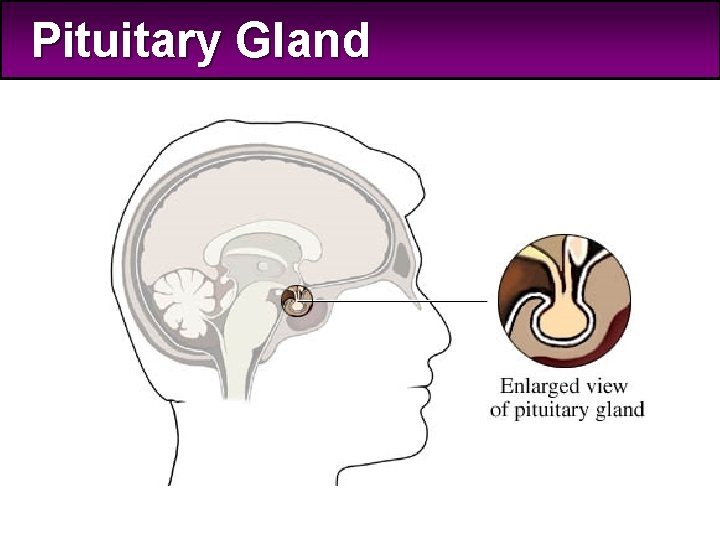
Pituitary Gland
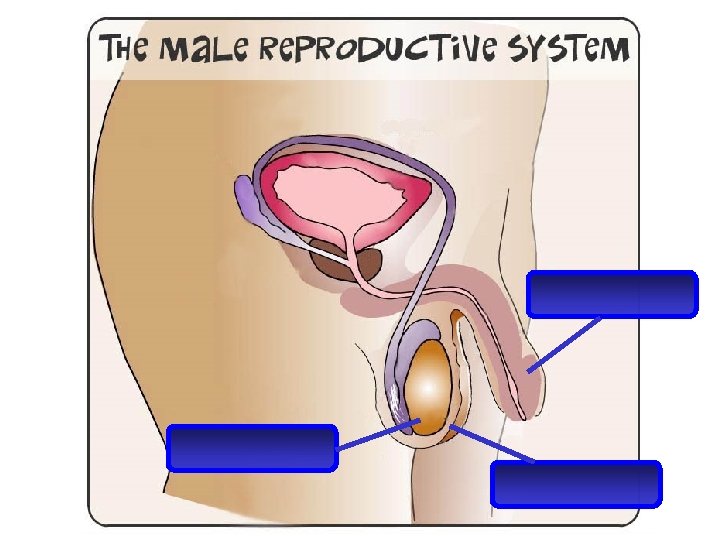
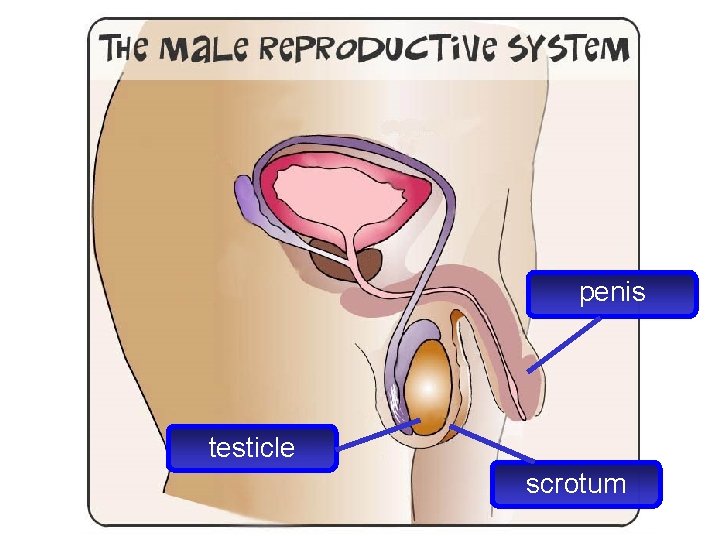
penis testicle scrotum
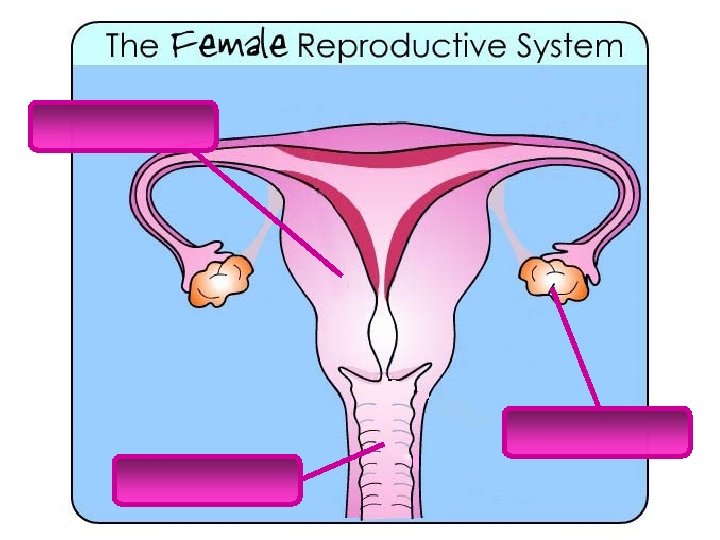
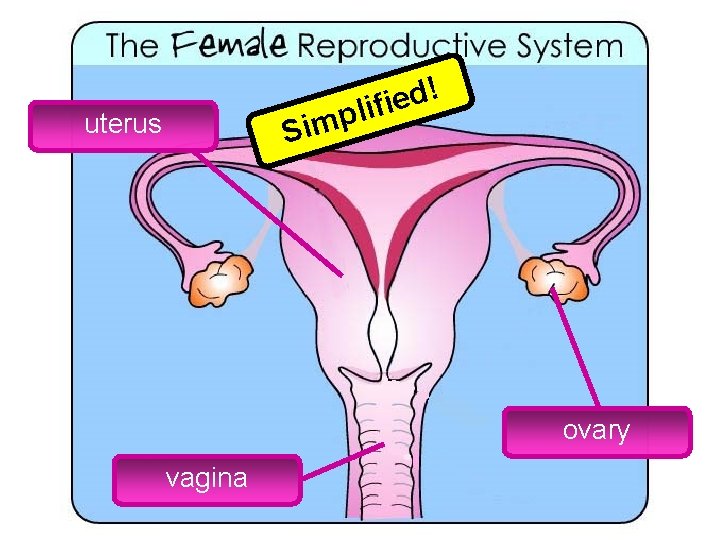
! d e i plif Sim uterus ovary vagina
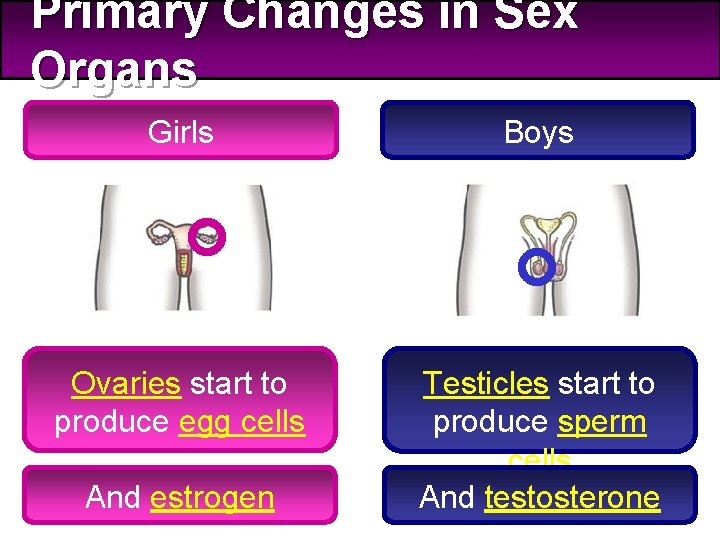
Primary Changes in Sex Organs Girls Boys Ovaries start to produce egg cells Testicles start to produce sperm cells And testosterone And estrogen
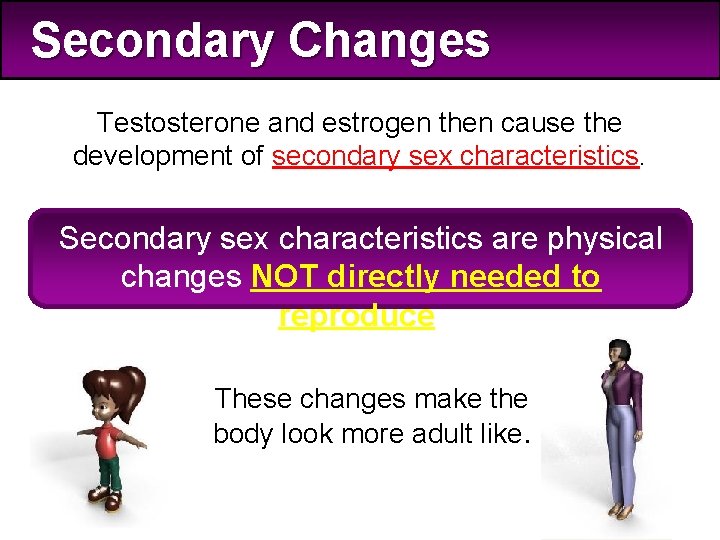
Secondary Changes Testosterone and estrogen then cause the development of secondary sex characteristics. Secondary sex characteristics are physical changes NOT directly needed to reproduce. These changes make the body look more adult like.
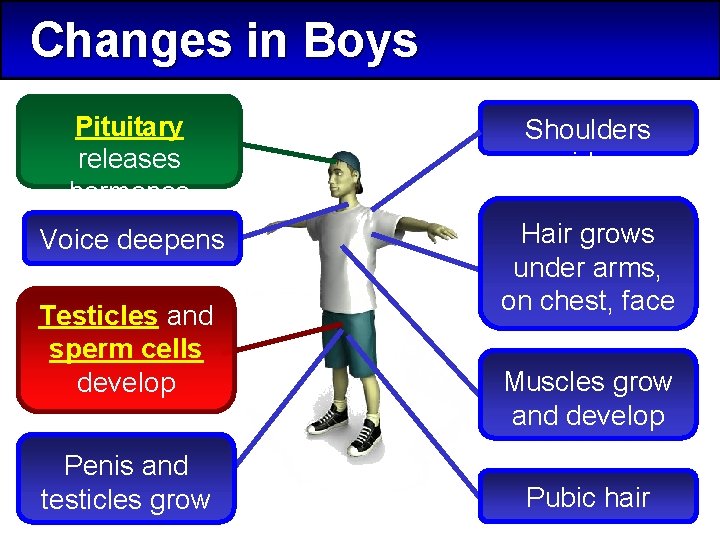
Changes in Boys Pituitary releases hormones Shoulders widen Voice deepens Hair grows under arms, on chest, face Testicles and sperm cells develop Penis and testicles grow Muscles grow and develop Pubic hair
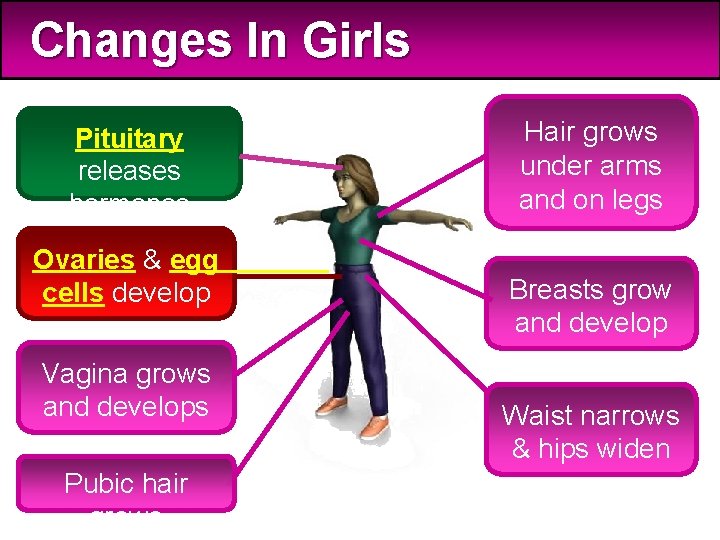
Changes In Girls Pituitary releases hormones Ovaries & egg cells develop Vagina grows and develops Pubic hair grows Hair grows under arms and on legs Breasts grow and develop Waist narrows & hips widen
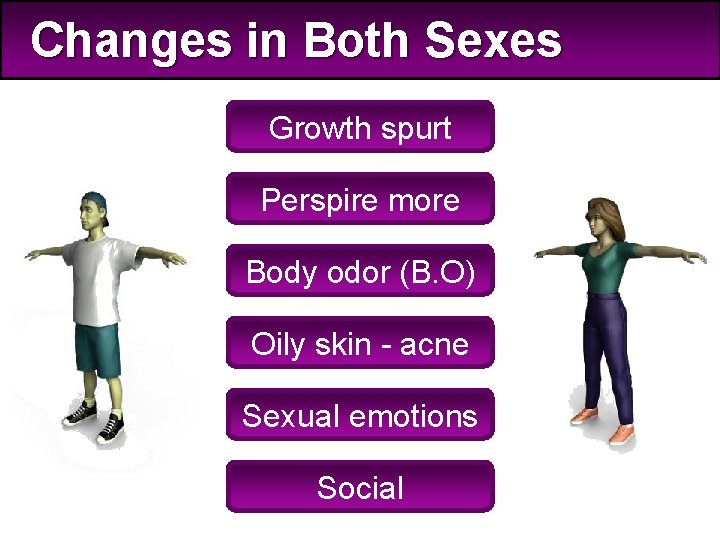
Changes in Both Sexes Growth spurt Perspire more Body odor (B. O) Oily skin - acne Sexual emotions Social changes…

Any Questions?
The Reproductive System Part 2: Reproductive Organs
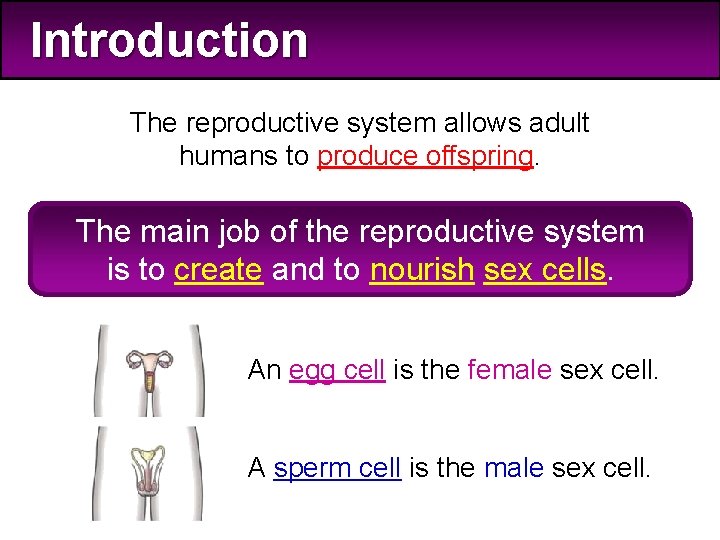
Introduction The reproductive system allows adult humans to produce offspring. The main job of the reproductive system is to create and to nourish sex cells. An egg cell is the female sex cell. A sperm cell is the male sex cell.
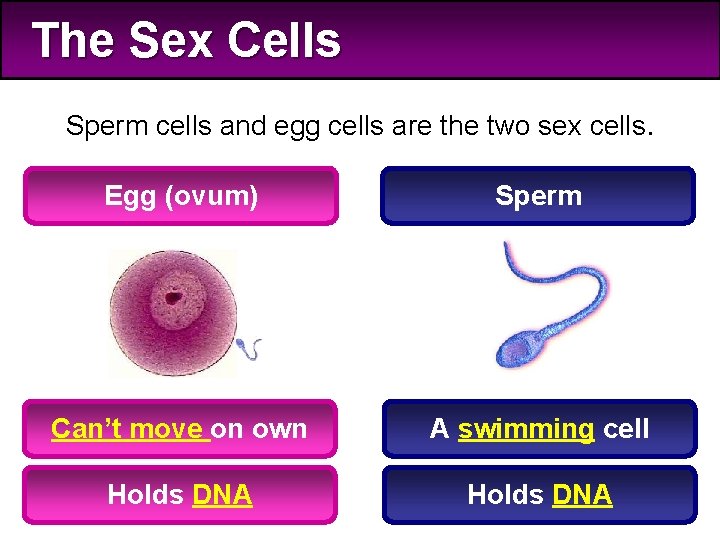
The Sex Cells Sperm cells and egg cells are the two sex cells. Egg (ovum) Sperm Can’t move on own A swimming cell Holds DNA
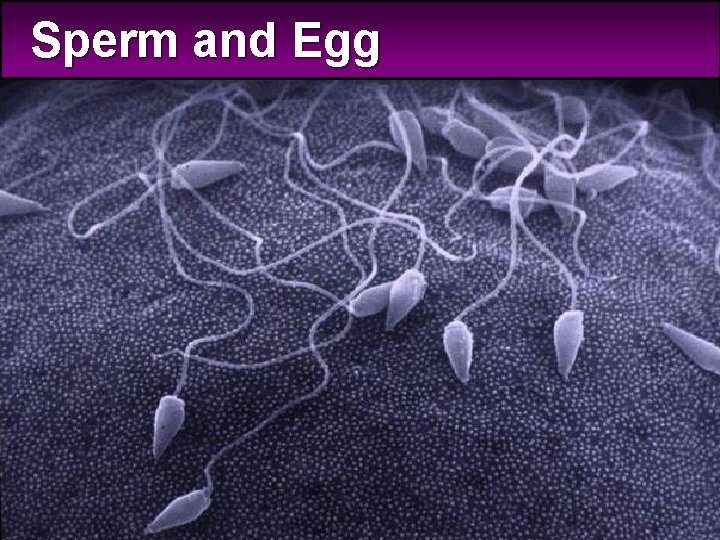
Sperm and Egg
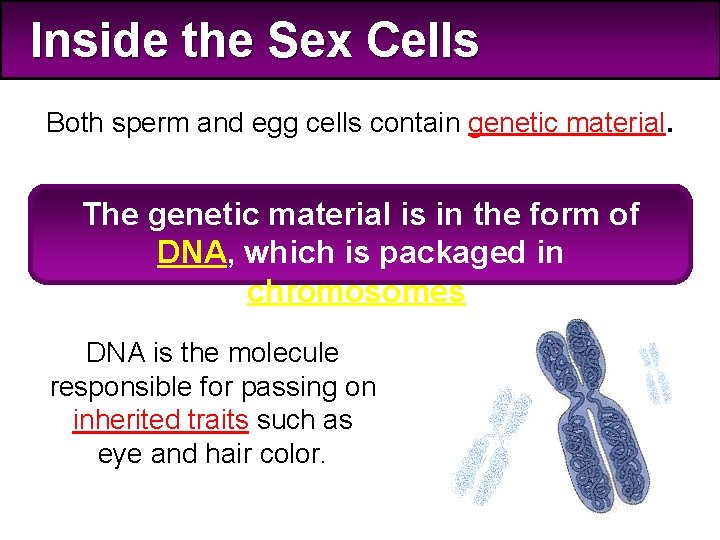
Inside the Sex Cells Both sperm and egg cells contain genetic material. The genetic material is in the form of DNA, which is packaged in chromosomes. DNA is the molecule responsible for passing on inherited traits such as eye and hair color.
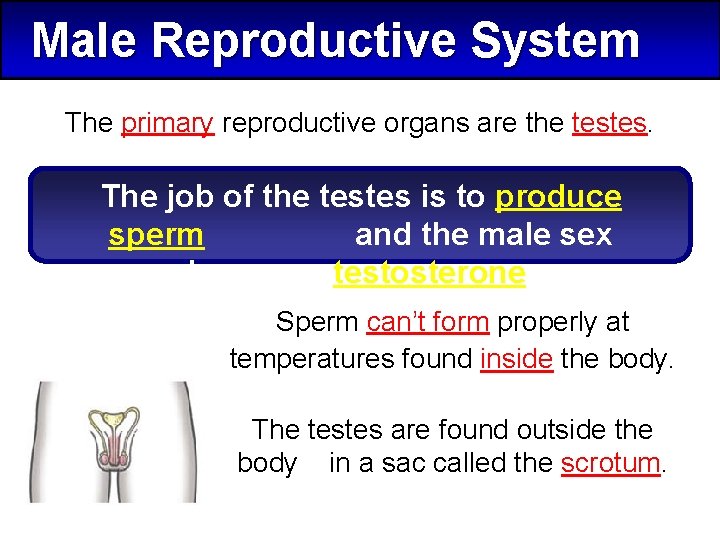
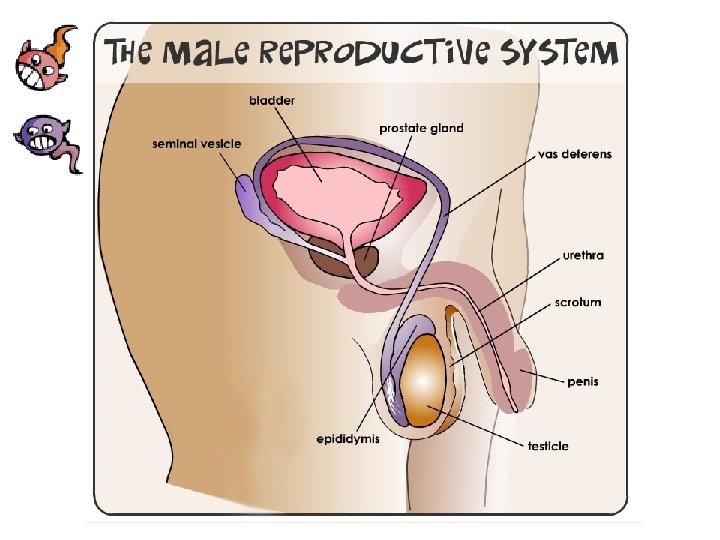
Male Reproductive System The primary reproductive organs are the testes. The job of the testes is to produce sperm and the male sex hormone testosterone. Sperm can’t form properly at temperatures found inside the body. The testes are found outside the body in a sac called the scrotum.
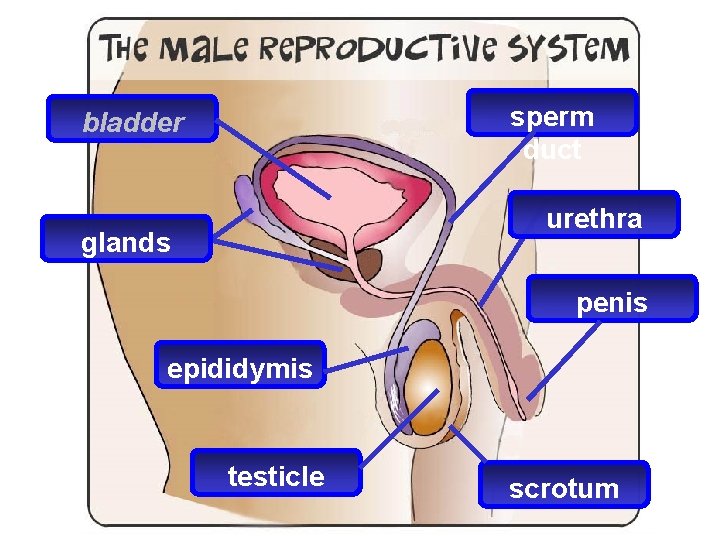
sperm duct bladder urethra glands penis epididymis testicle scrotum
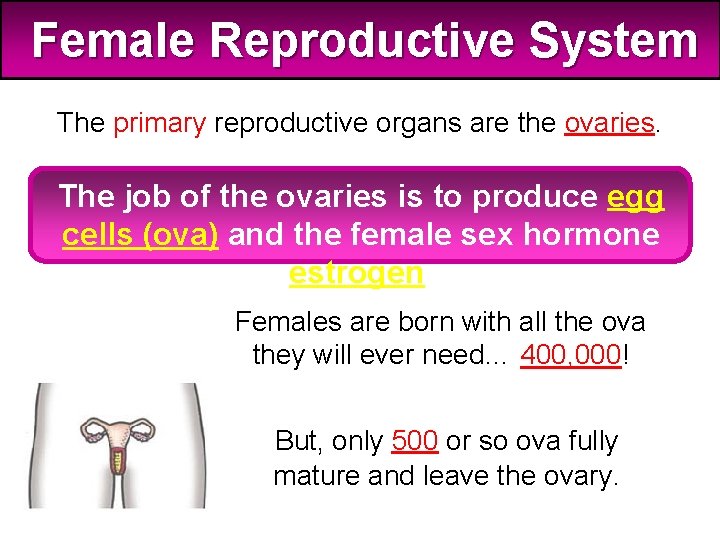
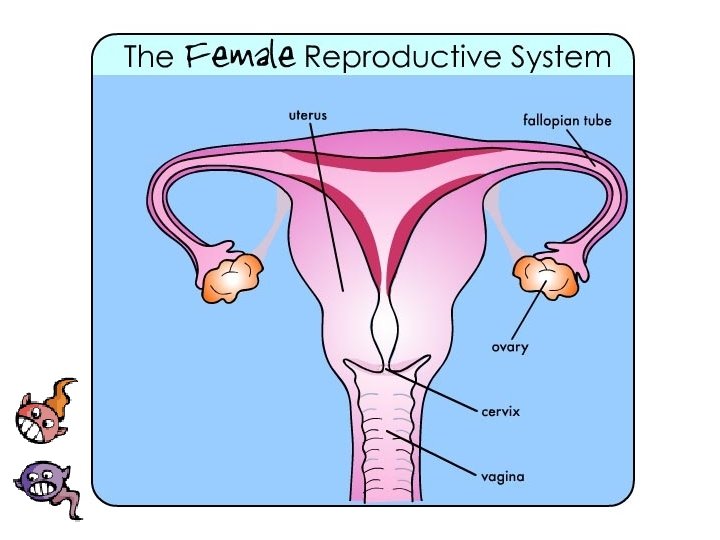
Female Reproductive System The primary reproductive organs are the ovaries. The job of the ovaries is to produce egg cells (ova) and the female sex hormone estrogen. Females are born with all the ova they will ever need… 400, 000! But, only 500 or so ova fully mature and leave the ovary.
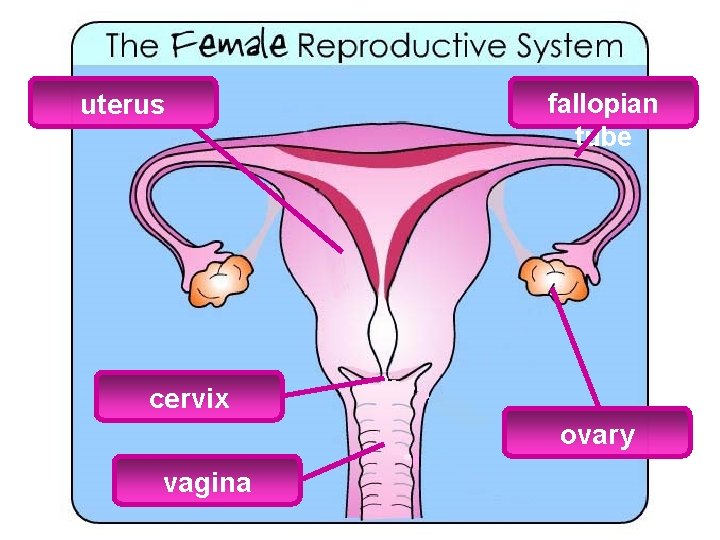
uterus fallopian tube cervix ovary vagina
Any Questions?
The Reproductive System Part 3: The Menstrual Cycle
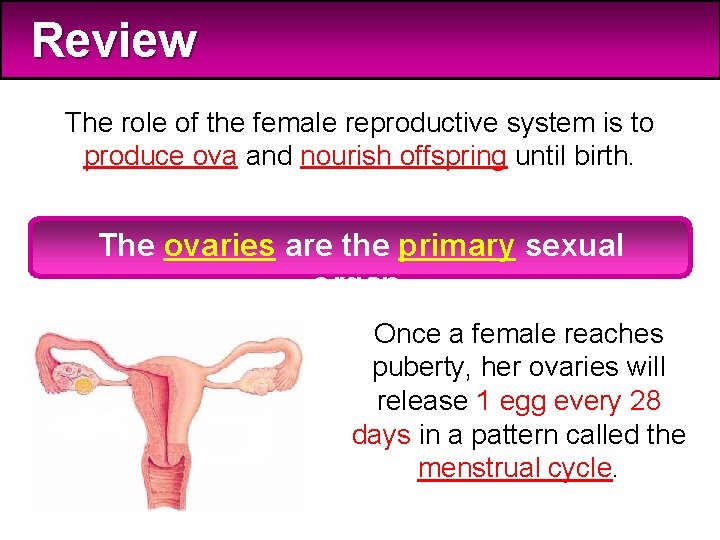
Review The role of the female reproductive system is to produce ova and nourish offspring until birth. The ovaries are the primary sexual organ. Once a female reaches puberty, her ovaries will release 1 egg every 28 days in a pattern called the menstrual cycle.
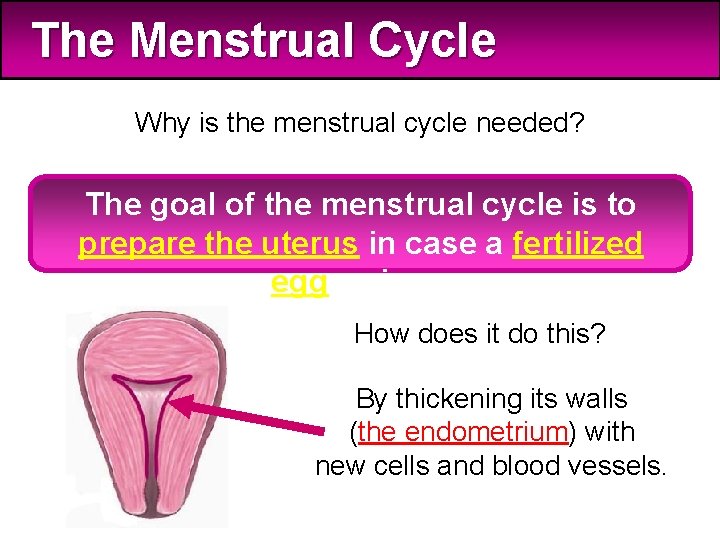
The Menstrual Cycle Why is the menstrual cycle needed? The goal of the menstrual cycle is to prepare the uterus in case a fertilized egg arrives. How does it do this? By thickening its walls (the endometrium) with new cells and blood vessels.
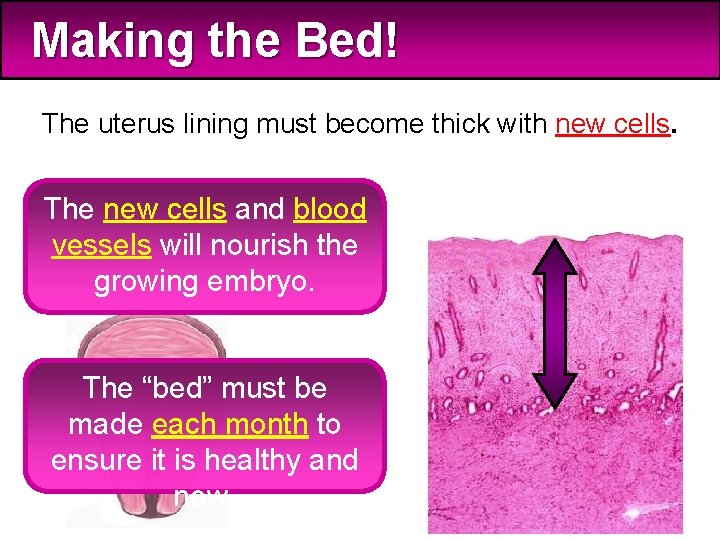
Making the Bed! The uterus lining must become thick with new cells. The new cells and blood vessels will nourish the growing embryo. The “bed” must be made each month to ensure it is healthy and new.
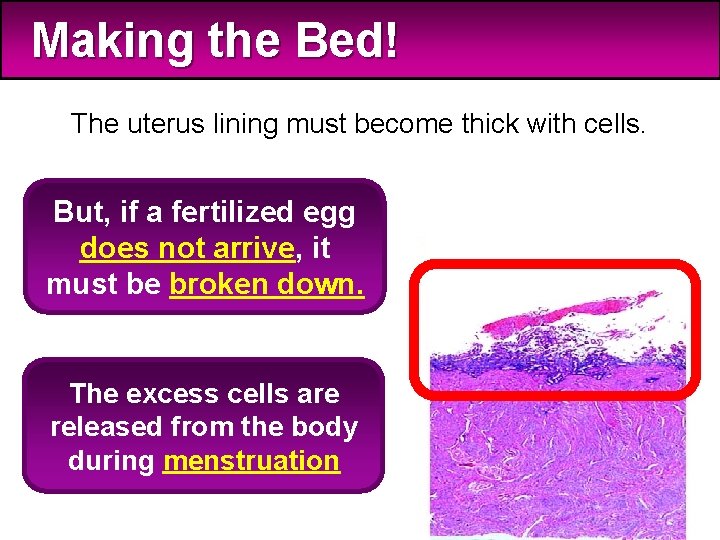
Making the Bed! The uterus lining must become thick with cells. But, if a fertilized egg does not arrive, it must be broken down. The excess cells are released from the body during menstruation
The Menstrual Cycle The menstrual cycle has several key events. The maturing of an egg in the ovary. The release of the egg. The build up of the uterus lining. The breakdown of the egg and uterus lining if no fertilization has taken place.
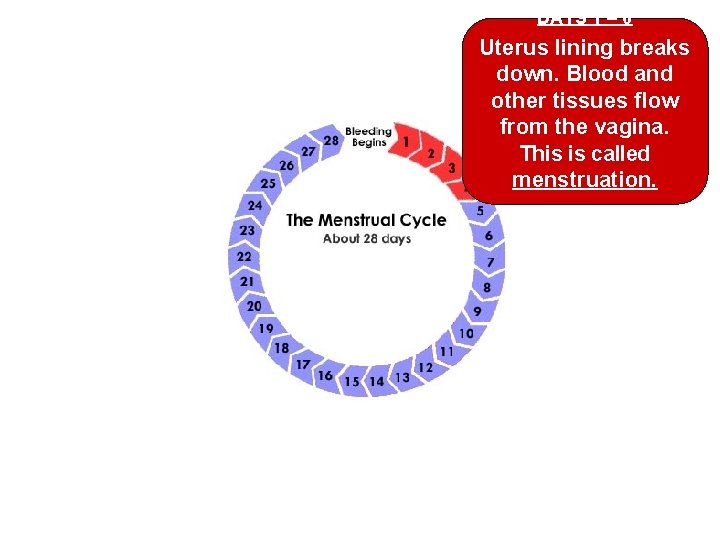
DAYS 1 – 6 Uterus lining breaks down. Blood and other tissues flow from the vagina. This is called menstruation.
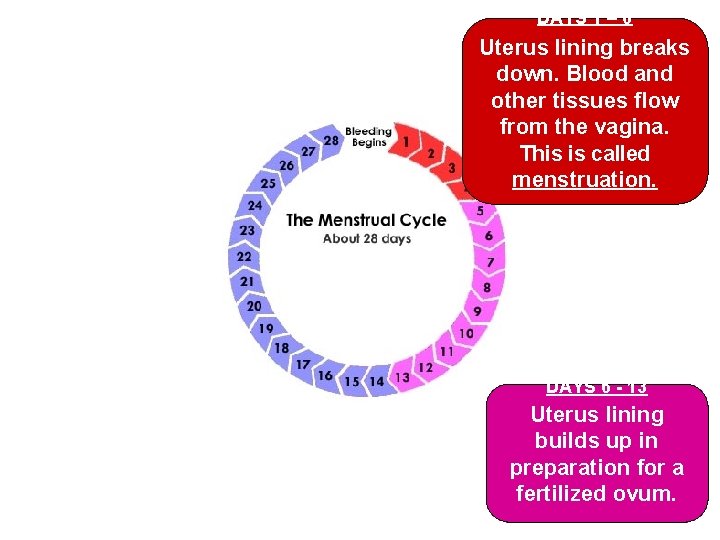
DAYS 1 – 6 Uterus lining breaks down. Blood and other tissues flow from the vagina. This is called menstruation. DAYS 6 - 13 Uterus lining builds up in preparation for a fertilized ovum.
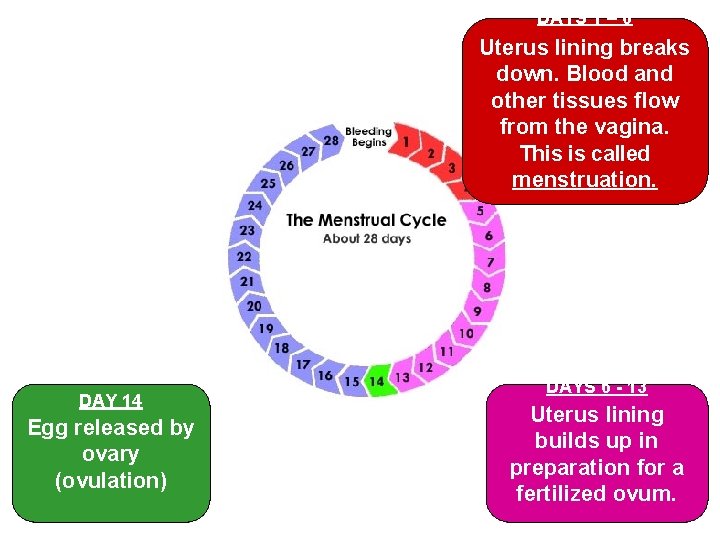
DAYS 1 – 6 Uterus lining breaks down. Blood and other tissues flow from the vagina. This is called menstruation. DAY 14 Egg released by ovary (ovulation) DAYS 6 - 13 Uterus lining builds up in preparation for a fertilized ovum.
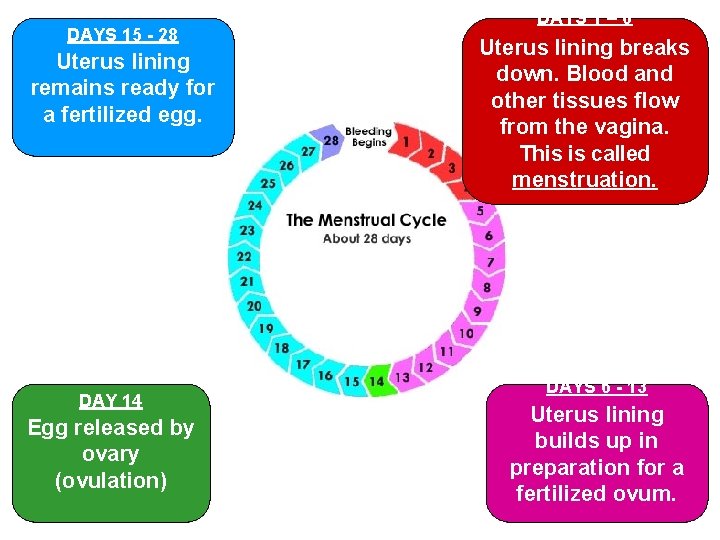
DAYS 15 - 28 Uterus lining remains ready for a fertilized egg. DAY 14 Egg released by ovary (ovulation) DAYS 1 – 6 Uterus lining breaks down. Blood and other tissues flow from the vagina. This is called menstruation. DAYS 6 - 13 Uterus lining builds up in preparation for a fertilized ovum.
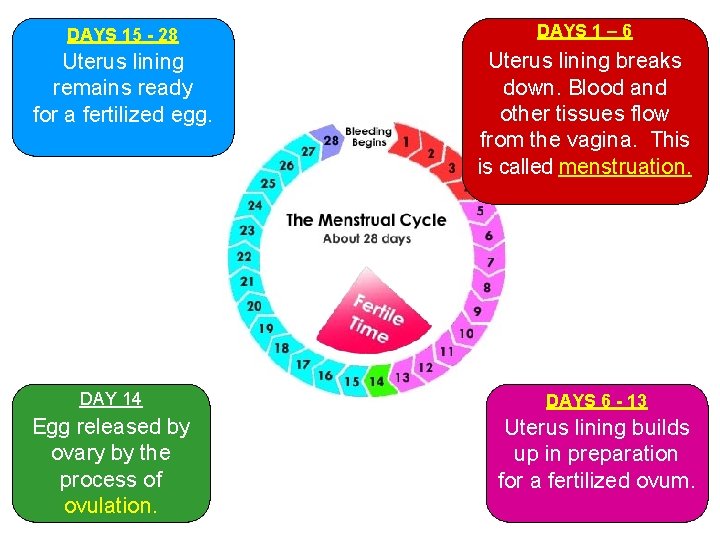
DAYS 15 - 28 DAYS 1 – 6 Uterus lining remains ready for a fertilized egg. Uterus lining breaks down. Blood and other tissues flow from the vagina. This is called menstruation. DAY 14 DAYS 6 - 13 Egg released by ovary by the process of ovulation. Uterus lining builds up in preparation for a fertilized ovum.
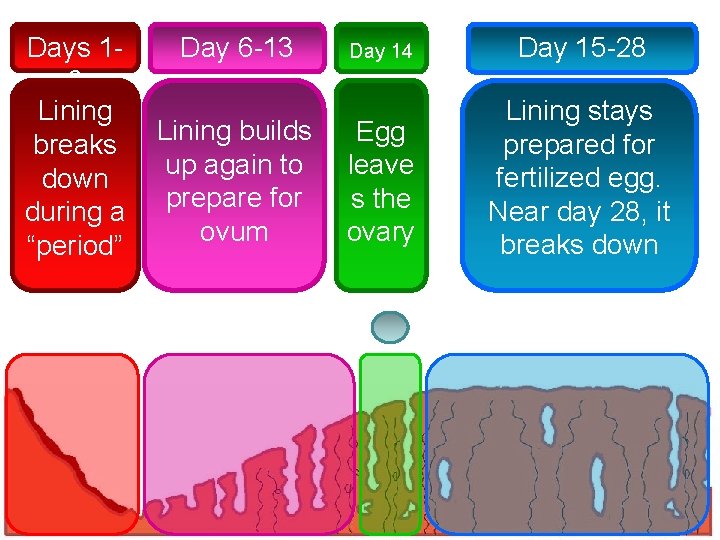
Days 16 Lining breaks down during a “period” Day 6 -13 Lining builds up again to prepare for ovum Day 14 Day 15 -28 Egg leave s the ovary Lining stays prepared for fertilized egg. Near day 28, it breaks down
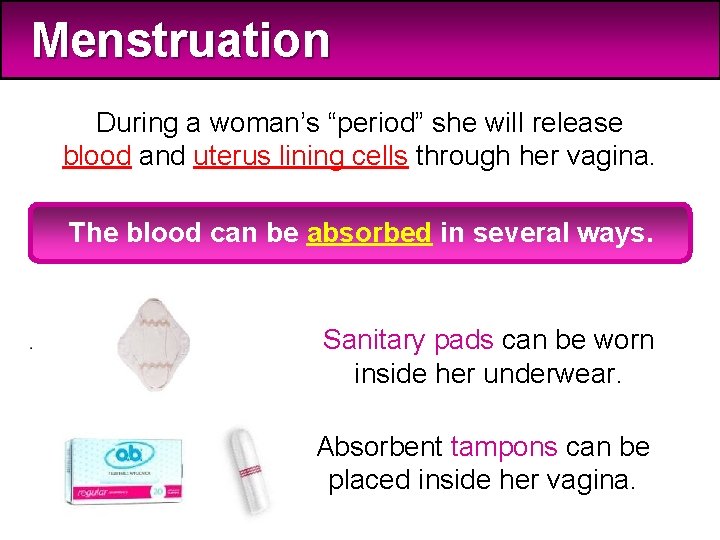
Menstruation During a woman’s “period” she will release blood and uterus lining cells through her vagina. The blood can be absorbed in several ways. Sanitary pads can be worn inside her underwear. Absorbent tampons can be placed inside her vagina.
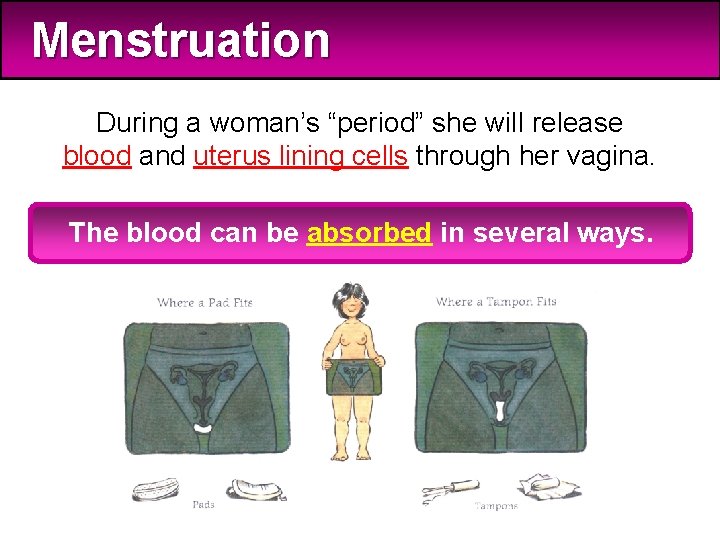
Menstruation During a woman’s “period” she will release blood and uterus lining cells through her vagina. The blood can be absorbed in several ways.
Any Questions?
The Reproductive System Part 4: Fertilization
Introduction Reproduction involves the joining of sperm and egg. To do this, humans must engage in sexual intercourse to bring sperm to the egg cell. Before sexual intercourse, two adults will have decided that they are ready to have a baby and are able to provide for their child throughout its life.
Before Intercourse When a man is sexually aroused, changes in his genitals prepare him for sexual intercourse. 1. The penis fills with blood, causing it to increase in size and stiffness, forming an erection. An erection is necessary to allow the penis to insert properly into the female’s vagina. 2. The testicles are pulled towards the man’s body to greater protect them.
Before Intercourse Changes also occur in the female to prepare her genitals for sexual intercourse. 1. Muscles surrounding the vagina relax. 2. The layers outside the (labia) vagina fill with blood and swell, making the vagina wider. 3. The vagina releases a clear fluid inside to lubricate it in preparation for intercourse.
Sexual Intercourse During sexual intercourse, the male’s erect penis enters the female’s vagina. Stimulation during intercourse causes sperm to be released from the epidymis. The sperm then mix with fluids from the other glands to produce a mixture called semen. Semen exits the penis during an ejaculation.
After Intercourse After being released inside the vagina during ejaculation, sperm swim towards the egg. The sperm swim up the vagina, through the cervix and uterus to reach the fallopian tubes. There, they hope to meet an egg to fertilize it. Only one sperm can penetrate the egg. All other sperm die off.
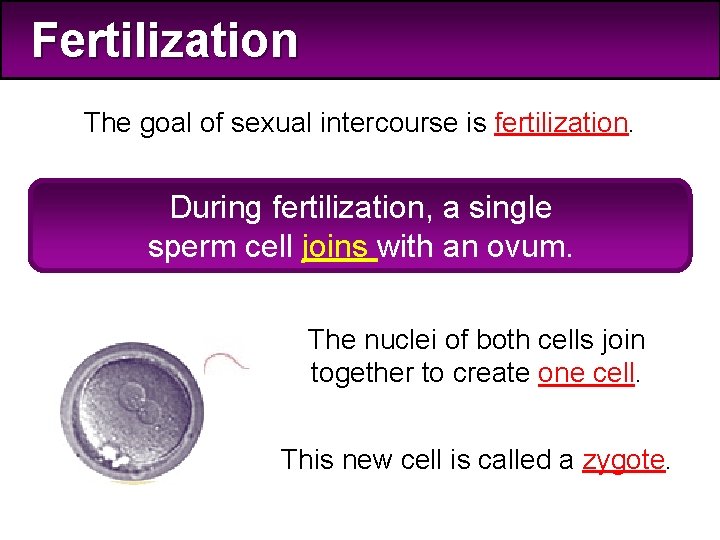
Fertilization The goal of sexual intercourse is fertilization. During fertilization, a single sperm cell joins with an ovum. The nuclei of both cells join together to create one cell. This new cell is called a zygote.
Fertilization I WON! zygote
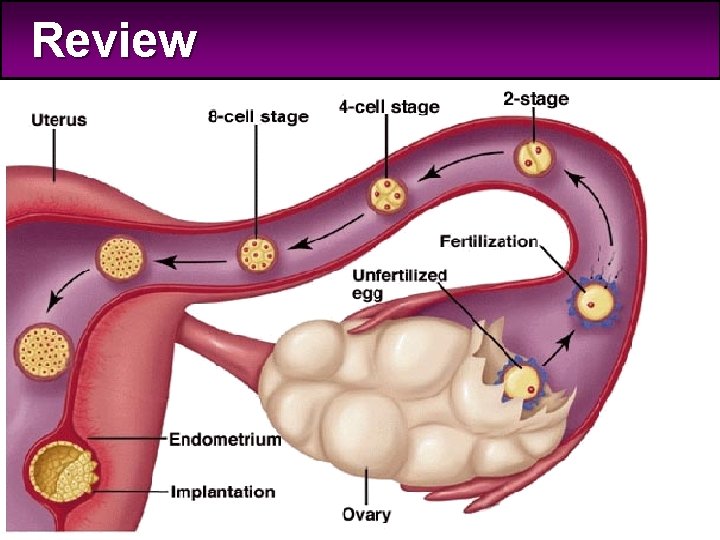
After Fertilization After fertilization, huge changes to the zygote begin. The new zygote releases chemicals to block all other sperm from entering. The zygote begins to travel down the fallopian tube towards the uterus. On its way, it begins to divide and quickly forms a growing mass of cells.

After Fertilization To the uterus!
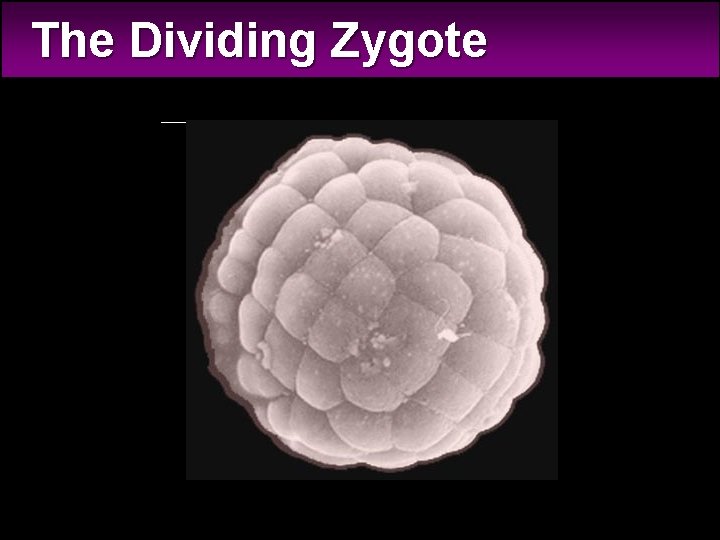
The Dividing After Fertilization Zygote
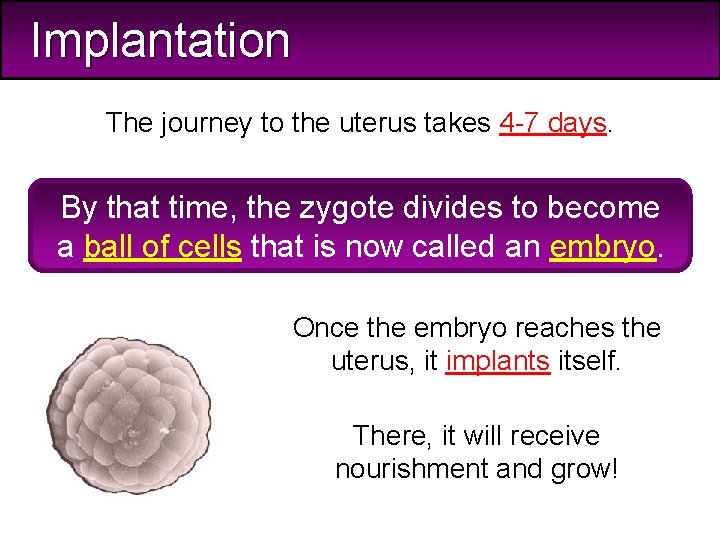
Implantation The journey to the uterus takes 4 -7 days. By that time, the zygote divides to become a ball of cells that is now called an embryo. Once the embryo reaches the uterus, it implants itself. There, it will receive nourishment and grow!
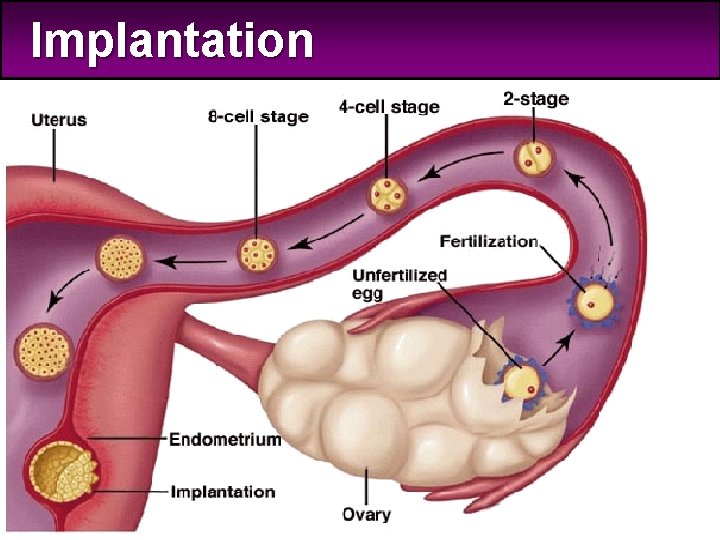
Implantation
Any Questions?
The Reproductive System Part 5: Development and Birth
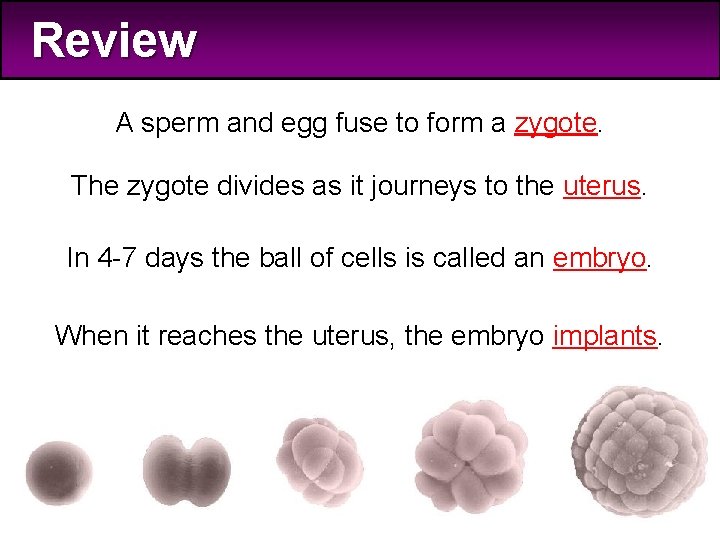
Review A sperm and egg fuse to form a zygote. The zygote divides as it journeys to the uterus. In 4 -7 days the ball of cells is called an embryo. When it reaches the uterus, the embryo implants.
Review
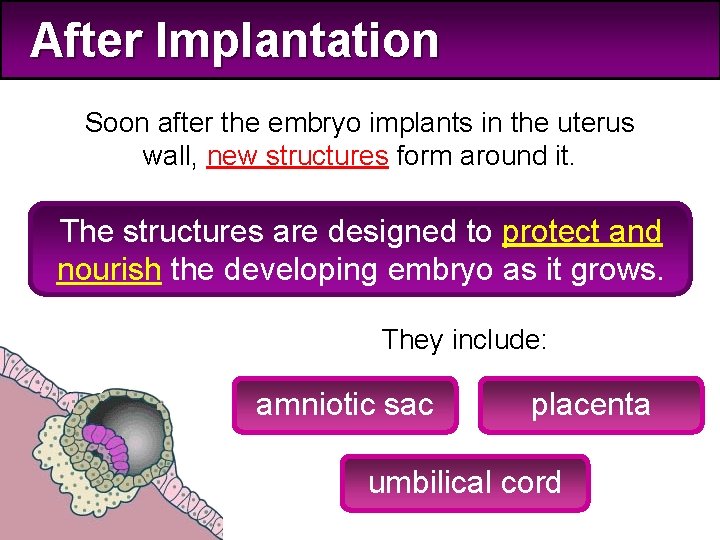
After Implantation Soon after the embryo implants in the uterus wall, new structures form around it. The structures are designed to protect and nourish the developing embryo as it grows. They include: amniotic sac placenta umbilical cord
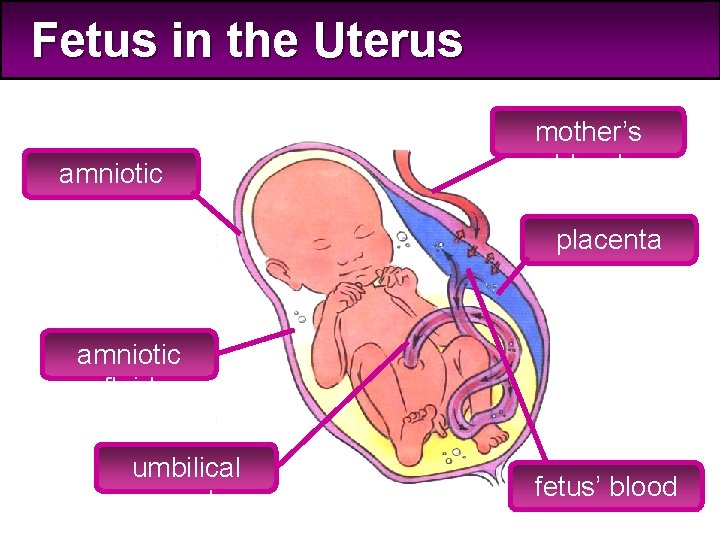
Fetus in the Uterus amniotic sac mother’s blood placenta amniotic fluid umbilical cord fetus’ blood
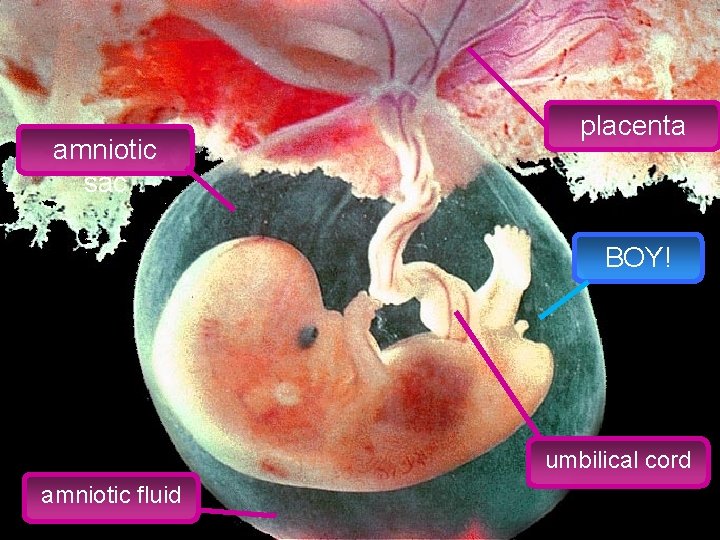
amniotic sac placenta BOY! umbilical cord amniotic fluid
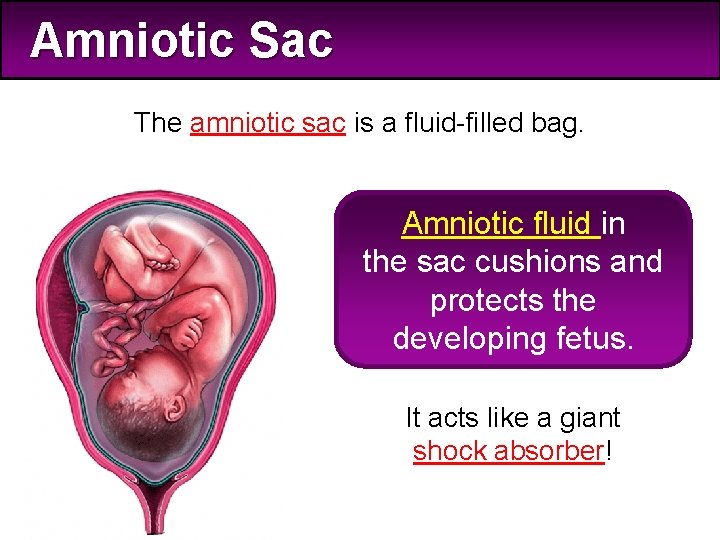
Amniotic Sac The amniotic sac is a fluid-filled bag. Amniotic fluid in the sac cushions and protects the developing fetus. It acts like a giant shock absorber!
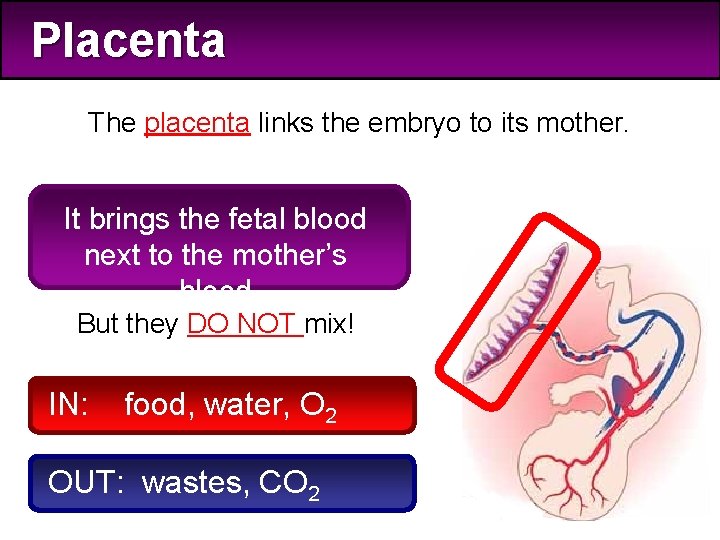
Placenta The placenta links the embryo to its mother. It brings the fetal blood next to the mother’s blood But they DO NOT mix! IN: food, water, O 2 OUT: wastes, CO 2
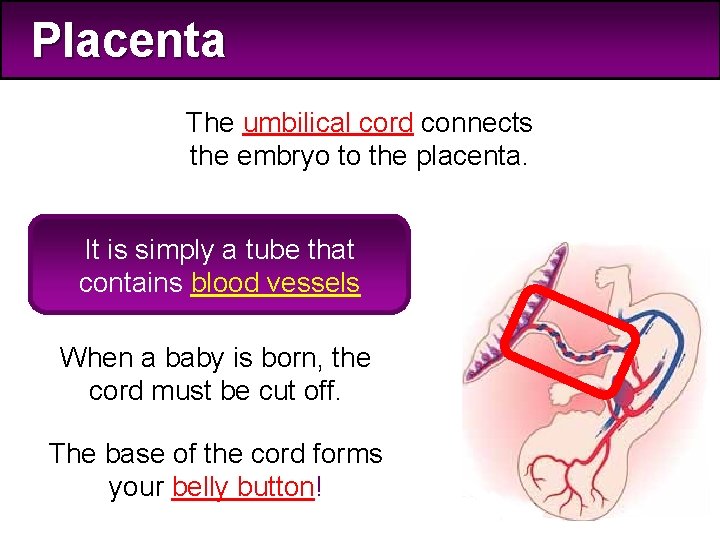
Placenta The umbilical cord connects the embryo to the placenta. It is simply a tube that contains blood vessels When a baby is born, the cord must be cut off. The base of the cord forms your belly button!
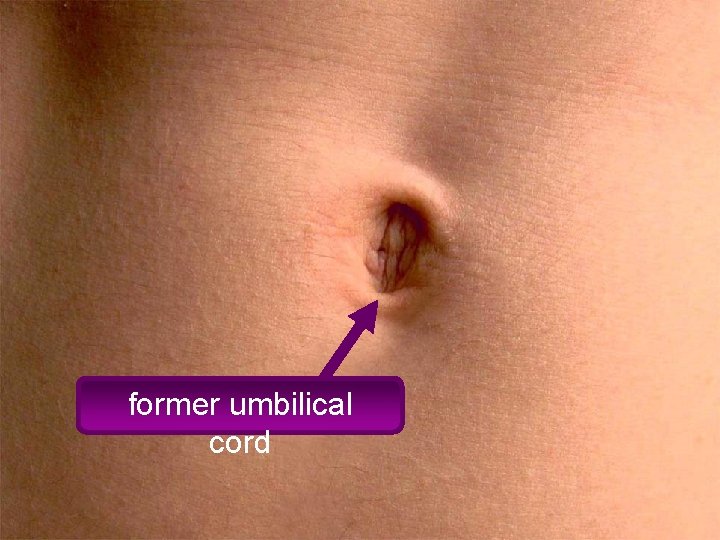
former umbilical cord
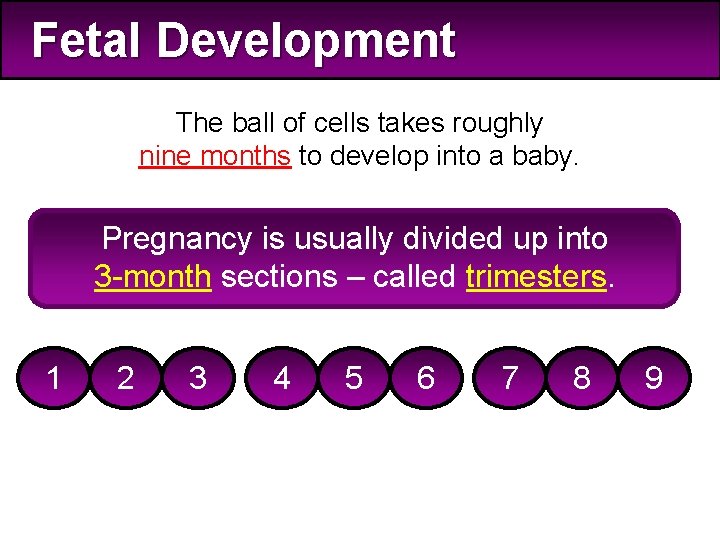
Fetal Development The ball of cells takes roughly nine months to develop into a baby. Pregnancy is usually divided up into 3 -month sections – called trimesters. 1 2 3 4 5 6 7 8 9
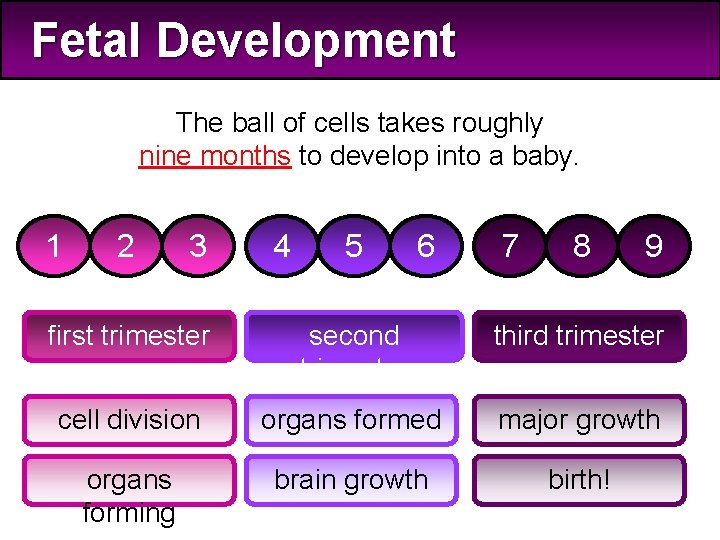
Fetal Development The ball of cells takes roughly nine months to develop into a baby. 1 2 3 4 5 6 7 8 9 first trimester second trimester third trimester cell division organs formed major growth organs forming brain growth birth!
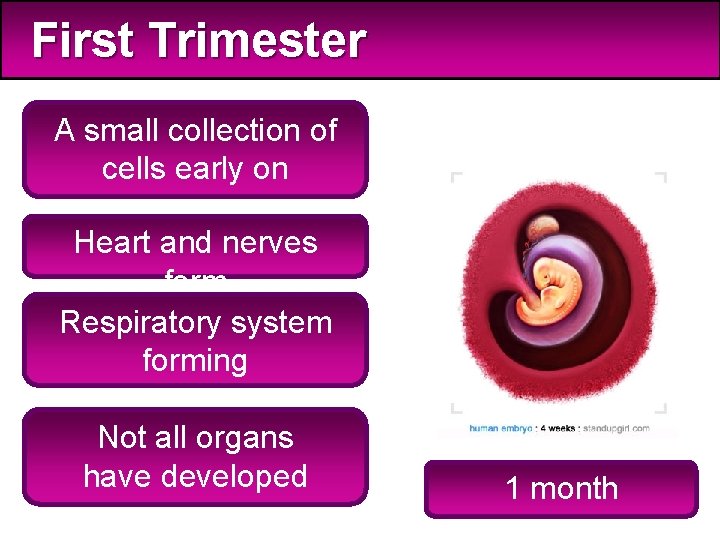
First Trimester A small collection of cells early on Heart and nerves form Respiratory system forming Not all organs have developed 1 month
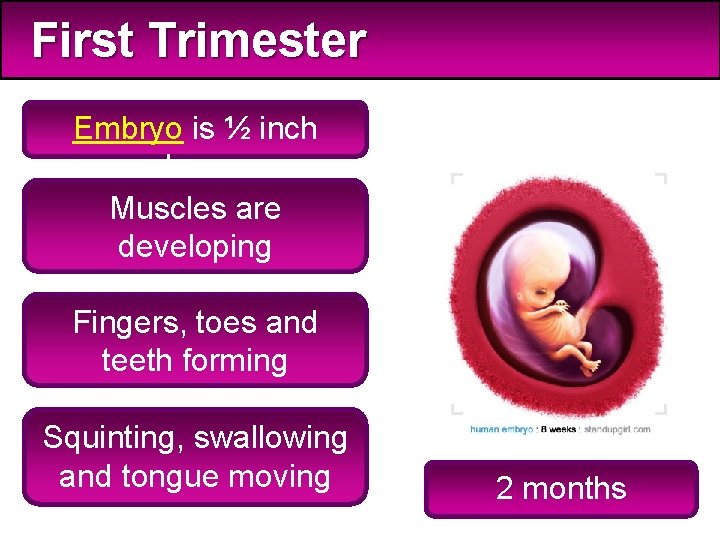
First Trimester Embryo is ½ inch long Muscles are developing Fingers, toes and teeth forming Squinting, swallowing and tongue moving 21 months month
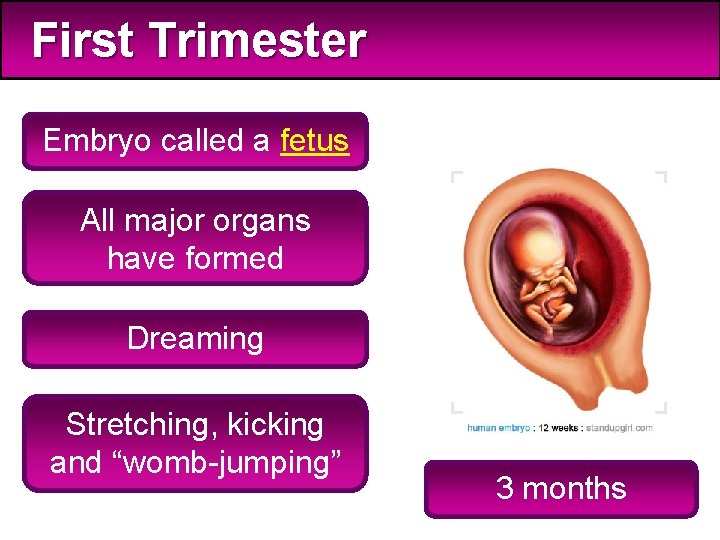
First Trimester Embryo called a fetus All major organs have formed Dreaming Stretching, kicking and “womb-jumping” 21 months 3 month
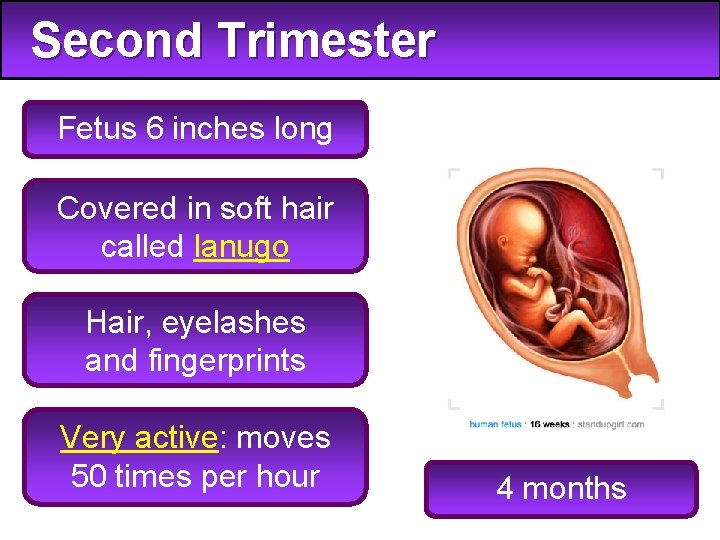
Second Trimester Fetus 6 inches long Covered in soft hair called lanugo Hair, eyelashes and fingerprints Very active: moves 50 times per hour 21 months 3 4 month
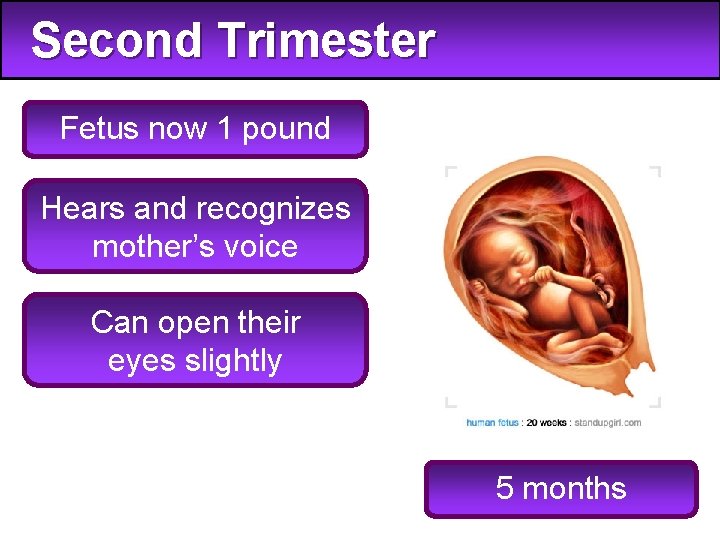
Second Trimester Fetus now 1 pound Hears and recognizes mother’s voice Can open their eyes slightly 21 months 3 4 5 month
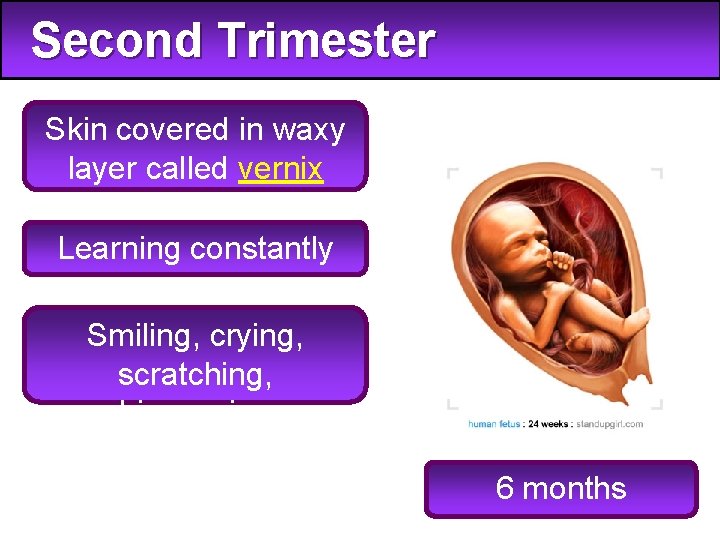
Second Trimester Skin covered in waxy layer called vernix Learning constantly Smiling, crying, scratching, hiccupping 21 months 3 4 5 6 month
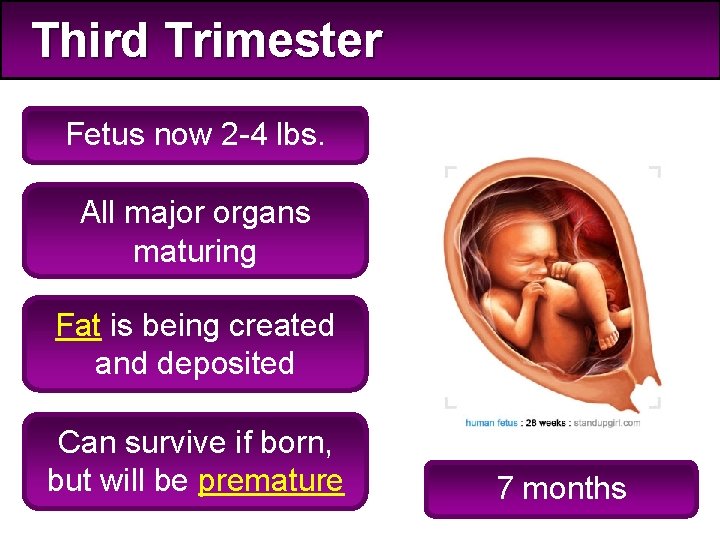
Third Trimester Fetus now 2 -4 lbs. All major organs maturing Fat is being created and deposited Can survive if born, but will be premature 21 months 3 4 5 6 7 month
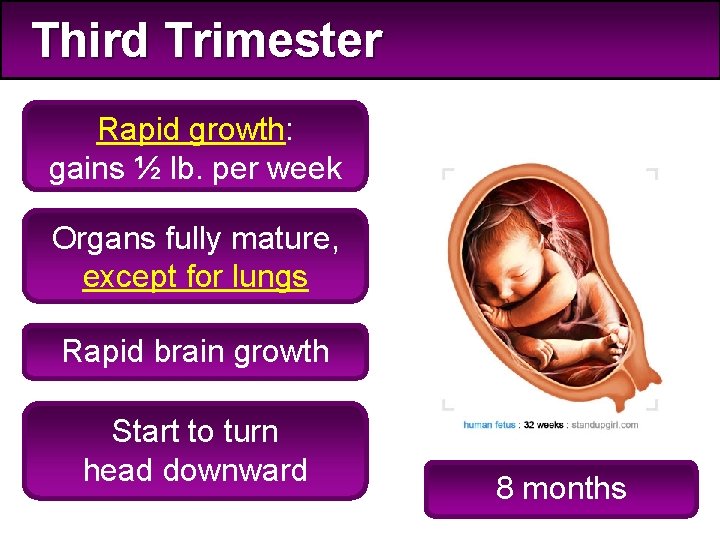
Third Trimester Rapid growth: gains ½ lb. per week Organs fully mature, except for lungs Rapid brain growth Start to turn head downward 21 months 3 4 5 6 7 8 month
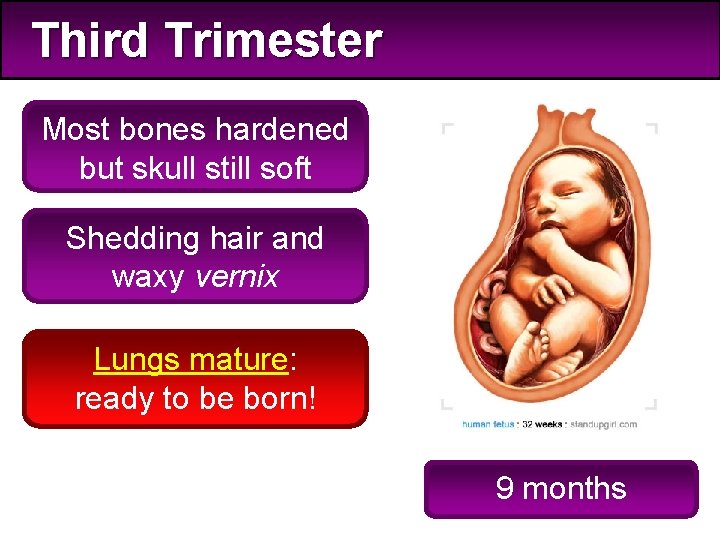
Third Trimester Most bones hardened but skull still soft Shedding hair and waxy vernix Lungs mature: ready to be born! 21 months 3 4 5 6 7 8 9 month
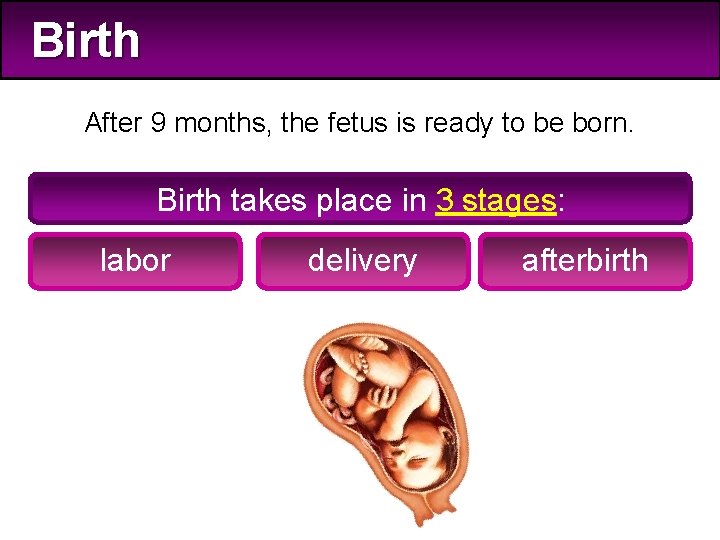
Birth After 9 months, the fetus is ready to be born. Birth takes place in 3 stages: labor delivery afterbirth
1. Labor Strong muscle contractions of the uterus make the cervix enlarge 2. Delivery The fetus pushed out of the uterus through the vagina. First breath with its lungs. 3. Afterbirth Final contractions push the placenta and other structures out of the uterus and
The Reproductive System Special Topic: Twins!
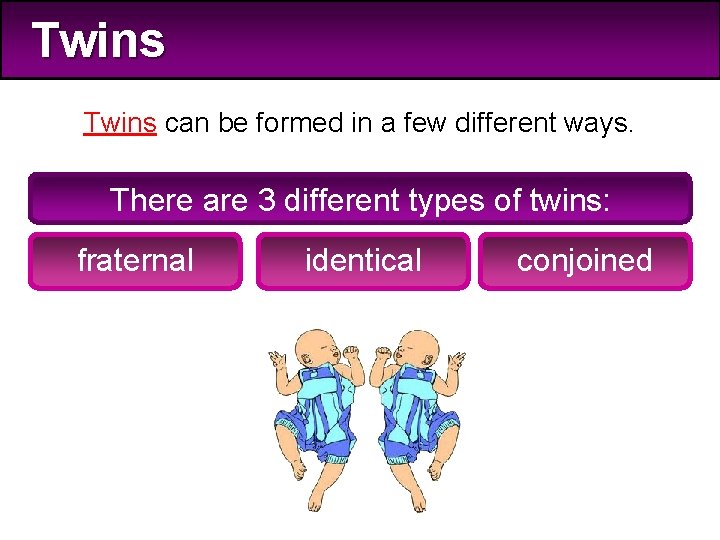
Twins can be formed in a few different ways. There are 3 different types of twins: fraternal identical conjoined
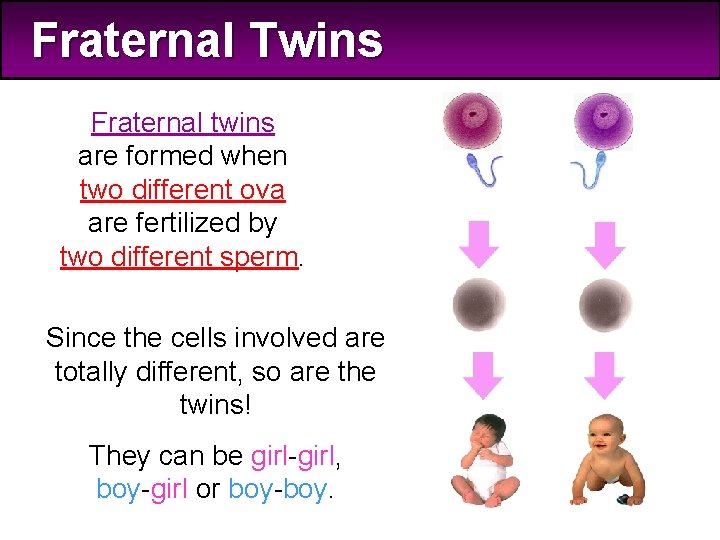
Fraternal Twins Fraternal twins are formed when two different ova are fertilized by two different sperm. Since the cells involved are totally different, so are the twins! They can be girl-girl, boy-girl or boy-boy.
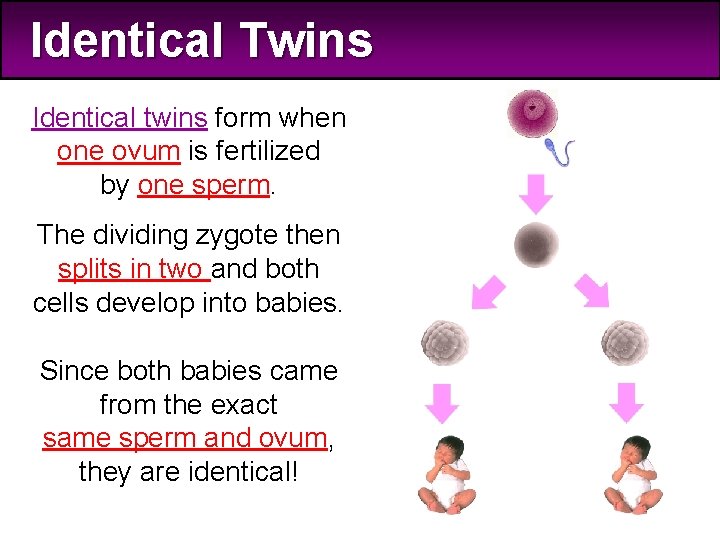
Identical Twins Identical twins form when one ovum is fertilized by one sperm. The dividing zygote then splits in two and both cells develop into babies. Since both babies came from the exact same sperm and ovum, they are identical!
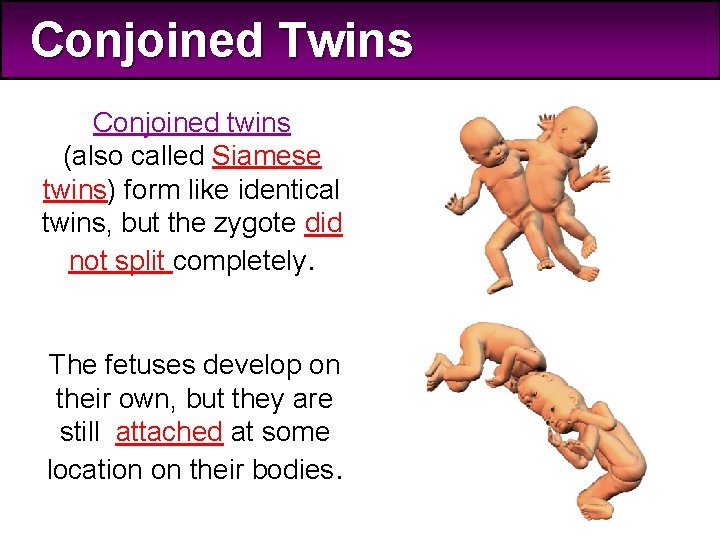
Conjoined Twins Conjoined twins (also called Siamese twins) form like identical twins, but the zygote did not split completely. The fetuses develop on their own, but they are still attached at some location on their bodies.
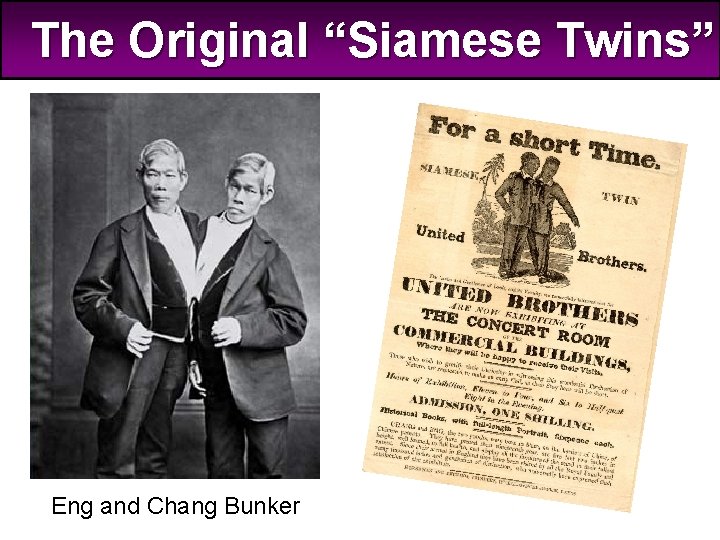
The Original “Siamese Twins” Eng and Chang Bunker
Any Questions?
- Slides: 88