
The Reproductive System Female Reproductive System Ovaries Duct
- Slides: 34
The Reproductive System
Female Reproductive System • Ovaries • Duct System – Uterine tubes (fallopian tubes) – Uterus – Vagina • External genitalia
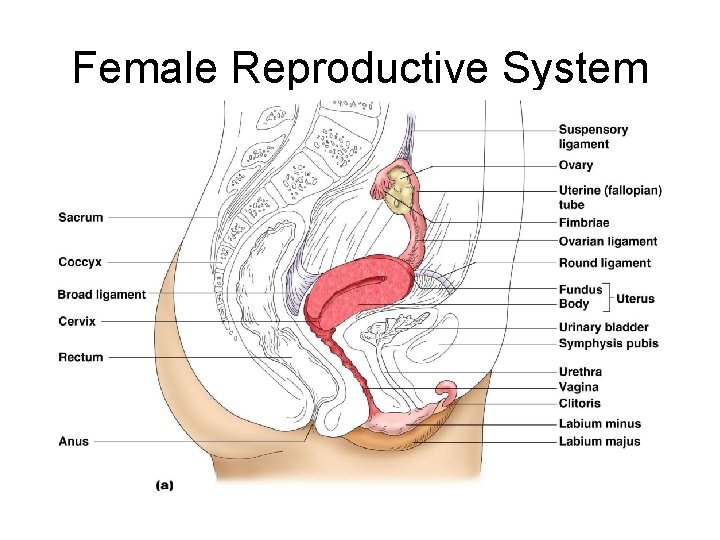
Female Reproductive System
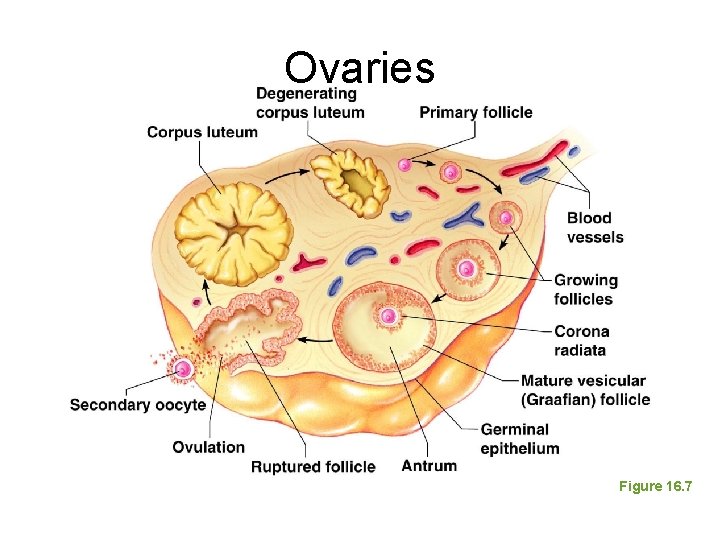
Ovaries • Composed of ovarian follicles (sac-like structures) • Each follicle consists of – Oocyte (immature egg) – Follicular cells—surround the oocyte
Ovaries Figure 16. 7
Ovarian Follicle Stages • Primary follicle—contains an immature oocyte • Graafian (vesicular) follicle—growing follicle with a maturing oocyte • Ovulation—when the egg is mature, the follicle ruptures; occurs about every 28 days • The ruptured follicle is transformed into a corpus luteum
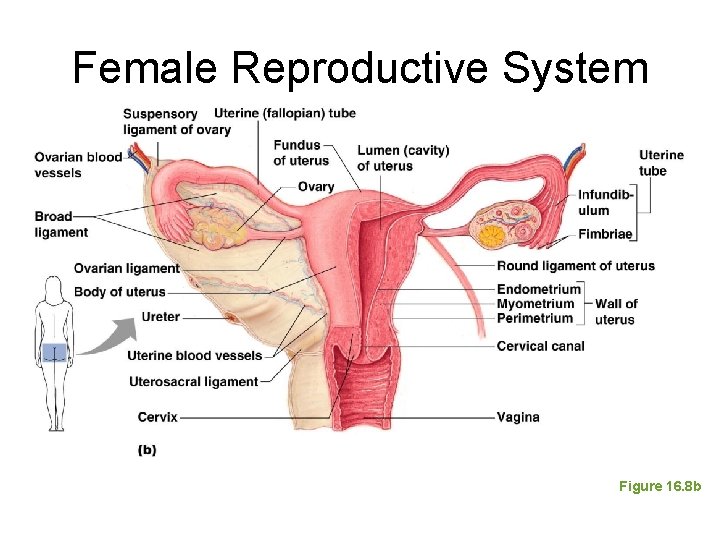
Support for Ovaries • Suspensory ligaments—secure ovary to lateral walls of the pelvis • Ovarian ligaments—attach to uterus • Broad ligament—a fold of the peritoneum, encloses suspensory ligament
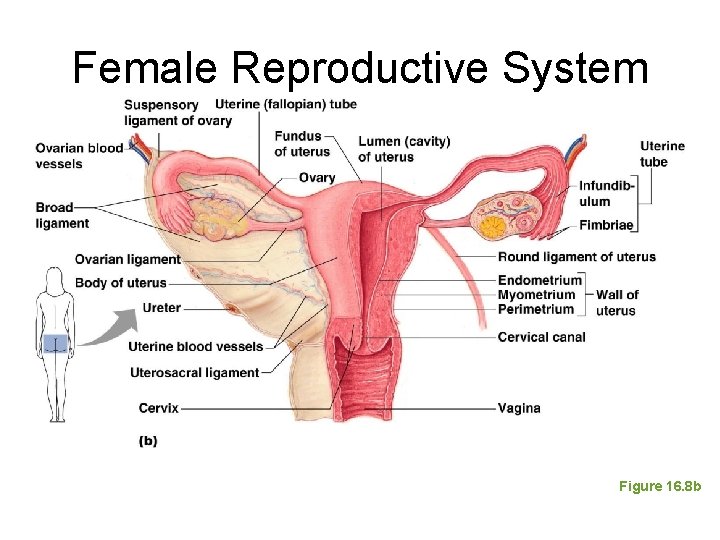
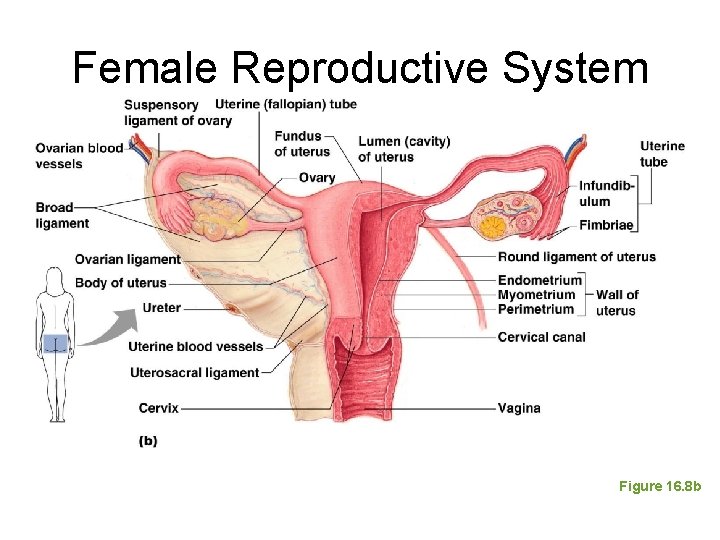
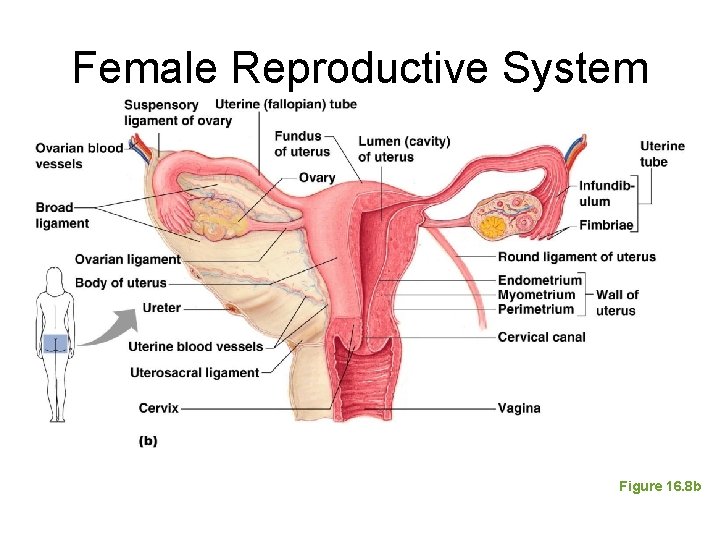
Female Reproductive System Figure 16. 8 b
Duct System • Uterine tubes (fallopian tubes) • Uterus • Vagina
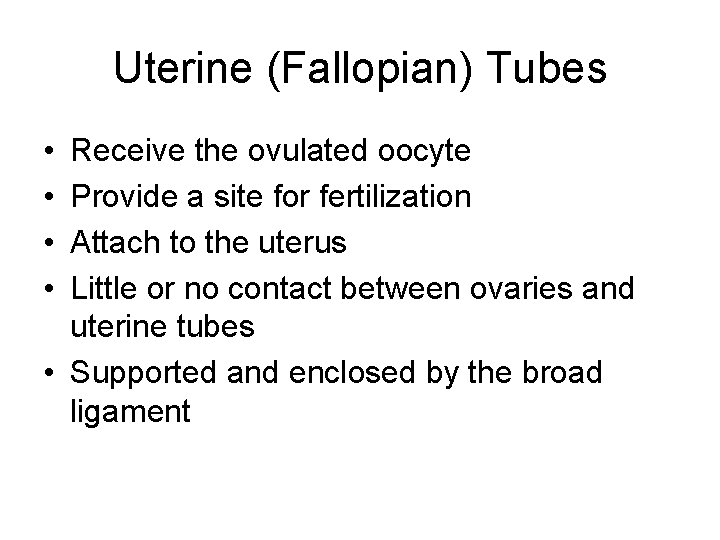
Uterine (Fallopian) Tubes • • Receive the ovulated oocyte Provide a site for fertilization Attach to the uterus Little or no contact between ovaries and uterine tubes • Supported and enclosed by the broad ligament
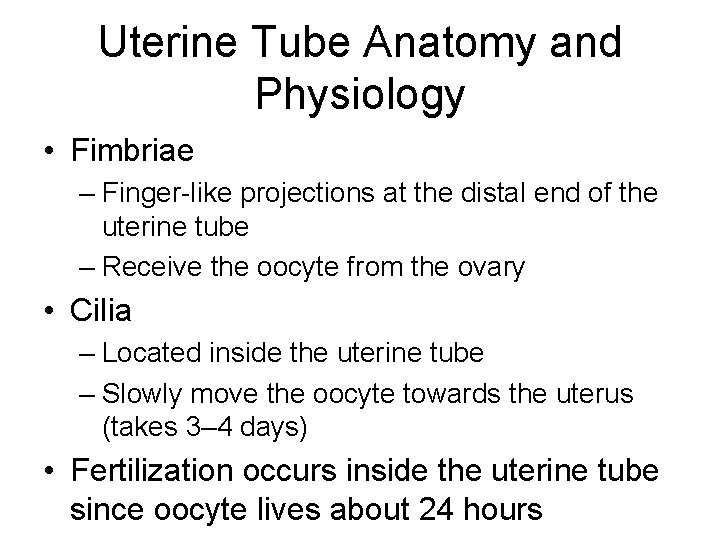
Uterine Tube Anatomy and Physiology • Fimbriae – Finger-like projections at the distal end of the uterine tube – Receive the oocyte from the ovary • Cilia – Located inside the uterine tube – Slowly move the oocyte towards the uterus (takes 3– 4 days) • Fertilization occurs inside the uterine tube since oocyte lives about 24 hours
Female Reproductive System Figure 16. 8 b
Uterus • Located between the urinary bladder and rectum • Hollow organ • Functions of the uterus – Receives a fertilized egg – Retains the fertilized egg – Nourishes the fertilized egg
Support for the Uterus • Broad ligament—attached to the pelvis • Round ligament—anchored anteriorly • Uterosacral ligaments—anchored posteriorly
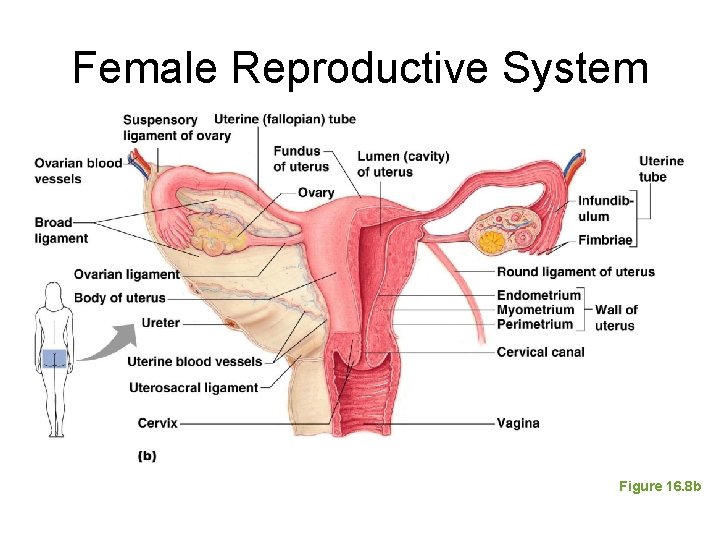
Female Reproductive System Figure 16. 8 b
Regions of the Uterus • Body—main portion • Fundus—superior rounded region above where uterine tube enters • Cervix—narrow outlet that protrudes into the vagina
Walls of the Uterus • Endometrium – Inner layer – Allows for implantation of a fertilized egg – Sloughs off if no pregnancy occurs (menses) • Myometrium—middle layer of smooth muscle • Perimetrium (visceral peritoneum)— outermost serous layer of the uterus
Female Reproductive System Figure 16. 8 b
Vagina • • Extends from cervix to exterior of body Located between bladder and rectum Serves as the birth canal Receives the penis during sexual intercourse • Hymen—partially closes the vagina until it is ruptured
Female Reproductive System Figure 16. 8 b
External Genitalia (Vulva) • • • Mons pubis Labia Clitoris Urethral orifice Vaginal orifice Greater vestibular glands
Mons Pubis • Fatty area overlying the pubic symphysis • Covered with pubic hair after puberty
Labia • Labia—skin folds – Labia majora—hair-covered skin folds – Labia minora—delicate, hair-free folds of skin
Vestibule and Greater Vestibular Glands • Vestibule – Enclosed by labia majora – Contains external openings of the urethra, vagina • Greater vestibular glands – One is found on each side of the vagina – Secretes lubricant during intercourse
Clitoris • Contains erectile tissue • Corresponds to the male penis • The clitoris is similar to the penis in that it is – Hooded by a prepuce – Composed of sensitive erectile tissue – Becomes swollen with blood during sexual excitement
Perineum • Diamond-shaped region between the anterior ends of the labial folds, anus posteriorly, and ischial tuberosities laterally
Oogenesis and the Ovarian Cycle • The total supply of eggs are present at birth • Ability to release eggs begins at puberty • Reproductive ability ends at menopause • Oocytes are matured in developing ovarian follicles
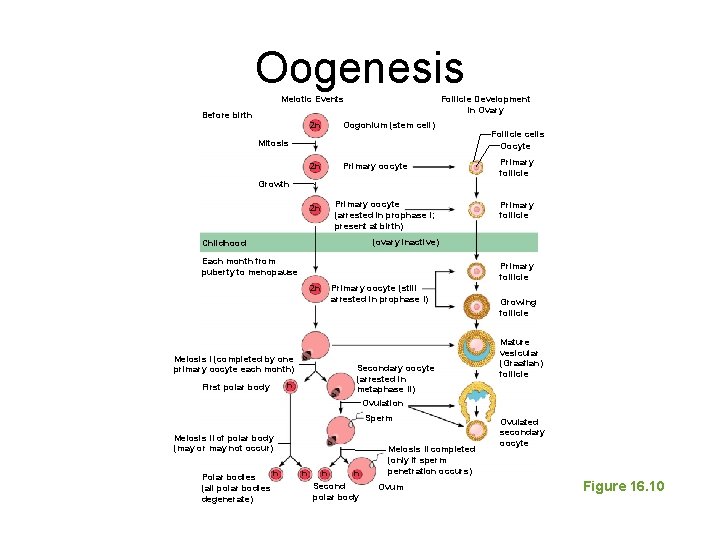
Oogenesis and the Ovarian Cycle • Oogonia—female stem cells found in a developing fetus • Oogonia undergo mitosis to produce primary oocytes • Primary oocytes are surrounded by cells that form primary follicles in the ovary • Oogonia no longer exist by the time of birth
Oogenesis and the Ovarian Cycle • Primary oocytes are inactive until puberty • Follicle stimulating hormone (FSH) causes some primary follicles to mature each month • Cyclic monthly changes constitute the ovarian cycle
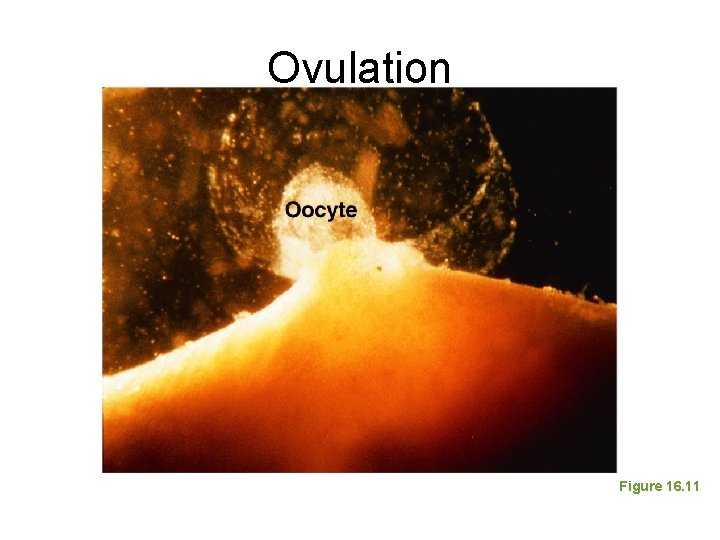
Oogenesis and the Ovarian Cycle • Meiosis starts inside maturing follicle • Produces a secondary oocyte and the first polar body • Follicle development to the stage of a vesicular follicle takes about 14 days • Ovulation of a secondary oocyte occurs with the release of luteinizing hormone (LH) • Secondary oocyte is released and surrounded by a corona radiata
Ovulation Figure 16. 11
Oogenesis and the Ovarian Cycle • Meiosis is completed after ovulation only if sperm penetrates – Ovum is produced – Two additional polar bodies are produced • Once ovum is formed, the 23 chromosomes can be combined with those of the sperm to form the fertilized egg (zygote) • If the secondary oocyte is not penetrated by a sperm, it dies and does not complete
Male and Female Differences • Meiosis – Males—produces four functional sperm – Females—produces one functional ovum and three polar bodies • Sex cell size and structure – Sperm are tiny, motile, and equipped with nutrients in seminal fluid – Egg is large, non-motile, and has nutrient reserves to nourish the embryo until implantation
Oogenesis Meiotic Events Before birth Follicle Development in Ovary 2 n Oogonium (stem cell) 2 n Primary oocyte Mitosis Follicle cells Oocyte Primary follicle Growth 2 n Primary oocyte (arrested in prophase I; present at birth) (ovary inactive) Childhood Each month from puberty to menopause Primary follicle 2 n Meiosis I (completed by one primary oocyte each month) First polar body Primary oocyte (still arrested in prophase I) Secondary oocyte (arrested in metaphase II) Ovulation n Sperm Meiosis II of polar body (may or may not occur) n Polar bodies (all polar bodies degenerate) Primary follicle n n n Second polar body Meiosis II completed (only if sperm penetration occurs) Ovum Growing follicle Mature vesicular (Graafian) follicle Ovulated secondary oocyte Figure 16. 10