
The Reproductive System Copyright 2003 Pearson Education Inc





- Slides: 49
The Reproductive System Copyright © 2003 Pearson Education, Inc. publishing as Benjamin Cummings
The Reproductive System · 1) Gonads – primary sex organs · Testes in males · Ovaries in females · 2) Gonads produce gametes (sex cells) and secrete hormones · Sperm – male gametes · Eggs (ova) – female gametes Copyright © 2003 Pearson Education, Inc. publishing as Benjamin Cummings Slide 16. 1
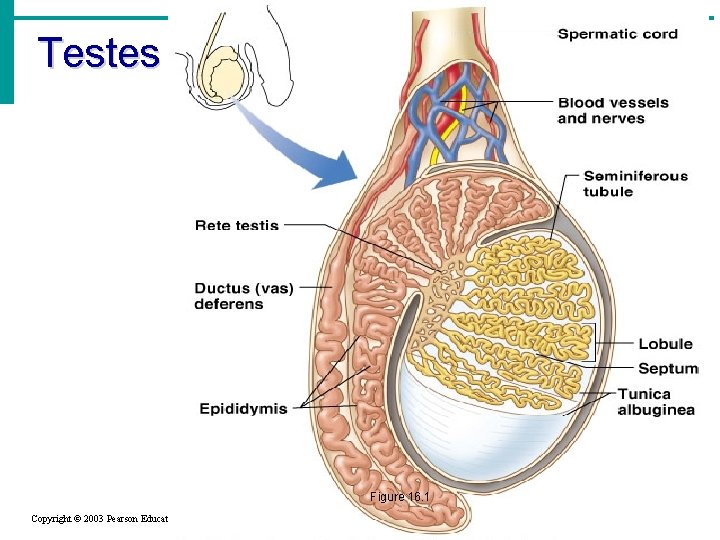
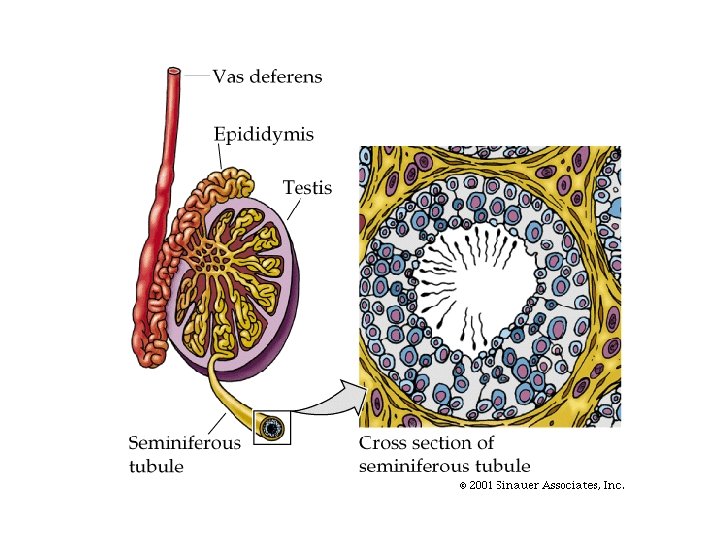
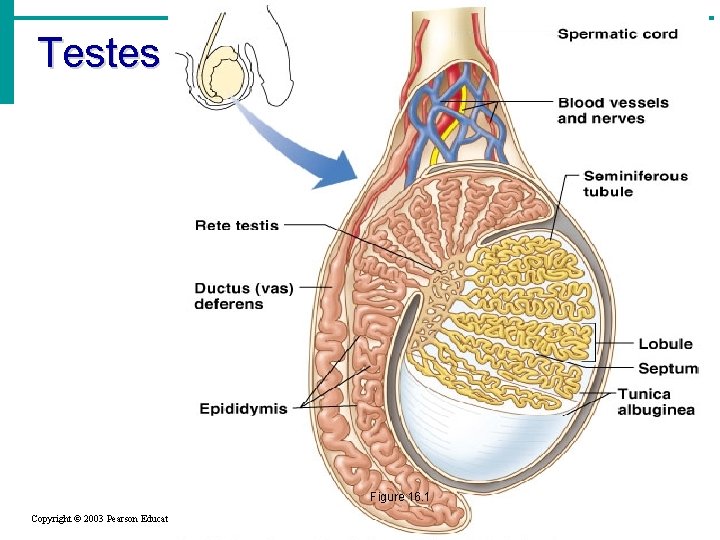
Testes · Each lobule contains one to four seminiferous tubules (sperm birth!) · Tightly coiled structures · Function as sperm-forming factories · Sperm travels from testes to the epididymis · Produce hormones such as testosterone Copyright © 2003 Pearson Education, Inc. publishing as Benjamin Cummings Slide 16. 4
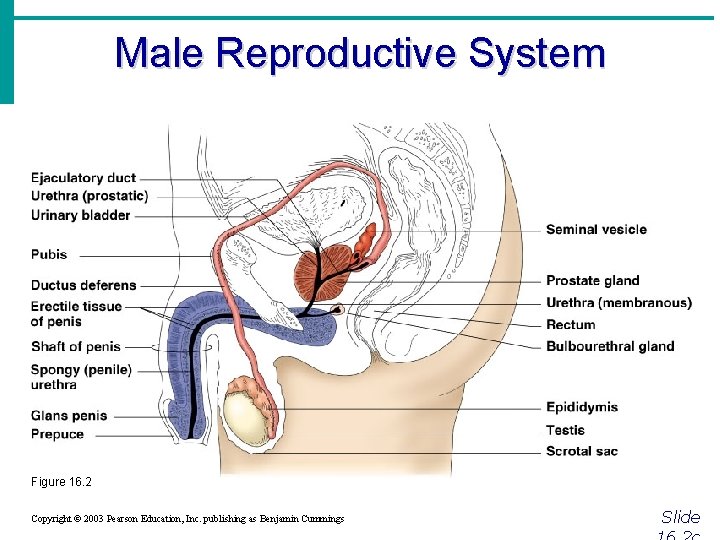
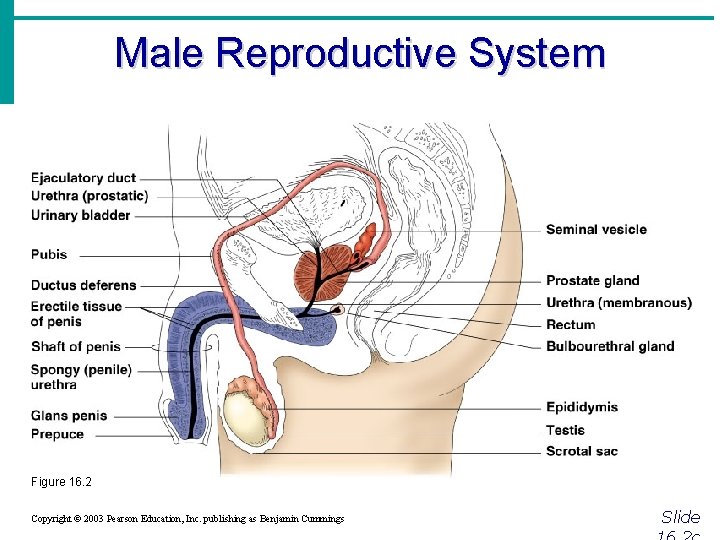
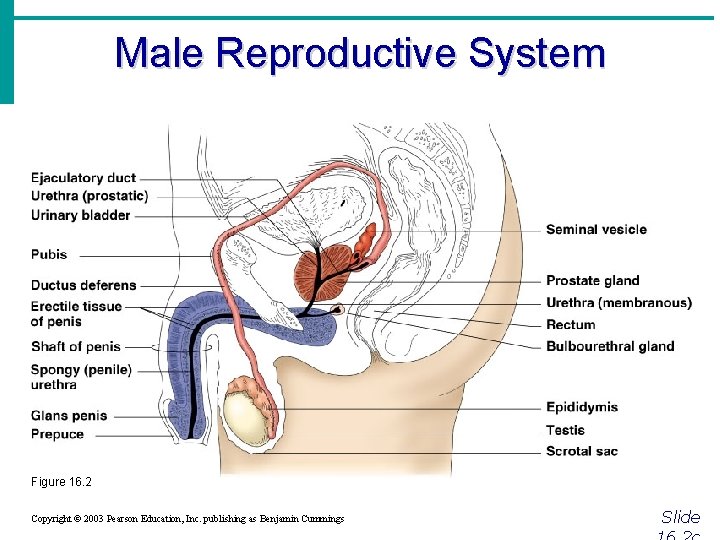
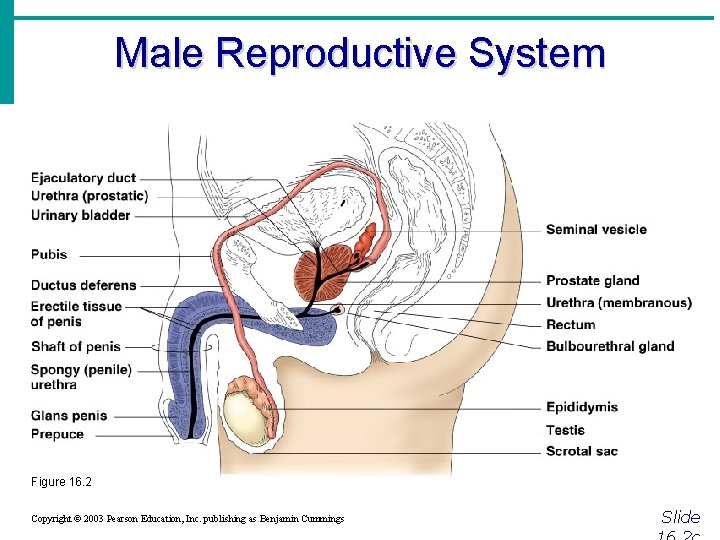
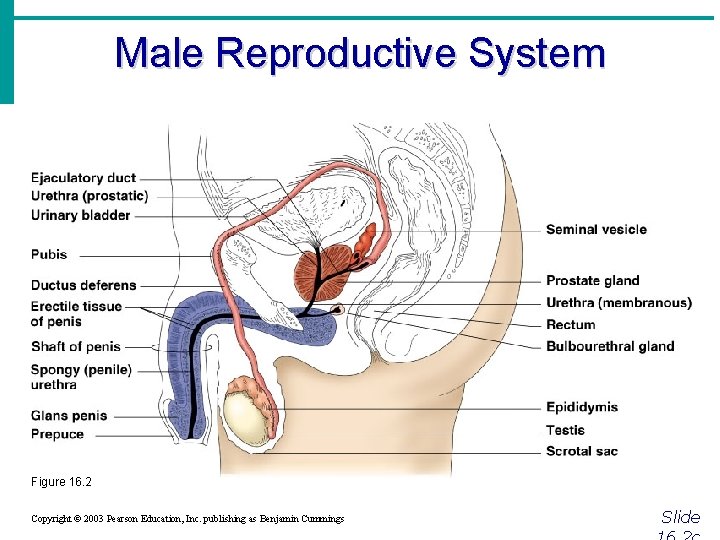
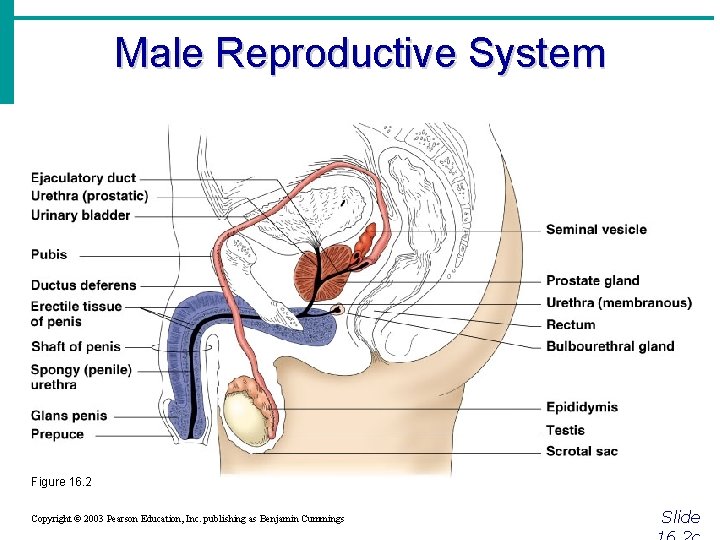
Male Reproductive System Figure 16. 2 Copyright © 2003 Pearson Education, Inc. publishing as Benjamin Cummings Slide
Testes Figure 16. 1 Copyright © 2003 Pearson Education, Inc. publishing as Benjamin Cummings Slide
Epididymis · Comma-shaped, tightly coiled tube · Functions to mature and store sperm cells (at least 20 days) · Expels sperm with the contraction of muscles in the epididymis walls to the vas deferens Copyright © 2003 Pearson Education, Inc. publishing as Benjamin Cummings Slide 16. 5
Male Reproductive System Figure 16. 2 Copyright © 2003 Pearson Education, Inc. publishing as Benjamin Cummings Slide
Vas Deferens · Carries sperm from the epididymis to the ejaculatory duct · Moves sperm by contraction · Ends in the ejaculatory duct which connects with the urethra Copyright © 2003 Pearson Education, Inc. publishing as Benjamin Cummings Slide
Male Reproductive System Figure 16. 2 Copyright © 2003 Pearson Education, Inc. publishing as Benjamin Cummings Slide
Testes Figure 16. 1 Copyright © 2003 Pearson Education, Inc. publishing as Benjamin Cummings Slide
Urethra · Extends from the base of the urinary bladder to the tip of the penis · Carries both urine and sperm · Sperm enters from the ejaculatory duct Copyright © 2003 Pearson Education, Inc. publishing as Benjamin Cummings Slide
Male Reproductive System Figure 16. 2 Copyright © 2003 Pearson Education, Inc. publishing as Benjamin Cummings Slide
Seminal Vesicles · Located at the base of the bladder · Produces a thick, yellowish secretion (60% of semen) · Fructose (sugar) · Vitamin C · Other substances that nourish and activate sperm Copyright © 2003 Pearson Education, Inc. publishing as Benjamin Cummings Slide 16. 8
Male Reproductive System Figure 16. 2 Copyright © 2003 Pearson Education, Inc. publishing as Benjamin Cummings Slide
Prostate Gland · Encircles the upper part of the urethra · Secretes a milky fluid · Helps to activate sperm Copyright © 2003 Pearson Education, Inc. publishing as Benjamin Cummings Slide 16. 9
Male Reproductive System Figure 16. 2 Copyright © 2003 Pearson Education, Inc. publishing as Benjamin Cummings Slide
Bulbourethral Glands · Pea-sized gland under the prostate · Produces a thick, clear mucus · Cleanses the urethra of acidic urine · Secreted into the urethra Copyright © 2003 Pearson Education, Inc. publishing as Benjamin Cummings Slide
Male Reproductive System Figure 16. 2 Copyright © 2003 Pearson Education, Inc. publishing as Benjamin Cummings Slide
Semen · Mixture of sperm and gland secretions · Advantages of gland secretions · Fructose provides energy for sperm cells · Semen helps neutralize the acidic environment of vagina · Semen inhibits bacteria · Elements of semen enhance sperm movement Copyright © 2003 Pearson Education, Inc. publishing as Benjamin Cummings Slide
External Genitalia · Scrotum · Divided sac of skin outside the abdomen · Maintains testes at 3°C lower than normal body temperature to protect sperm Copyright © 2003 Pearson Education, Inc. publishing as Benjamin Cummings Slide
Male Reproductive System Figure 16. 2 Copyright © 2003 Pearson Education, Inc. publishing as Benjamin Cummings Slide
External Genitalia · Penis · Delivers sperm into the female reproductive tract · Regions of the penis · Shaft · Glans penis (enlarged tip) · Prepuce (foreskin) · Folded cuff of skin around proximal end · Often removed by circumcision Copyright © 2003 Pearson Education, Inc. publishing as Benjamin Cummings Slide
Male Reproductive System Figure 16. 2 Copyright © 2003 Pearson Education, Inc. publishing as Benjamin Cummings Slide
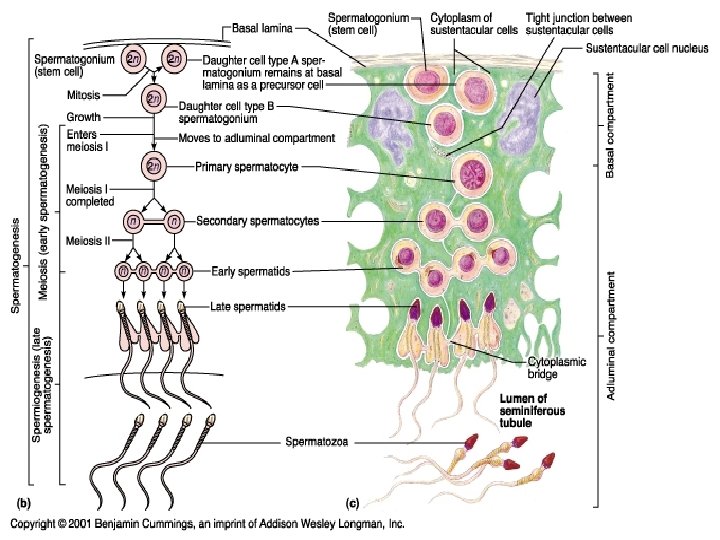
Spermatogenesis · 1)Production of sperm cells · Begins at puberty and continues throughout life · Occurs in the seminiferous tubules Copyright © 2003 Pearson Education, Inc. publishing as Benjamin Cummings Slide
Processes of Spermatogenesis · Spermatogonia (‘immature’ sperm) undergo rapid mitosis to produce more spermatogonia before puberty · Follicle stimulating hormone (FSH) allows the male to produce sperm when he reaches puberty. · Spermatogenesis takes 64 to 72 days Copyright © 2003 Pearson Education, Inc. publishing as Benjamin Cummings Slide
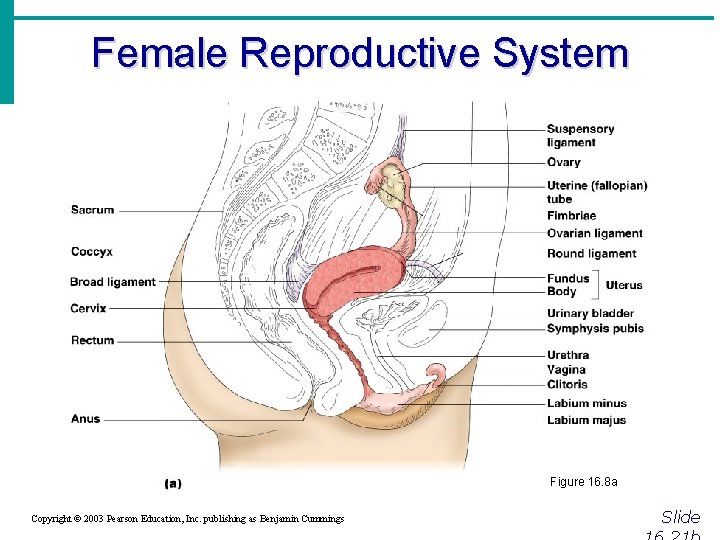
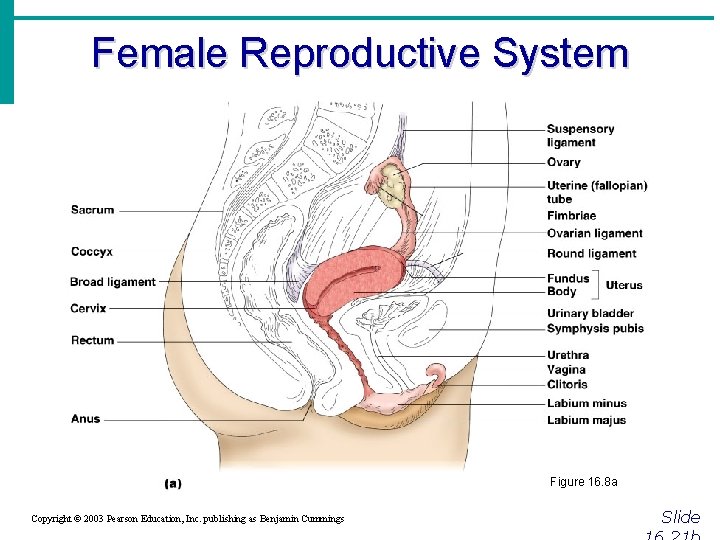
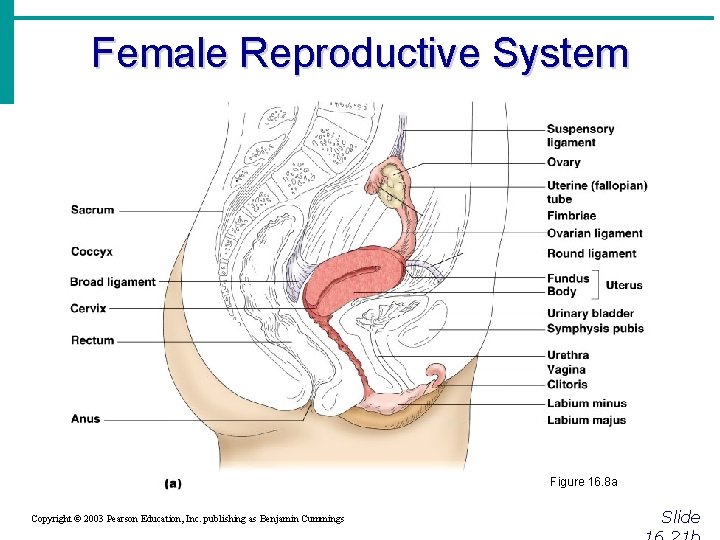
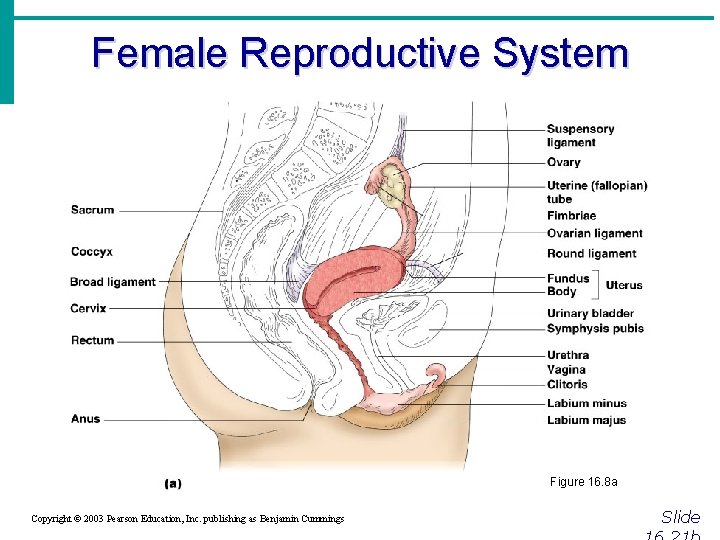
Female Reproductive System Figure 16. 8 a Copyright © 2003 Pearson Education, Inc. publishing as Benjamin Cummings Slide
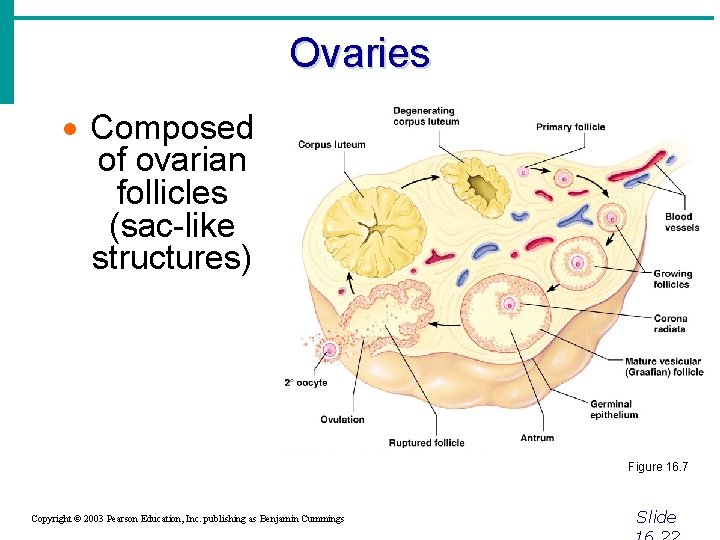
Ovaries · Composed of ovarian follicles (sac-like structures) Figure 16. 7 Copyright © 2003 Pearson Education, Inc. publishing as Benjamin Cummings Slide
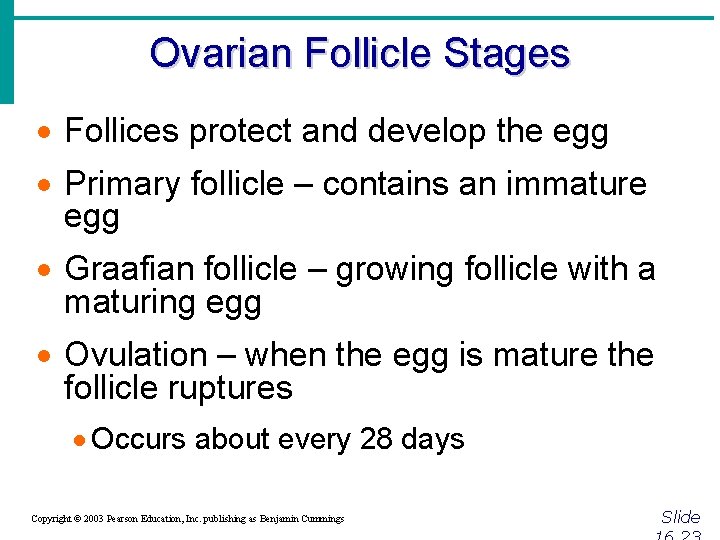
Ovarian Follicle Stages · Follices protect and develop the egg · Primary follicle – contains an immature egg · Graafian follicle – growing follicle with a maturing egg · Ovulation – when the egg is mature the follicle ruptures · Occurs about every 28 days Copyright © 2003 Pearson Education, Inc. publishing as Benjamin Cummings Slide
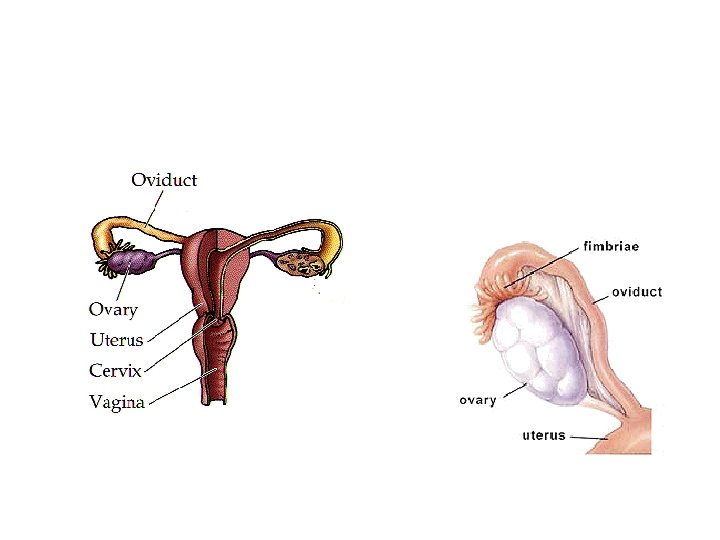
Fallopian Tubes · Receive the ovulated egg · Provide a site for fertilization · Attaches to the uterus · Does not physically attach to the ovary · Supported by the broad ligament of muscle Copyright © 2003 Pearson Education, Inc. publishing as Benjamin Cummings Slide
Female Reproductive System Figure 16. 8 a Copyright © 2003 Pearson Education, Inc. publishing as Benjamin Cummings Slide
Fallopian Tube Function · Fimbriae – finger-like projections at the end that receive the egg · Cilia inside the fallopian tube slowly move the egg towards the uterus (takes 3– 4 days) · Fertilization occurs inside the fallopian tube Copyright © 2003 Pearson Education, Inc. publishing as Benjamin Cummings Slide
Uterus · Located between the bladder and rectum · Hollow organ · Functions of the uterus · Receives a fertilized egg · Retains the fertilized egg · Nourishes the fertilized egg Copyright © 2003 Pearson Education, Inc. publishing as Benjamin Cummings Slide
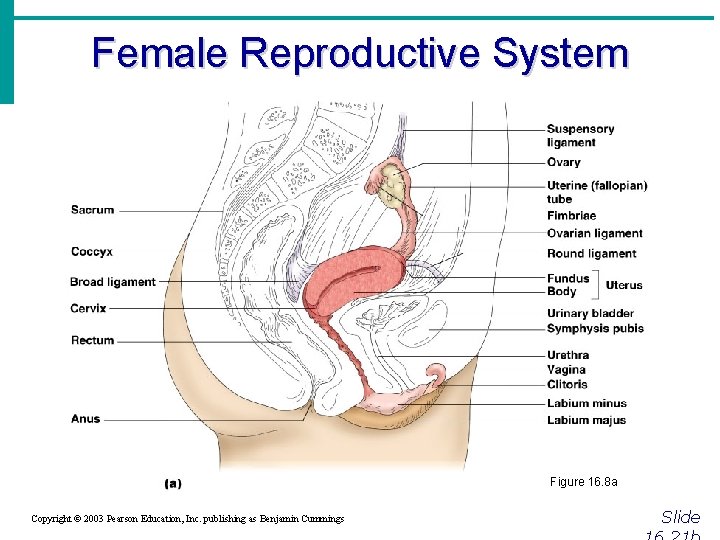
Female Reproductive System Figure 16. 8 a Copyright © 2003 Pearson Education, Inc. publishing as Benjamin Cummings Slide
Walls of the Uterus · Endometrium · Inner layer · Allows for implantation of a fertilized egg · Released if no pregnancy occurs (menstration) · Myometrium – middle layer of smooth muscle · Serous layer – outer veiny layer Copyright © 2003 Pearson Education, Inc. publishing as Benjamin Cummings Slide
Cervix • The lower entrance into the uterus. The opening lies between the uterus and the vagina.
Female Reproductive System Figure 16. 8 a Copyright © 2003 Pearson Education, Inc. publishing as Benjamin Cummings Slide
Vagina · Extends from cervix to exterior of body · Behind bladder and in front of rectum · Serves as the birth canal Copyright © 2003 Pearson Education, Inc. publishing as Benjamin Cummings Slide
Female Reproductive System Figure 16. 8 a Copyright © 2003 Pearson Education, Inc. publishing as Benjamin Cummings Slide
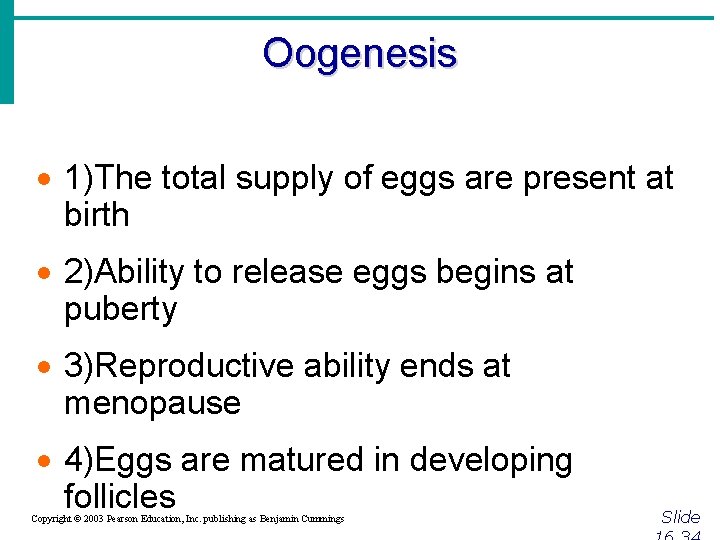
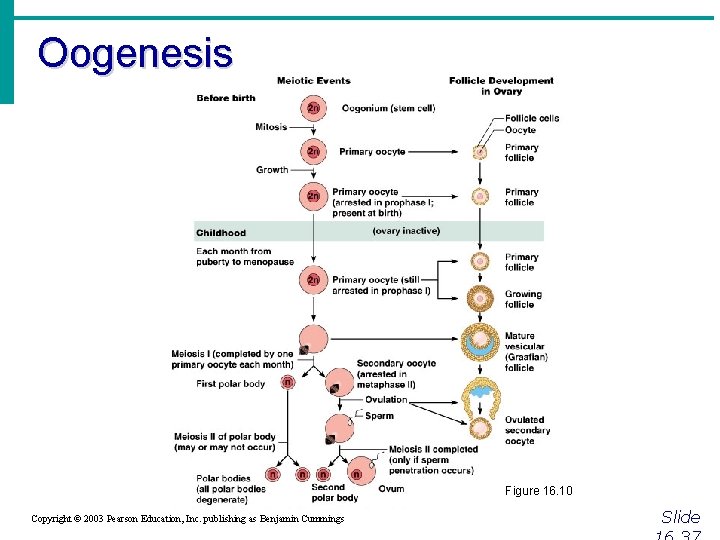
Oogenesis · 1)The total supply of eggs are present at birth · 2)Ability to release eggs begins at puberty · 3)Reproductive ability ends at menopause · 4)Eggs are matured in developing follicles Copyright © 2003 Pearson Education, Inc. publishing as Benjamin Cummings Slide
Oogenesis Figure 16. 10 Copyright © 2003 Pearson Education, Inc. publishing as Benjamin Cummings Slide
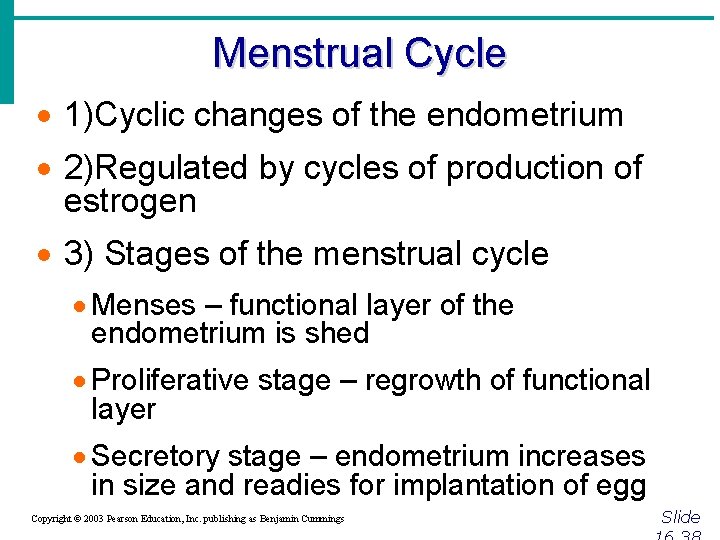
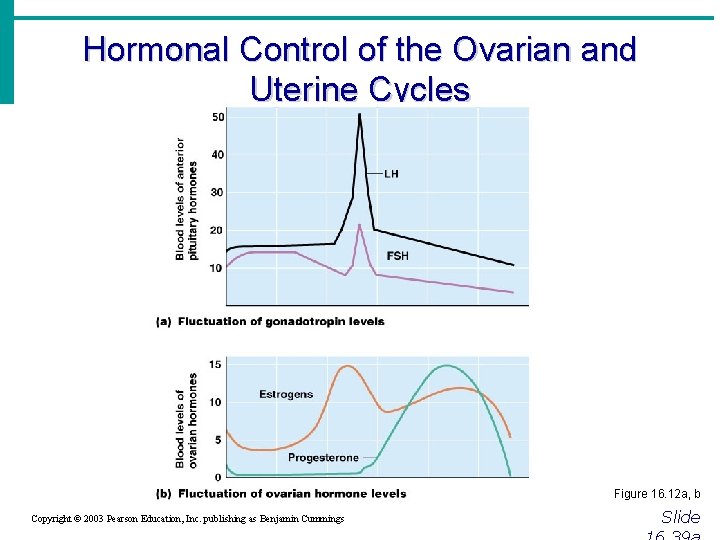
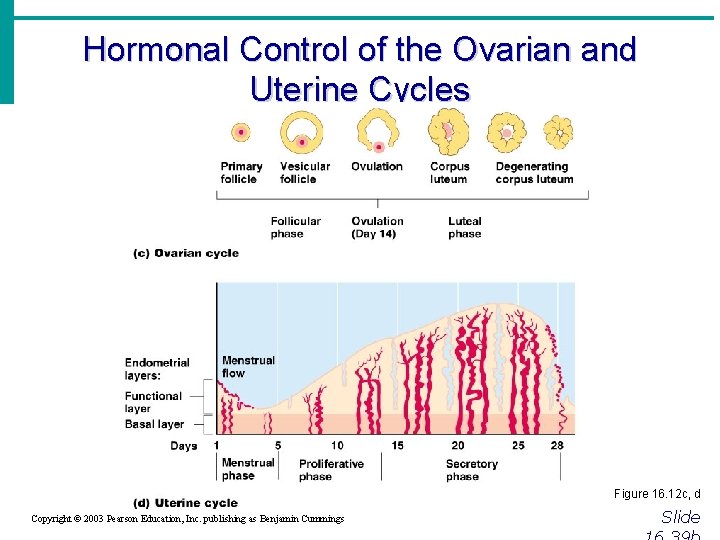
Menstrual Cycle · 1)Cyclic changes of the endometrium · 2)Regulated by cycles of production of estrogen · 3) Stages of the menstrual cycle · Menses – functional layer of the endometrium is shed · Proliferative stage – regrowth of functional layer · Secretory stage – endometrium increases in size and readies for implantation of egg Copyright © 2003 Pearson Education, Inc. publishing as Benjamin Cummings Slide
Hormonal Control of the Ovarian and Uterine Cycles Figure 16. 12 a, b Copyright © 2003 Pearson Education, Inc. publishing as Benjamin Cummings Slide
Hormonal Control of the Ovarian and Uterine Cycles Figure 16. 12 c, d Copyright © 2003 Pearson Education, Inc. publishing as Benjamin Cummings Slide
Mammary Glands · 1)Present in both sexes, but only function in females · 2)Function is to produce milk · 3)Stimulated by sex hormones (mostly estrogens) to increase in size Copyright © 2003 Pearson Education, Inc. publishing as Benjamin Cummings Slide
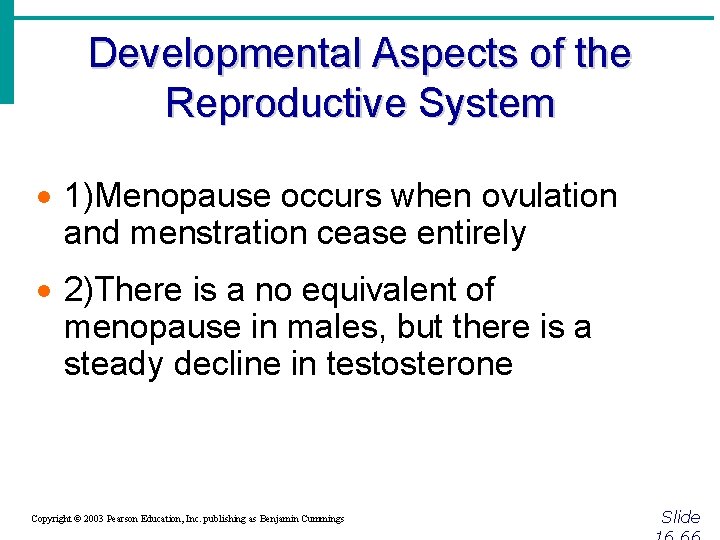
Developmental Aspects of the Reproductive System · 1)Menopause occurs when ovulation and menstration cease entirely · 2)There is a no equivalent of menopause in males, but there is a steady decline in testosterone Copyright © 2003 Pearson Education, Inc. publishing as Benjamin Cummings Slide
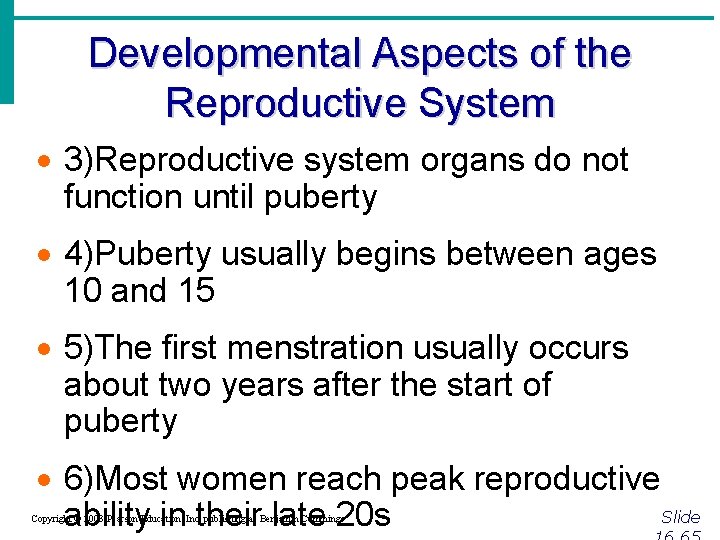
Developmental Aspects of the Reproductive System · 3)Reproductive system organs do not function until puberty · 4)Puberty usually begins between ages 10 and 15 · 5)The first menstration usually occurs about two years after the start of puberty · 6)Most women reach peak reproductive Slide ability in their late 20 s Copyright © 2003 Pearson Education, Inc. publishing as Benjamin Cummings