
The Reproductive System Chapter 16 primary sex organsie
- Slides: 84
The Reproductive System Chapter 16
• __________-primary sex organs-ie. Testes and ovaries • ____________--sex cells produced by gonads as well as gonads secrete sex hormones • ________________-remaining reproductive structures • Joint purpose of Reproductive system is produce offspring--via sperm in males and ______ in females gonads gametes Accessory reproductive organs ova
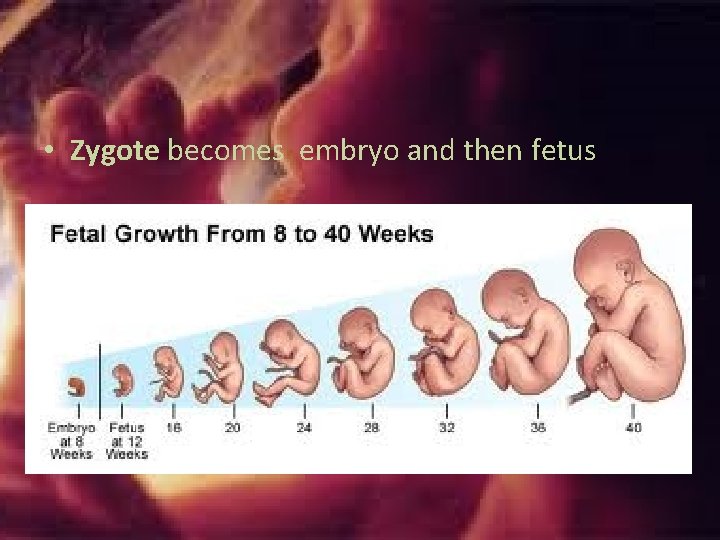
• Zygote becomes embryo and then fetus
• Anatomy of Male Reproductive System • Testes have exocrine-sperm producingfunction and endocrine-testosterone producing • Accessory structures in delivery of sperm to exterior or to female
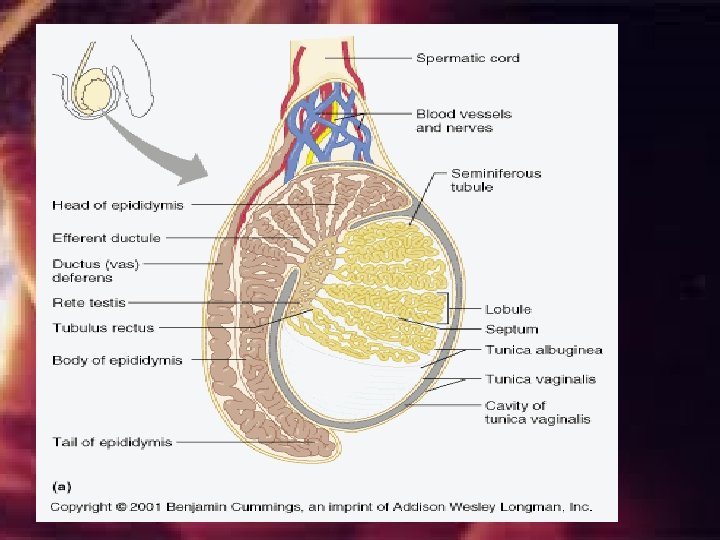
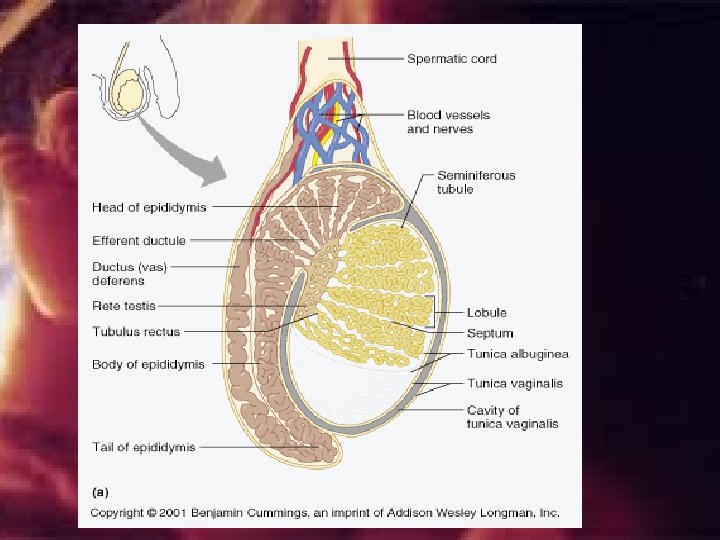
TESTES- Tunica albuginea • Plum shaped---4 cm –sized surrounded by fibrous connective tissue capsule-_______________-“white coat” • Extensions of capsule extend into testes and divide into wedge-shaped ___________each containing 14 _______________-sperm producing portion lobules Seminiferous tubules
• Seminiferous tubules empty into another set of tubules--__________on each side of testis-sperm travel from rete to enter 1 st part of duct system__________-hugging external testis • In soft tissue around seminiferous tubules are _________-that produce androgens-esp. testosterone---thus different tissue process sperm and then hormones Rete testis epididymis Interstitial cells
• DUCT SYSTEM-inc. edididymis, ducus deferns, and urethra • A. ______________-highly coiled tube-~6 mcapping superior testis and extends posterolaterallytemporary storage for immature sperm entering from testis • Takes sperm about _______days to travel epididymis, maturing along the way. . . and become motile • During ejaculation, epididymis contracts to expel ______into--_________________ epididymis 20 Sperm…. ductus deferens
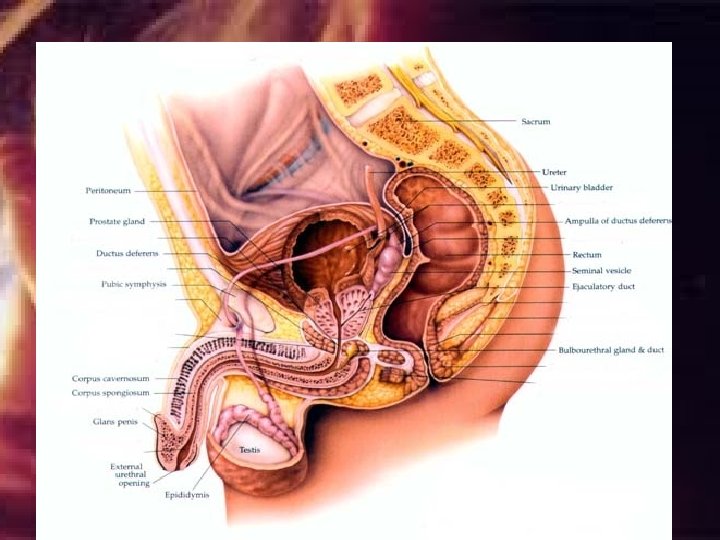
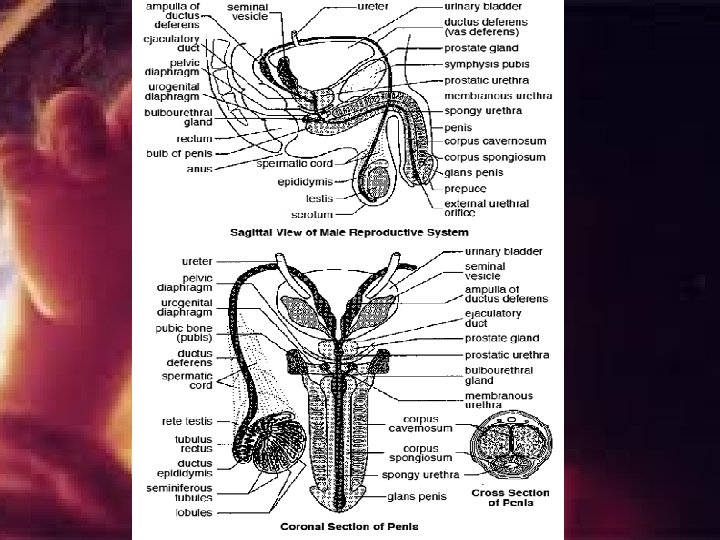
• . Ductus Deferens (= vas deferens)-extends upward from epididymis through inguinal canal, to pelvic cavity and arches over superior bladder…enclosed w/ blood vessels and nerves and connective tissue sheath-___________ and it travels up through inguinal canal Spermatic cord
• Loops medially over ureter and goes down posterior bladder-expands as ampulla and empties into _________--this passes through prostate gland merges w/ urethra • Main function of ductus deferens is to _____________ • At ejaculation smooth muscle squeeze sperm forward by __________ Ejaculatory duct Propel live sperm from storageepididymis and distal vas deferns peristalsis
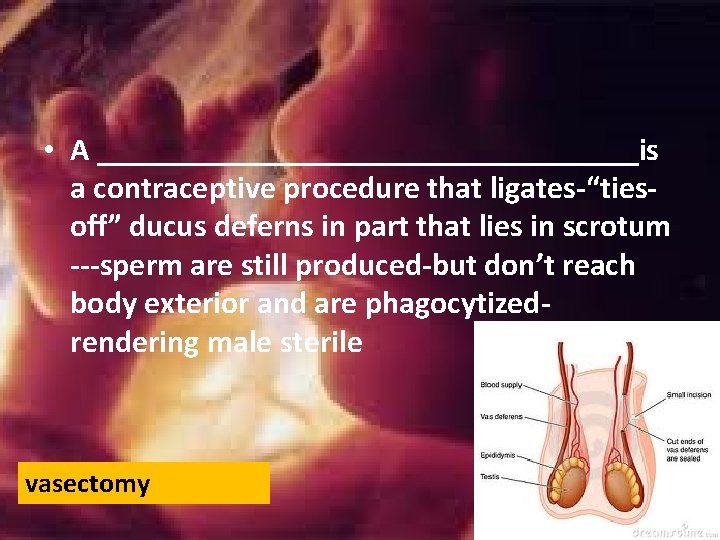
• A _________________is a contraceptive procedure that ligates-“tiesoff” ducus deferns in part that lies in scrotum ---sperm are still produced-but don’t reach body exterior and are phagocytizedrendering male sterile vasectomy
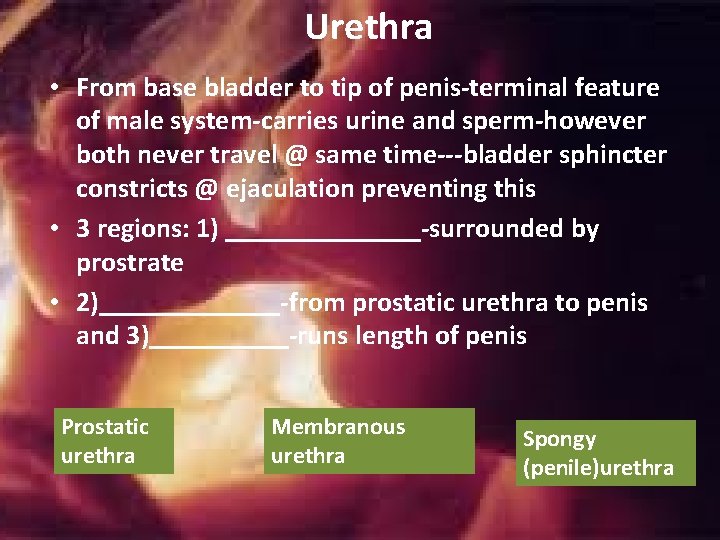
Urethra • From base bladder to tip of penis-terminal feature of male system-carries urine and sperm-however both never travel @ same time---bladder sphincter constricts @ ejaculation preventing this • 3 regions: 1) _______-surrounded by prostrate • 2)_______-from prostatic urethra to penis and 3)_____-runs length of penis Prostatic urethra Membranous urethra Spongy (penile)urethra
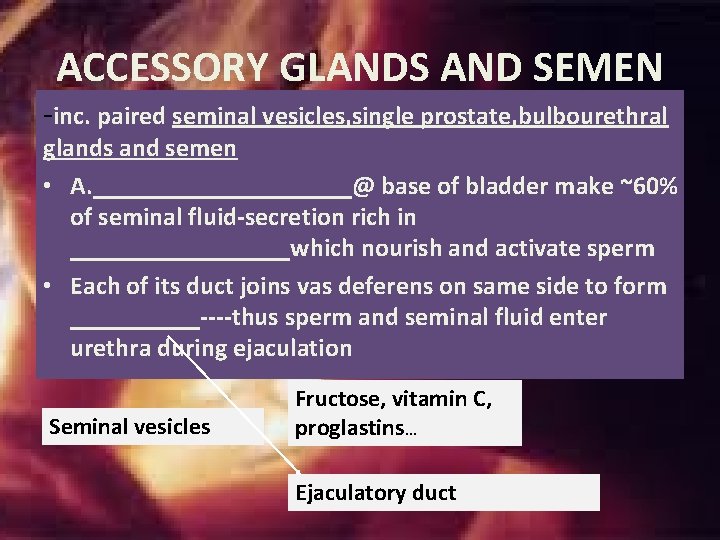
ACCESSORY GLANDS AND SEMEN -inc. paired seminal vesicles, single prostate, bulbourethral glands and semen • A. __________@ base of bladder make ~60% of seminal fluid-secretion rich in _________which nourish and activate sperm • Each of its duct joins vas deferens on same side to form _____----thus sperm and seminal fluid enter urethra during ejaculation Seminal vesicles Fructose, vitamin C, proglastins… Ejaculatory duct
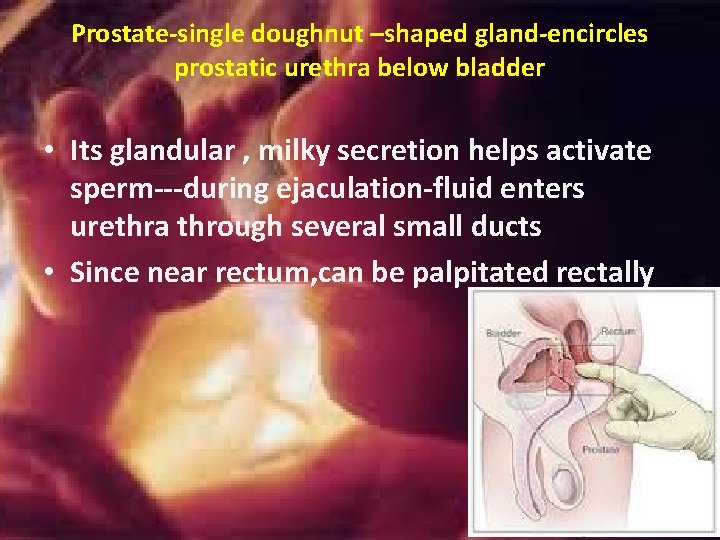
Prostate-single doughnut –shaped gland-encircles prostatic urethra below bladder • Its glandular , milky secretion helps activate sperm---during ejaculation-fluid enters urethra through several small ducts • Since near rectum, can be palpitated rectally
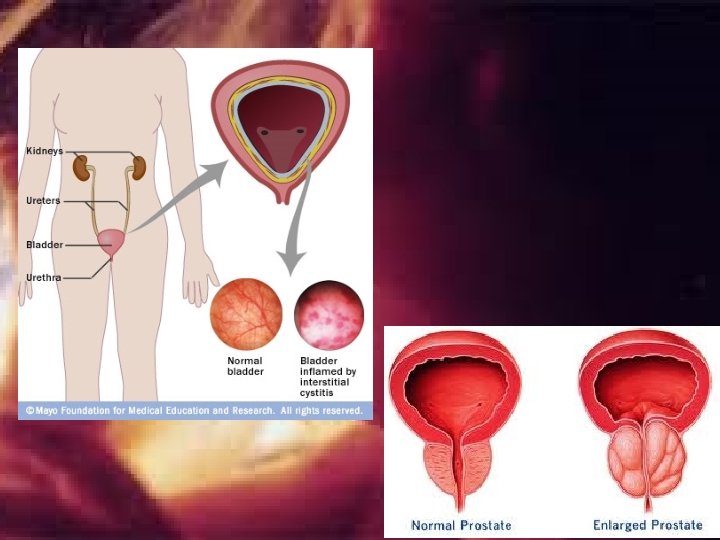
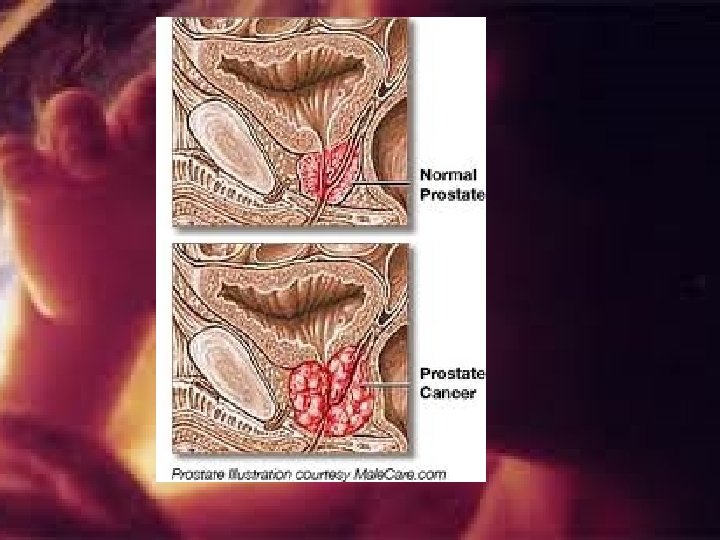
• Older men suffer hypertrophy of gland, strangling urethramaking urination difficult and increases risk of bladder infections-________ and kidney damage • Treatments include : surgery, drugs or microwaves to shrink prostate, insertion of small balloon to push prostate away from urethra, incineration w/low energy radiation • __________-inflammation of prostate-common • ________-most prevalent cancer in men-slow growing, usually cystitis prostatitis Prostatic cancer
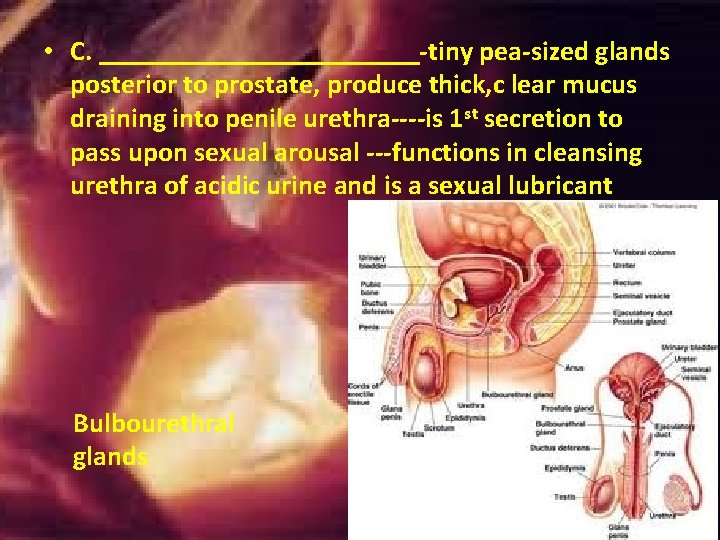
• C. ____________-tiny pea-sized glands posterior to prostate, produce thick, c lear mucus draining into penile urethra----is 1 st secretion to pass upon sexual arousal ---functions in cleansing urethra of acidic urine and is a sexual lubricant Bulbourethral glands
D. Semen-milky white, somewhat sticky mixture of sperm and gland secretions ; transport medium for nutrients and chemicals that protect and aid in movement of sperm • Sperm have little cytoplasm or stored nutrients so _________ is energy fuel • p. H ~ 7. 2 -7. 6 helps neutralize acidic vagina(3. 5 -4. 0)protecting sperm(sperm are sluggish in acidic environment) • ________-antibiotic chemical destroying certain bacteria • Hormone________-……………. fructose seminalplasmin relaxin
Semen cont’d • Enzymes to enhance sperm motility • Substances to inhibit female reproductive immune response • Male infertility---causes include obstruction of duct system, hormone imbalance , environmental estrogens , pesticides, too much alcohol…. often _________is checked to analyze sperm count, motility, and morphology, semen volume , p. H, fructose amount…sperm count should not be below 20 million /m. L Semen analysis
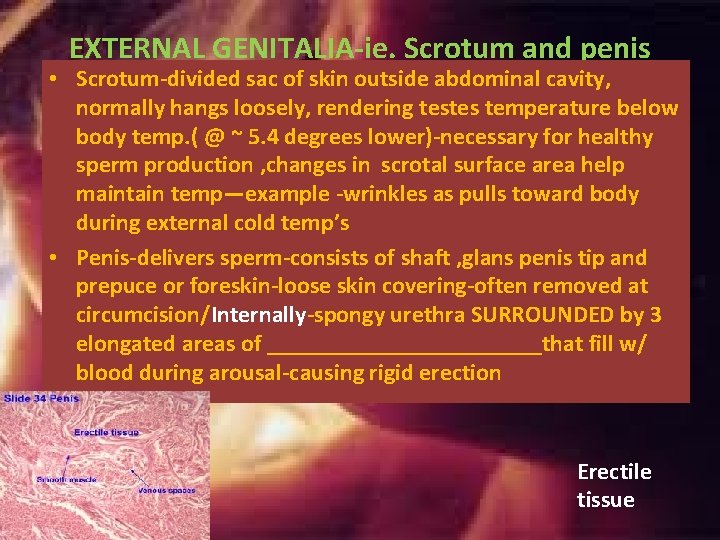
EXTERNAL GENITALIA-ie. Scrotum and penis • Scrotum-divided sac of skin outside abdominal cavity, normally hangs loosely, rendering testes temperature below body temp. ( @ ~ 5. 4 degrees lower)-necessary for healthy sperm production , changes in scrotal surface area help maintain temp—example -wrinkles as pulls toward body during external cold temp’s • Penis-delivers sperm-consists of shaft , glans penis tip and prepuce or foreskin-loose skin covering-often removed at circumcision/Internally-spongy urethra SURROUNDED by 3 elongated areas of ____________that fill w/ blood during arousal-causing rigid erection Erectile tissue
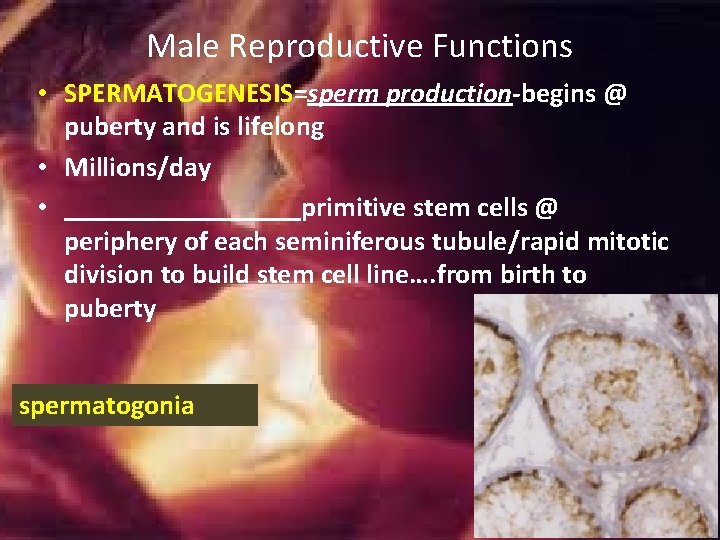
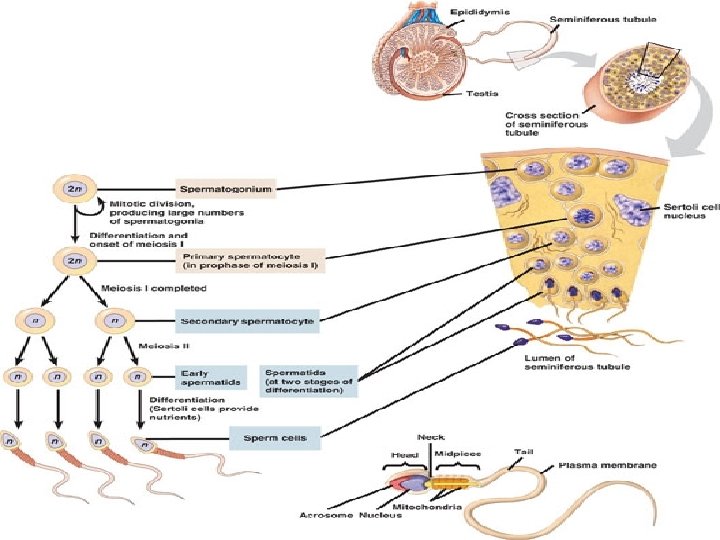
Male Reproductive Functions • SPERMATOGENESIS=sperm production-begins @ puberty and is lifelong • Millions/day • _________primitive stem cells @ periphery of each seminiferous tubule/rapid mitotic division to build stem cell line…. from birth to puberty spermatogonia
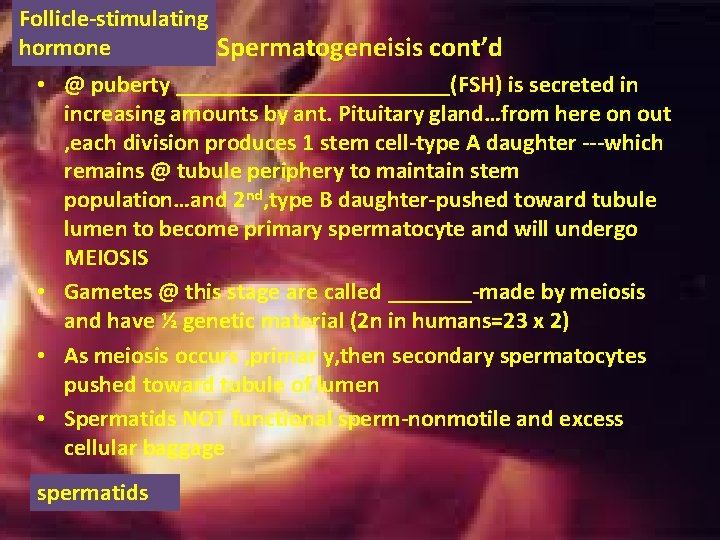
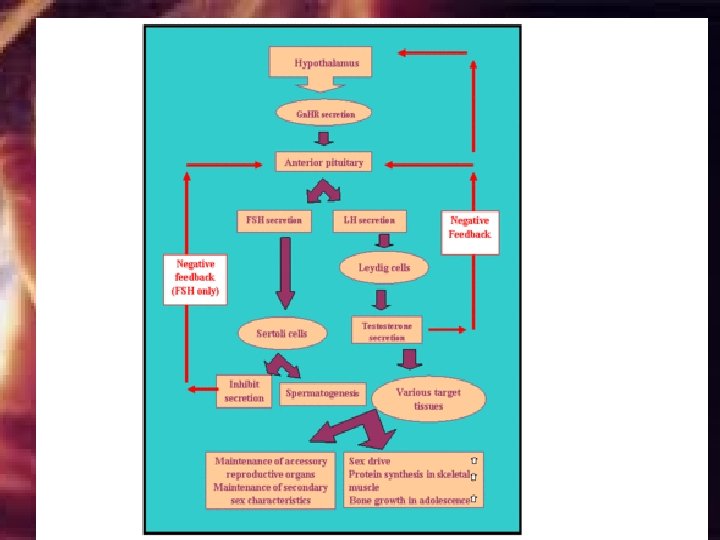
Follicle-stimulating hormone Spermatogeneisis cont’d • @ puberty ____________(FSH) is secreted in increasing amounts by ant. Pituitary gland…from here on out , each division produces 1 stem cell-type A daughter ---which remains @ tubule periphery to maintain stem population…and 2 nd, type B daughter-pushed toward tubule lumen to become primary spermatocyte and will undergo MEIOSIS • Gametes @ this stage are called _______-made by meiosis and have ½ genetic material (2 n in humans=23 x 2) • As meiosis occurs , primar y, then secondary spermatocytes pushed toward tubule of lumen • Spermatids NOT functional sperm-nonmotile and excess cellular baggage spermatids
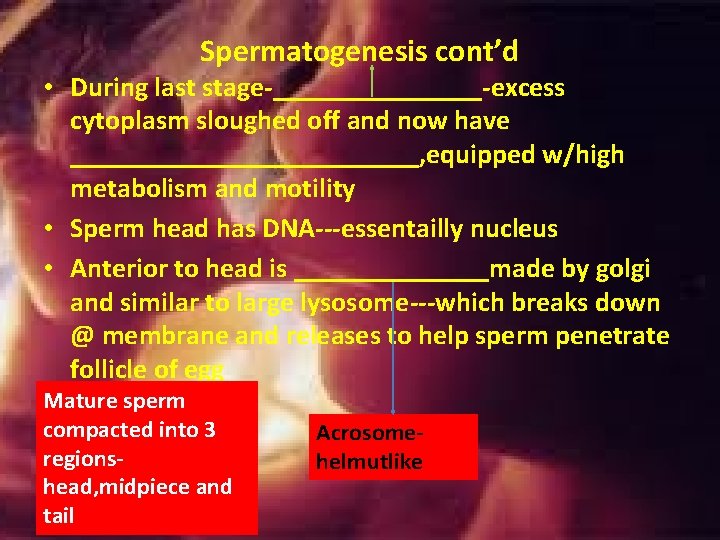
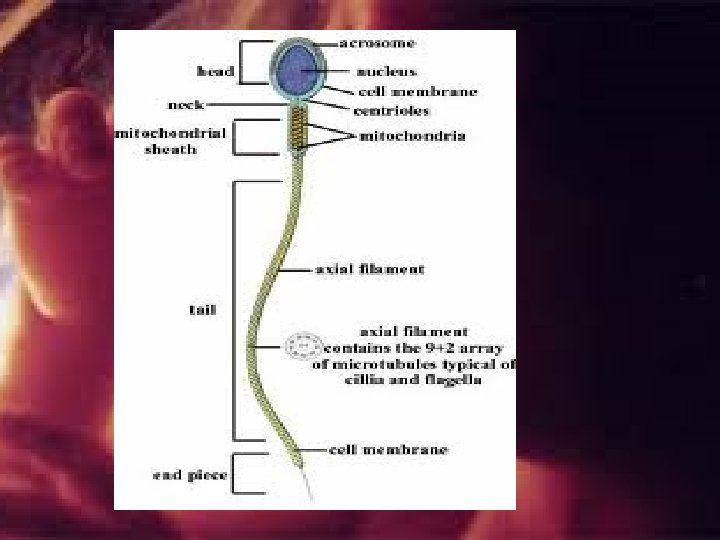
Spermatogenesis cont’d • During last stage-________-excess cytoplasm sloughed off and now have _____________, equipped w/high metabolism and motility • Sperm head has DNA---essentailly nucleus • Anterior to head is _______made by golgi and similar to large lysosome---which breaks down @ membrane and releases to help sperm penetrate follicle of egg Mature sperm compacted into 3 regionshead, midpiece and tail Acrosomehelmutlike
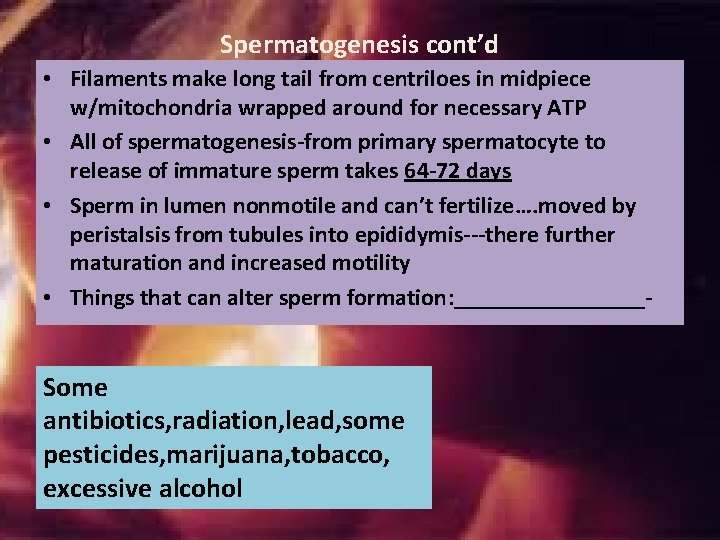
Spermatogenesis cont’d • Filaments make long tail from centriloes in midpiece w/mitochondria wrapped around for necessary ATP • All of spermatogenesis-from primary spermatocyte to release of immature sperm takes 64 -72 days • Sperm in lumen nonmotile and can’t fertilize…. moved by peristalsis from tubules into epididymis---there further maturation and increased motility • Things that can alter sperm formation: ________- Some antibiotics, radiation, lead, some pesticides, marijuana, tobacco, excessive alcohol
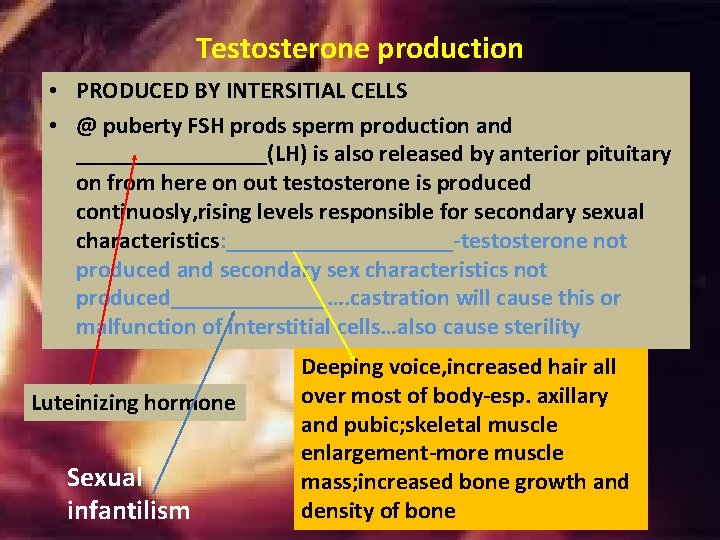
Testosterone production • PRODUCED BY INTERSITIAL CELLS • @ puberty FSH prods sperm production and ________(LH) is also released by anterior pituitary on from here on out testosterone is produced continuosly, rising levels responsible for secondary sexual characteristics: __________-testosterone not produced and secondary sex characteristics not produced_______…. castration will cause this or malfunction of interstitial cells…also cause sterility Luteinizing hormone Sexual infantilism Deeping voice, increased hair all over most of body-esp. axillary and pubic; skeletal muscle enlargement-more muscle mass; increased bone growth and density of bone
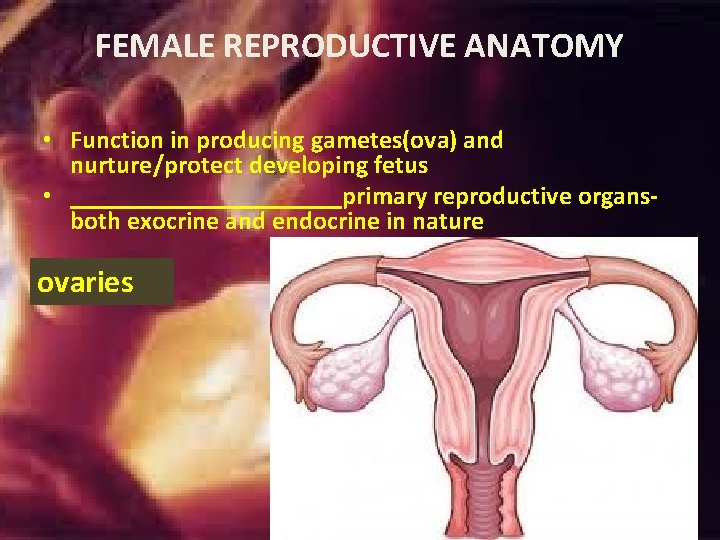
FEMALE REPRODUCTIVE ANATOMY • Function in producing gametes(ova) and nurture/protect developing fetus • ___________primary reproductive organsboth exocrine and endocrine in nature ovaries
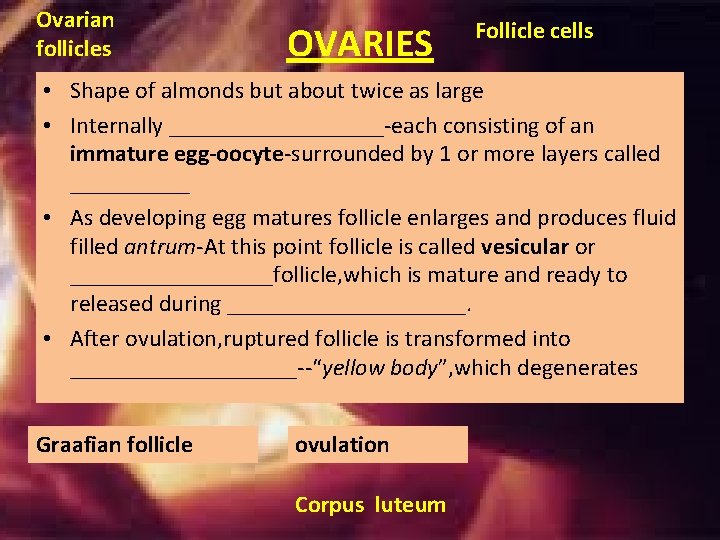
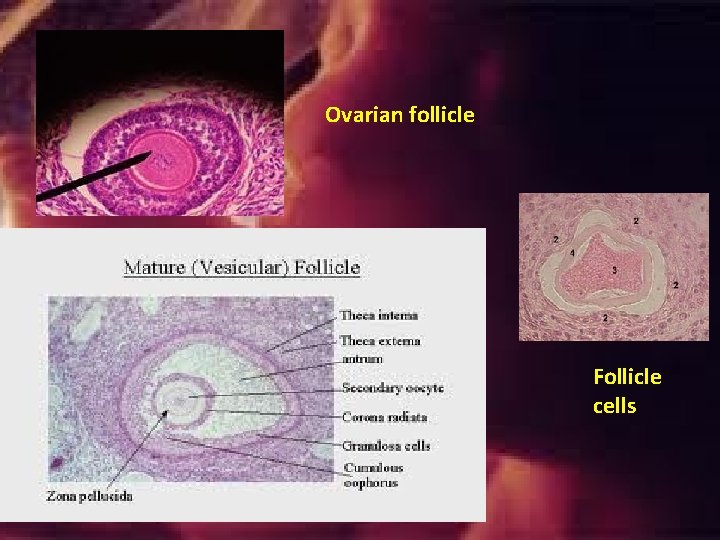
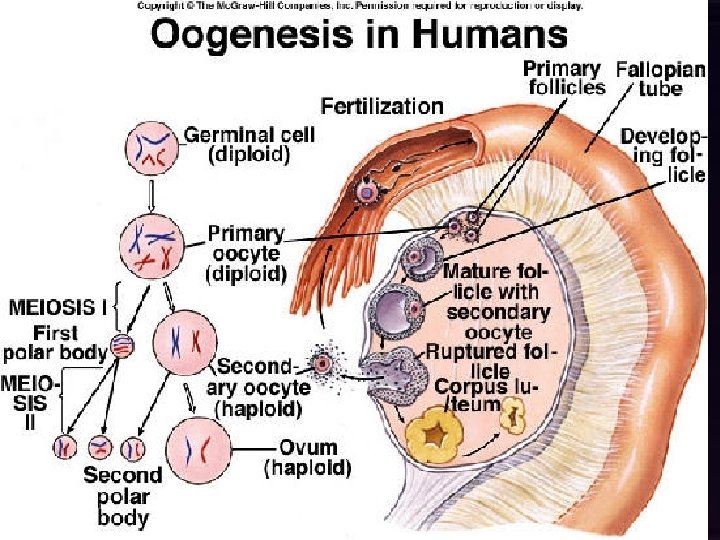
Ovarian follicles OVARIES Follicle cells • Shape of almonds but about twice as large • Internally _________-each consisting of an immature egg-oocyte-surrounded by 1 or more layers called _____ • As developing egg matures follicle enlarges and produces fluid filled antrum-At this point follicle is called vesicular or _________follicle, which is mature and ready to released during __________. • After ovulation, ruptured follicle is transformed into __________--“yellow body”, which degenerates Graafian follicle ovulation Corpus luteum
Ovarian follicle Follicle cells
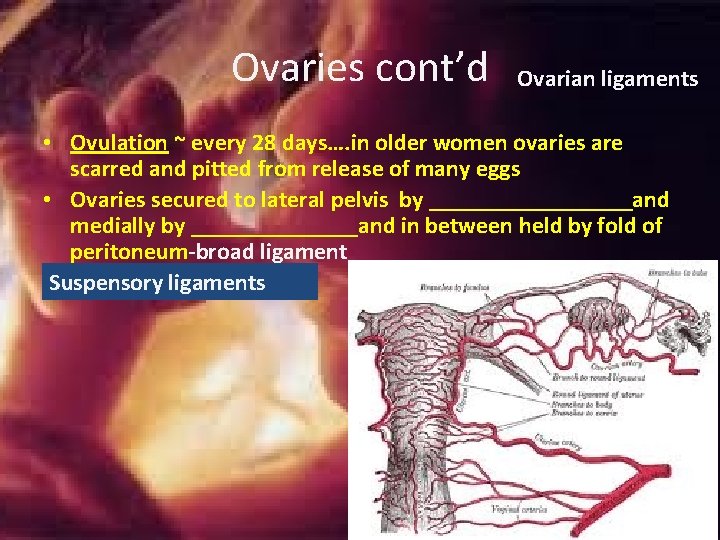
Ovaries cont’d Ovarian ligaments • Ovulation ~ every 28 days…. in older women ovaries are scarred and pitted from release of many eggs • Ovaries secured to lateral pelvis by _________and medially by _______and in between held by fold of peritoneum-broad ligament Suspensory ligaments
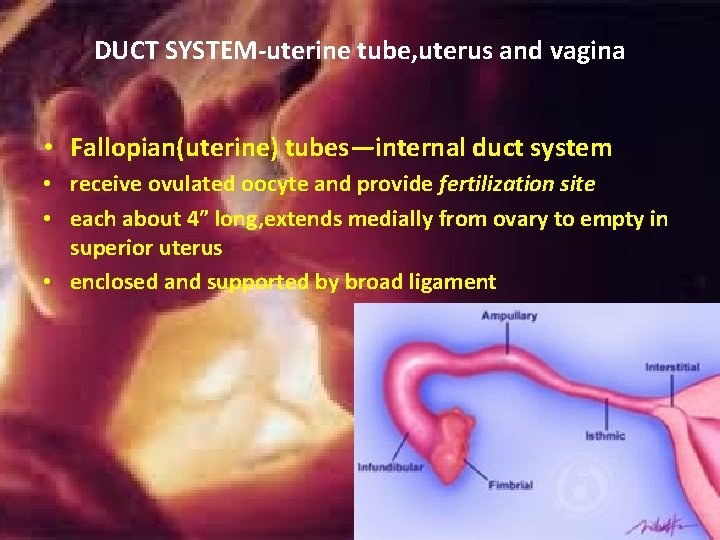
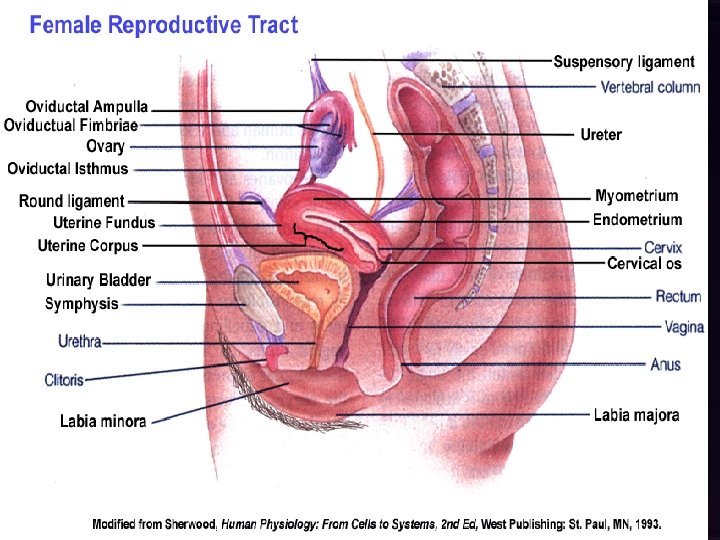
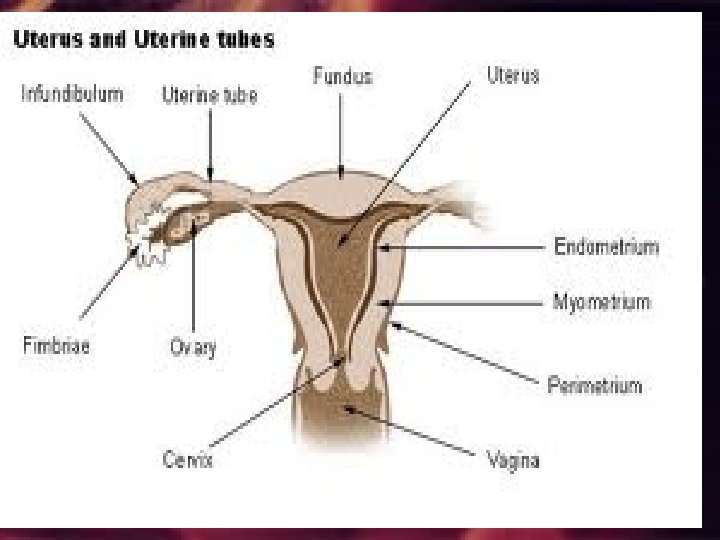
DUCT SYSTEM-uterine tube, uterus and vagina • Fallopian(uterine) tubes—internal duct system • receive ovulated oocyte and provide fertilization site • each about 4” long, extends medially from ovary to empty in superior uterus • enclosed and supported by broad ligament
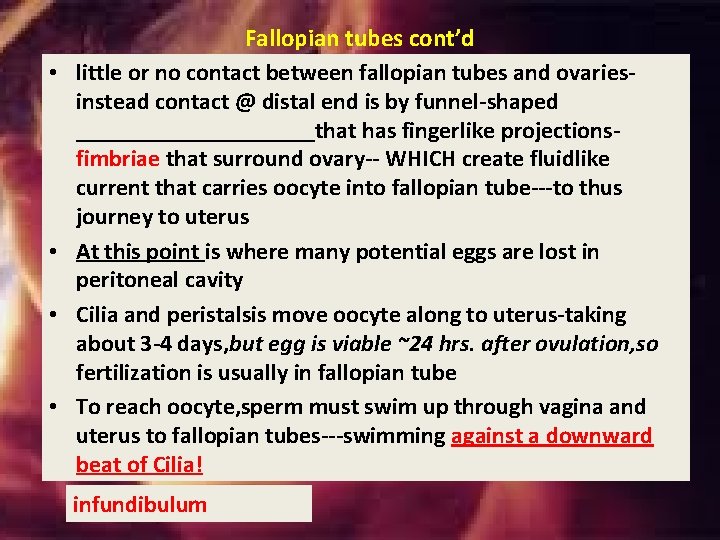
• • Fallopian tubes cont’d little or no contact between fallopian tubes and ovariesinstead contact @ distal end is by funnel-shaped __________that has fingerlike projectionsfimbriae that surround ovary-- WHICH create fluidlike current that carries oocyte into fallopian tube---to thus journey to uterus At this point is where many potential eggs are lost in peritoneal cavity Cilia and peristalsis move oocyte along to uterus-taking about 3 -4 days, but egg is viable ~24 hrs. after ovulation, so fertilization is usually in fallopian tube To reach oocyte, sperm must swim up through vagina and uterus to fallopian tubes---swimming against a downward beat of Cilia! infundibulum
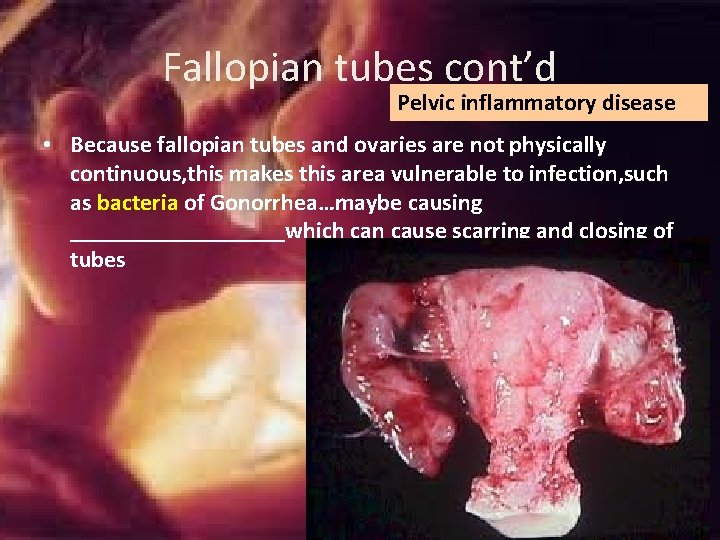
Fallopian tubes cont’d Pelvic inflammatory disease • Because fallopian tubes and ovaries are not physically continuous, this makes this area vulnerable to infection, such as bacteria of Gonorrhea…maybe causing _________which can cause scarring and closing of tubes
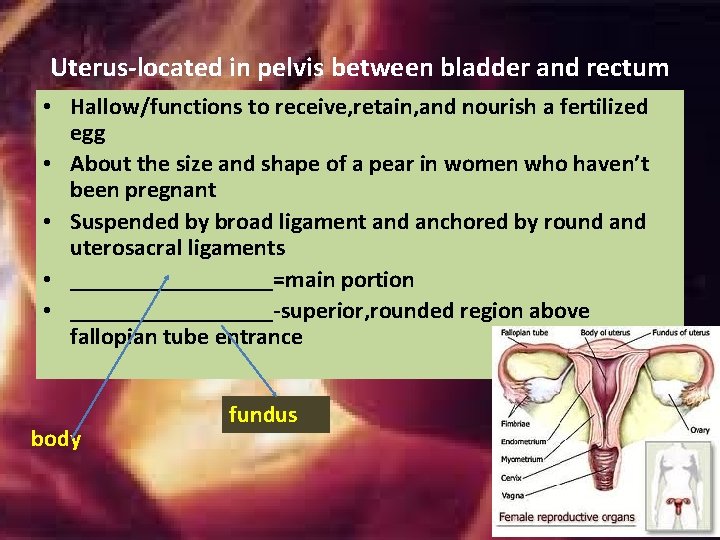
Uterus-located in pelvis between bladder and rectum • Hallow/functions to receive, retain, and nourish a fertilized egg • About the size and shape of a pear in women who haven’t been pregnant • Suspended by broad ligament and anchored by round and uterosacral ligaments • _________=main portion • _________-superior, rounded region above fallopian tube entrance body fundus
Uterus cont’d • _______-narrow outlet into vagina below • Wall is thick w/3 layers: 1)inner mucosa________-At implantation-fertilized egg burrows here/This layer sloughs off during ________-menstruation every 28 days- if not fertilized • 2)_______-interlacing bundles of smooth muscle making bulky middle layercontracts during labor 3) perimetrium-outer serous layer(visceral peritoneum cervix endometrium myometrium menses
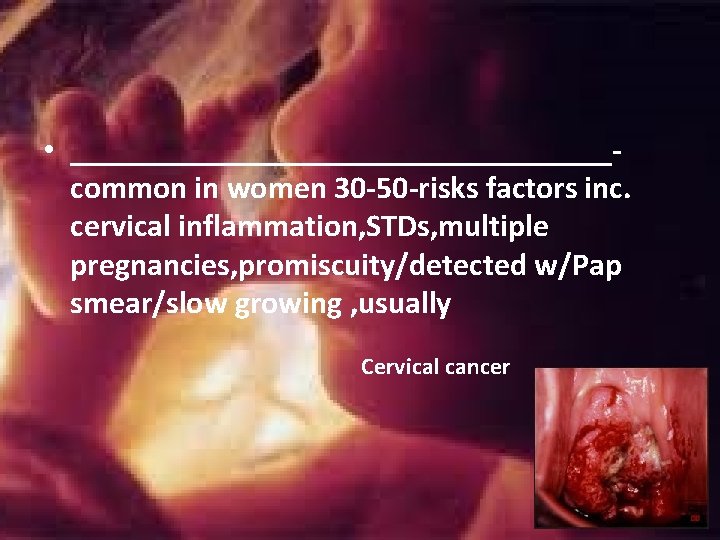
• _________________common in women 30 -50 -risks factors inc. cervical inflammation, STDs, multiple pregnancies, promiscuity/detected w/Pap smear/slow growing , usually Cervical cancer
• Vagina-thin-walled tube 3 -4”long/between bladder and rectum from cervix to body exterior=birth canal. /also organ of copulation • Distally partially enclosed by _____mucosawhich is very vascular and bleeds when ruptured hymen
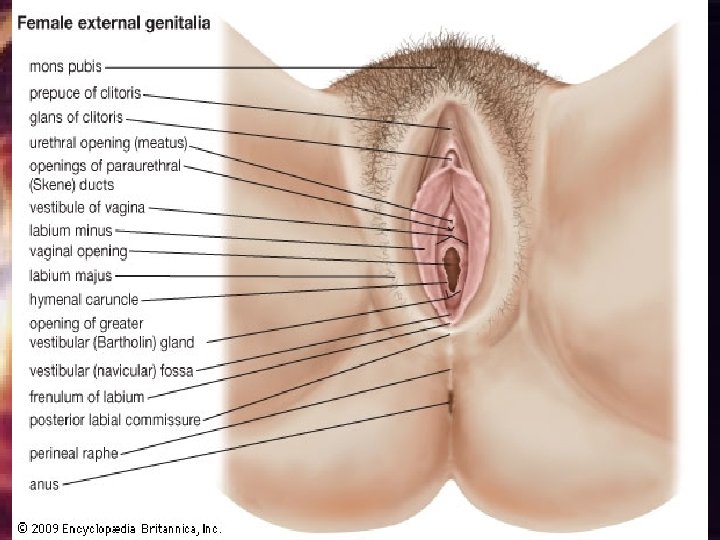
EXTERNAL GENITALIA=VULVA • mons pubis-fatty, rounded area overlying pubic symphysishair after puberty • laterally are 2 skin folds w/hair-labia majora (encloses vestibule which houses external urethra opening and vagina)and l. minora • _______ surround vagina and secretes for distal vagina • Clitoris-small protrusion that is corresponding to penis w/erectile tissue but no reproductive duct • __________-between ant. labial folds, anus and ischial tuberosities Greater vestibular glands perineum
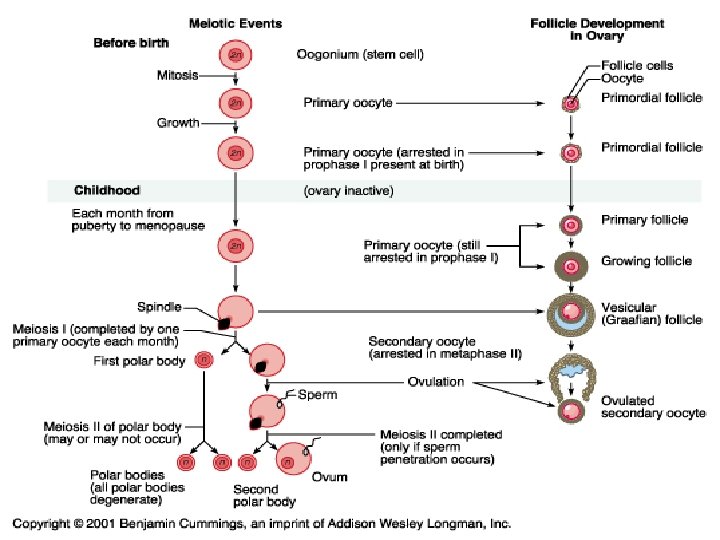
FEMALE REPRODUCTIVE FUNCTIONS AND CYCLES • OOGENESIS AND THE OVARIAN CYCLE • Females’ reproductive ability begins at puberty and ends around 50’s(menopause) • In developing female fetus, _____-female stem cells multiply rapidly to increase their numbers, then daughter cells-primary oocytes-push into ovary connective tissue and primary follicle forms around them • By birth, oogonia cease to exist and a lifetime supply of primary oocytes are in place---waiting 10 -14 years to undergo MEIOSIS! • @ puberty , ant. Pituitary produces_____FSH-stimulates a small # of primary follicles to grow and mature each month and then ovulation occurs monthly…. constituting the _____cycle oogonia Follicle-stimulating hormone ovarian
• • • Oogenesis and ovarian cycle cont’d @ puberty ~ 250, 000 oocytes remain w/ a small # activated each month…. appx 500 of the 250, 000 ova are released in the limited # of years of fertility The FSH prods the follicle to enlarge , accumulating fluid in central antrum/Primary oocyte replicates chromosomes and MEIOSIS occurs-producing 1 ________and polar Secondary oocyte body Follicle development to the point of rupture takes about 14 days with ___ovulation________ occurring at just about this time Ovulation occurs at the response to _luteinizing hormone__LH Secondary oocyte is still surrounded by follicle cell capsule now called_corona radiata(“radiating crown”)…abdominal pain can accompany this-mittelschmerz
• 1 developing follicle dominates each month/mature follicles not ovulated are overripe and deteriorate • Besides triggering ovulation each month, LH aso causes ruptured follicle to turn into corpus luteum(Both c. luteum and maturing follicle produce hormones) • If ovulated, secondary oocyte is penetrated by sperm in fallopian tube, THEN oocyte undergoes_________________making another polar body and ovum 2 nd meiotic division
• …. its 23 chromosomes are combined w/23 of sperm in fertilized egg • If not fertilized, deteriorates • Polar bodies deteriorate • Sperm v. egg: -sperm relies mostly on surrounding for nutrients, while—egg larger and___________stocked w/ nutrients nonmotile
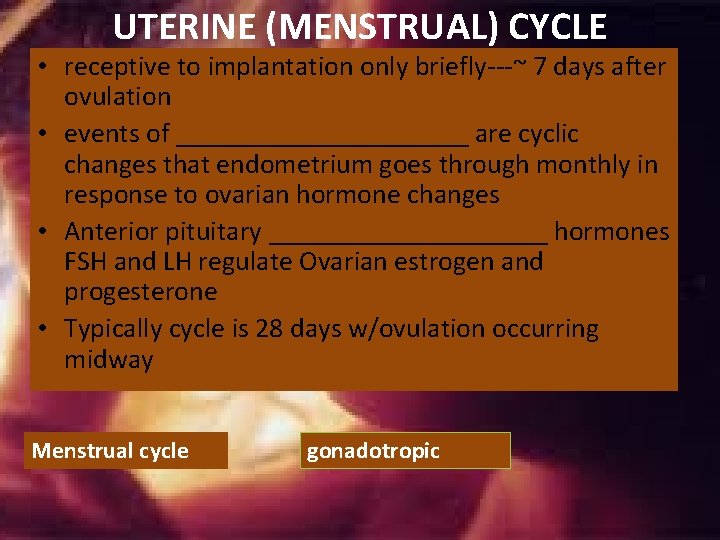
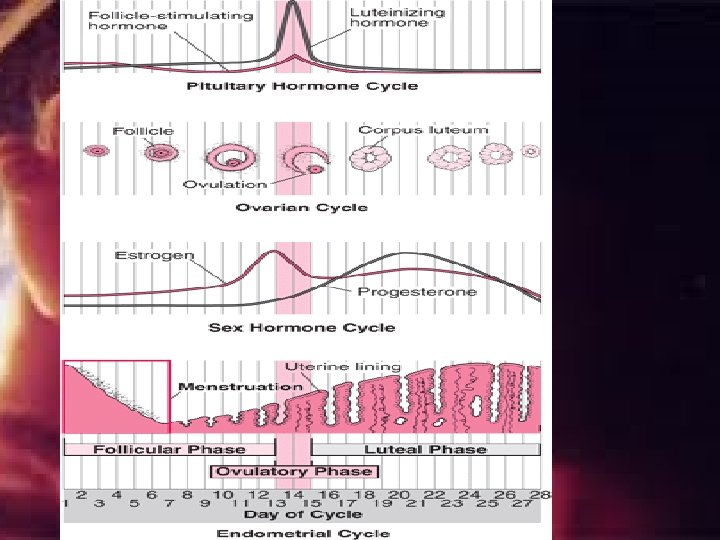
UTERINE (MENSTRUAL) CYCLE • receptive to implantation only briefly---~ 7 days after ovulation • events of ___________ are cyclic changes that endometrium goes through monthly in response to ovarian hormone changes • Anterior pituitary __________ hormones FSH and LH regulate Ovarian estrogen and progesterone • Typically cycle is 28 days w/ovulation occurring midway Menstrual cycle gonadotropic
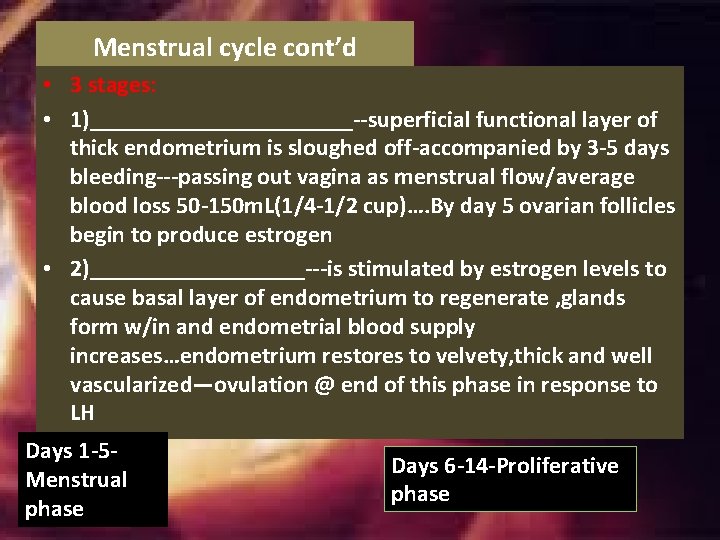
Menstrual cycle cont’d • 3 stages: • 1)___________--superficial functional layer of thick endometrium is sloughed off-accompanied by 3 -5 days bleeding---passing out vagina as menstrual flow/average blood loss 50 -150 m. L(1/4 -1/2 cup)…. By day 5 ovarian follicles begin to produce estrogen • 2)_________---is stimulated by estrogen levels to cause basal layer of endometrium to regenerate , glands form w/in and endometrial blood supply increases…endometrium restores to velvety, thick and well vascularized—ovulation @ end of this phase in response to LH Days 1 -5 Menstrual phase Days 6 -14 -Proliferative phase
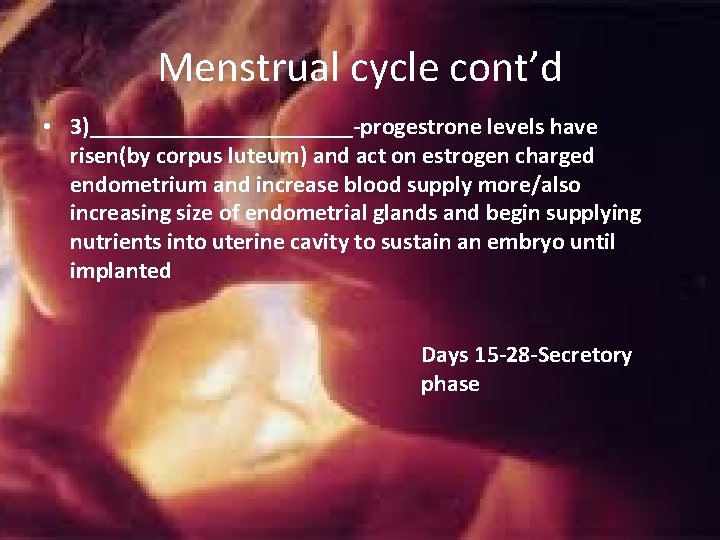
Menstrual cycle cont’d • 3)___________-progestrone levels have risen(by corpus luteum) and act on estrogen charged endometrium and increase blood supply more/also increasing size of endometrial glands and begin supplying nutrients into uterine cavity to sustain an embryo until implanted Days 15 -28 -Secretory phase
• If fertilization does occur, embryo produces hormone similar to LH-causes _______________ • If fertilization does NOT occur, c. luteum degenerates and LH levels drop…This causes vessels supplying endometrium to go into spasms and kink—causing endometrial cells-deprived of O 2 –to die …. setting stage for next menses • Cycle can vary from 21 -40 days , but time of ovulation is usually @ 14 -15 days Corpus luteum to cont. producing its hormones
HORMONE PRODUCTION BY OVARIES • Begin @ puberty • Follicle cells of growing follicles produce____________-causing the appearance of secondary sex characteristics : enlargement of fallopian tubes, vagina and external genitalia ; development of breasts ; axillary and pubic hair ; increased fat in hips and breasts and in general; Widening and lightening of pelvis; Onset of menses • Estrogen also has metabolic effects---ex-maintaing blood cholesterol(high HDL) and help Ca 2+ uptake estrogens
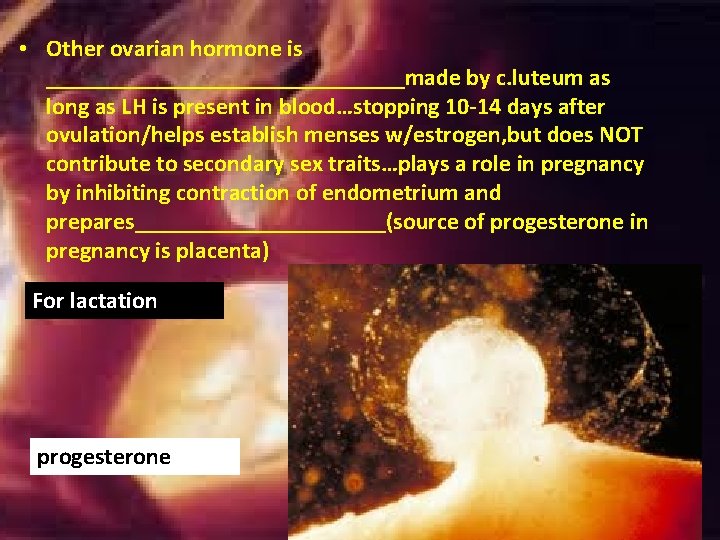
• Other ovarian hormone is _______________made by c. luteum as long as LH is present in blood…stopping 10 -14 days after ovulation/helps establish menses w/estrogen, but does NOT contribute to secondary sex traits…plays a role in pregnancy by inhibiting contraction of endometrium and prepares___________(source of progesterone in pregnancy is placenta) For lactation progesterone
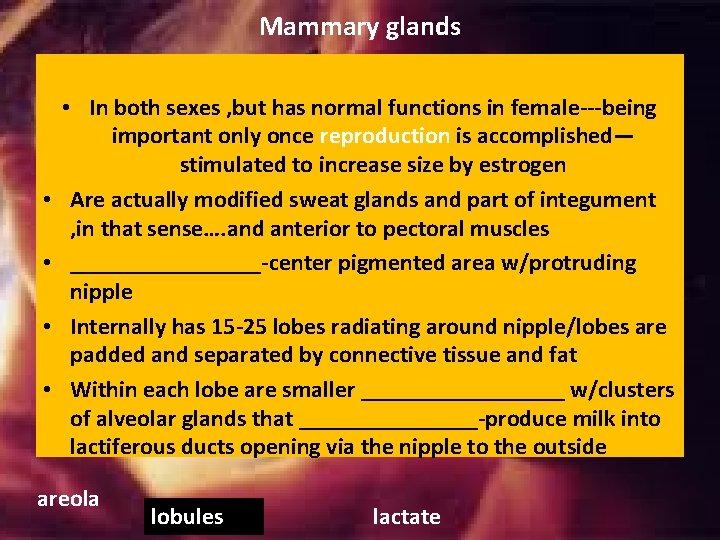
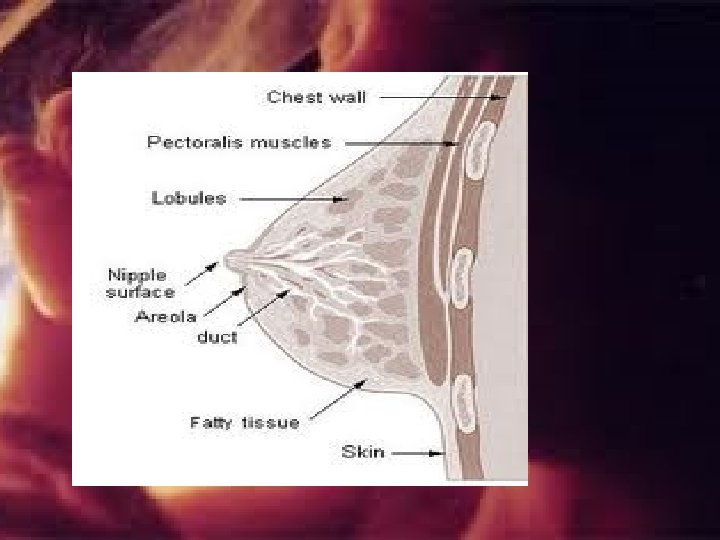
Mammary glands • • • In both sexes , but has normal functions in female---being important only once reproduction is accomplished— stimulated to increase size by estrogen Are actually modified sweat glands and part of integument , in that sense…. and anterior to pectoral muscles ________-center pigmented area w/protruding nipple Internally has 15 -25 lobes radiating around nipple/lobes are padded and separated by connective tissue and fat Within each lobe are smaller _________ w/clusters of alveolar glands that ________-produce milk into lactiferous ducts opening via the nipple to the outside areola lobules lactate
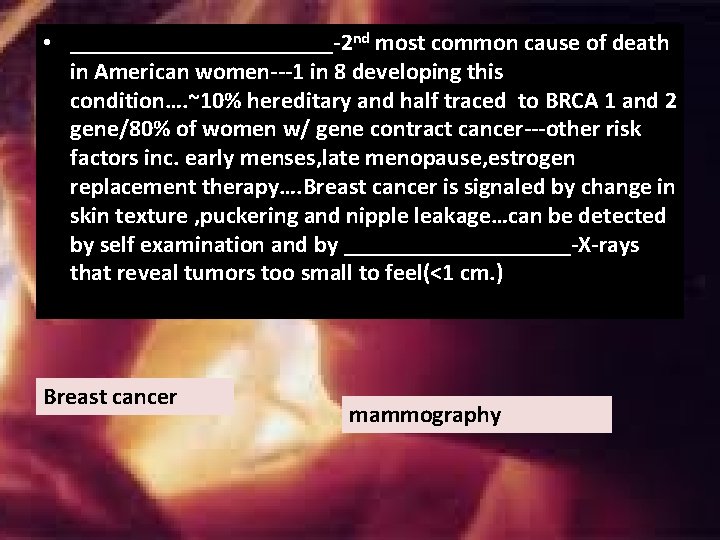
• ___________-2 nd most common cause of death in American women---1 in 8 developing this condition…. ~10% hereditary and half traced to BRCA 1 and 2 gene/80% of women w/ gene contract cancer---other risk factors inc. early menses, late menopause, estrogen replacement therapy…. Breast cancer is signaled by change in skin texture , puckering and nipple leakage…can be detected by self examination and by __________-X-rays that reveal tumors too small to feel(<1 cm. ) Breast cancer mammography
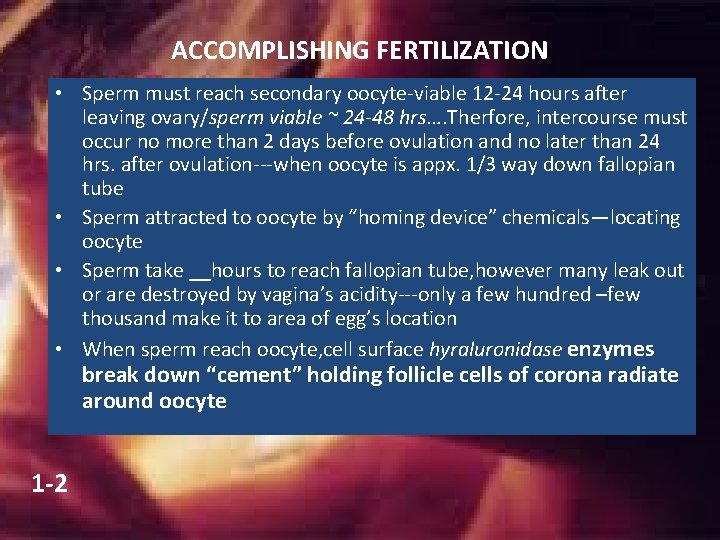
ACCOMPLISHING FERTILIZATION • Sperm must reach secondary oocyte-viable 12 -24 hours after leaving ovary/sperm viable ~ 24 -48 hrs…. Therfore, intercourse must occur no more than 2 days before ovulation and no later than 24 hrs. after ovulation---when oocyte is appx. 1/3 way down fallopian tube • Sperm attracted to oocyte by “homing device” chemicals—locating oocyte • Sperm take __hours to reach fallopian tube, however many leak out or are destroyed by vagina’s acidity---only a few hundred –few thousand make it to area of egg’s location • When sperm reach oocyte, cell surface hyraluronidase enzymes break down “cement” holding follicle cells of corona radiate around oocyte 1 -2
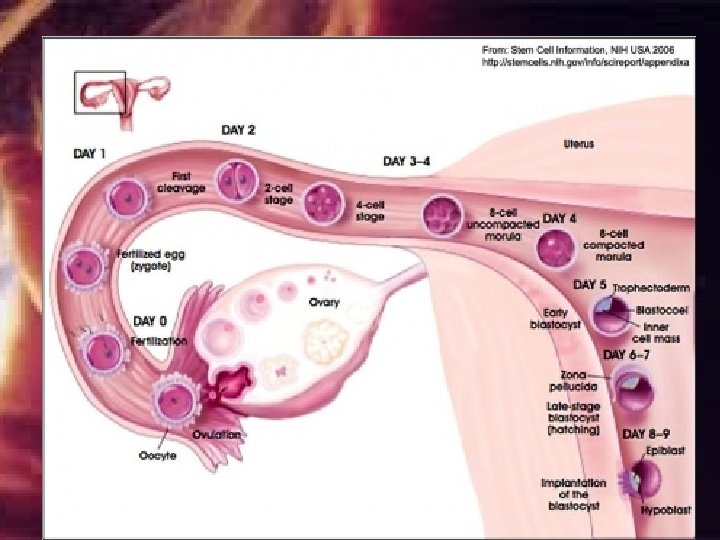
• Once path cleared through corona, 1000’s sperm undergo____________where acrosome membrane break down-releasing enzymes to lyse through oocyte membrane…. then a single sperm can make contact w/oocyte membrane receptors---pulling head(nucleus) of sperm pulled into oocyte cytoplasm…. ****sperm reaching this point after acrosomal reactions have started are the more likely to fertilize • After a sperm has reached oocyte, 2 nd meiosis occurs--making ovum and polar body • Changes in fertilized egg preventing other sperm entry • _________occurs @ moment genetic material of sperm combines w/ that of ovum to make________-fertilized egg Acrosomal reaction zygote fertilization
EVENTS OF EMBRYONIC AND FETAL DEVELOPMENT • Rapid MITOTIC division as zygote goes down fallopian tube-________, w/daughter cells becoming smaller and smaller—large # of cells will be building block of embryo-until 9 th week • By time embryo reaches uterus(3 days after ovulation)=_________-ball of 16 cells looking like a raspberry …Since uterus not totally prepared for embryo yet, embryo floats in uterine cavity---using uterine secretions for nutreints @ this time--Unattached, continues to develop to ~ 100 cells---It then hallows out to form_____or chorionic vesicle morula cleavage blastocyst
• @ this same time , it is secreting a hormone called___________(h. CG)-this prods c. luteum of ovary continue hormone production(otherwise, endometrium would shed) • Pregnancy tests usually detect_______levels • Blastocyst also has _________-forming large fluidfilled sphere and also an inner cell mass-small cell cluster to one side • By day 7 after ovulation, blastocyst attahes to endometrium, eroding away some of lining and envelops into thick mucosa Human chorionic gonadotropin hcg trophoblast
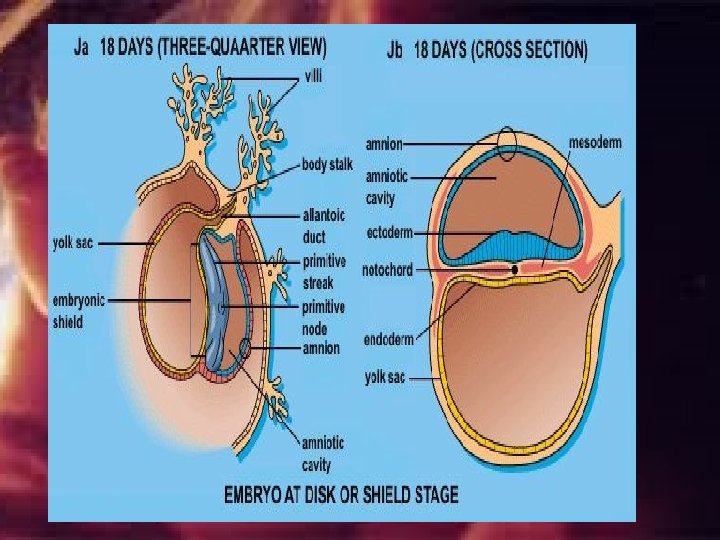
• During this time the primary germ layers are forming from inner mass: • ___________gives rise to nervous system and epidermis • ___________forms mucosa and associated glands • _____________gives rises to basically everything else ectoderm endoderm mesoderm
• By day 14 after ovulation, implantation is complete and mucosa grown over embryo…The _______of the blastocyst develops projections called chorionic villi, combining w/uterus to produce _____________ trohoblast placenta
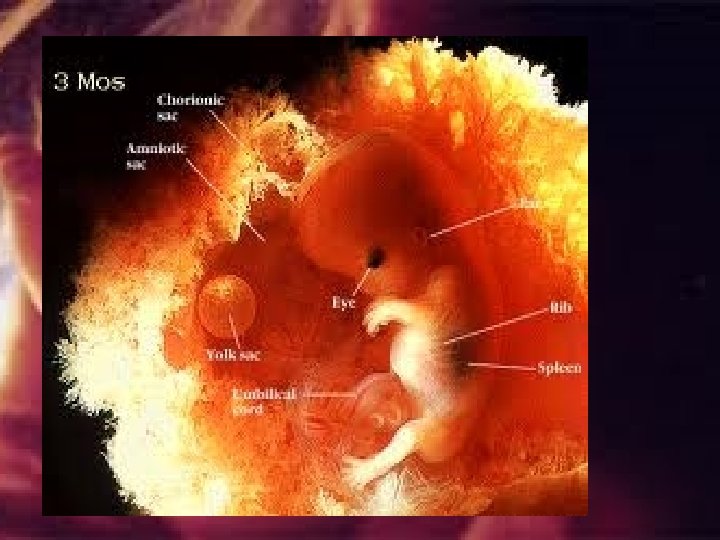
• Once placenta has formed, embryonic body is surrounded by_______________-fluid –filled sac and attaches w/blood vessel stalk___________________ • By 3 rd week, placenta delivers nutrients and O 2 to and removes wastes from embryonic blood---all through ______________ • By end of 2 nd month, placeta becomes endocrine organ producing estrogen, progesterone, and other hormones to maintain pregnancy…c. luteum becomes inactive amnion Umbilical cord Placental barrier
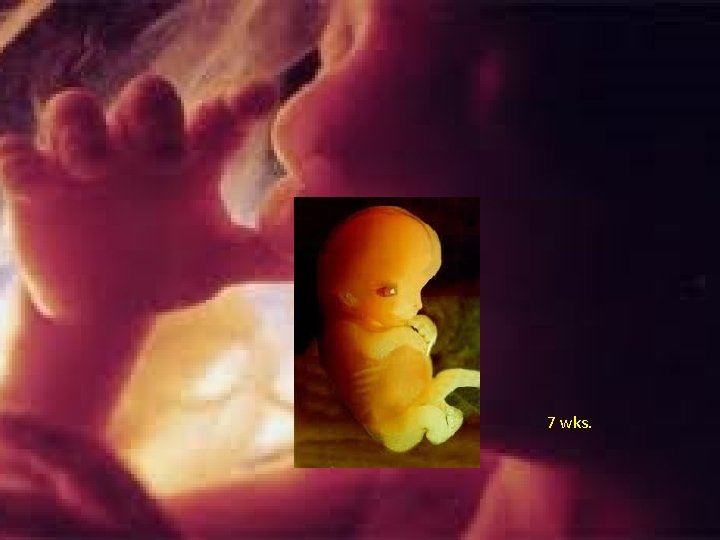
• By week 8 --all organ systems laid down in some form and looks human • Week 9—Now called_____-now growth and organ specialization are major activities • As fetus, grows from ~ 3 cm. and 1 g to 36 cm(14”), ~4 kg(6 -10 lbs. )…at birth ~ 22” • 270 days-10 th lunar month-full term fetus
7 wks.
EFFECTS OF PREGNANCY ON MOTHER • ______________-period from conception to birth • Anatomical changes • Uterus goes from fist sized to eventually nearing level of xiphoid processthorax widens as organs press on diaphragm • Center of gravity changes sometimes causing lordosois---thus backaches • Placental hormone__________causes pelvic ligaments and pubic symphsis to relax, widen and become more flexible • Good nutrition necessary—needing only about 300 calories extra/day • Substances that can cross placental barriers are alcohol, nicotine, many drugs and maternal infections • _________ termination of pregnancy by loss of fetus--spontaneous abortion is a miscarriage pregnancy relaxin abortion
• Physiological Changes • GI system-morning sickness usually first trimester, as mother adjusts to elevated estrogens; heartburn because of displaced esophagus and displaced stomach; constipation –because GI motility decreased • Urinary system-kidneys now need to dispose of fetal metabolic wastes, producing MORE urine; also uterus compresses bladder---frequent urination-Ie. stress incontinence • Respiratory System-nasal mucosa responds to estrogen by swelling and congested, maybe nosebleeds ; respiratory rate increases but residual volume declines causing________-difficult breathing in later stages • Cardiovascular system-Total body water rises and blood volume increases 25 -40%---helping in safeguarding from blood loss effects during labor; BP and pulse increase and raise cardiac output 20 -40%; venous return from lower limbs may be impaired---maybe causing varicose veins dyspnea
parturition CHILDBIRTH=____________ • Usually w/in 15 days of calculated due date (280 days from last menstrual period) • _________-series of events that expel infant from uterus • Initiation of labor • Estrogen has reached highest levels causing myometrium to form much ________receptors-to be receptive to that hormone • AND interfering with progesterone’s quieting influence on uterine muscle—causing weak uterine contractions---called _________contractions—often producing false labor oxytocin Braxton-Hicks contractions
• Then , cells of fetus produce oxytocin and this stimulates placenta to release ____________stimulating more frequent and powerful contractions • Mom’s hypothalamus activated by emotional and physical stress---signals oxytocin release by posterior pituitary gland --rhythmic , expulsive contractions-TRUE LABOR…positive feedback mechanism now w/hypothalamus, strengthening contractions • Anything that interferes w/oxytocin or proglastins can hinder onset of labor…. example--antiproglastin drugs such as aspirin and ibuprofen proglastins
Stages of Labor • 1 st-_______________from time of true contractions until full-10 cm-dilation of cervix…. contractions move from upper uterus to vagina, becoming more vigorous and softening cervix and thinning…. amnion ruptures-“water –breaking”----usually 6 -12 hours or MORE!!! Dilation stage
• 2 nd-Expulsion stage-full dilation to delivery…urge increases to push 20 min -50 min. ---sometimes 2 hrs • Infant should be head first-Vertex position-skull as a wedge to dilate cervix…after head, rest of body comes out more easily…umbilical cord clamped off • ________-buttocks-first • _________-during a difficult 2 nd stage, O 2 delivery inadequate leading to cerebral palsy or epilepsy…. often a Csection done to prevent these • 3 rd-__________-w/in 15 min. placenta usually expelled---placenta and other fetal membranes constitute __________ breech dystocia Placental stage afterbirth
DEVELOPMENTAL ASPECTS • Gonads from 8 th week and then accessory structures and external genitalia…. all depends on presence or absence of testosterone • If genetic male fails to produce testosterone-female accessory structures form and external genitalia… • --If genetic female exposed to testosterone-male accessory ducts and glands as well as penis and scrotum…. both cases are pseudohermaphrodites----a true hermaphrodite (now referred to as intersexual)possesses ovaries and testes-rare case • XO female appears normal but lacks ovaries/YO males perish • _________narrowing of foreskin of penis and misplaced urethral openings • ____________-failure of full descent of testes phimosis cryptorchidism
• ________=period ~11 -13 ---taking another 2 years for dependable ovulation • Most common problem in females are infection-sometimes caused by STD’s • Male inflammatory conditions include ____________, maybe following STD transmission • _______-inflammation of testes…. maybe following STD or mumps • Neoplasms a danger in both genders orchiditis • Women reach peak reproductive abilities @ late 20’s, estrogen declines eventually producing________-producing a ceasing of menses —irritability and mood changes can accompany • Dangers can accompany HRT • Its all downhill…! Urethritis, prostatitis, epi • Puberty @ 10 -15 yrs. didymitis puberty menopause