
The Representation Of Female Characters In T V
- Slides: 14
The Representation Of Female Characters In T. V and Film
T. V Drama In this presentation I am going to analyze the, physical appearance, family life, professional life of how the media portrays female characters in TV dramas. In T. V dramas women are always related to words such as emotional, prudent, gentle, submissive, sensitive, etc. ; men are usually pictured as rational, impulsive, ruthless, independent, aggressive, etc.
Professional Life Female characters professional lives are usually ignored, or more often, they are portrayed as housewives who takes care of children and family chores everyday, but not ambitious at all in building a career. Even if women do work, they are often shown on TV in traditional feminine jobs such as teachers, secretaries and nurses, which kind of professions all require patience, carefulness, warm-heartedness. For the relatively small amount of women who try to further their professional lives, Example: Samantha from East. Enders left her husband to pursue a career in modelling, but was unsuccessful. Family Life In terms of the importance of family life, most female characters in TV dramas are set in domestic situation. Their ultimate life achievement is supposed to be getting married and giving birth to children, is that she is expected to stay at home and look after her children while her husband/boyfriend, is out doing work. Woman are shown physically weaker and more vulnerable than men. Example: in the T. V show, Misfits, she follows the rules of the stereotype, because Louise Young a mother who kicks out her son Nathan out of her boyfriends home, for not liking her boyfriend, similar to the stereotypical female character as she always put her lover first.
Physical Appearance To be specific, the representation of women’s body imaged has long been static. A young single woman tend to conform to the typical tall, slim, beautiful girl with a friendly and happy personality, without much intelligence. Having a nice figure is necessary for measuring a woman’s worth in the show. Research shows that over-weighted actresses tend to receive negative comments from other male characters about their bodies, and “ 80% of these comments are followed by canned audience laughter Interpersonal Relationships Women become the dominant gender without question, such as coping with the relationship with neighbors or soothing and comforting family members, there also negative comments on the way women taking advantage of their sexuality or pregnancy to gain power or achieve certain things from men, being portrayed as evil-minded. In general, women tend to shown as relying on their parents, boyfriends or husbands and their other female friends, because women are stereotyped as not being able to solve personal problem by themselves.
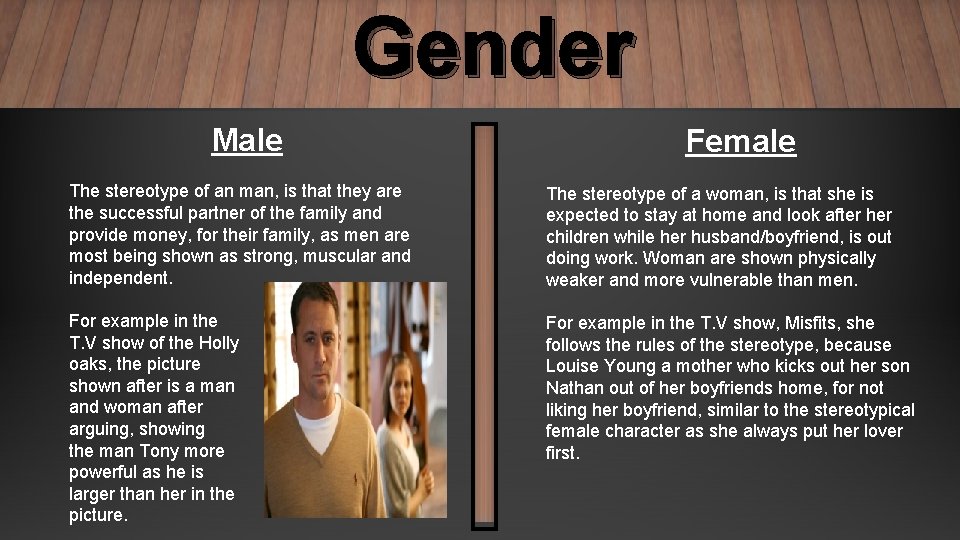
Gender Male Female The stereotype of an man, is that they are the successful partner of the family and provide money, for their family, as men are most being shown as strong, muscular and independent. The stereotype of a woman, is that she is expected to stay at home and look after her children while her husband/boyfriend, is out doing work. Woman are shown physically weaker and more vulnerable than men. For example in the T. V show of the Holly oaks, the picture shown after is a man and woman after arguing, showing the man Tony more powerful as he is larger than her in the picture. For example in the T. V show, Misfits, she follows the rules of the stereotype, because Louise Young a mother who kicks out her son Nathan out of her boyfriends home, for not liking her boyfriend, similar to the stereotypical female character as she always put her lover first.
Television Woman make up 50% percent of the population, only 57% of movies featured at least one female in a co-starring role, only 18% featured more than one woman in a co-starring role and only 32% featured a woman in a starring role, and when woman an presented, woman being portrayed as sexual representations, stereotypes of being vulnerable and as objects, implying that this is how woman are treated or should be treated, still today woman are portrayed as sex objects and still is not enough change, to say that woman are being treated as equals to men, not only are actresses being paid less, they also are degraded in movies but the representation of woman particularly in action films has changed overtime as woman are seen to be taken bigger role in movies, for example Wonder Woman, now in this movie Wonder Woman shows independence, power and courage however the target audience is mostly male as in the film she wears sexy clothes is more seen as a sex symbol despite the strength she has as a woman.
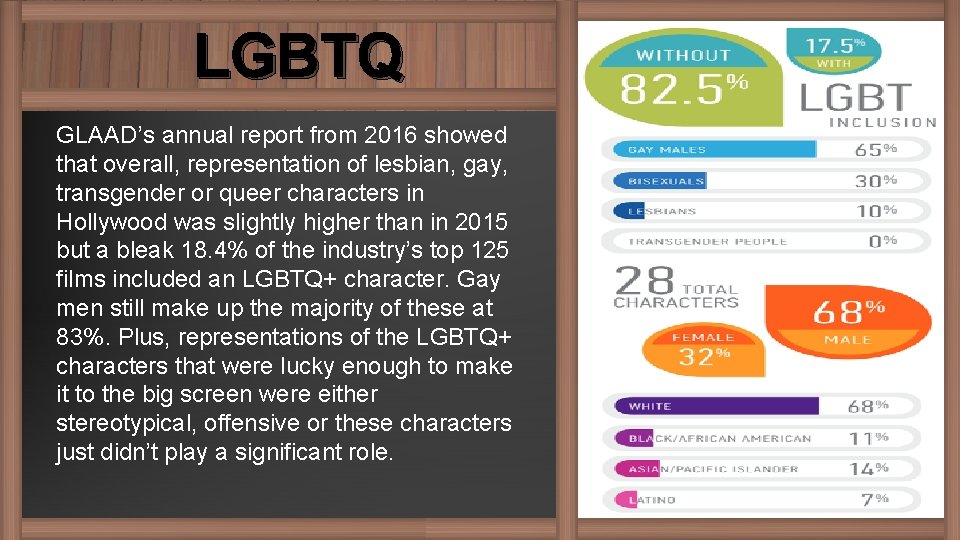
LGBTQ GLAAD’s annual report from 2016 showed that overall, representation of lesbian, gay, transgender or queer characters in Hollywood was slightly higher than in 2015 but a bleak 18. 4% of the industry’s top 125 films included an LGBTQ+ character. Gay men still make up the majority of these at 83%. Plus, representations of the LGBTQ+ characters that were lucky enough to make it to the big screen were either stereotypical, offensive or these characters just didn’t play a significant role.
Audience Demographics
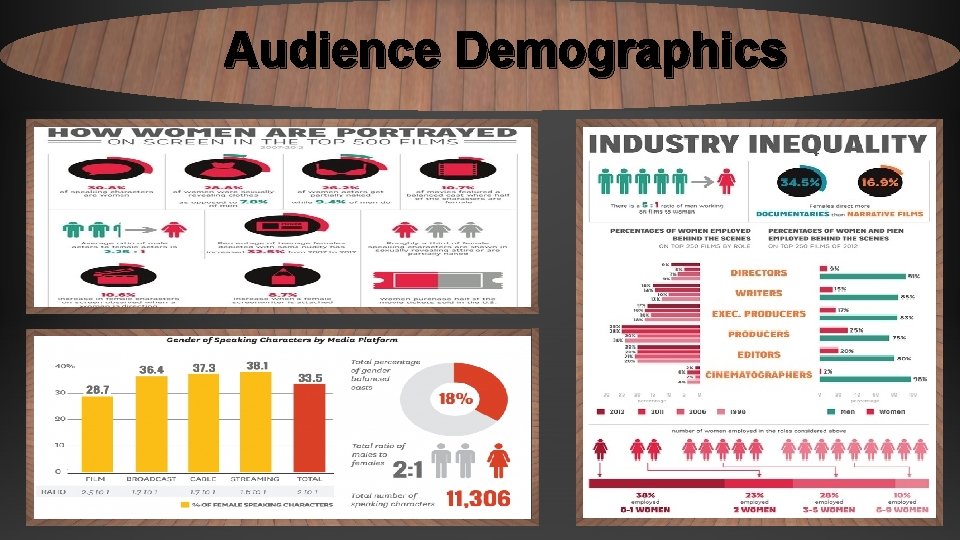
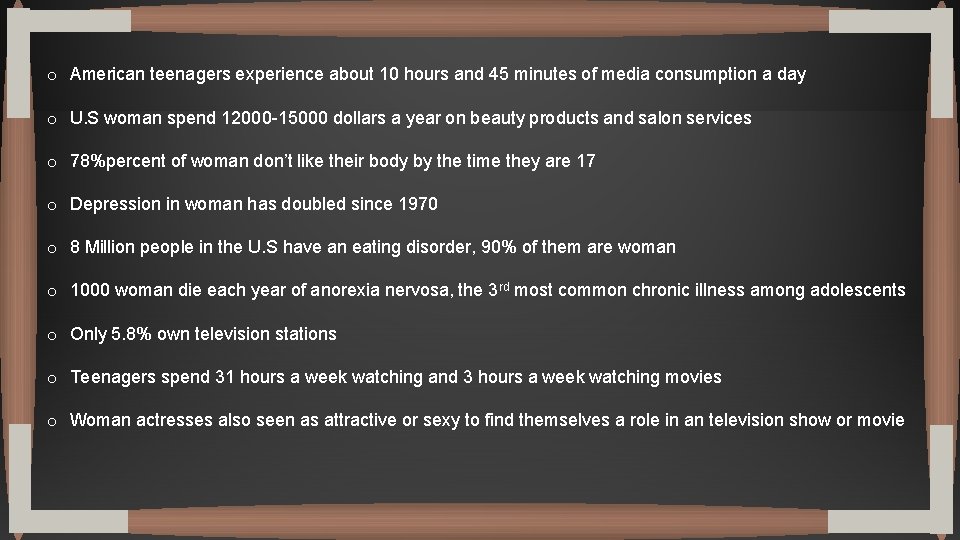
o American teenagers experience about 10 hours and 45 minutes of media consumption a day o U. S woman spend 12000 -15000 dollars a year on beauty products and salon services o 78%percent of woman don’t like their body by the time they are 17 o Depression in woman has doubled since 1970 o 8 Million people in the U. S have an eating disorder, 90% of them are woman o 1000 woman die each year of anorexia nervosa, the 3 rd most common chronic illness among adolescents o Only 5. 8% own television stations o Teenagers spend 31 hours a week watching and 3 hours a week watching movies o Woman actresses also seen as attractive or sexy to find themselves a role in an television show or movie
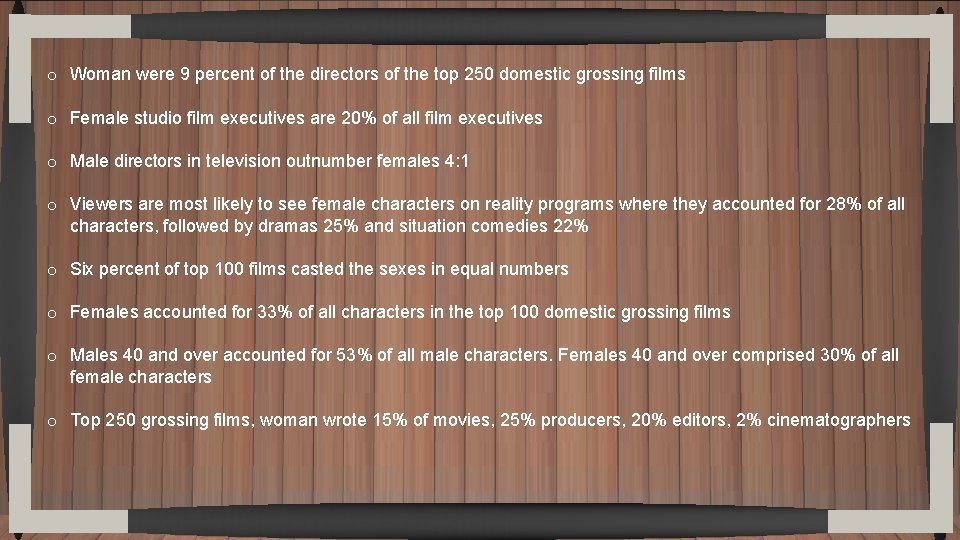
o Woman were 9 percent of the directors of the top 250 domestic grossing films o Female studio film executives are 20% of all film executives o Male directors in television outnumber females 4: 1 o Viewers are most likely to see female characters on reality programs where they accounted for 28% of all characters, followed by dramas 25% and situation comedies 22% o Six percent of top 100 films casted the sexes in equal numbers o Females accounted for 33% of all characters in the top 100 domestic grossing films o Males 40 and over accounted for 53% of all male characters. Females 40 and over comprised 30% of all female characters o Top 250 grossing films, woman wrote 15% of movies, 25% producers, 20% editors, 2% cinematographers
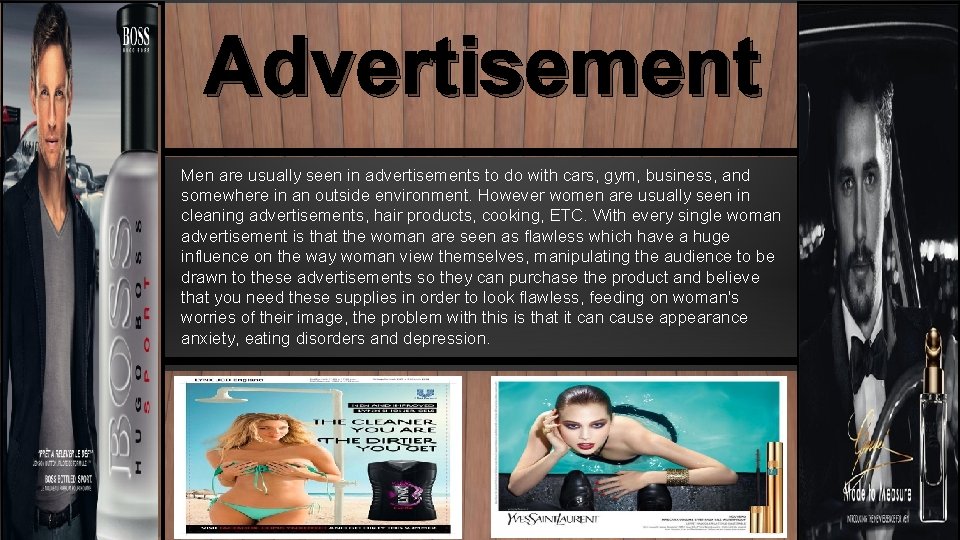
Advertisements Men are usually seen in advertisements to do with cars, gym, business, and somewhere in an outside environment. However women are usually seen in cleaning advertisements, hair products, cooking, ETC. With every single woman advertisement is that the woman are seen as flawless which have a huge influence on the way woman view themselves, manipulating the audience to be drawn to these advertisements so they can purchase the product and believe that you need these supplies in order to look flawless, feeding on woman's worries of their image, the problem with this is that it can cause appearance anxiety, eating disorders and depression.
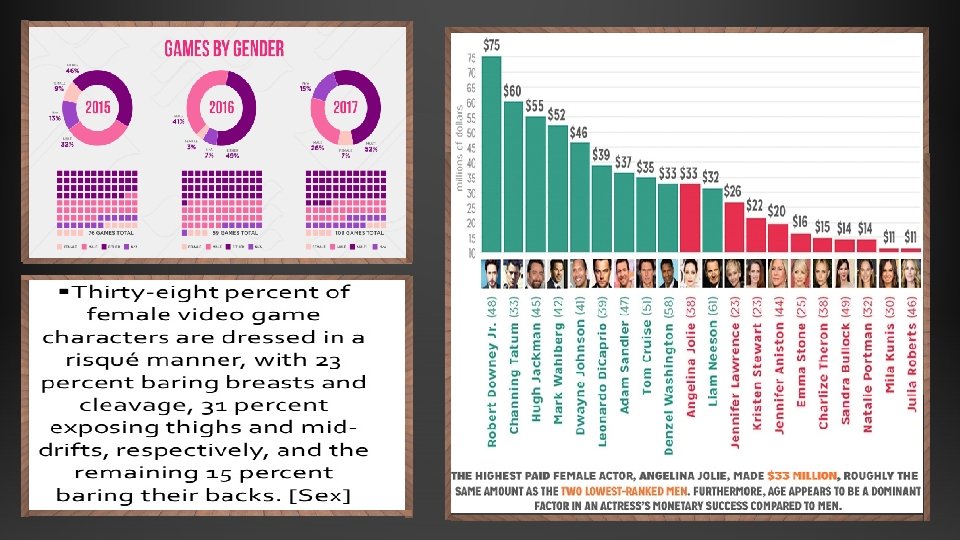
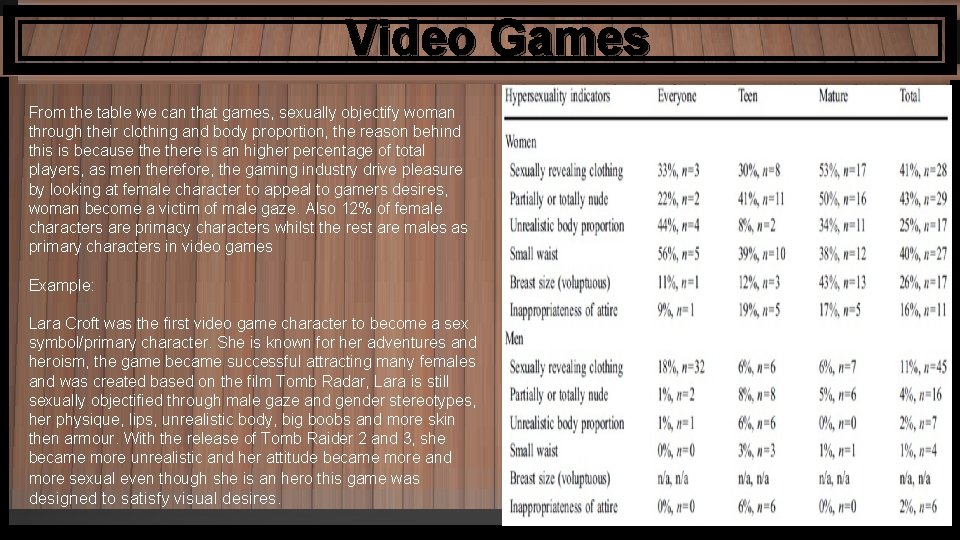
Video Games From the table we can that games, sexually objectify woman through their clothing and body proportion, the reason behind this is because there is an higher percentage of total players, as men therefore, the gaming industry drive pleasure by looking at female character to appeal to gamers desires, woman become a victim of male gaze. Also 12% of female characters are primacy characters whilst the rest are males as primary characters in video games Example: Lara Croft was the first video game character to become a sex symbol/primary character. She is known for her adventures and heroism, the game became successful attracting many females and was created based on the film Tomb Radar, Lara is still sexually objectified through male gaze and gender stereotypes, her physique, lips, unrealistic body, big boobs and more skin then armour. With the release of Tomb Raider 2 and 3, she became more unrealistic and her attitude became more and more sexual even though she is an hero this game was designed to satisfy visual desires.
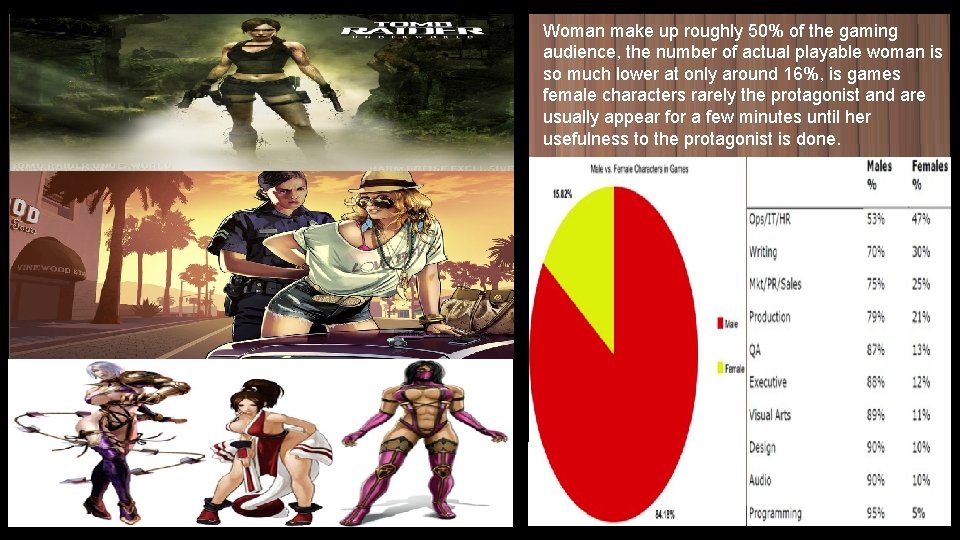
Woman make up roughly 50% of the gaming audience, the number of actual playable woman is so much lower at only around 16%, is games female characters rarely the protagonist and are usually appear for a few minutes until her usefulness to the protagonist is done.