
The Renewed National Core Curriculum of Basic Education
The Renewed National Core Curriculum of Basic Education Health Education and Oral Health as a part of Health Education in Basic Education Curriculum SHE Summer School 2015 Professor Kerttu Tossavainen Postdoctoral researcher Marjorita Sormunen Ph. D student Hanna Miettinen MSc student Mira Ulmanen UEF // University of Eastern Finland

1. National Core Curriculum of Basic Education (2014) 2. Health Education in Basic Education Curriculum (2014) 3. Case: Oral Health as a part of Health Education in Basic Education Curriculum (2014) UEF // University of Eastern Finland
“The core curriculum has a dual role: on one hand it is an administrative steering document, on the other a tool for teachers to develop their own pedagogical praxis”. UEF // University of Eastern Finland
National Core Curriculum of Basic Education (2014) The national core curriculum for basic education is being renewed. The process involves all stakeholders, particularly education providers and education personnel. The aim is to encourage also parents and pupils to participate in the process. New local curricula that is based on core curriculum should be prepared and ready by the beginning of school year 2016– 2017. UEF // University of Eastern Finland 25. 10. 2020 4

Background of basic education curriculum • The Government decides on the overall time allocation by defining the minimum number of lessons for core subjects during basic education • The national core curriculum is determined by the Finnish National Board of Education • The local education authorities and the schools themselves (=the education providers) draw up their own curricula within the framework of the national core curriculum UEF // University of Eastern Finland Source: Finnish National Board of Education 2015 25. 10. 2020 5
Laws and regulations concerning basic education curriculum Basic education is governed by: • Constitution of Finland 731/1999 • Basic Education Act (628/1998) • Child Welfare Act (417/2007) • The Act on Pupil and Student Welfare (1287/2013) • Basic Education Decree (852/1998) • Government Decree on the General National Objectives and Distribution of Lesson Hours in Basic Education (1435/2001) • UN: Universal Declaration of Human Rights 1948 UEF // University of Eastern Finland Source: Finnish National Board of Education 2015
And what about the renewal process? • The renewed core curriculum was completed by the end of 2014. • The entire general education system is due for reform in terms of objectives, lesson hour distribution, the National Core Curricula and local curricula. • The preparation was carried out in working groups* that focused on: q Structure q Objectives q Conceptions of learning q Support for learning q The different subjects taught in basic education UEF // University of Eastern Finland * Each working group consists of educational officials, researchers and teachers **Parents and pupils’ have also been involved as stakeholders in the process Source: Finnish National Board of Education 2015
WHY? WHAT? HOW? • WHY? The world in which schools operate has undergone major changes since the beginning of the 2000 s, increasing the impact of globalization and the challenges for a sustainable future • WHAT? Competencies needed in society and working life have changed, requiring skills for building a sustainable future • HOW? Content of teaching, pedagogy and school practices should be reviewed and renewed in relation to the changes in the operating environment and skills UEF // University of Eastern Finland Source: Finnish National Board of Education 2015

The Content of National Core Curriculum of Basic Education (2014) UEF // University of Eastern Finland 25. 10. 2020 9
National core curriculum of basic education All schools follow a national core curriculum, which includes ØObjectives of different subjects ØCore contents of different subjects ØPrinciples of pupil assessment ØSpecial-needs education ØPupil welfare guidance ØEducational guidance • Also the principles of a good learning environment, working approaches as well as the concept of learning are addressed in the core curriculum. UEF // University of Eastern Finland Source: Finnish National Board of Education 2015 25. 10. 2020 10

National core curriculum of basic education The (curriculum) publication is divided into fifteen (15) chapters Chapter 1: The significance and formation of the local curriculum Chapter 2: Basic education as the basis of common knowledge Chapter 3: The mission and general objectives of basic education Chapter 4: The operating culture of an integrated basic education Chapter 5: Organizing a learning and well-being promoting schoolwork Chapter 6: The evaluation of learning Chapter 7: The support of learning and studying Chapter 8: Student service Chapter 9: Questions concerning the language and culture UEF // University of Eastern Finland Source: Finnish National Board of Education 2015 25. 10. 2020 11
National core curriculum of basic education The (curriculum) publication is divided into fifteen (15) chapters: Chapter 10: Bilingual teaching Chapter 11: Basic education based on particular worldview or education teaching system Chapter 12: Optional courses in basic education Chapter 13: Grades 1 -2 (teaching subjects) Chapter 14: Grades 3 -5 (teaching subjects) Chapter 15: Grades 7 -9 (teaching subjects) + Appendices UEF // University of Eastern Finland Source: Finnish National Board of Education 2015 25. 10. 2020 12
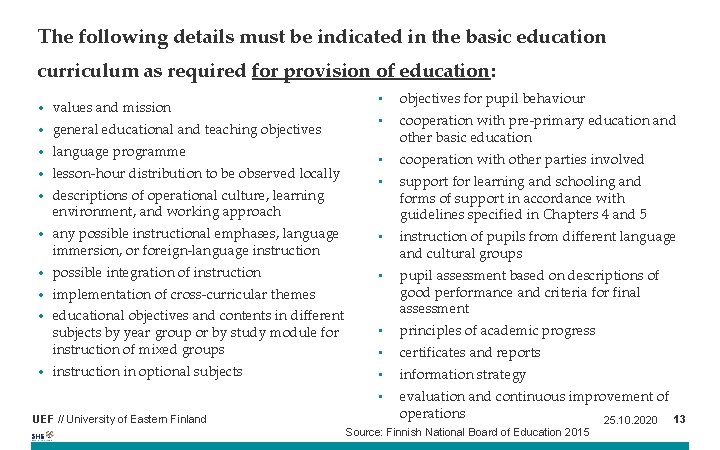
The following details must be indicated in the basic education curriculum as required for provision of education: • objectives for pupil behaviour • cooperation with pre-primary education and other basic education • cooperation with other parties involved • • any possible instructional emphases, language immersion, or foreign-language instruction support for learning and schooling and forms of support in accordance with guidelines specified in Chapters 4 and 5 • • possible integration of instruction of pupils from different language and cultural groups • • educational objectives and contents in different subjects by year group or by study module for instruction of mixed groups pupil assessment based on descriptions of good performance and criteria for final assessment • principles of academic progress • • instruction in optional subjects certificates and reports • information strategy • evaluation and continuous improvement of operations 25. 10. 2020 13 • values and mission • general educational and teaching objectives • language programme • lesson-hour distribution to be observed locally • descriptions of operational culture, learning environment, and working approach • implementation of cross-curricular themes UEF // University of Eastern Finland Source: Finnish National Board of Education 2015
Health Education in Basic Education Curriculum (2014) UEF // University of Eastern Finland 25. 10. 2020 14
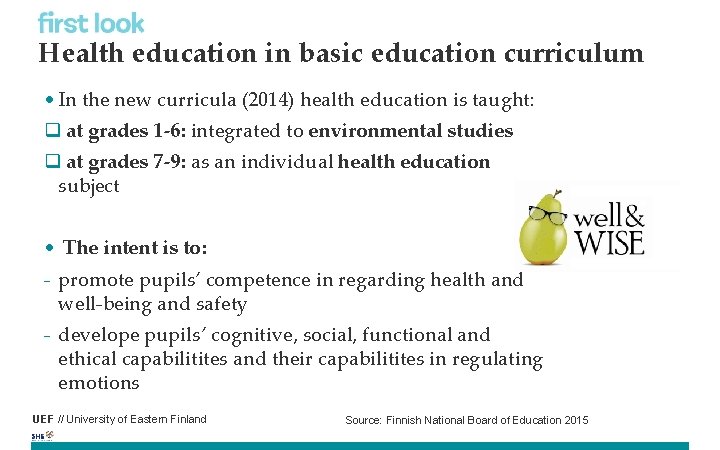
Health education in basic education curriculum • In the new curricula (2014) health education is taught: q at grades 1 -6: integrated to environmental studies q at grades 7 -9: as an individual health education subject • The intent is to: - promote pupils’ competence in regarding health and well-being and safety - develope pupils’ cognitive, social, functional and ethical capabilitites and their capabilitites in regulating emotions UEF // University of Eastern Finland Source: Finnish National Board of Education 2015
Health education in basic education curriculum • Objectives 1/2 : - Learn to recognize the identifying features of the individual’s growth, development, and life span, and will gain an understanding of the physical, psychological, and social development that takes place during youth - Come to understand the importance of human well-being of community, human relations, and caring for one another - Come to understand themselves and human diversity, as well as values and viewpoints related to health, disability and disease - Learn to describe and evaluate the main factors that promote health or cause diseases and to identify and weigh choices related to health UEF // University of Eastern Finland Source: Finnish National Board of Education 2015 25. 10. 2020 16
Health education in basic education curriculum • Objectives 2/2: - Take care of themselves and their environment, recognize the need for prevention and support, and act appropriately in situations relevant to health, disease and safety - Recognize, understand, and develope coping skills important to health and well-being - Asses the importance of the environment: one’s way of life, culture, and the media from the perspective of safety and health - Utilize concepts and information acquisition methods relevant to health and disease, and benefit from them in promoting health - Understand the significance of rules, agreements and trust UEF // University of Eastern Finland Source: Finnish National Board of Education 2015
Health education in basic education curriculum • Health education core contents at grades 1 -2 - Growth and development - Operating at school and at home - Vicinity and observation of changes - Exploring and experimenting - Consideration of the basic conditions of life - Exercising sustainable lifestyle UEF // University of Eastern Finland Source: Finnish National Board of Education 2015
Health education in basic education curriculum • Health education core contents at grades 3 -6 - Me as a person - Coping in everyday life situations and being a part of the community - Discovery trip to the diversity of world - Exploring the environment - Natural concepts, principles and cycles - Building a sustainable future UEF // University of Eastern Finland Source: Finnish National Board of Education 2015
Health education in basic education curriculum • Health education core contents at grades 7 -9 - Supporting healthy growth and development - Health supporting and consuming factors and prevention of diseases - Health , communities, society, and culture UEF // University of Eastern Finland Source: Finnish National Board of Education 2015
Case: Oral Health as a part of Health Education in Basic Education Curriculum (2014) (Includes preliminary study findings from MSc (Health Sciences) student Mira Ulmanen’s master thesis 2015) UEF // University of Eastern Finland 25. 10. 2020 21
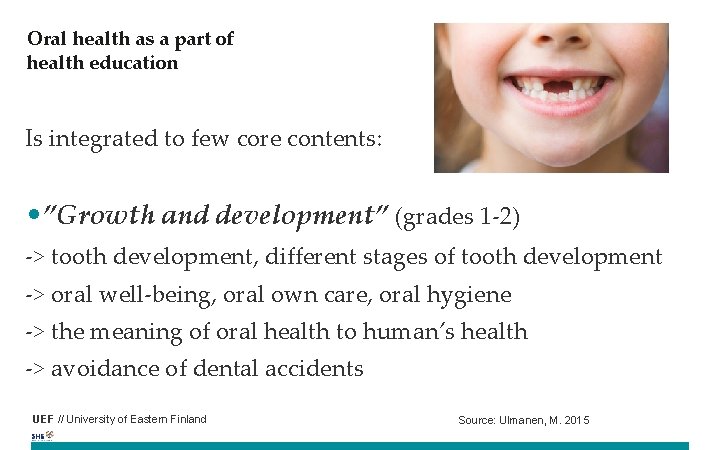
Oral health as a part of health education Is integrated to few core contents: • ”Growth and development” (grades 1 -2) -> tooth development, different stages of tooth development -> oral well-being, oral own care, oral hygiene -> the meaning of oral health to human’s health -> avoidance of dental accidents UEF // University of Eastern Finland Source: Ulmanen, M. 2015
Oral health as a part of health education • ”Operating at school and at home” (grades 1 -2) -> meaning of healthy nutrition and meal rhytm to oral health -> meaning of using milk products to oral health -> meaning of sugar (or unhealthy foods) to oral health -> recognizing factors related to the risks in oral health (unhealthy nutrition, tobacco, intoxicants) UEF // University of Eastern Finland Source: Ulmanen, M. 2015
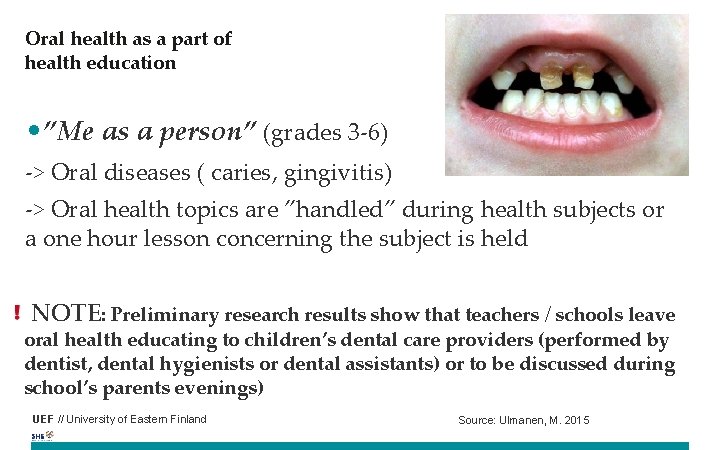
Oral health as a part of health education • ”Me as a person” (grades 3 -6) -> Oral diseases ( caries, gingivitis) -> Oral health topics are ”handled” during health subjects or a one hour lesson concerning the subject is held NOTE: Preliminary research results show that teachers / schools leave oral health educating to children’s dental care providers (performed by dentist, dental hygienists or dental assistants) or to be discussed during school’s parents evenings) UEF // University of Eastern Finland Source: Ulmanen, M. 2015
An example How to help schools in educating oral health? Project AHIC (2013 -2014) UEF // University of Eastern Finland 25. 10. 2020 25
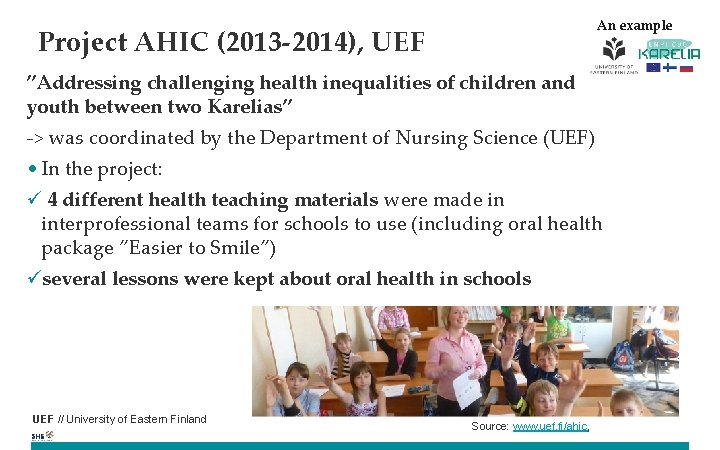
An example Project AHIC (2013 -2014), UEF ”Addressing challenging health inequalities of children and youth between two Karelias” -> was coordinated by the Department of Nursing Science (UEF) • In the project: ü 4 different health teaching materials were made in interprofessional teams for schools to use (including oral health package ”Easier to Smile”) üseveral lessons were kept about oral health in schools UEF // University of Eastern Finland Source: www. uef. fi/ahic,
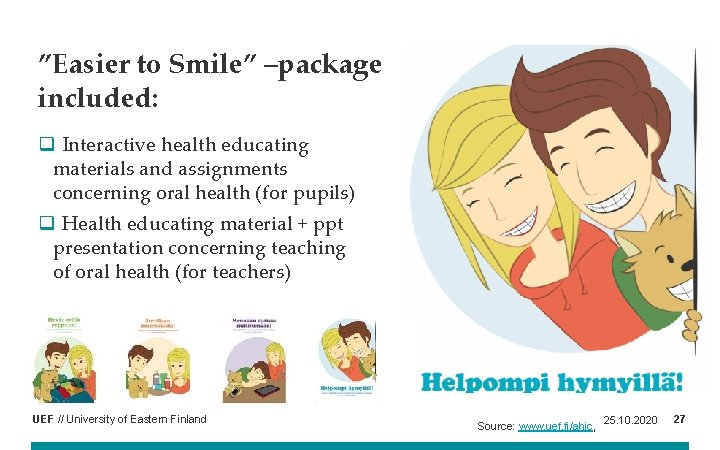
”Easier to Smile” –package included: q Interactive health educating materials and assignments concerning oral health (for pupils) q Health educating material + ppt presentation concerning teaching of oral health (for teachers) UEF // University of Eastern Finland Source: www. uef. fi/ahic, 25. 10. 2020 27
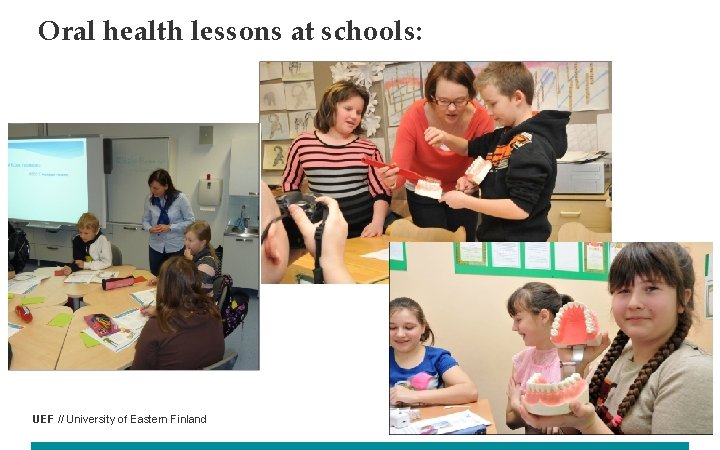
Oral health lessons at schools: UEF // University of Eastern Finland
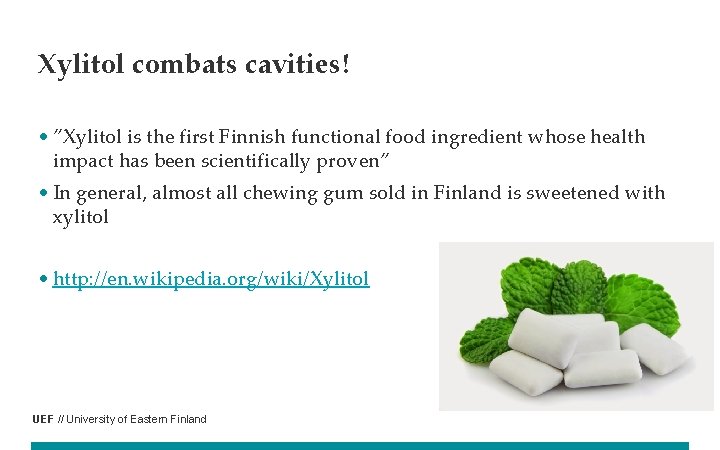
Xylitol combats cavities! • ”Xylitol is the first Finnish functional food ingredient whose health impact has been scientifically proven” • In general, almost all chewing gum sold in Finland is sweetened with xylitol • http: //en. wikipedia. org/wiki/Xylitol UEF // University of Eastern Finland
Sources • AHIC. 2015. Addressing Challenging Health Inequalities of Children and Yout between two Karelias. University of Eastern Finland. Retrieved: www. uef. fi/ahic • Finnish National Board of Education. 2015. Retrieved: http: //www. oph. fi/english/curricula_and_qualifications • Miettinen H, Ulmanen M, Holopainen T, Stigell E. 2015. Promoting childrens’ and adolescents’ oral health in Finland in Russia. The Finnish Dental Hygienist (Suomen Suuhygienistiliiton jäsenlehti) 2, 48 -52. • Ministry of Education and Culture. 2015. Retrieved: http. : //www. minedu. fi/OPM/Koulutus/perusopetus/? lang=en • Ulmanen, M. 2015. Oral health as a part of health education in Finnish basic education curriculum. Masters thesis (under making, preliminary results). University of Eastern Finland. Kuopio. UEF // University of Eastern Finland Esityksen nimi / Tekijä 25. 10. 2020 30
Thank you! uef. fi
- Slides: 31