
The Renaissance was a period of great cultural
- Slides: 12
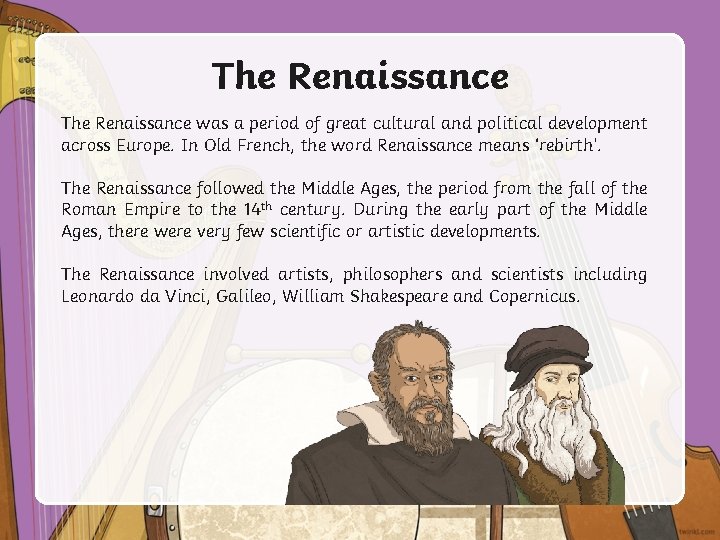
The Renaissance was a period of great cultural and political development across Europe. In Old French, the word Renaissance means ‘rebirth’. The Renaissance followed the Middle Ages, the period from the fall of the Roman Empire to the 14 th century. During the early part of the Middle Ages, there were very few scientific or artistic developments. The Renaissance involved artists, philosophers and scientists including Leonardo da Vinci, Galileo, William Shakespeare and Copernicus.
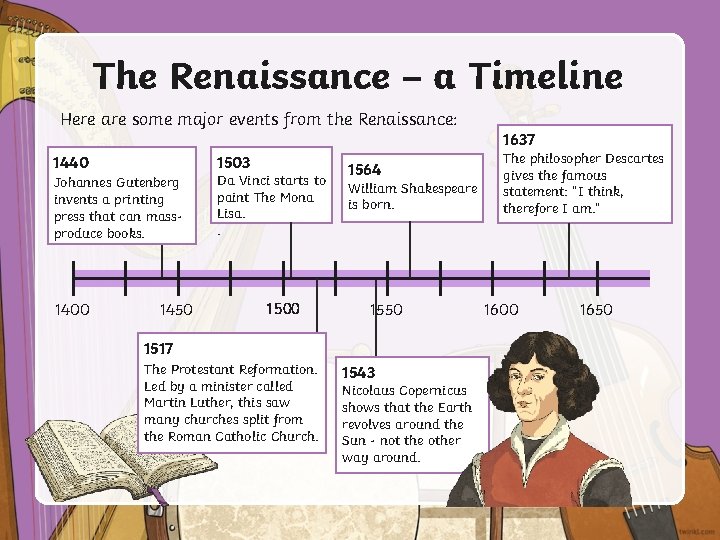
The Renaissance – a Timeline Here are some major events from the Renaissance: 1637 1503 1440 Johannes Gutenberg invents a printing press that can massproduce books. 1400 1450 Da Vinci starts to paint The Mona Lisa. . 1500 1564 William Shakespeare is born. 1550 1517 The Protestant Reformation. Led by a minister called Martin Luther, this saw many churches split from the Roman Catholic Church. 1543 Nicolaus Copernicus shows that the Earth revolves around the Sun - not the other way around. The philosopher Descartes gives the famous statement: “I think, therefore I am. ” 1600 1650
Renaissance Music Renaissance music is sometimes divided into two categories, sacred and secular: • sacred - related to religion, often played in church services. • secular - non-religious music, including music to dance to and music performed in the Royal Courts of Europe. Lots of Renaissance music was still based around singing. As the period continued, instruments were used more. The invention of the printing press meant that music could be shared across Europe more easily and quickly. Previously, each piece of written music had to be created by hand.
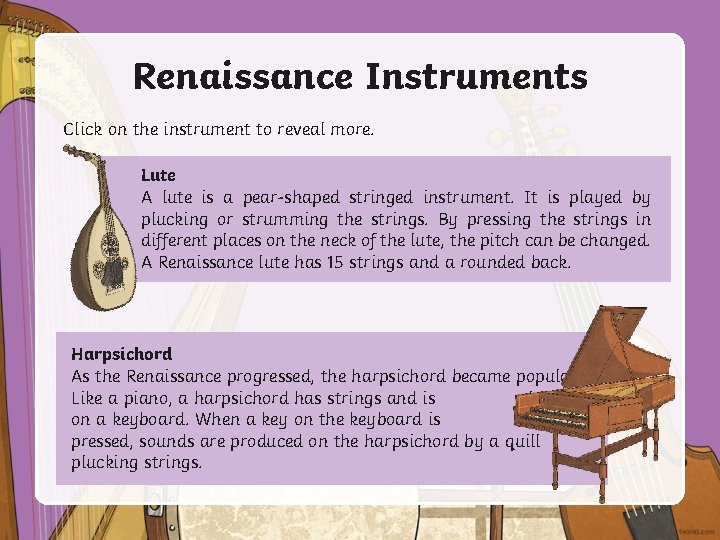
Renaissance Instruments Click on the instrument to reveal more. Lute A lute is a pear-shaped stringed instrument. It is played by plucking or strumming the strings. By pressing the strings in different places on the neck of the lute, the pitch can be changed. A Renaissance lute has 15 strings and a rounded back. Harpsichord As the Renaissance progressed, the harpsichord became popular. Like a piano, a harpsichord has strings and is played on a keyboard. When a key on the keyboard is pressed, sounds are produced on the harpsichord by a quill plucking strings.
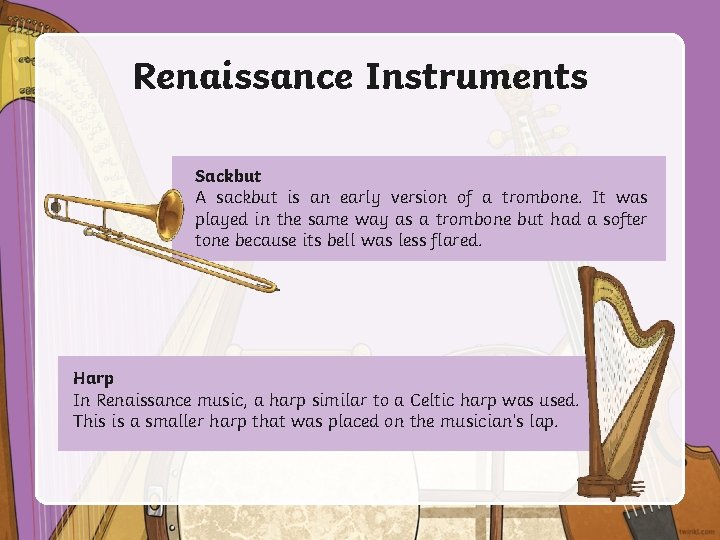
Renaissance Instruments Sackbut A sackbut is an early version of a trombone. It was played in the same way as a trombone but had a softer tone because its bell was less flared. Harp In Renaissance music, a harp similar to a Celtic harp was used. This is a smaller harp that was placed on the musician’s lap.
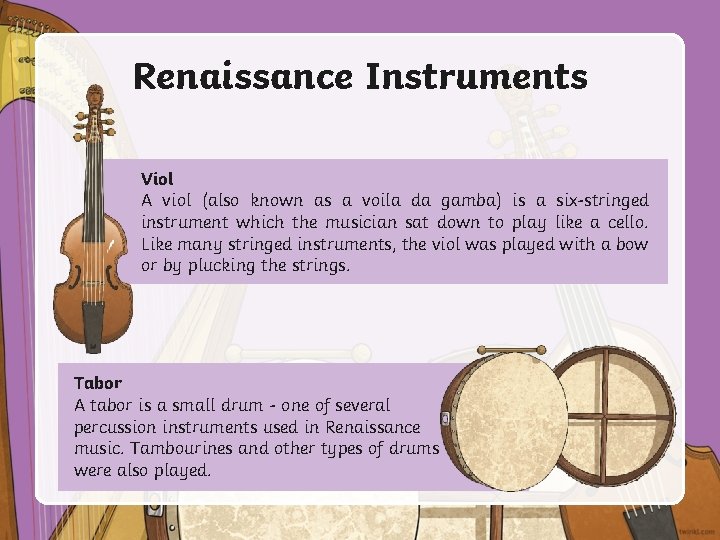
Renaissance Instruments Viol A viol (also known as a voila da gamba) is a six-stringed instrument which the musician sat down to play like a cello. Like many stringed instruments, the viol was played with a bow or by plucking the strings. Tabor A tabor is a small drum - one of several percussion instruments used in Renaissance music. Tambourines and other types of drums were also played.
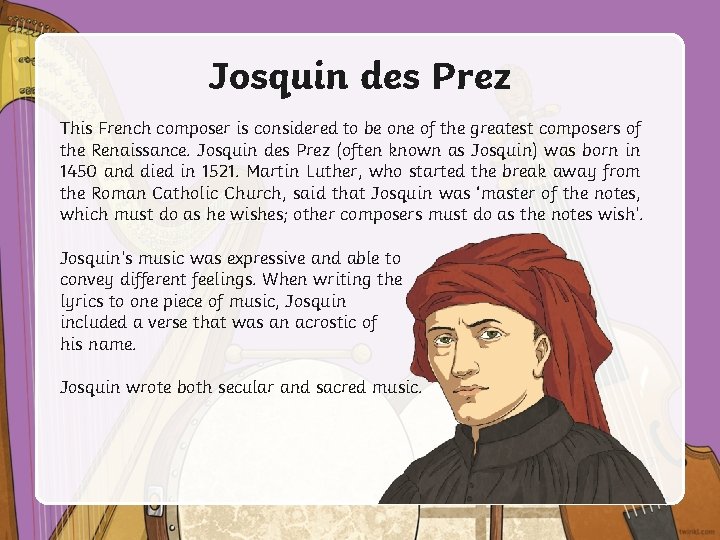
Josquin des Prez This French composer is considered to be one of the greatest composers of the Renaissance. Josquin des Prez (often known as Josquin) was born in 1450 and died in 1521. Martin Luther, who started the break away from the Roman Catholic Church, said that Josquin was ‘master of the notes, which must do as he wishes; other composers must do as the notes wish’. Josquin’s music was expressive and able to convey different feelings. When writing the lyrics to one piece of music, Josquin included a verse that was an acrostic of his name. Josquin wrote both secular and sacred music.
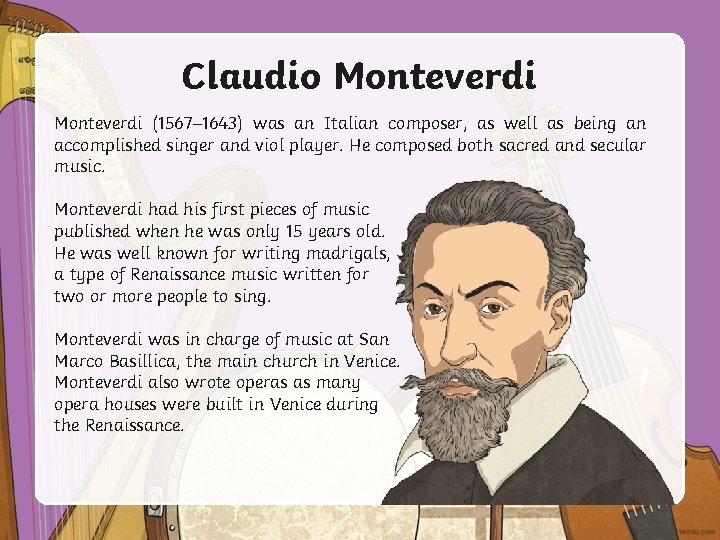
Claudio Monteverdi (1567– 1643) was an Italian composer, as well as being an accomplished singer and viol player. He composed both sacred and secular music. Monteverdi had his first pieces of music published when he was only 15 years old. He was well known for writing madrigals, a type of Renaissance music written for two or more people to sing. Monteverdi was in charge of music at San Marco Basillica, the main church in Venice. Monteverdi also wrote operas as many opera houses were built in Venice during the Renaissance.
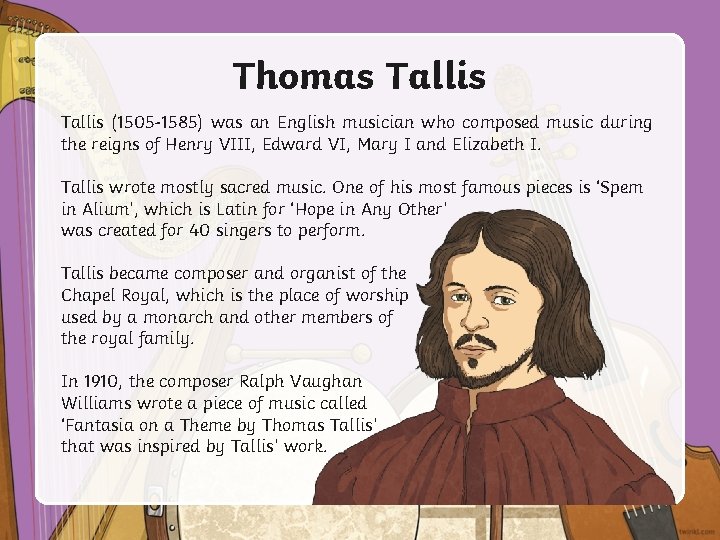
Thomas Tallis (1505 -1585) was an English musician who composed music during the reigns of Henry VIII, Edward VI, Mary I and Elizabeth I. Tallis wrote mostly sacred music. One of his most famous pieces is ‘Spem in Alium’, which is Latin for ‘Hope in Any Other’ was created for 40 singers to perform. Tallis became composer and organist of the Chapel Royal, which is the place of worship used by a monarch and other members of the royal family. In 1910, the composer Ralph Vaughan Williams wrote a piece of music called ‘Fantasia on a Theme by Thomas Tallis’ that was inspired by Tallis’ work.
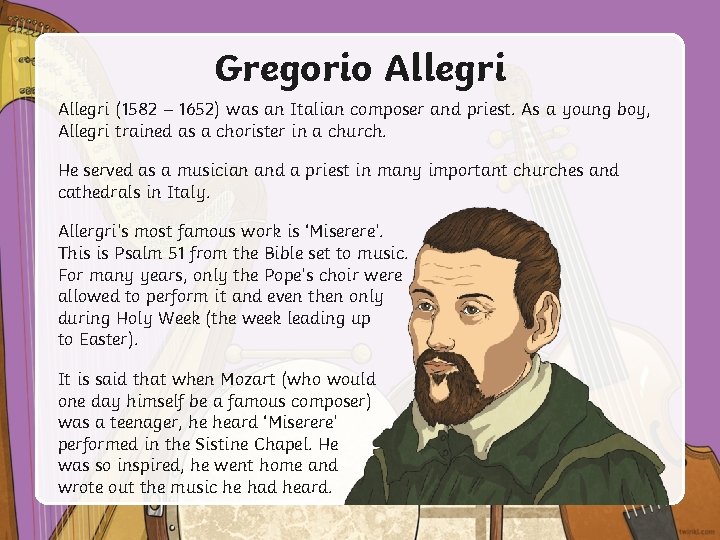
Gregorio Allegri (1582 – 1652) was an Italian composer and priest. As a young boy, Allegri trained as a chorister in a church. He served as a musician and a priest in many important churches and cathedrals in Italy. Allergri’s most famous work is ‘Miserere’. This is Psalm 51 from the Bible set to music. For many years, only the Pope’s choir were allowed to perform it and even then only during Holy Week (the week leading up to Easter). It is said that when Mozart (who would one day himself be a famous composer) was a teenager, he heard ‘Miserere’ performed in the Sistine Chapel. He was so inspired, he went home and wrote out the music he had heard.