
The Renaissance The Cradle of the Renaissance The

- Slides: 12
The Renaissance
The Cradle of the Renaissance • The Renaissance began in Italy • Wealthy merchants paid artists to create paintings and sculptures for their homes • Wealthy merchant families in the city-states of Florence, Venice, Naples, Milan, and Genoa competed to make their cities centers of art and learning • Rediscovered the learning of the Greeks and Romans
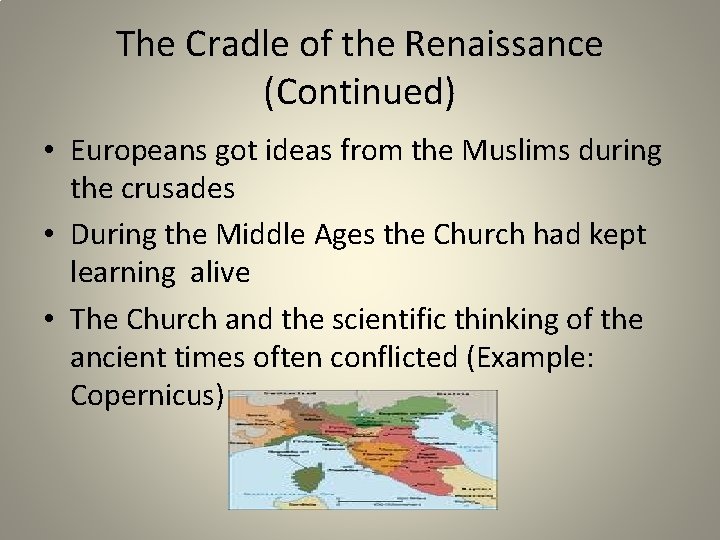
The Cradle of the Renaissance (Continued) • Europeans got ideas from the Muslims during the crusades • During the Middle Ages the Church had kept learning alive • The Church and the scientific thinking of the ancient times often conflicted (Example: Copernicus)
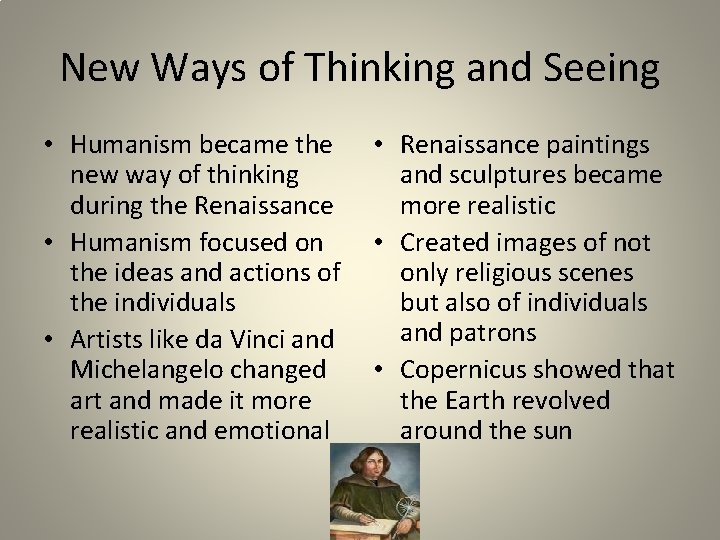
New Ways of Thinking and Seeing • Humanism became the new way of thinking during the Renaissance • Humanism focused on the ideas and actions of the individuals • Artists like da Vinci and Michelangelo changed art and made it more realistic and emotional • Renaissance paintings and sculptures became more realistic • Created images of not only religious scenes but also of individuals and patrons • Copernicus showed that the Earth revolved around the sun
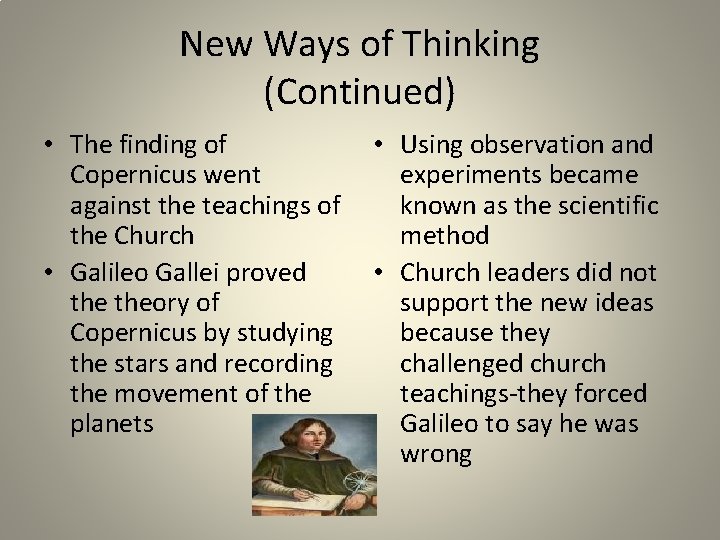
New Ways of Thinking (Continued) • The finding of Copernicus went against the teachings of the Church • Galileo Gallei proved theory of Copernicus by studying the stars and recording the movement of the planets • Using observation and experiments became known as the scientific method • Church leaders did not support the new ideas because they challenged church teachings-they forced Galileo to say he was wrong
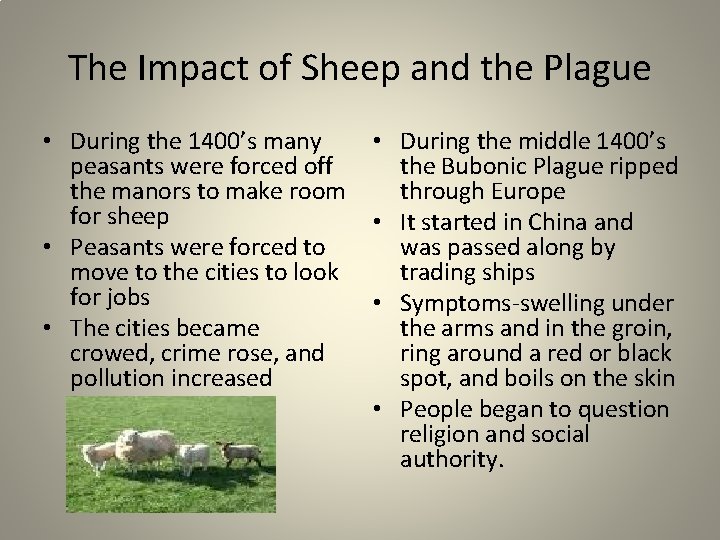
The Impact of Sheep and the Plague • During the 1400’s many peasants were forced off the manors to make room for sheep • Peasants were forced to move to the cities to look for jobs • The cities became crowed, crime rose, and pollution increased • During the middle 1400’s the Bubonic Plague ripped through Europe • It started in China and was passed along by trading ships • Symptoms-swelling under the arms and in the groin, ring around a red or black spot, and boils on the skin • People began to question religion and social authority.
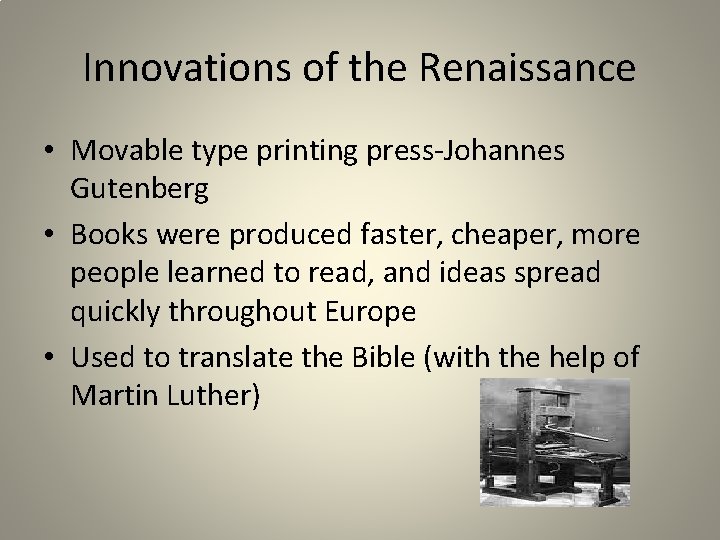
Innovations of the Renaissance • Movable type printing press-Johannes Gutenberg • Books were produced faster, cheaper, more people learned to read, and ideas spread quickly throughout Europe • Used to translate the Bible (with the help of Martin Luther)
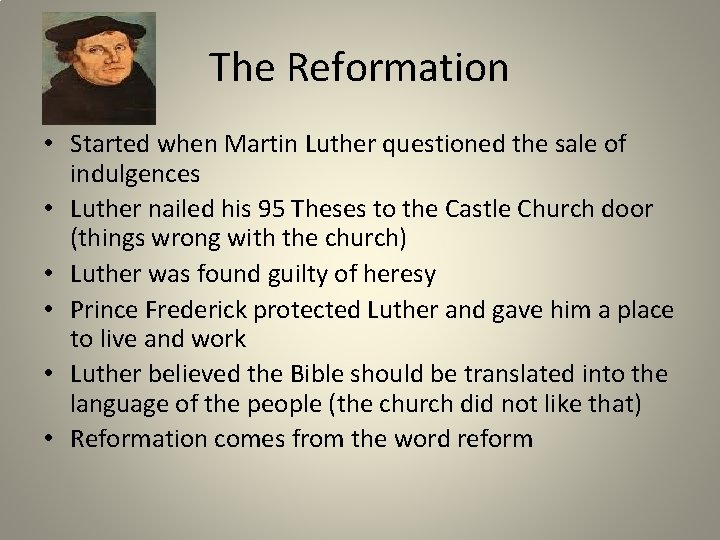
The Reformation • Started when Martin Luther questioned the sale of indulgences • Luther nailed his 95 Theses to the Castle Church door (things wrong with the church) • Luther was found guilty of heresy • Prince Frederick protected Luther and gave him a place to live and work • Luther believed the Bible should be translated into the language of the people (the church did not like that) • Reformation comes from the word reform
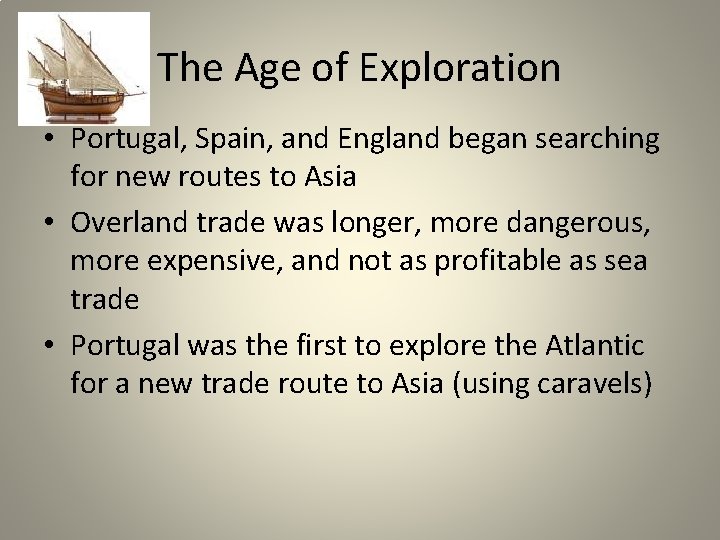
The Age of Exploration • Portugal, Spain, and England began searching for new routes to Asia • Overland trade was longer, more dangerous, more expensive, and not as profitable as sea trade • Portugal was the first to explore the Atlantic for a new trade route to Asia (using caravels)
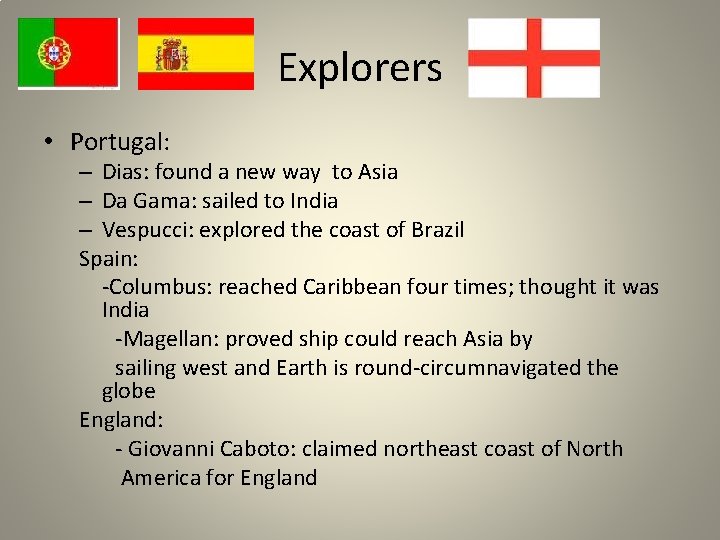
Explorers • Portugal: – Dias: found a new way to Asia – Da Gama: sailed to India – Vespucci: explored the coast of Brazil Spain: -Columbus: reached Caribbean four times; thought it was India -Magellan: proved ship could reach Asia by sailing west and Earth is round-circumnavigated the globe England: - Giovanni Caboto: claimed northeast coast of North America for England
Colonization of the Americas • Spanish conquistadors (Cortes, Pizzaro, and Columbus) went to the Americas and conquered the cultures of the New World • The Spanish explorers brought with them the Catholic religion, Spanish language, diseases, sugarcane, rice, bananas, wheat, cattle, pigs, chickens, sheep, chickpeas, and horses • From the Americas explorers took gold, silver, beans, potatoes, maize, tomatoes, and chocolate • This transfer of goods was known as the Columbian Exchange
Colonization of the Americas (Continued) • The Spanish enslaved many of the Native Americans and forced them to work for them (encomienda system) • The Spanish also forced them to accept the Catholic faith • After the many Native Americans died, the Europeans began to bring slaves from Africa to the new world • The French also colonized the Americas along the St. Lawrence and Mississippi rivers-they were looking for animal furs • The French integrated with the Native Americans (they were called the Coureurs de bois-runners of the woods