
THE RENAISSANCE Rise of Italian CityStates Contributions Effects
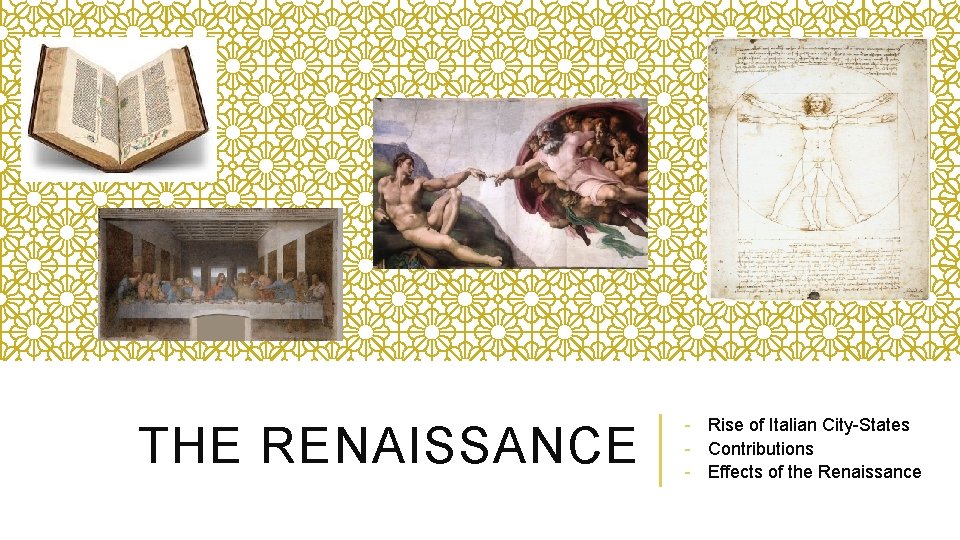
THE RENAISSANCE - Rise of Italian City-States - Contributions - Effects of the Renaissance
CORNELL NOTE-TAKING METHOD Notes color-coded in RED go on this side of the line. Notes color-coded in BLUE go on this side of the line. These items will include: Supporting details Dates, Times, and Biographic details Vocabulary Definitions Main Ideas Big Concepts Vocabulary Words These items will include: Any items in BLACK text are optional. Remember: the more thorough your notes, the more prepared you will be for exams.
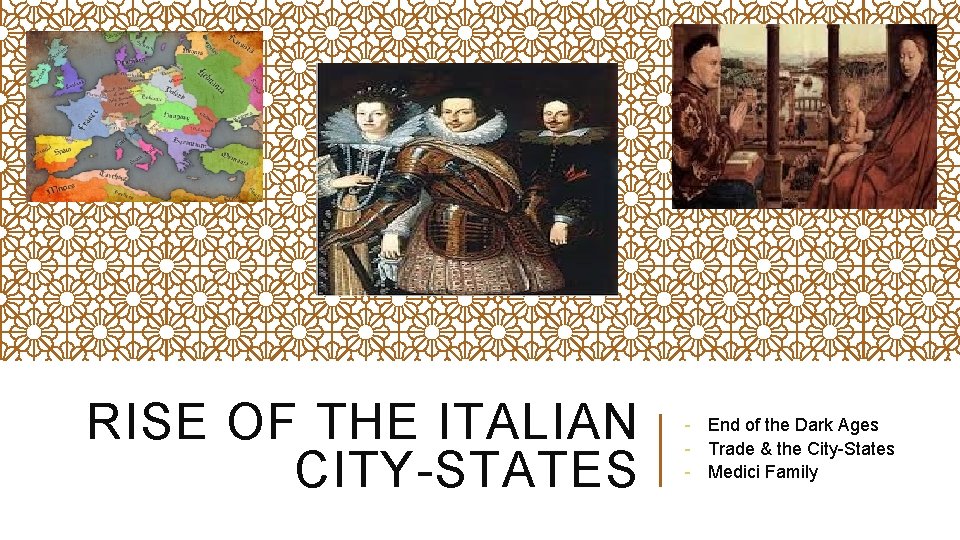
RISE OF THE ITALIAN CITY-STATES - End of the Dark Ages - Trade & the City-States - Medici Family
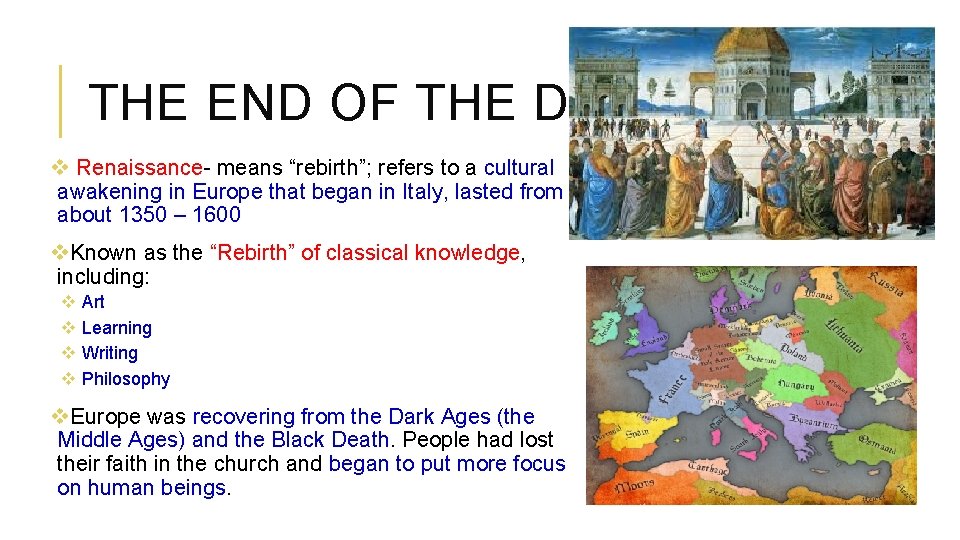
THE END OF THE DARK AGES v Renaissance- means “rebirth”; refers to a cultural awakening in Europe that began in Italy, lasted from about 1350 – 1600 v. Known as the “Rebirth” of classical knowledge, including: v Art v Learning v Writing v Philosophy v. Europe was recovering from the Dark Ages (the Middle Ages) and the Black Death. People had lost their faith in the church and began to put more focus on human beings.
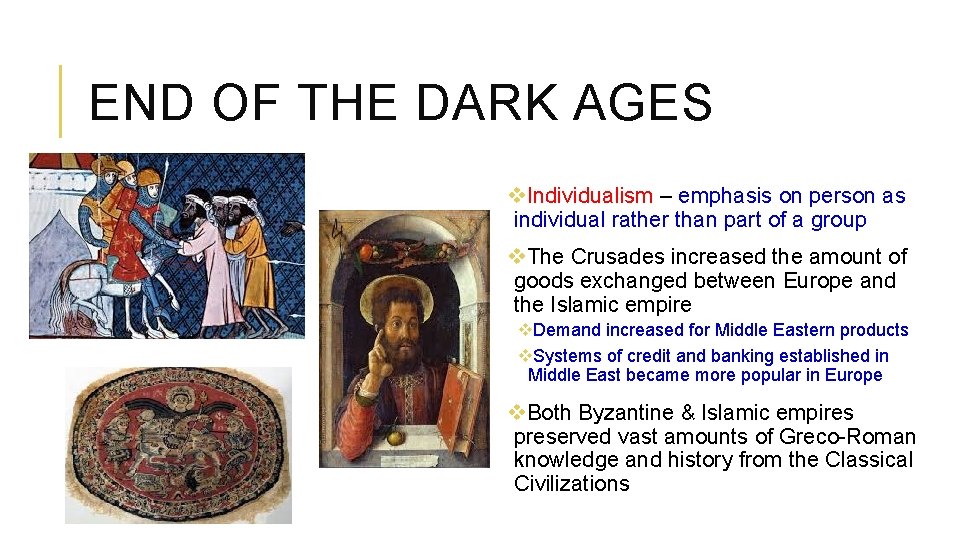
END OF THE DARK AGES v. Individualism – emphasis on person as individual rather than part of a group v. The Crusades increased the amount of goods exchanged between Europe and the Islamic empire v. Demand increased for Middle Eastern products v. Systems of credit and banking established in Middle East became more popular in Europe v. Both Byzantine & Islamic empires preserved vast amounts of Greco-Roman knowledge and history from the Classical Civilizations
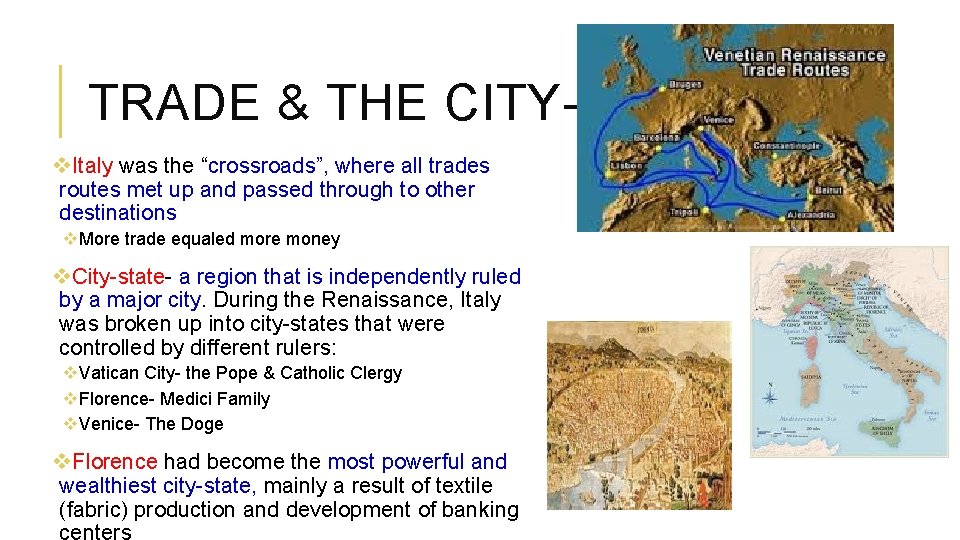
TRADE & THE CITY-STATES v. Italy was the “crossroads”, where all trades routes met up and passed through to other destinations v. More trade equaled more money v. City-state- a region that is independently ruled by a major city. During the Renaissance, Italy was broken up into city-states that were controlled by different rulers: v. Vatican City- the Pope & Catholic Clergy v. Florence- Medici Family v. Venice- The Doge v. Florence had become the most powerful and wealthiest city-state, mainly a result of textile (fabric) production and development of banking
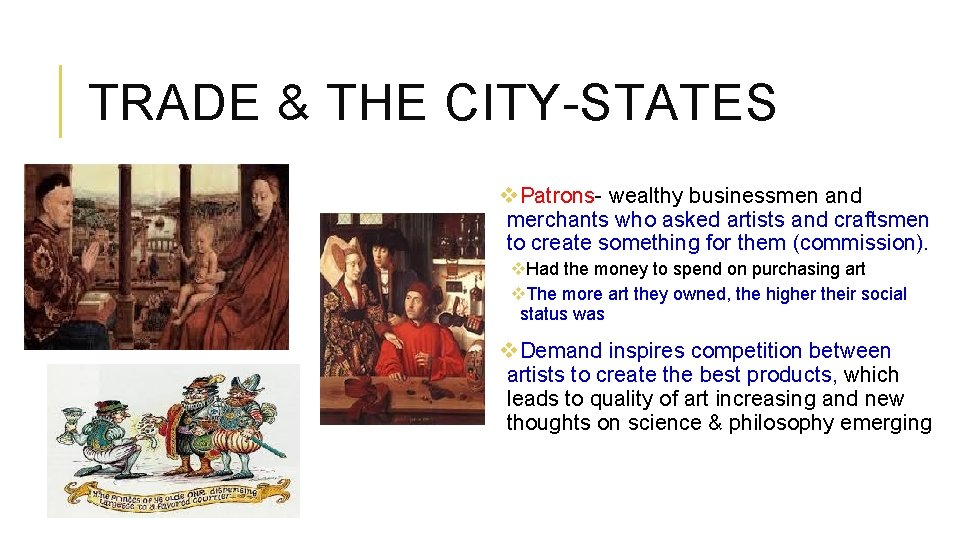
TRADE & THE CITY-STATES v. Patrons- wealthy businessmen and merchants who asked artists and craftsmen to create something for them (commission). v. Had the money to spend on purchasing art v. The more art they owned, the higher their social status was v. Demand inspires competition between artists to create the best products, which leads to quality of art increasing and new thoughts on science & philosophy emerging

THE MEDICI FAMILY v. Medici Family- wool merchants and banking family that amassed a large amount of wealth; most famous for patronage of various artists v. Giovanni de Medici- first leader of the family, influenced Florence merchants v. Support allowed artists to work without worrying about money v Family’s influence extended over the next 200 years: v. Cosimo- leader of Florence government; patron of sculptor Donatello v. Lorenzo- patron of Michelangelo, da Vinci, and Botticelli v. Giovanni Lorenzo- first of four Medici to become Pope, reigned as Pope Leo X; patron of Raphael v. Catherine- Queen of France in 1547 and Regent for 3 French kings (her sons); brought ballet to court
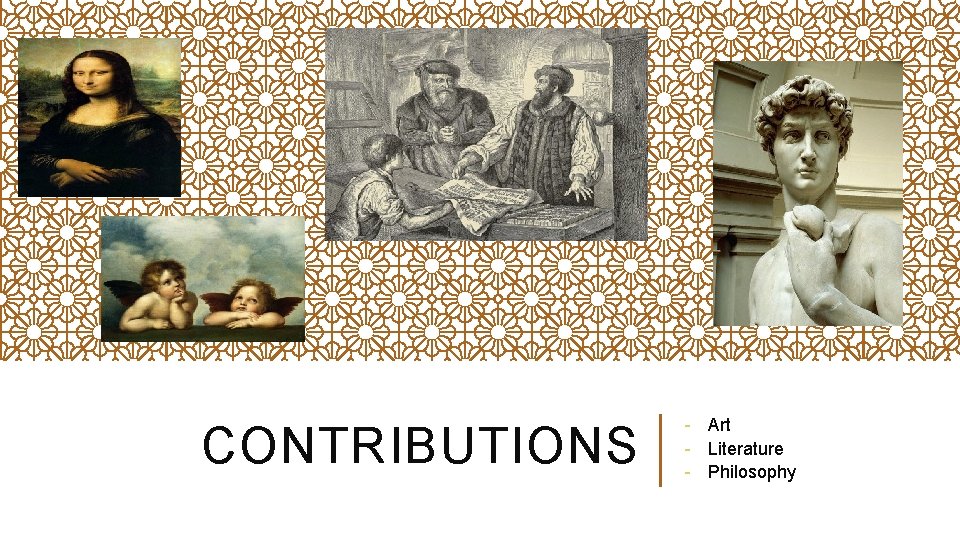
CONTRIBUTIONS - Art - Literature - Philosophy
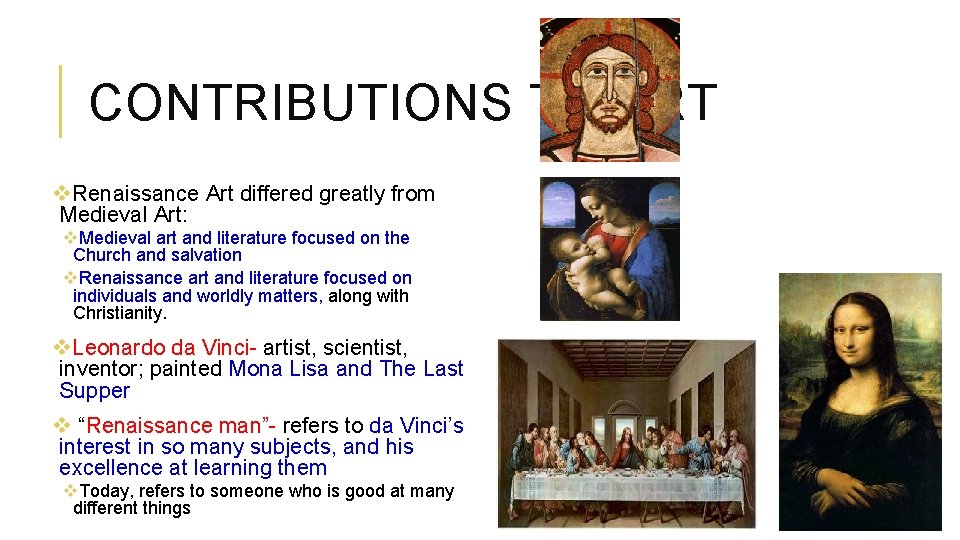
CONTRIBUTIONS TO ART v. Renaissance Art differed greatly from Medieval Art: v. Medieval art and literature focused on the Church and salvation v. Renaissance art and literature focused on individuals and worldly matters, along with Christianity. v. Leonardo da Vinci- artist, scientist, inventor; painted Mona Lisa and The Last Supper v “Renaissance man”- refers to da Vinci’s interest in so many subjects, and his excellence at learning them v. Today, refers to someone who is good at many different things
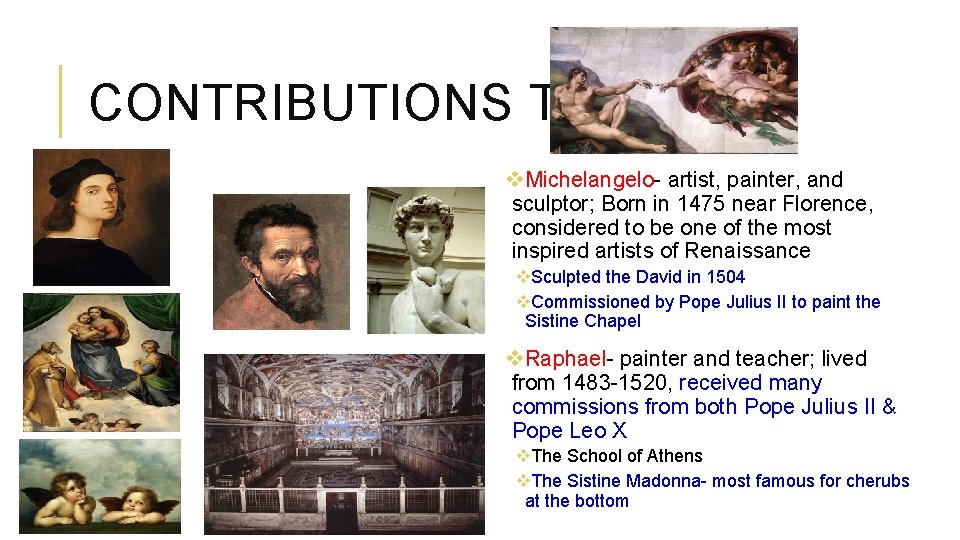
CONTRIBUTIONS TO ART v. Michelangelo- artist, painter, and sculptor; Born in 1475 near Florence, considered to be one of the most inspired artists of Renaissance v. Sculpted the David in 1504 v. Commissioned by Pope Julius II to paint the Sistine Chapel v. Raphael- painter and teacher; lived from 1483 -1520, received many commissions from both Pope Julius II & Pope Leo X v. The School of Athens v. The Sistine Madonna- most famous for cherubs at the bottom
JUST FYI…
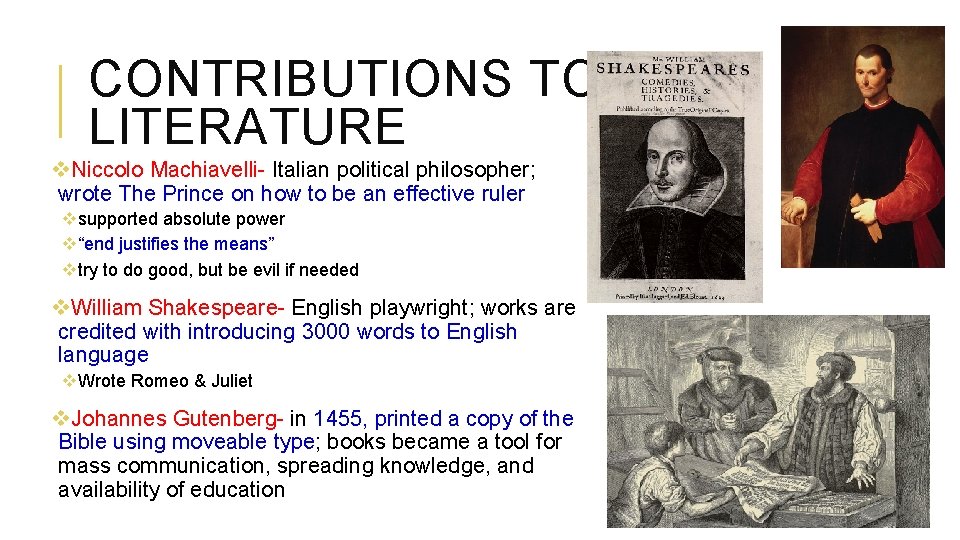
CONTRIBUTIONS TO LITERATURE v. Niccolo Machiavelli- Italian political philosopher; wrote The Prince on how to be an effective ruler vsupported absolute power v“end justifies the means” vtry to do good, but be evil if needed v. William Shakespeare- English playwright; works are credited with introducing 3000 words to English language v. Wrote Romeo & Juliet v. Johannes Gutenberg- in 1455, printed a copy of the Bible using moveable type; books became a tool for mass communication, spreading knowledge, and availability of education
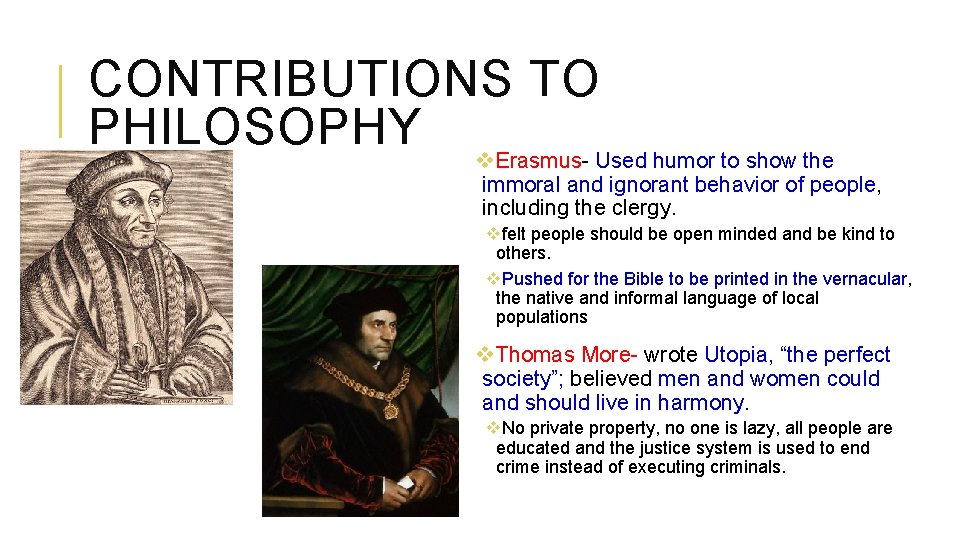
CONTRIBUTIONS TO PHILOSOPHY v. Erasmus- Used humor to show the immoral and ignorant behavior of people, including the clergy. vfelt people should be open minded and be kind to others. v. Pushed for the Bible to be printed in the vernacular, the native and informal language of local populations v. Thomas More- wrote Utopia, “the perfect society”; believed men and women could and should live in harmony. v. No private property, no one is lazy, all people are educated and the justice system is used to end crime instead of executing criminals.
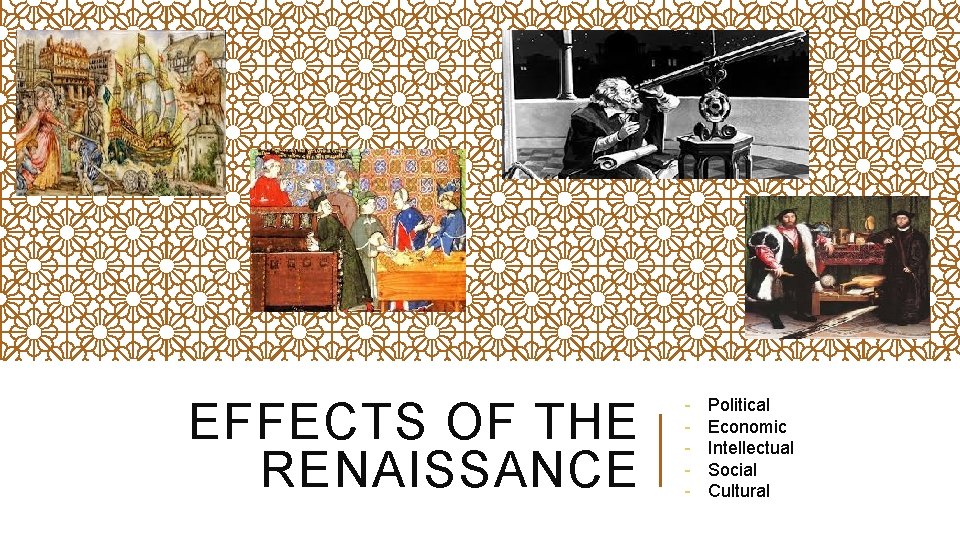
EFFECTS OF THE RENAISSANCE - Political Economic Intellectual Social Cultural
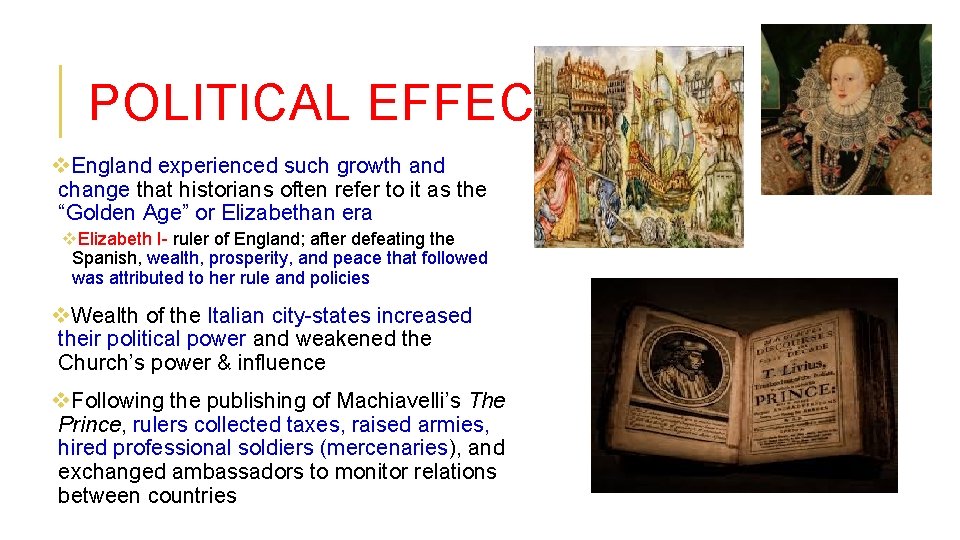
POLITICAL EFFECTS v. England experienced such growth and change that historians often refer to it as the “Golden Age” or Elizabethan era v. Elizabeth I- ruler of England; after defeating the Spanish, wealth, prosperity, and peace that followed was attributed to her rule and policies v. Wealth of the Italian city-states increased their political power and weakened the Church’s power & influence v. Following the publishing of Machiavelli’s The Prince, rulers collected taxes, raised armies, hired professional soldiers (mercenaries), and exchanged ambassadors to monitor relations between countries
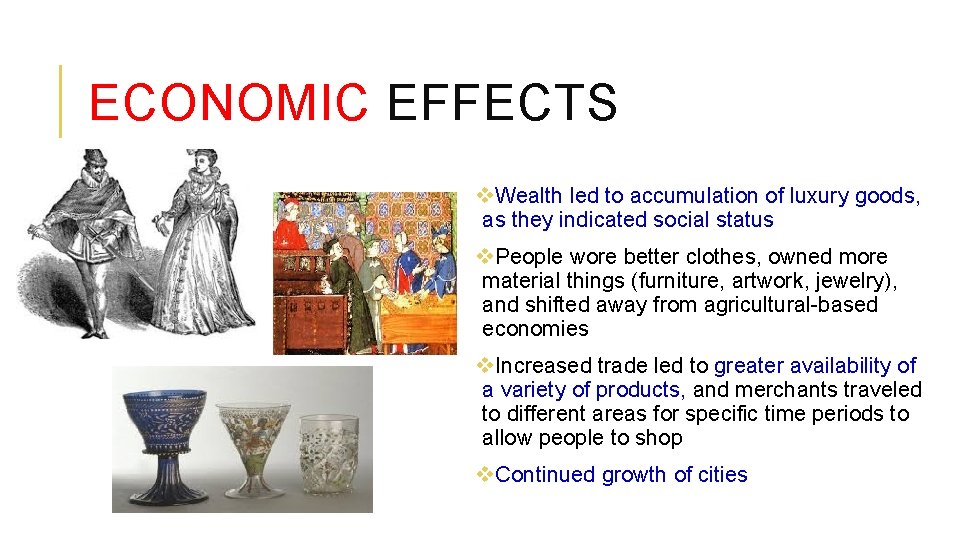
ECONOMIC EFFECTS v. Wealth led to accumulation of luxury goods, as they indicated social status v. People wore better clothes, owned more material things (furniture, artwork, jewelry), and shifted away from agricultural-based economies v. Increased trade led to greater availability of a variety of products, and merchants traveled to different areas for specific time periods to allow people to shop v. Continued growth of cities
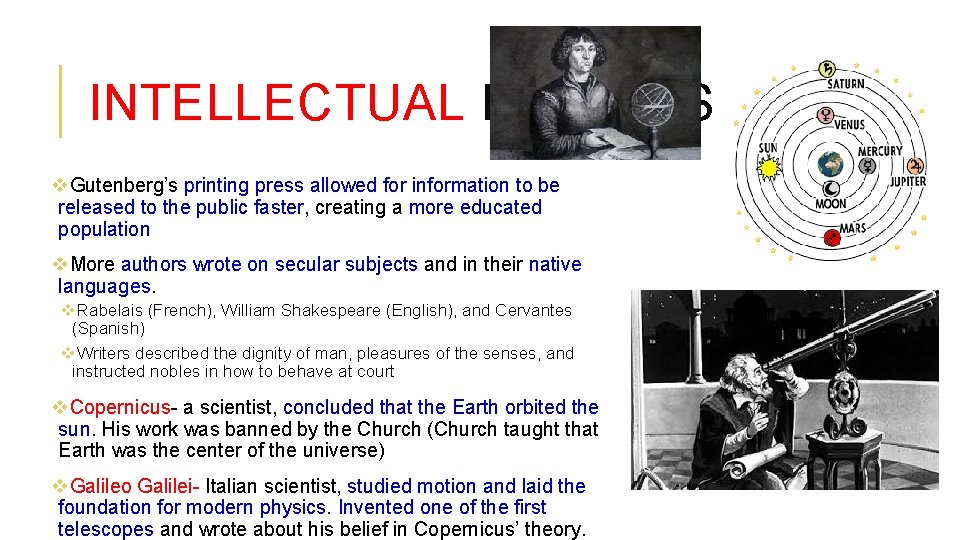
INTELLECTUAL EFFECTS v. Gutenberg’s printing press allowed for information to be released to the public faster, creating a more educated population v. More authors wrote on secular subjects and in their native languages. v. Rabelais (French), William Shakespeare (English), and Cervantes (Spanish) v. Writers described the dignity of man, pleasures of the senses, and instructed nobles in how to behave at court v. Copernicus- a scientist, concluded that the Earth orbited the sun. His work was banned by the Church (Church taught that Earth was the center of the universe) v. Galileo Galilei- Italian scientist, studied motion and laid the foundation for modern physics. Invented one of the first telescopes and wrote about his belief in Copernicus’ theory.
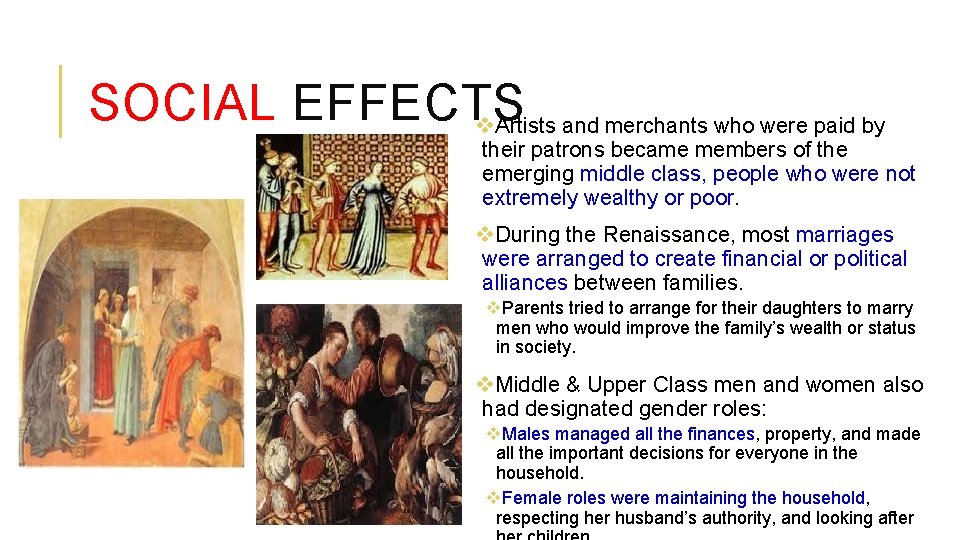
SOCIAL EFFECTS v. Artists and merchants who were paid by their patrons became members of the emerging middle class, people who were not extremely wealthy or poor. v. During the Renaissance, most marriages were arranged to create financial or political alliances between families. v. Parents tried to arrange for their daughters to marry men who would improve the family’s wealth or status in society. v. Middle & Upper Class men and women also had designated gender roles: v. Males managed all the finances, property, and made all the important decisions for everyone in the household. v. Female roles were maintaining the household, respecting her husband’s authority, and looking after
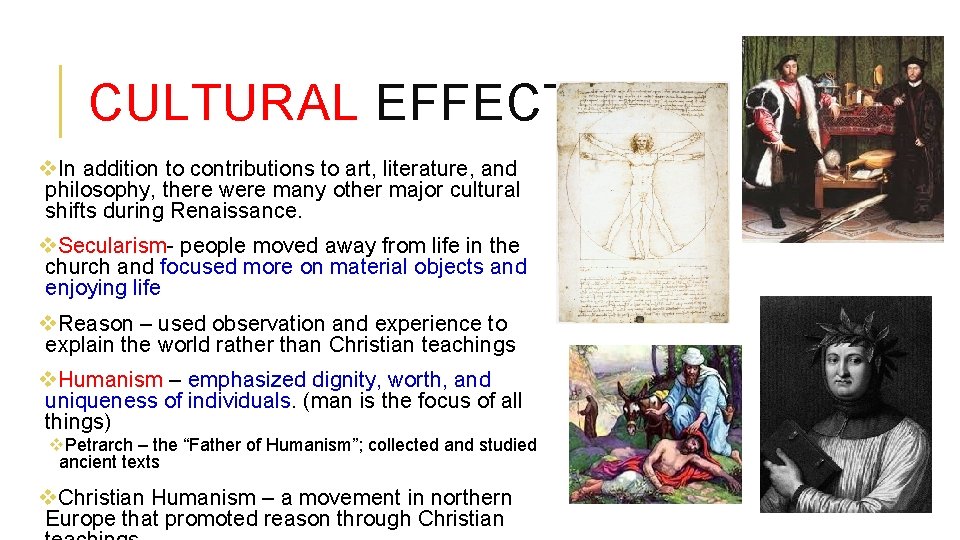
CULTURAL EFFECTS v. In addition to contributions to art, literature, and philosophy, there were many other major cultural shifts during Renaissance. v. Secularism- people moved away from life in the church and focused more on material objects and enjoying life v. Reason – used observation and experience to explain the world rather than Christian teachings v. Humanism – emphasized dignity, worth, and uniqueness of individuals. (man is the focus of all things) v. Petrarch – the “Father of Humanism”; collected and studied ancient texts v. Christian Humanism – a movement in northern Europe that promoted reason through Christian
- Slides: 20