
The Renaissance Renaissance means rebirth and it started
The Renaissance • Renaissance means “rebirth” and it started in Western Europe around the 1300 s – Transition from medieval to modern times with expression in art and literature • Creativity and change in politics, socially, economically, and culturally • More comprehension of the world and technology – More attention toward classical views from Greece and Rome to restore order • Still used Latin in the Church and for scholarship • Renaissance thinkers explored the richness and variety of human experience (look at life now not after death) and emphasis on individual accomplishment
Deep Thinking and Humanism • Renaissance thinkers encouraged adventure to new worlds and more observation of space – New art forms and a belief that man can do anything • HUMANISM began, study of Greece and Rome to understand their own times – Where Christians focused on worldly subjects instead of religious subjects – Belief that education should stimulate the individual’s creative powers – HUMANITIES studies were emphasized, study of grammar, rhetoric (effective language), poetry and history
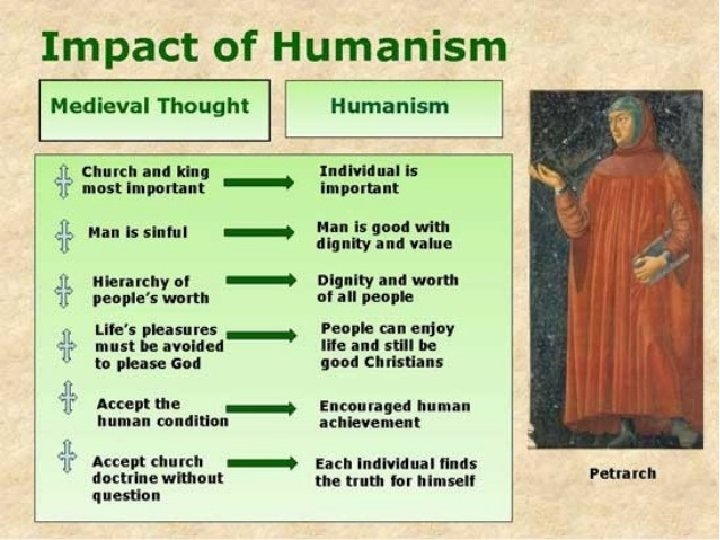
Start in Italy • FRANCESCO PETRARCH, from Florentine in 1300 s, was a humanists poet, and scholar who assembled a Greek and Roman library – Started them in churches and led to larger libraries so people would recognize the works of Cicero, Homer and Virgil • The Renaissance began in Italy and over the next 100 years spread to Europe – New interest in ancient Rome put Italy at the fore front, Rome was the center of the Roman Empire • Could study the art and architecture, the Church also supported the art and scholars
Why the Renaissance in Italy? • Geography and History – Rome was center of Roman Empire • Can study art and architecture – Roman Catholic Church is in Rome • Funded the artists and scholars – Middle of Mediterranean Sea • Allowed easy sea trade with Muslim Empire and Italian merchants brought back great wealth and the knowledge that was lost from Rome and Greece was retained by the Muslims
City-States Spark Change • Italy had many city-states ruled by wealthy and powerful families – Had interest in art and architecture – Medici family of FLORENCE, were rich merchants and bankers • Had control of government in 1434 • Were PATRONS, financial supporters, of the arts during rough periods – Florence came to symbolize the Renaissance with artists, scientists, architects, scholars and poets residing there
Renaissance Growth and Techniques • Popes, Princes and other patrons were still supporting artists – Renaissance art reflected humanism • Most art had religious themes with Greek and Roman backgrounds • Paintings of well known figures, humanism, individual achievement – Donatello created a life size sculpture of a soldier on horseback – Medieval art was more stylized and Renaissance art was made with PERSPECTIVE, smaller objects in back to appear three-dimensional • Used realism, live models and new oils paints with shading
Architecture and Artists • Architecture, the ‘social art’ – Rejected gothic style of middle ages and went back to domes and columns • Da Vinci – Created drawings of flying machines and submarines • Was into anatomy (dissecting bodies) optics, music, botany, architecture and engineering • Michelangelo – Created a large sculptor of David and the Pieta (Mary holding Jesus) to show sorrow • Created dome for St. Peter’s Cathedral, used as model for Capitol building in Washington D. C. • Sistine Chapel depicted the Bible from Creation to Flood – Took 4 years and left him partially crippled
Writing • Wrote works based on Humanism and wrote about philosophy and scholarship – BALDASSARE CASTIGLIONE wrote The Book of the Courtier • Described the skills required to be a member of the court, was a guide book – NICCOLO MACHIAVELLI wrote a guide for rulers on how to maintain power • The end justifies the means in The Prince, he was against oppression and corruption, but spoke truthfully about politics
Sec. 2) Renaissance in the North • The Renaissance took longer to reach the North because of the Black Death – An inventing aided the spread of the Renaissance, the printing press, invented by JOHANN GUTENBURG in 1455 • First book printed… the Bible • Printed books were now cheaper, people bought more, knowledge spread at a more rapid pace • The Renaissance started in a town called FLANDERS, part of northern France, Belgium, and Netherlands
Artists of the North • Main painters used realistic traditions… see it, paint it – ALBRECHT DURER was one of the first artists affected by the Renaissance • 1494 he traveled to Italy • Spread the Renaissance in the north, called the “Leonardo of the North” • Applied the ideas of Italian painting to ENGRAVING, etching designs into metal plates with acid – Many of his etches portrayed religious portrayal
Northern Vernacular • Northern artists started to write using VERNACULAR, everyday language of ordinary people… JK LOLZERZ! – Think SHAKESPEARE… he is unreal!
Writing Goes Through Change • Desiderius ERASMUS, humanists who came up with a Greek edition of Bible – Encouraged that a Bible be printed in vernacular so everyone could read the scriptures • THOMAS MORE, wrote a book called Utopia – More dreamed of a society where men and women were equal, all educated, and justice used to end crime instead of eliminate the criminal • UTOPIAN is a word used today to describe an impractical society • SHAKESPEARE, conducted over 37 plays and entered more than 1, 700 words into his works – Used Renaissance ideals and common language the common people could understand
Renaissance Creates Religious Upheaval • Wealth was distributed unequally in the Northern Europe – More humanists ideas and knowledge becoming readily available thanks to the printing press • Many people began to questions the Church • The Church was constantly in worldly affairs – Competed for political power – Fought wars to protect Papal states – Plotted against monarchs, and fought to expand its own interests – Popes led lavish lives and hired artists • To do this they charged higher fees for marriages, baptisms and sold INDULGENCES, lessening of time a soul would have to spend in purgatory (used to be given for good deeds) – By 1400 s, people became fed up with practices of the Church
Revolts Against the Church • Revolts began against the Church – In England 1300 s, John Wycliffe launched an attack against the church • Used sermons and writings to call for change • When he died, followers met in secret • Jan Hus, led another revolt 40 years later and was executed • 1517, a full on revolt against the Church started – A German monk and professor of theology, MARTIN LUTHER sparked the revolt
Martin Luther and Change • Martin Luther tried to lead a holy life – He saw the corruption of the Church and its growing worldliness – 1517, a priest named Johann Tetzel setup a pulpit near WITTENBERG, Germany • Offered indulgences to anyone who offered money toward rebuilding the St. Peter Cathedral in Rome • Claimed the indulgences would guarantee entrance into heaven and for the patrons dead relatives • Luther was MAD! That meant poor peasants could never get into heaven – He drew up his 95 THESES argument against Tetzel’s actions – Argued that indulgences had no basis in the Bible
95 Theses Causes Craziness • Luther’s 95 Theses were printed everywhere almost overnight – The Church wanted Luther to give up his radical views – Instead he came up with more radical views • Urged Christians to reject the authority of Rome • Said the Church could be reformed by secular, non-Church authorities – 1951, Pope Leo X excommunicated Luther • CHARLES V (the Holy Roman Emperor), summoned Luther to a DIET, or meeting, and asked Luther to give up on his ideas
Luther Continues His Fight • Charles V considered Luther an outlaw and made it a crime to help him – Luther survived though, had thousands of supporters • Luther’s teachings were different from Catholicism – Believed everyone had equal access to God through faith and the Bible – Wanted ordinary people to read the Bible – Wanted every town to have a school for children so they could read the Bible – Banned indulgences, confession, pilgrimages and prayers to saints – Simplified mass, emphasized the sermon and clergy could marry
Lutheranism Takes Off • Luther believed the printing press was “God’s highest act of grace” – Many Lutherans took the name Protestant, for “protesting” church authority • Some changed to Lutheran to end Holy Roman Empire, selfish reasons, to throw off the Church, trying to gain Church property or feelings for national unity • Many Lutherans sought an end to serfdom in Germany and harsh treatment in 1524 – The revolt grew violent and Luther denounced any lack of respect for authority, tens of thousands were killed to end revolt
Peace of Augsburg • 1530 s-1540 s, Charles V tried to force Lutheran princes back into Catholicism – After some warfare, an agreement was signed in 1555 – Allowed the princes of Germany to choose between Catholicism or Lutheranism • North Germ. – Lutheran, South Germ. – Catholic • Another reformer Ulrich Zwingli, admired Erasmus and stressed the Bible, rejected elaborate church rituals

Calvinism Born in Switzerland • JOHN CALVIN was also for reforming – Born in France and was a priest and lawyer • 1536, published a book that set his beliefs and how to organize his form of a Protestant church • Calvin shared Luther’s beliefs, but made a couple changes • Calvin preached PREDESTINATION, the idea that God had long ago determined who would gain salvation – The world was divided into saints and sinners, try to live a life like a saint
Calvinism Spreads • 1541, protestants in the Swiss city-state of GENEVA, asked Calvin to lead their community – Calvin set up a THEORCRACY, government run by church officials • People in the area saw themselves as the “chosen people” entrusted by God to build a Christian society • Practiced thrift, hard work, discipline, honesty and morality – No swearing, laughing or dancing… who face fines • Spread to England, France, Germany and Netherlands – Religious wars were taking place all over Europe
Sec. 4) Reform Continues, Protestant Ideas Spread • The Catholic Church was losing members at a rapid pace – Sought reform to keep members, but Protestant ideas were still growing • New Protestant SECTS, or religious groups, began to take shape based off the ideals of Calvin, Luther, Zwingli – Some even rejected baptism because they thought babies did not understand or accept Christian faith, Anabaptists • Anabaptists were both extreme (no private property, speed up God’s judgment by violent means) and peaceful (separation of church and state and tolerance) – Today, Baptists, Mennonites and the Amish trace roots back to Anabaptists
English Reformation • Reform started in England around 1300 (john Wycliffe) – The break with the Catholic Church happened with HENRY VIII, king of England • At first he was against Protestant reform – Give title by Pope of “Defender of Faith” • 1527, Henry was upset with his 18 year marriage to Catherine of Argon because they only had a female child, MARY TUDOR, and there was no heir – He was “in love” with Anne Boleyn, Catherine’s assistant, and thought he could divorce Catherine and bear a male child with Anne – The Catholic Church did not accept divorce, asked for annulment – The Pope refused and thought it would offend Charles V, Catherine’s nephew – Henry was upset
Breaking From the Church • Henry VIII decided to break from the Church – Took control of the Church of England • Appointed THOMAS CRANMER archbishop of the new church – 1533, Henry then annulled his marriage and married Anne Boleyn, they had a daughter ELIZABETH – 1534, Parliament passed the Act of Supremacy naming Henry head of the Church of England • Many Catholics refused and were killed, including Thomas More (Catholic Church then declared him a saint, CANONIZED)
Church of England Grows • 1536 -1540, royal officials confiscated the Catholic Church – They took Catholic lands, closed churches and monasteries (claimed they were immoral) • Gave land to high ranking nobles and they then supported the Anglican Church (name for Church of England) • Henry kept most Catholic ritual in his church and killed many of his wives (married 6 times!) • Henry VIII died in 1547, Edward VI (9 years old) took over – Protestant reform then took place – Thomas Cranmer drew up Book of Common Prayer, outlined the new Protestant service
More Change • Edward VI died in his teens, Mary Tudor became queen – Returned the Church of England back to Catholic service • Killed English Protestants by burning them at the stake • 1558, Mary died and throne went to Elizabeth – Started Elizabethan Settlement, reforms in the church • She practiced COMPROMISE, middle ground between Protestant and Catholic (WHAT!? )
Elizabeth Running the Show • Church under Elizabeth – Catholic ritual – Declared herself “supreme governor” of the church, not the head – Allowed a revised version of the Book of Common Prayer – English replaced Latin in services • All of this ended a lot of religious turmoil – England was a Protestant nation
Catholic Reform • With all the reform, the Catholic Church had to do the same – Pope Paul III led the reform (Catholic or Counter Reformation) • Called the COUNCIL OF TRENT in 1545 – – Reaffirmed salvation through faith and good works The Bible is not the only source of info Stiff penalties for worldliness and corruption Schools created to create a better educated clergy – Pope Paul strengthened Inquisition of Protestantism • Inquisition was from Middle Ages to torture, try and kill heresies • Also had Index of Forbidden Books, books not allowed – Included works of Luther and Calvin
New Group Forms • 1540, the Pope recognized the Society of Jesus, or the JESUITS – Started by IGNATIUS OF LOYOLA, a Spanish knight who lost his leg in battle • Read the works of saints and called himself a “soldier of God” • Produced a strict program of moral discipline, religious training and absolute obedience to the church • Spread Catholic faith worldwide, no matter the cost • Became advisors to Catholic rulers, set up schools that taught humanism and Catholic beliefs • Spread to distant lands in Africa, Asia and Americas
Renewal of Catholic Faith • TERESE of AVILA, entered a convent in her youth and thought the convent was not strict enough – There was an intense renewal of faith, and she started a strict order of nuns • Lived in isolation, little sleeping or eating and dedicated to prayer and meditation • Canonized after death and writings are some of the most important Catholic texts, still read today
Reform a Success • The Catholic Reformation was a big success, many Europeans remained Catholic – Protestants still had a major foothold – Intense conflicts were common with the renewal of faiths • Today Europe is still divided religiously • Persecution became widespread – Catholics and Protestants persecuted radical views like Anabaptists, witches and Jews
Witch Hunts • 1450 -1750 tens of thousands of men and women (mostly men) were killed for being witches, agents of the devil – Most were from Germany, Switzerland France – Religious radicals and some favored old scriptures no longer accepted by the Church • Some say they were persecuted for being a mix of Christians and believing in ‘magic’ • Many people were just social outcasts, not like the other – This included beggars, midwives and herbalists
Jews Persecuted… Again • Jews were in Italy, expelled from Spain, but had prosperous lives during the Renaissance – There was always pressure for Jews to convert • 1516, Venice ordered Jews into separate quarters called the GHETTO – During the Reformation, restrictions on Jews increased • Luther hoped Jews would convert, they didn’t, then he expelled them from Christian lands and synagogues to be burned • German princes expelled Jews • Pope Paul IV placed more restrictions on Jews in 1550 • Charles V banned Jews from Spanish territory and new lands in American colonies • Jews migrated to Ottoman Empire and Netherlands
- Slides: 34