
The Renaissance Politics Faith Culture Renaissance Reminders What

- Slides: 58
The Renaissance Politics, Faith, & Culture
Renaissance Reminders • What does the Plague do? • What are some of the effects of the Crusades?
Renaissance Reminders • End of the Medieval Era – Plague – Learning – Social Order and Cultural Change
Renaissance Reminders • Loss of up to one-half the population – Alters dynamics of feudal system – More land meant less reliance on the upper class to provide for the peasants • Decreased overall production – BUT: • Increased individual wealth • Increased demand for luxury goods • Falling grain prices led to diversified crops and better diet for Europeans
Renaissance Politics • One thing I forgot to add from before: – After 1250, we see less and less influence in Italy* from the German Monarchy. • We are left with 3 large divisions in Italy* which help usher in the Renaissance: – The city-states in the north – The Papal states – The Kingdom of Naples • While the cities competed against each other, within each city there were intense Rivalries and feuds too.
Renaissance Knowledge Check • BIG IDEAS: • The dominant institutions of the Middle Ages are falling/declining: scholasticism*, Church authority, and conformity. • The intense interest in classical Greece and Rome coincides with a focus on this life and not only the afterlife. • With new knowledge of the past, how can we improve the now! • * A medieval theological and philosophical system of learning based on the authority of St. Augustine and other leaders of the early Christian Church, and on the works of Aristotle. It sought to bridge the gap between religion and reason.
Renaissance Knowledge Check • BIG IDEAS: • Northern Italian cities (Genoa, Venice, Milan, Florence) went through a period of commercial renewal in the wake of the Black Death • The merging of Italian feudal nobility with the commercial aristocracy of the cities led to a new and powerful social class: the urban nobility
Renaissance Knowledge Check • BIG IDEAS: • By 1300, members of the urban nobility dominated Italian city-state politics and the “Renaissance” reflects their power, wealth, and values • Individualism – Belief in the intellectual power and capacity of human beings to think, rather than feel, their way through the world
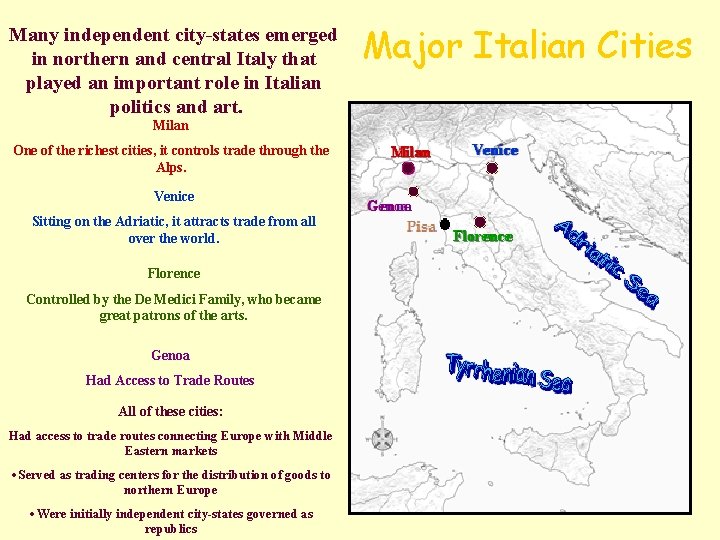
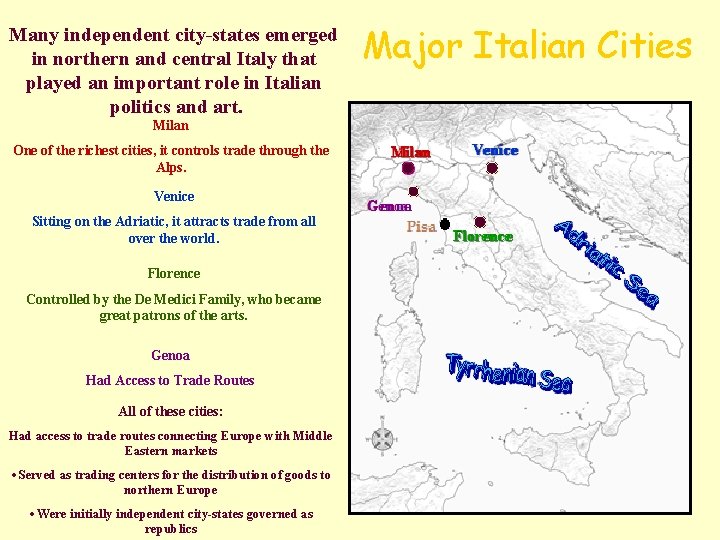
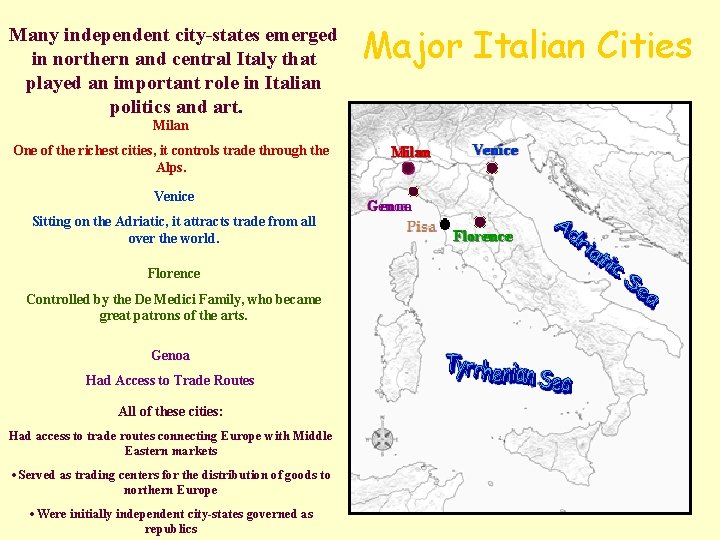
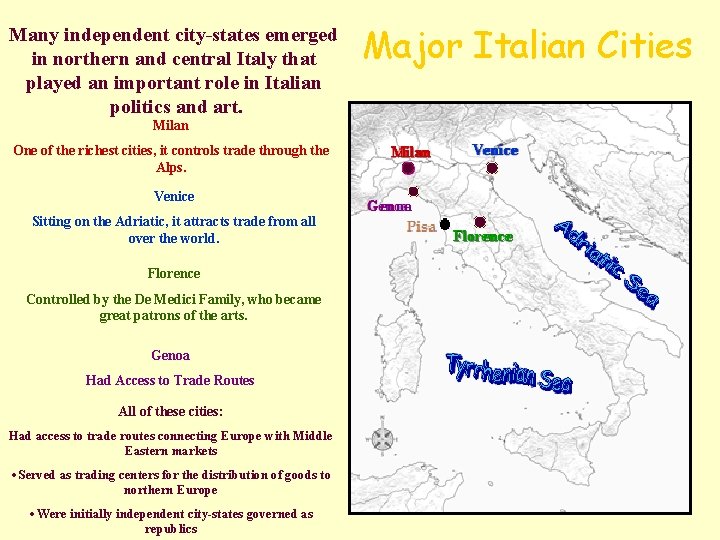
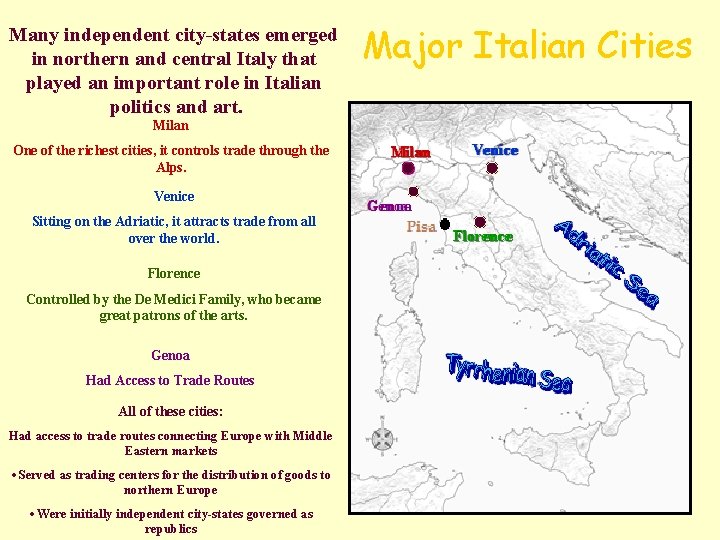
Many independent city-states emerged in northern and central Italy that played an important role in Italian politics and art. Major Italian Cities Milan One of the richest cities, it controls trade through the Alps. Venice Sitting on the Adriatic, it attracts trade from all over the world. Florence Controlled by the De Medici Family, who became great patrons of the arts. Genoa Had Access to Trade Routes All of these cities: Had access to trade routes connecting Europe with Middle Eastern markets • Served as trading centers for the distribution of goods to northern Europe • Were initially independent city-states governed as republics Milan Venice Genoa Florence
Renaissance Politics • In northern Europe, the bourgeoisie lived in the towns and the nobility resided in estates in the countryside. • In Italy the nobility had “city houses” too. • The competition amongst families and cities led to mini-revolutions in how power was structured and administered. • Until the late 1200’s (What art style pops up here? ), there is a trend/tendency towards republicanism & representative government. – Venice & Florence
Milan • Milan, the most northern of the major Italian city-states, came to dominate the Po River valley. • The city's strategic location along trade lines and as a gateway to Italy from the north necessitated a strong military state. • Due to the need for strong leadership, Milan became a strong monarchy under a succession of powerful dukes.
Milan • The Visconti family ruled as dukes almost continuously from 1317 to 1447, maintaining the stability of the volatile region through military might. • At the height of their power they controlled nearly all of northernmost Italy.
Milan • In 1447 Filippo Maria Visconti, Duke of Milan, died without a male heir; following the end of the Visconti line, the Ambrosian Republic was enacted. • The Ambrosian Republic took its name from St. Ambrose, popular patron saint of the city of Milan.
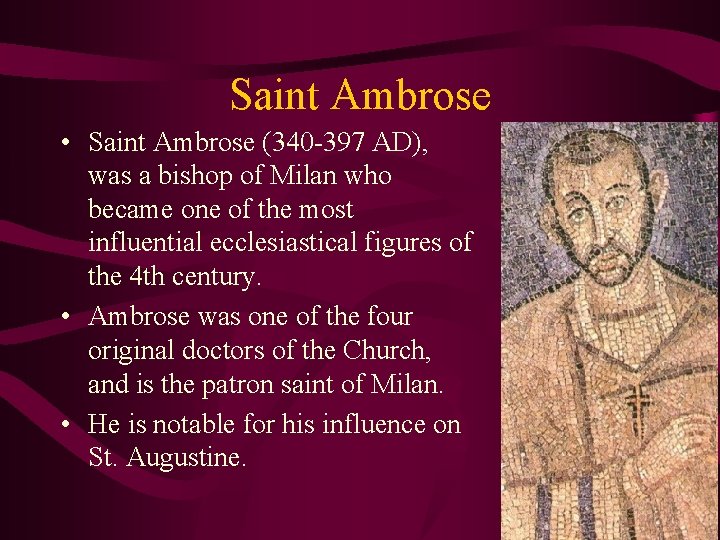
Saint Ambrose • Saint Ambrose (340 -397 AD), was a bishop of Milan who became one of the most influential ecclesiastical figures of the 4 th century. • Ambrose was one of the four original doctors of the Church, and is the patron saint of Milan. • He is notable for his influence on St. Augustine.
Milan • Aurelius Ambrosius, better known in English as Saint Ambrose (/ˈæmbroʊz/; c. 340 – 4 April 397), was a bishop of Milan who became one of the most influential ecclesiastical figures of the 4 th century. • Ambrose was one of the four original doctors of the Church, and is the patron saint of Milan. He is notable for his influence on St. Augustine.
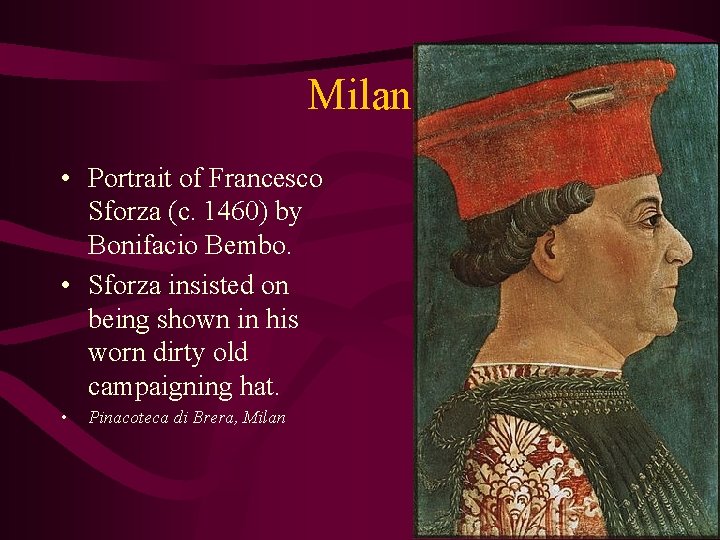
Milan • This wouldn’t last long! • The Republic collapsed when in 1450, Milan was conquered by Francesco Sforza, of the House of Sforza, who made Milan one of the leading cities of the Italian Renaissance. – Why is this guy SO familiar?
Milan • Portrait of Francesco Sforza (c. 1460) by Bonifacio Bembo. • Sforza insisted on being shown in his worn dirty old campaigning hat. • Pinacoteca di Brera, Milan
Milan • This wouldn’t last long! • The Republic collapsed when in 1450, Milan was conquered by Francesco Sforza, of the House of Sforza, who made Milan one of the leading cities of the Italian Renaissance. – Why is this guy SO familiar? – Skyler, Wyatt, Hunter put your hands down.
Milan • This wouldn’t last long! • The Republic collapsed when in 1450, Milan was conquered by Francesco Sforza, of the House of Sforza, who made Milan one of the leading cities of the Italian Renaissance. – Why is this guy SO familiar? – Skyler, Wyatt, Hunter put your hands down. – This is the guy Leonardo was working for when he built his “robot” knight, and worked up the plans for his horse – as well as building the clay model.
Milan • This wouldn’t last long! • The Republic collapsed when in 1450, Milan was conquered by Francesco Sforza, of the House of Sforza, who made Milan one of the leading cities of the Italian Renaissance. – Why is this guy SO familiar? – Skyler, Wyatt, Hunter put your hands down. – This is the guy Leonardo was working for when he built his “robot” knight, and worked up the plans for his horse – as well as building the clay model.
Milan • You may wonder why Leonardo, aged around 30, decided to move to Milan at all. • At the time (1480 s) he was living in Florence, the city of the Medici Family renowned for their art patronage which in turn attracted the most talented artists of the time such as Michelangelo and Botticelli. • Florence was however an essentially humanist city celebrating the rediscovery of the antiques and classical culture.
Milan • Milan was instead characterized by a more pragmatic approach representing therefore a cultural environment more conducive to Leonardo’s aspirations and more supportive of his experiments. The Duchy of Milan, ruled at the time by Ludovico il Moro, was wealthy, modern and industrious but not so firmly established and with a consolidated power. – No factions fighting against each other, only the joy of autocratic rule!
Milan • The ruling house of Sforza had only come to power in 1450, Milan was still at war with Venice, and coveted by other European States. • Hence, Ludovico il Moro was much interested in all of Leonardo’s war machines and other inventions which could strengthen the city as well as in his artistic skills since the Italian city-states were in constant struggle to establish their cultural supremacy.
Milan • Artists such as Leonardo da Vinci were attracted to the glamour and wealth of Milan and flocked to the city in search of commissions. • Don’t hate Leo, he’s not a sell-out. • Is it really wrong to NOT want to eat dog food when you are old?
Many independent city-states emerged in northern and central Italy that played an important role in Italian politics and art. Major Italian Cities Milan One of the richest cities, it controls trade through the Alps. Venice Sitting on the Adriatic, it attracts trade from all over the world. Florence Controlled by the De Medici Family, who became great patrons of the arts. Genoa Had Access to Trade Routes All of these cities: Had access to trade routes connecting Europe with Middle Eastern markets • Served as trading centers for the distribution of goods to northern Europe • Were initially independent city-states governed as republics Milan Venice Genoa Florence
Venice • The “Pearl of the Adriatic” • Situated on the Adriatic Sea, Venice traded with the Byzantine Empire and the Muslim world extensively. • During the late thirteenth century, Venice was the most prosperous city in all of Europe. • At the peak of its power and wealth, it had 36, 000 sailors operating 3, 300 ships, dominating Mediterranean commerce.
Venice • What happens when you have money?
Venice • During this time, Venice's leading families vied with each other to build the grandest palaces and support the work of the greatest and most talented artists. – They ripped power away from the nobility and transferred it to rich merchant families/ • The city was governed by the Great Council, which was made up of members of the most influential families in Venice. • The Great Council appointed all public officials and elected a Senate of 200 to 300
Venice • The Senate then chose the Council of Ten, a secretive group which held the utmost power in the administration of the city. • One member of the great council was elected 'doge, ' or duke, the ceremonial head of the city. • The merchant oligarchy, while sometimes harsh, squashed internal dissent and provided the city with good stable government.
Many independent city-states emerged in northern and central Italy that played an important role in Italian politics and art. Major Italian Cities Milan One of the richest cities, it controls trade through the Alps. Venice Sitting on the Adriatic, it attracts trade from all over the world. Florence Controlled by the De Medici Family, who became great patrons of the arts. Genoa Had Access to Trade Routes All of these cities: Had access to trade routes connecting Europe with Middle Eastern markets • Served as trading centers for the distribution of goods to northern Europe • Were initially independent city-states governed as republics Milan Venice Genoa Florence
Florence • Known for: – Wool, leather silk industries • Florence had some of the richest merchants and bankers in all of Europe. • Its gold coin circulated in many lands as the official coin of that land.
Florence • Known for: – Wool, leather silk industries • Florence had some of the richest merchants and bankers in all of Europe. • Its gold coin the florin circulated in many lands as the official coin of that land. – You know you have power when OTHER countries use your money. • Who’s traveled outside the U. S. ? • Florence had a complex constitution with checks and counter-checks on power.
Florence • Examples? – The head of state only had power for two months – All measures needed a 2/3’s majority • In theory it was a democracy but like Venice it was controlled by the wealth elite. • With time (as we approach the Renaissance), most of the city states, except Venice, fall into despotism and Florence is no exception. • Anyone know the family that comes to dominate Florence? – They have no noble blood lines; just filthy rich.
Florence • The Medici family, also known as the House of Medici, first attained wealth and political power in Florence in the 13 th century through its success in commerce and banking. • Beginning in 1434 with the rise to power of Cosimo de’ Medici (or Cosimo the Elder), the family’s support of the arts and humanities made Florence into the cradle of the Renaissance, a cultural flowering rivaled only by that of ancient Greece.
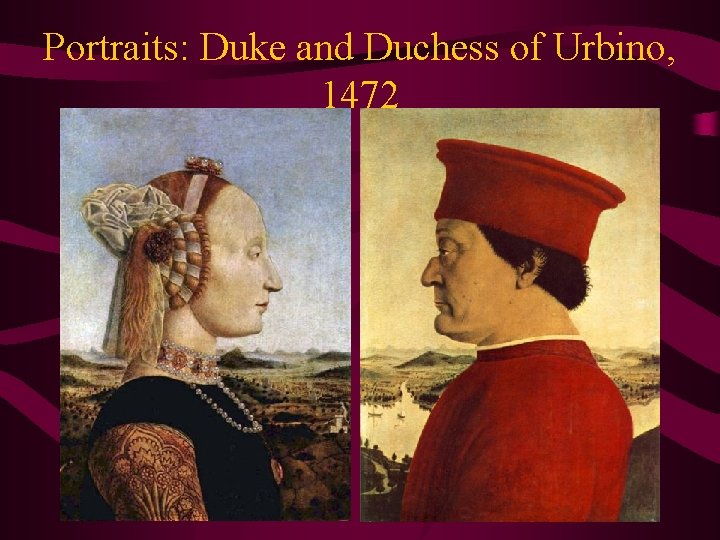
Portraits: Duke and Duchess of Urbino, 1472
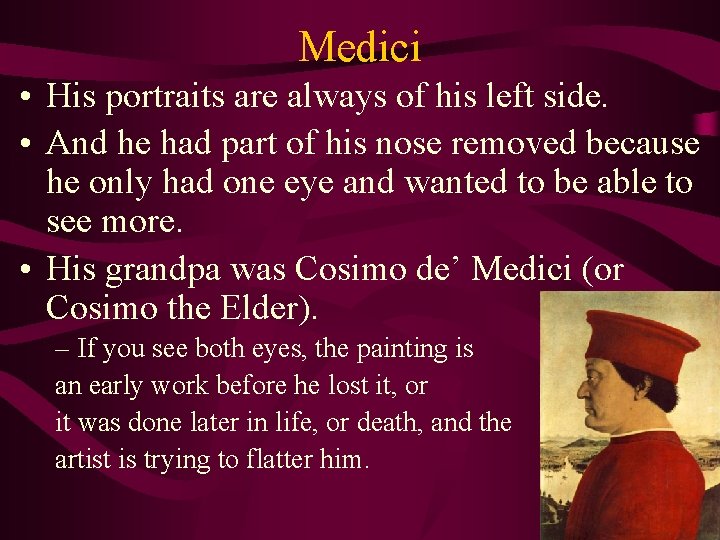
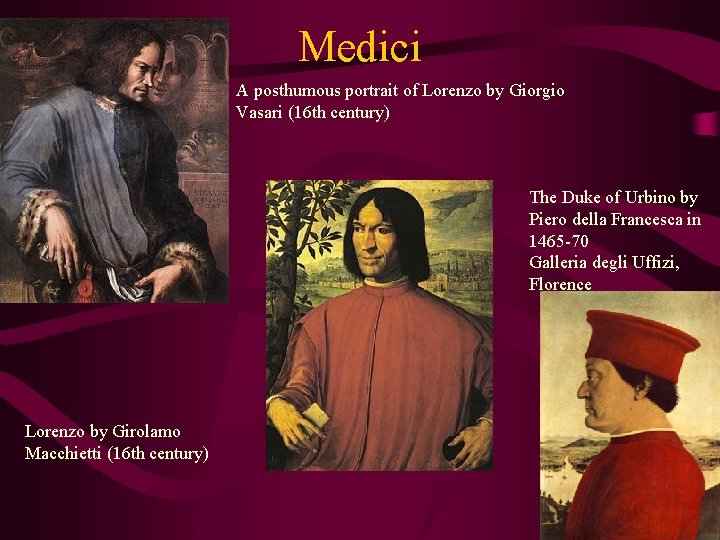
Medici • Lorenzo de' Medici (1449 – 1492) was an Italian statesman and de facto ruler of the Florentine Republic, who was one of the most powerful and enthusiastic patrons of the Renaissance. – Also known as Lorenzo the Magnificent by contemporary Florentines, he was a magnate/mogul/baron/rich businessman, diplomat, politician and patron of scholars, artists and poets. • He is well known for his contribution to the art world by sponsoring artists such as Botticelli and Michelangelo.
Medici • His portraits are always of his left side. • And he had part of his nose removed because he only had one eye and wanted to be able to see more. • His grandpa was Cosimo de’ Medici (or Cosimo the Elder). – If you see both eyes, the painting is an early work before he lost it, or it was done later in life, or death, and the artist is trying to flatter him.
Medici A posthumous portrait of Lorenzo by Giorgio Vasari (16 th century) The Duke of Urbino by Piero della Francesca in 1465 -70 Galleria degli Uffizi, Florence Lorenzo by Girolamo Macchietti (16 th century)
Florence • The Medicis produced four popes (Leo X, Clement VII, Pius IV and Leon XI), and their genes have been mixed into many of Europe’s royal families. • The last Medici ruler died without a male heir in 1737, ending the family dynasty after almost three centuries.
Florence • Why are the Medici’s important? • There are several “bloodlines” but all Medici’s seem to have certain hereditary traits. . . – In the first place, not being soldiers, they were constantly confronting their adversaries with bribes of gold rather than with battalions of armed men. – In addition, the early Medici resolutely courted favor with the middle and poorer classes in the city, and this determination to be popolani (“plebeian”) endured a long time after them. – Finally, all were consumed by a passion for arts and letters and for building.
Many independent city-states emerged in northern and central Italy that played an important role in Italian politics and art. Major Italian Cities Milan One of the richest cities, it controls trade through the Alps. Venice Sitting on the Adriatic, it attracts trade from all over the world. Florence Controlled by the De Medici Family, who became great patrons of the arts. Genoa Had Access to Trade Routes All of these cities: Had access to trade routes connecting Europe with Middle Eastern markets • Served as trading centers for the distribution of goods to northern Europe • Were initially independent city-states governed as republics Milan Venice Genoa Florence
Genoa • Genoa is located on Italy's north-western coastline. It was considered one of Italy's greatest mercantile (commercial) powers during the Middle Ages. • Genoa was also an important sea port during the time of the Roman Empire, due to its position at the crossroads of Italy and Northern Europe and its natural harbor, which is located in the deepest gulf of the Mediterranean Sea. • It’s been important for a long time.
Genoa • Okay, so while I was going through my musty books and grabbing pictures online I found this little gem: • “During the Middle Ages, Genoa was a rival power to the eastern Italian trading ports of Venice and Pisa. ” • This is half true. – Care to catch the mistake?
Many independent city-states emerged in northern and central Italy that played an important role in Italian politics and art. Major Italian Cities Milan One of the richest cities, it controls trade through the Alps. Venice Sitting on the Adriatic, it attracts trade from all over the world. Florence Controlled by the De Medici Family, who became great patrons of the arts. Genoa Had Access to Trade Routes All of these cities: Had access to trade routes connecting Europe with Middle Eastern markets • Served as trading centers for the distribution of goods to northern Europe • Were initially independent city-states governed as republics Milan Venice Genoa Florence
Genoa • LIFE BIG IDEA: • DON’T ACCEPT SOURCES AS THE GOSPEL TRUTH.
Genoa • LIFE BIG IDEA: • DON’T ACCEPT SOURCES AS THE GOSPEL TRUTH. • ESPECIALLY ONLINE.
Genoa • LIFE BIG IDEA: • DON’T ACCEPT SOURCES AS THE GOSPEL TRUTH. • ESPECIALLY ONLINE. • ESPECIALLY WIKIPEDIA!!!
Genoa • The state was managed as a business affair, to the common profit of the ruling families— such as the Spinola, Fieschi, Grimaldi, and Doria—and generally to the advantage of the whole population. • The form of government changed and evolved, so that by the second half of the 13 th century “captains of the people” were governing with unlimited tenure and with the support of the guilds. – Remember what I said about the trend towards despots?
Genoa • Genoa’s political zenith/apex/height was marked by a crushing naval victory over the Pisans at Meloria (1284) and a less decisive one over the Venetians at Curzola (1298). • After that… Genoa’s class and party struggles kept the government in perpetual turmoil, and public finances were ruined by war. • After emerging from periods of French domination (1394– 1409) and Milanese overlordship (1421– 35), Genoa was no longer a great power.
Genoa • But Genoa has given us something that most of us use weekly if not daily. • Anyone know what it is? • Some call them the “southern necessity”.
Genoa • But Genoa has given us something that most of us use weekly if not daily. • Anyone know what it is? • Some call them the “southern necessity”. • The word “jeans” derives from the Frenchlanguage name for the city (Genes), as the blue canvas trousers were initially associated with Genoese sailors, before becoming famous on the bodies of California miners, and later, the rest of America.
Faith • It seems Christian art is never without a nod to classicism, but where early Christians utilized Roman religious symbols, Renaissance Christians embraced both the art and philosophy of the ancients. • As the Middle Ages was ending, the rediscovery of Greco-Roman artwork complemented and mirrored a shift in ideology in Europe.
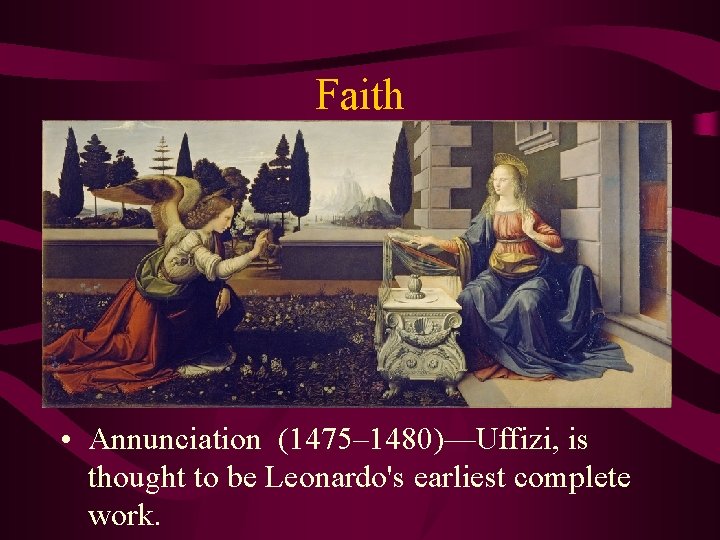
Faith • Annunciation (1475– 1480)—Uffizi, is thought to be Leonardo's earliest complete work.
Faith • “The development of the Julian High Renaissance was supported by the pope’s interest in the grandeur of ancient Rome…and by the sensational discovery of the sculptural group of ‘Laocoön and His Sons’” (Hartt 494). • In form, Renaissance artist began to replicate the artists of antiquity in their idealization of the human form. • With this we see a blending of the Catholic Church and ancient learning.
Faith • Explosion of art patronage, from the Vatican all the way down. • Also see it in writings: – Italian influence reached northern Europe and inspired similar values and ideas – Europeans stressed more in the way of social reform – Northern Renaissance Humanists sought to create a “perfect” world
Faith • Erasmus: education makes reform possible; Christianity comes from within – “from the effort to align the heart and spirit with worldly values” – focused on developing peaceful kingdoms, based on piety and learning and charity/good works - curbing the power of “Christian” princes, clerical corruption • Thomas More’s Utopian vision – communal world where an equal distribution of goods/services - public schools, communal kitchens, hospitals, nurseries - and no private property or money allowed people to pursue knowledge and natural religions
Faith • Side note on Utopia. • "Utopia" is derived from the Greek prefix "ou -"(ou), meaning "not", and topos (τόπος), "place", with the suffix -iā (-ία); hence the name literally means "nowhere. ” • It doesn’t exist and never will. • It’s a rip on man and civilization.
Faith • The divine becomes tangible. • To me, it is the overriding theme of the Renaissance when it comes to faith and art.