
The Renaissance c 1400 1600 FC 74 THE














- Slides: 130
The Renaissance (c. 1400 -1600)
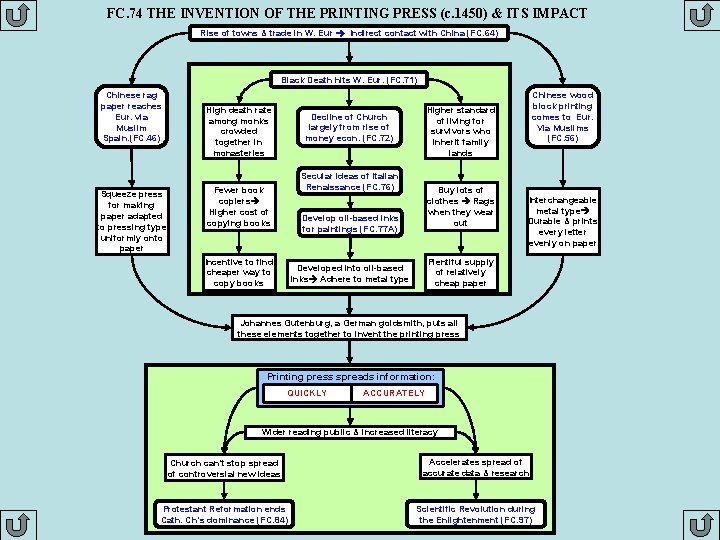
FC. 74 THE INVENTION OF THE PRINTING PRESS (c. 1450) & ITS IMPACT Rise of towns & trade in W. Eur Indirect contact with China (FC. 64) Black Death hits W. Eur. (FC. 71) Chinese rag paper reaches Eur. via Muslim Spain. (FC. 46) Squeeze press for making paper adapted to pressing type uniformly onto paper High death rate among monks crowded together in monasteries Higher standard of living for survivors who inherit family lands Decline of Church largely from rise of money econ. (FC. 72) Secular ideas of Italian Renaissance (FC. 76) Fewer book copiers Higher cost of copying books Buy lots of clothes Rags when they wear out Develop oil-based inks for paintings (FC. 77 A) Incentive to find cheaper way to copy books Chinese wood block printing comes to Eur. Via Muslims (FC. 56) Interchangeable metal type Durable & prints every letter evenly on paper Plentiful supply of relatively cheap paper Developed into oil-based inks Adhere to metal type Johannes Gutenburg, a German goldsmith, puts all these elements together to invent the printing press Printing press spreads information: QUICKLY ACCURATELY Wider reading public & increased literacy Church can’t stop spread of controversial new ideas Accelerates spread of accurate data & research Protestant Reformation ends Cath. Ch’s dominance (FC. 84) Scientific Revolution during the Enlightenment (FC. 97)
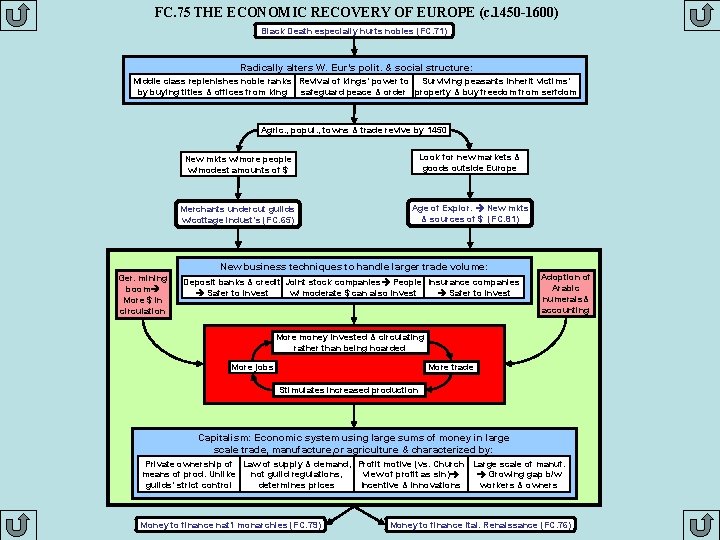
FC. 75 THE ECONOMIC RECOVERY OF EUROPE (c. 1450 -1600) Black Death especially hurts nobles (FC. 71) Radically alters W. Eur’s polit. & social structure: Middle class replenishes noble ranks Revival of kings’ power to Surviving peasants inherit victims’ by buying titles & offices from king safeguard peace & order property & buy freedom from serfdom Agric. , popul. , towns & trade revive by 1450 New mkts w/more people w/modest amounts of $ Look for new markets & goods outside Europe Merchants undercut guilds w/cottage indust’s (FC. 65) Age of Explor. New mkts & sources of $ (FC. 81) New business techniques to handle larger trade volume: Ger. mining boom More $ in circulation Deposit banks & credit Joint stock companies People Insurance companies Safer to invest w/ moderate $ can also invest Safer to invest Adoption of Arabic numerals& accounting More money invested & circulating rather than being hoarded More jobs More trade Stimulates increased production Capitalism: Economic system using large sums of money in large scale trade, manufacture, or agriculture & characterized by: Private ownership of Law of supply & demand, Profit motive (vs. Church Large scale of manuf. view of profit as sin) Growing gap b/w means of prod. Unlike not guild regulations, guilds’ strict control determines prices Incentive & innovations workers & owners Money to finance nat’l monarchies (FC. 79) Money to finance Ital. Renaissance (FC. 76)
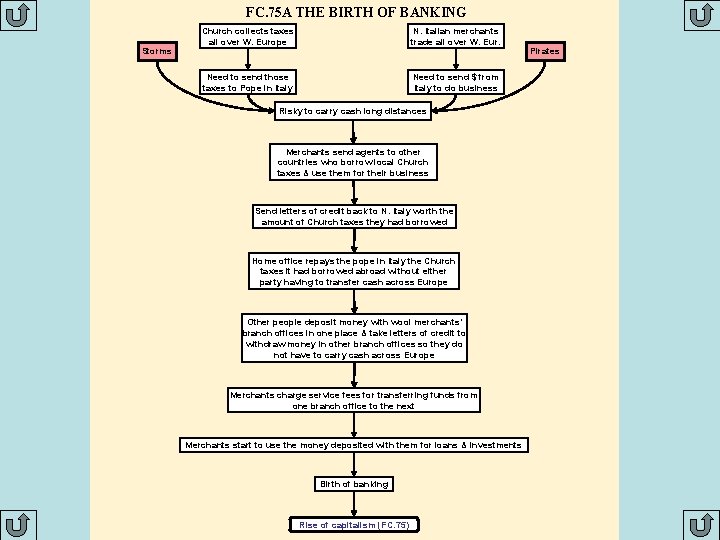
FC. 75 A THE BIRTH OF BANKING Storms Church collects taxes all over W. Europe N. Italian merchants trade all over W. Eur. Need to send those taxes to Pope in Italy Need to send $ from Italy to do business Risky to carry cash long distances Merchants send agents to other countries who borrow local Church taxes & use them for their business Send letters of credit back to N. Italy worth the amount of Church taxes they had borrowed Home office repays the pope in Italy the Church taxes it had borrowed abroad without either party having to transfer cash across Europe Other people deposit money with wool merchants’ branch offices in one place & take letters of credit to withdraw money in other branch offices so they do not have to carry cash across Europe Merchants charge service fees for transferring funds from one branch office to the next Merchants start to use the money deposited with them for loans & investments Birth of banking Rise of capitalism (FC. 75) Pirates
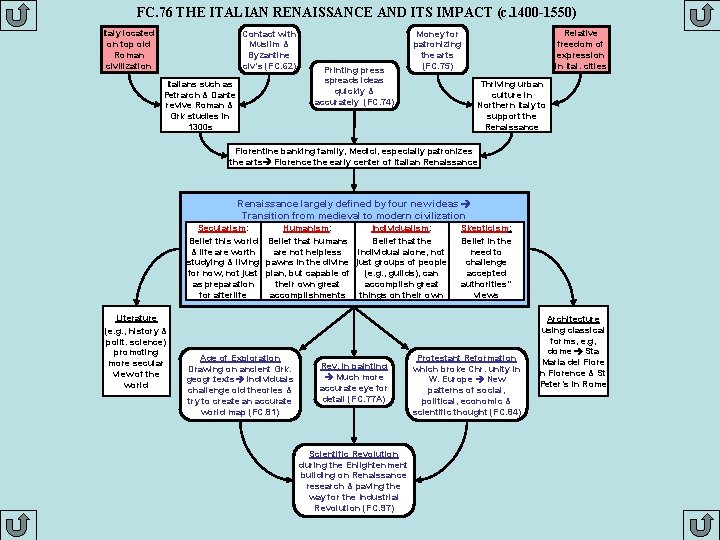
FC. 76 THE ITALIAN RENAISSANCE AND ITS IMPACT (c. 1400 -1550) Italy located on top old Roman civilization Contact with Muslim & Byzantine civ’s (FC. 62) Italians such as Petrarch & Dante revive Roman & Grk studies in 1300 s Printing press spreads ideas quickly & accurately (FC. 74) Relative freedom of expression in Ital. cities Money for patronizing the arts (FC. 75) Thriving urban culture in Northern Italy to support the Renaissance Florentine banking family, Medici, especially patronizes the arts Florence the early center of Italian Renaissance largely defined by four new ideas Transition from medieval to modern civilization Secularism: Humanism: Individualism: Belief this world Belief that humans Belief that the & life are worth are not helpless individual alone, not studying & living pawns in the divine just groups of people for now, not just plan, but capable of (e. g. , guilds), can as preparation their own great accomplish great for afterlife accomplishments things on their own Literature (e. g. , history & polit. science) promoting more secular view of the world Age of Exploration Drawing on ancient Grk. geogr. texts individuals challenge old theories & try to create an accurate world map (FC. 81) Rev. in painting Much more accurate eye for detail (FC. 77 A) Scientific Revolution during the Enlightenment building on Renaissance research & paving the way for the Industrial Revolution (FC. 97) Skepticism: Belief in the need to challenge accepted authorities” views Protestant Reformation which broke Chr. unity in W. Europe New patterns of social, political, economic & scientific thought (FC. 84) Architecture using classical forms, e. g, dome Sta Maria del Fiore in Florence & St. Peter’s in Rome
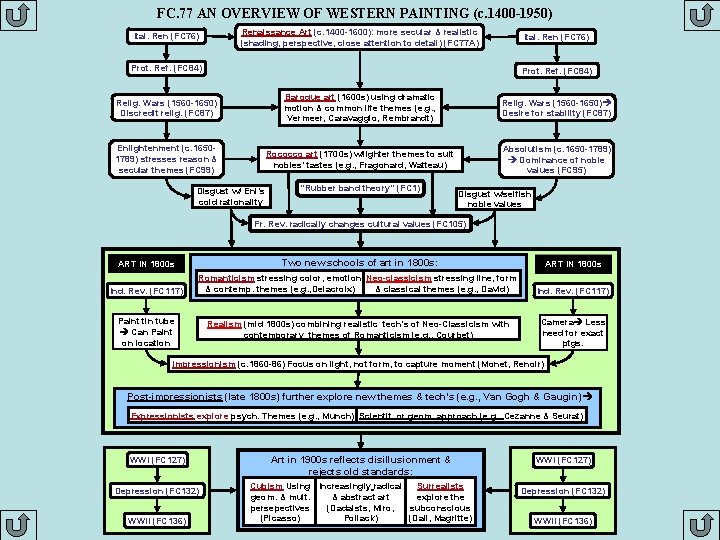
FC. 77 AN OVERVIEW OF WESTERN PAINTING (c. 1400 -1950) Renaissance Art (c. 1400 -1600): more secular & realistic (shading, perspective, close attention to detail) (FC 77 A) Ital. Ren (FC 76) A Ital. Ren (FC 76) Prot. Ref. (FC 84) Relig. Wars (1560 -1650) Discredit relig. (FC 87) Baroque art (1600 s) using dramatic motion & common life themes (e. g. , Vermeer, Caravaggio, Rembrandt) Relig. Wars (1560 -1650) Desire for stability (FC 87) Enlightenment (c. 16501789) stresses reason & secular themes (FC 99) Rococco art (1700 s) w/lighter themes to suit nobles’ tastes (e. g. , Fragonard, Watteau) Absolutism (c. 1650 -1789) Dominance of noble values (FC 95) Disgust w/ Enl’s cold rationality “Rubber band theory” (FC 1) Disgust w/selfish noble values Fr. Rev. radically changes cultural values (FC 105) ART IN 1800 s Two new schools of art in 1800 s: ART IN 1800 S 1800 s Ind. Rev. (FC 117) Romanticism stressing color, emotion Neo-classicism stressing line, form & contemp. themes (e. g. , Delacroix) & classical themes (e. g. , David) Ind. Rev. (FC 117) Paint tin tube Can Paint on location Realism (mid 1800 s) combining realistic tech’s of Neo-Classicism with contemporary themes of Romanticism (e. g. , Courbet) Camera Less need for exact ptgs. Impressionism (c. 1860 -86) Focus on light, not form, to capture moment (Monet, Renoir) Post-impressionists (late 1800 s) further explore new themes & tech’s (e. g. , Van Gogh & Gaugin) Expressionists explore psych. Themes (e. g. , Munch) Scientif. or geom. approach (e. g. , Cezanne & Seurat) WWI (FC 127) Depression (FC 132) WWII (FC 136) Art in 1900 s reflects disillusionment & rejects old standards: Cubism Using Increasingly radical Surrealists geom. & mult. & abstract art explore the persepectives (Dadaists, Miro, subconscious (Picasso) Pollack) (Dali, Magritte) WWI (FC 127) Depression (FC 132) WWII (FC 136)
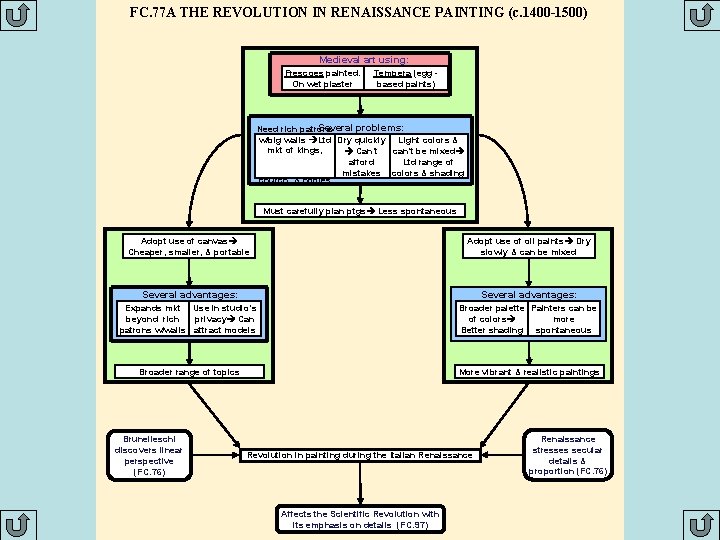
FC. 77 A THE REVOLUTION IN RENAISSANCE PAINTING (c. 1400 -1500) Medieval art using: Frescoes painted. On wet plaster Tempera (egg based paints) Several problems: Need rich patrons w/big walls Ltd Dry quickly Light colors & mkt of kings, can’t be mixed Can’t Ltd range of afford mistakes colors & shading church, & nobles Must carefully plan ptgs Less spontaneous Adopt use of canvas Cheaper, smaller, & portable Adopt use of oil paints Dry slowly & can be mixed Several advantages: Expands mkt Use in studio’s privacy Can beyond rich patrons w/walls attract models Broader palette Painters can be of colors more Better shading spontaneous Broader range of topics More vibrant & realistic paintings Brunelleschi discovers linear perspective (FC. 76) Revolution in painting during the Italian Renaissance Affects the Scientific Revolution with its emphasis on details (FC. 97) Renaissance stresses secular details & proportion (FC. 76)
FC. 78 THE NORTHERN RENAISSANCE AND ITS IMPACT (c. 1400 -1550) Money from colonies after 1550 (FC. 81) Rise of national monarchies by 1500 (FC. 79) Towns & trade revive in NW Europe after 1450 (FC. 75) Printing press spreads Ren. ideas (FC. 74) More money for patronizing the arts French invade Italy in 1494 (FC. 79) Church loses some, but not all influence Trade & contact with ideas of the Italian Renaissance Northern Renaissance (c. 1500 -1600) which differs from Italian Ren. in two ways: More religious fervor Each nation’s Ren. is than in Italy Scholars unique (e. g. , literature study Bible in original written in vernacular, not Greek & Hebrew Latin) Ren. Learning, rising power of kings vs. popes, religious fervor, & anger at Church abuses Protestant Reformation (FC. 84) Opens way for new ideas about money Rise of capitalism (FC. 75) Opens way for more secular ideas of the state, including democracy (FC. 85 A) Scientific Revolution Breaks Church monopoly on learning Scientific Revolution (FC. 97)
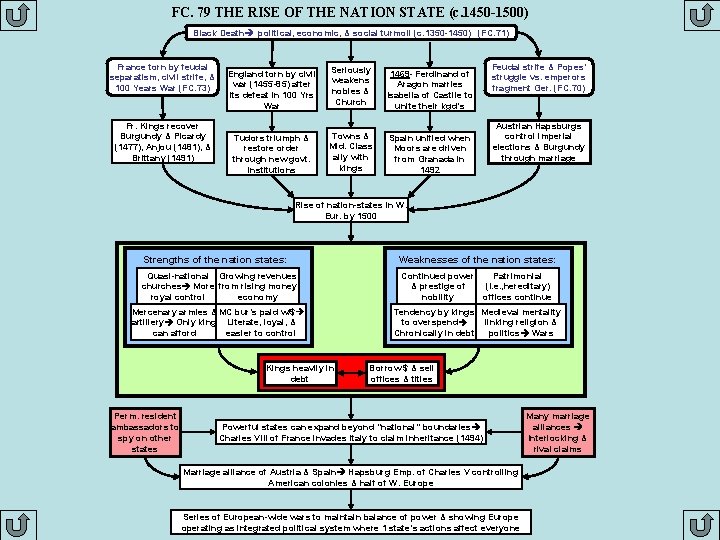
FC. 79 THE RISE OF THE NATION STATE (c. 1450 -1500) Black Death political, economic, & social turmoil (c. 1350 -1450) (FC. 71) France torn by feudal separatism, civil strife, & 100 Years War (FC. 73) Fr. Kings recover Burgundy & Picardy (1477), Anjou (1481), & Brittany (1491) England torn by civil war (1455 -85) after its defeat in 100 Yrs War Seriously weakens nobles & Church 1469 - Ferdinand of Aragon marries Isabella of Castile to unite their kgd’s Tudors triumph & restore order through new govt. institutions Towns & Mid. Class ally with kings Spain unified when Moors are driven from Granada in 1492 Feudal strife & Popes’ struggle vs. emperors fragment Ger. (FC. 70) Austrian Hapsburgs control imperial elections & Burgundy through marriage Rise of nation-states in W. Eur. by 1500 Strengths of the nation states: Weaknesses of the nation states: Quasi-national Growing revenues churches More from rising money royal control economy Continued power Patrimonial & prestige of (I. e. , hereditary) nobility offices continue Mercenary armies & MC bur’s paid w/$ artillery Only king Literate, loyal, & can afford easier to control Tendency by kings Medieval mentality to overspend linking religion & politics Wars Chronically in debt Kings heavily in debt Perm. resident ambassadors to spy on other states Borrow $ & sell offices & titles Powerful states can expand beyond “national” boundaries Charles VIII of France invades Italy to claim inheritance (1494) Marriage alliance of Austria & Spain Hapsburg Emp. of Charles V controlling American colonies & half of W. Europe Series of European-wide wars to maintain balance of power & showing Europe operating as integrated political system where 1 state’s actions affect everyone Many marriage alliances Interlocking & rival claims
The Age of Exploration (c. 1400 -1900)
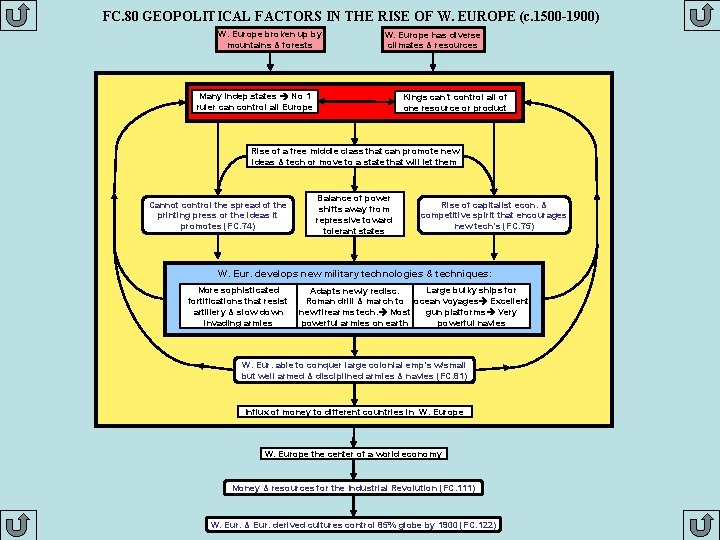
FC. 80 GEOPOLITICAL FACTORS IN THE RISE OF W. EUROPE (c. 1500 -1900) W. Europe broken up by mountains & forests W. Europe has diverse climates & resources Many indep. states No 1 ruler can control all Europe Kings can’t control all of one resource or product Rise of a free middle class that can promote new ideas & tech or move to a state that will let them Cannot control the spread of the printing press or the ideas it promotes (FC. 74) Balance of power shifts away from repressive toward tolerant states Rise of capitalist econ. & competitive spirit that encourages new tech’s (FC. 75) W. Eur. develops new military technologies & techniques: More sophisticated fortifications that resist artillery & slow down invading armies Large bulky ships for Adapts newly redisc. Roman drill & march to ocean voyages Excellent gun platforms Very new firearms tech. Most powerful navies powerful armies on earth W. Eur. able to conquer large colonial emp’s w/small but well armed & disciplined armies & navies (FC. 81) Influx of money to different countries in W. Europe the center of a world economy Money & resources for the Industrial Revolution (FC. 111) W. Eur. & Eur. derived cultures control 85% globe by 1900 (FC. 122)
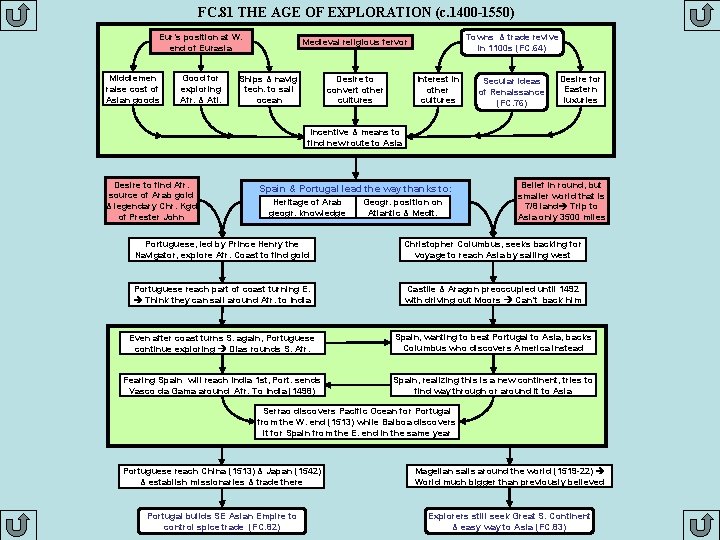
FC. 81 THE AGE OF EXPLORATION (c. 1400 -1550) Eur’s position at W. end of Eurasia Middlemen raise cost of Asian goods Good for exploring Afr. & Atl. Towns & trade revive in 1100 s (FC. 64) Medieval religious fervor Ships & navig. tech. to sail ocean Desire to convert other cultures Interest in other cultures Secular ideas of Renaissance (FC. 76) Desire for Eastern luxuries Incentive & means to find new route to Asia Desire to find Afr. source of Arab gold & legendary Chr. Kgd of Prester John Spain & Portugal lead the way thanks to: Heritage of Arab geogr. knowledge Geogr. position on Atlantic & Medit. Belief in round, but smaller world that is 7/8 land Trip to Asia only 3500 miles Portuguese, led by Prince Henry the Navigator, explore Afr. Coast to find gold Christopher Columbus, seeks backing for voyage to reach Asia by sailing west Portuguese reach part of coast turning E. Think they can sail around Afr. to India Castile & Aragon preoccupied until 1492 with driving out Moors Can’t back him Even after coast turns S. again, Portuguese continue exploring Dias rounds S. Afr. Spain, wanting to beat Portugal to Asia, backs Columbus who discovers America instead Fearing Spain will reach India 1 st, Port. sends Vasco da Gama around Afr. To India (1498) Spain, realizing this is a new continent, tries to find way through or around it to Asia Serrao discovers Pacific Ocean for Portugal from the W. end (1513) while Balboa discovers it for Spain from the E. end in the same year Portuguese reach China (1513) & Japan (1542) & establish missionaries & trade there Magellan sails around the world (1519 -22) World much bigger than previously believed Portugal builds SE Asian Empire to control spice trade (FC. 82) Explorers still seek Great S. Continent & easy way to Asia (FC. 83)
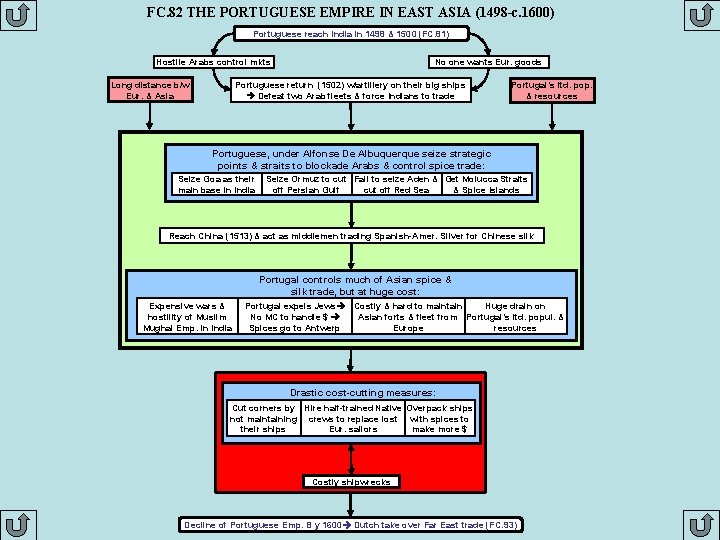
FC. 82 THE PORTUGUESE EMPIRE IN EAST ASIA (1498 -c. 1600) Portuguese reach India in 1498 & 1500 (FC. 81) Hostile Arabs control mkts Long distance b/w Eur. & Asia No one wants Eur. goods Portuguese return (1502) w/artillery on their big ships Defeat two Arab fleets & force Indians to trade Portugal’s ltd. pop. & resources Portuguese, under Alfonse De Albuquerque seize strategic points & straits to blockade Arabs & control spice trade: Seize Goa as their main base in India Seize Ormuz to cut Fail to seize Aden & Get Molucca Straits off Persian Gulf cut off Red Sea & Spice Islands Reach China (1513) & act as middlemen trading Spanish-Amer. Silver for Chinese silk Portugal controls much of Asian spice & silk trade, but at huge cost: Expensive wars & hostility of Muslim Mughal Emp. in India Portugal expels Jews Costly & hard to maintain Huge drain on No MC to handle $ Asian forts & fleet from Portugal’s ltd. popul. & Spices go to Antwerp Europe resources Drastic cost-cutting measures: Cut corners by Hire half-trained Native Overpack ships not maintaining crews to replace lost with spices to their ships Eur. sailors make more $ Costly shipwrecks Decline of Portuguese Emp. B y 1600 Dutch take over Far East trade (FC. 93)
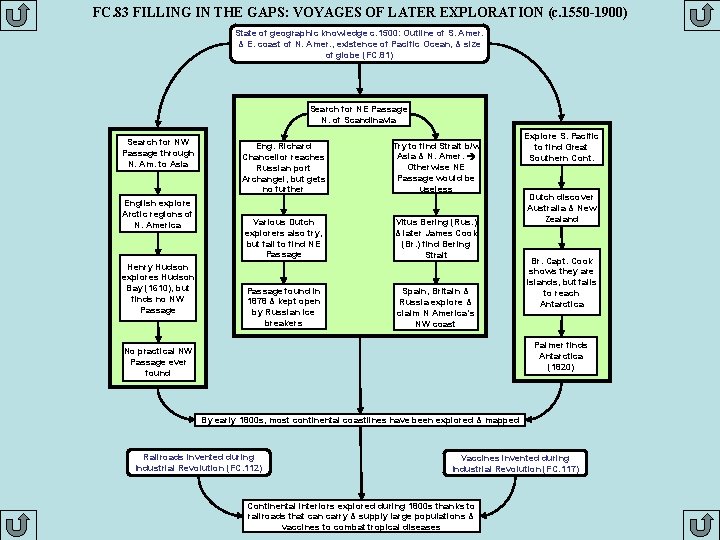
FC. 83 FILLING IN THE GAPS: VOYAGES OF LATER EXPLORATION (c. 1550 -1900) State of geographic knowledge c. 1500: Outline of S. Amer. & E. coast of N. Amer. , existence of Pacific Ocean, & size of globe (FC. 81) Search for NE Passage N. of Scandinavia Search for NW Passage through N. Am. to Asia English explore Arctic regions of N. America Henry Hudson explores Hudson Bay (1610), but finds no NW Passage Eng. Richard Chancellor reaches Russian port Archangel, but gets no further Try to find Strait b/w Asia & N. Amer. Otherwise NE Passage would be useless Various Dutch explorers also try, but fail to find NE Passage Vitus Bering (Rus. ) & later James Cook (Br. ) find Bering Strait Passage found in 1878 & kept open by Russian ice breakers Spain, Britain & Russia explore & claim N America’s NW coast Explore S. Pacific to find Great Southern Cont. Dutch discover Australia & New Zealand Br. Capt. Cook shows they are islands, but fails to reach Antarctica Palmer finds Antarctica (1820) No practical NW Passage ever found By early 1800 s, most continental coastlines have been explored & mapped Railroads invented during Industrial Revolution (FC. 112) Vaccines invented during Industrial Revolution (FC. 117) Continental interiors explored during 1800 s thanks to railroads that can carry & supply large populations & vaccines to combat tropical diseases
The Reformation (1517 -60)
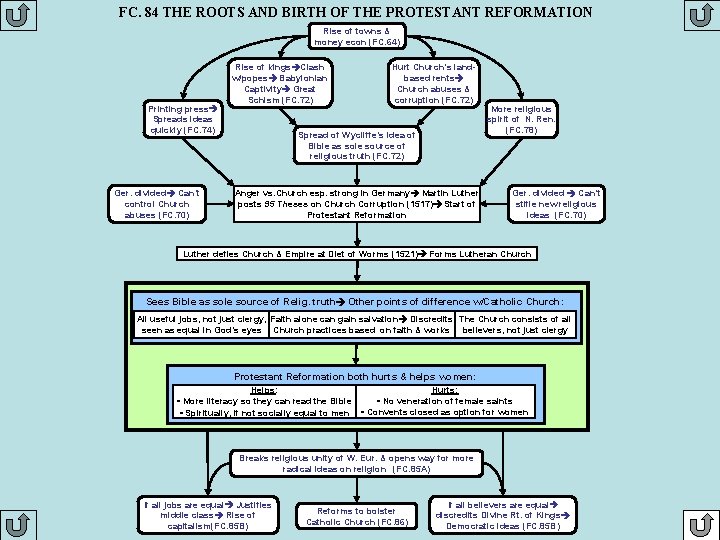
FC. 84 THE ROOTS AND BIRTH OF THE PROTESTANT REFORMATION Rise of towns & money econ (FC. 64) Printing press Spreads ideas quickly (FC. 74) Ger. divided Can’t control Church abuses (FC. 70) Rise of kings Clash w/popes Babylonian Captivity Great Schism (FC. 72) Hurt Church’s landbased rents Church abuses & corruption (FC. 72) Spread of Wycliffe’s idea of Bible as sole source of religious truth (FC. 72) Anger vs. Church esp. strong in Germany Martin Luther posts 95 Theses on Church Corruption (1517) Start of Protestant Reformation More religious spirit of N. Ren. (FC. 78) Ger. divided Can’t stifle new religious ideas (FC. 70) Luther defies Church & Empire at Diet of Worms (1521) Forms Lutheran Church Sees Bible as sole source of Relig. truth Other points of difference w/Catholic Church: All useful jobs, not just clergy, Faith alone can gain salvation Discredits The Church consists of all seen as equal in God’s eyes Church practices based on faith & works believers, not just clergy Protestant Reformation both hurts & helps women: Hurts: Helps: • No veneration of female saints • More literacy so they can read the Bible • Spiritually, if not socially equal to men • Convents closed as option for women Breaks religious unity of W. Eur. & opens way for more radical ideas on religion (FC. 85 A) If all jobs are equal Justifies middle class Rise of capitalism(FC. 85 B) Reforms to bolster Catholic Church (FC. 86) If all believers are equal discredits Divine Rt. of Kings Democratic ideas (FC. 85 B)
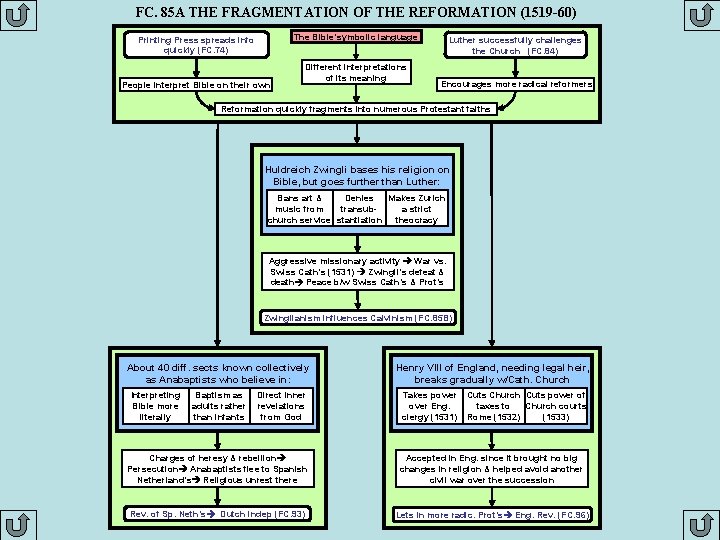
FC. 85 A THE FRAGMENTATION OF THE REFORMATION (1519 -60) The Bible’symbolic language Printing Press spreads info quickly (FC. 74) People interpret Bible on their own Different interpretations of its meaning Luther successfully challenges the Church (FC. 84) Encourages more radical reformers Reformation quickly fragments into numerous Protestant faiths Huldreich Zwingli bases his religion on Bible, but goes further than Luther: Bans art & Denies Makes Zurich music from transuba strict church service stantiation theocracy Aggressive missionary activity War vs. Swiss Cath’s (1531) Zwingli’s defeat & death Peace b/w Swiss Cath’s & Prot’s Zwinglianism influences Calvinism (FC. 85 B) About 40 diff. sects known collectively as Anabaptists who believe in: Interpreting Bible more literally Baptism as adults rather than infants Direct inner revelations from God Henry VIII of England, needing legal heir, breaks gradually w/Cath. Church Takes power over Eng. clergy (1531) Cuts Church Cuts power of taxes to Church courts Rome (1532) (1533) Charges of heresy & rebellion Persecution Anabaptists flee to Spanish Netherland’s Religious unrest there Accepted in Eng. since it brought no big changes in religion & helped avoid another civil war over the succession Rev. of Sp. Neth’s Dutch indep (FC. 93) Lets in more radic. Prot’s Eng. Rev. (FC. 96)
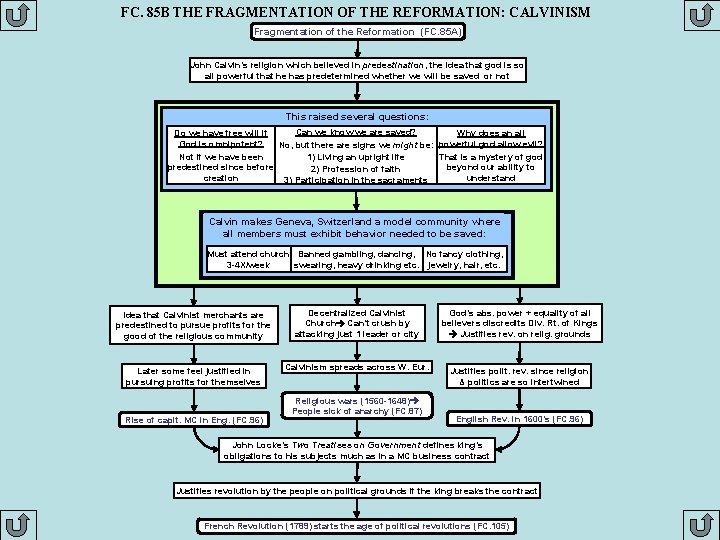
FC. 85 B THE FRAGMENTATION OF THE REFORMATION: CALVINISM Fragmentation of the Reformation (FC. 85 A) John Calvin’s religion which believed in predestination, the idea that god is so all powerful that he has predetermined whether we will be saved or not This raised several questions: Can we know we are saved? Do we have free will if Why does an all God is omnipotent? No, but there are signs we might be: powerful god allow evil? Not if we have been That is a mystery of god 1) Living an upright life predestined since before beyond our ability to 2) Profession of faith creation understand 3) Participation in the sacraments Calvin makes Geneva, Switzerland a model community where all members must exhibit behavior needed to be saved: Must attend church Banned gambling, dancing, No fancy clothing, 3 -4 X/week swearing, heavy drinking etc. jewelry, hair, etc. Idea that Calvinist merchants are predestined to pursue profits for the good of the religious community Decentralized Calvinist Church Can’t crush by attacking just 1 leader or city God’s abs. power + equality of all believers discredits Div. Rt. of Kings Justifies rev. on relig. grounds Later some feel justified in pursuing profits for themselves Calvinism spreads across W. Eur. Justifies polit. rev. since religion & politics are so intertwined Rise of capit. MC in Eng. (FC. 96) Religious wars (1560 -1648) People sick of anarchy (FC. 87) English Rev. in 1600’s (FC. 96) John Locke’s Two Treatises on Government defines king’s obligations to his subjects much as in a MC business contract Justifies revolution by the people on political grounds if the king breaks the contract French Revolution (1789) starts the age of political revolutions (FC. 105)
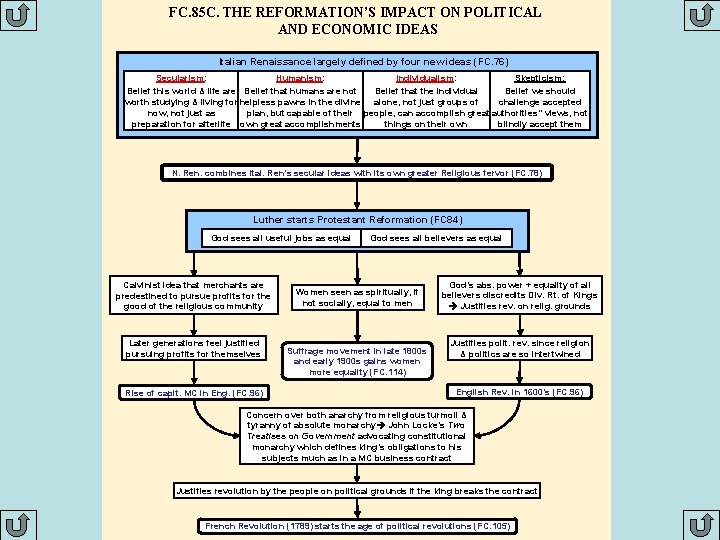
FC. 85 C. THE REFORMATION’S IMPACT ON POLITICAL AND ECONOMIC IDEAS Italian Renaissance largely defined by four new ideas (FC. 76) Secularism: Humanism: Individualism: Skepticism: Belief this world & life are Belief that humans are not Belief that the individual Belief we should worth studying & living for helpless pawns in the divine alone, not just groups of challenge accepted now, not just as plan, but capable of their people, can accomplish great authorities” views, not preparation for afterlife own great accomplishments things on their own blindly accept them N. Ren. combines Ital. Ren’s secular ideas with its own greater Religious fervor (FC. 78) Luther starts Protestant Reformation (FC 84) God sees all useful jobs as equal Calvinist idea that merchants are predestined to pursue profits for the good of the religious community Later generations feel justified pursuing profits for themselves Rise of capit. MC in Eng. (FC. 96) God sees all believers as equal Women seen as spiritually, if not socially, equal to men Suffrage movement in late 1800 s and early 1900 s gains women more equality (FC. 114) God’s abs. power + equality of all believers discredits Div. Rt. of Kings Justifies rev. on relig. grounds Justifies polit. rev. since religion & politics are so intertwined English Rev. in 1600’s (FC. 96) Concern over both anarchy from religious turmoil & tyranny of absolute monarchy John Locke’s Two Treatises on Government advocating constitutional monarchy which defines king’s obligations to his subjects much as in a MC business contract Justifies revolution by the people on political grounds if the king breaks the contract French Revolution (1789) starts the age of political revolutions (FC. 105)
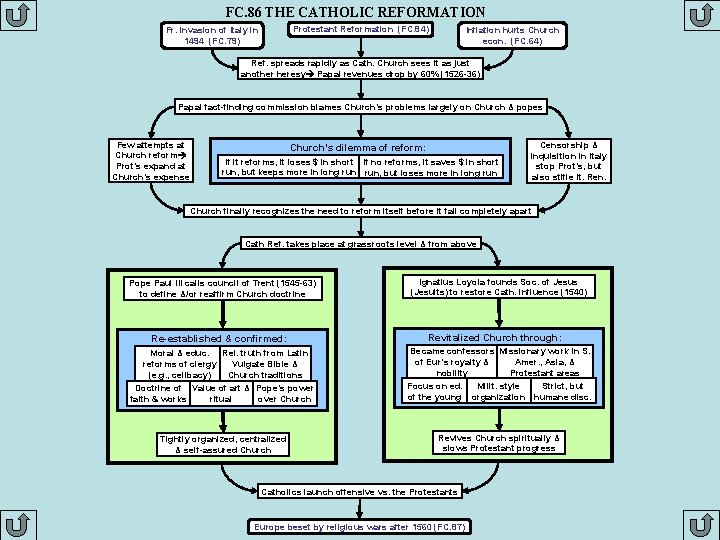
FC. 86 THE CATHOLIC REFORMATION Protestant Reformation (FC. 84) Fr. invasion of Italy in 1494 (FC. 79) Inflation hurts Church econ. (FC. 64) Ref. spreads rapidly as Cath. Church sees it as just another heresy Papal revenues drop by 60% (1526 -36) Papal fact-finding commission blames Church’s problems largely on Church & popes Few attempts at Church reform Prot’s expand at Church’s expense Church’s dilemma of reform: If it reforms, it loses $ in short If no reforms, it saves $ in short run, but keeps more in long run, but loses more in long run Censorship & inquisition in Italy stop Prot’s, but also stifle It. Ren. Church finally recognizes the need to reform itself before it fall completely apart Cath Ref. takes place at grassroots level & from above Pope Paul III calls council of Trent (1545 -63) to define &/or reaffirm Church doctrine Re-established & confirmed: Ignatius Loyola founds Soc. of Jesus (Jesuits) to restore Cath. influence (1540) Revitalized Church through: Moral & educ. Rel. truth from Latin reforms of clergy Vulgate Bible & (e. g. , celibacy) Church traditions Doctrine of Value of art & Pope’s power faith & works ritual over Church Became confessors Missionary work in S. of Eur’s royalty & Amer. , Asia, & nobility Protestant areas Focus on ed. Milit. style Strict, but of the young organization humane disc. Tightly organized, centralized & self-assured Church Revives Church spiritually & slows Protestant progress Catholics launch offensive vs. the Protestants Europe beset by religious wars after 1560 (FC. 87)
The Age of Religious Wars (1560 -1650)
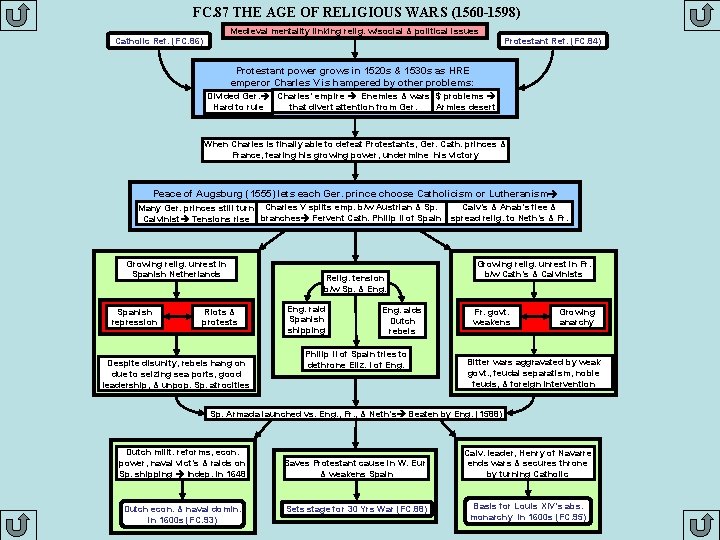
FC. 87 THE AGE OF RELIGIOUS WARS (1560 -1598) Medieval mentality linking relig. w/social & political issues Catholic Ref. (FC. 86) Protestant Ref. (FC. 84) Protestant power grows in 1520 s & 1530 s as HRE emperor Charles V is hampered by other problems: Divided Ger. Charles’ empire Enemies & wars $ problems that divert attention from Ger. Armies desert Hard to rule When Charles is finally able to defeat Protestants, Ger. Cath. princes & France, fearing his growing power, undermine his victory Peace of Augsburg (1555) lets each Ger. prince choose Catholicism or Lutheranism Calv’s & Anab’s flee & Many Ger. princes still turn Charles V splits emp. b/w Austrian & Sp. Calvinist Tensions rise branches Fervent Cath. Philip II of Spain spread relig. to Neth’s & Fr. Growing relig. unrest in Spanish Netherlands Spanish repression Riots & protests Despite disunity, rebels hang on due to seizing sea ports, good leadership, & unpop. Sp. atrocities Relig. tension b/w Sp. & Eng. raid Spanish shipping Eng. aids Dutch rebels Philip II of Spain tries to dethrone Eliz. I of Eng. Growing relig. unrest in Fr. b/w Cath’s & Calvinists Fr. govt. weakens Growing anarchy Bitter wars aggravated by weak govt. , feudal separatism, noble feuds, & foreign intervention Sp. Armada launched vs. Eng. , Fr. , & Neth’s Beaten by Eng. (1588) Dutch milit. reforms, econ. power, naval vict’s & raids on Sp. shipping Indep. in 1648 Dutch econ. & naval domin. in 1600 s (FC. 93) Saves Protestant cause in W. Eur. & weakens Spain Sets stage for 30 Yrs War (FC. 88) Calv. leader, Henry of Navarre ends wars & secures throne by turning Catholic Basis for Louis XIV’s abs. monarchy in 1600 s (FC. 95)
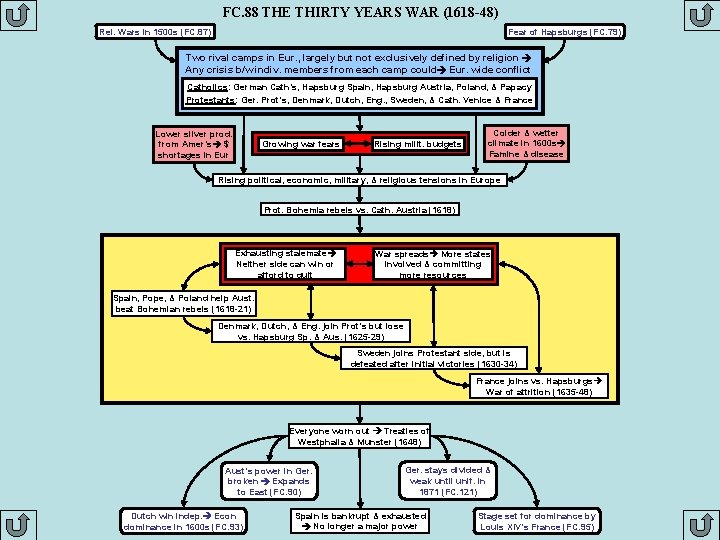
FC. 88 THE THIRTY YEARS WAR (1618 -48) Rel. Wars in 1500 s (FC. 87) Fear of Hapsburgs (FC. 79) Two rival camps in Eur. , largely but not exclusively defined by religion Any crisis b/w indiv. members from each camp could Eur. wide conflict Catholics: German Cath’s, Hapsburg Spain, Hapsburg Austria, Poland, & Papacy Protestants: Ger. Prot’s, Denmark, Dutch, Eng. , Sweden, & Cath. Venice & France Lower silver prod. from Amer’s $ shortages in Eur Growing war fears Rising milit. budgets Colder & wetter climate in 1600 s Famine & disease Rising political, economic, military, & religious tensions in Europe Prot. Bohemia rebels vs. Cath. Austria (1618) Exhausting stalemate Neither side can win or afford to quit War spreads More states involved & committing more resources Spain, Pope, & Poland help Aust. beat Bohemian rebels (1618 -21) Denmark, Dutch, & Eng. join Prot’s but lose vs. Hapsburg Sp. & Aus. (1625 -29) Sweden joins Protestant side, but is defeated after initial victories (1630 -34) France joins vs. Hapsburgs War of attrition (1635 -48) Everyone worn out Treaties of Westphalia & Munster (1648) Aust’s power in Ger. broken Expands to East (FC. 90) Dutch win indep. Econ dominance in 1600 s (FC. 93) Ger. stays divided & weak until unif. in 1871 (FC. 121) Spain is bankrupt & exhausted No longer a major power Stage set for dominance by Louis XIV’s France (FC. 95)
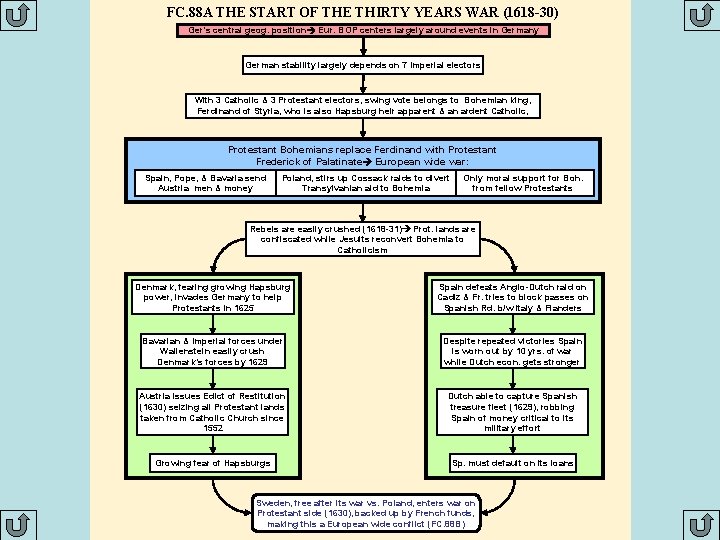
FC. 88 A THE START OF THE THIRTY YEARS WAR (1618 -30) Ger’s central geog. position Eur. BOP centers largely around events in Germany German stability largely depends on 7 Imperial electors With 3 Catholic & 3 Protestant electors, swing vote belongs to Bohemian king, Ferdinand of Styria, who is also Hapsburg heir apparent & an ardent Catholic, Protestant Bohemians replace Ferdinand with Protestant Frederick of Palatinate European wide war: Spain, Pope, & Bavaria send Austria men & money Poland, stirs up Cossack raids to divert Transylvanian aid to Bohemia Only moral support for Boh. from fellow Protestants Rebels are easily crushed (1618 -31) Prot. lands are confiscated while Jesuits reconvert Bohemia to Catholicism Denmark, fearing growing Hapsburg power, invades Germany to help Protestants in 1625 Spain defeats Anglo-Dutch raid on Cadiz & Fr. tries to block passes on Spanish Rd. b/w Italy & Flanders Bavarian & Imperial forces under Wallenstein easily crush Denmark’s forces by 1629 Despite repeated victories Spain is worn out by 10 yrs. of war while Dutch econ. gets stronger Austria issues Edict of Restitution (1630) seizing all Protestant lands taken from Catholic Church since 1552 Dutch able to capture Spanish treasure fleet (1629), robbing Spain of money critical to its military effort Growing fear of Hapsburgs Sp. must default on its loans Sweden, free after its war vs. Poland, enters war on Protestant side (1630), backed up by French funds, making this a European wide conflict (FC. 88 B)
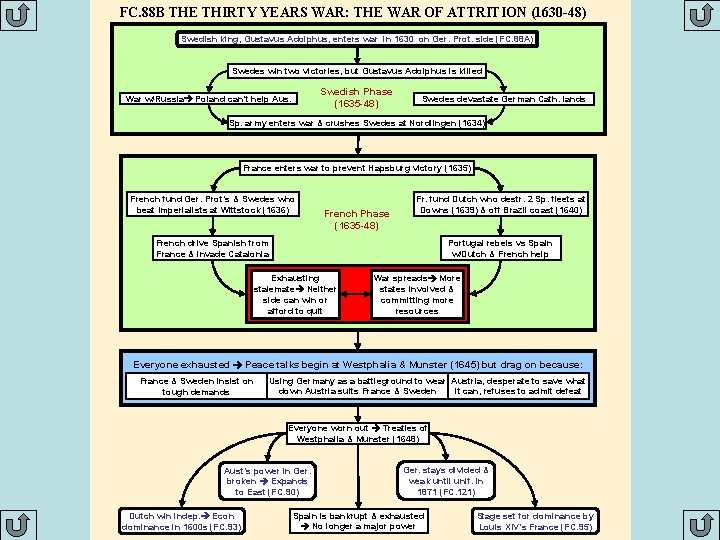
FC. 88 B THE THIRTY YEARS WAR: THE WAR OF ATTRITION (1630 -48) Swedish king, Gustavus Adolphus, enters war in 1630 on Ger. Prot. side (FC. 88 A) Swedes win two victories, but Gustavus Adolphus is killed Swedish Phase (1635 -48) War w/Russia Poland can’t help Aus. Swedes devastate German Cath. lands Sp. army enters war & crushes Swedes at Nordlingen (1634) France enters war to prevent Hapsburg victory (1635) French fund Ger. Prot’s & Swedes who beat Imperialists at Wittstock (1636) French Phase (1635 -48) Fr. fund Dutch who destr. 2 Sp. fleets at Downs (1639) & off Brazil coast (1640) French drive Spanish from France & invade Catalonia Portugal rebels vs Spain w/Dutch & French help Exhausting stalemate Neither side can win or afford to quit War spreads More states involved & committing more resources Everyone exhausted Peace talks begin at Westphalia & Munster (1645) but drag on because: France & Sweden insist on tough demands Using Germany as a battleground to wear Austria, desperate to save what down Austria suits France & Sweden it can, refuses to admit defeat Everyone worn out Treaties of Westphalia & Munster (1648) Aust’s power in Ger. broken Expands to East (FC. 90) Dutch win indep. Econ dominance in 1600 s (FC. 93) Ger. stays divided & weak until unif. in 1871 (FC. 121) Spain is bankrupt & exhausted No longer a major power Stage set for dominance by Louis XIV’s France (FC. 95)
17 th Century State Building
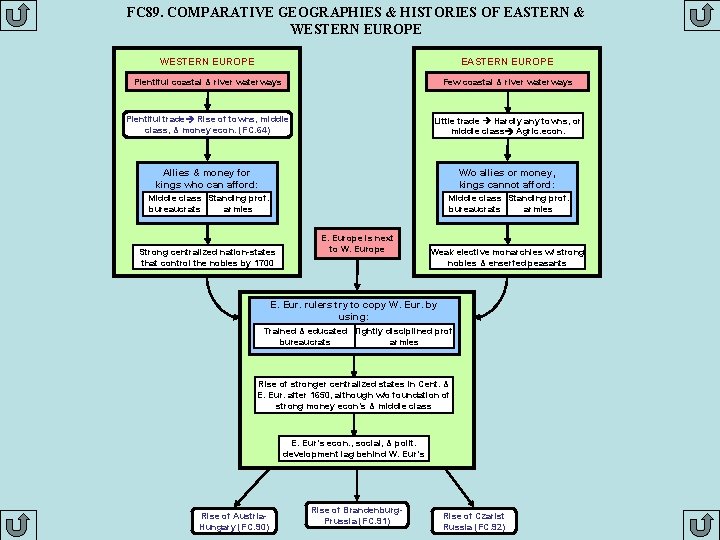
FC 89. COMPARATIVE GEOGRAPHIES & HISTORIES OF EASTERN & WESTERN EUROPE EASTERN EUROPE Plentiful coastal & river waterways Few coastal & river waterways Plentiful trade Rise of towns, middle class, & money econ. (FC. 64) Little trade Hardly any towns, or middle class Agric. econ. Allies & money for kings who can afford: W/o allies or money, kings cannot afford: Middle class Standing prof. bureaucrats armies Strong centralized nation-states that control the nobles by 1700 E. Europe is next to W. Europe Weak elective monarchies w/ strong nobles & enserfed peasants E. Eur. rulers try to copy W. Eur. by using: Trained & educated Tightly disciplined prof. bureaucrats armies Rise of stronger centralized states in Cent. & E. Eur. after 1650, although w/o foundation of strong money econ’s & middle class E. Eur’s econ. , social, & polit. development lag behind W. Eur’s Rise of Austria. Hungary (FC. 90) Rise of Brandenburg. Prussia (FC. 91) Rise of Czarist Russia (FC. 92)
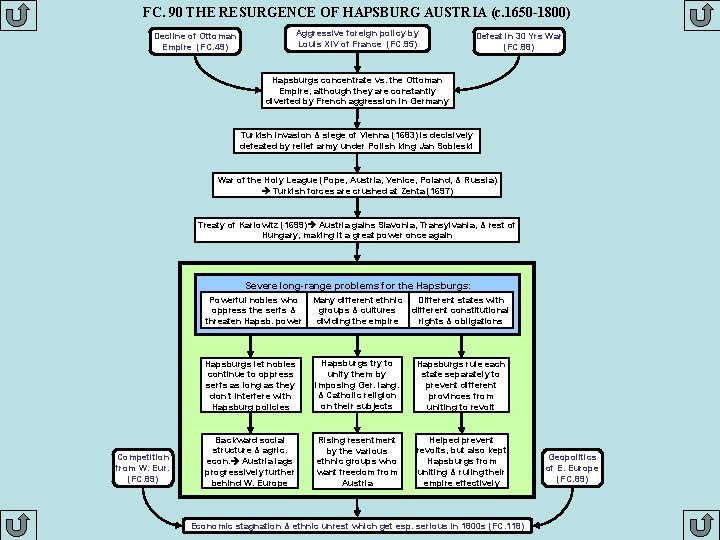
FC. 90 THE RESURGENCE OF HAPSBURG AUSTRIA (c. 1650 -1800) Aggressive foreign policy by Louis XIV of France (FC. 95) Decline of Ottoman Empire (FC. 49) Defeat in 30 Yrs War (FC. 88) Hapsburgs concentrate vs. the Ottoman Empire, although they are constantly diverted by French aggression in Germany Turkish invasion & siege of Vienna (1683) is decisively defeated by relief army under Polish king Jan Sobieski War of the Holy League (Pope, Austria, Venice, Poland, & Russia) Turkish forces are crushed at Zenta (1697) Treaty of Karlowitz (1699) Austria gains Slavonia, Transylvania, & rest of Hungary, making it a great power once again Severe long-range problems for the Hapsburgs: Powerful nobles who oppress the serfs & threaten Hapsb. power Competition from W. Eur. (FC. 89) Many different ethnic groups & cultures dividing the empire Different states with different constitutional rights & obligations Hapsburgs let nobles continue to oppress serfs as long as they don’t interfere with Hapsburg policies Hapsburgs try to unify them by imposing Ger. lang. & Catholic religion on their subjects Hapsburgs rule each state separately to prevent different provinces from uniting to revolt Backward social structure & agric. econ. Austria lags progressively further behind W. Europe Rising resentment by the various ethnic groups who want freedom from Austria Helped prevent revolts, but also kept Hapsburgs from uniting & ruling their empire effectively Economic stagnation & ethnic unrest which get esp. serious in 1800 s (FC. 118) Geopolitics of E. Europe (FC. 89)
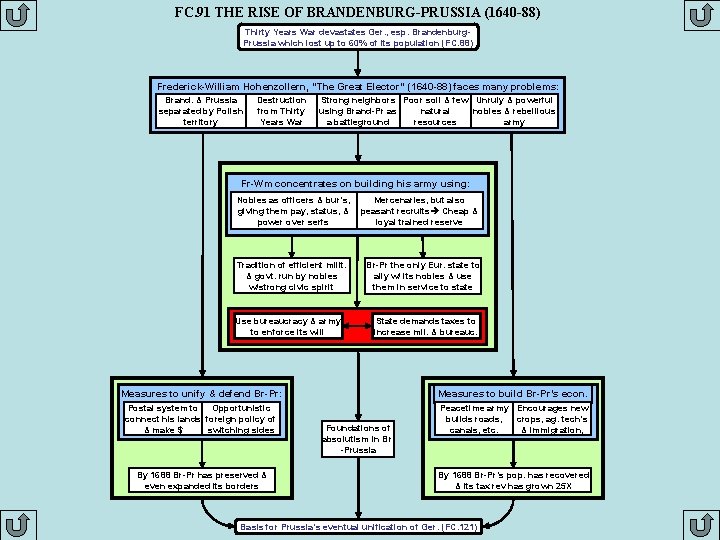
FC. 91 THE RISE OF BRANDENBURG-PRUSSIA (1640 -88) Thirty Years War devastates Ger. , esp. Brandenburg. Prussia which lost up to 60% of its population (FC. 88) Frederick-William Hohenzollern, “The Great Elector” (1640 -88) faces many problems: Brand. & Prussia separated by Polish territory Destruction from Thirty Years War Strong neighbors Poor soil & few Unruly & powerful using Brand-Pr as natural nobles & rebellious a battleground resources army Fr-Wm concentrates on building his army using: Nobles as officers & bur’s, giving them pay, status, & power over serfs Tradition of efficient milit. & govt. run by nobles w/strong civic spirit Use bureaucracy & army to enforce its will Mercenaries, but also peasant recruits Cheap & loyal trained reserve Br-Pr the only Eur. state to ally w/ its nobles & use them in service to state State demands taxes to increase mil. & bureauc. Measures to unify & defend Br-Pr: Measures to build Br-Pr’s econ. Postal system to Opportunistic connect his lands foreign policy of & make $ switching sides Peacetime army Encourages new builds roads, crops, ag. tech’s canals, etc. & immigration, By 1688 Br-Pr has preserved & even expanded its borders Foundations of absolutism in Br. -Prussia By 1688 Br-Pr’s pop. has recovered & its tax rev has grown 25 X Basis for Prussia’s eventual unification of Ger. (FC. 121)
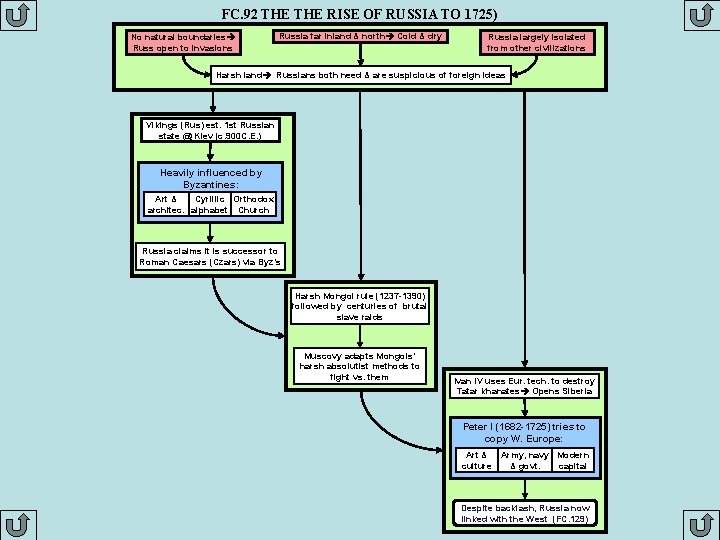
FC. 92 THE RISE OF RUSSIA TO 1725) No natural boundaries Russ open to invasions Russia far inland & north Cold & dry Russia largely isolated from other civilizations Harsh land Russians both need & are suspicious of foreign ideas Vikings (Rus) est. 1 st Russian state @ Kiev (c. 900 C. E. ) Heavily influenced by Byzantines: Art & Cyrillic Orthodox architec. alphabet Church Russia claims it is successor to Roman Caesars (Czars) via Byz’s Harsh Mongol rule (1237 -1390) followed by centuries of brutal slave raids Muscovy adapts Mongols’ harsh absolutist methods to fight vs. them Ivan IV uses Eur. tech. to destroy Tatar khanates Opens Siberia Peter I (1682 -1725) tries to copy W. Europe: Art & Army, navy Modern culture & govt. capital Despite backlash, Russia now linked with the West (FC. 129)
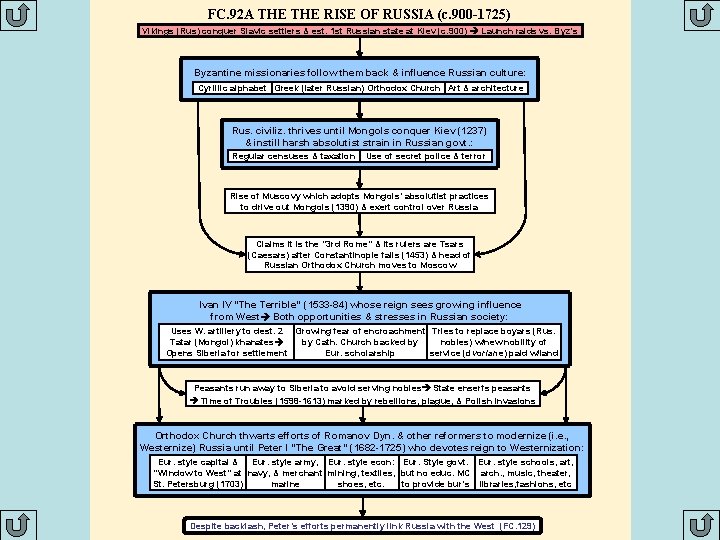
FC. 92 A THE RISE OF RUSSIA (c. 900 -1725) Vikings (Rus) conquer Slavic settlers & est. 1 st Russian state at Kiev (c. 900) Launch raids vs. Byz’s Byzantine missionaries follow them back & influence Russian culture: Cyrillic alphabet Greek (later Russian) Orthodox Church Art & architecture Rus. civiliz. thrives until Mongols conquer Kiev (1237) & instill harsh absolutist strain in Russian govt. : Regular censuses & taxation Use of secret police & terror Rise of Muscovy which adopts Mongols’ absolutist practices to drive out Mongols (1390) & exert control over Russia Claims it is the “ 3 rd Rome” & its rulers are Tsars (Caesars) after Constantinople falls (1453) & head of Russian Orthodox Church moves to Moscow Ivan IV “The Terrible” (1533 -84) whose reign sees growing influence from West Both opportunities & stresses in Russian society: Uses W. artillery to dest. 2 Growing fear of encroachment Tries to replace boyars (Rus. nobles) w/new nobility of Tatar (Mongol) khanates by Cath. Church backed by service (dvoriane) paid w/land Opens Siberia for settlement Eur. scholarship Peasants run away to Siberia to avoid serving nobles State enserfs peasants Time of Troubles (1598 -1613) marked by rebellions, plague, & Polish invasions Orthodox Church thwarts efforts of Romanov Dyn. & other reformers to modernize (i. e. , Westernize) Russia until Peter I “The Great” (1682 -1725) who devotes reign to Westernization: Eur. style capital & Eur. style army, Eur. style econ: Eur. Style govt. Eur. style schools, art, “Window to West” at navy, & merchant mining, textiles, but no educ. MC arch. , music, theater, St. Petersburg (1703) marine shoes, etc. to provide bur’s libraries, fashions, etc Despite backlash, Peter’s efforts permanently link Russia with the West (FC. 129)
FC. 93 THE DUTCH REPUBLIC IN THE 1600 S Netherlands largely below sea level Few natural resources By the sea & trade routes Need dikes, polders, windmills, & drainage systems to reclaim land from the sea Dutch are resourceful engineers, merchants & artisans Base their trade on salted herring after herring shoals shift to N. Sea in 1400 s Invest profits in new ventures Dutch make profits Further develop foreign trade: Further develop domestic econ: Trade in Baltic Efficient & cheap cargo ship Domin. Russian furs, Scandin. timber, & carrying trade & Polish grain ship bldg. ind. Textile, tobacco Finance institutions: curing, munitions, Bank of Amsterdam soap, & sugar (1609) & stock refining industries market Expand scope of trade in late 1500 s: W. Indies for salt Sugar Africa to get slaves E. Asia for Italy to sell spices Polish Grain Explore S. Pacific Trade w/Turks Build excellent long-range navy to protect trade Also dominate naval ship bldg ind. Louis XIV jealous of Dutch wealth Wars (FC. 95) Amsterdam the center of world trade & a cultural golden age in 1600 s England jealous of Dutch wealth Wars (FC. 96 B) Decline of Dutch Rep. by 1700 from cost & strain of wars
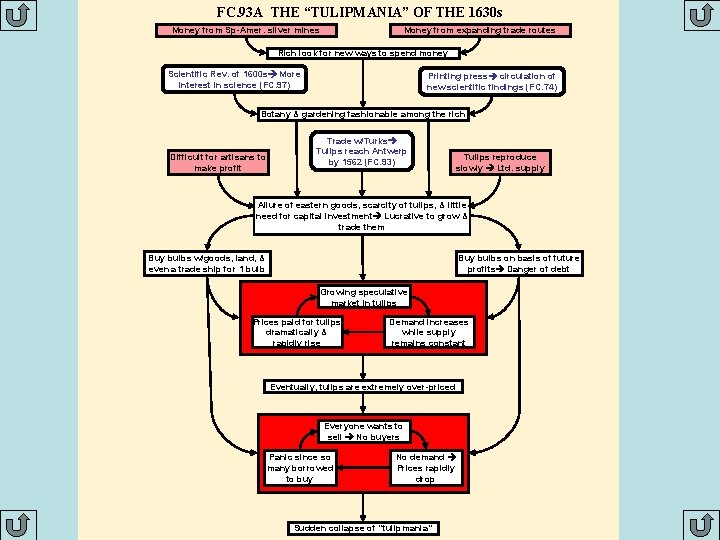
FC. 93 A THE “TULIPMANIA” OF THE 1630 s Money from Sp-Amer. silver mines Money from expanding trade routes Rich look for new ways to spend money Scientific Rev. of 1600 s More interest in science (FC. 97) Printing press circulation of new scientific findings (FC. 74) Botany & gardening fashionable among the rich Difficult for artisans to make profit Trade w/Turks Tulips reach Antwerp by 1562 (FC. 93) Tulips reproduce slowly Ltd. supply Allure of eastern goods, scarcity of tulips, & little need for capital investment Lucrative to grow & trade them Buy bulbs w/goods, land, & even a trade ship for 1 bulb Buy bulbs on basis of future profits Danger of debt Growing speculative market in tulips Prices paid for tulips dramatically & rapidly rise Demand increases while supply remains constant Eventually, tulips are extremely over-priced Everyone wants to sell No buyers Panic since so many borrowed to buy No demand Prices rapidly drop Sudden collapse of “tulipmania”
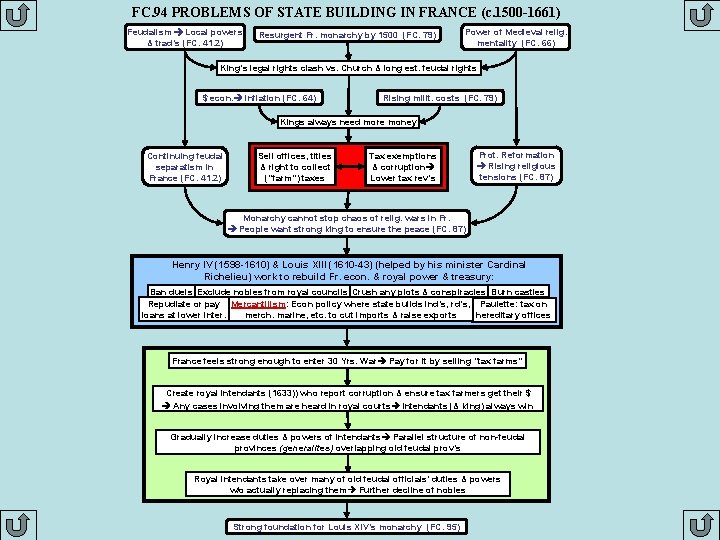
FC. 94 PROBLEMS OF STATE BUILDING IN FRANCE (c. 1500 -1661) Feudalism Local powers & trad’s (FC. 41. 2) Resurgent Fr. monarchy by 1500 (FC. 79) Power of Medieval relig. mentality (FC. 66) King’s legal rights clash vs. Church & long est. feudal rights $ econ. inflation (FC. 64) Rising milit. costs (FC. 79) Kings always need more money Continuing feudal separatism in France (FC. 41. 2) Sell offices, titles & right to collect (“farm”) taxes Tax exemptions & corruption Lower tax rev’s Prot. Reformation Rising religious tensions (FC. 87) Monarchy cannot stop chaos of relig. wars in Fr. People want strong king to ensure the peace (FC. 87) Henry IV (1598 -1610) & Louis XIII (1610 -43) (helped by his minister Cardinal Richelieu) work to rebuild Fr. econ. & royal power & treasury: Ban duels Exclude nobles from royal councils Crush any plots & conspiracies Burn castles Repudiate or pay Mercantilism: Econ policy where state builds ind’s, rd’s, Paulette: tax on loans at lower inter. merch. marine, etc. to cut imports & raise exports hereditary offices France feels strong enough to enter 30 Yrs. War Pay for it by selling “tax farms” Create royal intendants (1633)) who report corruption & ensure tax farmers get their $ Any cases involving them are heard in royal courts Intendants (& king) always win Gradually increase duties & powers of intendants Parallel structure of non-feudal provinces (generalites) overlapping old feudal prov’s Royal intendants take over many of old feudal officials’ duties & powers w/o actually replacing them Further decline of nobles Strong foundation for Louis XIV’s monarchy (FC. 95)
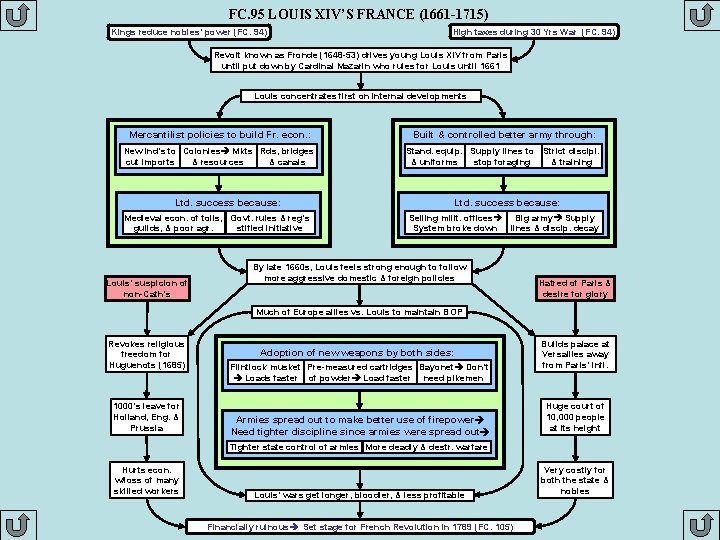
FC. 95 LOUIS XIV’S FRANCE (1661 -1715) Kings reduce nobles’ power (FC. 94) High taxes during 30 Yrs War (FC. 94) Revolt known as Fronde (1648 -53) drives young Louis XIV from Paris until put down by Cardinal Mazarin who rules for Louis until 1661 Louis concentrates first on internal developments Mercantilist policies to build Fr. econ. : New ind’s to Colonies Mkts Rds, bridges & resources cut imports & canals Ltd. success because: Medieval econ. of tolls, Govt. rules & reg’s guilds, & poor agr. stifled initiative Louis’ suspicion of non-Cath’s Built & controlled better army through: Stand. equip. Supply lines to stop foraging & uniforms Strict discipl. & training Ltd. success because: Selling milit. offices Big army Supply System broke down lines & discip. decay By late 1660 s, Louis feels strong enough to follow more aggressive domestic & foreign policies Hatred of Paris & desire for glory Much of Europe allies vs. Louis to maintain BOP Revokes religious freedom for Huguenots (1685) 1000’s leave for Holland, Eng. & Prussia Adoption of new weapons by both sides: Flintlock musket Pre-measured cartridges Bayonet Don’t Loads faster of powder Load faster need pikemen Armies spread out to make better use of firepower Need tighter discipline since armies were spread out Builds palace at Versailles away from Paris’ infl. Huge court of 10, 000 people at its height Tighter state control of armies More deadly & destr. warfare Hurts econ. w/loss of many skilled workers Louis’ wars get longer, bloodier, & less profitable Financially ruinous Set stage for French Revolution in 1789 (FC. 105) Very costly for both the state & nobles
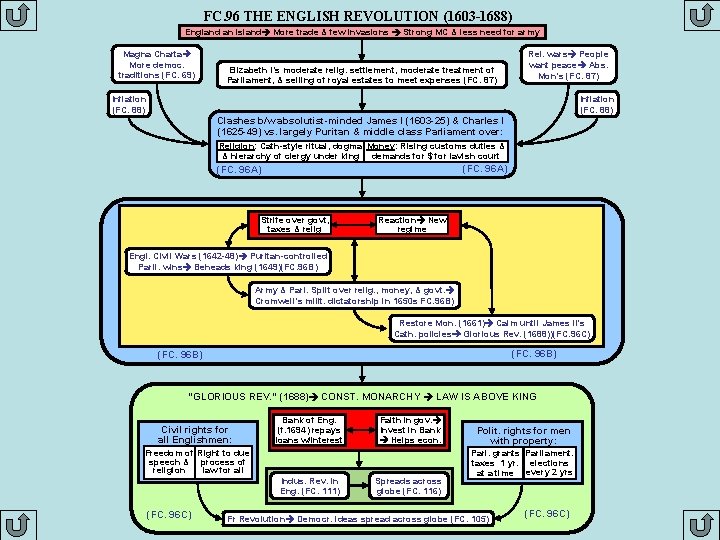
FC. 96 THE ENGLISH REVOLUTION (1603 -1688) England an island More trade & few invasions Strong MC & less need for army Magna Charta More democ. traditions (FC. 69) Elizabeth I’s moderate relig. settlement, moderate treatment of Parliament, & selling of royal estates to meet expenses (FC. 87) Rel. wars People want peace Abs. Mon’s (FC. 87) Inflation (FC. 88) Clashes b/w absolutist-minded James I (1603 -25) & Charles I (1625 -49) vs. largely Puritan & middle class Parliament over: Religion: Cath-style ritual, dogma Money: Rising customs duties & & hierarchy of clergy under king demands for $ for lavish court (FC. 96 A) Strife over govt, taxes & relig Reaction New regime Engl. Civil Wars (1642 -48) Puritan-controlled Parli. wins Beheads king (1649)(FC. 96 B) Army & Parl. Split over relig. , money, & govt. Cromwell’s milit. dictatorship in 1650 s FC. 96 B) Restore Mon. (1661) Calm until James II’s Cath. policies Glorious Rev. (1688))(FC. 96 C) (FC. 96 B) “GLORIOUS REV. ” (1688) CONST. MONARCHY LAW IS ABOVE KING Civil rights for all Englishmen: Bank of Eng. (f. 1694) repays loans w/interest Faith in gov. Invest in Bank Helps econ. Freedom of Right to due speech & process of religion law for all Indus. Rev. in Eng. (FC. 111) (FC. 96 C) Spreads across globe (FC. 116) Polit. rights for men with property: Parl. grants Parliament. taxes 1 yr. elections at a time every 2 yrs Fr Revolution Democr. ideas spread across globe (FC. 105) (FC. 96 C)
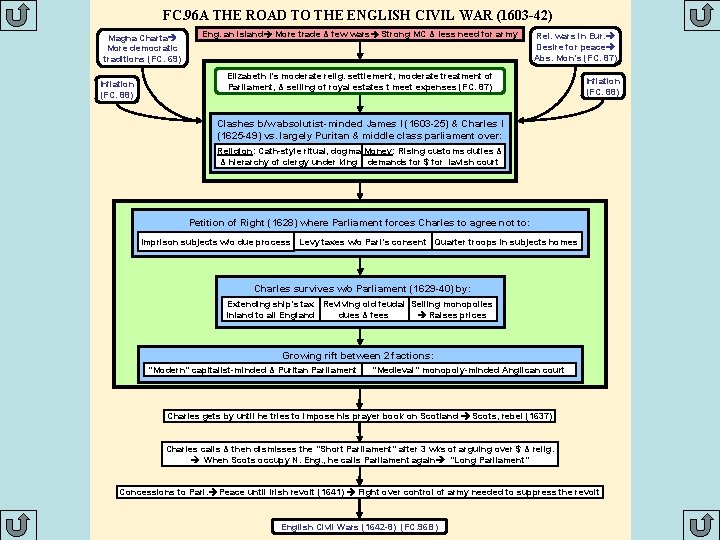
FC. 96 A THE ROAD TO THE ENGLISH CIVIL WAR (1603 -42) Magna Charta More democratic traditions (FC. 69) Inflation (FC. 88) Eng. an island More trade & few wars Strong MC & less need for army Rel. wars in Eur. Desire for peace Abs. Mon’s (FC. 87) Elizabeth I’s moderate relig. settlement, moderate treatment of Parliament, & selling of royal estates t meet expenses (FC. 87) Inflation (FC. 88) Clashes b/w absolutist-minded James I (1603 -25) & Charles I (1625 -49) vs. largely Puritan & middle class parliament over: Religion: Cath-style ritual, dogma Money: Rising customs duties & & hierarchy of clergy under king demands for $ for lavish court Petition of Right (1628) where Parliament forces Charles to agree not to: Imprison subjects w/o due process Levy taxes w/o Parl’s consent Quarter troops in subjects homes Charles survives w/o Parliament (1629 -40) by: Extending ship’s tax Reviving old feudal Selling monopolies inland to all England Raises prices dues & fees Growing rift between 2 factions: “Modern” capitalist-minded & Puritan Parliament “Medieval” monopoly-minded Anglican court Charles gets by until he tries to impose his prayer book on Scotland Scots, rebel (1637) Charles calls & then dismisses the “Short Parliament” after 3 wks of arguing over $ & relig. When Scots occupy N. Eng. , he calls Parliament again “Long Parliament” Concessions to Parl. Peace until Irish revolt (1641) Fight over control of army needed to suppress the revolt English Civil Wars (1642 -8) (FC. 96 B)
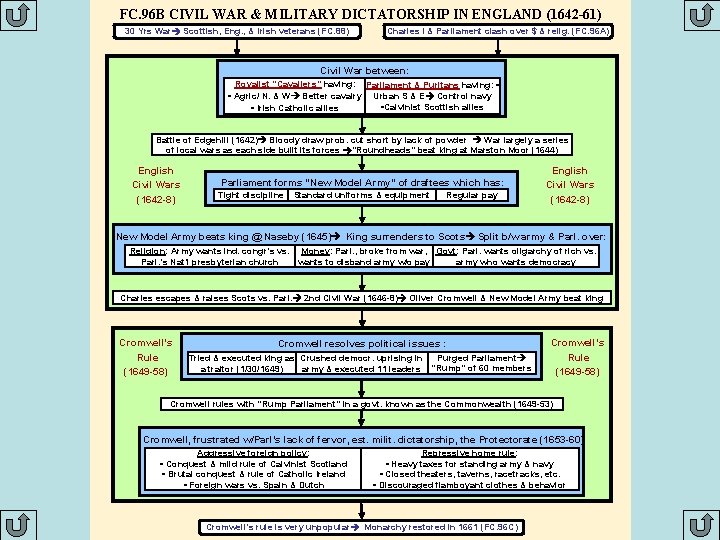
FC. 96 B CIVIL WAR & MILITARY DICTATORSHIP IN ENGLAND (1642 -61) 30 Yrs War Scottish, Eng. , & Irish veterans (FC. 88) Charles I & Parliament clash over $ & relig. (FC. 96 A) Civil War between: Royalist “Cavaliers” having: Parliament & Puritans having: • • Agric/ N. & W Better cavalry Urban S & E Control navy • Calvinist Scottish allies • Irish Catholic allies Battle of Edgehill (1642) Bloody draw prob. cut short by lack of powder War largely a series of local wars as each side built its forces “Roundheads” beat king at Marston Moor (1644) English Civil Wars (1642 -8) Parliament forms “New Model Army” of draftees which has: Tight discipline Standard uniforms & equipment Regular pay English Civil Wars (1642 -8) New Model Army beats king @ Naseby (1645) King surrenders to Scots Split b/w army & Parl. over: Religion: Army wants ind. congr’s vs. Money: Parl. , broke from war, Govt: Parl. wants oligarchy of rich vs. Parl. ’s Nat’l presbyterian church wants to disband army w/o pay army who wants democracy Charles escapes & raises Scots vs. Parl. 2 nd Civil War (1646 -8) Oliver Cromwell & New Model Army beat king Cromwell’s Rule (1649 -58) Cromwell resolves political issues : Purged Parliament Tried & executed king as Crushed democr. uprising in a traitor (1/30/1649) army & executed 11 leaders “Rump” of 60 members Cromwell’s Rule (1649 -58) Cromwell rules with “Rump Parliament” in a govt. known as the Commonwealth (1649 -53) Cromwell, frustrated w/Parl’s lack of fervor, est. milit. dictatorship, the Protectorate (1653 -60) Aggressive foreign policy: • Conquest & mild rule of Calvinist Scotland • Brutal conquest & rule of Catholic Ireland • Foreign wars vs. Spain & Dutch Repressive home rule: • Heavy taxes for standing army & navy • Closed theaters, taverns, racetracks, etc. • Discouraged flamboyant clothes & behavior Cromwell’s rule is very unpopular Monarchy restored in 1661 (FC. 96 C)
FC. 96 C FROM RESTORATION MONARCHY TO GLORIOUS REVOLUTION Restoration of the monarchy in 1661 after Cromwell’s harsh rule (FC. 96 B) Monarchy of Charles II (1661 -85), a more frivolous monarch who reopens theaters, racetracks, pubs, etc. , & rules with a largely cavalier Parliament who votes him a good allowance. Issues of money, religion, & politics still remain: Religion: Charles, secretly Catholic, Politics: Evolution of 2 parties: Money: Charles largely indep. of restores power of Church of England Whigs who are Pro-Parliament Parl, esp in later yrs because: • More & Presbyterian church money from trade with bishops & other Cath. elements vs. • More $ from N. Am. colonies • Manages to resist attempts to disown his brother & heir apparent, James Tories who are pro-royalist & • Secret funding from Louis XIV so who is an avowed Catholic Anglican (not Catholic) he could restore Cath. Ch. in Eng. On the surface, Eng. monarchy seems as strong as ever by Charles’ death in 1685 Accession of James II (1685 -88) a stubborn & bigoted king openly favoring Catholicism & absolute monarchy Tories & Whigs join together to invite James’ daughter, Mary, & her husband, William III of Holland to depose him “Glorious Rev. ” (1688) Constitutional Monarchy Law is above king Bank of Eng. (f. 1694) repays loans w/interest Civil rights for all Englishmen: Freedom of speech & religion Faith in gov. Invest in Bank Helps econ. Right to due process of law for all Polit. rights for men with property: Parl. grants Parliament. taxes 1 yr. at elections a time every 2 yrs Indus. Rev. in Eng. (FC. 111) Spreads across globe (FC. 116) Fr Revolution Democr. ideas spread across globe (FC. 104)
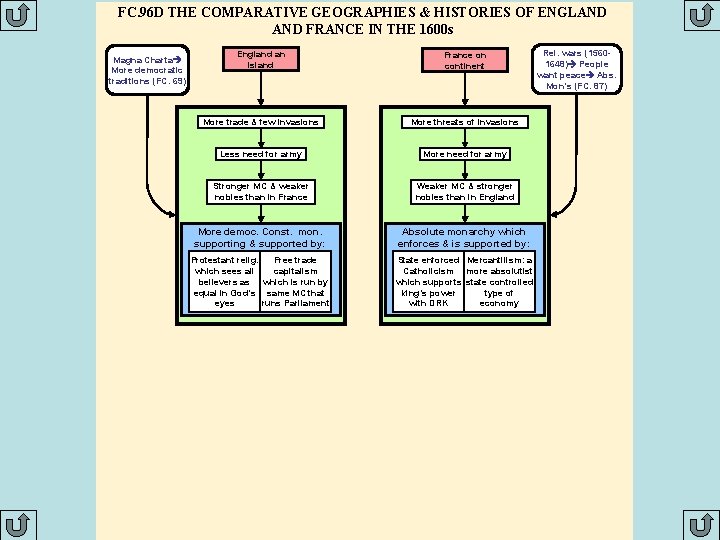
FC. 96 D THE COMPARATIVE GEOGRAPHIES & HISTORIES OF ENGLAND FRANCE IN THE 1600 s Magna Charta More democratic traditions (FC. 69) England an island France on continent More trade & few invasions More threats of invasions Less need for army More need for army Stronger MC & weaker nobles than in France Weaker MC & stronger nobles than in England More democ. Const. mon. supporting & supported by: Absolute monarchy which enforces & is supported by: Protestant relig. Free trade which sees all capitalism believers as which is run by equal in God’s same MC that eyes runs Parliament State enforced Mercantilism: a Catholicism more absolutist which supports state controlled king’s power type of with DRK economy Rel. wars (15601648) People want peace Abs. Mon’s (FC. 87)
The Enlightenment (1650 -1789)
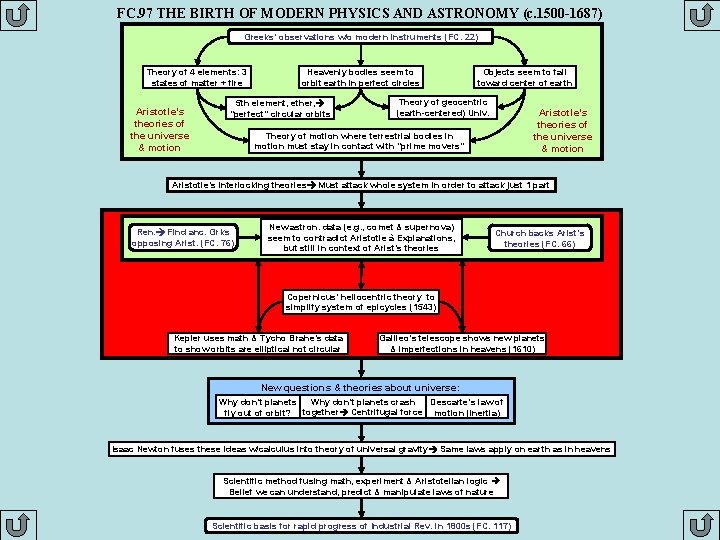
FC. 97 THE BIRTH OF MODERN PHYSICS AND ASTRONOMY (c. 1500 -1687) Greeks’ observations w/o modern instruments (FC. 22) Theory of 4 elements: 3 states of matter + fire Aristotle’s theories of the universe & motion Heavenly bodies seem to orbit earth in perfect circles 5 th element, ether, “perfect” circular orbits Objects seem to fall toward center of earth Theory of geocentric (earth-centered) Univ. Aristotle’s theories of the universe & motion Theory of motion where terrestrial bodies in motion must stay in contact with “prime movers” Aristotle’s interlocking theories Must attack whole system in order to attack just 1 part Ren. Find anc. Grks opposing Arist. (FC. 76) New astron. data (e. g. , comet & supernova) seem to contradict Aristotle à Explanations, but still in context of Arist’s theories Church backs Arist’s theories (FC. 66) Copernicus’ heliocentric theory to simplify system of epicycles (1543) Kepler uses math & Tycho Brahe’s data to show orbits are elliptical not circular Galileo’s telescope shows new planets & imperfections in heavens (1610) New questions & theories about universe: Why don’t planets crash Descarte’s law of fly out of orbit? together Centrifugal force motion (inertia) Isaac Newton fuses these ideas w/calculus into theory of universal gravity Same laws apply on earth as in heavens Scientific method fusing math, experiment & Aristotelian logic Belief we can understand, predict & manipulate laws of nature Scientific basis for rapid progress of Industrial Rev. in 1800 s (FC. 117)
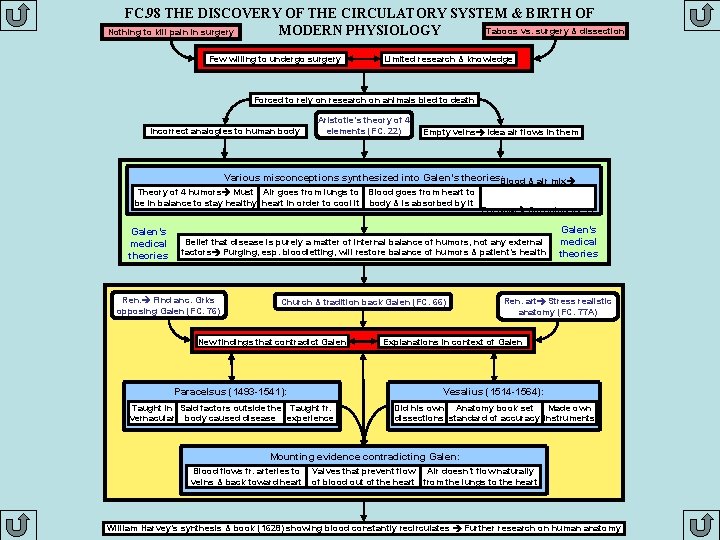
FC. 98 THE DISCOVERY OF THE CIRCULATORY SYSTEM & BIRTH OF Taboos vs. surgery & dissection MODERN PHYSIOLOGY Nothing to kill pain in surgery Few willing to undergo surgery Limited research & knowledge Forced to rely on research on animals bled to death Incorrect analogies to human body Aristotle’s theory of 4 elements (FC. 22) Empty veins Idea air flows in them Various misconceptions synthesized into Galen’s theories: Blood & air mix Theory of 4 humors Must Air goes from lungs to Blood goes from heart to be in balance to stay healthy heart in order to cool it body & is absorbed by it Galen’s medical theories Pneuma Consciousness Belief that disease is purely a matter of internal balance of humors, not any external factors Purging, esp. bloodletting, will restore balance of humors & patient’s health Ren. Find anc. Grks opposing Galen (FC. 76) Church & tradition back Galen (FC. 66) New findings that contradict Galen’s medical theories Ren. art Stress realistic anatomy (FC. 77 A) Explanations in context of Galen Paracelsus (1493 -1541): Vesalius (1514 -1564): Taught in Said factors outside the Taught fr. vernacular body caused disease experience Did his own Anatomy book set Made own dissections standard of accuracy instruments Mounting evidence contradicting Galen: Blood flows fr. arteries to veins & back toward heart Valves that prevent flow Air doesn’t flow naturally of blood out of the heart from the lungs to the heart William Harvey’s synthesis & book (1628) showing blood constantly recirculates Further research on human anatomy
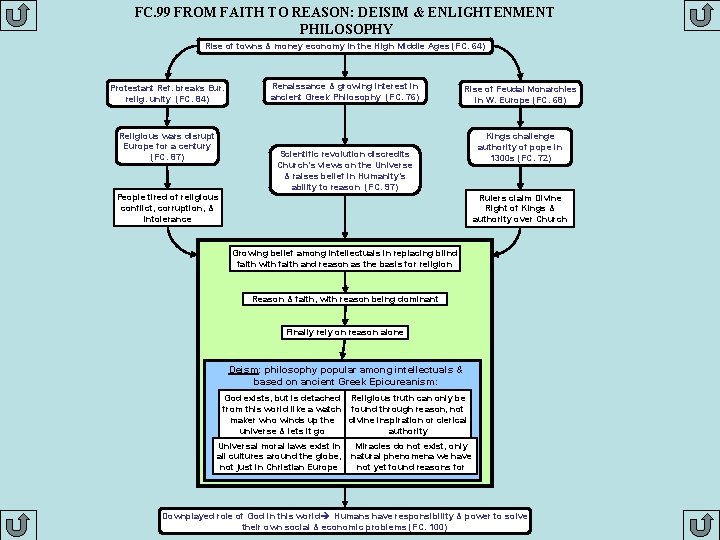
FC. 99 FROM FAITH TO REASON: DEISIM & ENLIGHTENMENT PHILOSOPHY Rise of towns & money economy in the High Middle Ages (FC. 64) Protestant Ref. breaks Eur. relig. unity (FC. 84) Religious wars disrupt Europe for a century (FC. 87) Renaissance & growing interest in ancient Greek Philosophy (FC. 76) Rise of Feudal Monarchies in W. Europe (FC. 68) Scientific revolution discredits Church’s views on the Universe & raises belief in Humanity’s ability to reason (FC. 97) People tired of religious conflict, corruption, & intolerance Kings challenge authority of pope in 1300 s (FC. 72) Rulers claim Divine Right of Kings & authority over Church Growing belief among intellectuals in replacing blind faith with faith and reason as the basis for religion Reason & faith, with reason being dominant Finally rely on reason alone Deism: philosophy popular among intellectuals & based on ancient Greek Epicureanism: God exists, but is detached Religious truth can only be from this world like a watch found through reason, not maker who winds up the divine inspiration or clerical universe & lets it go authority Universal moral laws exist in all cultures around the globe, not just in Christian Europe Miracles do not exist, only natural phenomena we have not yet found reasons for Downplayed role of God in this world Humans have responsibility & power to solve their own social & economic problems (FC. 100)
FC. 100 ENLIGHTENMENT POLITICAL, SOCIAL, & ECONOMIC IDEAS Rise of towns & money economy in the High Middle Ages (FC. 64) Enlightenment & Deism (FC. 99) England’s rising economy (FC. 96 C) View that humanity can & must reform society since the Deist god is detached Rapidly changing society with new wealth, problems, & the need to solve them Search for the ideal soc. , or at least ways to remedy society’s ills French philosophers who are heavily influenced by John Locke: Montesquieu Rousseau Voltaire who wanted called for separation of direct small more civil & powers in scale polit. liberties govt. democr’s French Rev. (FC. 105) Adam Smith’s economics: New ideas in psychology: Free trade Econ’s regulate People have themselves incentive to Everyone can work hard & be profit productive Helvetius: We Bentham’s are born blank Utilitarianism: slates We’re Providing ideal products of our environment Ideal society Search for the ideal society, or at least ways to remedy society’s ills Modern theories of behavioral psychology
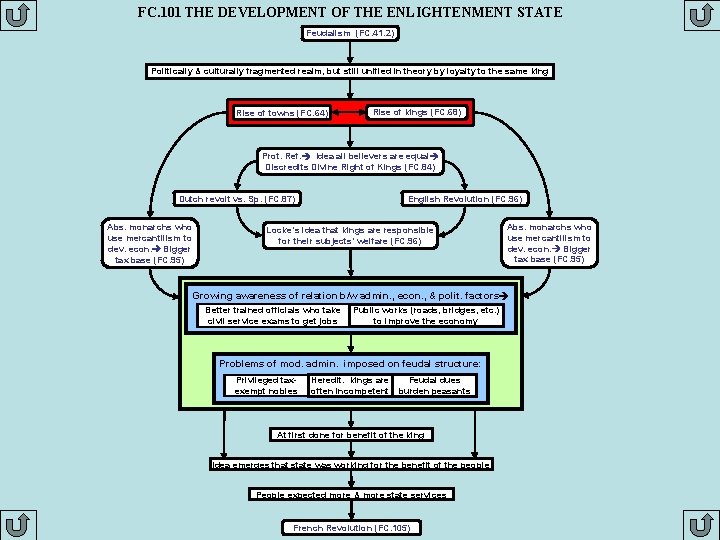
FC. 101 THE DEVELOPMENT OF THE ENLIGHTENMENT STATE Feudalism (FC. 41. 2) Politically & culturally fragmented realm, but still unified in theory by loyalty to the same king Rise of towns (FC. 64) Rise of kings (FC. 68) Prot. Ref. Idea all believers are equal Discredits Divine Right of Kings (FC. 84) Dutch revolt vs. Sp. (FC. 87) Abs. monarchs who use mercantilism to dev. econ. Bigger tax base (FC. 95) English Revolution (FC. 96) Locke’s idea that kings are responsible for their subjects’ welfare (FC. 96) Abs. monarchs who use mercantilism to dev. econ. Bigger tax base (FC. 95) Growing awareness of relation b/w admin. , econ. , & polit. factors Better trained officials who take civil service exams to get jobs Public works (roads, bridges, etc. ) to improve the economy Problems of mod. admin. imposed on feudal structure: Privileged taxexempt nobles Heredit. kings are often incompetent Feudal dues burden peasants At first done for benefit of the king Idea emerges that state was working for the benefit of the people People expected more & more state services French Revolution (FC. 105)
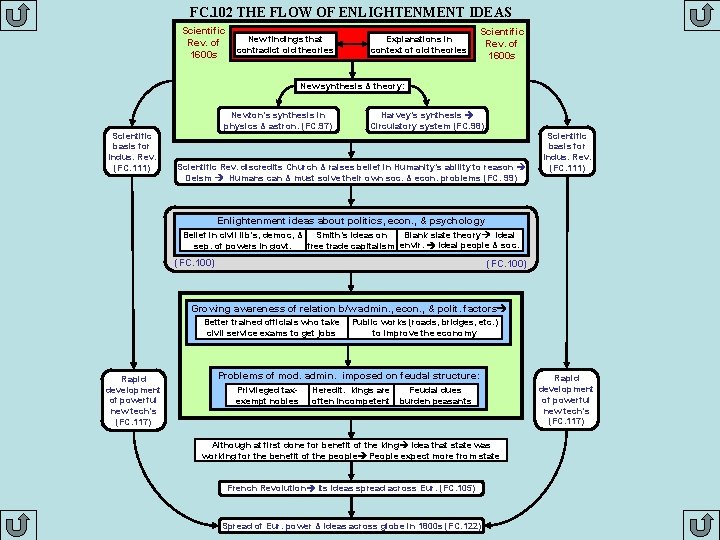
FC. 102 THE FLOW OF ENLIGHTENMENT IDEAS Scientific Rev. of 1600 s New findings that contradict old theories Explanations in context of old theories Scientific Rev. of 1600 s New synthesis & theory: Scientific basis for Indus. Rev. (FC. 111) Newton’s synthesis in physics & astron. (FC. 97) Harvey’s synthesis Circulatory system (FC. 98) Scientific Rev. discredits Church & raises belief in Humanity’s ability to reason Deism Humans can & must solve their own soc. & econ. problems (FC. 99) Scientific basis for Indus. Rev. (FC. 111) Enlightenment ideas about politics, econ. , & psychology Blank slate theory Ideal Belief in civil lib’s, democ, & Smith’s ideas on sep. of powers in govt. free trade capitalism envir. Ideal people & soc. (FC. 100) Growing awareness of relation b/w admin. , econ. , & polit. factors Better trained officials who take civil service exams to get jobs Rapid development of powerful new tech’s (FC. 117) Public works (roads, bridges, etc. ) to improve the economy Problems of mod. admin. imposed on feudal structure: Privileged taxexempt nobles Heredit. kings are often incompetent Feudal dues burden peasants Although at first done for benefit of the king Idea that state was working for the benefit of the people People expect more from state French Revolution Its ideas spread across Eur. (FC. 105) Spread of Eur. power & ideas across globe in 1800 s (FC. 122) Rapid development of powerful new tech’s (FC. 117)
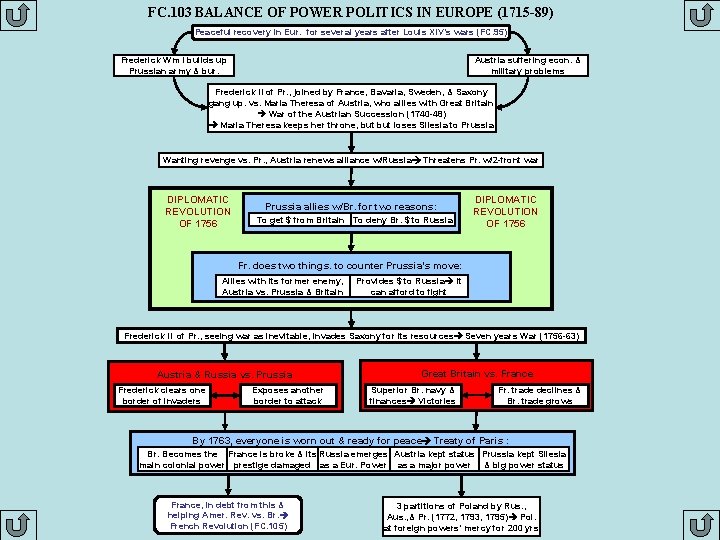
FC. 103 BALANCE OF POWER POLITICS IN EUROPE (1715 -89) Peaceful recovery in Eur. for several years after Louis XIV’s wars (FC. 95) Frederick Wm I builds up Prussian army & bur. Austria suffering econ. & military problems Frederick II of Pr. , joined by France, Bavaria, Sweden, & Saxony gang up. vs. Maria Theresa of Austria, who allies with Great Britain War of the Austrian Succession (1740 -48) Maria Theresa keeps her throne, but loses Silesia to Prussia Wanting revenge vs. Pr. , Austria renews alliance w/Russia Threatens Pr. w/2 -front war DIPLOMATIC REVOLUTION OF 1756 Prussia allies w/Br. for two reasons: To get $ from Britain To deny Br. $ to Russia DIPLOMATIC REVOLUTION OF 1756 Fr. does two things. to counter Prussia’s move: Allies with its former enemy, Austria vs. Prussia & Britain Provides $ to Russia It can afford to fight Frederick II of Pr. , seeing war as inevitable, invades Saxony for its resources Seven years War (1756 -63) Austria & Russia vs. Prussia Frederick clears one border of invaders Exposes another border to attack Great Britain vs. France Superior Br. navy & finances Victories Fr. trade declines & Br. trade grows By 1763, everyone is worn out & ready for peace Treaty of Paris : Br. Becomes the France is broke & its Russia emerges Austria kept status Prussia kept Silesia main colonial power prestige damaged as a Eur. Power as a major power & big power status France, in debt from this & helping Amer. Rev. vs. Br. French Revolution (FC. 105) 3 partitions of Poland by Rus. , Aus. , & Pr. (1772, 1793, 1795) Pol. at foreign powers’ mercy for 200 yrs
Age of Revolutions (1789 -1848)
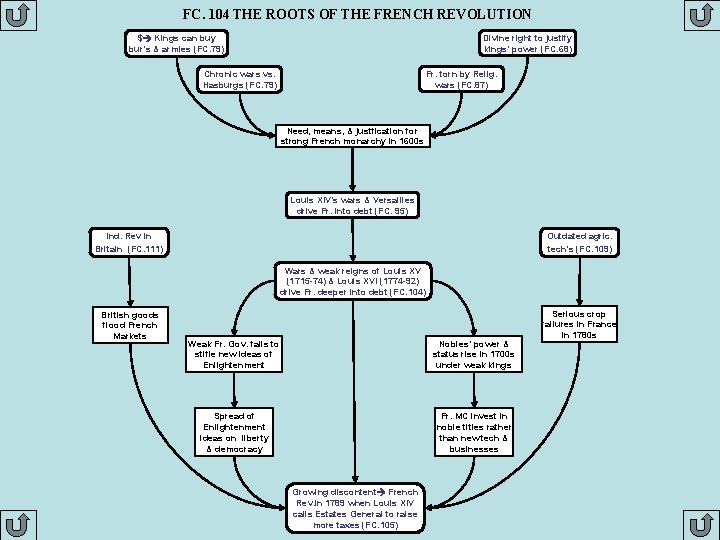
FC. 104 THE ROOTS OF THE FRENCH REVOLUTION Divine right to justify kings’ power (FC. 68) $ Kings can buy bur’s & armies (FC. 79) Fr. torn by Relig. wars (FC. 87) Chronic wars vs. Hasburgs (FC. 79) Need, means, & justfication for strong French monarchy in 1600 s Louis XIV’s wars & Versailles drive Fr. into debt (FC. 95) Ind. Rev in Britain (FC. 111) Outdated agric. tech’s (FC. 109) Wars & weak reigns of Louis XV (1715 -74) & Louis XVI (1774 -92) drive Fr. deeper into debt (FC. 104) British goods flood French Markets Weak Fr. Gov. fails to stifle new ideas of Enlightenment Nobles’ power & status rise in 1700 s under weak kings Spread of Enlightenment ideas on liberty & democracy Fr. MC invest in noble titles rather than new tech & businesses Growing discontent French Rev. in 1789 when Louis XIV calls Estates General to raise more taxes (FC. 105) Serious crop failures in France in 1780 s
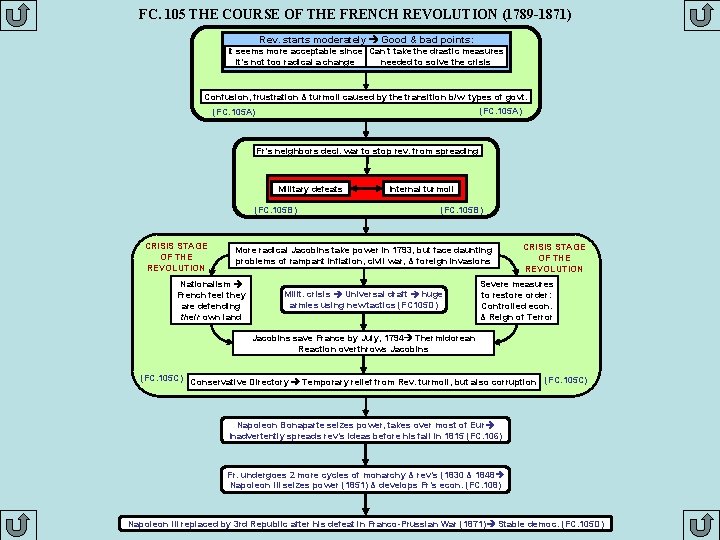
FC. 105 THE COURSE OF THE FRENCH REVOLUTION (1789 -1871) Rev. starts moderately Good & bad points: It seems more acceptable since Can’t take the drastic measures it’s not too radical a change needed to solve the crisis Confusion, frustration & turmoil caused by the transition b/w types of govt. (FC. 105 A) Fr’s neighbors decl. war to stop rev. from spreading Military defeats (FC. 105 B) CRISIS STAGE OF THE REVOLUTION Internal turmoil (FC. 105 B) More radical Jacobins take power in 1793, but face daunting problems of rampant inflation, civil war, & foreign invasions Nationalism French feel they are defending their own land Milit. crisis Universal draft huge armies using new tactics (FC 105 D) CRISIS STAGE OF THE REVOLUTION Severe measures to restore order: Controlled econ. & Reign of Terror Jacobins save France by July, 1794 Thermidorean Reaction overthrows Jacobins (FC. 105 C) Conservative Directory Temporary relief from Rev. turmoil, but also corruption (FC. 105 C) Napoleon Bonaparte seizes power, takes over most of Eur Inadvertently spreads rev’s ideas before his fall in 1815 (FC. 106) Fr. undergoes 2 more cycles of monarchy & rev’s (1830 & 1848 Napoleon III seizes power (1851) & develops Fr’s econ. (FC. 108) Napoleon III replaced by 3 rd Republic after his defeat in Franco-Prussian War (1871) Stable democ. (FC. 105 D)
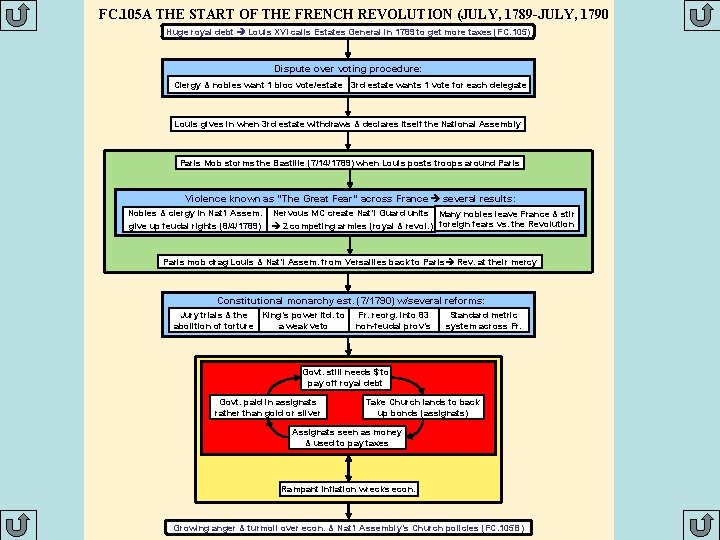
FC. 105 A THE START OF THE FRENCH REVOLUTION (JULY, 1789 -JULY, 1790 Huge royal debt Louis XVI calls Estates General in 1789 to get more taxes (FC. 105) Dispute over voting procedure: Clergy & nobles want 1 bloc vote/estate 3 rd estate wants 1 vote for each delegate Louis gives in when 3 rd estate withdraws & declares itself the National Assembly Paris Mob storms the Bastille (7/14/1789) when Louis posts troops around Paris Violence known as “The Great Fear” across France several results: Nobles & clergy in Nat’l Assem. give up feudal rights (8/4/1789) Nervous MC create Nat’l Guard units Many nobles leave France & stir 2 competing armies (royal & revol. ) foreign fears vs. the Revolution Paris mob drag Louis & Nat’l Assem. from Versailles back to Paris Rev. at their mercy Constitutional monarchy est. (7/1790) w/several reforms: Jury trials & the King’s power ltd. to abolition of torture a weak veto Fr. reorg. into 83 non-feudal prov’s Standard metric system across Fr. Govt. still needs $ to pay off royal debt Govt. paid in assignats rather than gold or silver Take Church lands to back up bonds (assignats) Assignats seen as money & used to pay taxes Rampant inflation wrecks econ. Growing anger & turmoil over econ. & Nat’l Assembly’s Church policies (FC. 105 B)
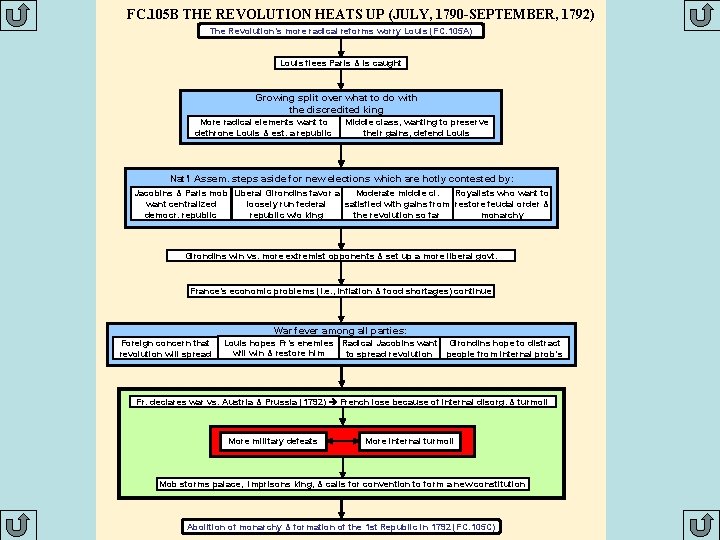
FC. 105 B THE REVOLUTION HEATS UP (JULY, 1790 -SEPTEMBER, 1792) The Revolution’s more radical reforms worry Louis (FC. 105 A) Louis flees Paris & is caught Growing split over what to do with the discredited king More radical elements want to dethrone Louis & est. a republic Middle class, wanting to preserve their gains, defend Louis Nat’l Assem. steps aside for new elections which are hotly contested by: Moderate middle cl. Jacobins & Paris mob Liberal Girondins favor a Royalists who want to satisfied with gains from restore feudal order & want centralized loosely run federal the revolution so far democr. republic w/o king monarchy Girondins win vs. more extremist opponents & set up a more liberal govt. France’s economic problems (I. e. , inflation & food shortages) continue War fever among all parties: Foreign concern that revolution will spread Louis hopes Fr’s enemies Radical Jacobins want Girondins hope to distract will win & restore him to spread revolution people from internal prob’s Fr. declares war vs. Austria & Prussia (1792) French lose because of internal disorg. & turmoil More military defeats More internal turmoil Mob storms palace, imprisons king, & calls for convention to form a new constitution Abolition of monarchy & formation of the 1 st Republic in 1792 (FC. 105 C)
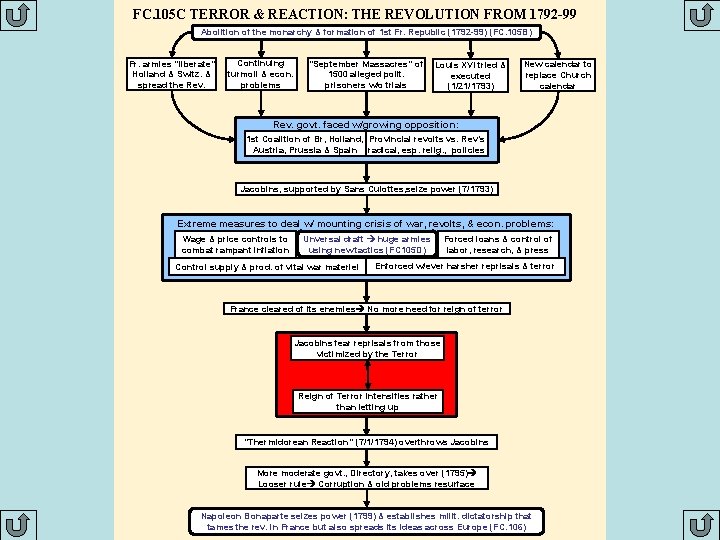
FC. 105 C TERROR & REACTION: THE REVOLUTION FROM 1792 -99 Abolition of the monarchy & formation of 1 st Fr. Republic (1792 -99) (FC. 105 B) Fr. armies “liberate” Holland & Switz. & spread the Rev. Continuing turmoil & econ. problems “September Massacres” of 1500 alleged polit. prisoners w/o trials Louis XVI tried & executed (1/21/1793) New calendar to replace Church calendar Rev. govt. faced w/growing opposition: 1 st Coalition of Br, Holland, Provincial revolts vs. Rev’s Austria, Prussia & Spain radical, esp. relig. , policies Jacobins, supported by Sans Culottes, seize power (7/1793) Extreme measures to deal w/ mounting crisis of war, revolts, & econ. problems: Wage & price controls to combat rampant inflation Unversal draft huge armies using new tactics (FC 105 D) Control supply & prod. of vital war materiel Forced loans & control of labor, research, & press Enforced w/ever harsher reprisals & terror France cleared of its enemies No more need for reign of terror Jacobins fear reprisals from those victimized by the Terror Reign of Terror intensifies rather than letting up “Thermidorean Reaction” (7/1/1794) overthrows Jacobins More moderate govt. , Directory, takes over (1795) Looser rule Corruption & old problems resurface Napoleon Bonaparte seizes power (1799) & establishes milit. dictatorship that tames the rev. in France but also spreads its ideas across Europe (FC. 106)
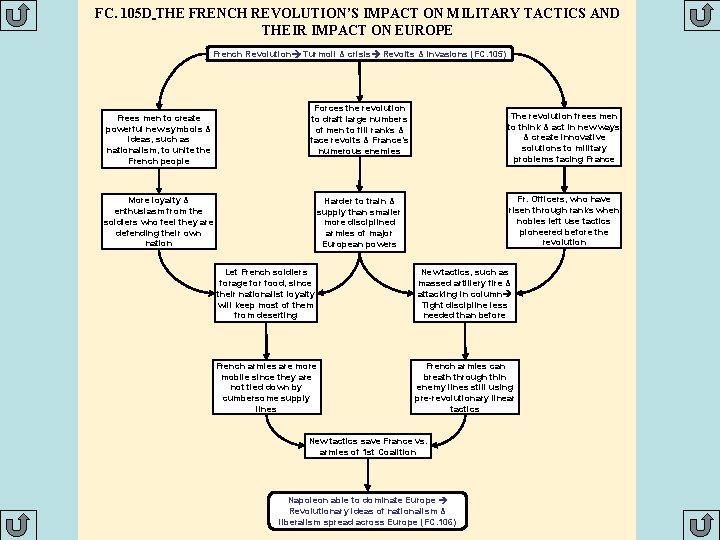
FC. 105 D THE FRENCH REVOLUTION’S IMPACT ON MILITARY TACTICS AND THEIR IMPACT ON EUROPE French Revolution Turmoil & crisis Revolts & invasions (FC. 105) Frees men to create powerful new symbols & ideas, such as nationalism, to unite the French people Forces the revolution to draft large numbers of men to fill ranks & face revolts & France’s numerous enemies More loyalty & enthusiasm from the soldiers who feel they are defending their own nation The revolution frees men to think & act in new ways & create innovative solutions to military problems facing France Fr. Officers, who have risen through ranks when nobles left use tactics pioneered before the revolution Harder to train & supply than smaller more disciplined armies of major European powers Let French soldiers forage for food, since their nationalist loyalty will keep most of them from deserting New tactics, such as massed artillery fire & attacking in column Tight discipline less needed than before French armies are mobile since they are not tied down by cumbersome supply lines French armies can breath through thin enemy lines still using pre-revolutionary linear tactics New tactics save France vs. armies of 1 st Coalition Napoleon able to dominate Europe Revolutionary ideas of nationalism & liberalism spread across Europe (FC. 106)
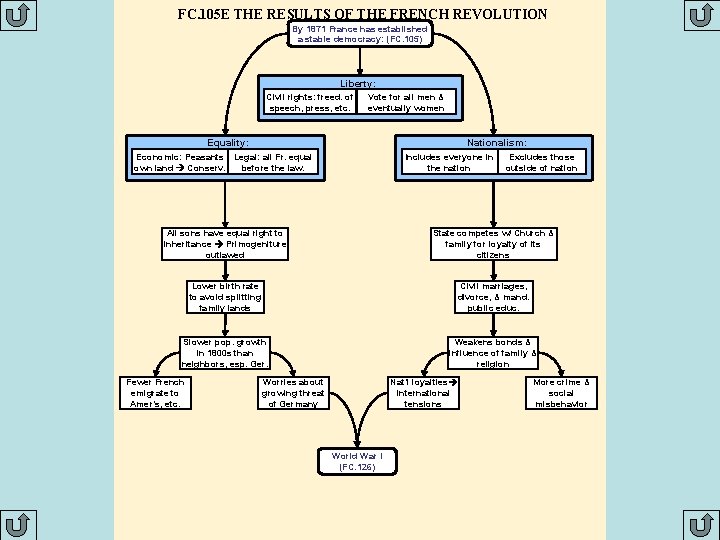
FC. 105 E THE RESULTS OF THE FRENCH REVOLUTION By 1871 France has established a stable democracy: (FC. 105) Liberty: Civil rights: freed. of speech, press, etc. Vote for all men & eventually women Nationalism: Equality: Economic: Peasants Legal: all Fr. equal own land Conserv. before the law. Includes everyone in the nation Excludes those outside of nation All sons have equal right to inheritance Primogeniture outlawed State competes w/ Church & family for loyalty of its citizens Lower birth rate to avoid splitting family lands Civil marriages, divorce, & mand. public educ. Slower pop. growth in 1800 s than neighbors, esp. Ger. Weakens bonds & influence of family & religion Fewer French emigrate to Amer’s, etc. Nat’l loyalties international tensions Worries about growing threat of Germany World War I (FC. 126) More crime & social misbehavior
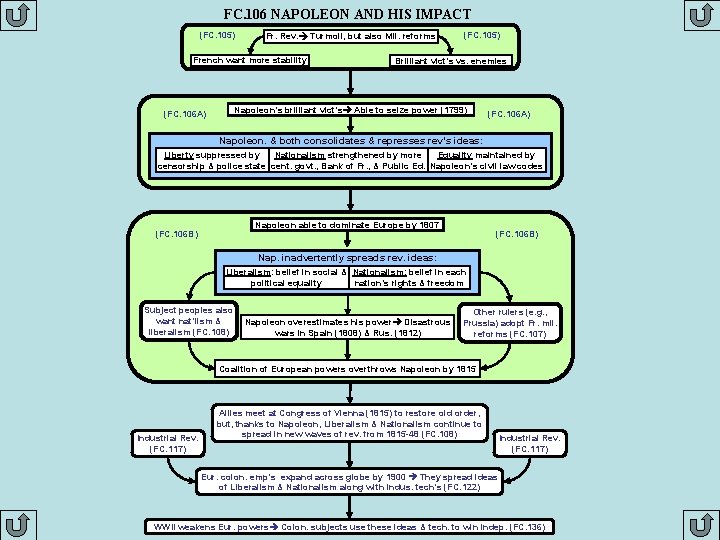
FC. 106 NAPOLEON AND HIS IMPACT (FC. 105) Fr. Rev. Turmoil, but also Mil. reforms French want more stability (FC. 105) Brilliant vict’s vs. enemies Napoleon’s brilliant vict’s Able to seize power (1799) (FC. 106 A) Napoleon. & both consolidates & represses rev’s ideas: Liberty suppressed by Nationalism strengthened by more Equality maintained by censorship & police state cent. govt. , Bank of Fr. , & Public Ed. Napoleon’s civil law codes Napoleon able to dominate Europe by 1807 (FC. 106 B) Nap. inadvertently spreads rev. ideas: Liberalism: belief in social & Nationalism: belief in each political equality nation’s rights & freedom Subject peoples also want nat’lism & liberalism (FC. 108) Napoleon overestimates his power Disastrous wars in Spain (1808) & Rus. (1812) Other rulers (e. g. , Prussia) adopt Fr. mil. reforms (FC. 107) Coalition of European powers overthrows Napoleon by 1815 Industrial Rev. (FC. 117) Allies meet at Congress of Vienna (1815) to restore old order, but, thanks to Napoleon, Liberalism & Nationalism continue to spread in new waves of rev. from 1815 -48 (FC. 108) Industrial Rev. (FC. 117) Eur. colon. emp’s expand across globe by 1900 They spread ideas of Liberalism & Nationalism along with indus. tech’s (FC. 122) WWII weakens Eur. powers Colon. subjects use these ideas & tech. to win indep. (FC. 136)
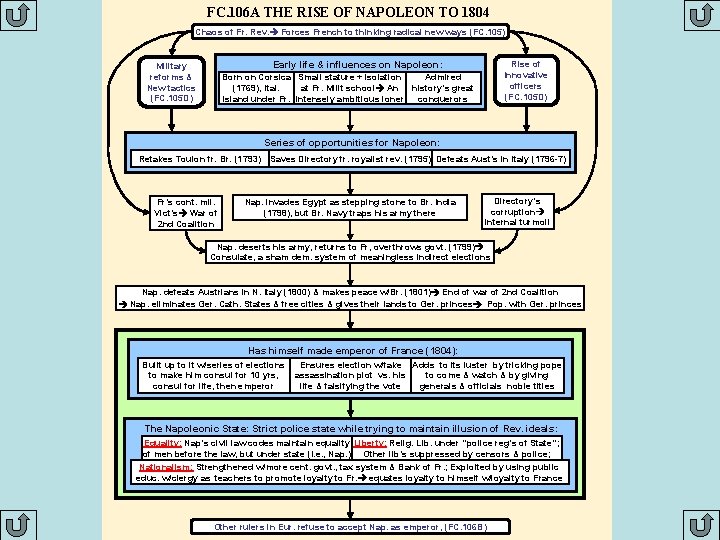
FC. 106 A THE RISE OF NAPOLEON TO 1804 Chaos of Fr. Rev. Forces French to thinking radical new ways (FC. 105) Early life & influences on Napoleon: Military reforms & New tactics (FC. 105 D) Rise of Innovative officers (FC. 105 D) Born on Corsica Small stature + isolation Admired at Fr. Milit school An (1769), Ital. history’s great island under Fr. intensely ambitious loner conquerors Series of opportunities for Napoleon: Retakes Toulon fr. Br. (1793) Fr’s cont. mil. Vict’s War of 2 nd Coalition Saves Directory fr. royalist rev. (1795) Defeats Aust’s in Italy (1796 -7) Nap. invades Egypt as stepping stone to Br. India (1798), but Br. Navy traps his army there Directory’s corruption internal turmoil Nap. deserts his army, returns to Fr, overthrows govt. (1799) Consulate, a sham dem. system of meaningless indirect elections Nap. defeats Austrians in N. Italy (1800) & makes peace w/Br. (1801) End of war of 2 nd Coalition Nap. eliminates Ger. Cath. States & free cities & gives their lands to Ger. princes Pop. with Ger. princes Has himself made emperor of France (1804): Built up to it w/series of elections to make him consul for 10 yrs, consul for life, then emperor Ensures election w/fake Adds to its luster by tricking pope assassination plot vs. his to come & watch & by giving life & falsifying the vote generals & officials noble titles The Napoleonic State: Strict police state while trying to maintain illusion of Rev. ideals: Equality: Nap’s civil law codes maintain equality Liberty: Relig. Lib. under “police reg’s of State”; of men before the law, but under state (I. e. , Nap. ) Other lib’s suppressed by censors & police; Nationalism: Strengthened w/more cent. govt. , tax system & Bank of Fr. ; Exploited by using public educ. w/clergy as teachers to promote loyalty to Fr. equates loyalty to himself w/loyalty to France Other rulers in Eur. refuse to accept Nap. as emperor, (FC. 106 B)
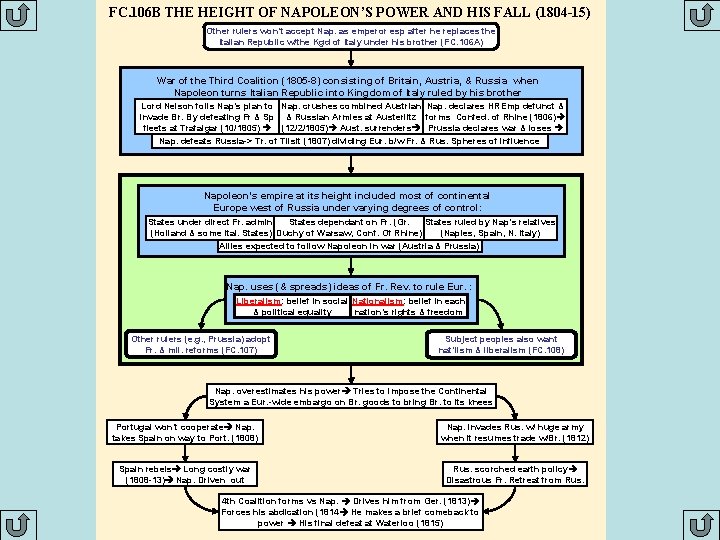
FC. 106 B THE HEIGHT OF NAPOLEON’S POWER AND HIS FALL (1804 -15) Other rulers won’t accept Nap. as emperor esp after he replaces the Italian Republic w/the Kgd of Italy under his brother (FC. 106 A) War of the Third Coalition (1805 -8) consisting of Britain, Austria, & Russia when Napoleon turns Italian Republic into Kingdom of Italy ruled by his brother Lord Nelson foils Nap’s plan to Nap. crushes combined Austrian Nap. declares HREmp defunct & invade Br. By defeating Fr & Sp & Russian Armies at Austerlitz forms Confed. of Rhine (1806) fleets at Trafalgar (10/1805) (12/2/1805) Aust. surrenders Prussia declares war & loses Nap. defeats Russia-> Tr. of Tilsit (1807) dividing Eur. b/w Fr. & Rus. Spheres of influence Napoleon’s empire at its height included most of continental Europe west of Russia under varying degrees of control: States under direct Fr. admin. States dependant on Fr. (Gr. States ruled by Nap’s relatives (Holland & some Ital. States) Duchy of Warsaw, Conf. Of Rhine) (Naples, Spain, N. Italy) Allies expected to follow Napoleon in war (Austria & Prussia) Nap. uses (& spreads) ideas of Fr. Rev. to rule Eur. : Liberalism: belief in social Nationalism: belief in each & political equality nation’s rights & freedom Other rulers (e. g. , Prussia) adopt Fr. & mil. reforms (FC. 107) Subject peoples also want nat’lism & liberalism (FC. 108) Nap. overestimates his power Tries to impose the Continental System a Eur. -wide embargo on Br. goods to bring Br. to its knees Portugal won’t cooperate Nap. takes Spain on way to Port. (1808) Nap. invades Rus. w/ huge army when it resumes trade w/Br. (1812) Spain rebels Long costly war (1808 -13) Nap. Driven out Rus. scorched earth policy Disastrous Fr. Retreat from Rus. 4 th Coalition forms vs Nap. Drives him from Ger. (1813) Forces his abdication (1814 He makes a brief comeback to power His final defeat at Waterloo (1815)
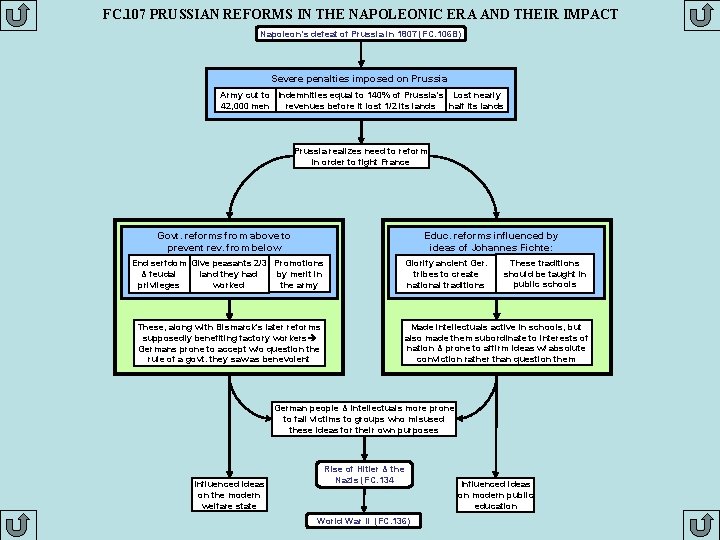
FC. 107 PRUSSIAN REFORMS IN THE NAPOLEONIC ERA AND THEIR IMPACT Napoleon’s defeat of Prussia in 1807 (FC. 106 B) Severe penalties imposed on Prussia Army cut to Indemnities equal to 140% of Prussia’s Lost nearly 42, 000 men revenues before it lost 1/2 its lands half its lands Prussia realizes need to reform in order to fight France Govt. reforms from above to prevent rev. from below Educ. reforms influenced by ideas of Johannes Fichte: End serfdom Give peasants 2/3 Promotions by merit in & feudal land they had the army privileges worked Glorify ancient Ger. tribes to create national traditions These traditions should be taught in public schools Made intellectuals active in schools, but also made them subordinate to interests of nation & prone to affirm ideas w/ absolute conviction rather than question them These, along with Bismarck's later reforms supposedly benefiting factory workers Germans prone to accept w/o question the rule of a govt. they saw as benevolent German people & intellectuals more prone to fall victims to groups who misused these ideas for their own purposes Influenced ideas on the modern welfare state Rise of Hitler & the Nazis (FC. 134 World War II (FC. 136) Influenced ideas on modern public education
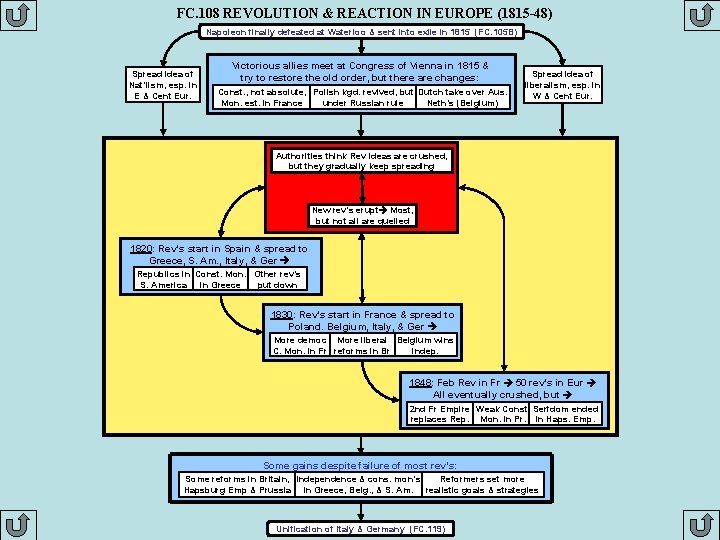
FC. 108 REVOLUTION & REACTION IN EUROPE (1815 -48) Napoleon finally defeated at Waterloo & sent into exile in 1815 (FC. 105 B) Spread idea of Nat’lism, esp. in E & Cent Eur. Victorious allies meet at Congress of Vienna in 1815 & try to restore the old order, but there are changes: Const. , not absolute, Polish kgd. revived, but Dutch take over Aus. Mon. est. in France under Russian rule Neth’s (Belgium) Spread idea of liberalism, esp. in W & Cent Eur. Authorities think Rev ideas are crushed, but they gradually keep spreading New rev’s erupt Most, but not all are quelled 1820: Rev’s start in Spain & spread to Greece, S. Am. , Italy, & Ger Republics in Const. Mon. Other rev’s S. America in Greece put down 1830: Rev’s start in France & spread to Poland. Belgium, Italy, & Ger More democ More liberal Belgium wins C. Mon. in Fr reforms in Br indep. 1848: Feb Rev in Fr 50 rev’s in Eur All eventually crushed, but 2 nd Fr Empire Weak Const. Serfdom ended replaces Rep. Mon. in Pr. in Haps. Emp. Some gains despite failure of most rev’s: Some reforms in Britain, Independence & cons. mon’s Reformers set more Hapsburg Emp & Prussia in Greece, Belg. , & S. Am. realistic goals & strategies Unification of Italy & Germany (FC. 119)
FC. 107 A THE VICIOUS CYCLE AFFECTING LATIN AMERICAN NATIONS Latin Amer. Colonies gain independence (FC. 107) Europeans encourage 1 product economies US sees W. Hemisphere as its sphere of influence Spanish bureaucrats leave during revolutions Direct intervention by US Too dependant on foreign mkts Haiti: 1915 -34 Chile (1973) Mexico: 1846 -48, 1914, 1916; Nicaragua: 1912 -33; 1981 -87 Dominican Rep: 1916 -24; 1965 -66 Grenada: 1983 Guatemala: 1954 Cuba: 1898 -1902, 1917, 1921 -23; 1933; 1961 Puerto Rico: 1898 -now Panama: 1903 -18; 1989 Unstable economies Unstable military dictatorships Military coups & revolutions Only military left to run gov’s
The Industrial Revolution (c. 1750 -1914)
FC. 109 AGRICULTURAL BACKGROUND TO THE INDUSTRIAL REVOLUTION New agricultural techniques & technology Virtual revolution in medieval agriculture (FC. 63) 3 -field system Heavy plow Rise of towns in High Middle Ages Rise of middle class with money to invest (FC. 64) Peasants must share plow teams Divide fields into strips so everyone gets some land plowed All must agree on any changes in Agr Tech’s No change Stagnant agric. production Enlightenment Scient. advances (FC. 97) 4 -field system using turnips, barley, wheat (or some variant), & clover (to replenish soil) Several advantages: Crop rotation Can use No fallow % Keeps land less fertile land used goes from 67 100% fertile lands Most land needed for grain crops just to feed people Little land available for supporting livestock Little manure Virtually no fertilizer for crops stagnant agric. production Vastly expanded potential for food prod. Need a better way to feed & expand Britain’s population Peasants can afford feed for livestock More meat & protein in commoners’ diet Requires large tracts of land to practice Enclosure Movement to enclose large tracts of land Affects Br’s population in 2 ways: Many peasants must leave Dramatic population their lands to move to growth as agric. prod. cities for homes & jobs grows by as much as 2 X Labor supply for Britain’s textile mills (FC. 111) Need a better way to feed & expand Britain’s population
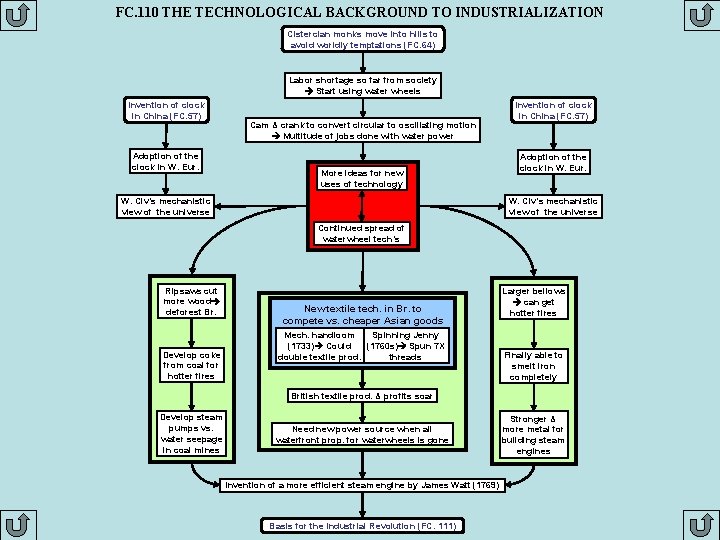
FC. 110 THE TECHNOLOGICAL BACKGROUND TO INDUSTRIALIZATION Cistercian monks move into hills to avoid worldly temptations (FC. 64) Labor shortage so far from society Start using water wheels Invention of clock in China (FC. 57) Adoption of the clock in W. Eur. Cam & crank to convert circular to oscillating motion Multitude of jobs done with water power More ideas for new uses of technology Invention of clock in China (FC. 57) Adoption of the clock in W. Eur. W. Civ’s mechanistic view of the universe Continued spread of waterwheel tech’s Ripsaws cut more wood deforest Br. Develop coke from coal for hotter fires New textile tech. in Br. to compete vs. cheaper Asian goods Mech. handloom Spinning Jenny (1733) Could (1760 s) Spun 7 X double textile prod. threads Larger bellows can get hotter fires Finally able to smelt iron completely British textile prod. & profits soar Develop steam pumps vs. water seepage in coal mines Need new power source when all waterfront prop. for waterwheels is gone Invention of a more efficient steam engine by James Watt (1769) Basis for the Industrial Revolution (FC. 111) Stronger & more metal for building steam engines
FC. 111 THE BIRTH OF THE INDUSTRIAL REVOLUTION IN BRITAIN (c. 1750) Triumph of rich middle class willing & able to invest in new business & tech. (FC. 96) Britain’s colonial empire (FC. 96 C) New agricultural tech’s (FC. 109) New steam & textile tech. (FC. 110)) Population growth Labor force & mkts for goods Develop transp. system: ships & canals Resources for textile mills & markets for goods Br’s excellent waterways & trade position Bank of Eng Money to invest (FC. 96 C) Large deposits of coal & iron in N. England Industrial Revolution starts in Great Britain, putting it well ahead of the rest of the world Steamships & Railroads Tie whole continents & globe more tightly together (FC. 112) Drastic changes in living conditions, social & family structure, & women’s status (FC. 113) Virtual explosion of new technologies, esp. after creation of research labs (FC. 117) Powerful forces & effects of Ind. Rev. spread across globe (FC. 119)
FC. 111 B AN OVERVIEW OF THE IMPACT OF THE INDUSTRIAL REVOLUTION Industrial Revolution starts in Great Britain, putting it well ahead of the rest of the world (FC. 111) Impact on women (FC. 114) Rising status seen in: Railroads (FC. 112) RR’s, along w/steamships & telegraph Social effects (FC. 113) Drastic changes in people’s lives: More soc. mobility & less confining fashions More women Women win pursue educ. the vote More women in workforce More $ & power Global economic & political interdep. Govt’s need to fund RRs, & est. standard gauges & safety practices Awful work cond’s Govt’s help workers Impers. urban soc + sep. of home & work Nucl. fam. replaces ext. fam Higher standard of living after initial decline Dev. cont. interiors & link mkts, fact’s & resources Accelerating pace of technological change (FC. 117) More sales More $ in economy Profusion of new tech’s Raise production More Jobs Incentive to create new products Research labs Ind. Rev. spreads across globe (FC. 116) Rising power of the nation state (FC. 117) Higher standard of living
FC. 112 RAILROADS & THEIR IMPACT (c. 1825 -1900) James Watts’ more efficient steam engine (FC. 110) Napoleonic Wars (FC. 106) Need to expand steam engine’s versatility Need stronger iron to make stronger boilers Serious shortage of horses Patent to convert oscillating to rotary motion in 1780 s Rolling & puddling process Cheap rails for RR’s Efforts to create steam locomotive 1 st working locomotive (1804) 1 st RR’s in Brit Profits Rapid expansion of RR’s in Britain Spreads to other countries (FC. 116) Growing government involvement in: Shorter transp. time & cheaper rates Funding Standard gauges & Location of RR’s safety measures of RR’s Dev. Contin. Can feed once Can grow interiors isolated areas cash crops More people can afford consumer goods Medi. & agr. advances raise stand. of living More prod Jobs $ in ec. Sales Etc. Virtual explosion of new inventions & tech (FC. 117)
FC. 113 THE SOCIAL IMPACT OF THE INDUSTRIAL REVOLUTION Industrial Revolution (FC. 111) Mass migration to urban areas New cities rise up quickly Village network of friends & relatives is replaced by: Nuclear family in Work separates city often w/o any fam’s from home & each other outside help Horrible working conditions: Horrible living conditions: Low wages & Dangerous machinery & little job long days security Polluted air & Poorly built & crowded water & housing tainted food Growing problems of crime, alcoholism & drugs Rapid advances in public health & medicine (FC. 117) Growing reform movements: Some fact. owners Govt. laws to Workers form labor work to provide regulate work unions to win better good housing & conditions, public work conditions sanitation, etc. Rising standard of living by 1900: Longer life Real wages Dramatic pop. expectancy double by 1900 growth Rapid advances in public health & medicine (FC. 117)
FC. 114 THE RISING STATUS OF WOMEN IN THE LATE 1800’s More labor saving devices & birth of consumer society (FC. 116) Separation of home & work (FC. 113) Women compete w/men for jobs Many women pushed out of “male” occupations MC women at home w/ leisure time Time to get involved in charitable causes MC women at home do the shopping MC women more actively involved in society: Targeted by emerging advertising ind. Women pursue Women work to univ. educ’s get the vote More women in More soc. mobility “female” jobs as w/sports & less teachers, secr’s, etc. confining fashions Women’s growing visibility & status Liberalism, should apply for all people (FC. 108) Demonstrations to win the vote Some harsh reactions Publicity Growing support for women’s suffrage Women win vote in many developed countries by 1925, but continue to struggle through 1900 s for full equality (FC. 148) World War I Women more essential to econ. (FC. 127)
FC. 115 THE MARXIST VIEW OF HISTORY & ITS IMPACT MARX SEES HISTORY AS EVOLVING THROUGH A SERIES OF ECONOMIC STAGES CHARACTERIZED BY CLASS STRUGGLES: Primitive society w/o any excess wealth no class conflicts Slave society w/more conflict b/w slave & master as wealth increases Ind. Rev. Social problems (FC. 113) Feudal soc. w/conflict b/w serf & lord Ind. Rev. Social problems (FC. 113) Capitalist society conflict between owners & workers Owners charge more for their goods than they paid Some owners survive while others don’t Increasingly smaller class of owners who individually are much richer To stay competitive, they invest in more efficient, but expensive machinery Must layoff workers Growing class of poor unable to support themselves or capitalist econ Workers’ rev. overthrows capitalism. Transitional govt. that will eventually evolve into ideal socialist society: No social classes No private No need for govt. , or conflicts property family, or religion Marxism successful in some ways but not in others: Marxist rev’s Indiv. genius, greed, Caused many govt. Pointed out the role of happened in prestupidity, etc. not reforms both for & vs. economics & class struggle in history indus. , not ind. soc’s accounted for Marxism
FC. 116 INDUSTRIALIZATION SPREADS BEYOND BRITAIN (1850 -1900) Indust. Rev. in Britain. (FC. 111) Br. industries far ahead of rest of the world because: Resistance to Ind. Coal & iron Econ. disunity & Competition from Br. tries to keep Rev. in countries resources in other Internal tolls & in Br. drains needed their tech. from seeing squalor of countries isolated fragmented countries money from other spreading beyond Br. cities from each other (e. g. , Ger. & Italy) countries Britain Industrial Revolution spreads to W. Eur. & U. S. because: Common culture, Br. invests in W. Eur. & U. S. must Br. tech. leaks Geog. proximity to out to other Br. exposes Eur. & esp. tech, of W. cheaper for. compete vs. countries U. S. to Br. tech. Eur. & U. S. to Br. ind’s & RR’s cheaper Br. goods W. Eur. , U. S. , & Japan industrialize, typically starting w/railroads Belgium: small size & closeness of coal & iron resources 1 st in Eur. to indust. France: Nap. III develops RR’s & then industries, harbors & foreign trade Japan: rapidly industrializes after being forced open to trade by U. S. , (FC. 125) Germany: Unific. Rapid indust. growth Passes Br. steel prod. & RR mileage U. S. : Vast resources & trans -continent. RR Rapid ind. growth Competition for mkts & resources Eur. , U. S. & Japan expand into Asia & Africa (FC. 122) Growing tensions that erupt into WWI when there are no more areas for expansion (FC. 126)
FC. 116 A ‘THE ONGOING CYCLE OF FOREIGN INVESTMENT AND SPREAD OF INDUSTRIALIZATION As a nation industrializes Build factories in nonind. nations with cheap labor Higher cost of labor & living as econ. grows Less competitive in international mkts Ind. Rev. spreads to W. Eur. , U. S. , & Japan after 1850 Ind. Rev. spreads to E. Asian “Mini-dragons” after 1945 Ind. Rev. spreads to China, SE Asia, & India after 1990
FC. 117 ACCELLERATING TECHNOLOGICAL GROWTH (c. 1850 -1900) Birth of Ind. Rev. (FC. 111) Ind. Rev Higher standard of living Birth of Scient. Rev. (FC. 97) Growing complexity of tech. separate from science Sales, production & employment rise Growing complexity of science separate from technology Incentive to create new products Govt’s & corporations invest in research labs that fuse science & technology New inventions at an ever faster pace Ideas for ever more inventions Transportation: RR’s, steamships, cars & airplanes drastically cut travel time Medicine: Anesthesia, germ theory & aseptic procedure Cure &/or prevent many diseases New energy sources: Oil & electricity (which transfers energy over long distances) Chemical indus. : Bleaches, dyes, soaps, veg. oils, & 1000’s of new products. Communications: Telegraph, radio, & telephone cut time of comm’s from months to minutes Building mater’s: steel & concrete Skyscrapers & much longer bridges Far reaching economic, political & philosophical effects: Indus. states exert Global econ. New philosophies interdependence unprecedented power that challenge Polit. interdep. over their people traditional beliefs Agriculture: Chem. fertilizers, tractors, mech. reapers & combines Better fed popul’s
FC. 117 A THE EVOLUTION OF MODERN SURGERY Lack of anesthetics Few willing to undergo surgery (FC. 98) Discovery of anesthetic properties of ether & chloroform in 1840 s Painless surgeries Growing number of surgeries Growing number of infections from surgeries Pasteur’s germ theory links microbes to disease & infection (1864) Joseph Lister sprays carbolic acid on patients as an antiseptic during surgery More patients survive, but some patients & medical staff react to the acid Patients’ infections shown to have same germs as those on surgeons’ hands Rubber gloves to protect nurse’s hands from spray of carbolic acid Aseptic procedure where everything in the operating room is sterilized Infections drastically reduced More surgeries More problems from blood loss Random blood transfusions Many patients die until blood typing is discovered Use of Sodium citrate during WWI to keep blood from clotting Long term storage of donated blood Discovery of penicillin in WWII allows Dr’s to halt internal infections w/o surgery
Nationalism & Neo-Imperialism (1850 -1914)
FC. 118 THE DECLINE OF THE HAPSBURG EMPIRE IN THE 1800 s German expansion into Central & E. Eur. in Middle Ages (FC. 70) Crowded conditions in cities Unsanitary conditions in cities German ruling class establishes itself in the cities Inability to sustain urban population due to disease Gradual influx of Slavic migrants to cities to replace lost German popul. Cholera epidemic severely depletes Germanized urban popul. Slavic migrants absorb German culture & are incorporated into the German ruling class Rising tide of nationalism (FC. 108) Huge influx of Slavic migrants into cities Ger. Pop. unable to assimilate all these new migrants to cities Ind. Rev. need for large factory work force (FC. 111) Rising tide of nationalism (FC. 108) Growing threat & fear that slavic peoples & culture will overwhelm German people & culture Growing conservative backlash vs. Slavs Growing resistance of Slavic nationalist groups vs. Germans Steady decay of Hapsburg Emp. in late 1800 s & early 1900 s Outbreak of WWI (FC. 125) Haps. Emp. collapses at end of WWI (FC. 127)
FC. 119 EUROPEAN NATIONALISM (1848 -1914) Napoleon spreads ideas of nationalism & liberalism across Europe (FC. 106) Rev’s of 1848 sweep across Europe, but fail because of unrealistic appreciation of what Nat’l unif. required (FC. 108) Decay of Hapsb. Emp. (FC. 118) Decay of Ottoman Emp. (FC. 49) Italy broken into many states (FC. 39) Italians & Germans want to found their own indep. nation states Subject peoples want to found their own indep. nation states Nationalist movements in the Balkans destabilize the already crumbling Hapsburg & Ottoman Empires Italy Unified by 1871 (FC. 120) Ger. Unified by 1871 (FC. 121) Both nations strive to industrialize, but only Germany succeeds Russia moves in as the champion of Slavic liberties vs. Austria & Turkey Rising tensions between Austria, Turkey, & Russia Ger. broken into many states (FC. 70) Upsets balance of power Rising tensions Outbreak of World War I (FC. 126)
FC. 120 THE UNIFICATION OF ITALY & ITS EFFECTS (1848 -1914) Rev’s of 1848 fail when Pope & Duke of Tuscany desert the cause of Italian unification & indep. (FC. 108) Kgd. of Sardinia (aka: Piedmont) seen as the natural leader for Italian unification Loans from Britain Camillo Cavour, Sardinia’s prime minister, skillfully orchestrates Italy’s unification Repays loans Builds a good credit rating Camillo Cavour, Sardinia’s prime minister, skillfully orchestrates Italy’s unification Builds strong econ. (RR’s, banks, ind’s, etc. Investments pay off Sardinia, needing allies vs. Austria, helps France & Britain vs. Russia in Crimean War Fr. helps Sardinia vs Aust. in War of 1859, but drops out after two costly victories Sardinia gets most of N. Italy, while France gets Nice & Savoy for its help Giuseppe Garibaldi, a fiery rev. leader, furious about Fr. deserting the Ital. cause & then getting Nice, his birthplace, plans to take Nice back Sard. diverts him to S. Italy & Sicily, which he takes from the Bourbons. Sard. takes Papal States (exc. Rome) fr. France Garibaldi turns S. Italy & Sicily over to Sardinia Formation of Kgd. Of Italy (1861) Need 2 more areas to complete unification Venice which falls to Italy after Rome which falls to Italy after Franco-Prussian War (1871) Austro Prussian War (1866) Efforts to build Italy w/nat’l army, nat’l RR, & public education largely fail because: Resistance from local Different subcultures Uneven distr. of groups (e. g. , Mafia) wealth b/w N & S Italy in N. & S. Italy’s poor performance in World War I (FC. 127) Italy destabilized & open to takeover by Mussolini & the Fascists (FC. 133)
FC. 121 THE EMERGENCE OF THE GERMAN NATION (1848 -1914) Germany used as battleground since Thirty Years War (FC. 88) Rising tide of Nationalism in 1800 s (FC. 119) Cong. of Vienna consolidates Germany into 38 states (FC. 107) Otto Von Bismarck guides Prussia through a series of wars that The next war Danish War (1864) over Schleswig-Holstein Pr. “champion” Dispute w/Aus. of Ger. liberties over Sch. -Holstein Austro-Pr. or 7 Wks War (1866) N. Germany united Tensions b/w Pr. under Prussia & France rise Franco-Prussian War (1870 -1) Final unification of Fr. bitter over Germany (1871) loss of Als-Lorr. Germany rapidly industrializes & even surpasses Brit. steel prod. by 1900 (FC. 117) More diverse soc. Harder to control Economic problems by late 1800 s Upsets BOP in Europe Ag. & ind. compet. Mkt. speculation fr. US, Rus, & Brit. Depr. in 1873 Use repression & “Kulturkampf” vs. benefits vs. Soc’s Cath. influence Several results: Soc. & Pol. change Tariffs to protect Ger. Rising anti-Semitism Socialist movement lag behind econ. Agr. & industries keeps growing to deflect blame Rising internat’l & domestic tensions Outbreak of World War I (FC. 125) Upsets BOP in Europe
FC. 122 EUROPEAN IMPERIAL EXPANSION INTO AFRICA (c. 1870 -1914) German unific. & Balkan turmoil upset balance of power (FC. 119) Social changes brought by Ind. . Rev. (FC. 113) Spread of Ind. Rev. outside Britain (FC. 116) Several problems for Britain after 1870: More complex Brit. feels powerless to Hard to compete soc Harder to stop these changes & vs cheap labor & unite politically econ. depression in 1873 newer factories Br. Prime min. , Benjamin Disraeli proposes imperial expansion which will: Enhance Britain’s Protect Br’s econ. Provide new mkts. internat’l prestige interests overseas & resources Other politicians, not wanting to lose popularity, also support imperialism Early efforts focus on Africa as the main object of imperial expansion despite its relative unimportance to Britain’s economy. Brit. seizes Egypt to guard Henry Stanley’s travel Br. conquers Zulus in S. Afr its interests in Suez Canal account Interest in Afr. to protect Dutch Boers Br. conquers Sudan to keep it from blocking Nile R. Vaccines vs. trop. diseases (FC. 117) When new lands to colonize are gone Rising tensions in Eur. helps lead to WWI (FC. 126) Leopold II of Belgium seizes & mercilessly exploits the Congo Tensions b/w Br & Boers Boer War Br. takes S. Afr. Scramble for colonies by other Eur. powers who want to keep up w/Britain Most of Africa carved up into colonies by 1914 Arbitrary borders drawn w/o respect for tribal divisions splits some tribes while throwing others together Benefits of Eur. Civ. (schools, RR’s, etc. ) offset by suffering & humiliation caused by European rule Improvements in milit. tech. (FC. 117) WWII Eur. weak & natives use Eur. tech. & ideas of to win indep. (FC. 139)
FC. 123 THE BRITISH IN INDIA (c. 1600 -1947) Decline of Portuguese Emp. in SE Asia by 1600 (FC. 82) Decline of Mughal Empire Growing turmoil (FC. 52) Br. E. Indies Comp. (BEIC) sets up & must defend trading posts in India BEIC trains native troops like Eur. armies Defeat Fr. expansion in S. Defeat Bengalis at Plassey India during 7 Yrs War vs. 30: 1 odds (1757) Br. send missionaries, some to help Indians & some to show Eur. superiority Many Indians upset either way WWI (FC. 127) WWII (FC. 135) India wide open for exploitation & conquest by BEIC & its employees Many make Tropical diseases Many adopt huge fortunes & heat kill many local customs BEIC in debt Br. govt. assumes more control Growing tension between: British advocating British having no respect for Ind. civ. Great India Mutiny (1857) Br. Gov. takes control of India (1858) Gandhi’s nonviolent movement Many Indians upset either way WWI (FC. 127) Dev. Tea, cotton, Continue bldg. Efficient but coal & iron ind’s RR’s & telegr. segregated bur. Indep. . movement by Hindus Indian Muslims want sep. state Br. rapidly modernize Ind. , some to help Indians & some to show Eur. superiority Br. needs Indian help More promises of concessions Muslim/Hindu clashes worsen Br. grants indep. (1947), but to separate Hindu India & Muslim Pakistan WWII (FC. 135)
FC. 124 CHINA AND THE WEST (c. 1800 -1911) China’s trade & contact w/West (FC. 81) Eur. free trade vs. centralized Chin. econ. (FC. 100) Drain of silver from Br. since Chinese don’t want Br. goods Chinese feel superior toward outsiders (FC. 53) Br. E. Ind. Co. sells opium from India to get silver for Chin. tea Millions of Chinese addicted Stresses from overpopulation (FC. 58) 1 st Opium War (1839 -42) Br wins Controls Hong Kong & free trade in 5 Chin. ports through Treaty of Nanking Dynastic corruption cycle (FC. 53) Other Eur. nations force China to grant similar treaties, status of most favored nation & extraterritoriality, & right to collect debts by collecting Ch. taxes China in further decay Conservative reaction vs. change & foreign ideas Defeat in war &/or revolt Needs foreign intervention Growing reform movement Taiping Reb. (1850 -64) & 2 nd Opium War (1858 -60) Sporadic reforms mostly thwarted Japan humiliates China in Sino-Jap. War over Korea (1894 -5) “ 100 Days Reforms” Quickly crushed Boxer Rebellion (1898 -1900) Foreign intervention Serious & lasting reforms Rev. in 1911 establishes moderate but weak Western style democracy Growing chaos since Govt is too weak to stop turmoil & rise of more radical Communists (FC. 147)
FC. 125 THE EMERGENCE OF MODERN JAPAN (1853 -1937) 200 yrs of peace weaken samurai (FC. 61) Brit. power in China worries Japan (FC. 124) Famine disease, inflation, & unrest in 1830 s Struggle b/w isolationists & West. style reformers as Jap. Gov. weakens Mex. War US a Pacific power (USFC. 7) U. S. forces Japan to open up to the West (1854) 1868 - Meiji Restoration of emperor’s power & program of Success of Ger Unif. , Ind. Rev. & autocracy (FC. 121) reforms to make Japan a major power Polit. & soc. reforms modeled on West, but keeping trad. Jap. values Conditions to modernize: Replace feudal Abolish class Keep Shinto w/mod. prov’s distinctions as state relig. Banking tech’s & unific. under Tokugawas (FC. 61) Mandatory educ. for all Industrial & military reforms: Draftees replace RR; s, mining, army, navy, Gov. coordinates samurai merch. marine & mod. agr. & funds ind’s Japan emerging as a major power Power & need to expand Sino-Jap. War (1894 -5) Rev. in Chin. (FC. 124) Russo-Jap. War (1903 -5) Rev. of 1905 (FC. 129) Japan joins allies vs. Germany in WWI (FC. 127) Communist Rev. in China (FC. 147) Com. Rev. in Rus (FC. 130) Jap. Gets Ger’s lands in China FC. 128) Stresses from overpopul. Growing milit. control of Gov. Jap. takes Manchuria from China (1931) Japan invades China (1937) WWII in Asia (FC. 135) Depression cuts trade (FC. 132)
World War I (1914 -19)
FC. 126 THE CAUSES OF WORLD WAR I (1870 -1914) Combination of the two main driving forces of 1800 s: Fr. Rev Nat’lism (FC. 105) Spread of Ind. Rev. (FC. 116) Military/diplomatic rivalries: Mutual fear of each others’ milit. strength Two rival alliances of Eur. powers All raise milit. spending Drains econ’s War b/w any 2 powers drags all others in Economic rivalries: Nationalist rivalries: Hapsburgs France vs. vs Russia Germany New Balkan states vs. Hapsburgs & each other Serbian nationalist murders heir to Hapsburg throne Competition for mkts & colonies Protective tariffs ruin trade & econ. Fewer mkts & colonies to exploit Politicians blame other nations Austria blames Serbia Harsh ultimatum Rising international tensions Serbia unable to comply Gets Russian support Rising international tensions Ger. assures Austria of its total support vs. Russia Ger’s geog. pos. b/w hostile Fr. & Russia, as a dipl. move to show it is serious, mobilizes its army Ind. Rev faster milit. mobiliz. in Fr than Rus Ger. activates Schlieffen Plan to avoid 2 -front war by knocking out Fr. before Rus. can mobilize Ger. declares war on Fr. as well as Russia & invades neutral Belgium to get to Fr. Britain declares war on Germany Eur’s colonies also get drawn in, making it a global war (FC. 127)
FC. 127 THE FIRST WORLD WAR (1914 -1918) Ind. Rev Fast tech change (FC. 117) Pop. growth & mech. prod Millions more men for army Rapid milit. changes Gen’ls can’t or won’t adapt Modern artillery & machine gun Massed firepower Daily papers Public impatient for quick victory Continuous Front b/w Alps & N. Sea Can’t outflank it Hopeless frontal assaults Gov’ts control mater. resources: Pressure on Gen’ls for quick victory Raw mat’s Factories & scientif. & what research they make VICIOUS CYCLE OF STALEMATE ON W. FRONT Gov’ts control human resources: Censor info to maintain morale Draft News. Women in papers & factories posters Misinformed public New weapons (subs, tanks, flamethrowers, & planes) to try to break stalemate in W. Ger. sub. raids Ltd success of US declares tanks & planes war (1917) vs. trenches Russia suffers disastrous defeats vs. Germany Russ. Rev. (1917) Rus. drops out of WWI (FC. 130) Look for victories on other fronts: Italy, Turkey, Asia, & Africa Ger’s allies Naval blockade weakening & slowly starves near collapse Germany Ger’s use troops freed from E. front for 1 last offensive before US troops arrive Nearly succeeds, but wears out Ger. army Allied offensive drives Ger’s steadily back until Germany asks for ceasefire (11/11/1918) Treaty Of Versailles further destabilizes Europe (FC. 128)
FC. 128 THE RESULTS OF WORLD WAR I World War I (FC. 127) Tr. of Versailles Ger. loses land, $, resources, & most of its army Ottoman & Haps. Emp’s broken up Germany must take full blame for World War I Expensive Eur’s sell off many colon. assets (e. g. , RR’s, mines & plantations Weakens Eur Colonies win indep. after WWII High cost of war Huge loans U. S. center of world economy Eur’s lose consumer markets to the United States Eur’s overdependence on US unstable econ Econ. & polit. instability & bitterness in Ger. Rev. Rus. hostile to the West (FC. 130) Great Depression in 1930 s (FC. 132) E. Eur. broken into many small & unstable nations Arabs under Br. & Fr. mandates instead of ind. as promised by allies in WWI Rise of Hitler & the Nazis (FC. 134) Disunity of Germany’s former enemies (Br. , Fr. , & Rus. ) Hitler exploits E. Eur. instability & disunity of Germany’s former enemies (FC. 135) World War II (FC. 136) Anti-Semitism & Holocaust Jews est. Israel (1948) Uneasy alliance of Comm. Russia, Br. , & U. S. vs. Ger. Old tensions resurface after WWII (FC. 138) Commun. ideas spread to China & other non. West. nations wanting indep.
The Russian Revolution (1917 -40)
FC. 129 THE CAUSES OF THE RUSSIAN REVOLUTION) Russia’s huge size, geog. isolation, & history of foreign invasions Slow moving & backward autocracy (FC. 92) Russia falls further behind the West Reform movement gets wrecked Reforms to help Russia catch up Conservative backlash vs. reforms Peter the Great tries to westernize Russia in early 1700 s (FC. 92) Catherine the Great tries to reform Russia in late 1700 s Alexander II frees serfs (1861) after defeat in Crimean War (1854 -6) Ind Rev spreads to Russia (FC. 116) Soc. problems from Ind. Rev. (FC. 113) Rev. of 1905 Forces reforms from Tsar Nicholas II: Rising infl. of Marxism (FC. 115) Jap. defeats Rus. (19035) (FC. 125) Duma (parliament) Gets Economic reforms Many gradually stripped of power peasants get own lands World War I (FC. 127) Growing gap b/w econ. & polit. progress, aggravated by Rus’s defeat in WWI Russian Revolution (FC. 130)
FC. 130 THE COURSE OF THE RUSSIAN REVOLUTION (1917 - ) Rev. starts moderately Good & bad points: It seems more acceptable since Can’t take the drastic measures it’s not too radical a change needed to solve the crisis Russia stays in WWI to keep Fr. & Br. happy & look legitimate (FC. 130 A) REV’S CRISIS STAGE Military defeats Internal turmoil (FC. 130 A) Rad. Bolsheviks seize power (11/7/1917) & pull Rus. out of WWI Civil war and foreign invasions to overthrow Bolsh’s Nationalist support from Rus’s defending their land vs. foreigners (FC. 130 A) REV’S DICTATOR STAGE (FC. 130 B) Crisis Bolsheviks take severe measures: War communism for war effort Red Terror to crush dissent REV’S CRISIS STAGE Bolsh’s free to think & act in new ways Build Red army of 5, 000 men Bolsheviks, against heavy odds, win by 1920, but Russia is badly damaged Some lightening up (e. g. , Lenin’s New Economic Policy) (FC. 130 A) REV’S DICTATOR STAGE Stalin seizes power Harsh dictatorship that transforms Russia into a world power, but at terrible cost (FC. 130 B) Stalinist system overthrown by more liberal democ. (1991) Problems in transition to mkt. econ. (FC. 149) Vladimir Putin tightens polit. control to help Russia’s transition to mkt. econ (FC. 150) Rising educ. middle class that will want more democ. govt ?
FC. 130 A THE RUSSIAN REVOLUTION AND CIVIL WAR (1917 -20) Hardships from WWI (FC. 129) Bread riots in Petrograd Tsar Nicholas II abdicates (March, 1917) Moderate republic under Alexander Kerensky & moderate legislative assembly (Duma) that stays in WWI to look legitimate to other nations Marxist belief that WWI is a war of capitalists for making profits Rise of Lenin & the Bolsheviks Military defeats Internal turmoil Bolshevik belief that workers can’t develop socialism on their own Lenin & Bolsheviks seize power (11/7/1917) Bolsheviks pull Russia out Strict decrees vs. private of WWI (March, 1918) property & civil liberties Russia’s old allies attack Bolsheviks Rise of Lenin & the Bolsheviks Growing opposition to Bolshevik rule Russian Civil War (1918 -20) between: Reds (AKA Bolsheviks) who are outnumbered Whites (Tsarists & other factions vs. Reds) who are scattered around Reds Little coop. but united & control interior lines of comm’s War characterized by confused fighting & brutality on both sides: Prisoners on both sides Reds capture & execute Large scale massacres tortured & executed Tsar & his family committed by both sides Reds win because: Foreign Intervention for Severe ec. policies: Red Terror to crush Strong decisive leadership Whites alienates Rus. people War Communism any dissent Large & effective Red Army Lenin takes drastic ruling measures to revive Russia, which is devastated by war & famine (FC. 130 B)
FC. 130 B THE COMMUNIST DICTATORSHIPS OF LENIN & STALIN (1920 -39) Bosheviks win Russian Civil War, but Russia is devastated (FC. 130 A) Lenin takes drastic ruling measures to revive Russia: Revives govt. & econ. Maintains tight control Creates party structure Revives Russ. Emp. as USSR, valuing world rev. using old tsarist bur’s & w/secret police (CHEKA) parallel to that of govt. & Red Terror over nat’l sovereignty ltd. free enterprise (NEP) More efficient control Lenin’s Rule Lenin survives assass. plot His health deteriorates He dies (Jan. , 1924) Power struggle b/w Joseph Stalin & Leon Trotsky who push different policies: Stalin wants to build USSR’s strength before spreading Comm. revolution Stalin’s Rule Trotsky wants to spread Revolution right away to exploit post WWI turmoil in Eur. Stalin wins & launches ruthless campaign to secure his position & make USSR a major industrial power (“Socialism in One Country”) Industrialization of Russia: Overcentralized planning USSR 3 rd biggest ind. that ignored needs & Power in world, prob. In available resources spite of Stalin’s Rule Collectivized agr to feed new ind. Cities Resistance Brutal repression Millions killed or starved System ruined Soviet agr. Throughout the Communist period Purges to ensure his power & position: Purges in 1920 s of Major purges in 1930 s of old Bolsheviks Trotskyites & moderates in party & Wrecked army officer also non-Comm. bur’s corps before WWII Creates new bur’s educ. in Stalinist ideas Conservative & loyal, but unimaginative Steady supply of forced labor for Stalin’s gulags (concen. camps) USSR an indust. power, but at terrible cost Disastrous losses at start of WWII (FC. 136)
130 C. A COMPARISON OF THE FRENCH & RUSSIAN REVOLUTIONS Growing gap b/w ec. progress & soc. & polit. stagnation Rising frustration aggravated by: Rising cost of wars for Fr. & Russia: Fr. debts from Am. Rev. (FC. 104) High cost of WWI for Russ. (FC. 129) Enlit ideas on liberty in Fr. (FC. 100) Appeal of Marxism to the poor (FC. 115) Weak rulers Events get out of control: Weak rule of Louis XVI (FC. 104) Weak rule of Nicholas II (FC. 129) Moderate govt. keeps old policies to seem legit. Nat’l Assem. In Fr. honors royal debt (FC. 105 A) Duma keeps Russia in WWI (FC. 130 A) Rising discontent as new gov’s moderate policies fail to quickly fix the problems that caused the rev. Growing internal turmoil & milit. defeats Robespierre & Jacobins, supported by urban sans culottes, seize power & restore order through severe measures & Reign of Terror (FC. 1 O 5 C) Rise of rad. factions For. intervention Lenin & Bolsheviks, supported by urban soviets seize power & restore order through severe measures & Red Terror (FC. 130 A) Conservative backlash or retrenchment: Therlmidorean Reaction in Fr. (FC. 105 C) Lenin’s New Economic policy (FC. 130 B) Ruthless dictator tames rev. & uses its ideas for his purposes: Napol. wrecks Fr. trying to conq. Eur. (FC. 106 B) Stalin’s rule nearly wrecks Rus. (FC. 130 B) Gradual evolution toward stable economy & democracy: Rev’s of 1830 & 1848 Napoleon III whose ec. reforms prepare Fr. For 3 rd Republic (FC. 108) Comm’s collapse (1991) Putin’s rule to stabilize Russ’s econ. & politics (FC. 150)
Depression, Fascism, & World War II (1920 -45)
FC. 131 POST WAR BOOM AND BUST (1920 -29) After-effects of World War I on world economy (FC. 128) US takes over many Eur. Mkts (FC. 128) US loans & sales to Eur. Unbalanced $ flow to US for loans, goods & resources Agr. Boom in US from selling grain to Eur. Agr. prices fall in 1920 s when Eur. can feed itself again Agr crisis in US when farmers can’t pay mortgages on land bought during the war Eur’s rebuild ind’s, but don’t reclaim mkts (FC. 128) Tariffs to protect home mkts Higher prices & heavier competition fewer mkts Unstable world econ. in 1920 s despite illusion of prosperity Stock mkt craze in US where investors pay only 10% down & borrow rest from banks at 10 -15% interest Stocks must rise 10 -15%/yr to break even Investors prone to panic selling at 1 st sign of trouble Stocks drop Panic selling Loss of faith in econ. Loss of jobs & consumers Less buying & investment Cut production 5000 US banks, which over-invested in stock mkt, crash Eur. Banks crash when US banks call in loans Worldwide depression (FC. 132)
FC. 132 THE GREAT DEPRESSION & EFFORTS TO SOLVE IT (1929 -39) Depression spreads over the globe (FC. 131) Govt’s raise tariffs & establish import quotas, trading blocs & bilateral trade pacts World trade drops 2/3 by 1933 Govt’s cut civil servants’ pay & public works programs More unemployment Fewer consumers Brit. Abandons gold standard & devalues its currency to undersell for. Competition Other nations copy Chaos Depression deepens & internat’l tensions build Growing belief that the Indust. State should work more actively to ensure the welfare of soc. Tax high & spend low in prosperous times Stimulates econ. recovery Keynesian Economics Surplus in govt. treasury Tax low & spend high in hard times US: FDR’s New Deal supports: Social programs Safety net for poor Banks, Agr. , Publ. works & vital ind’s Jobs Can better defend itself Germany, Italy, & Japan build their military Both jobs, & aggression (FC. 135) Rising international tensions Aggression escalates into World War II (FC. 136) Brit: funds new programs: Social programs Safety net for poor Milit. , navy, Electronics & aircraft & radar Can better defend itself
FC. 133 THE RISE OF FASCISM IN ITALY (1919 -1925) World War I (FC. 127) Italy & Germany mad about Treaty of Versailles (FC. 128) Political & economic chaos in Italy Russian Rev. Growing fear of Communism (FC. 130) Rise of Fascism which: Controls most Allows private prop. & aspects of society free enterprise Is aggressively nationalistic Popular with middle class who fear Communism will eliminate private property & free enterprise Benito Mussolini & Fascists in Italy gain popularity by starting riots to destabilize govt. while posing as champions of law & order. Local party bosses march on Rome to overthrow govt Mussolini follows along Govt. panics & makes Mussolini prime minister (1922) Mussolini intimidates parliament to give him emergency powers He ends civil liberties Mussolini tries to build Italy’s power by developing: Few resources in Italy’s ind’s, esp. shipping & aircraft Italy’s military strength Public works (e. g. , Hydro-elect. dams) Success, limited. largely by poor planning & corruption though Mussolini still claims Italy is a great power Despite his failures, Mussolini inspires Hitler to seize power (FC. 134) Depression (FC. 132)
FC. 134 THE RISE OF HITLER AND THE NAZIS (1919 -39) Harsh Treaty of Versailles (FC. 128) Ger. bitter & unstable Depression Higher tariffs & tensions (FC. 132) Moderate but weak Weimar Republic Can’t maintain law & order Ger. econ. collapses with U. S. stock Mkt. (FC. 131) Rise of Hitler & Nazis who believe in: Master Hatred of Jews, Slavs, Avenging Aryan race & other “inferior” races Tr. of Vers. Nazis gain support during Depression using a combination of: Propaganda + free food & Street fights vs. Comm’s to festivals to win popularity embarrass weak Ger. Govt Industrialists make Hitler chancellor (1933) to stop Comm’s Nazis burn the Reichstag & blame the Communists Emergency powers & legal basis for Hitler’s dictatorship Hitler builds his power & Ger. Nat’l pride by: Rearming Using terror, govt. Making Jews Germany to 7 X powers, & propaganda to scapegoats for its 1933 level crush his enemies 1 by 1 Ger’s problems Strain on Ger. econ aggression World War II (FC. 135) Growing fear of Ger. aggression Belief Jews betrayed Ger.
FC. 135 THE ROAD TO WORLD WAR II First World War (FC. 127) Depression (FC. 132) Intense fear of war Ger. bitter It rearms (FC. 134) Japan takes Manchuria (1931) Invades China (1937) W. powers do nothing Fr allies w/Ger’s neighbors, incl. Russia Rus. Rev. (FC. 130) Allies try to overthrow communists Rus. Hostile vs. Western powers Br, fearing Rus. Power, lets Ger. Rebuild its navy Intense fear of war Shows weakness & disunity of old alliance vs. Ger. Encourages fascist Shows weakness & disunity aggression of old alliance vs. Ger. Western powers fail to react Italy invades Ethiopia (1935) Hitler occupies Rhineland (‘ 36) Ger. & It. intervene in Sp. Civ. War Hitler occupies Austria (1938 Hitler takes Sudetenland (‘ 38) Hitler takes rest of Czech (3/’ 39) Fr & Br finally decide to stop future Ger aggression Stalin allies w/Hitler since Fr & Br won’t stop Hitler Ger. invades Poland (9/1/39) Fr & Br decl. war on Ger WW II (FC. 136)
FC. 136 WORLD WAR II IN EUROPE (1939 -45) Hitler invades Poland (9/1/1939) World War II (FC. 135) Ind. Rev Faster tech. growth (FC. 117) France & Brit. declare war, but do nothing vs Ger. while it is involved in E. Europe Hitler takes Norway, Denmark, & Fr. (1940) New developments in warfare: Tanks & planes fire- Continued population growth power & mobility Blitzkrieg using concerted attacks by tanks & planes to break through enemy lines Designed for quick vict. to avoid prolonged war Stalin takes E. Poland, Latvia, Estonia, Lithuania, & parts of Romania Ger. Blitzkrieg almost conquers SU in 1941 Continuous front is mobile Much more destruction Br. , w/US aid, hangs on vs Ger. Air raids & submarine raids on its shipping in N. Atlantic US helps Br. drive Ger’s from N. Afr. & invade Italy to divert Ger’s fr. Russia Exper. of Italian camp. & Stalin’s pressure to open 2 nd front US & Br. invade occupied France (1944) Nazis become complacent while allies adapt to & modify some aspects of blitzkrieg: Add motorized Extend use of Allies adapt infantry & air power to economies to assault guns to mass bombing full war product. slow blitzkrieg of cities right away US Br. launch air raids vs Ger cities while they prepare to invade Ger. occupied Europe Devastates Ger’s cities & diverts Ger. air power from E. Front Russian air superiority on E. Front Russian winter allows Russians to bolster defenses vs new Ger. offensive in 1942 Russians stop Ger’s @ Leningrad & destroy a Ger. army @ Stalingrad Russian perseverance, ind. prod. & allied aid via Arctic ocean help drive Ger’s back across E. Eur. (1943 -5) Devastation of Ger’’s cities & convergence of allied armies from E & W Germany surrenders (5/8/1945) Cold War b/w SU & US(FC. 138)
FC. 137 WORLD WAR II IN THE PACIFIC (1937 -45) Hitler fails to keep Japan informed of his plans vs. Russia (FC. 135) Stalemate between Japan & China (FC. 135) France & Britain distracted by war in Eur. (FC. 136) Japan plans to conquer SE Asia & set up Greater E. Asia Co-Prosperity sphere to discredit Eur. powers & gain economic control of E. Asia US cuts oil supplies to Japan to force it to stop expansion (1941) Japan launches surprise attack on US naval base at Pearl Harbor in Hawaii (12/7/1941) Nearly unbroken string of Japanese victories in early 1942 Mounting problems for Japan: Huge island empire Japanese over-confidence US war prod. Huge hard to supply or contributes to major naval numbers of ships & concentrate its forces defeat at Midway (June, 1942) planes in S. Pacific US submarines ravage Japan’s unprotected shipping US wants to win the war before Stalin can intervene in E. Asia US & allies drive Japanese back island by island In range to bomb Japanese cities Allies poised to invade Japan by mid 1945, but worried about massive casualties they would suffer Japan worn down by enemy’s numbers & firepower US develops & tests 1 st atomic bomb (7/161945) Atomic bombs devastate Hiroshima (8/6/45) & Nagasaki (8/9/45) but not before Stalin declares war on Japan (8/8/45) Japan surrenders (9/2/1945) Civil war in China resumes Comm’s take over (FC. 147) Tensions b/w US & SU resume Cold War (FC. 138)
1945 -Present
FC. 138 THE START OF THE COLD WAR (1945 -48) End of World War II (FC. 136) Rus. Rev Hostility b/w Capit. West & Comm. SU (FC. 130) US has A-bomb & $, but public is still isolationist W. Eur’s mad at leaders who had blundered into Depr. & WWII Rising pop. of Communism Stalin’s growing power in 1930 s (FC. 130 B) USSR hurt badly, but has world’s largest army Stalin suspicious of U. S. suspicious of Stalin Long delay to launch D-Day Stalin takes over of E. Eur. Churchill’s “Iron” Curtain Speech Soviet reaction vs. his speech Truman Doctrine & Marshall Plan Stalin tries to sabotage M. Plan U. S. econ. aid (Marshall Plan) & Milit. intervention in Greece & Turkey (Truman Doctrine) defeat Communist bids for power in W. Eur. Cold War: Period of intense competition b/w U. S. & USSR stopping short of direct conflict (FC. 139)
FC. 139 THE EVOLUTION AND ANATOMY OF COLD WAR CRISES Ind. Rev Accelerating pace of tech. change (FC. 117) Railroads, telegraph & telephone (FC. 117) Mach. gun, etc. mechanized killing Less time for diplomats to defuse crises WWI lesson that too much provocation War (FC. 126) Tanks & planes more destr. Britain & France try to appease Hitler WWII (FC. 134) Nuclear weapons Cold War Mounting threat of nuclear destruction (FC. 138) Need to find middle path b/w aggression & appeasement to avoid WWIII Pursued in one of two ways: Directly where each side & its armed Indirectly through 3 rd parties US forces directly face each other & Rus. troops don’t face each other Direct confrontation Greater risk of escalating into war b/w US & USSR Must assess seriousness of crisis based on: The strategic value of target country in terms of location and resources Dipl. relations of target country w/each side Whose sphere of influence the crisis is in Need option b/w aggression & appeasement that will: Show resolve w/o Push the situation so close to brink of war Let opponent back being too provocative down w/o losing face opponent must back down or go to war
FC. 140 THE EARLY YEARS OF THE COLD WAR (1948 -53) Cold War Series of crises resolved either: SU dev’s ABomb (1949) threat of Nuc. War Communists take over China in 1949 (FC. 147) Directly Must resolve in Indirectly via 3 rd parties peacefully to avoid war to avoid US/Sov. war (FC. 139) EUROPE ASIA West moves to create indep. W. Ger. Stalin blockades W. Berlin Soviet backed N. Koreans invade S. Korean War (1950 -3) US & Brit. airlift supplies into W. Berlin (1948 -9) UN forces led by US fight N. Kor. & Chinese forces Stalin lifts blockade to avoid war 2 opposing alliances: Threat of WWIII Both sides realize need for compromise N. Atlantic Treaty Warsaw Pact in Org. (NATO) to 1955 to guard SU guard W. Eur. vs. attacks from vs. SU (1949) West US keeps forces in US helps Japan’s S. Korea to guard econ. revival to vs. N. Korea & stop communism Communist China from spreading Europe a potential battlefield as NATO & Warsaw Pact forces stay mobilized BOP in E. Asia b/w US-backed Taiwan, Japan & S Kor. vs Com. China & N Kor. US & SU increasingly paranoid of each other: Stalinist terror & Mc. Carthy’s antigulags revived Comm. hysteria Stalin dies (1953) More moderate rule but can’t immediately dismantle his legacy Mc. Carthy finally discredited, but Anti-Comm. paranoia persists for decades Uncertainty on both sides about how to deal with one another after Stalin’s death in 1953 (FC. 141)
FC. 141 THE AFTERMATH OF STALIN’S DEATH (1953 -56) Stalin’s death in March, 1953 Moderate coalition takes over in Kremlin (FC. 140) Beria, Stalin’s old right hand man, is executed Peace talks in Korea resume two wks later Sign truce in July, 1953 Korean War (1950 -3) Strain on US milit. resources (FC. 140) NATO admits W. Germany (1954) & lets it rearm (1955) USSR forms Warsaw Pact as a counter-measure (FC 140) Worker riots in E. Ger. nearly overthrow Com’s Sov. army crushes uprising Eisenhower admin. split on how to treat new Sov. govt. Uncertainty about direction of US-Sov. relations Khruschev, now in charge, wants more moderate rule Withdraws troops fr. Austria (1955) Restores normal Denounces Stalin’s harsh rule to promote better relations w/US relations w/Yugoslavia (1956) to signal more relaxed rule Polish workers feel encouraged to agitate for liberal reforms (1956) Khruschev moves forces toward Warsaw, but then grants Poland more freedom as long as it stays loyal to Warsaw Pact Encourages anti-Commun. reform movement in Hungary Soviet tanks & troops driven from Budapest More radical anti-Soviet govt. encouraged by US propaganda Suez Crisis diverts US attention from Hungary (FC. 146 A) Sov. forces crush Hung. rev. w/o US intervention (10/1956) US-Soviet relations deteriorate in late 1950 s (FC. 143) Suez Crisis diverts US attention from Hungary (FC. 146 A)
FC. 142 POSTWAR CONFORMITY & THE SEEDS OF DISSENT IN THE 1950 S World War II (FC. 135) Unprecedented prosperity, tech. growth, leisure & opportunities for education & research New factors to encourage conformity, esp. spending to maintain the consumer econ: Modern advertising (FC. 142 C) Supermarkets New ways Credit cards to shop & Easy buying consume Growing debt (FC. 145 B) problem in US Mass media, especially television Pressure to give baby boomers lots of new stuff Go from milit. conformity to corporate conformity Millions of new fam’s Need homes Suburb. sprawl Kinsey reports on sexual behavior of humans Birth control pill (1960) to relieve women in poverty Men feel trapped in meaningless jobs Housewives feel isolated & trapped in their lives More open attitudes to sex (e. g. , Playboy) Women less fearful of getting pregnant Growing anger vs. conformity Looser sexual standards Beats & Rock and Roll (FC. 145 C) Start of Civil Rts movement (FC. 146 B) Roots of social, cultural & political dissent in 1960 s (FC. 148)
FC. 142 A BEATS, ROCK’N ROLL & THE COUNTER-CULTURE CYCLE (c. 1950 - ) African-American gospel music World War II US is global econ. Superpower (FC. 136) Fast pace of urban culture Jazz evolves in American cities Blues evolves in Mississippi Delta Rural white country music Major effects in 50 s: Prosperity & Mass media, new tech’s esp. TV Jack Kerouac, Allen Ginsberg, et. al. , combine poetry w/jazz rhythms Beat culture Unforeseen side effects: Affluent teens buy Media industry record players sees teens as an Free from parents’ affluent & huge censorship new mkt Popularity among teenagers of Beat culture & esp. Rock & Roll in U. S. & later across the globe Media incorporates more acceptable aspects while rejecting or parodying (e. g. , “beatniks”)more radical aspects of the new “youth culture” Diluted “youth culture” grows in popularity Eventually, the culture is so diluted & mainstream, it loses its appeal to teenagers Emergence of new counter-cultural form (“Hippies” in 1960 s, Punk & New Wave in late 1970 s, & Hip-hop in 1980 s & ‘ 90 s) Elvis Presley combines influences of Black & White music in Memphis Rock & Roll
FC. 142 B THE EVOLUTION OF THE SUPERMARKET & ITS IMPACT (1917 -60) Indust. Rev. (FC. 111) Better agricultural & transp. tech. (FC. 117) More affluent & urban US pop. by 1920 (FC. 116) Consumer mkt. w/cash replaces mkt of farmers needing seasonal credit Piggly Wiggly, 1 st cash & carry grocery w/o credit or free delivery (1917) Cheaper Popul. w/public that has cash Automobiles & cheaper food easily available Mobile & even more affluent population 1930 - Michael Cullen opens 1 st supermarket with Self service plus cash & carry and: Remote location reachable Huge volume & variety by car cheaper rent & Low profit margins to more parking undersell competition Invention of refrigeration Refrigerator People can Frozen foods Stores can buy & store more food stock more w/o spoilage Invention & use of the shopping cart Able to carry more Buy more Impractical to package foods @ supermarket Attractive pre-packaged foods that also advertise the product More sophis. psych. used in ads to target consumers’ subconscious & unconscious: piped in music, bright lights, & colorful displays, etc. By 1960, supermarkets are selling 70% nation’s groceries Concentrated consumer mkt Easy to reach Mass media Advertising More business
FC. 142 C THE HIDDEN PERSUADERS: A SHORT HISTORY OF ADVERTISING Puitan thrift ethic discourages consumption World War II (FC. 137) US has 60% of world’s ind’s Post-war boom Am’s have all the goods they need Rest of world is impoverished by war & can’t buy products from US Puitan thrift ethic discourages consumption US businesses fear another Depression if they can’t sell products, esp. if there is no real difference b/w their products & others Surveys of people’s buying habits that showed: Marshall Plan to revive Eur. Mkt’s (FC. 138) Consumers often couldn’t People buy on basis of distinguish their “favorite” subconscious fears, prejudices, etc. products from others in blind tests & unconscious feelings Marshall Plan to revive Eur. Mkt’s (FC. 138) Madison Ave. hires psych’s who identify & exploit several needs of consumers’ psyches: Conformity Oral gratification Security Use of non-rational techniques (e. g. , bright colors & logos) to sell the illusion of: Sex appeal: (e. g. , fountain pens w/sleek bodies, beer, cigars, Marlboro cigarettes, cars, & men’s adventure mags) Ego gratification: (e. g. , Reassurance of worth: (e. g. , Creative outlets: (e. g. , vanity presses so authors detergents that give women Instant cake mixes where can see their work in print) status of clean homes) you add the egg & milk) Emotional security: Immortality: (e. g. , Sense of power: Roots & fam. (e. g. , freezers that hold insurance policies (e. g. , new car every tradition: (e. g. , wines more food than people You can take care of 2 yrs to renew just like grandma need or can afford) your fam. after you die) sense of manhood) used to make) Focus ads on TV which has several advantages: TV ads can reach & influence esp. impressionable children Lifelong customers TV ads go straight into homes Much harder to ignore TV ads can incessantly repeat their message Sinks in Consumers can’t escape visual medium than radio
FC. 143 THE HEIGHT OF THE COLD WAR (1957 -72) Action by 1 side Reaction by the other Continuing. tensions b/w US & USSR (FC. 141) Sov. milit. progress reactions: Increased More nucl. US spy bomb tests flights W Ger’s superior economic opportunities Sov. demands to abandon W. Berlin Tensions rise E. Ger’s flee to W. Ger 1 st Sov. space flight US reactions: Stresses Starts its science & own space math ed. program Comm’s divide E. & W. Berlin w/wall (1961) Traps E. Ger. pop. , but averts possible war Cuban Missile Crisis (1962): SU puts nuclear missiles in Cuba US blockades Cuba since SU can’t airlift aid into Cuba Compromise to avoid nuclear war Both sides try harder to avoid nuclear war although Cold War tensions persist (FC. 144) Growing US mil. aid to S. Vietnam vs. Comm N. Viet Rising power of Red China (FC. 147) Guerilla attacks vs US troops Media portrays war as US defeat US troops retaliate vs. Vietnamese civilians Student protests TV coverage US public turns vs. Vietnam War Nixon’s “Peace with honor” (1973) US pulls out of Vietnam S. Vietnam falls to N. Vietnam (1975) Détente: Period of better US/Soviet relations in 1970 s (FC. 148) Rising power of Red China (FC. 147)
FC. 143 A AMERICAN FOREIGN POLICY AND THE VIETNAM WAR (1954 -75) Continuing fear of & hostility to communist Russia & China (FC. 141) Early Jap. vict’s in WWII weaken & discredit Eur. colonial powers (FC. 137) US equates anything communist with Soviet or Chinese aggression Vietnam wins ind. from Fr (1954). Split b/w comm. N. Viet. & “dem” S. Viet. Blinds itself to any other possible causes of comm. insurgencies (e. g. , nationalism or corrupt dictatorships) US, ignoring long hostility b/w Vietnamese& China assumes Viet comm’s are tools of Chin. aggression Supports any anti-commun. regimes, even corrupt dictatorships US blocks planned elections, fearing communists will win US supports dictatorship in S. Viet civil war vs Comm. N. Viet. Growing US mil. aid to S. Vietnam vs. Comm N. Viet Guerilla attacks vs US troops retaliate vs. Vietnamese civilians No apparent progress in war because: Jungles Can’t advance Must hold back to avoid along a visible front war w/SU or Chin. Comm. supplies go through neutral Cambodia & Laos Rising power of Red China (FC. 147) Media portrays war as US defeat Student protests TV coverage US public turns vs. Vietnam War Nixon’s “Peace with honor” (1973) US pulls out of Vietnam S. Vietnam falls to N. Vietnam (1975) Détente: Period of better US/Soviet relations in 1970 s (FC. 148) Rising power of Red China (FC. 147)
FC. 143 B. THE US GOVERNMENT AND THE PRESS (1917 -2003) Persian Emp. Proud & indep. Iranian history & culture (FC. 15) Zoroastrian belief rulers must rule justly or be overthrown (FC. 15) Ind. Rev. W. Eur’s tremendous tech. & econ. power (FC. 122) Safavid Dyn. (1501 -c. 1800) replaced by corrupt Qajar Dyn. (1800 -1925) Mounting debts Iranian Shi’ites’ fervent demands for social justice (FC. 46) Br. banks gain increasing control countries’ economies through loans which govt’s cannot repay World War I (FC. 108) Concessions Br. control whole sectors of Iran’s ec. (e. g. , RR’s) Rising Shi’ite discontent & debts Less ability to repay Spreading infl. of Rus. Revolution (FC. 130) Growing influence of & agitation for nationalism & liberal ideas in Iran after 1900 World War II (FC. 136) Start of Cold War (FC. 138) 1941 - Joint occup. by SU & Br. to protect oil & commun’s World War II (FC. 136) 1946 - Br leaves, but SU stays Dipl. Pressure from US SU withdraws Start of Cold War (FC. 138) 1953 - Fears of Iran nationalizing its oil Br. Petrol (BP) convinces US that Iran may go commun. Br. & CIA overthrow Iran. Govt. Brutal regime of Shah Pahlavi backed by US to keep SU contained. Korean War (FC. 143 A) Vietnam War (FC. 143 A) Watergate Scandal (FC. 143 A) TV coverage of wars (FC. 143 A)
FC. 144 THE NUCLEAR ARMS RACE (1945 -2001) Stalin’s rule in E. Eur. (FC. 138) One side fearful of other side Develops new weapons Sov. Espionage in US (FC. 140) Other side fearful of 1 st side Develops new weapons West reacts vs. Stalin (FC. 138) US has A-bomb (FC. 137) SU develops A-bomb by 1949 Both sides work on much more destructive H-bomb US develops H-bomb by 1952 SU develops H-bomb by 1953 Growing threat & fear of nuclear war in 1950 s as seen in: Sov’s dev. ICBMs & launch Sputnik Sov. bomber able to hit US Anti nuclear protests in West US reacts more to fear of Sov. nucl. superiority than to fear of nucl. war: US space program Criticized for being soft on Commun. Stress science & Ike raises defense budgets math in US educ. to catch SU US spy flights Get caught (1960) Huge Sov. nucl. tests to cover its nucl. inferiority Mutually Assured Destruction (MAD): nuclear strategy of inflicting total destr. on aggressor Scares each side away from Human or mech. error could intentional aggression Cont. dev. of more powerful nukes Destr. of civiliz. Tensions over Cuba nearly trigger nuclear war (1962) Growing strain on US & Sov. Econ’s Efforts by both sides to avoid nuclear war: • Hot line to ensure better communications during crisis (1962) • Test Ban Treaty outlawing atmospheric tests (1963) • Nuclear non proliferation treaty to stop spread of Nukes (1968) • SALT I Treaty limiting number of new weapons (1972) • SALT II Treaty New cap on number of new weapons (1979) • INF (Intermediate Nucl. Forces) Treaty eliminates many missiles, esp. in Eur. (1987) • START I (Strategic Arms Reduction Tr. ) cut #Nukes from 23, 500 15, 400 (1991) • START II Eliminated land based MIRV’s (Multiple Indep. Re-entry Vehicles) (1993) • Agreement to cut # of US & Russian warheads to under 2000 each (2001)
FC. 145 FRAGMENTATION & COUNTERCULTURE IN THE 1960’S World War II (FC. 136) Mechaniz. of cotton picking (1944) Afr-Am. GI’s feel entitled to more rights “Great Migration” to N. cities Non-violent Civil Rights movement Violent reactions Crowded cities & few decent opportunities N. liberals sympathize w/civil rt’s Major effects in 50 s: Prosperity & Military style new tech’s conformity Cold War Global role for U. S. (FC. 138) Involvement in Vietnam Guerrilla war w/no vict. in sight Unforeseen side effects: TV Graphic news coverage Beatniks flout old values Media & public turn vs. the war Growing dissatisfaction with traditional values that seem increasingly repressive More devious tactics (e. g. , private schools) to thwart civil rights Delayed fam’s Baby boom after 1945 Well educ. & affluent generation Idealistic, but impatient teens by 1960 s Growing student radicalism as truth about Viet Nam comes out Growing frustration and anger with slow progress of change Turbulent years of late 1960 s Urban riots & unrest, esp. after Martin Luther King is killed (1968) Challenges to trad. mid. class values Student riots & unrest, esp. after Kent State Univ. shootings (1970) Civil Rights movement’s momentum dissipates in disillusionment as Afr-Am’s face more subtle forms of racism Backlash along generational & class lines Vietnam becomes catalyst for wider range of social protests & pre-occupation with individual experiences Counter-culture characterized by: Experimentation Youth oriented Flaunting of sex with drugs rock & roll (AKA “free love) Lasting impact on mainstream culture in 1970 s on attitudes toward: Vegetarian Gender roles, esp. Gay Sex & diet rt/s & Women’s Lib. marriage Racial Fashion no longer The relations dictated by designers environment (FC. 148)
FC. 145 A THE CIVIL RIGHTS MOVEMENT (1954 -68) WW II (FC. 136) Mech. cotton picker (1944) Afr-Am’s in S. need jobs Several effect on Afr-Am’s: Prosperity Jobs in northern Holocaust cities discredits racism social awareness FDR’s liberal admin. more status for Afr. Am’s Brown vs. Bd. of Ed. (1954) Dest. legal basis for segregation 2 nd Great Migration (1940 s) Less power over Afr-Am’s in S. Non-violent demo’s emerge from church & commun. Movement grows Violent reprisals Civil Rights Movement (1954 -64) Portrayal by liberal N. media Support from many N. whites Growng support from federal govt. & court decisions climaxes with M. L. King’s march on Wash. D. C. (1963) Civil Rights Law (1965) Movement begins to sputter in face of more subtle institutionalized racism, slowness of change, & infighting Split b/w Afr-Am leaders over use of violence Alienates many whites Cycle of Inter. Racial Fragmentation (1964 -68) Frustrated militants turn more to violence Urban race riots Racists use more subtle arguments & tactics Less media coverage & more support Assassination of M. L. King (1968) Civil rights Movement stalls as Vietnam becomes main issue for Whites (& many Afr-Am’s) Activism becomes fragmented (FC. 148)
FC. 146 A. ISRAEL & THE ARABS (c. 1880 -1973) WWI Br. pledges Jews a home in Palest. (FC. 127) Palestine’s relig. & historic imp. to Jews (FC. 14) Rising anti-Semitism in Eur Zionist movement by mostly secular Jews to resettle in Palestine’s relig. & historic imp. to Islam (FC. 46) More & more Jews move to Palestine, esp. after Holocaust in WWII Old concentr. camps often the only shelters available WWII Holocaust Jews deter. to found own state (FC. 135) Growing conflict b/w Jews & native Palestinians Br. can’t control violence Sends Jews back to Eur. UN partitions Palestine b/w Jewish Israel & Arab Jordan (1948) Israel wins series of wars vs. Arabs (1948, 1956, 1967) Isr. takes rest of Biblical Holy Land in 1967 Growing violence b/w Isr. & Arabs Many Palest’s flee to other Arab states Host nations, esp. Lebanon & Jordan, can’t absorb so many refugees Influx of relig. Jews to reclaim Bibl. homeland displace Palest’s on W. Bank of Jordan R. Israel rules large Palestinian population Dilemma: If Isr. keeps all Palest. as its If Isr. gives up these lands to Biblical heritage It gives up stay Jewish and democr being a predominantly Jewish Growing # of relig. Jews think it and democr. state betrayed their faith Isr. govt. indecisive about W. Bank settlements More Jewish settlements displacing Palestinians Growing turmoil & violence after 1967 Yom Kippur War in 1973 (FC. 146 B) Palest’s prev. under diff. gov’s now united under Isr. Occup. Revives drive for Palest. state
FC. 146 B ISRAEL & THE ARABS (1973 -2001)) Growing dependence on Mid-east oil US supports Isr. to protect its oil supplies Isr. Decisively defeats its Arab neighbors in Yom Kippur War (FC. 146 A) Rising Palestinian anger vs Isr. over new W. Bank settlements (FC. 146 A) Growing Arab reaction vs. Israel & its supporter, US: Palestinians use “terrorist” Arabs form oil cartel (OPEC), tactics vs. more powerful Isr. cut oil prod. , & raise prices Isr’s milit. strength Other Arab states less willing to fight on behalf of Palest’s Isr’s milit. strength is less effective vs. terrorist attacks by its Palest. subjects US more sensitive to Arab position Camp David Accord b/w Egypt & Isr. (1978) More violence inside Israel Both sides suffer End of Cold War (FC. 149) 600 k Eur. Jews PLO’s ally, go to Isr. USSR, falls needs US econ. Lose milit. & UN aid support Peace efforts Extremists on both sides fear betrayal Isr. encourages growth of rad. Islamic group, Hamas, to weaken PLO Growing attacks vs. Isr’s, inside Israel 1 st Gulf War (1991) PLO support Iraqi missiles hit Isr for Iraq PLO Shows Isr’s loses rich Arabs’ support vulnerability US gets Isr. & PLO to talk (1992) Isr. makes concessions Isr. leader, Rabin, assass. by Isr’s afraid of his peace plan More Israeli settlements on W. Bank displace Palestinians Apparent US indifference to Mid-East peace Palestinian uprising (Intifada) Harsh, but ineffective Isr. reprisals Apparent US insensitivity to Islamic world Growing anger in Muslim world vs. US, Israel, & the West in general Terrorism increasingly aimed vs. US: US embassies in Africa (1998) USS Cole (2000) World Trade Center (9/11/2001)
FC. 146 C. IRAN (1872 -2006) Persian Emp. Proud & indep. Iranian history & culture (FC. 15) Zoroastrian belief rulers must rule justly or be overthrown (FC. 15) Ind. Rev. W. Eur’s tremendous tech. & econ. power (FC. 122) Safavid Dyn. (1501 -c. 1800) replaced by corrupt Qajar Dyn. (1800 -1925) Mounting debts Iranian Shi’ites’ fervent demands for social justice (FC. 46) Br. banks gain increasing control countries’ economies through loans which govt’s cannot repay Spreading infl. of liberalism & nat’lism (FC. 108) Concessions Br. control whole sectors of Iran’s ec. (e. g. , RR’s) Rising Shi’ite discontent & debts Less ability to repay Spreading infl. of Rus. Revolution (FC. 130) Growing influence of & agitation for nationalism & liberal ideas in Iran after 1900 World War II (FC. 136) Start of Cold War (FC. 138) 1941 - Joint occup. by SU & Br. to protect oil & commun’s World War II (FC. 136) Start of Cold War (FC. 138) 1946 - Br leaves, but SU stays Dipl. Pressure from US SU withdraws 1953 - Fears of Iran nationalizing its oil Br. Petrol (BP) convinces US that Iran may go commun. Br. & CIA overthrow Iran. Govt. Brutal regime of Shah Pahlavi backed by US to keep SU contained. Sunni-Shi’ite split largely along Arab. Iranian lines (FC. 46) 1979 - Islamic Rev. led by Ayatollah Khoemeini overthrows shah & establishes radical Shi’ite state that is very anti-Western Sunni-Shi’ite split largely along Arab. Iranian lines (FC. 46) 1980 -88 - Iran-Iraq War exhausts both Iran & Iraq w/o resolving anything Iran still hostile to West Works to develop nuclear capability & stir up Muslims vs. Israel & US 1990 - Iraq invades Kuwait for its oil coalition led by US drives Iraqis back, but leaves Saddam Hussein in power 2003 - US invades Iraq & deposes Saddam Hussein Power vacuum Growing turmoil from factional fighting Iran hopes to win over Iraqi Shi’ites
FC. 147 THE COURSE OF THE CHINESE REVOLUTION (1911 -? ) Sun Yat Sen’s Rev. starts moderately Good & bad points: (FC. 124) It seems more acceptable since Can’t take the drastic measures it’s not too radical a change needed to solve the crisis (FC. 124) Confusion & turmoil caused by the transition b/w types of govt. REV’S CRISIS STAGE Civil war b/w Nationalists & Communists Chaos & turmoil intensify during 1920 s & 30 s REV’S CRISIS STAGE Intervention by Japan (1937) Temporary truce b/w Nationalists & Comm’s Civil War b/w Comm’s & Nationalists resumes after WWII Comm’ respectful treatment of peasants wins their support (FC. 135) Comm’s free to use innovative tactics to win civil war (FC. 135) Comm’s win by 1949 despite infer. numbers & equip. REV’S DICTATOR STAGE (FC. 147 A) Continuing crisis severe measures: Collectivization of industries, RR’s, & agriculture REV’S DICTATOR STAGE Aggressive foreign policy in Korea & Tibet (FC. 147 A) Some lightening up (“Let 100 flowers Bloom” campaign) Dissent increases Mao reasserts power (“Great Leap Forward” & Cultural Rev. ) Harsh dictatorship that transforms China into a world power but at great human & econ. cost Mao’s death His system replaced by more liberal mkt reforms of Zhou En Lai & Deng Xiaoping, but w/o corresponding democ. progress (FC. 147 B) Gap b/w econ. progress & lack of democ. progress Rising educ. middle class that wants more democ. govt. (FC. 147 B)
FC. 147 A THE COMMUNIST REVOLUTION IN CHINA (1949 -70) Civil war b/w Nationalists & Communists is interrupted by World War II (FC. 135) Civil war resumes Comm’s win (1949) w/support & acceptance by Chinese people because: Red Army’s discipline & helpfulness to peasants Lessons of Stalin’s disastrous ind. & agr policies (FC. 130 B) Focus on land reform & peasant-based Rev. Chin. people weary after It fit historic pattern of Ch. yrs of war & civil strife utopian movements Successful land reform giving landlords’ land to peasants Korean War (1950) US forces close to China (FC. 140) Aggressive foreign policy & domestic Five Year Plan (1950 -57): Collectivize ind’s, RR’s, Propaganda & psych. Intervene in Korea (1950) banks & agr. gradually torture to promote Comm. & occupy Tibet (1951) Mao, feeling strong & confident, launches “Let 100 Flowers Bloom” campaign to encourage more intellectual freedom People criticism Mao ends “ 100 Flowers” campaign Mao concerned about revolution’s progress & his own power “Great Leap Forward” (1958) to generate intense econ. dev. : Tries to spread rev. to Afr. & S. Amer Very ltd. success Gather cooperatives into huge communes Famine 30 mill. die Revert to smaller farms Decentr. steel prod. in farms & back yards Inferior steel due to poor tech. & few incentives Split w/SU over ideology & Mao’s personality cult Mao still concerned about rev’s progress & his power Mao’s Great Cultural Rev. vs. his enemies (1966 -70) Vast upheavals led by Mao’s Red Guards Reign of terror by youthful Red Guards who purge Red Guards damage China’s ind’s, agr, & educ. Mao’s rivals along with millions of innocent people Mao uses Army to rein in Red Gd’s & restore order Disastrous results of the Great Leap Forward & the Cultural Rev. More moderate policies after 1970 (FC. 147 B)
FC. 147 B CHINA SINCE THE CULTURAL REVOLUTION (1971 -2000) Cultural Rev. virtually over by 1970 (FC. 147 A) More moderate leaders, Chou En Lai & Deng Xiaoping, emerge even before Mao’s death (1976) & work to improve Ch’s econ. & dipl. position: China admitted to UN (1971) & starts to More econ. freedom & incentives normalize relations w/US (1972) Rising stand. of living, but w/o polit. rt’s Deaths of Mao Chou En Lai in 1976 Brief power struggle b/w moderate Deng Xiaoping & radical Gang of Four led by Mao’s widow Deng Xiaoping wins & institutes The Four Reforms to open China further to global market forces while keeping authoritarian communist govt. “Rubber Band” Theory (FC. 1) Growing gap b/w China’s economic progress & continuing political repression “Rubber Band” Theory (FC. 1) Tensions over its human rights violations & rising econ. & polit. power Demonstration & protests for more liberal govt. on verge of toppling Comm. Rule Govt. finally sends in army & crushes the movement at Tianenmen Square in Beijing (1989) Ch’s Trad. as Mid. Kgd (FC. 53) Rapid econ. development continues into 1990 s Ch’s cheap labor attracts foreign investments Resurgent China in 21 st century faces several issues: Internat’l Environ. Growing pressure for China wants to reclaim democ. reforms to internat’l prestige, esp. tensions over issues from trade policies ind. pollution match econ. progress retake Taiwan Indust. growth cycle (FC. 116 A)
FC. 148 DETENTE, YUPPIES, AND THE “ME GENERATION” THE 1970 S Viet war’s unpop. (FC. 143 A) Media turns vs. govt. Watergate Nixon resigns Cuban Crisis tensions ease (FC. 143) Public distrusts govt. US less concerned about Soviet military threat M. L. King’s murder (FC. 145 A) Anti-milit. feelings & malaise after S Vietnam falls U. S military stagnates Soviet military catching up to US by late 1970 s ‘ 60 s counter-cult. (FC. 145) Fragments into several different movements Promise of opport’s seems to give way to poverty depend. on welfare Women’s Liberation Movement Accelerating pace of Ind. Rev. (FC. 117) Birth control pill Women less tied down by child care More influence as “baby boomers” come of age “Hippies” become “Yuppies” Women work for more econ. indep. & equality Am’s, tired of corruption & Vietnam. , elect sincere but inexper. Jimmy Carter as pres. Women win better jobs, pay & right to abortions Rift over pro-life vs. pro-choice Foreign policy flounders because: Several unforeseen social effects: High oil prices hurt US as an oil consumer & help USSR as a producer Bigger Sov. & smaller US milit. budgets Iranians overthrow USbacked shah & hold 52 Am’s hostage (1979) Crisis dominates rest of his term Backs human rt’s protests in SU & pushes for broader arms control Sov’s deploy missiles able to hit W Eur. Carter seen as weak despite late efforts to act tough vs. SU Accelerating pace of Ind. Rev. (FC. 117) Microchip Computer rev. Many women Issue of leave trad. jobs childcare in as teachers for families where higher paying both parents jobs Schools work full-time lose many of Men resist doing best teachers “women’s work” Crisis in educ. Urban poverty, family decay & malaise Drugs, crime, & violence More divorce Often no child support from fathers Less support for many kids & “feminization of poverty” Kids often get poor care & ed. Prob’s w/drugs & crime White backlash, shift to conservatism, & growth of relig. right which sanctifies America Virtually equates its own values (anti-abortion, anti-gays &anti-women’s rt’s) with divine will Polit. conservatism & rapid growth in tech & use of computers in 1980 s (FC. 149) Accelerating pace of Ind. Rev. (FC. 117) Microchip Computer rev.
FC. 148 A THE DESOCIALIZATION OF AMERICA SINCE 1945 WWII (FC. 136) Two main effects: Easy transition from milit. to regimented corp. workplace Housing shortage as returning veterans start own families Invention of suburbs by William Levitt (FC. 142) Prot. Work ethic continues even when relig. declines (FC. 85 B) Less stable comm’s as families are relocated for their jobs Television’s growing popularity since 1950 s (FC. 142) Millions move away from ties of friends & families to isolated suburbs that have: No front porches that Fences & hedges Air conditioning used to be meeting Less contact people move inside places for neighbors b/w neighbors away from neighbors Credit cards in 1950 s (FC. 142) Birth control pill “Sexual Rev” (FC. 145) More divorce Often no child support from fathers Less support for many kids & “feminization of poverty” Isolates family members from each other & keeps them indoors Modern advertising (FC. 142 C) Growing consumerism More value put on material things & less value on family & community Less cohesive communities and families Women’s Lib. More mothers w/jobs (FC. 148) Issue of childcare in families where both parents work full-time Men resist doing “women’s work”
FC. 149 THE END OF THE COLD WAR (1981 -91) Computer microchip in 1970 s (FC. 148) Apparent milit. Strength of USSR & weakness of US in late 1970 s (FC. 148) Expanding sophistic. & use of computers Aggressive rearmament under Pres. Reagan in 1980 s: Sov. Dilemma over using computers: Using them Not using Pop. can them Sov. learn about tech. falls world more outside SU behind Builds up both US applies high conventional & tech to its nuclear forces weapons Proposes Space Defense Initiative (SDI) Though unfeasible, scares Sov’s who think US can do it OPEC cuts oil prod. & raises prices (FC. 146 B) OPEC members break ranks & lower oil prices Different Effects on US & USSR: Less oil revenue for expenses for USSR, an oil US, an oil exporter importer Hurts Econ. Helps Econ Despite weaker econ, SU tries to keep up w/US Soaring mil. budgets Steadily weaker econ. Need to spend bigger % of GDP to keep up w/US Long overdue reforms launched by new leader, Mikhail Gorbachev, in mid 1980 s: Encourages free speech Reduces mil. burden & tensions w/ treaty to reduce Encourages: more democ. Criticism of Comm. system nuclear weapons & by pulling divisions from E. Eur. & some free markets Russians & E. Eur’s learn more about W Want more Conditions get even worse before reforms can take effect Reforms continue in efforts to stop further deterioration Russians & E. Eur’s frustrated w/Com’s mediocrity Steady erosion of public support & ability to control E. Eur Sudden collapse of Communism Warsaw Pact dissolves (1989) & Germany reunifies USSR breaks into Russia & other ind. states (1991) Newly indep. states & Russia struggle to adapt to high tech Capitalist world of 1990 s (FC. 150)
FC 150. RISING GLOBALIZATION IN 1990 s Microchip Personal computers in 1980 s (FC. 149) Collapse of USSR & Warsaw Pact by 1991 (FC. 149) Rapid spread of internet Multi-nat’l corp’s more active globally than nation states No more need to fund corrupt (& financially wasteful) regimes to gain political influence Investments in other countries to get profits rather than political influence Investors require two major conditions: Govt’s must let internet spread in their Transparency: Govt’s must open their books to countries so business can be done efficiently investors, liberalize econ. practices & cut People have access to information corruption to attract investors Developing countries in 1990 s break down into 2 categories: Countries that make reforms attract foreign investments econ. growth Countries not making reforms get no foreign investments No econ. growth Growing pressure on developing countries (both from outside investors & their own people) to liberalize their polit. Systems & keep peace w/their neighbors so business can carry on peacefully Rapid globalization of economy & culture tying remote areas to the mainstream Growing resistance from trad. cultures that fear both: Being left behind by more dev. nations Their values being overwhelmed Religious backlash & rising terrorism Growing resistance by people in dev. countries that fear: Unrestrained corp. Losing jobs to cheap greed Envir. destr. foreign labor Demonstrations vs. World Trade Org.
FC 151. COLONIAL AND POST COLONIAL AFRICA (c. 1870 -2000) Eur. powers take over Africa (c. 1870 -1914) Break up old tribes and throw previously hostile ones together (FC. 122) 1870 -1920 s: Colonies run more by private investors than Eur. govt’s: Colon. Govt’s often practice Misrule & contact w/rest of globe “indirect rule” through local Drastic pop. decline (e. g. , global flu tribal chiefs pandemic in 1918) WWI involves Afr. troops Rising discontent w/Eur’s (FC. 127) Col. Schools indoctrinate Africans w/Christian & Eur. ideologies Post WWI slump Falling mkts & prices for Afr. goods (FC. 128) Colon. powers cut involvement in Afr. colon’s (c. 1920 -45) Eur. govt’s cut budgets Sell off many colon. for Afr. Colon. admin’s Assets to pay war debts Missionary soc’s close many White settlers are subsidized schools & churches & take land from Afr. farmers WWII uses Afr. Troops in various fronts (FC. 136) Post war econ. Boom for Afr. products(FC. 138) WWII uses Afr. Troops in various fronts (FC. 136) Rising expectations for independence & modernization Trend toward socialistic managed econ’s (FC. 138) Eur. powers renew interest in Afr. Col’s “ 2 nd Colon. Invasion” (1945 -60) : Overbearing state intervention in Afr. White settlers seize more lands & est. Apartheid in S. Africa Uprisings Econ’s: More intensive agr. & irrig Infl. of Chin. agr collectiv. (FC. 147 A) Programs that are over-managed & inappropriate for Afr. conditions Eur. countries give up on them Most col’s get ind. in 1960 s but according to arbitrary Eur. boundaries that divide some tribes & throw previously hostile ones together Infl. of Chin. agr collectiv. (FC. 147 A) Newly indep. states continue efforts at controlled econ’s Fail because: Emergence of AIDS epidemic in 1980 s Local auth’s resist state interference Modern tech’s still not Afr. Peasants don’t like appropriate for Afr. conditions collectivization Virtual collapse of Afr. econ’s since 1970 because of: Deteriorating environment Lack of foreign High rates of Rapidly AIDS expanding pop. Famines Wars & genocide investment Corruption Colon. borders Little nati’l loyalty (FC. 122)