
The remnants of first stars for gravitational wave




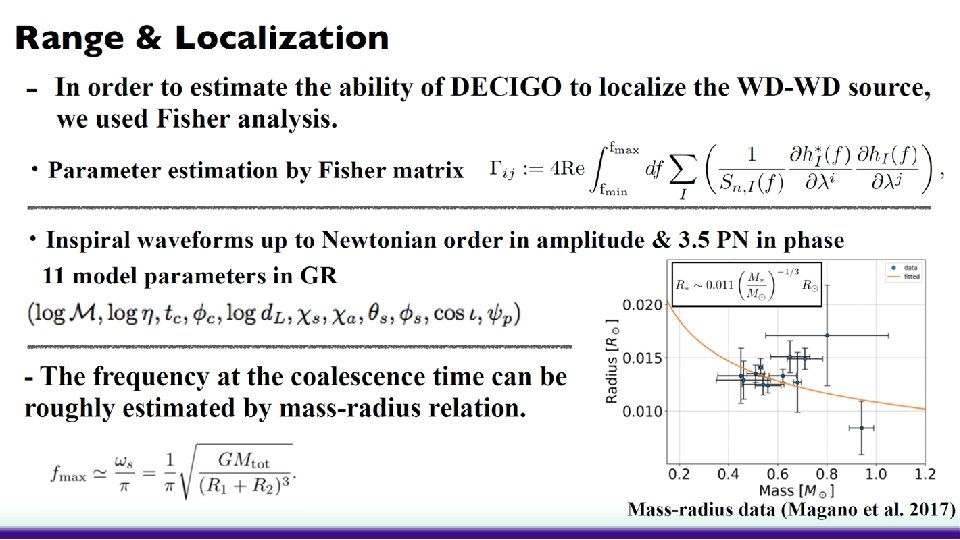
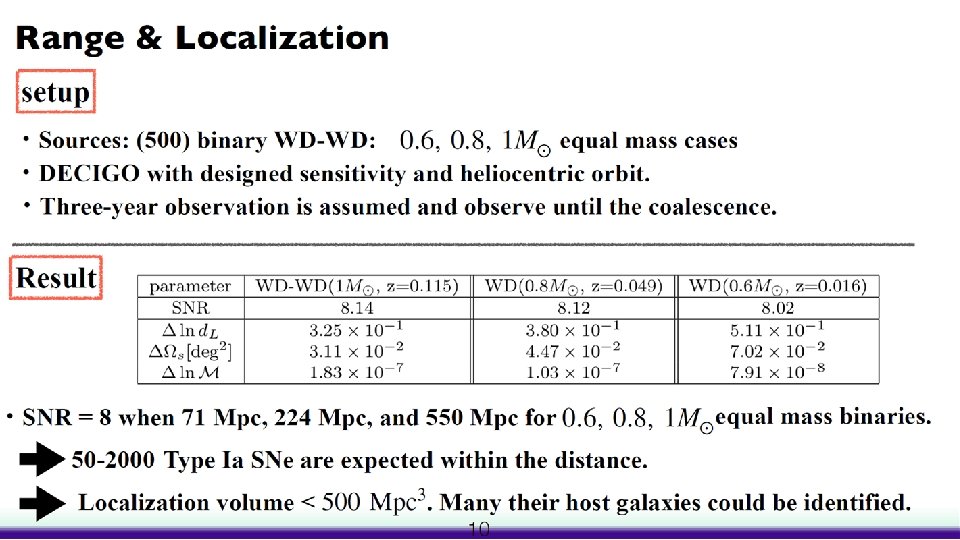
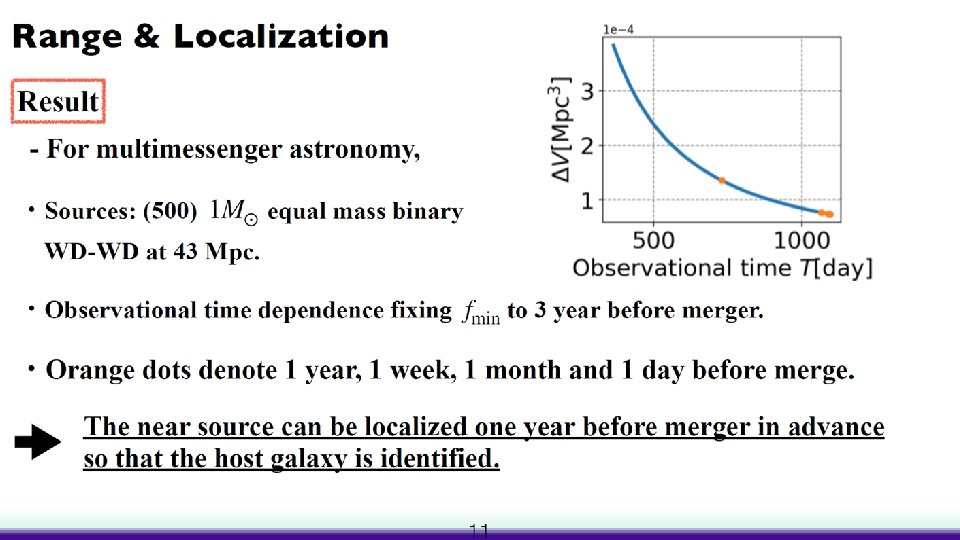
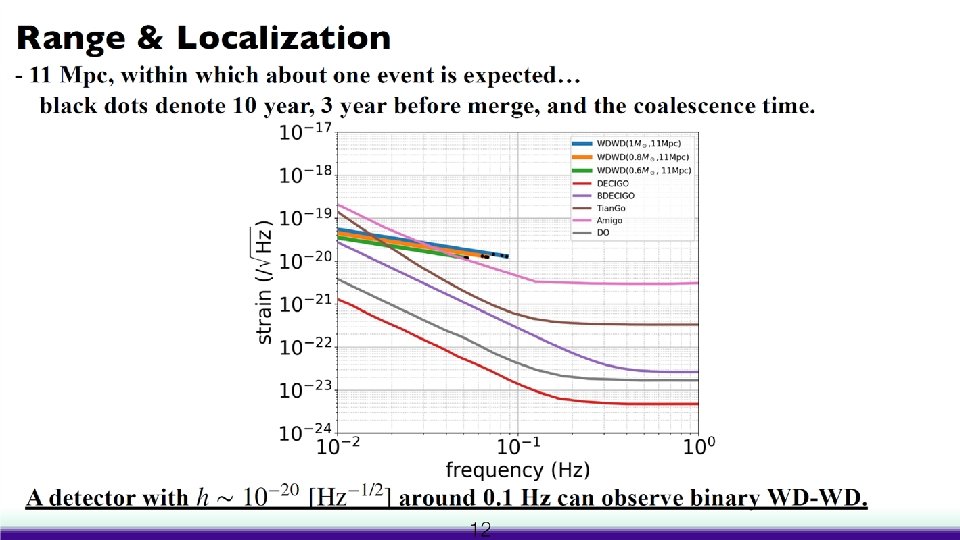



- Slides: 103
The remnants of first stars for gravitational wave sources Tomoya Kinugawa The University of Tokyo collaborators: T. Nakamura, K. Inayoshi, K. Hotokezaka, D. Nakauchi A. Miyamoto, N. Kanda, A. Tanikawa, T. Yoshida
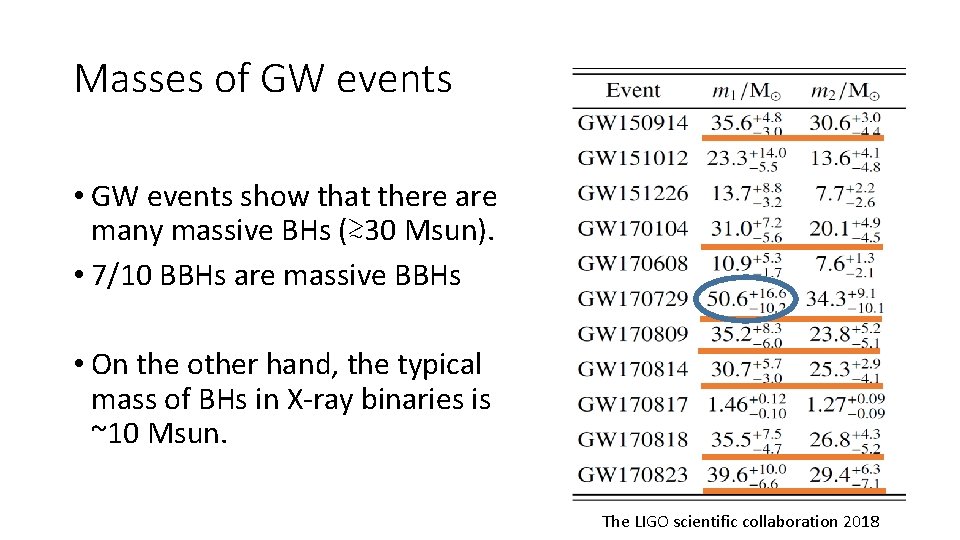
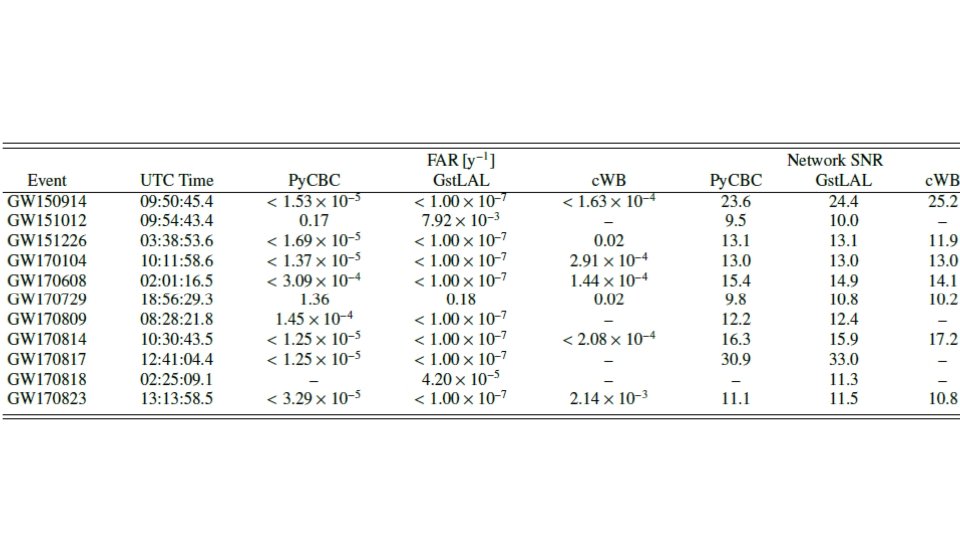
Masses of GW events • GW events show that there are many massive BHs (≳ 30 Msun). • 7/10 BBHs are massive BBHs • On the other hand, the typical mass of BHs in X-ray binaries is ~10 Msun. The LIGO scientific collaboration 2018
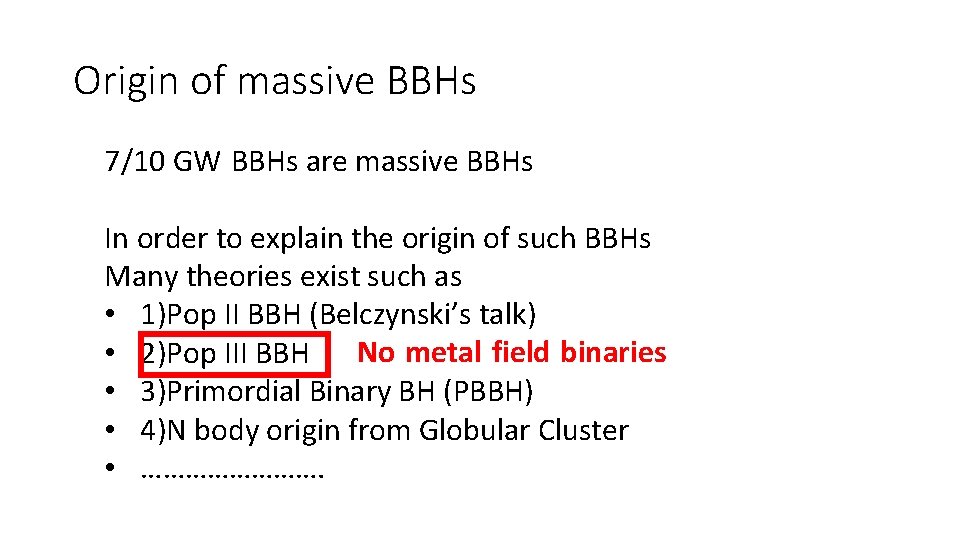
Origin of massive BBHs 7/10 GW BBHs are massive BBHs In order to explain the origin of such BBHs Many theories exist such as • 1)Pop II BBH (Belczynski’s talk) • 2)Pop III BBH No metal field binaries • 3)Primordial Binary BH (PBBH) • 4)N body origin from Globular Cluster • ………….
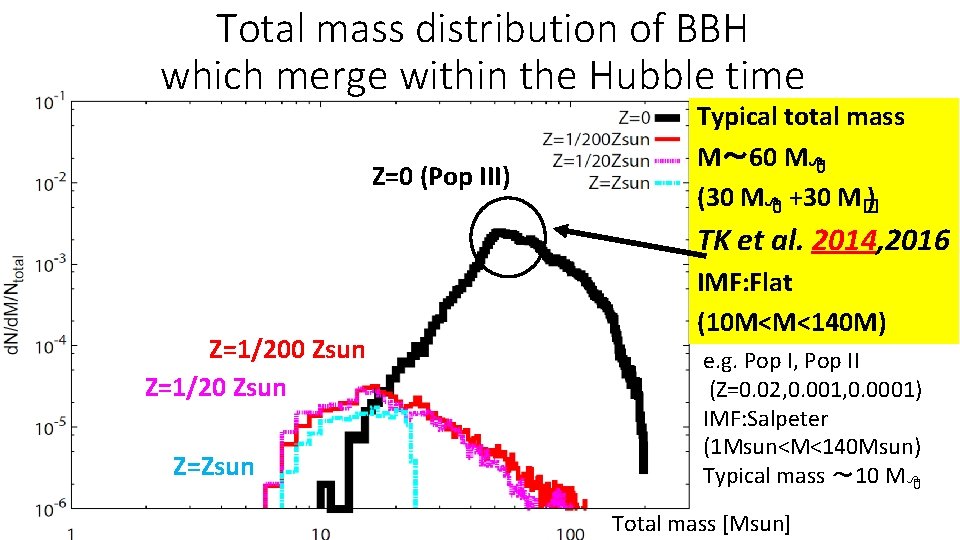
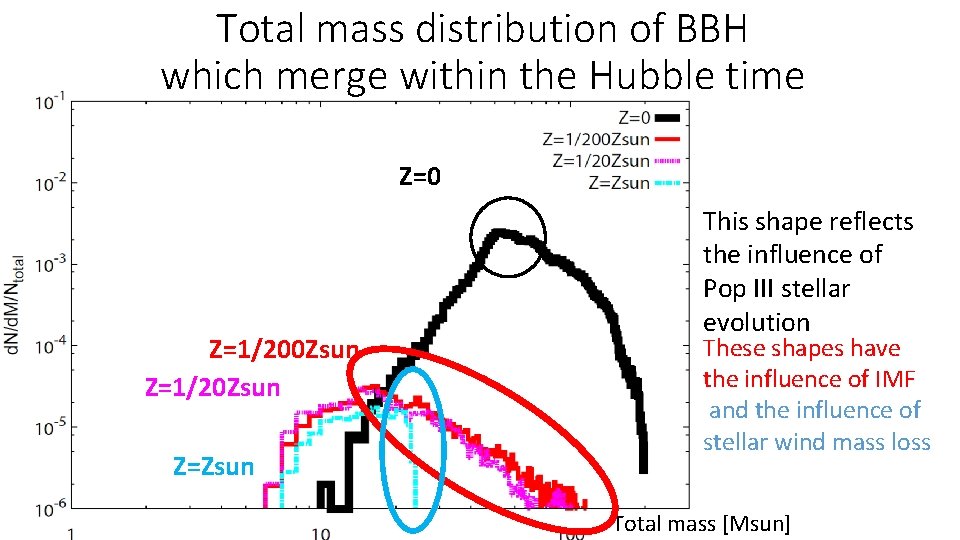
Total mass distribution of BBH which merge within the Hubble time Z=0 (Pop III) Typical total mass M~ 60 M (30 M +30 M�) TK et al. 2014, 2016 Z=1/200 Zsun Z=1/20 Zsun Z=Zsun IMF: Flat (10 M<M<140 M) e. g. Pop I, Pop II (Z=0. 02, 0. 001, 0. 0001) IMF: Salpeter (1 Msun<M<140 Msun) Typical mass ~ 10 M Total mass [Msun]
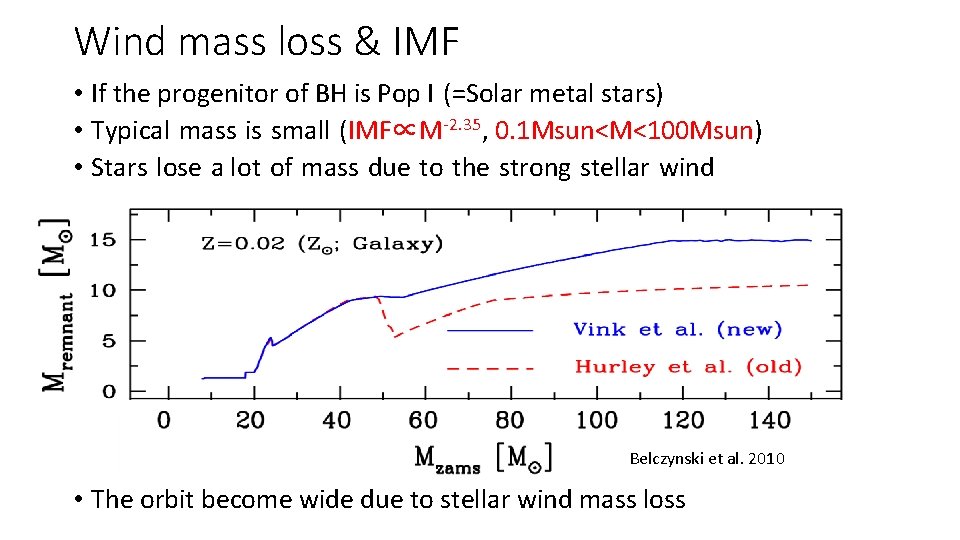
Wind mass loss & IMF • If the progenitor of BH is Pop I (=Solar metal stars) • Typical mass is small (IMF∝M-2. 35, 0. 1 Msun<M<100 Msun) • Stars lose a lot of mass due to the strong stellar wind Belczynski et al. 2010 • The orbit become wide due to stellar wind mass loss
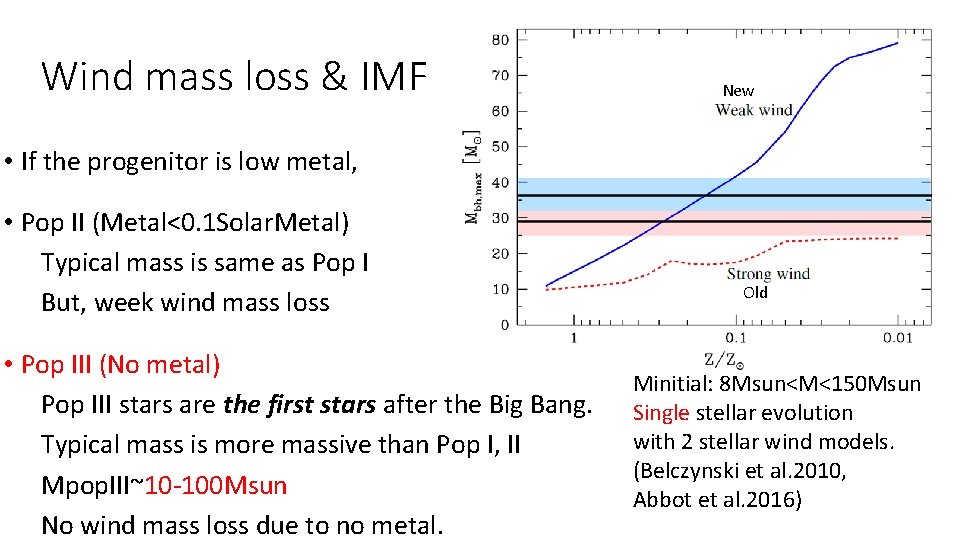
Wind mass loss & IMF New • If the progenitor is low metal, • Pop II (Metal<0. 1 Solar. Metal) Typical mass is same as Pop I But, week wind mass loss • Pop III (No metal) Pop III stars are the first stars after the Big Bang. Typical mass is more massive than Pop I, II Mpop. III~10 -100 Msun No wind mass loss due to no metal. Old Minitial: 8 Msun<M<150 Msun Single stellar evolution with 2 stellar wind models. (Belczynski et al. 2010, Abbot et al. 2016)
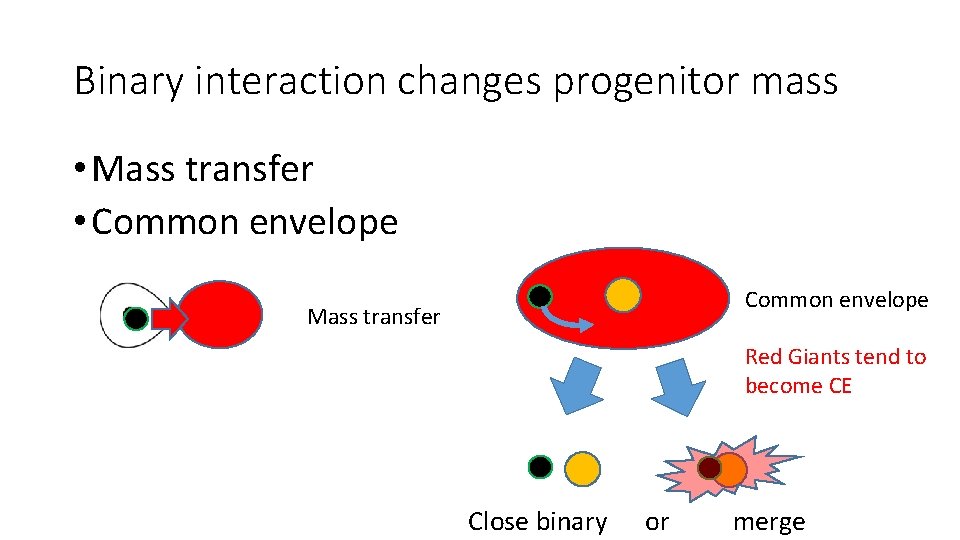
Binary interaction changes progenitor mass • Mass transfer • Common envelope Mass transfer Red Giants tend to become CE Close binary or merge
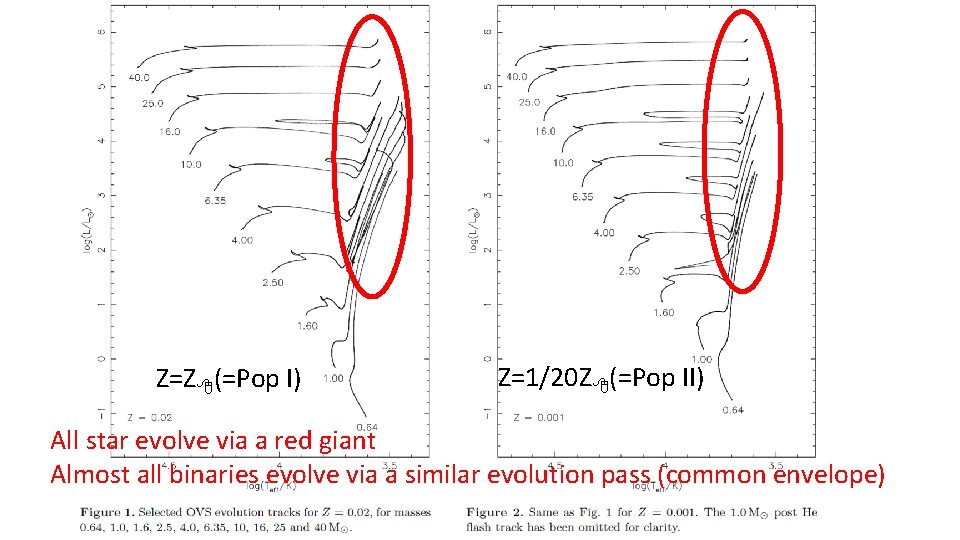
Z=Z (=Pop I) Z=1/20 Z (=Pop II) All star evolve via a red giant Almost all binaries evolve via a similar evolution pass (common envelope)
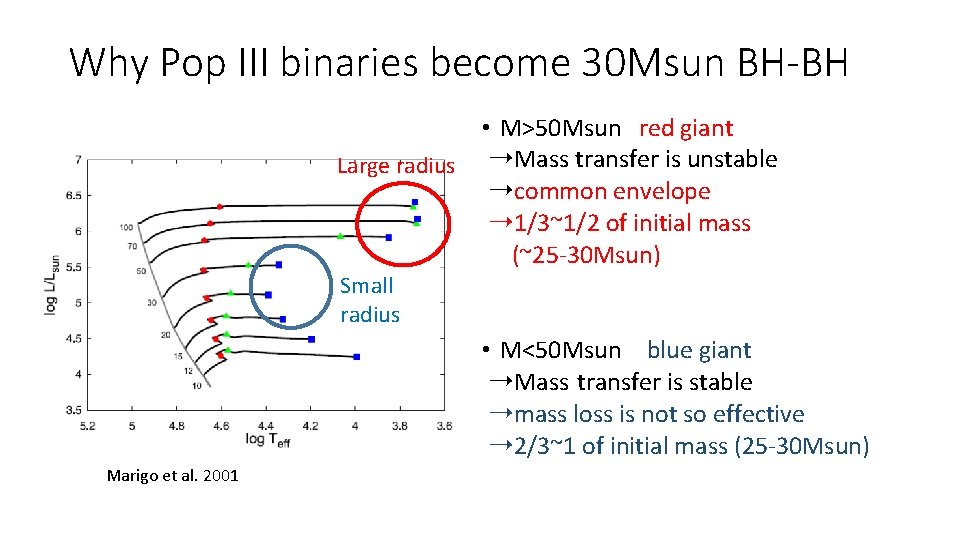
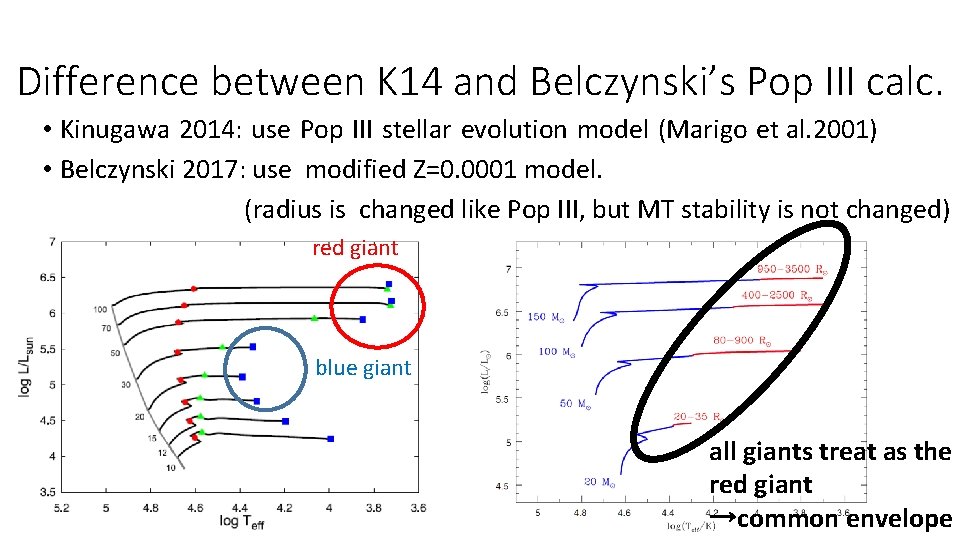
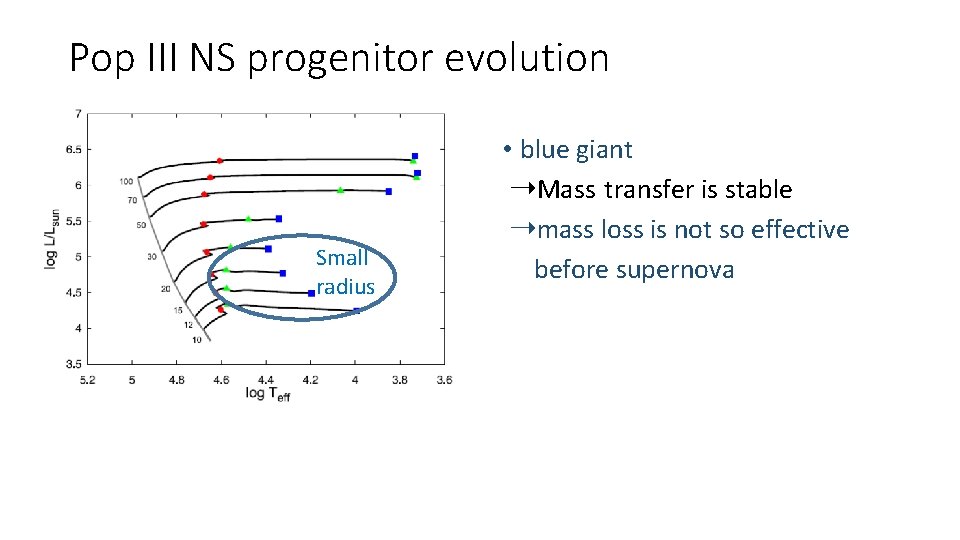
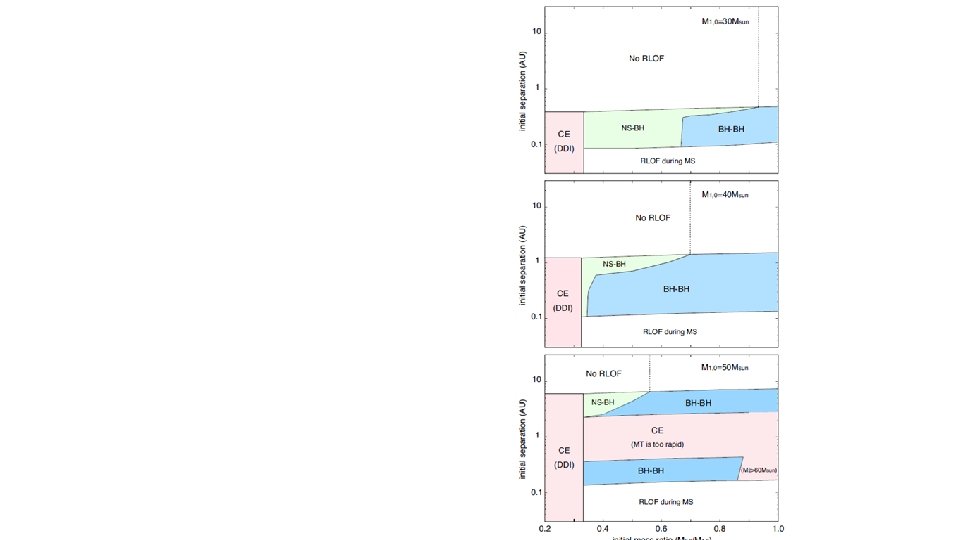
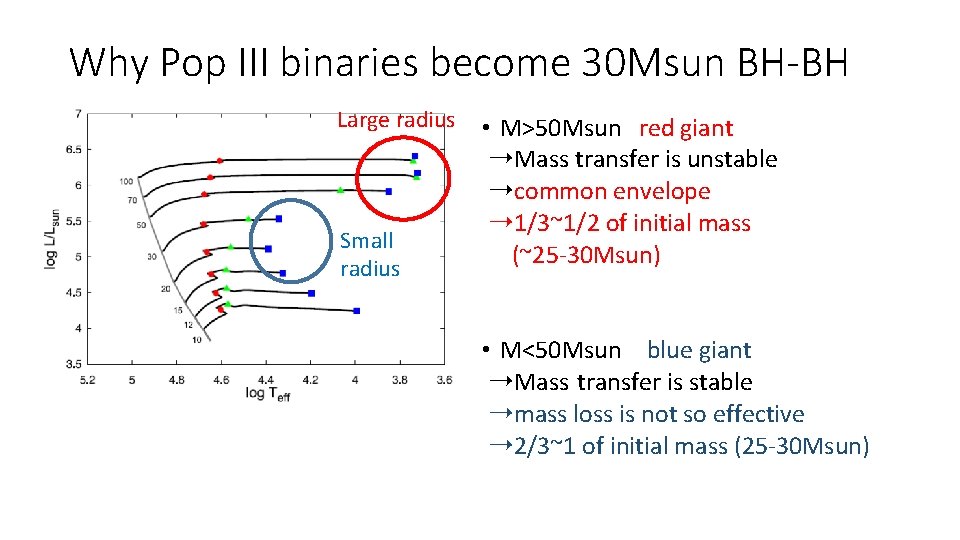
Why Pop III binaries become 30 Msun BH-BH • M>50 Msun red giant Large radius ➝Mass transfer is unstable ➝common envelope ➝ 1/3~1/2 of initial mass (~25 -30 Msun) Small radius • M<50 Msun blue giant ➝Mass transfer is stable ➝mass loss is not so effective ➝ 2/3~1 of initial mass (25 -30 Msun) Marigo et al. 2001
Total mass distribution of BBH which merge within the Hubble time Z=0 Z=1/200 Zsun Z=1/20 Zsun Z=Zsun This shape reflects the influence of Pop III stellar evolution These shapes have the influence of IMF and the influence of stellar wind mass loss Total mass [Msun]
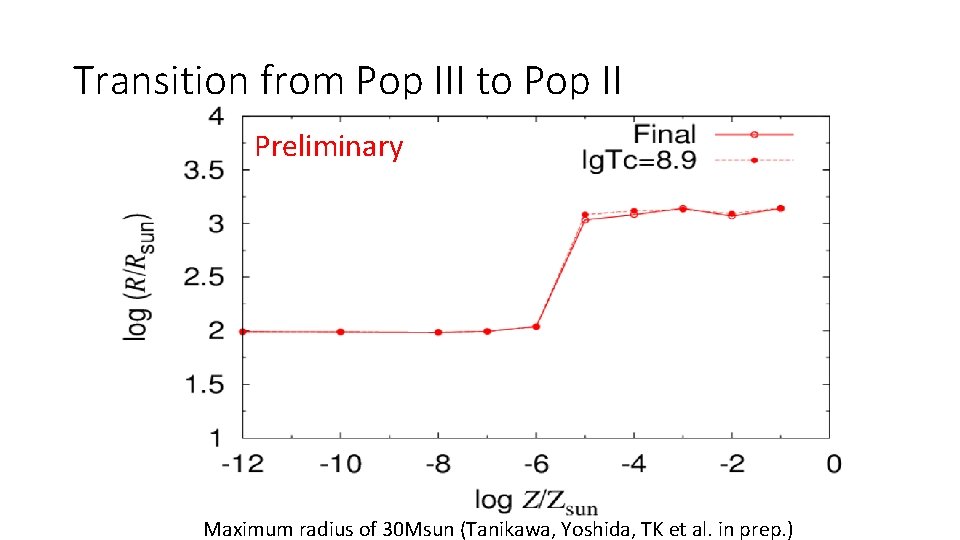
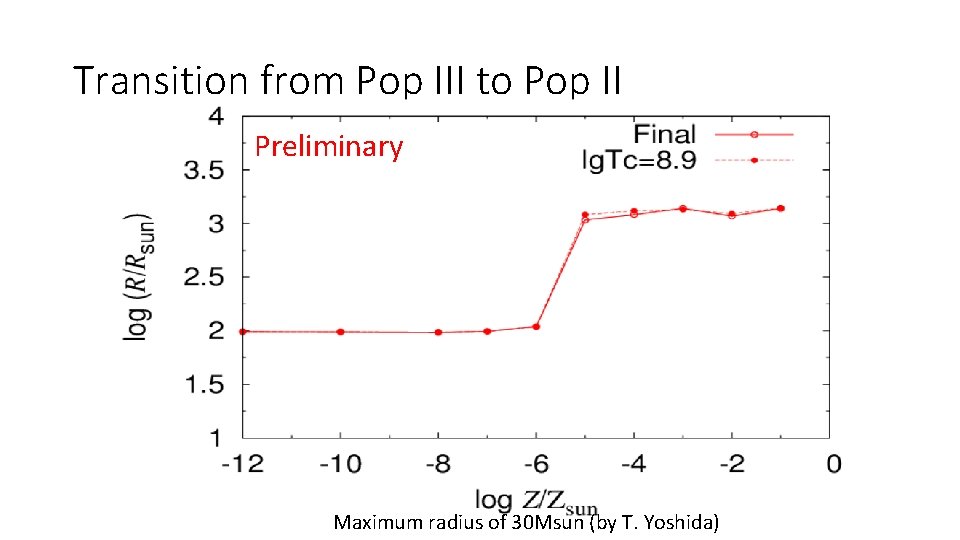
Transition from Pop III to Pop II Preliminary Maximum radius of 30 Msun (Tanikawa, Yoshida, TK et al. in prep. )
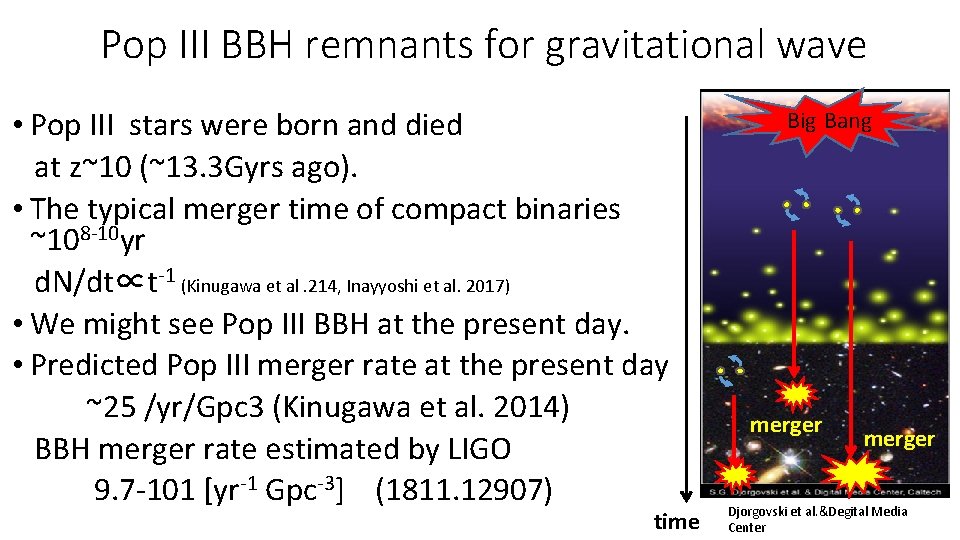
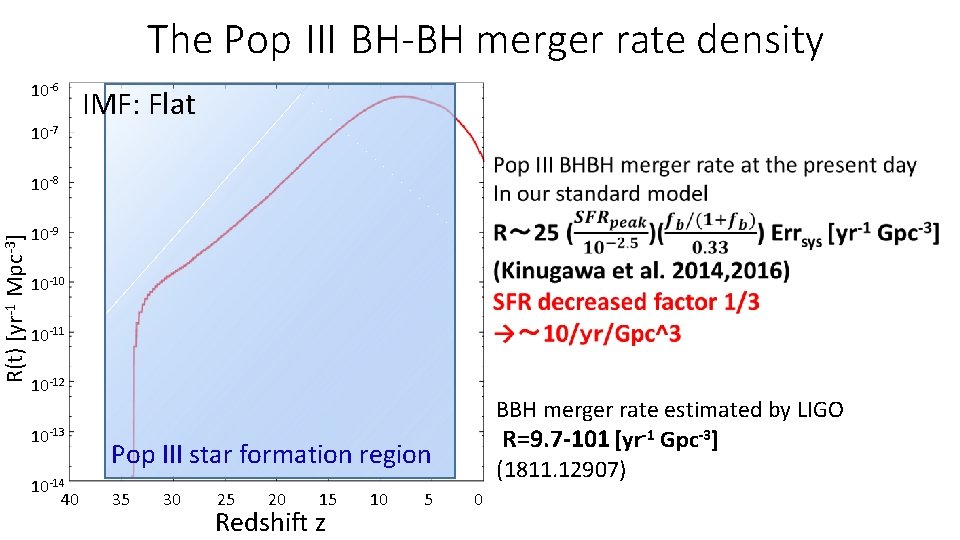
Pop III BBH remnants for gravitational wave • Pop III stars were born and died at z~10 (~13. 3 Gyrs ago). • The typical merger time of compact binaries ~108 -10 yr d. N/dt∝t-1 (Kinugawa et al. 214, Inayyoshi et al. 2017) • We might see Pop III BBH at the present day. • Predicted Pop III merger rate at the present day ~25 /yr/Gpc 3 (Kinugawa et al. 2014) BBH merger rate estimated by LIGO 9. 7 -101 [yr-1 Gpc-3] (1811. 12907) time Big Bang merger Djorgovski et al. &Degital Media Center
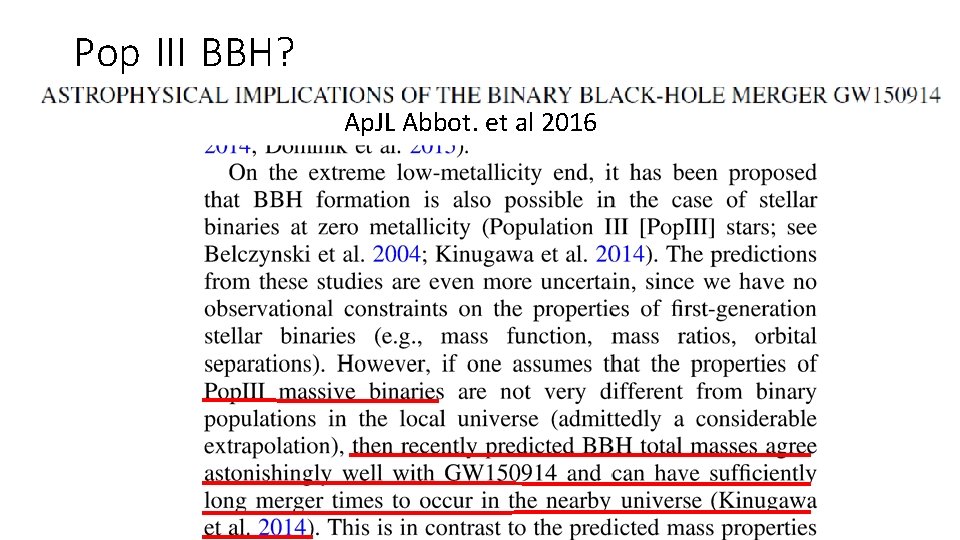
Pop III BBH? Ap. JL Abbot. et al 2016
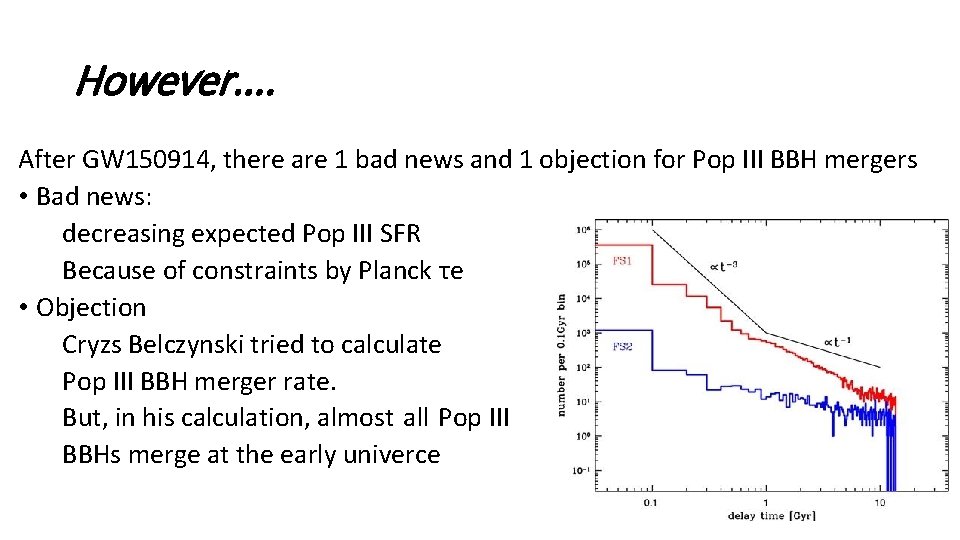
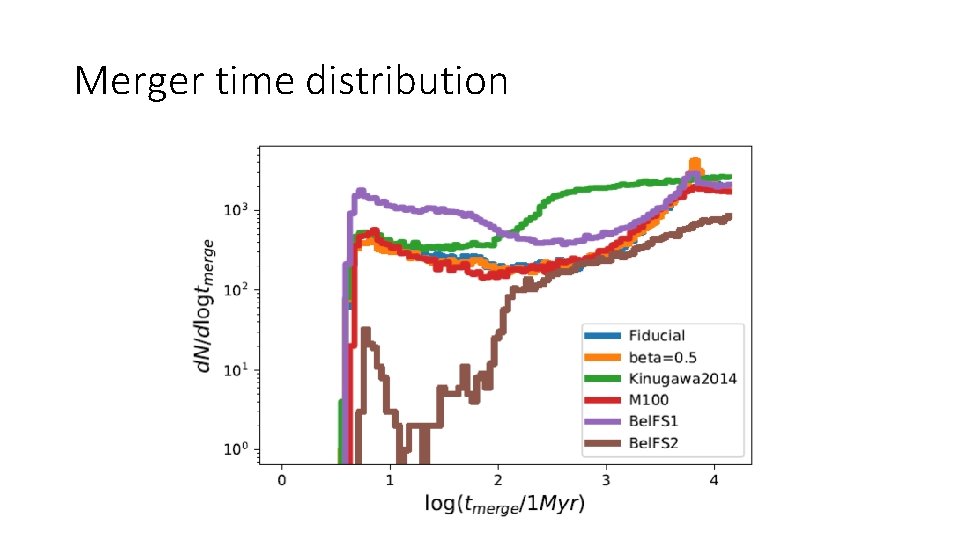
However. . After GW 150914, there are 1 bad news and 1 objection for Pop III BBH mergers • Bad news: decreasing expected Pop III SFR Because of constraints by Planck τe • Objection Cryzs Belczynski tried to calculate Pop III BBH merger rate. But, in his calculation, almost all Pop III BBHs merge at the early univerce
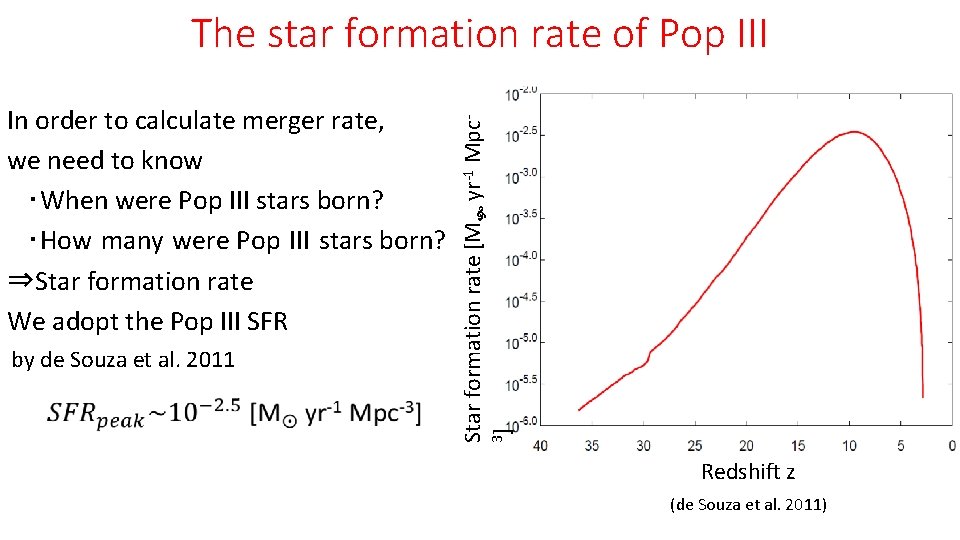
In order to calculate merger rate, we need to know ・When were Pop III stars born? ・How many were Pop III stars born? ⇒Star formation rate We adopt the Pop III SFR by de Souza et al. 2011 Star formation rate [M yr-1 Mpc 3] The star formation rate of Pop III Redshift z (de Souza et al. 2011)
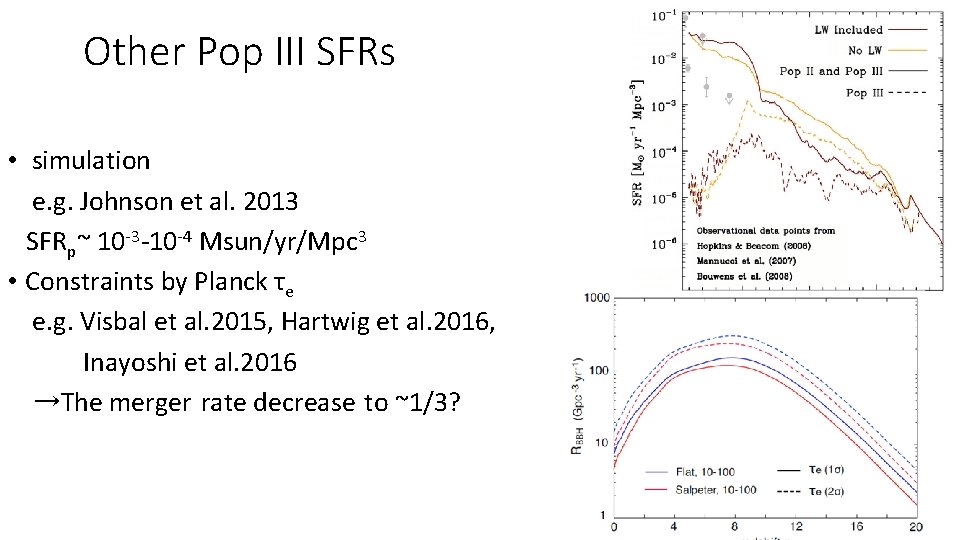
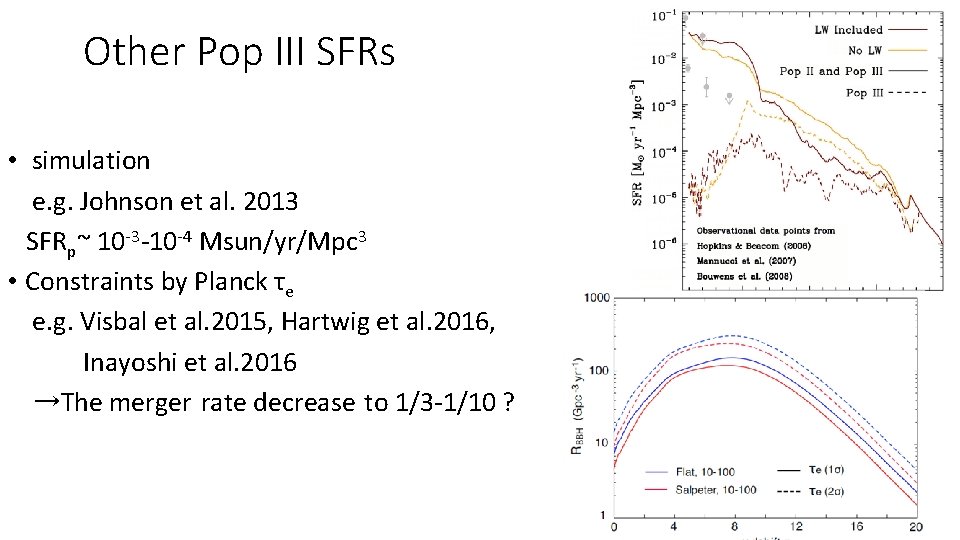
Other Pop III SFRs • simulation e. g. Johnson et al. 2013 SFRp~ 10 -3 -10 -4 Msun/yr/Mpc 3 • Constraints by Planck τe e. g. Visbal et al. 2015, Hartwig et al. 2016, Inayoshi et al. 2016 →The merger rate decrease to ~1/3?
R(t) [yr-1 Mpc-3] The Pop III BH-BH merger rate density 10 -6 10 -7 IMF: Flat 10 -8 10 -9 10 -10 10 -11 10 -12 10 -13 10 -14 40 BBH merger rate estimated by LIGO R=9. 7 -101 [yr-1 Gpc-3] (1811. 12907) Pop III star formation region 35 30 25 20 15 Redshift z 10 5 0
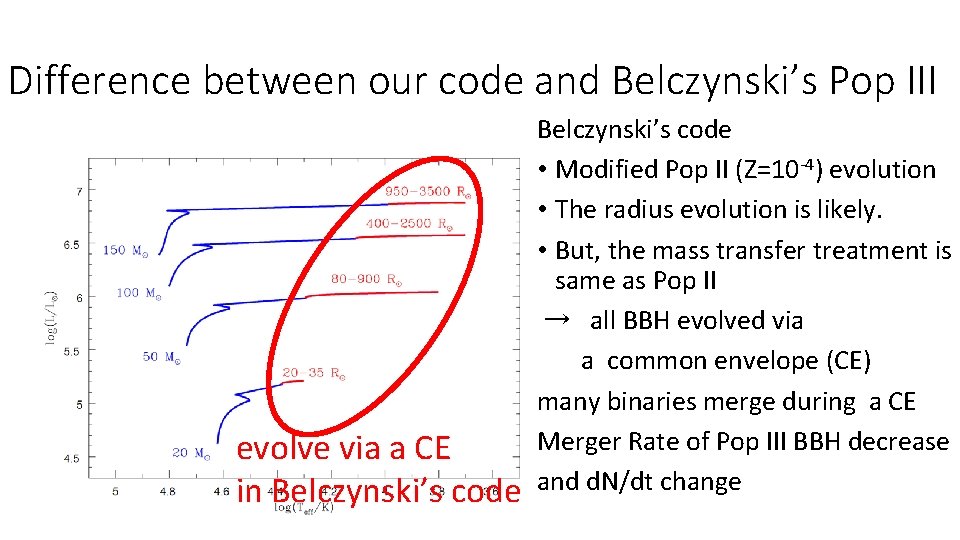
Difference between K 14 and Belczynski’s Pop III calc. • Kinugawa 2014: use Pop III stellar evolution model (Marigo et al. 2001) • Belczynski 2017: use modified Z=0. 0001 model. (radius is changed like Pop III, but MT stability is not changed) red giant blue giant all giants treat as the red giant →common envelope
Merger time distribution
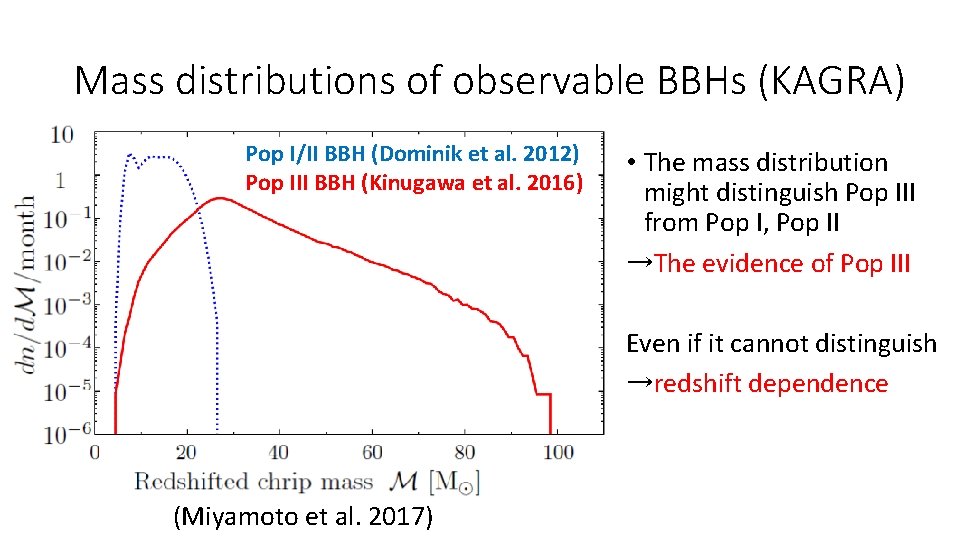
Mass distributions of observable BBHs (KAGRA) Pop I/II BBH (Dominik et al. 2012) Pop III BBH (Kinugawa et al. 2016) • The mass distribution might distinguish Pop III from Pop I, Pop II →The evidence of Pop III Even if it cannot distinguish →redshift dependence (Miyamoto et al. 2017)
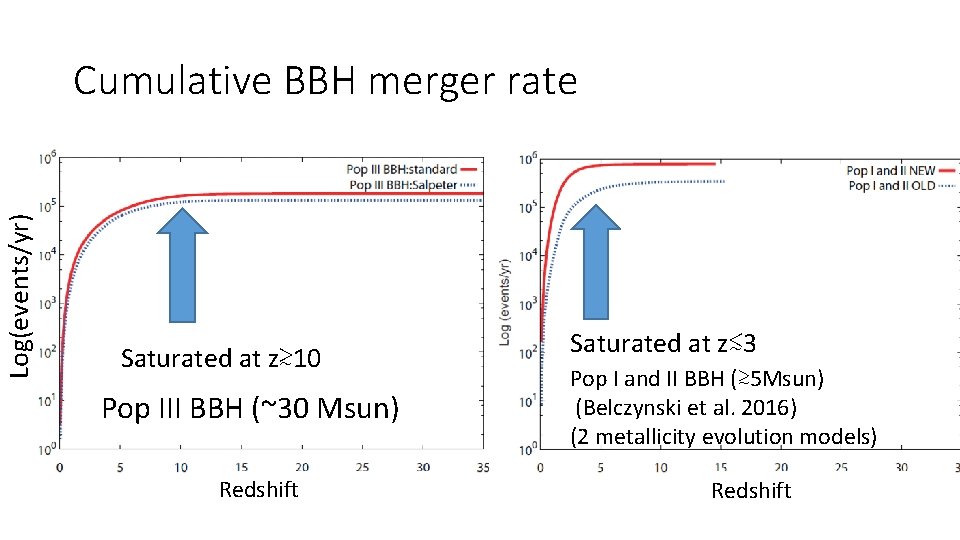
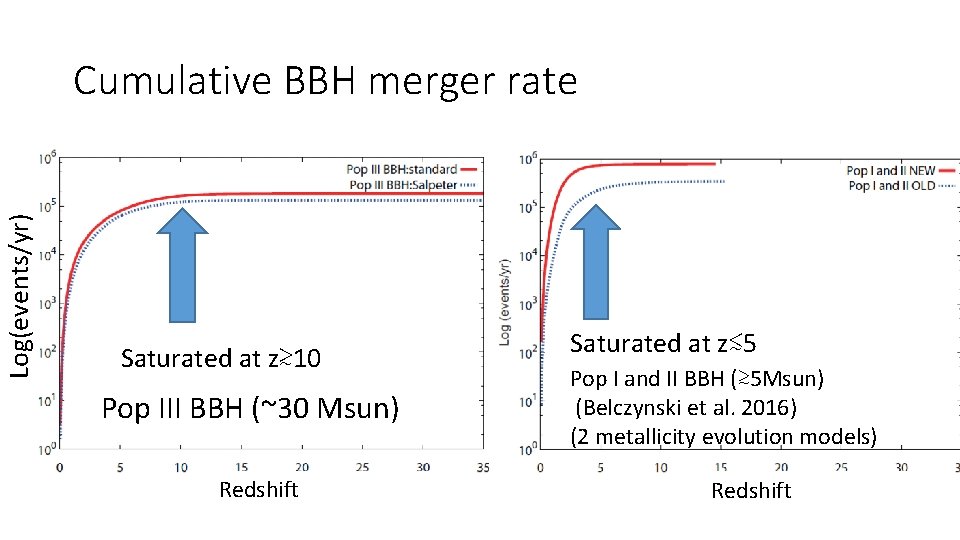
Log(events/yr) Cumulative BBH merger rate Saturated at z≳ 10 Pop III BBH (~30 Msun) Redshift Saturated at z≲ 3 Pop I and II BBH (≳ 5 Msun) (Belczynski et al. 2016) (2 metallicity evolution models) Redshift
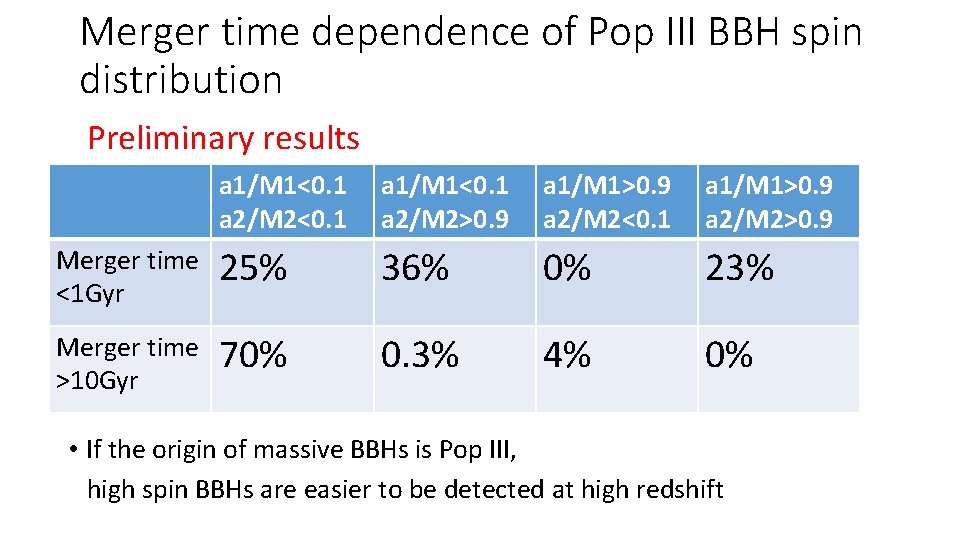
Merger time dependence of Pop III BBH spin distribution Preliminary results a 1/M 1<0. 1 a 2/M 2<0. 1 a 1/M 1<0. 1 a 2/M 2>0. 9 a 1/M 1>0. 9 a 2/M 2<0. 1 a 1/M 1>0. 9 a 2/M 2>0. 9 Merger time <1 Gyr 25% 36% 0% 23% Merger time >10 Gyr 70% 0. 3% 4% 0% • If the origin of massive BBHs is Pop III, high spin BBHs are easier to be detected at high redshift
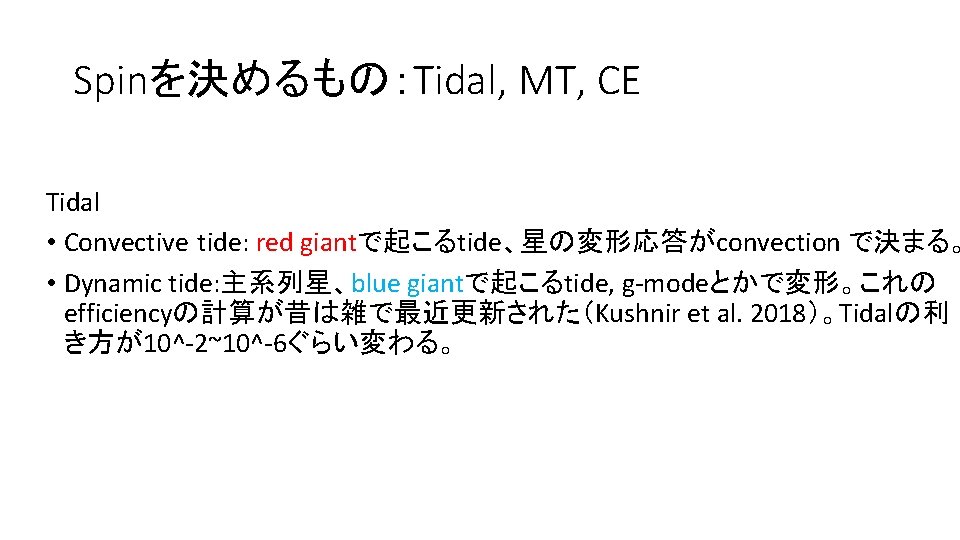
Spinを決めるもの:Tidal, MT, CE Tidal • Convective tide: red giantで起こるtide、星の変形応答がconvection で決まる。 • Dynamic tide: 主系列星、blue giantで起こるtide, g-modeとかで変形。これの efficiencyの計算が昔は雑で最近更新された(Kushnir et al. 2018)。Tidalの利 き方が10^-2~10^-6ぐらい変わる。
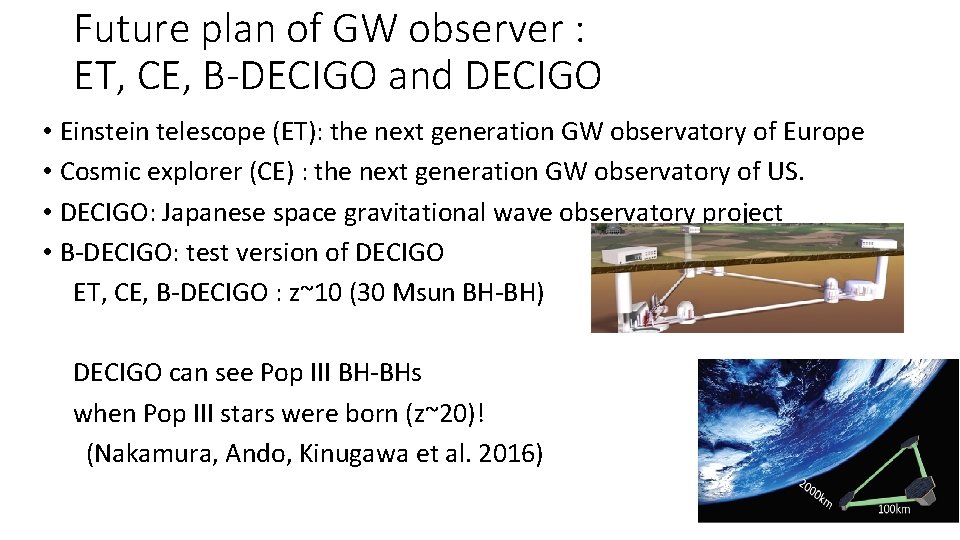
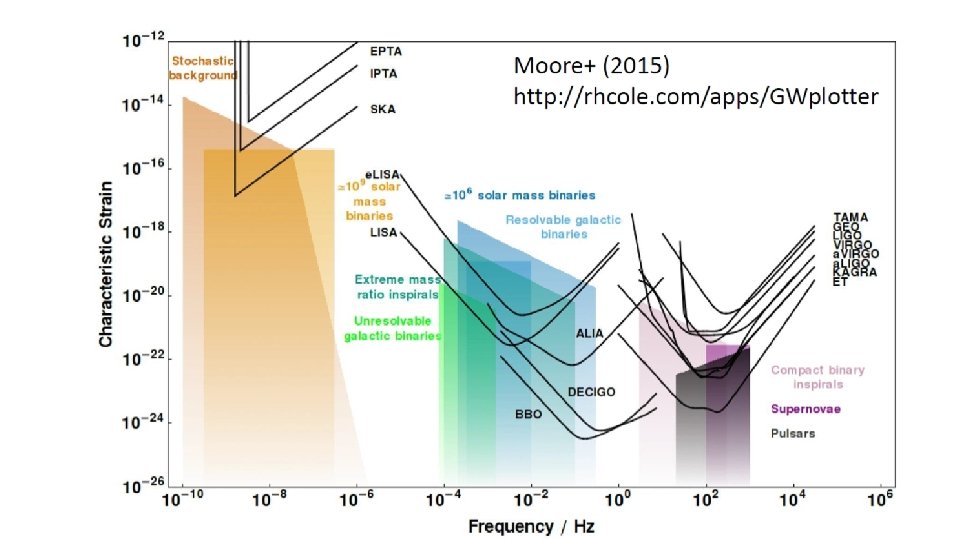
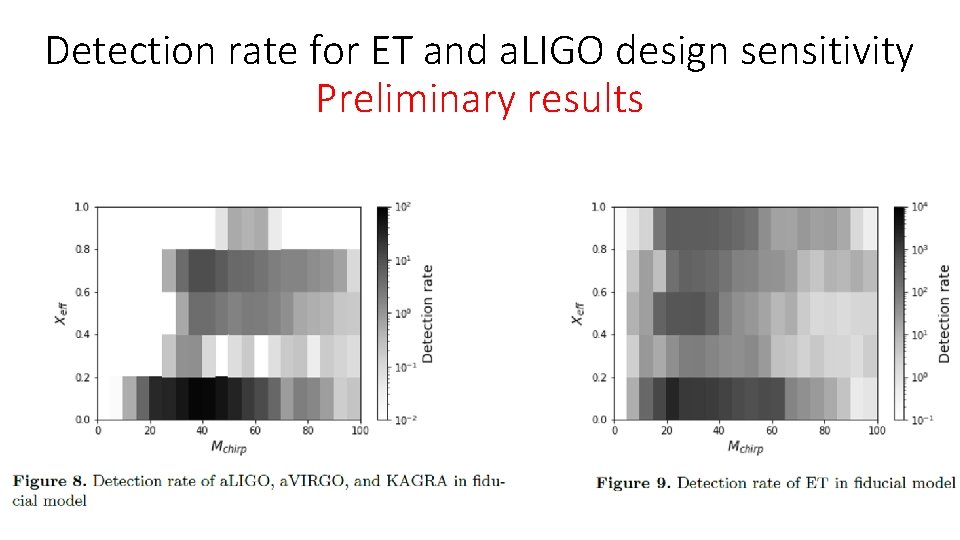
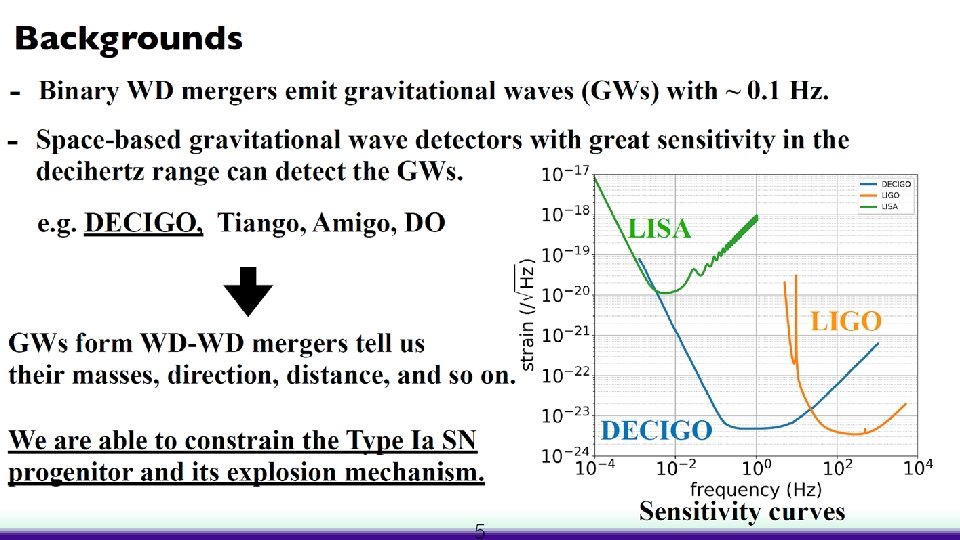
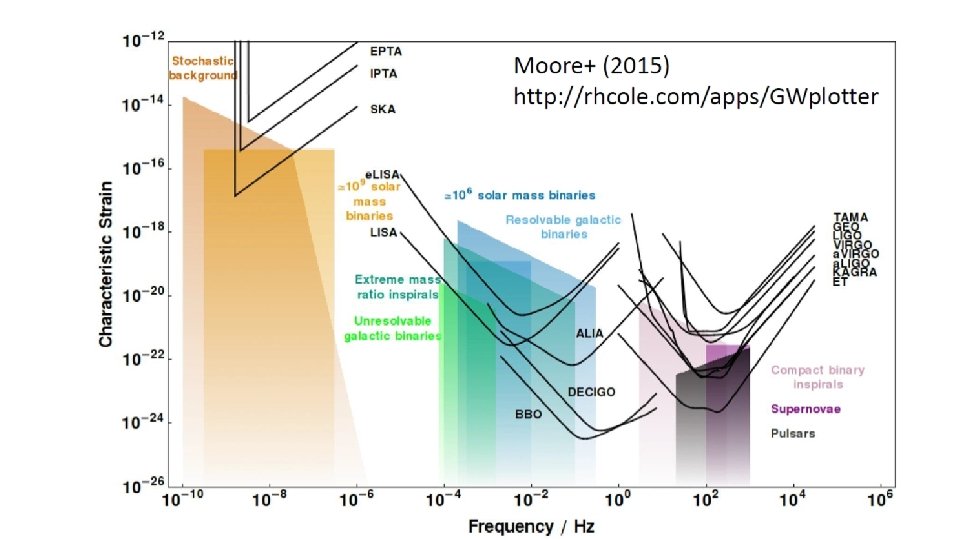
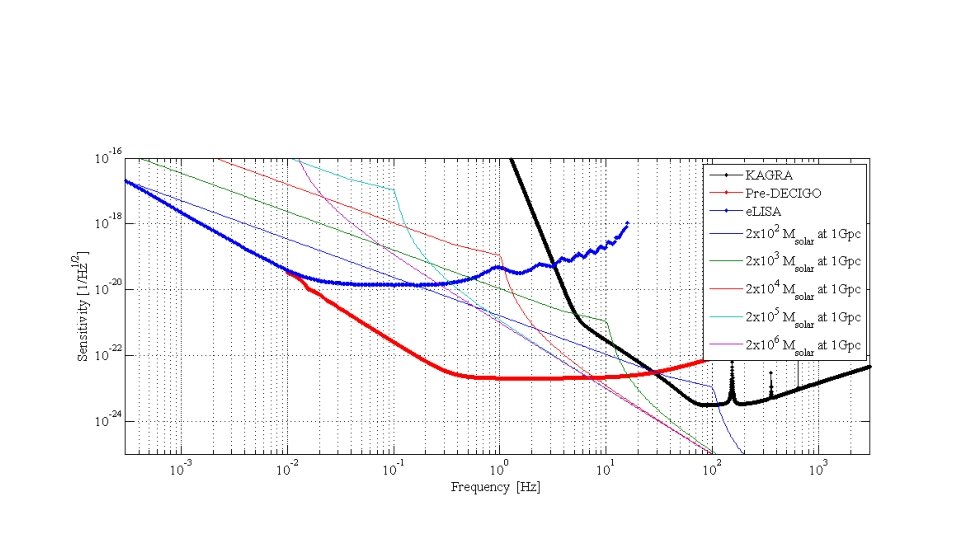
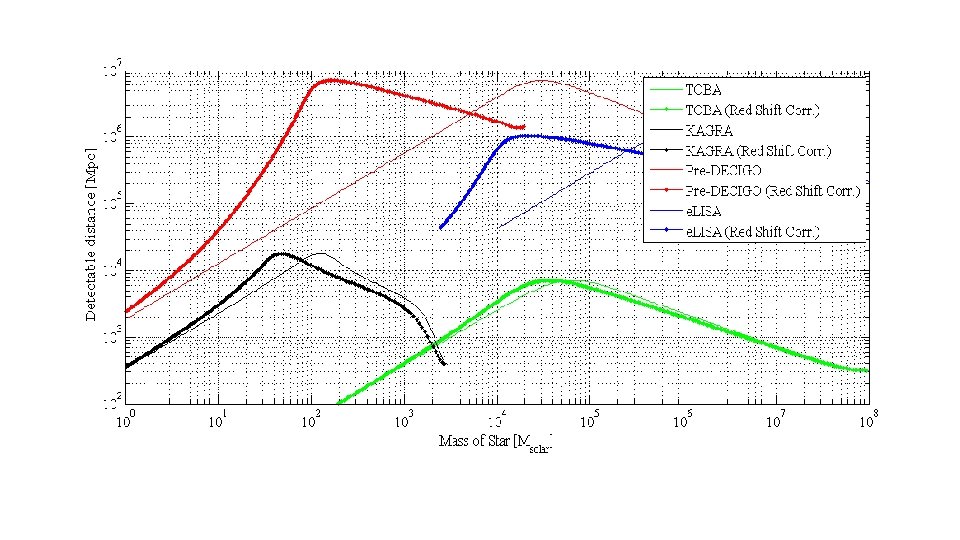
Future plan of GW observer : ET, CE, B-DECIGO and DECIGO • Einstein telescope (ET): the next generation GW observatory of Europe • Cosmic explorer (CE) : the next generation GW observatory of US. • DECIGO: Japanese space gravitational wave observatory project • B-DECIGO: test version of DECIGO ET, CE, B-DECIGO : z~10 (30 Msun BH-BH) DECIGO can see Pop III BH-BHs when Pop III stars were born (z~20)! (Nakamura, Ando, Kinugawa et al. 2016)
Detection rate for ET and a. LIGO design sensitivity Preliminary results
Pop. III BH-BH • Massive BBHs = the fossil of Pop III ?
Other Pop III compact binaries cases • Pop III NSNS Almost all binary NS (maybe) disrupt • Pop III NSBH
Pop III NS progenitor evolution Small radius • blue giant ➝Mass transfer is stable ➝mass loss is not so effective before supernova
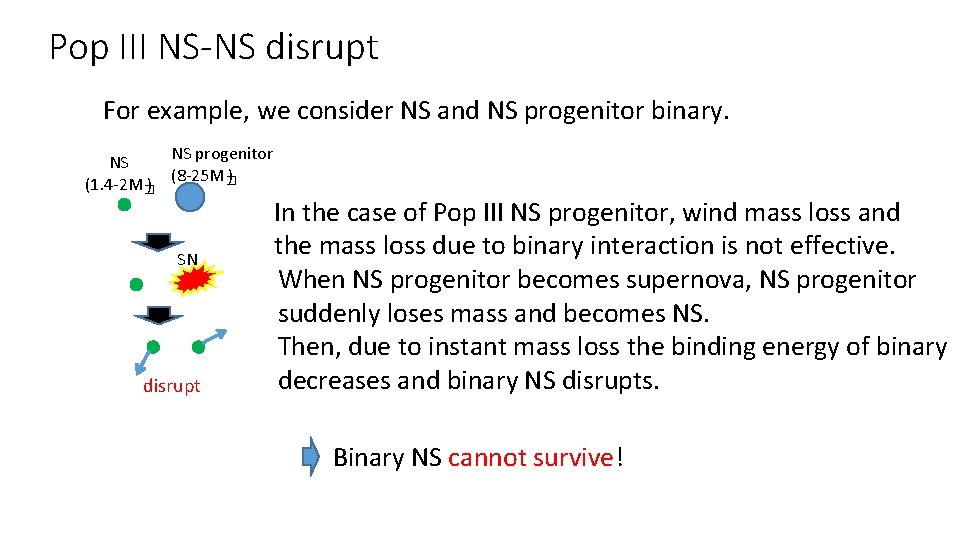
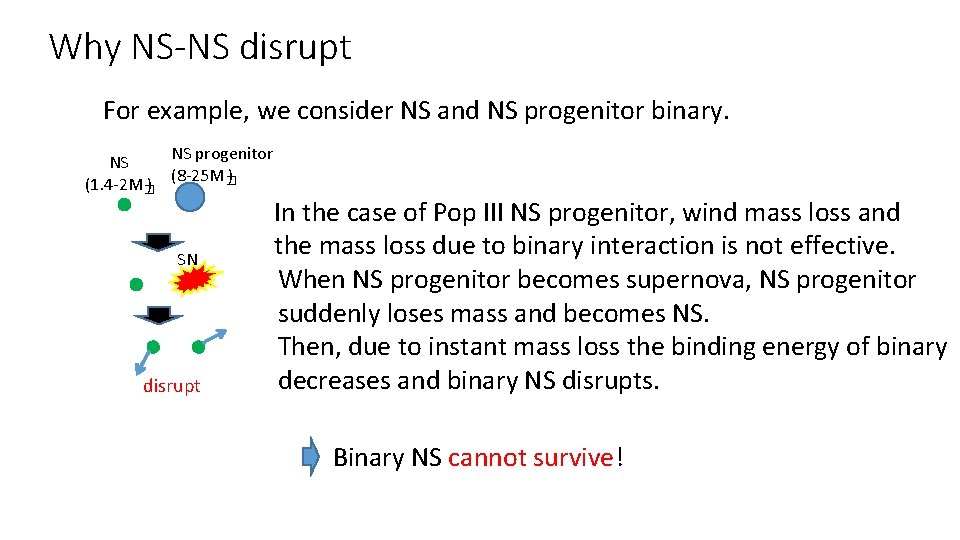
Pop III NS-NS disrupt For example, we consider NS and NS progenitor binary. NS progenitor NS (1. 4 -2 M�) (8 -25 M�) SN disrupt In the case of Pop III NS progenitor, wind mass loss and the mass loss due to binary interaction is not effective. When NS progenitor becomes supernova, NS progenitor suddenly loses mass and becomes NS. Then, due to instant mass loss the binding energy of binary decreases and binary NS disrupts. Binary NS cannot survive!
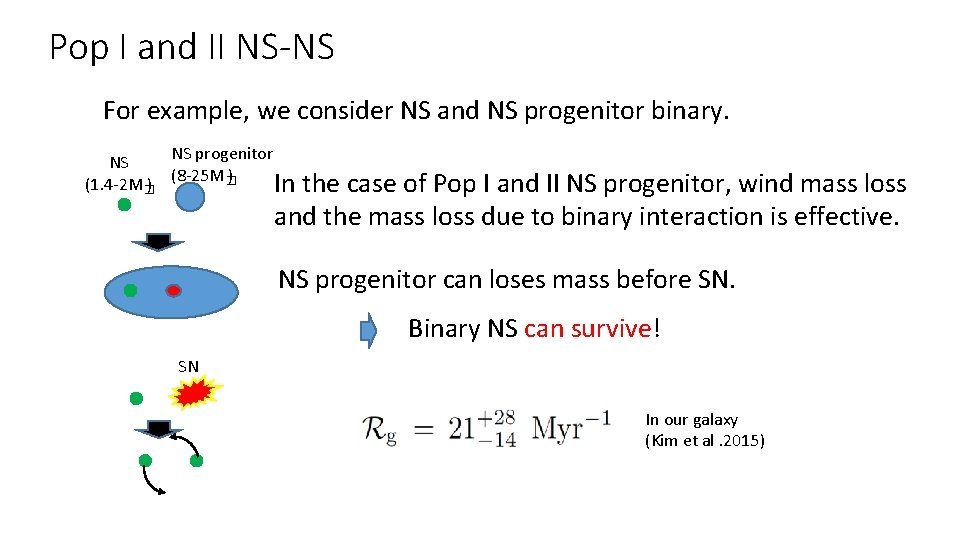
Pop I and II NS-NS For example, we consider NS and NS progenitor binary. NS progenitor NS (1. 4 -2 M�) (8 -25 M�) In the case of Pop I and II NS progenitor, wind mass loss and the mass loss due to binary interaction is effective. NS progenitor can loses mass before SN. Binary NS can survive! SN In our galaxy (Kim et al. 2015)
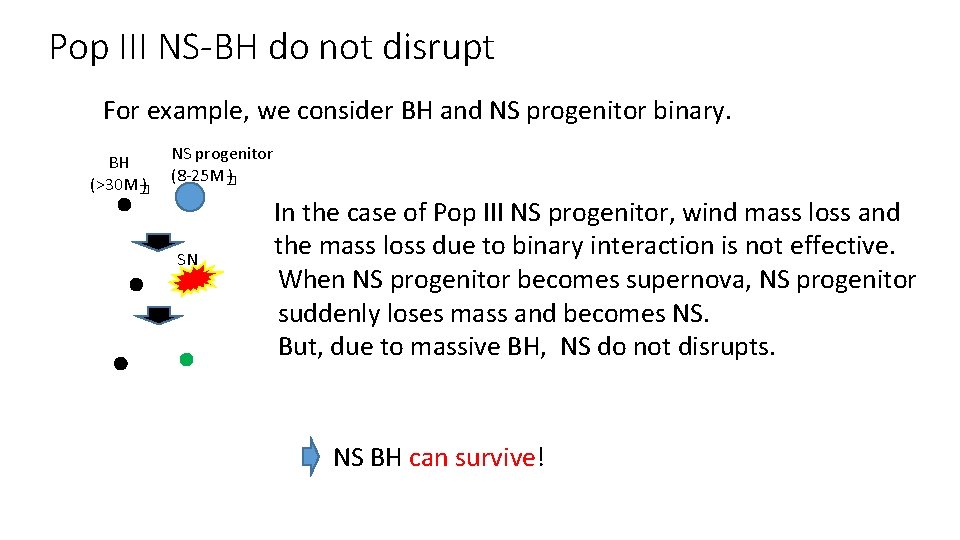
Other Pop III compact binaries cases • Pop III NSNS Almost all binary NS (maybe) disrupt • Pop III NSBH do not disrupt
Pop III NS-BH do not disrupt For example, we consider BH and NS progenitor binary. BH (>30 M�) NS progenitor (8 -25 M�) SN In the case of Pop III NS progenitor, wind mass loss and the mass loss due to binary interaction is not effective. When NS progenitor becomes supernova, NS progenitor suddenly loses mass and becomes NS. But, due to massive BH, NS do not disrupts. NS BH can survive!
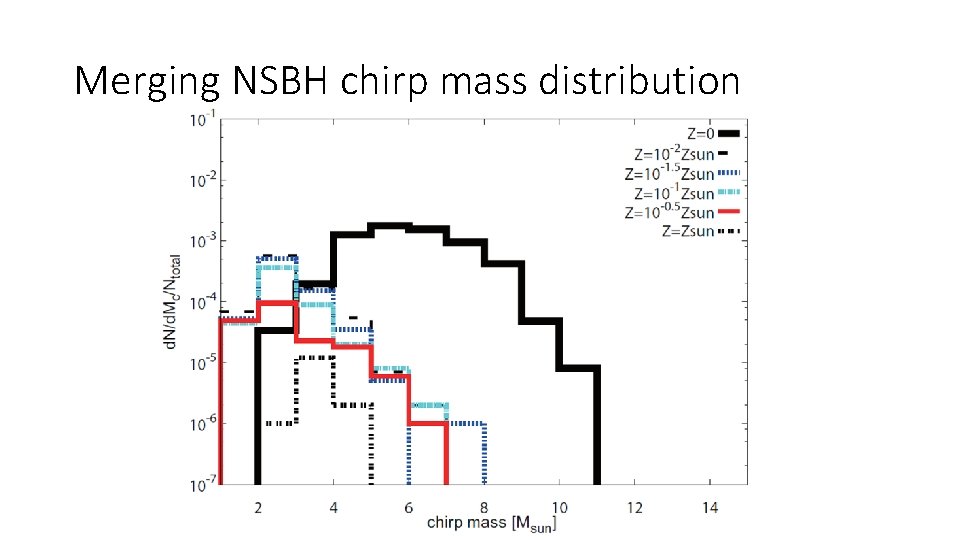
Merging NSBH chirp mass distribution
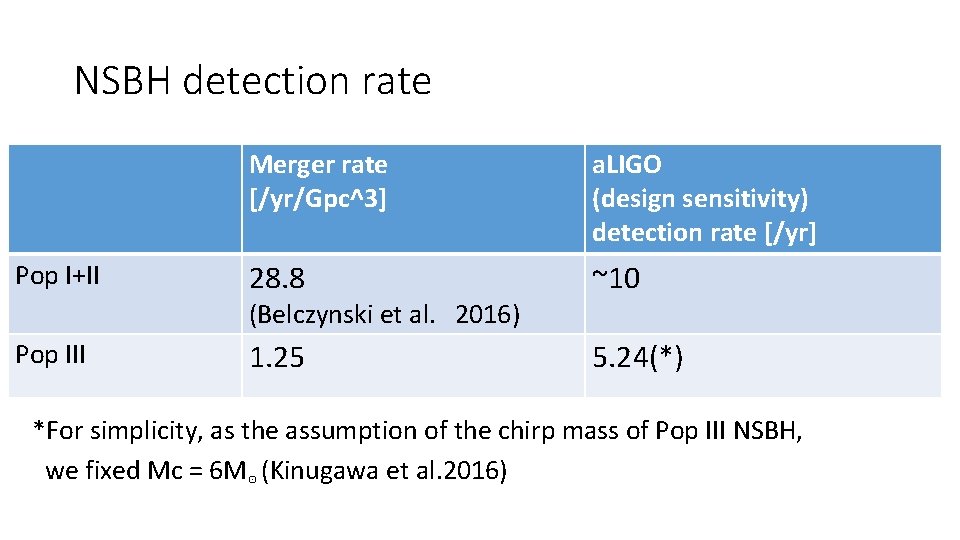
NSBH detection rate Pop I+II Merger rate [/yr/Gpc^3] a. LIGO (design sensitivity) detection rate [/yr] 28. 8 ~10 1. 25 5. 24(*) (Belczynski et al. 2016) Pop III *For simplicity, as the assumption of the chirp mass of Pop III NSBH, we fixed Mc = 6 M⊙ (Kinugawa et al. 2016)
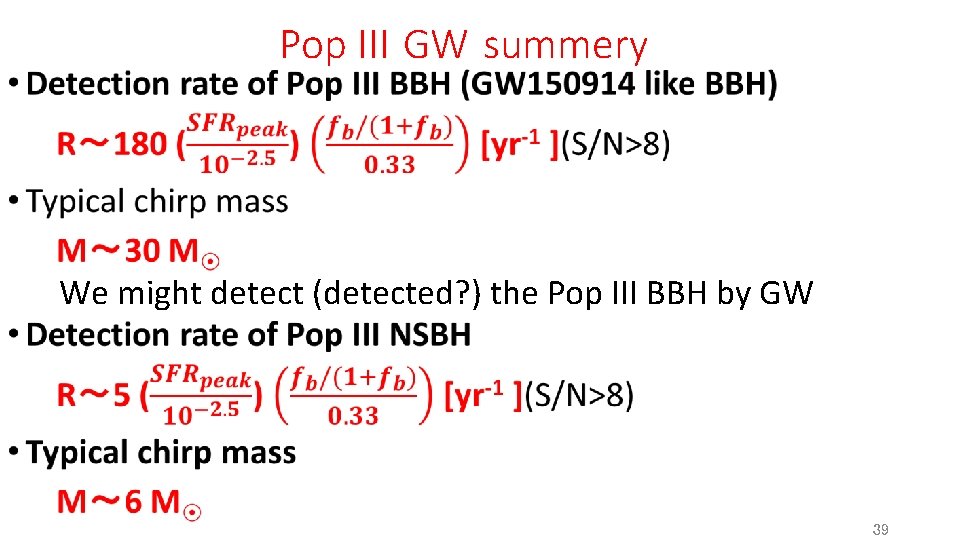
• Pop III GW summery We might detect (detected? ) the Pop III BBH by GW 39
Other Pop III SFRs • simulation e. g. Johnson et al. 2013 SFRp~ 10 -3 -10 -4 Msun/yr/Mpc 3 • Constraints by Planck τe e. g. Visbal et al. 2015, Hartwig et al. 2016, Inayoshi et al. 2016 →The merger rate decrease to 1/3 -1/10 ?
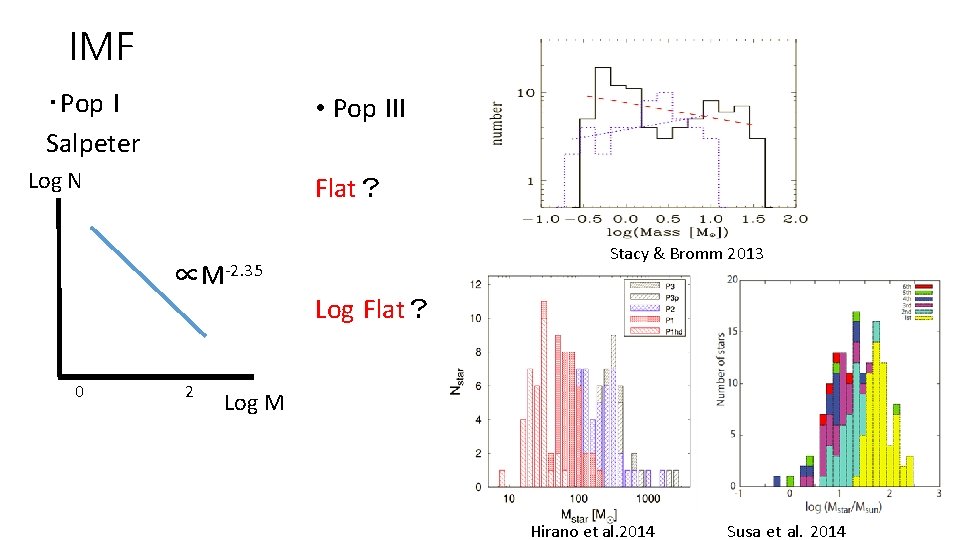
IMF ・Pop I Salpeter • Pop III Log N Flat? Stacy & Bromm 2013 ∝M-2. 35 Log Flat? 0 2 Log M Hirano et al. 2014 Susa et al. 2014
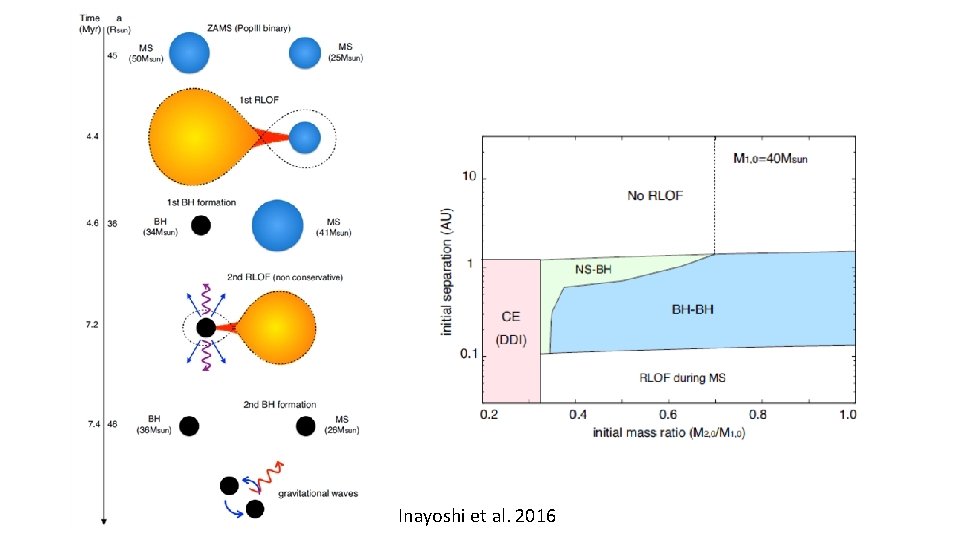
Inayoshi et al. 2016
Difference between our code and Belczynski’s Pop III evolve via a CE in Belczynski’s code • Modified Pop II (Z=10 -4) evolution • The radius evolution is likely. • But, the mass transfer treatment is same as Pop II → all BBH evolved via a common envelope (CE) many binaries merge during a CE Merger Rate of Pop III BBH decrease and d. N/dt change
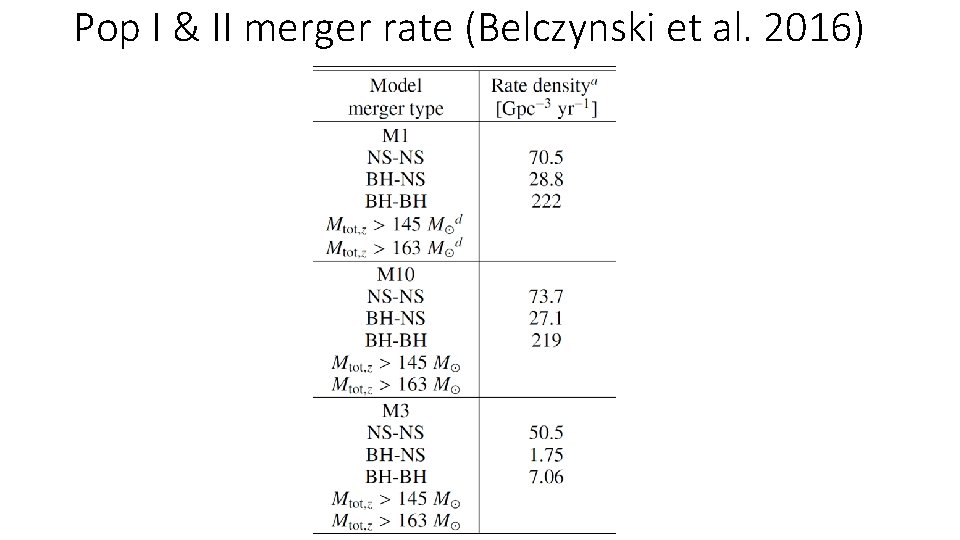
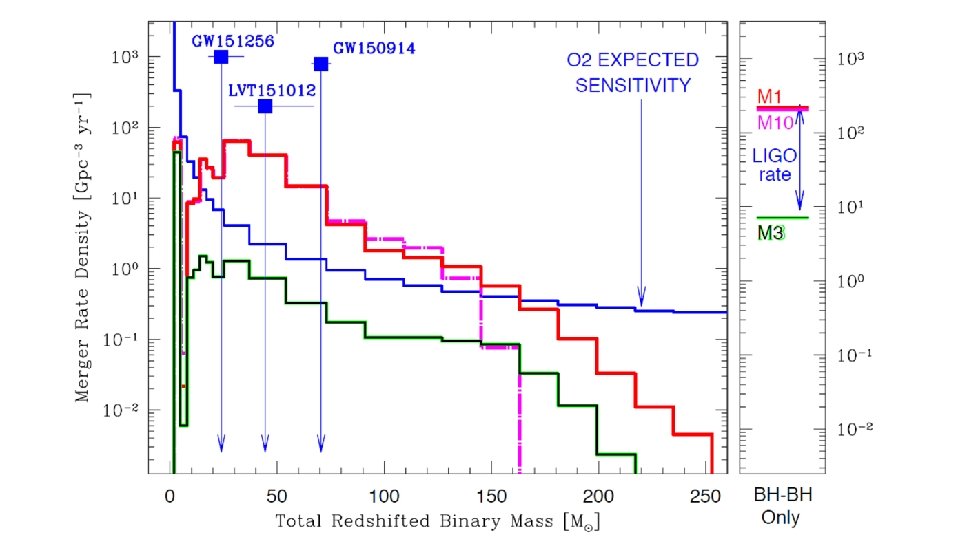
Pop I & II merger rate (Belczynski et al. 2016)
Log(events/yr) Cumulative BBH merger rate Saturated at z≳ 10 Pop III BBH (~30 Msun) Redshift Saturated at z≲ 5 Pop I and II BBH (≳ 5 Msun) (Belczynski et al. 2016) (2 metallicity evolution models) Redshift
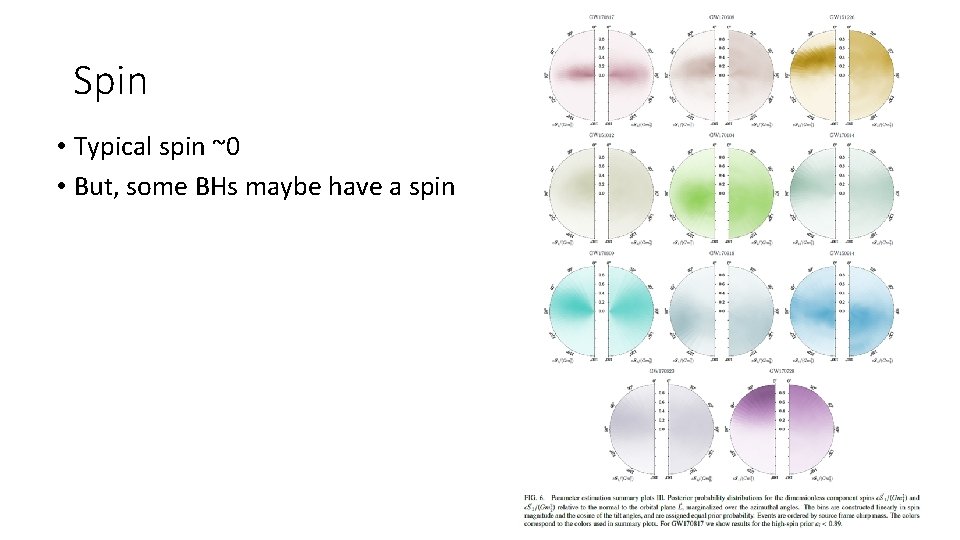
Spin • Typical spin ~0 • But, some BHs maybe have a spin
Transition from Pop III to Pop II Preliminary Maximum radius of 30 Msun (by T. Yoshida)
Why Pop III binaries become 30 Msun BH-BH Large radius Small radius • M>50 Msun red giant ➝Mass transfer is unstable ➝common envelope ➝ 1/3~1/2 of initial mass (~25 -30 Msun) • M<50 Msun blue giant ➝Mass transfer is stable ➝mass loss is not so effective ➝ 2/3~1 of initial mass (25 -30 Msun)
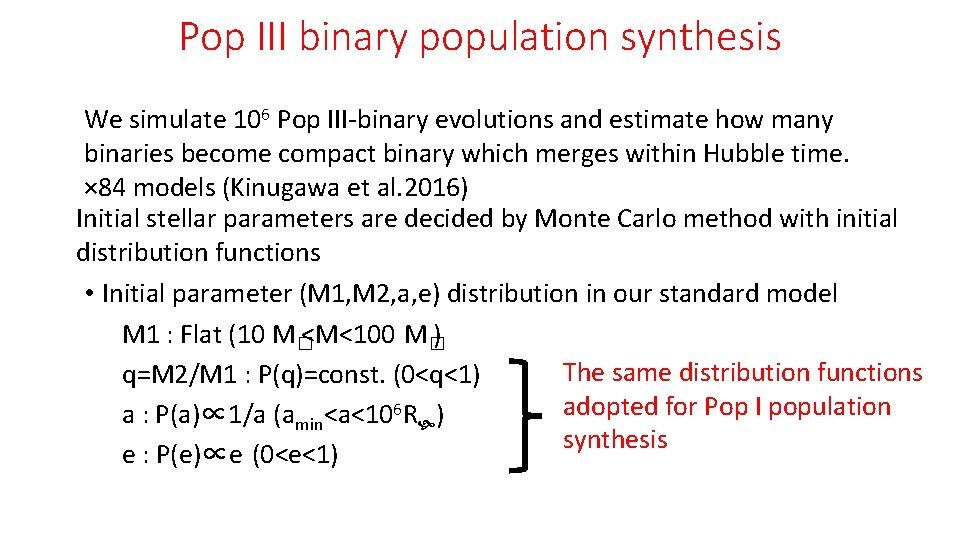
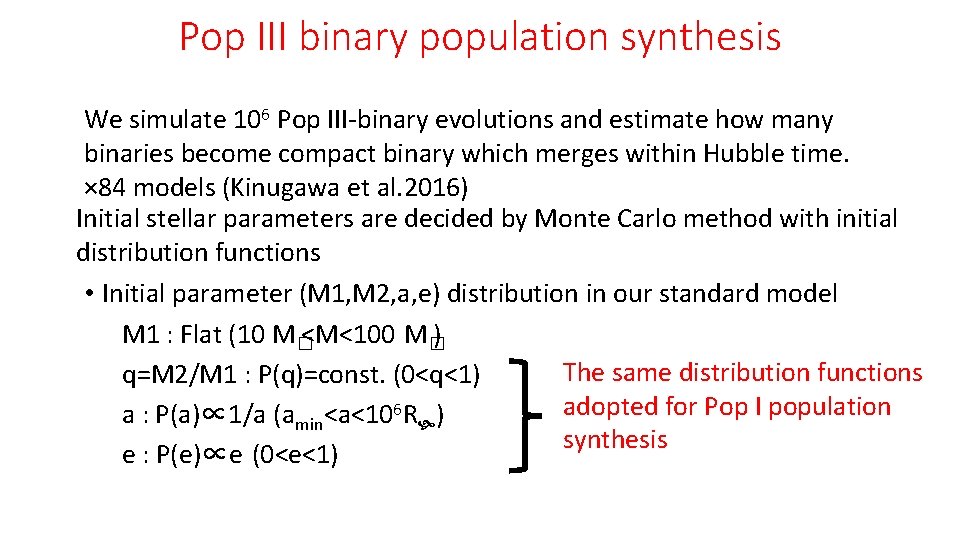
Pop III binary population synthesis We simulate 106 Pop III-binary evolutions and estimate how many binaries become compact binary which merges within Hubble time. × 84 models (Kinugawa et al. 2016) Initial stellar parameters are decided by Monte Carlo method with initial distribution functions • Initial parameter (M 1, M 2, a, e) distribution in our standard model M 1 : Flat (10 M�<M<100 M�) The same distribution functions q=M 2/M 1 : P(q)=const. (0<q<1) adopted for Pop I population a : P(a)∝ 1/a (amin<a<106 R ) synthesis e : P(e)∝e (0<e<1)
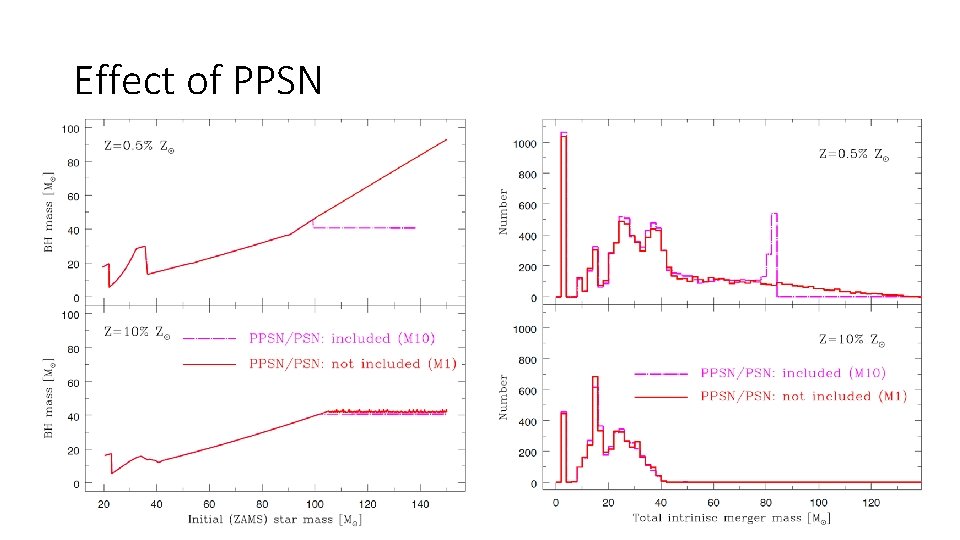
Effect of PPSN
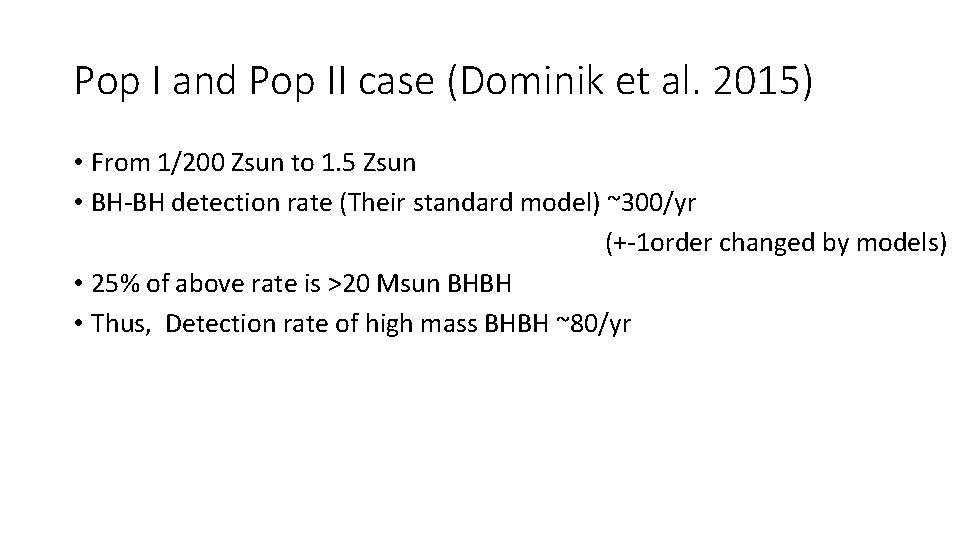
Pop I and Pop II case (Dominik et al. 2015) • From 1/200 Zsun to 1. 5 Zsun • BH-BH detection rate (Their standard model) ~300/yr (+-1 order changed by models) • 25% of above rate is >20 Msun BHBH • Thus, Detection rate of high mass BHBH ~80/yr
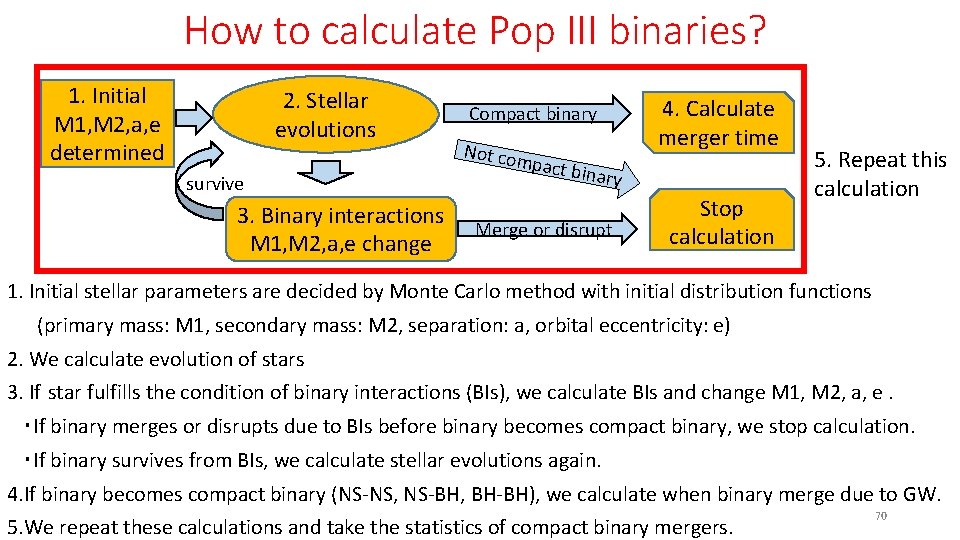
How to calculate Pop III binaries? 1. Initial M 1, M 2, a, e determined 2. Stellar evolutions survive 3. Binary interactions M 1, M 2, a, e change Compact binary Not com pact bi nary Merge or disrupt 4. Calculate merger time Stop calculation 5. Repeat this calculation 1. Initial stellar parameters are decided by Monte Carlo method with initial distribution functions (primary mass: M 1, secondary mass: M 2, separation: a, orbital eccentricity: e) 2. We calculate evolution of stars 3. If star fulfills the condition of binary interactions (BIs), we calculate BIs and change M 1, M 2, a, e. ・If binary merges or disrupts due to BIs before binary becomes compact binary, we stop calculation. ・If binary survives from BIs, we calculate stellar evolutions again. 4. If binary becomes compact binary (NS-NS, NS-BH, BH-BH), we calculate when binary merge due to GW. 5. We repeat these calculations and take the statistics of compact binary mergers. 70
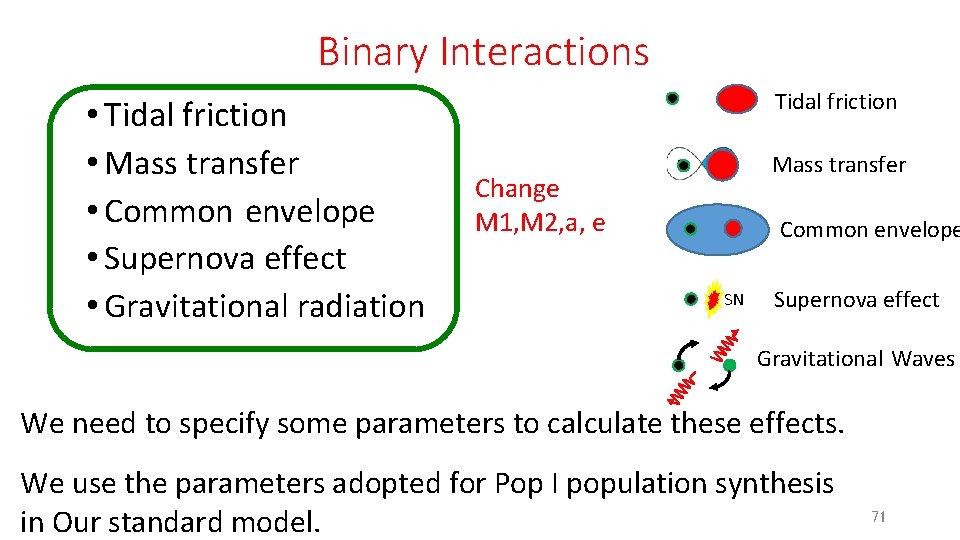
Binary Interactions • Tidal friction • Mass transfer • Common envelope • Supernova effect • Gravitational radiation Tidal friction Mass transfer Change M 1, M 2, a, e Common envelope SN Supernova effect Gravitational Waves We need to specify some parameters to calculate these effects. We use the parameters adopted for Pop I population synthesis in Our standard model. 71
Pop III binary population synthesis We simulate 106 Pop III-binary evolutions and estimate how many binaries become compact binary which merges within Hubble time. × 84 models (Kinugawa et al. 2016) Initial stellar parameters are decided by Monte Carlo method with initial distribution functions • Initial parameter (M 1, M 2, a, e) distribution in our standard model M 1 : Flat (10 M�<M<100 M�) The same distribution functions q=M 2/M 1 : P(q)=const. (0<q<1) adopted for Pop I population a : P(a)∝ 1/a (amin<a<106 R ) synthesis e : P(e)∝e (0<e<1)
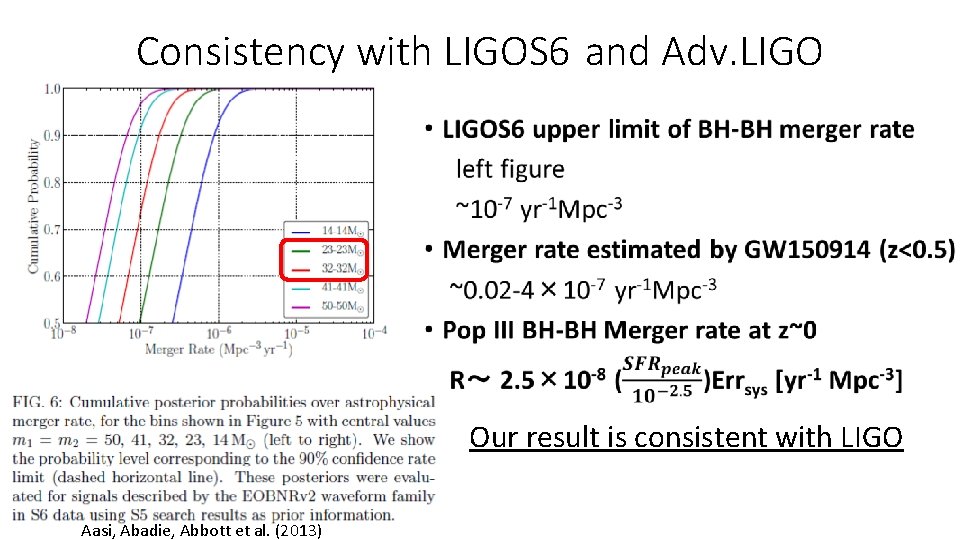
Consistency with LIGOS 6 and Adv. LIGO • Our result is consistent with LIGO Aasi, Abadie, Abbott et al. (2013)
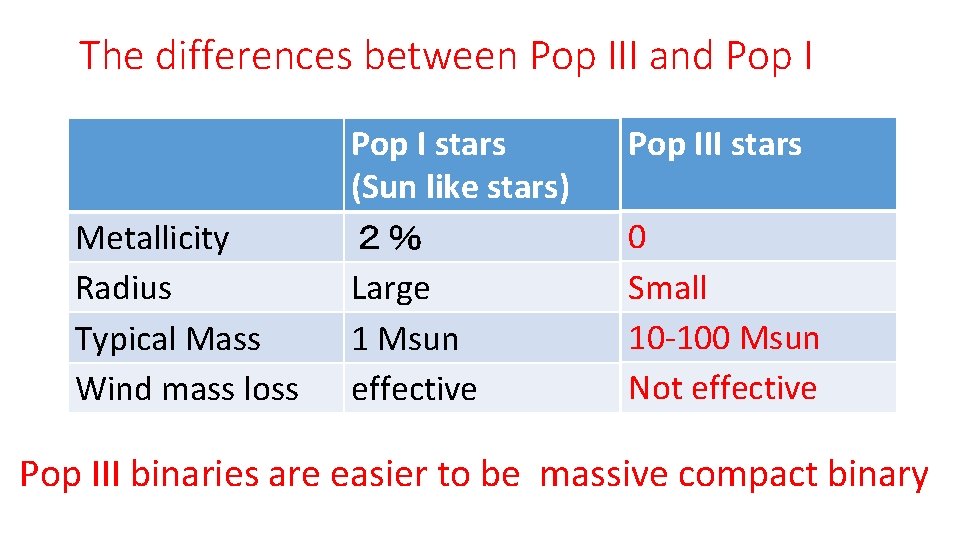
The differences between Pop III and Pop I Metallicity Radius Typical Mass Wind mass loss Pop I stars (Sun like stars) 2% Large 1 Msun effective Pop III stars 0 Small 10 -100 Msun Not effective Pop III binaries are easier to be massive compact binary
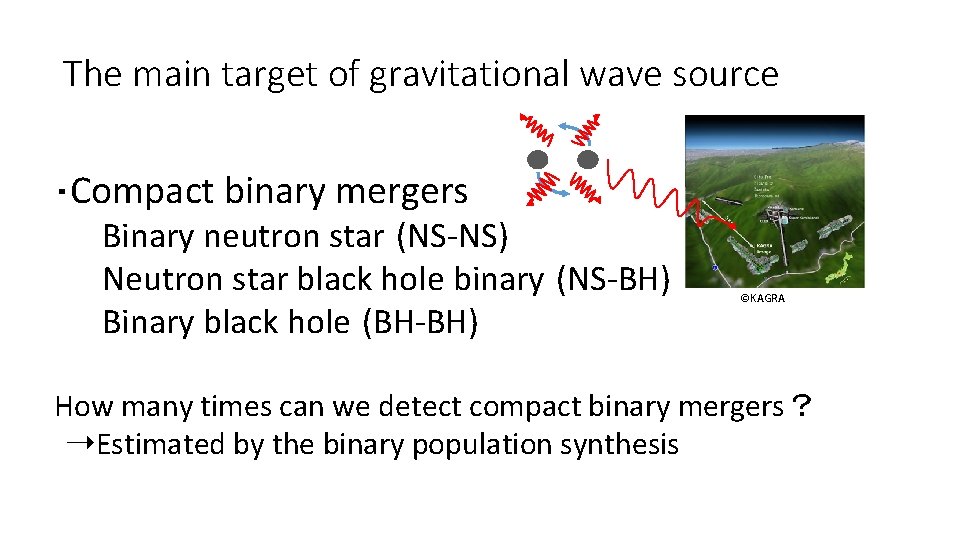
The main target of gravitational wave source ・Compact binary mergers Binary neutron star (NS-NS) Neutron star black hole binary (NS-BH) Binary black hole (BH-BH) ©KAGRA How many times can we detect compact binary mergers? by the binary population synthesis ➝Estimated
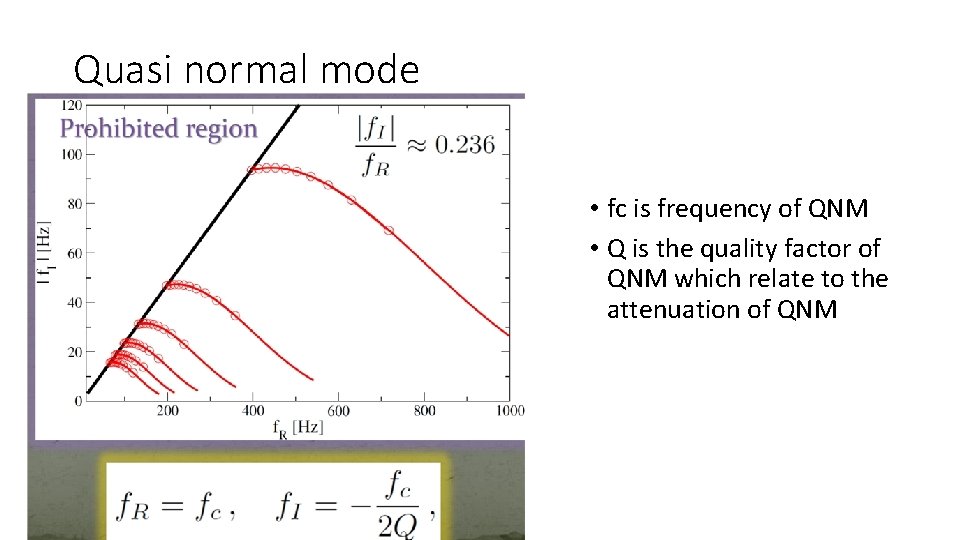
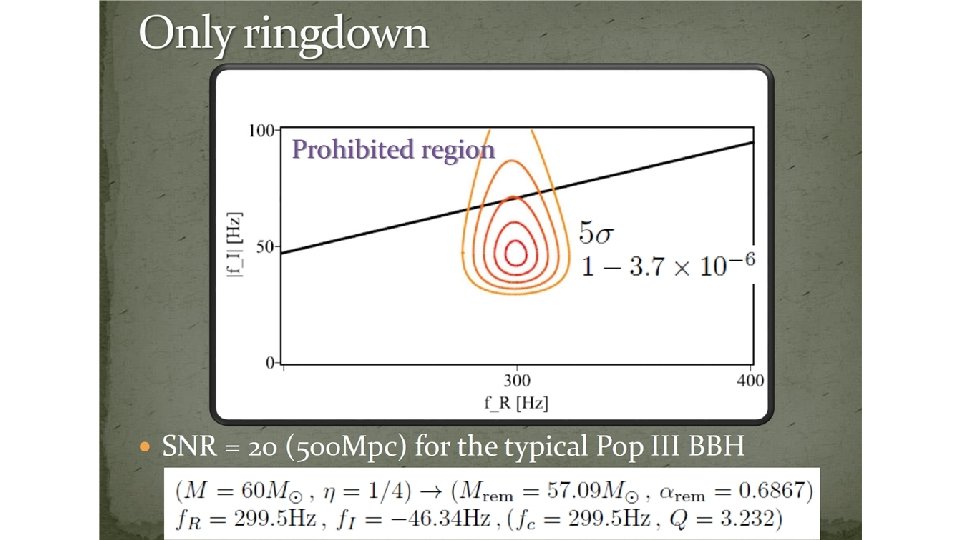
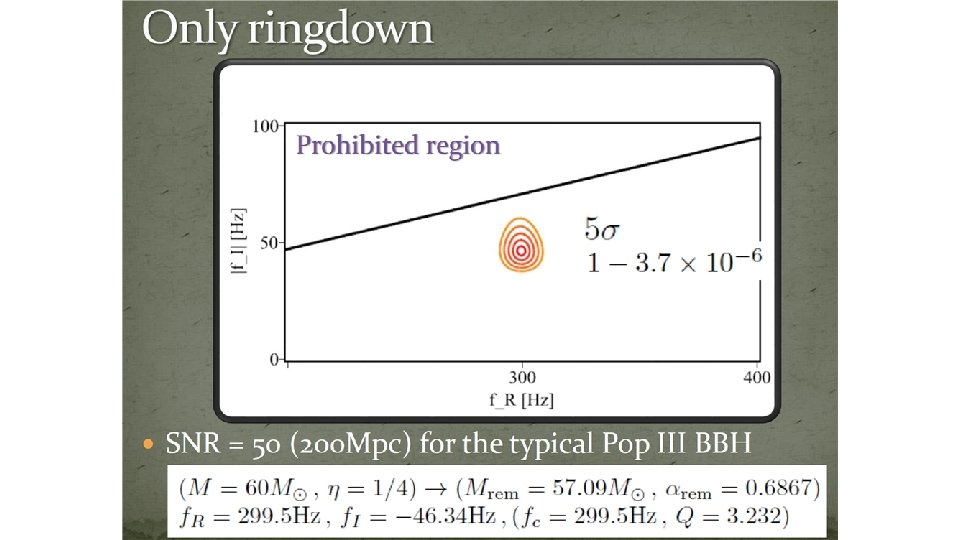
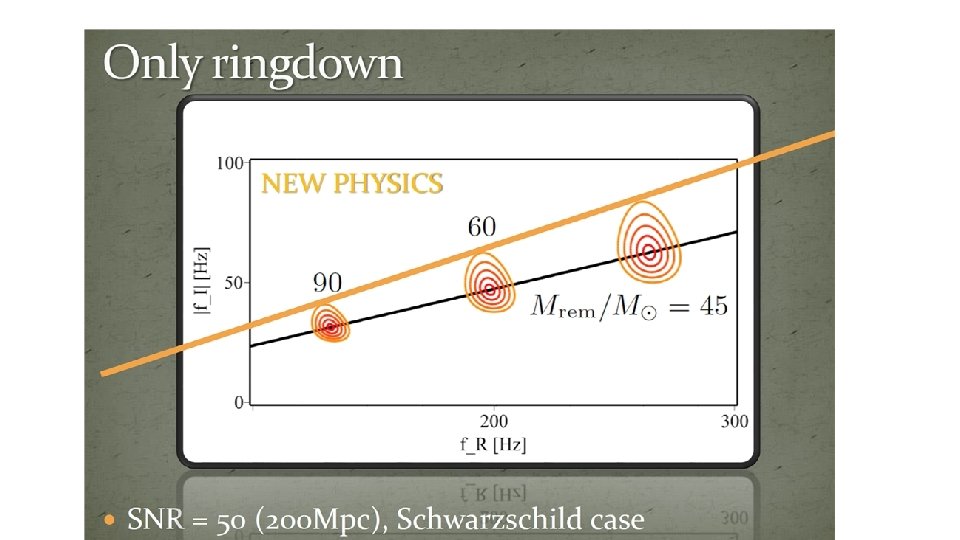
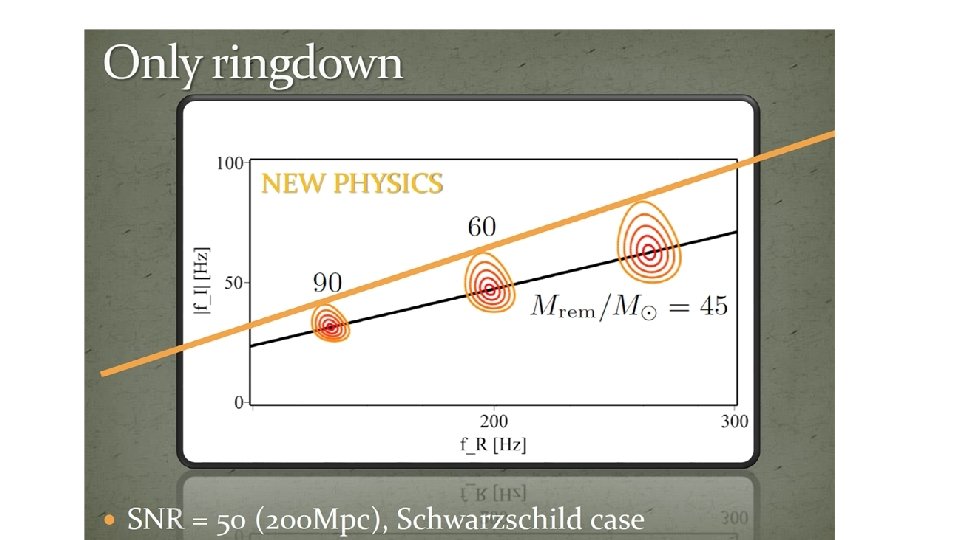
Quasi normal mode • fc is frequency of QNM • Q is the quality factor of QNM which relate to the attenuation of QNM
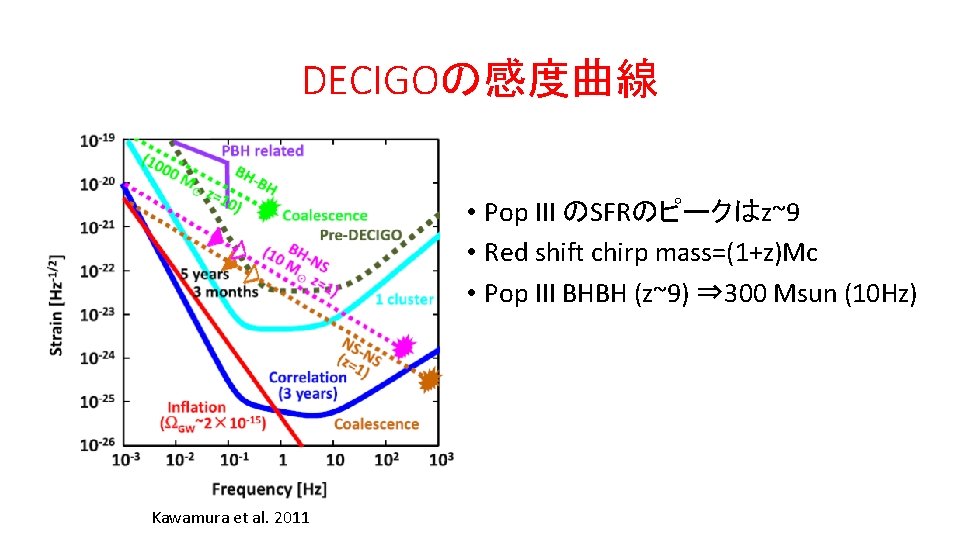
DECIGOの感度曲線 • Pop III のSFRのピークはz~9 • Red shift chirp mass=(1+z)Mc • Pop III BHBH (z~9) ⇒ 300 Msun (10 Hz) Kawamura et al. 2011
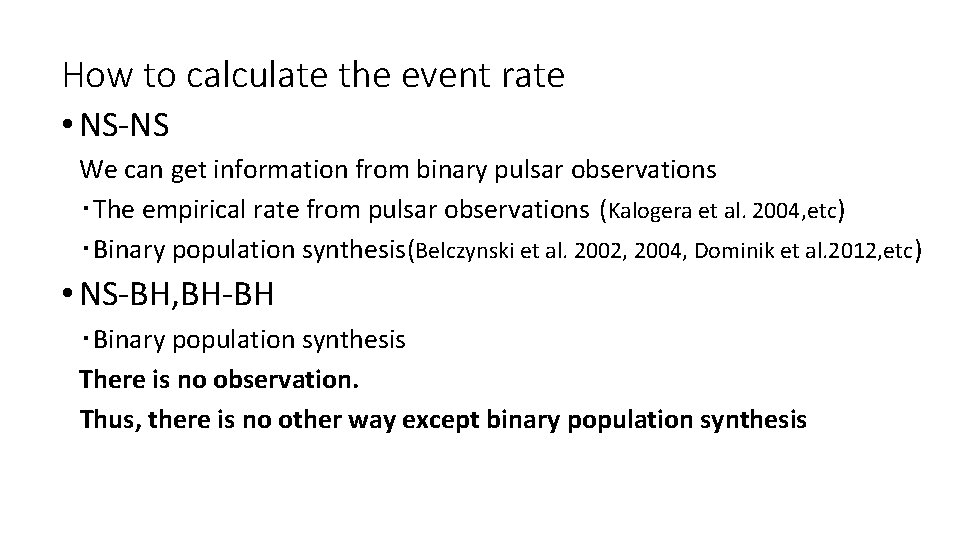
How to calculate the event rate • NS-NS We can get information from binary pulsar observations ・The empirical rate from pulsar observations (Kalogera et al. 2004, etc) ・Binary population synthesis(Belczynski et al. 2002, 2004, Dominik et al. 2012, etc) • NS-BH, BH-BH ・Binary population synthesis There is no observation. Thus, there is no other way except binary population synthesis
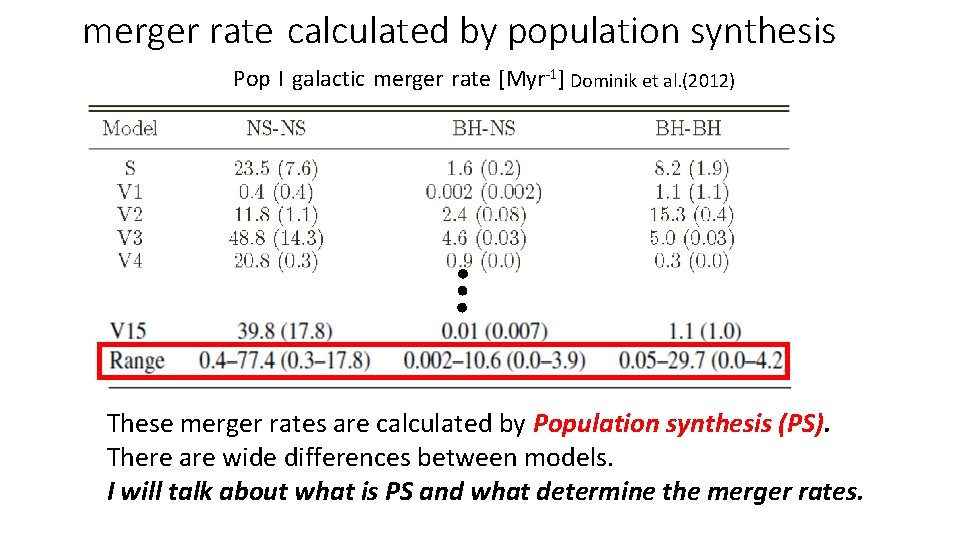
merger rate calculated by population synthesis Pop I galactic merger rate [Myr-1] Dominik et al. (2012) These merger rates are calculated by Population synthesis (PS). There are wide differences between models. I will talk about what is PS and what determine the merger rates.
Why NS-NS disrupt For example, we consider NS and NS progenitor binary. NS progenitor NS (1. 4 -2 M�) (8 -25 M�) SN disrupt In the case of Pop III NS progenitor, wind mass loss and the mass loss due to binary interaction is not effective. When NS progenitor becomes supernova, NS progenitor suddenly loses mass and becomes NS. Then, due to instant mass loss the binding energy of binary decreases and binary NS disrupts. Binary NS cannot survive!
Binary Interactions • Supernova effect In this talk, I will explain these two binary interactions. • Common envelope • Stable mass transfer • Orbital evolution (Tidal friction, Gravitational radiation)
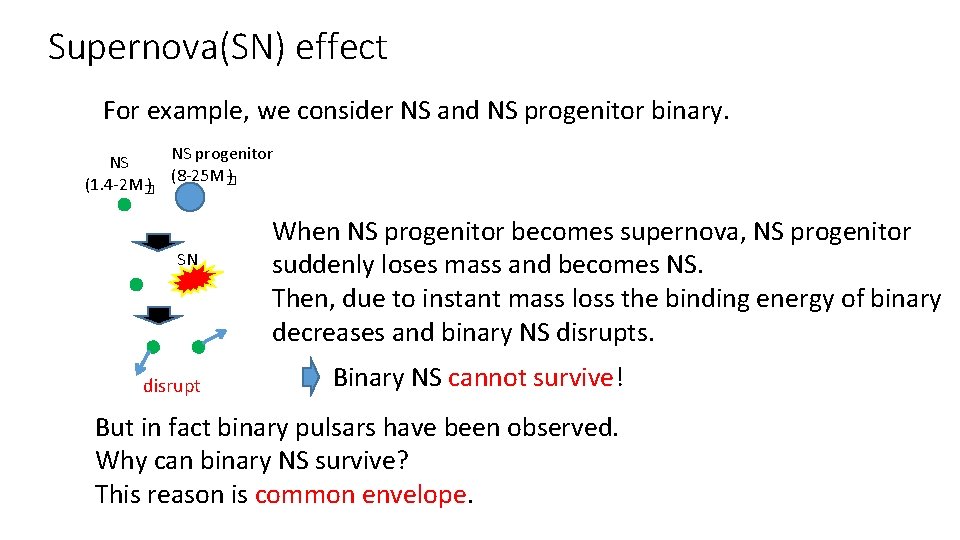
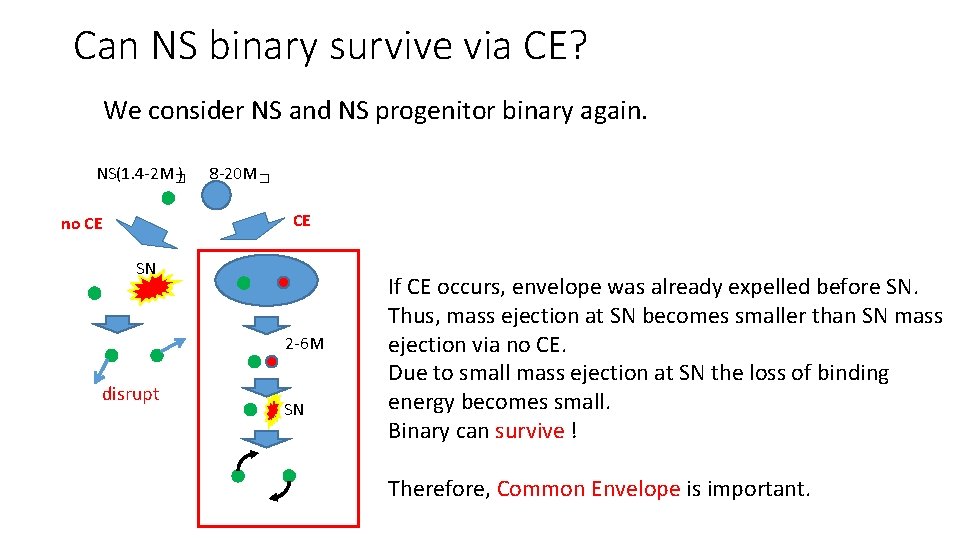
Supernova(SN) effect For example, we consider NS and NS progenitor binary. NS progenitor NS (1. 4 -2 M�) (8 -25 M�) SN disrupt When NS progenitor becomes supernova, NS progenitor suddenly loses mass and becomes NS. Then, due to instant mass loss the binding energy of binary decreases and binary NS disrupts. Binary NS cannot survive! But in fact binary pulsars have been observed. Why can binary NS survive? This reason is common envelope.
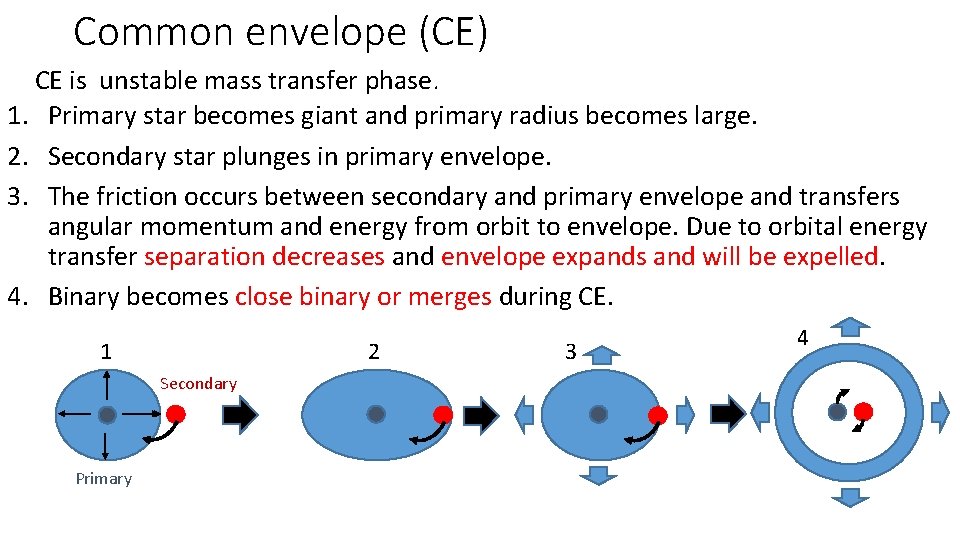
Common envelope (CE) CE is unstable mass transfer phase. 1. Primary star becomes giant and primary radius becomes large. 2. Secondary star plunges in primary envelope. 3. The friction occurs between secondary and primary envelope and transfers angular momentum and energy from orbit to envelope. Due to orbital energy transfer separation decreases and envelope expands and will be expelled. 4. Binary becomes close binary or merges during CE. 1 2 Secondary Primary 3 4
Can NS binary survive via CE? We consider NS and NS progenitor binary again. NS(1. 4 -2 M�) 8 -20 M� CE no CE SN 2 -6 M disrupt SN If CE occurs, envelope was already expelled before SN. Thus, mass ejection at SN becomes smaller than SN mass ejection via no CE. Due to small mass ejection at SN the loss of binding energy becomes small. Binary can survive ! Therefore, Common Envelope is important.
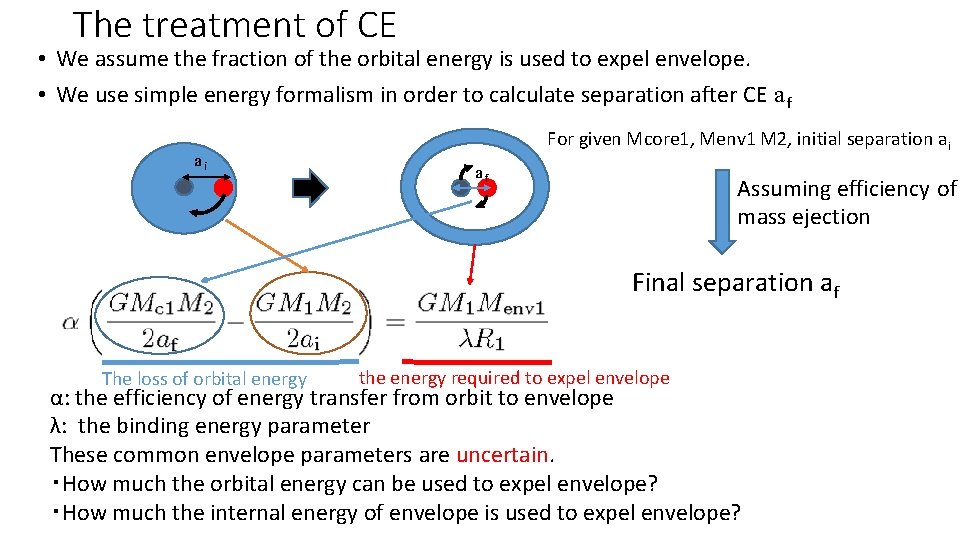
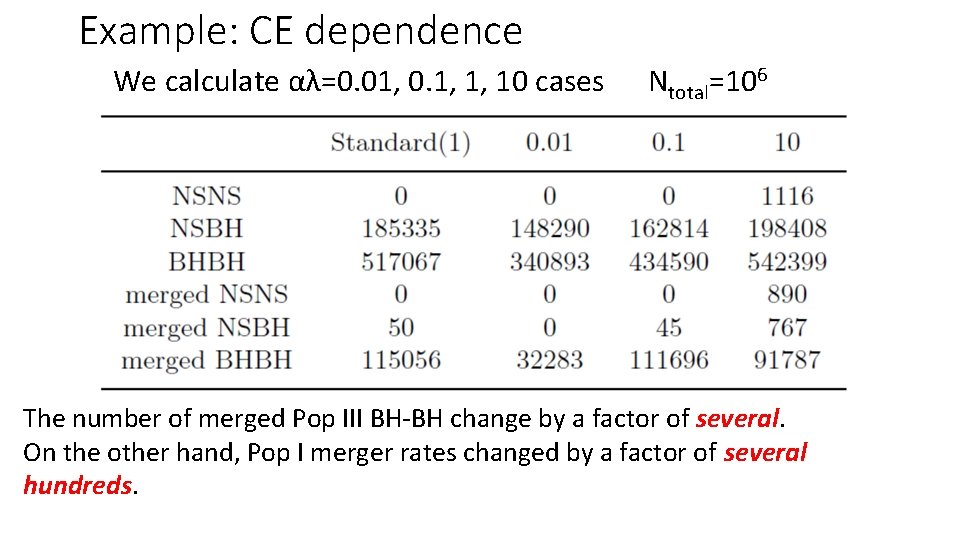
The treatment of CE • We assume the fraction of the orbital energy is used to expel envelope. • We use simple energy formalism in order to calculate separation after CE a f ai For given Mcore 1, Menv 1 M 2, initial separation ai af Assuming efficiency of mass ejection Final separation af The loss of orbital energy the energy required to expel envelope α: the efficiency of energy transfer from orbit to envelope λ: the binding energy parameter These common envelope parameters are uncertain. ・How much the orbital energy can be used to expel envelope? ・How much the internal energy of envelope is used to expel envelope?
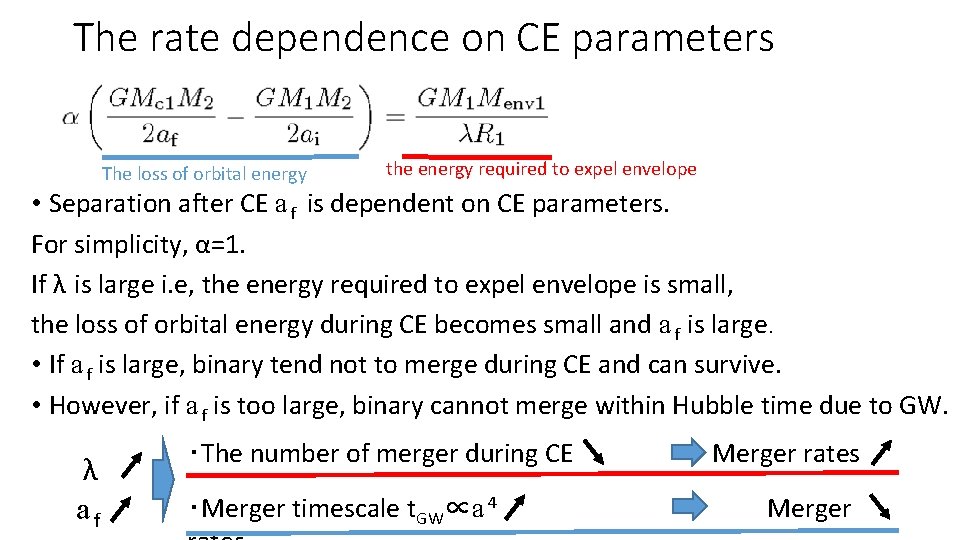
The rate dependence on CE parameters The loss of orbital energy the energy required to expel envelope • Separation after CE a f is dependent on CE parameters. For simplicity, α=1. If λ is large i. e, the energy required to expel envelope is small, the loss of orbital energy during CE becomes small and a f is large. • If a f is large, binary tend not to merge during CE and can survive. • However, if a f is too large, binary cannot merge within Hubble time due to GW. λ af ・The number of merger during CE ・Merger timescale t. GW∝a 4 Merger rates Merger
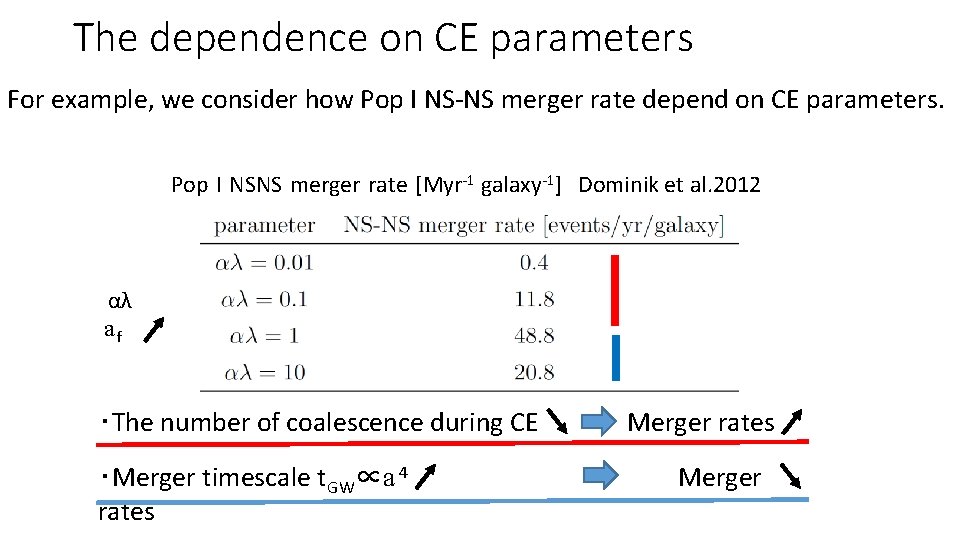
The dependence on CE parameters For example, we consider how Pop I NS-NS merger rate depend on CE parameters. Pop I NSNS merger rate [Myr-1 galaxy-1] Dominik et al. 2012 αλ af ・The number of coalescence during CE ・Merger timescale t. GW∝a 4 rates Merger rates Merger
Binary population synthesis • Population synthesis is a method of numerical simulation to research the population of stars with a complex evolutions. • Population synthesis can predict properties and merger rates of unobserved sources such as NS-BH, BH-BH • The common envelope of the key process of population synthesis • However, Common envelope parameters are uncertain. This uncertainty change event rate by a factor of several hundreds. We should reveal this uncertainty via comparison between result of population synthesis and observations such as GW and other observations and improve binary evolution theory
Example: CE dependence We calculate αλ=0. 01, 0. 1, 1, 10 cases Ntotal=106 The number of merged Pop III BH-BH change by a factor of several. On the other hand, Pop I merger rates changed by a factor of several hundreds.
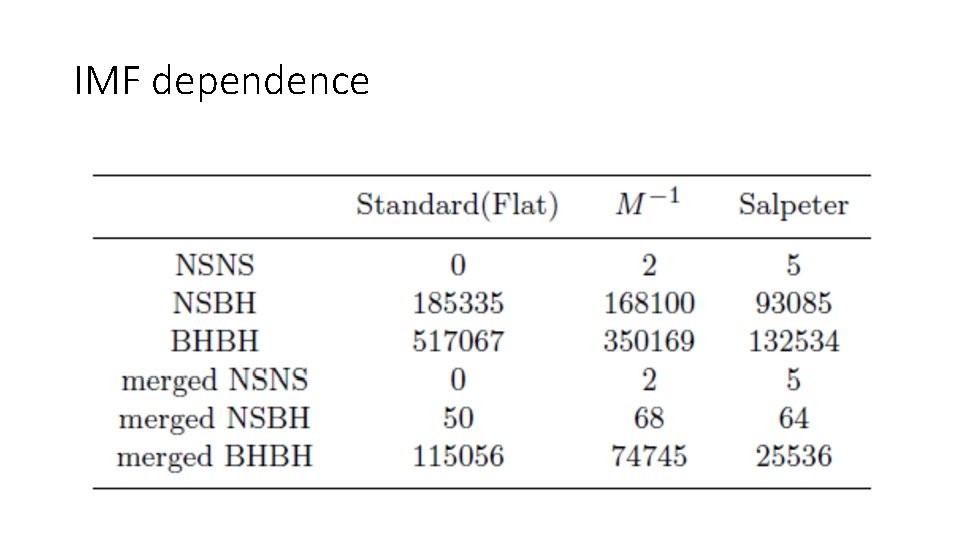
IMF dependence
Uncertainties of Pop III binary population synthesis • Initial condition IMF mass ratio separation eccentricity • Binary interactions Common envelope Mass transfer Supernova kick
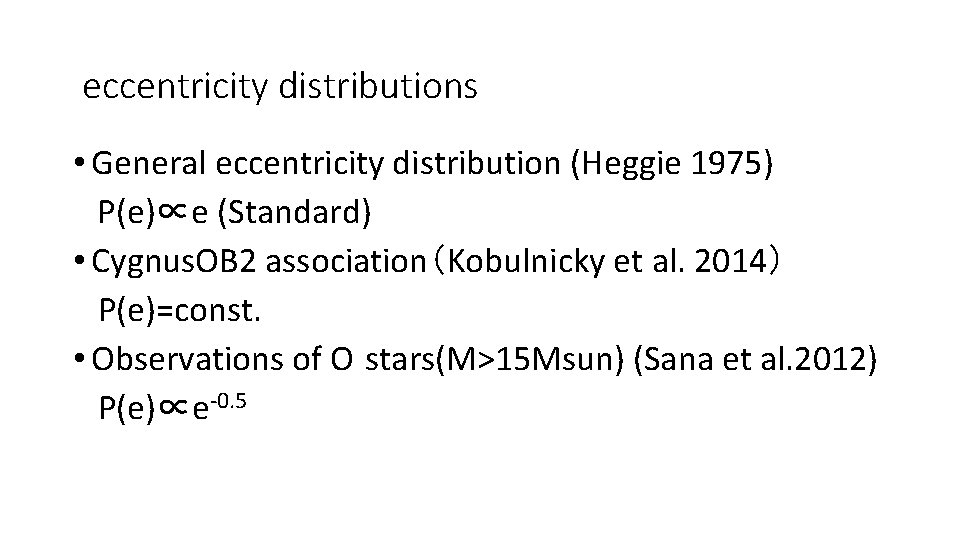
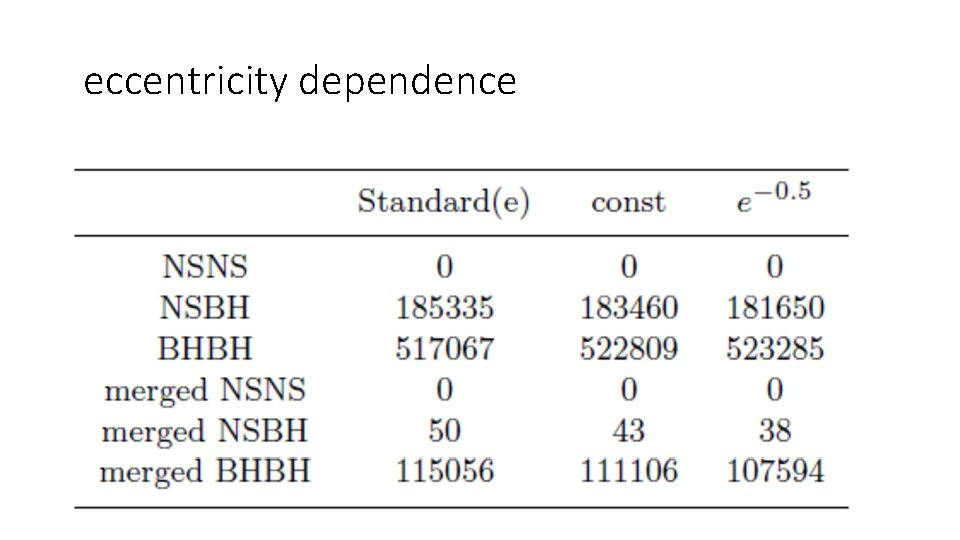
eccentricity distributions • General eccentricity distribution (Heggie 1975) P(e)∝e (Standard) • Cygnus. OB 2 association(Kobulnicky et al. 2014) P(e)=const. • Observations of O stars(M>15 Msun) (Sana et al. 2012) P(e)∝e-0. 5
eccentricity dependence
Uncertainties of Pop III binary population synthesis • Initial condition IMF mass ratio separation eccentricity • Binary interactions Common envelope Mass transfer Supernova kick
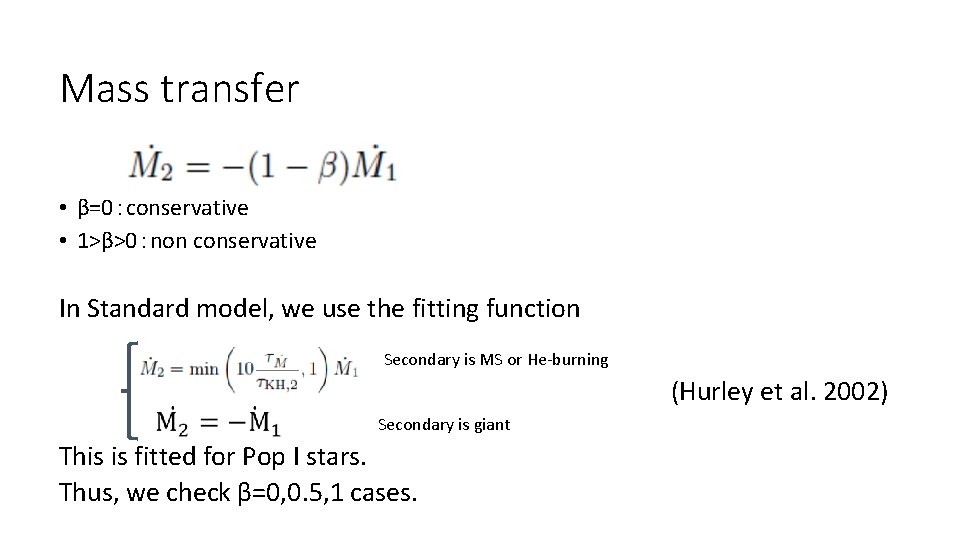
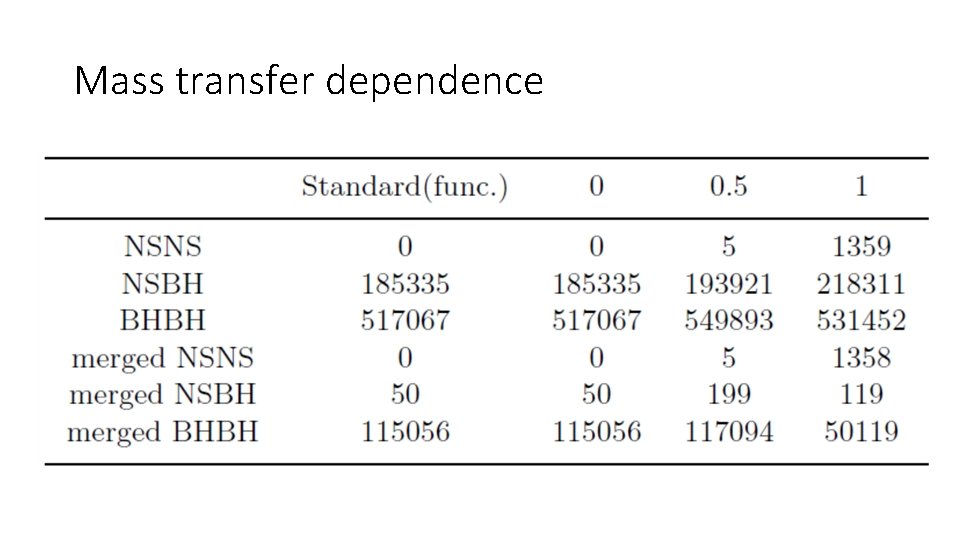
Mass transfer • β=0:conservative • 1>β>0:non conservative In Standard model, we use the fitting function Secondary is MS or He-burning (Hurley et al. 2002) Secondary is giant This is fitted for Pop I stars. Thus, we check β=0, 0. 5, 1 cases.
Mass transfer dependence
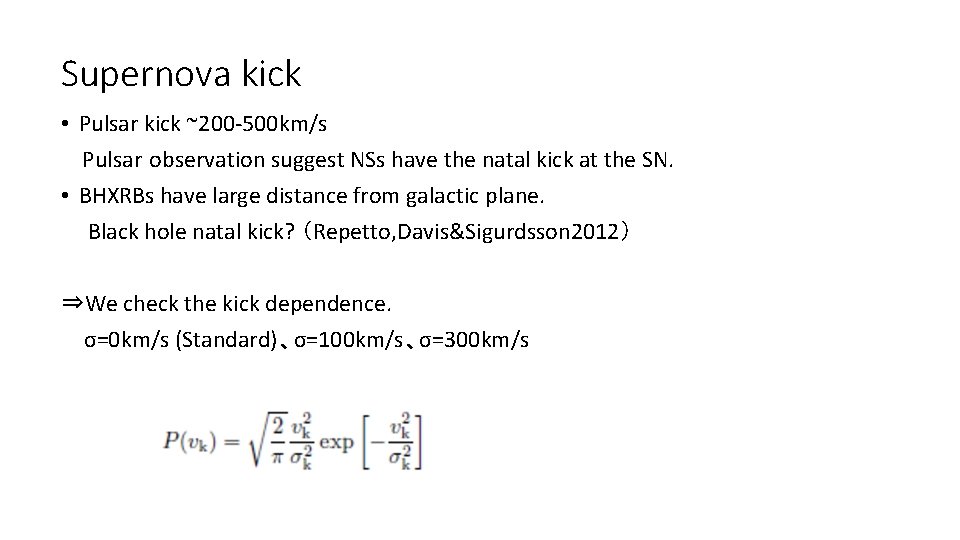
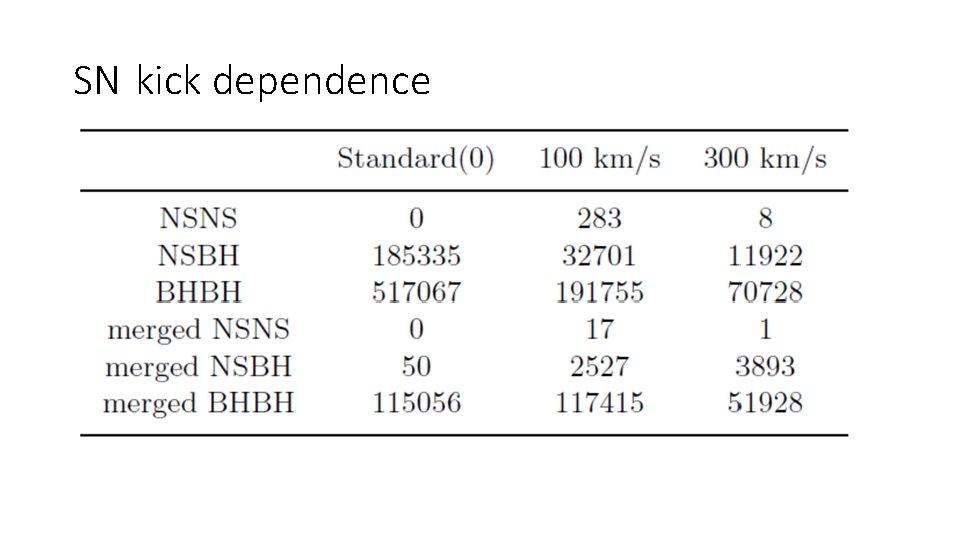
Supernova kick • Pulsar kick ~200 -500 km/s Pulsar observation suggest NSs have the natal kick at the SN. • BHXRBs have large distance from galactic plane. Black hole natal kick? (Repetto, Davis&Sigurdsson 2012) ⇒We check the kick dependence. σ=0 km/s (Standard)、σ=100 km/s、σ=300 km/s
SN kick dependence