
The Relevance of NonFinancial Key Performance Indicators KPIs
- Slides: 17
The Relevance of Non-Financial Key Performance Indicators (KPIs) Bingxu Fang, Partha Mohanram and Dushyant Vyas Professional Accounting Centre University of Toronto Sept 13, 2019
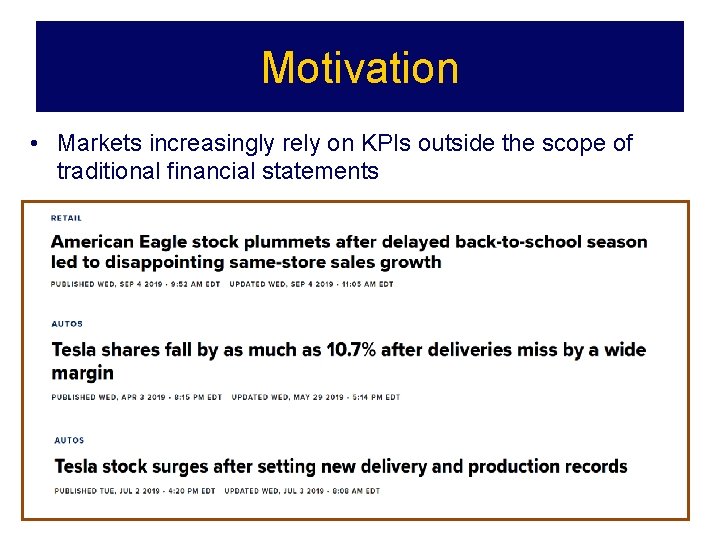
Motivation • Markets increasingly rely on KPIs outside the scope of traditional financial statements
Need for Nonfinancial KPIs? • KPIs are leading indicators of future financial performance: Traditional financial statement metrics (GAAP and non-GAAP) may not reflect underlying business developments on a timely basis • KPIs are customizable: Value drivers vary not only across, but within industries. Disclosure and use of nonfinancial KPIs can be contextualized • For example, same-store sales growth for retailers, passenger load factor and cost per seat mile for airlines, the value of new orders and value of order backlog for homebuilders, and the number of restaurants opened/closed for restaurant chains
Our Objectives 1. To examine the value relevance of a large set of industry specific non-financial KPIs 2. To study the efficacy of a fundamental analysis strategy using KPIs to screen firms in multiple industries 3. To study cross-sectional and inter-temporal variation in (1) and (2) based on firm- and KPI characteristics
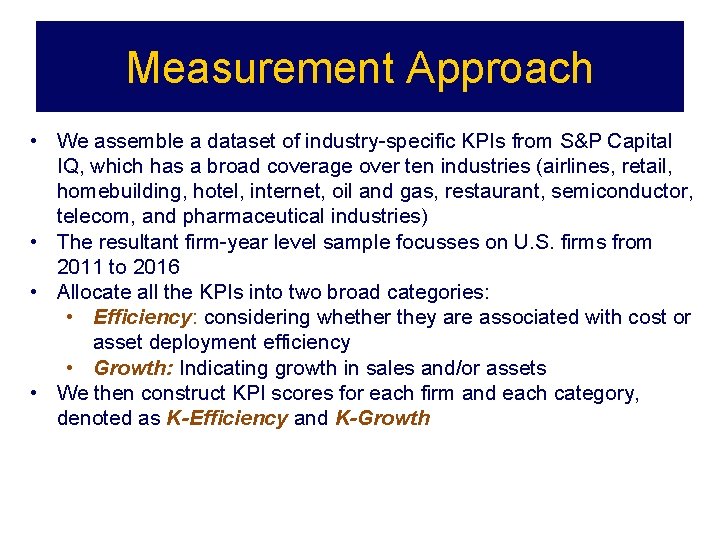
Measurement Approach • We assemble a dataset of industry-specific KPIs from S&P Capital IQ, which has a broad coverage over ten industries (airlines, retail, homebuilding, hotel, internet, oil and gas, restaurant, semiconductor, telecom, and pharmaceutical industries) • The resultant firm-year level sample focusses on U. S. firms from 2011 to 2016 • Allocate all the KPIs into two broad categories: • Efficiency: considering whether they are associated with cost or asset deployment efficiency • Growth: Indicating growth in sales and/or assets • We then construct KPI scores for each firm and each category, denoted as K-Efficiency and K-Growth
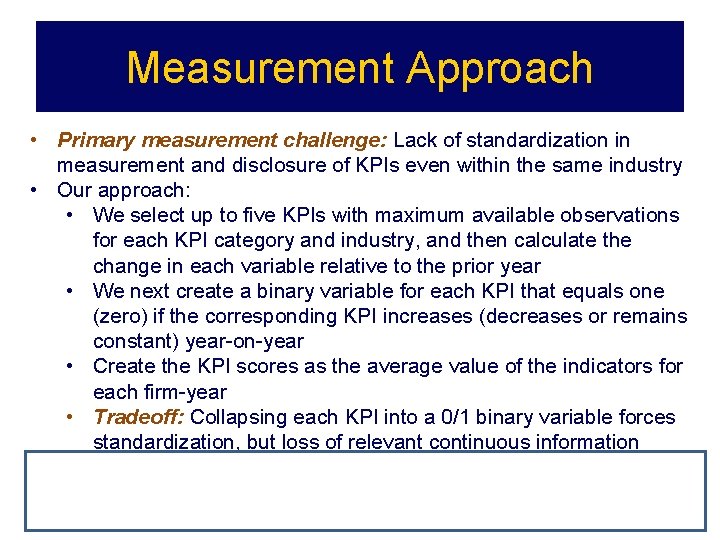
Measurement Approach • Primary measurement challenge: Lack of standardization in measurement and disclosure of KPIs even within the same industry • Our approach: • We select up to five KPIs with maximum available observations for each KPI category and industry, and then calculate the change in each variable relative to the prior year • We next create a binary variable for each KPI that equals one (zero) if the corresponding KPI increases (decreases or remains constant) year-on-year • Create the KPI scores as the average value of the indicators for each firm-year • Tradeoff: Collapsing each KPI into a 0/1 binary variable forces standardization, but loss of relevant continuous information
Empirical Analyses
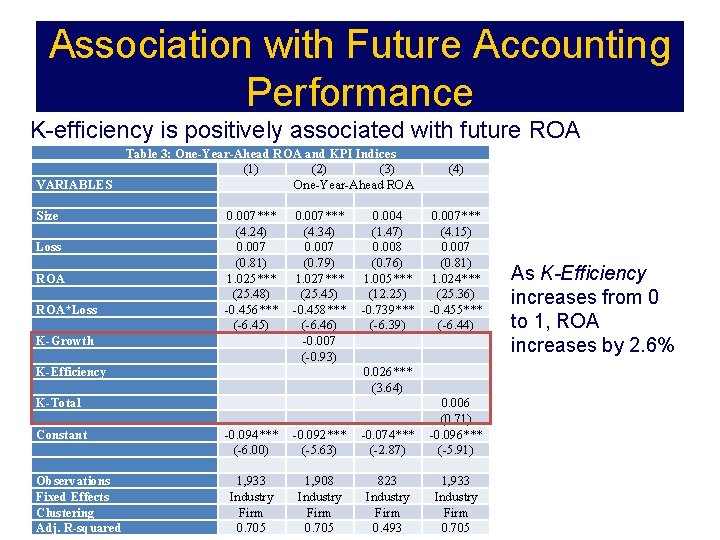
Association with Future Accounting Performance K-efficiency is positively associated with future ROA VARIABLES Size Loss ROA*Loss Table 3: One-Year-Ahead ROA and KPI Indices (1) (2) (3) One-Year-Ahead ROA 0. 007*** (4. 24) 0. 007 (0. 81) 1. 025*** (25. 48) -0. 456*** (-6. 45) K-Growth 0. 007*** (4. 34) 0. 007 (0. 79) 1. 027*** (25. 45) -0. 458*** (-6. 46) -0. 007 (-0. 93) K-Efficiency 0. 004 (1. 47) 0. 008 (0. 76) 1. 005*** (12. 25) -0. 739*** (-6. 39) Observations Fixed Effects Clustering Adj. R-squared 0. 007*** (4. 15) 0. 007 (0. 81) 1. 024*** (25. 36) -0. 455*** (-6. 44) 0. 026*** (3. 64) K-Total Constant (4) -0. 094*** (-6. 00) -0. 092*** (-5. 63) -0. 074*** (-2. 87) 0. 006 (0. 71) -0. 096*** (-5. 91) 1, 933 Industry Firm 0. 705 1, 908 Industry Firm 0. 705 823 Industry Firm 0. 493 1, 933 Industry Firm 0. 705 As K-Efficiency increases from 0 to 1, ROA increases by 2. 6%
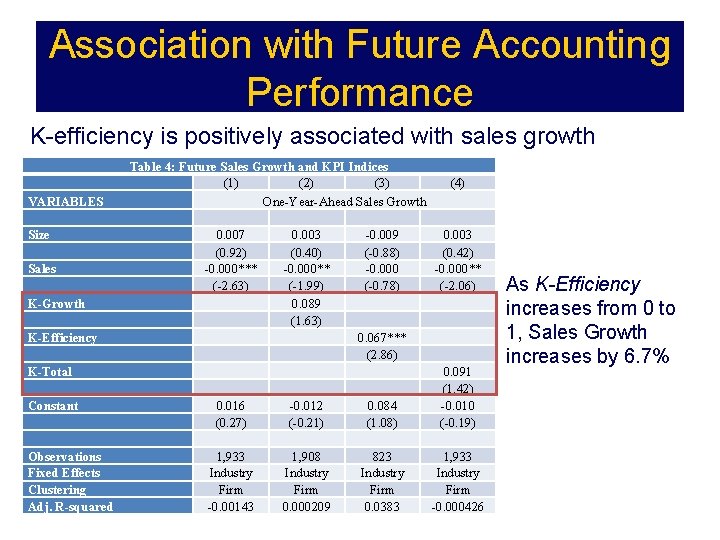
Association with Future Accounting Performance K-efficiency is positively associated with sales growth VARIABLES Size Sales Table 4: Future Sales Growth and KPI Indices (1) (2) (3) One-Year-Ahead Sales Growth 0. 007 (0. 92) -0. 000*** (-2. 63) K-Growth 0. 003 (0. 40) -0. 000** (-1. 99) 0. 089 (1. 63) K-Efficiency -0. 009 (-0. 88) -0. 000 (-0. 78) Observations Fixed Effects Clustering Adj. R-squared 0. 003 (0. 42) -0. 000** (-2. 06) 0. 067*** (2. 86) K-Total Constant (4) 0. 016 (0. 27) -0. 012 (-0. 21) 0. 084 (1. 08) 0. 091 (1. 42) -0. 010 (-0. 19) 1, 933 Industry Firm -0. 00143 1, 908 Industry Firm 0. 000209 823 Industry Firm 0. 0383 1, 933 Industry Firm -0. 000426 As K-Efficiency increases from 0 to 1, Sales Growth increases by 6. 7%
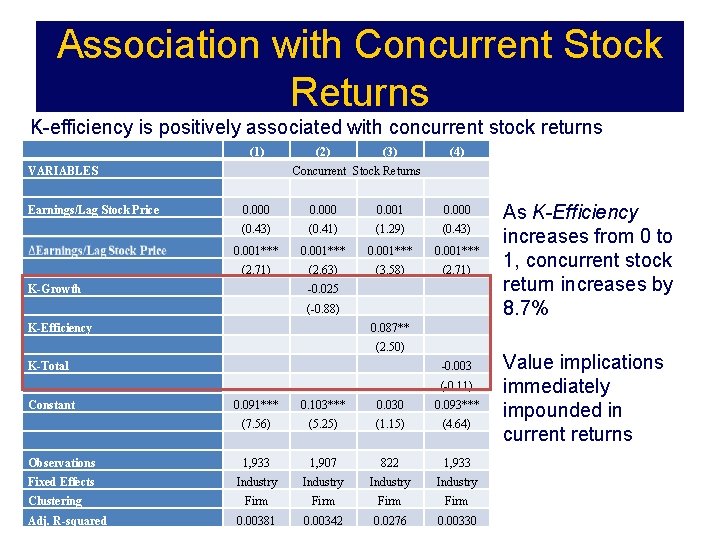
Association with Concurrent Stock Returns K-efficiency is positively associated with concurrent stock returns (1) VARIABLES Earnings/Lag Stock Price (2) (3) (4) Concurrent Stock Returns 0. 000 0. 001 0. 000 (0. 43) (0. 41) (1. 29) (0. 43) 0. 001*** (2. 71) (2. 63) (3. 58) (2. 71) K-Growth -0. 025 (-0. 88) K-Efficiency 0. 087** (2. 50) K-Total -0. 003 (-0. 11) Constant 0. 091*** 0. 103*** 0. 030 0. 093*** (7. 56) (5. 25) (1. 15) (4. 64) Observations 1, 933 1, 907 822 1, 933 Fixed Effects Industry Firm 0. 00381 0. 00342 0. 0276 0. 00330 Clustering Adj. R-squared As K-Efficiency increases from 0 to 1, concurrent stock return increases by 8. 7% Value implications immediately impounded in current returns
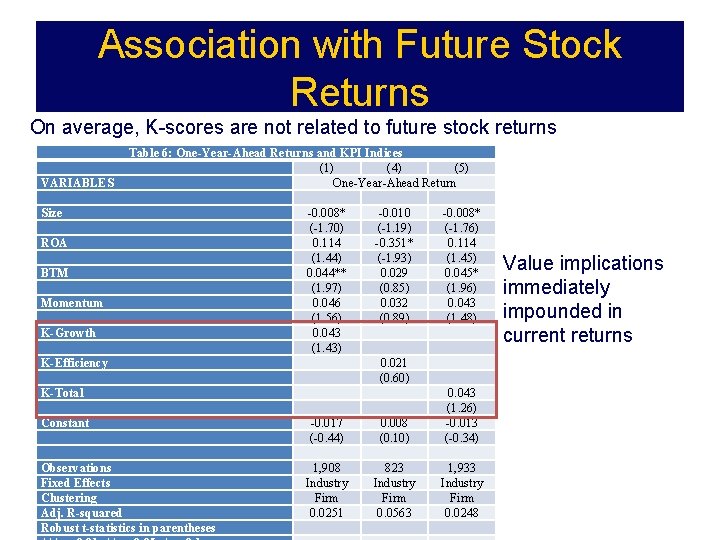
Association with Future Stock Returns On average, K-scores are not related to future stock returns VARIABLES Table 6: One-Year-Ahead Returns and KPI Indices (1) (4) (5) One-Year-Ahead Return Size ROA BTM Momentum K-Growth -0. 008* (-1. 70) 0. 114 (1. 44) 0. 044** (1. 97) 0. 046 (1. 56) 0. 043 (1. 43) K-Efficiency -0. 010 (-1. 19) -0. 351* (-1. 93) 0. 029 (0. 85) 0. 032 (0. 89) -0. 008* (-1. 76) 0. 114 (1. 45) 0. 045* (1. 96) 0. 043 (1. 48) 0. 021 (0. 60) K-Total Constant -0. 017 (-0. 44) 0. 008 (0. 10) 0. 043 (1. 26) -0. 013 (-0. 34) Observations Fixed Effects Clustering Adj. R-squared Robust t-statistics in parentheses 1, 908 Industry Firm 0. 0251 823 Industry Firm 0. 0563 1, 933 Industry Firm 0. 0248 Value implications immediately impounded in current returns
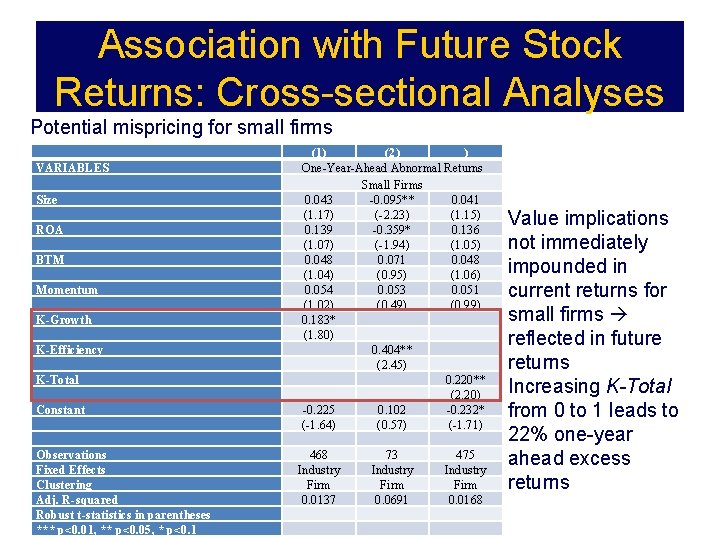
Association with Future Stock Returns: Cross-sectional Analyses Potential mispricing for small firms VARIABLES Size ROA BTM Momentum K-Growth K-Efficiency K-Total Constant Observations Fixed Effects Clustering Adj. R-squared Robust t-statistics in parentheses *** p<0. 01, ** p<0. 05, * p<0. 1 (1) (2) ) One-Year-Ahead Abnormal Returns Small Firms 0. 043 -0. 095** 0. 041 (1. 17) (-2. 23) (1. 15) 0. 139 -0. 359* 0. 136 (1. 07) (-1. 94) (1. 05) 0. 048 0. 071 0. 048 (1. 04) (0. 95) (1. 06) 0. 054 0. 053 0. 051 (1. 02) (0. 49) (0. 99) 0. 183* (1. 80) 0. 404** (2. 45) 0. 220** (2. 20) -0. 225 0. 102 -0. 232* (-1. 64) (0. 57) (-1. 71) 468 Industry Firm 0. 0137 73 Industry Firm 0. 0691 475 Industry Firm 0. 0168 Value implications not immediately impounded in current returns for small firms reflected in future returns Increasing K-Total from 0 to 1 leads to 22% one-year ahead excess returns
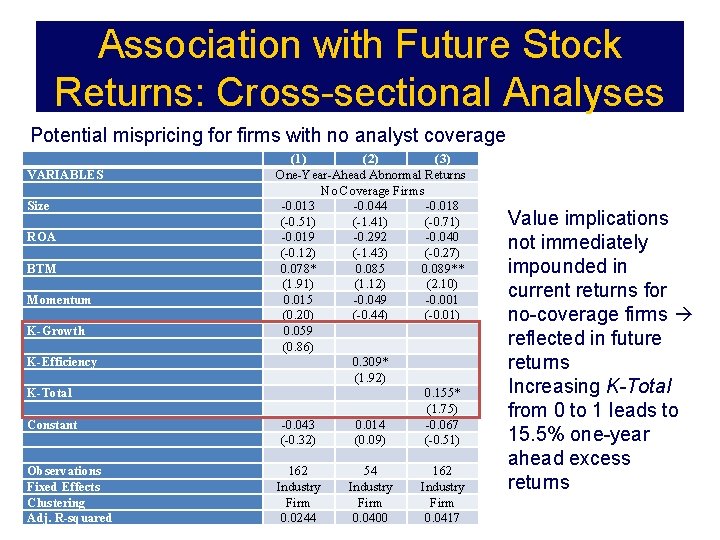
Association with Future Stock Returns: Cross-sectional Analyses Potential mispricing for firms with no analyst coverage VARIABLES Size ROA BTM Momentum K-Growth K-Efficiency K-Total Constant Observations Fixed Effects Clustering Adj. R-squared (1) (2) (3) One-Year-Ahead Abnormal Returns No Coverage Firms -0. 013 -0. 044 -0. 018 (-0. 51) (-1. 41) (-0. 71) -0. 019 -0. 292 -0. 040 (-0. 12) (-1. 43) (-0. 27) 0. 078* 0. 085 0. 089** (1. 91) (1. 12) (2. 10) 0. 015 -0. 049 -0. 001 (0. 20) (-0. 44) (-0. 01) 0. 059 (0. 86) 0. 309* (1. 92) 0. 155* (1. 75) -0. 043 0. 014 -0. 067 (-0. 32) (0. 09) (-0. 51) 162 Industry Firm 0. 0244 54 Industry Firm 0. 0400 162 Industry Firm 0. 0417 Value implications not immediately impounded in current returns for no-coverage firms reflected in future returns Increasing K-Total from 0 to 1 leads to 15. 5% one-year ahead excess returns
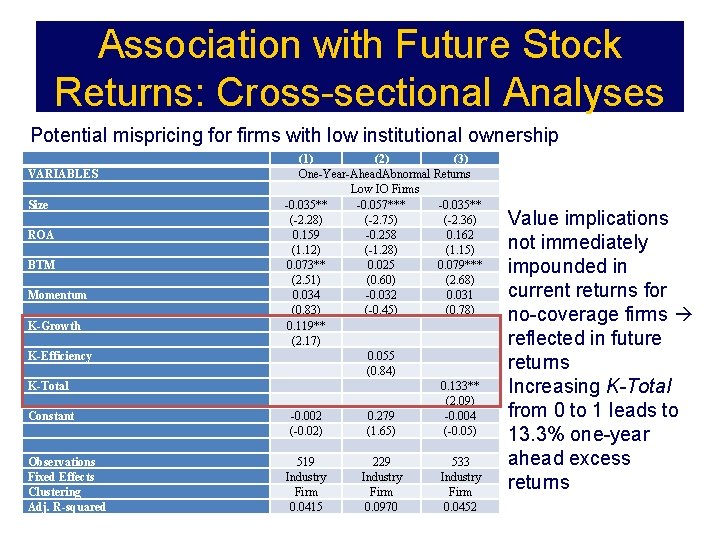
Association with Future Stock Returns: Cross-sectional Analyses Potential mispricing for firms with low institutional ownership VARIABLES Size ROA BTM Momentum K-Growth K-Efficiency K-Total Constant Observations Fixed Effects Clustering Adj. R-squared (1) (2) (3) One-Year-Ahead. Abnormal Returns Low IO Firms -0. 035** -0. 057*** -0. 035** (-2. 28) (-2. 75) (-2. 36) 0. 159 -0. 258 0. 162 (1. 12) (-1. 28) (1. 15) 0. 073** 0. 025 0. 079*** (2. 51) (0. 60) (2. 68) 0. 034 -0. 032 0. 031 (0. 83) (-0. 45) (0. 78) 0. 119** (2. 17) 0. 055 (0. 84) 0. 133** (2. 09) -0. 002 0. 279 -0. 004 (-0. 02) (1. 65) (-0. 05) 519 Industry Firm 0. 0415 229 Industry Firm 0. 0970 533 Industry Firm 0. 0452 Value implications not immediately impounded in current returns for no-coverage firms reflected in future returns Increasing K-Total from 0 to 1 leads to 13. 3% one-year ahead excess returns
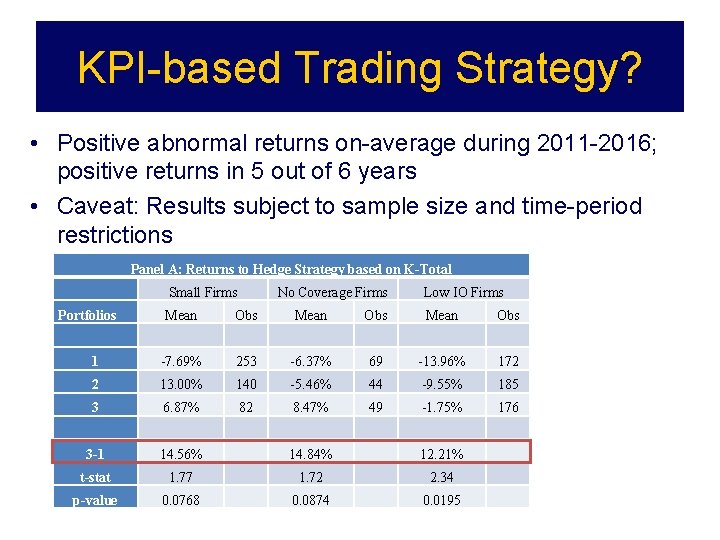
KPI-based Trading Strategy? • Positive abnormal returns on-average during 2011 -2016; positive returns in 5 out of 6 years • Caveat: Results subject to sample size and time-period restrictions Panel A: Returns to Hedge Strategy based on K-Total Small Firms Portfolios No Coverage Firms Low IO Firms Mean Obs 1 -7. 69% 253 -6. 37% 69 -13. 96% 172 2 13. 00% 140 -5. 46% 44 -9. 55% 185 3 6. 87% 82 8. 47% 49 -1. 75% 176 3 -1 14. 56% 14. 84% 12. 21% t-stat 1. 77 1. 72 2. 34 p-value 0. 0768 0. 0874 0. 0195
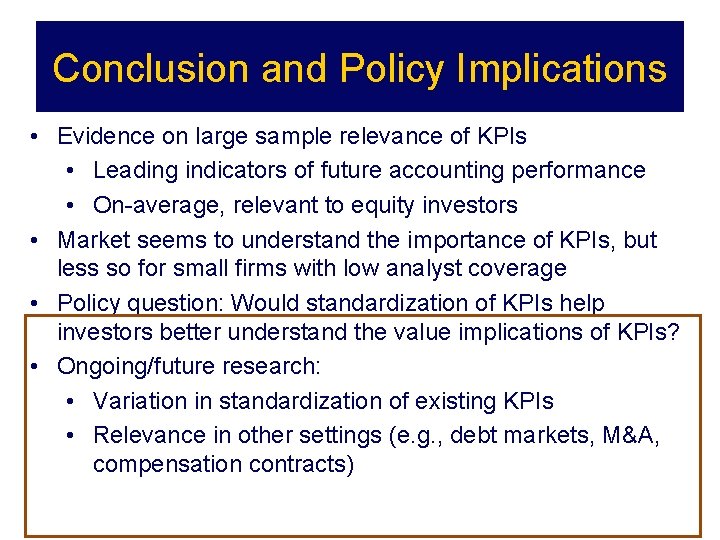
Conclusion and Policy Implications • Evidence on large sample relevance of KPIs • Leading indicators of future accounting performance • On-average, relevant to equity investors • Market seems to understand the importance of KPIs, but less so for small firms with low analyst coverage • Policy question: Would standardization of KPIs help investors better understand the value implications of KPIs? • Ongoing/future research: • Variation in standardization of existing KPIs • Relevance in other settings (e. g. , debt markets, M&A, compensation contracts)
Thank you