
The relevance of informetric studies to University research


- Slides: 31
The relevance of informetric studies to University research and visibility Dr. OB Onyancha Dept of Information Science UNISA
Questions, questions and questions? – On what basis should an institution allocate research funding to individual researchers? – How possible is it for institutions to identify research trends and the growth of knowledge in different scientific disciplines for decision making processes? – How can libraries and information services estimate the comprehensiveness of secondary periodicals? – Is it possible to identify the uses of different sources and subjects? – What about identifying most productive researchers, institutions and countries in various disciplines? – Can we be able to forecast past, present and future research or publishing trends? – How can we identify core periodicals in different disciplines? – Can we determine obsolescence of published literature? – How visible is one’s (individual and institutional) research, website, and similar activities? – What is one’s research and web impact?
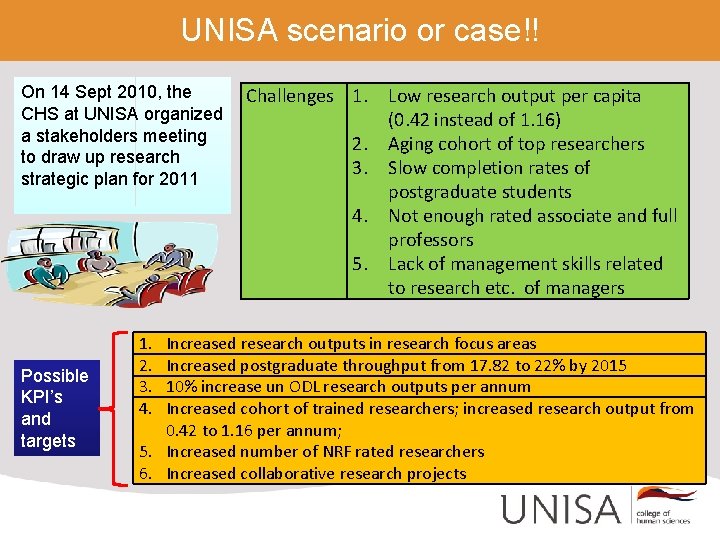
UNISA scenario or case!! On 14 Sept 2010, the CHS at UNISA organized a stakeholders meeting to draw up research strategic plan for 2011 Challenges 1. 2. 3. 4. 5. Possible KPI’s and targets 1. 2. 3. 4. Low research output per capita (0. 42 instead of 1. 16) Aging cohort of top researchers Slow completion rates of postgraduate students Not enough rated associate and full professors Lack of management skills related to research etc. of managers Increased research outputs in research focus areas Increased postgraduate throughput from 17. 82 to 22% by 2015 10% increase un ODL research outputs per annum Increased cohort of trained researchers; increased research output from 0. 42 to 1. 16 per annum; 5. Increased number of NRF rated researchers 6. Increased collaborative research projects
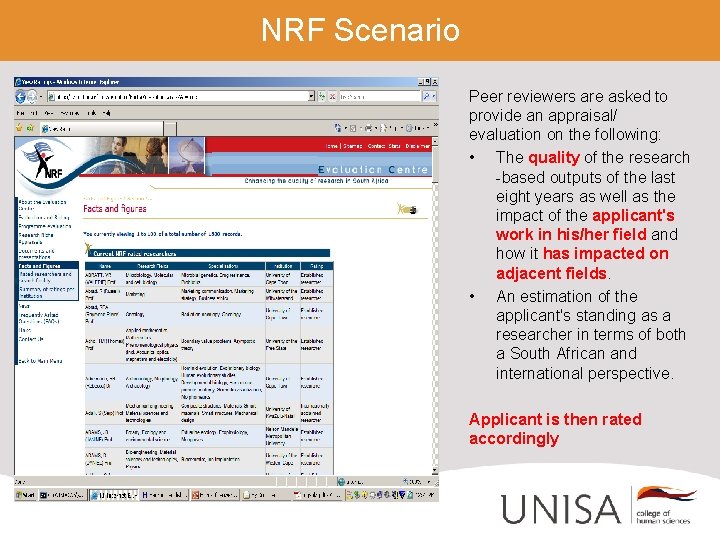
NRF Scenario Peer reviewers are asked to provide an appraisal/ evaluation on the following: • The quality of the research -based outputs of the last eight years as well as the impact of the applicant's work in his/her field and how it has impacted on adjacent fields. • An estimation of the applicant's standing as a researcher in terms of both a South African and international perspective. Applicant is then rated accordingly
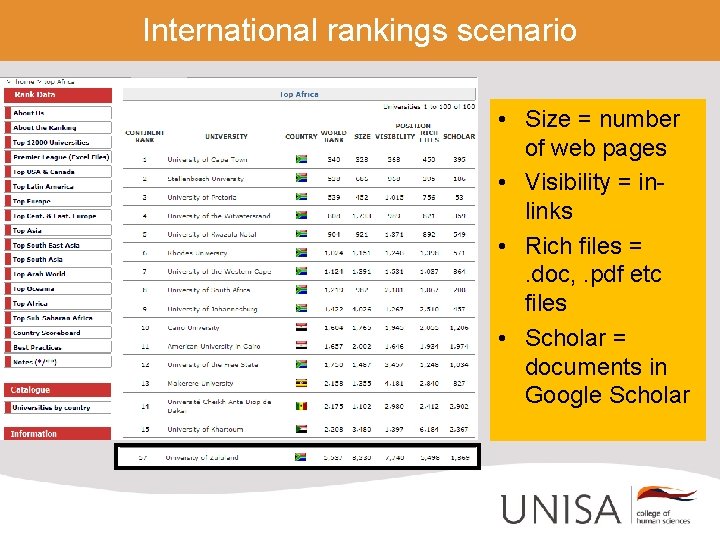
International rankings scenario • Size = number of web pages • Visibility = inlinks • Rich files =. doc, . pdf etc files • Scholar = documents in Google Scholar
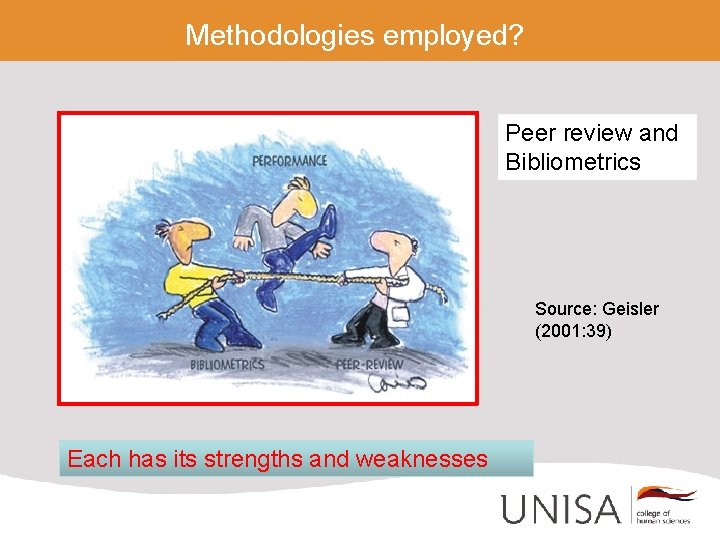
Methodologies employed? Peer review and Bibliometrics Source: Geisler (2001: 39) Each has its strengths and weaknesses
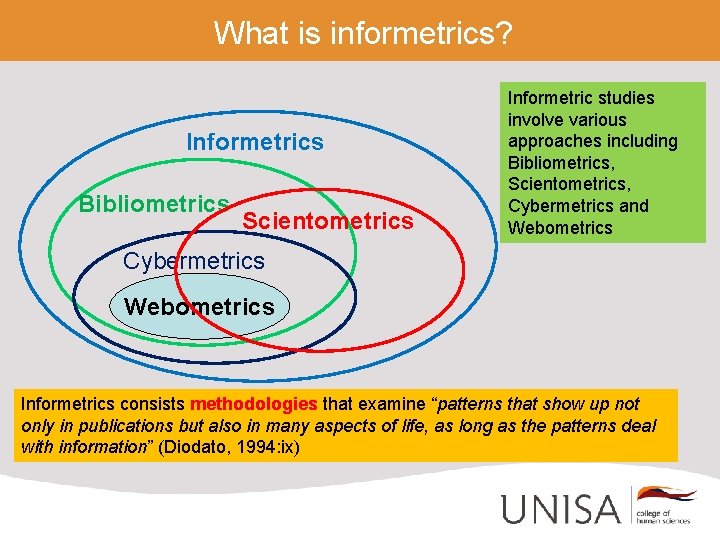
What is informetrics? Informetrics Bibliometrics Scientometrics Informetric studies involve various approaches including Bibliometrics, Scientometrics, Cybermetrics and Webometrics Cybermetrics Webometrics Informetrics consists methodologies that examine “patterns that show up not only in publications but also in many aspects of life, as long as the patterns deal with information” (Diodato, 1994: ix)
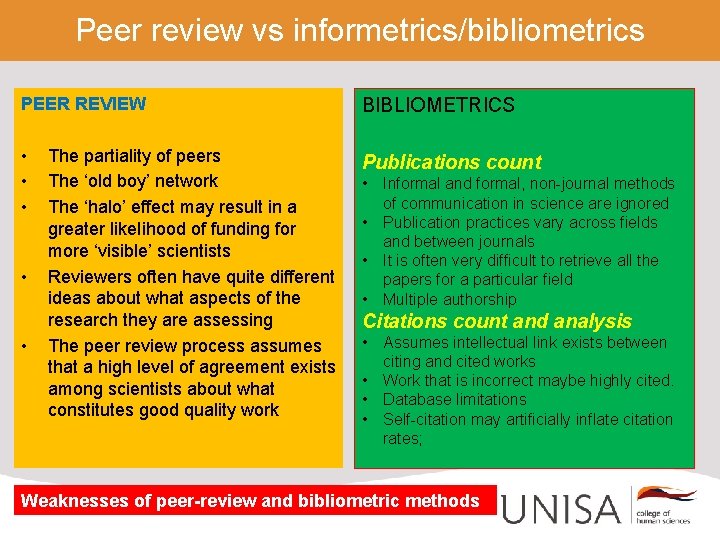
Peer review vs informetrics/bibliometrics PEER REVIEW BIBLIOMETRICS • • • Publications count • • The partiality of peers The ‘old boy’ network The ‘halo’ effect may result in a greater like. Iihood of funding for more ‘visible’ scientists Reviewers often have quite different ideas about what aspects of the research they are assessing The peer review process assumes that a high level of agreement exists among scientists about what constitutes good quality work • Informal and formal, non-journal methods of communication in science are ignored • Publication practices vary across fields and between journals • It is often very difficult to retrieve all the papers for a particular field • Multiple authorship Citations count and analysis • Assumes intellectual link exists between citing and cited works • Work that is incorrect maybe highly cited. • Database limitations • Self-citation may artificially inflate citation rates; Weaknesses of peer-review and bibliometric methods
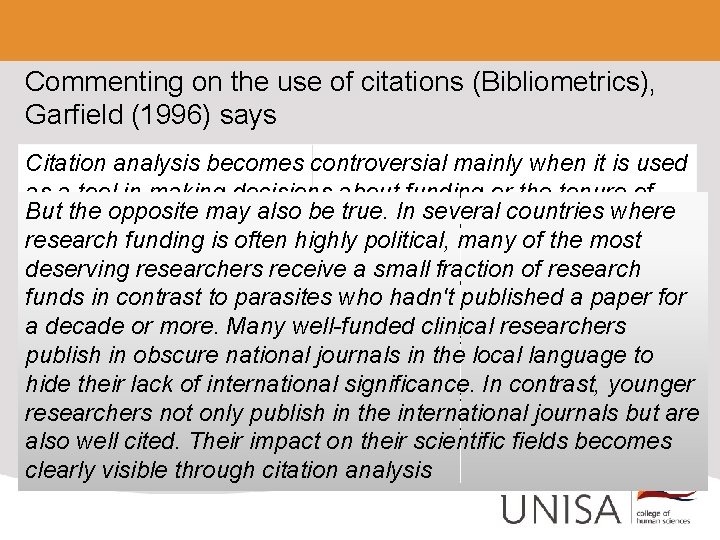
Commenting on the use of citations (Bibliometrics), Garfield (1996) says Citation analysis becomes controversial mainly when it is used as a tool in making decisions about funding or the tenure of But the opposite may also be true. In several countries individuals or groups, especially when it is perceived to where be an research funding highly political, of the most uninformed use is ofoften citation data. Many many of these unpublished deserving researchers receive a small fraction of research citation analyses, like most un-refereed work, may, in fact, funds contrast a paper involveinthe abusetoofparasites SCI datawho and hadn't rightly published evoke hostility or for a decade. After or more. Manyhighly well-funded clinical researchers unease. all, some published authors are little more publish in obscurewho national in the to local language to than bureaucrats attachjournals their names every paper they hide their lack of international significance. In contrast, citation younger can. Unless such details are known to the evaluators, researchers onlytopublish in theunjust international journals data could benot used perpetuate distribution of but are also well cited. Their impact on their scientific fields becomes resources clearly visible through citation analysis
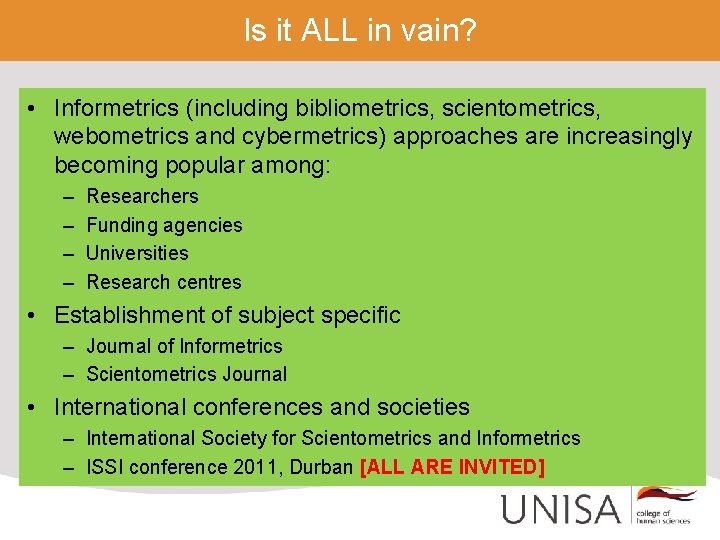
Is it ALL in vain? • Informetrics (including bibliometrics, scientometrics, webometrics and cybermetrics) approaches are increasingly becoming popular among: – – Researchers Funding agencies Universities Research centres • Establishment of subject specific – Journal of Informetrics – Scientometrics Journal • International conferences and societies – International Society for Scientometrics and Informetrics – ISSI conference 2011, Durban [ALL ARE INVITED]
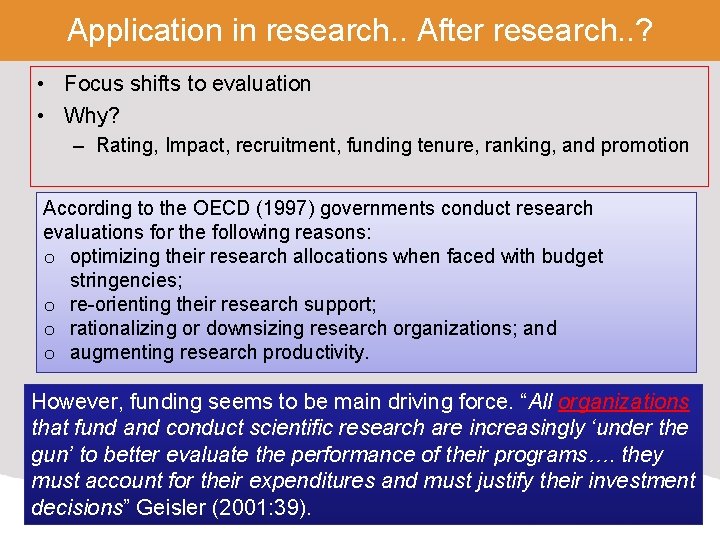
Application in research. . After research. . ? • Focus shifts to evaluation • Why? – Rating, Impact, recruitment, funding tenure, ranking, and promotion According to the OECD (1997) governments conduct research evaluations for the following reasons: o optimizing their research allocations when faced with budget stringencies; o re-orienting their research support; o rationalizing or downsizing research organizations; and o augmenting research productivity. However, funding seems to be main driving force. “All organizations that fund and conduct scientific research are increasingly ‘under the gun’ to better evaluate the performance of their programs…. they must account for their expenditures and must justify their investment decisions” Geisler (2001: 39).
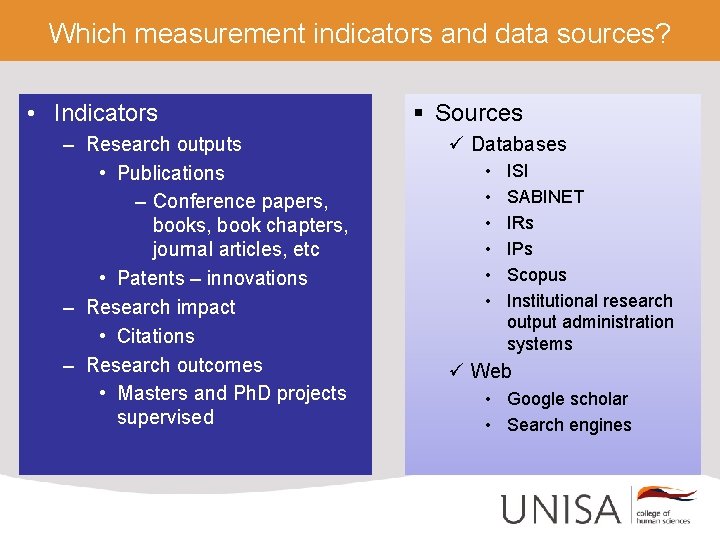
Which measurement indicators and data sources? • Indicators – Research outputs • Publications – Conference papers, book chapters, journal articles, etc • Patents – innovations – Research impact • Citations – Research outcomes • Masters and Ph. D projects supervised § Sources ü Databases • • • ISI SABINET IRs IPs Scopus Institutional research output administration systems ü Web • Google scholar • Search engines
How and what should be evaluated in institutional research and visibility? Example of informetric study specific to university research and visibility ü Mapping research areas and collaboration in the College of Human Sciences, University of South Africa Ocholla and Mostert’s study of the research trends of Arts, Humanities and Social Sciences at the University of Zululand, 1994 2008
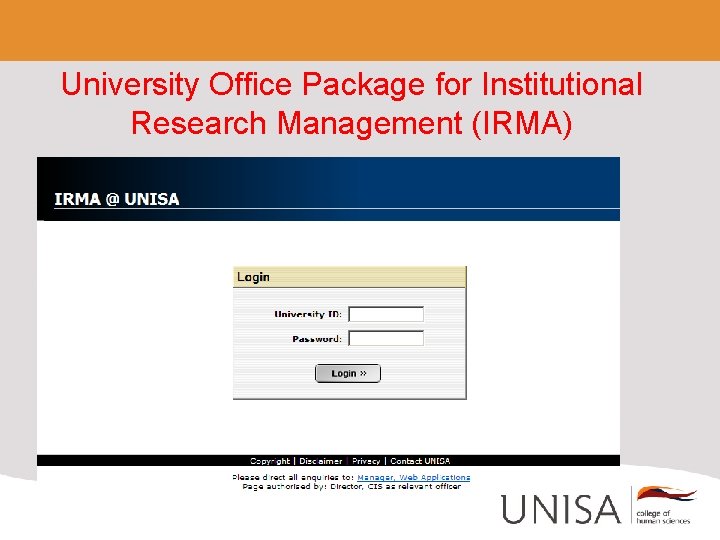
University Office Package for Institutional Research Management (IRMA)
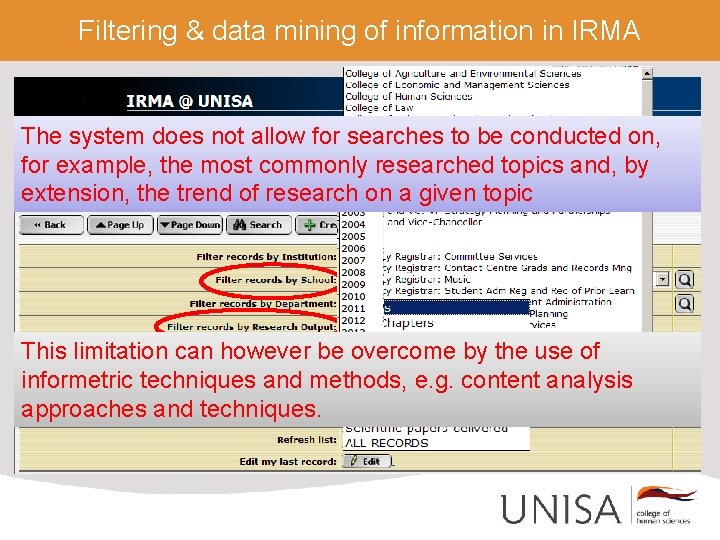
Filtering & data mining of information in IRMA The system does not allow for searches to be conducted on, for example, the most commonly researched topics and, by extension, the trend of research on a given topic This limitation can however be overcome by the use of informetric techniques and methods, e. g. content analysis approaches and techniques.
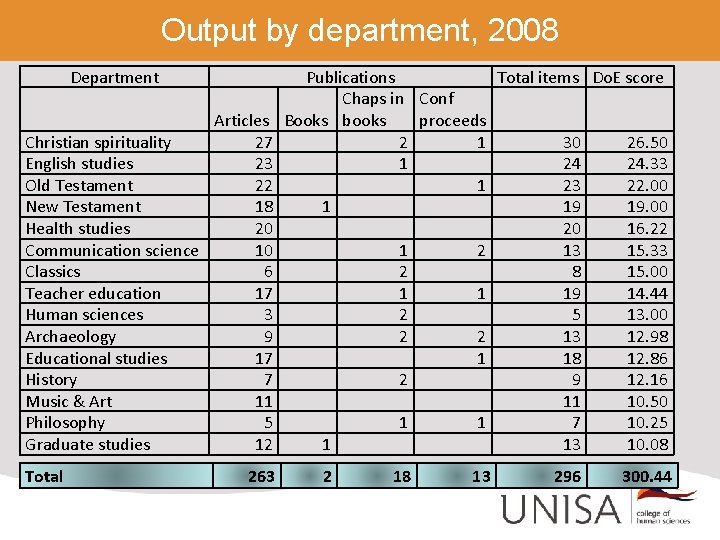
Output by department, 2008 Department Publications Total items Do. E score Chaps in Conf Articles Books books proceeds Christian spirituality 27 2 1 30 26. 50 English studies 23 1 24 24. 33 Old Testament 22 1 23 22. 00 New Testament 18 1 19 19. 00 Health studies 20 20 16. 22 Communication science 10 1 2 13 15. 33 Classics 6 2 8 15. 00 Teacher education 17 1 1 19 14. 44 Human sciences 3 2 5 13. 00 Archaeology 9 2 2 13 12. 98 Educational studies 17 1 18 12. 86 History 7 2 9 12. 16 Music & Art 11 11 10. 50 Philosophy 5 1 1 7 10. 25 Graduate studies 12 1 13 10. 08 Total 263 2 18 13 296 300. 44
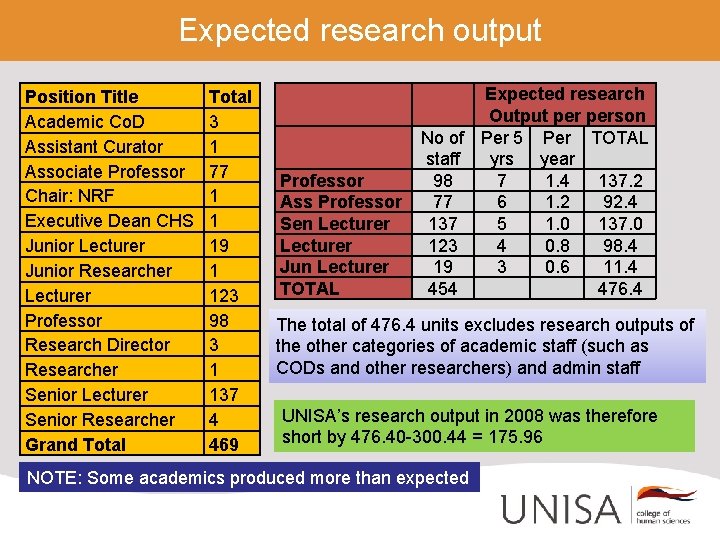
Expected research output Position Title Academic Co. D Assistant Curator Associate Professor Chair: NRF Executive Dean CHS Junior Lecturer Junior Researcher Lecturer Professor Research Director Researcher Senior Lecturer Senior Researcher Grand Total 3 1 77 1 1 19 1 123 98 3 1 137 4 469 Professor Ass Professor Sen Lecturer Jun Lecturer TOTAL Expected research Output person No of Per 5 Per TOTAL staff yrs year 98 7 1. 4 137. 2 77 6 1. 2 92. 4 137 5 1. 0 137. 0 123 4 0. 8 98. 4 19 3 0. 6 11. 4 454 476. 4 The total of 476. 4 units excludes research outputs of the other categories of academic staff (such as CODs and other researchers) and admin staff UNISA’s research output in 2008 was therefore short by 476. 40 -300. 44 = 175. 96 NOTE: Some academics produced more than expected
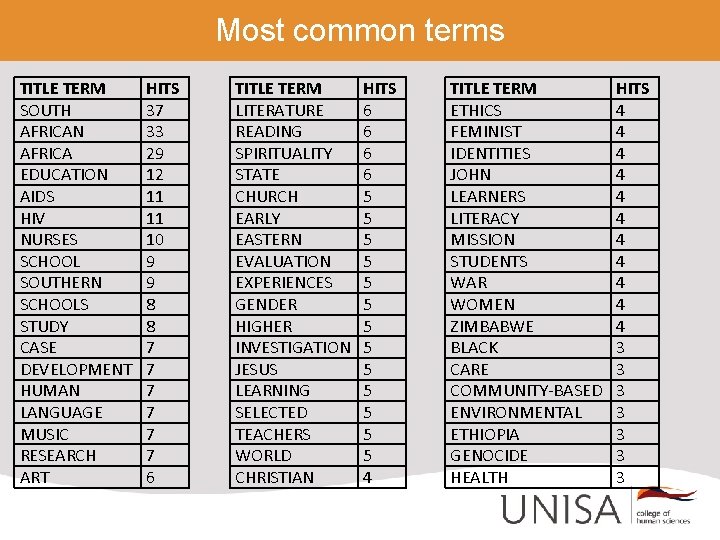
Most common terms TITLE TERM SOUTH AFRICAN AFRICA EDUCATION AIDS HIV NURSES SCHOOL SOUTHERN SCHOOLS STUDY CASE DEVELOPMENT HUMAN LANGUAGE MUSIC RESEARCH ART HITS 37 33 29 12 11 11 10 9 9 8 8 7 7 7 6 TITLE TERM LITERATURE READING SPIRITUALITY STATE CHURCH EARLY EASTERN EVALUATION EXPERIENCES GENDER HIGHER INVESTIGATION JESUS LEARNING SELECTED TEACHERS WORLD CHRISTIAN HITS 6 6 5 5 5 5 4 TITLE TERM ETHICS FEMINIST IDENTITIES JOHN LEARNERS LITERACY MISSION STUDENTS WAR WOMEN ZIMBABWE BLACK CARE COMMUNITY-BASED ENVIRONMENTAL ETHIOPIA GENOCIDE HEALTH HITS 4 4 4 3 3 3 3
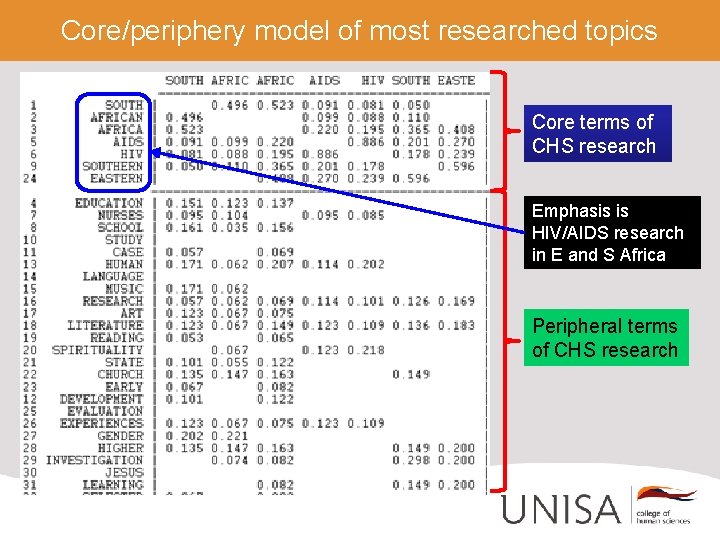
Core/periphery model of most researched topics Core terms of CHS research Emphasis is HIV/AIDS research in E and S Africa Peripheral terms of CHS research
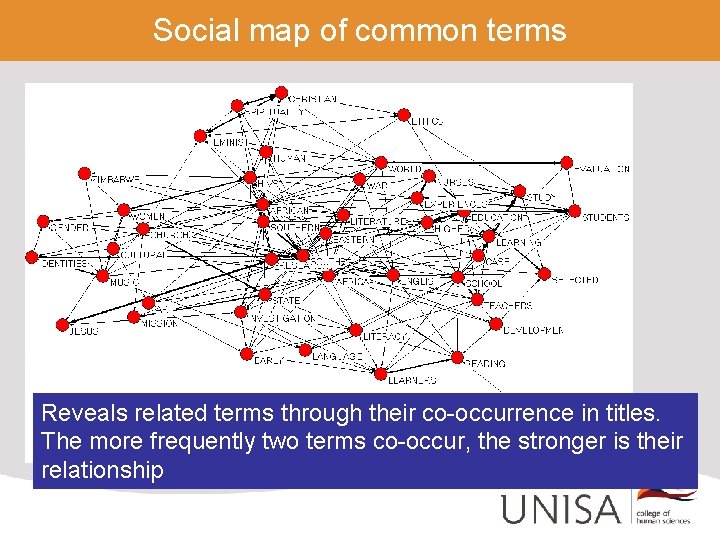
Social map of common terms Reveals related terms through their co-occurrence in titles. The more frequently two terms co-occur, the stronger is their relationship
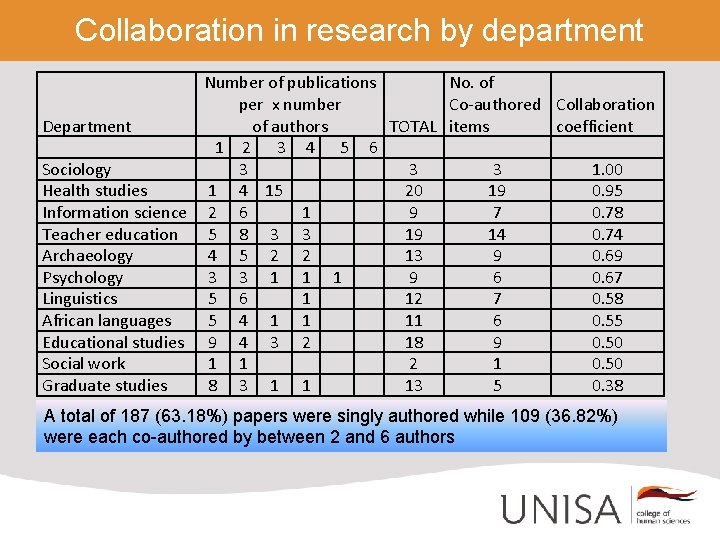
Collaboration in research by department Number of publications No. of per x number Co-authored Collaboration Department of authors TOTAL items coefficient 1 2 3 4 5 6 Sociology 3 3 3 1. 00 Health studies 1 4 15 20 19 0. 95 Information science 2 6 1 9 7 0. 78 Teacher education 5 8 3 3 19 14 0. 74 Archaeology 4 5 2 2 13 9 0. 69 Psychology 3 3 1 1 1 9 6 0. 67 Linguistics 5 6 1 12 7 0. 58 African languages 5 4 1 1 11 6 0. 55 Educational studies 9 4 3 2 18 9 0. 50 Social work 1 1 2 1 0. 50 Graduate studies 8 3 1 1 13 5 0. 38 A total of 187 (63. 18%) papers were singly authored while 109 (36. 82%) were each co-authored by between 2 and 6 authors
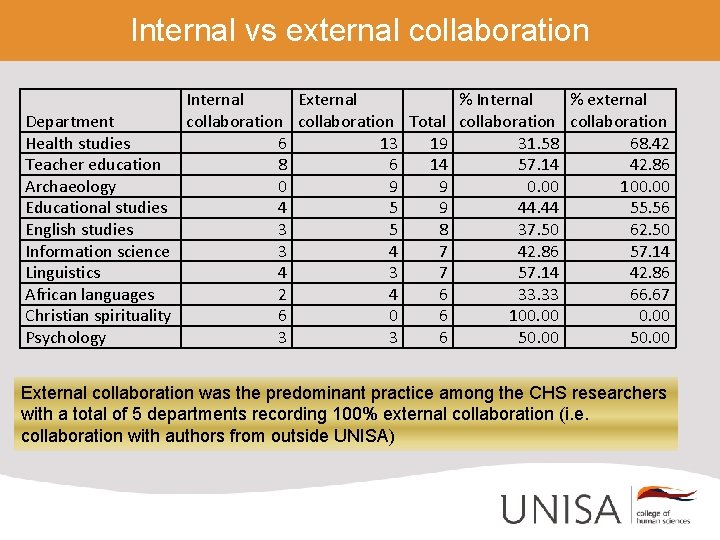
Internal vs external collaboration Internal External % Internal % external Department collaboration Total collaboration Health studies 6 13 19 31. 58 68. 42 Teacher education 8 6 14 57. 14 42. 86 Archaeology 0 9 9 0. 00 100. 00 Educational studies 4 5 9 44. 44 55. 56 English studies 3 5 8 37. 50 62. 50 Information science 3 4 7 42. 86 57. 14 Linguistics 4 3 7 57. 14 42. 86 African languages 2 4 6 33. 33 66. 67 Christian spirituality 6 0 6 100. 00 Psychology 3 3 6 50. 00 External collaboration was the predominant practice among the CHS researchers with a total of 5 departments recording 100% external collaboration (i. e. collaboration with authors from outside UNISA)
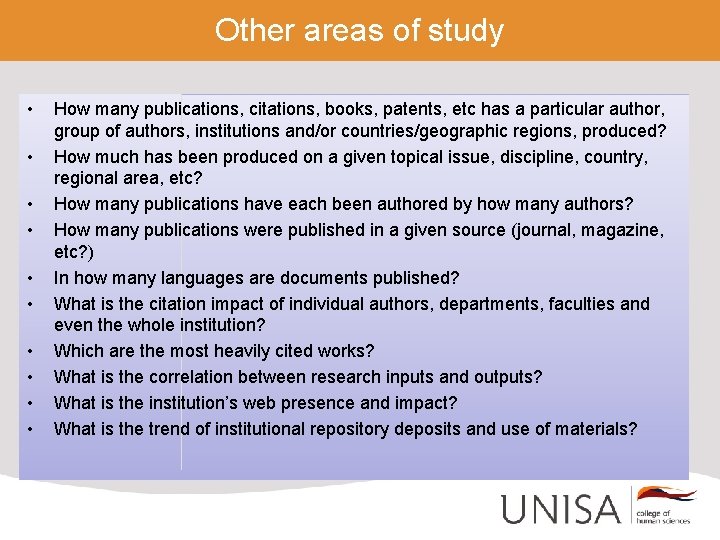
Other areas of study • • • How many publications, citations, books, patents, etc has a particular author, group of authors, institutions and/or countries/geographic regions, produced? How much has been produced on a given topical issue, discipline, country, regional area, etc? How many publications have each been authored by how many authors? How many publications were published in a given source (journal, magazine, etc? ) In how many languages are documents published? What is the citation impact of individual authors, departments, faculties and even the whole institution? Which are the most heavily cited works? What is the correlation between research inputs and outputs? What is the institution’s web presence and impact? What is the trend of institutional repository deposits and use of materials?
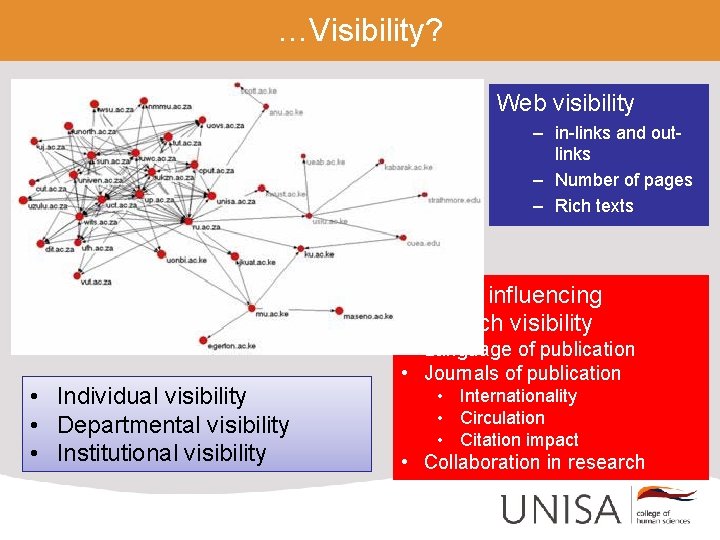
…Visibility? Web visibility – in-links and outlinks – Number of pages – Rich texts Factors influencing Research visibility • Individual visibility • Departmental visibility • Institutional visibility • Language of publication • Journals of publication • Internationality • Circulation • Citation impact • Collaboration in research
Research Output/impact Web presence
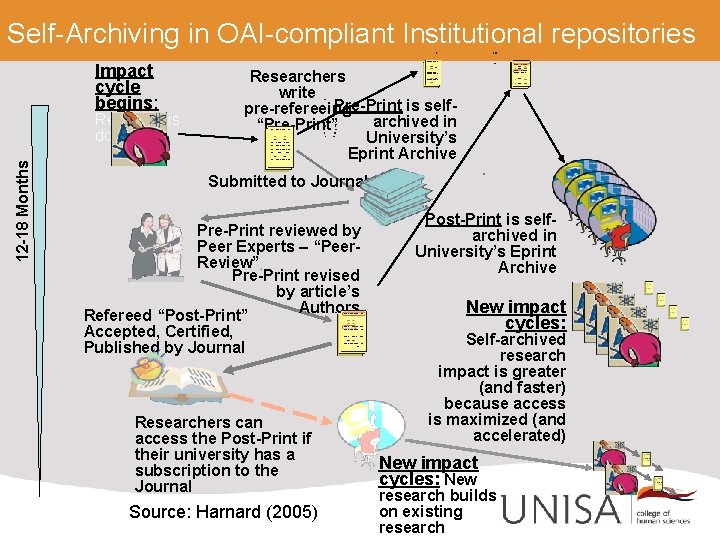
Self-Archiving in OAI-compliant Institutional repositories Impact cycle begins: 12 -18 Months Research is done Researchers write Pre-Print is selfpre-refereeing archived in “Pre-Print” University’s Eprint Archive Submitted to Journal Pre-Print reviewed by Peer Experts – “Peer. Review” Pre-Print revised by article’s Authors Refereed “Post-Print” Accepted, Certified, Published by Journal Researchers can access the Post-Print if their university has a subscription to the Journal Source: Harnard (2005) Post-Print is selfarchived in University’s Eprint Archive New impact cycles: Self-archived research impact is greater (and faster) because access is maximized (and accelerated) New impact cycles: New research builds on existing research
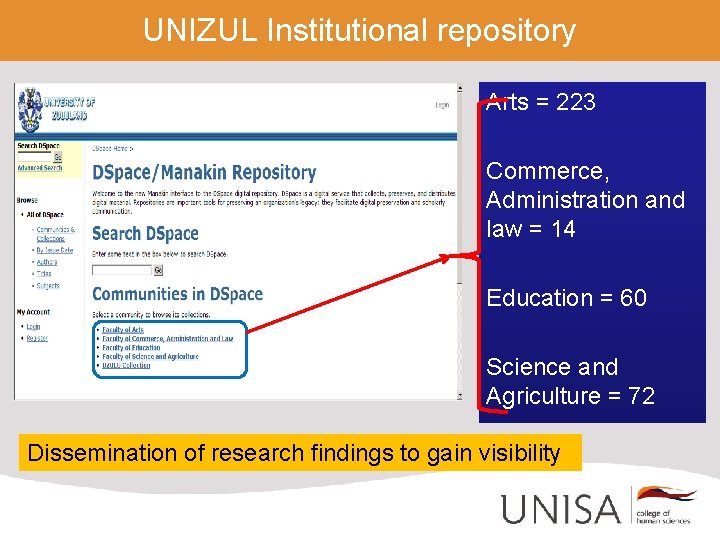
UNIZUL Institutional repository Arts = 223 Commerce, Administration and law = 14 Education = 60 Science and Agriculture = 72 Dissemination of research findings to gain visibility
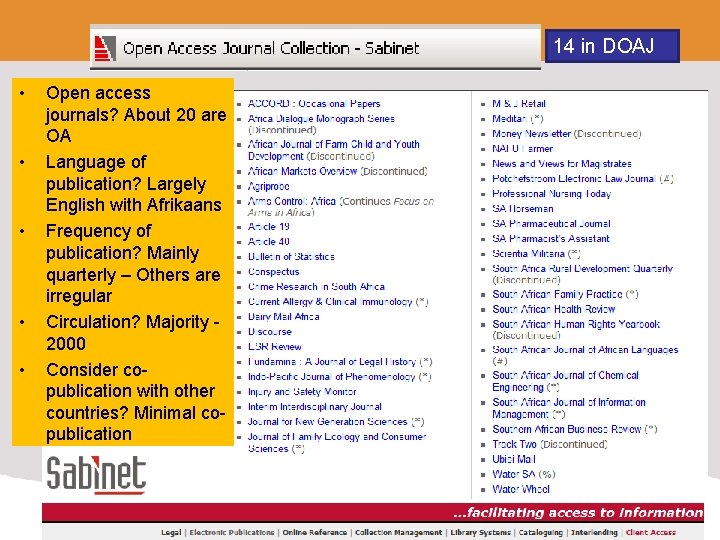
14 in DOAJ • • • Open access journals? About 20 are OA Language of publication? Largely English with Afrikaans Frequency of publication? Mainly quarterly – Others are irregular Circulation? Majority 2000 Consider copublication with other countries? Minimal copublication
Other issues to consider – Ratio of research in natural sciences to social sciences, on one hand, and to Arts and humanities, on the other, in SA is 1: 9. 20 and 1: 28. 01 respectively. For growth of Social Sciences and Arts and Humanities research output to be realized • • Encourage multidisciplinary research? Research within the focus/niche areas – expansion of areas Research within the Millennium Development Goals More funding, Perhaps! – Visibility (influence/impact) • Collaboration with international scholars • Presentation and/or publication of research findings both nationally and internationally • Application for NRF rating – Researcher visibility? • Web presence is required – Converting theses and dissertations into research articles “The incumbent will draft scientific articles based on data published in dissertations and theses of postgraduate students and data collected by academic staff during research for non-degree purposes” (Sunday Times, Business Times section, 10 August 2008: 6)
Conclusion Informetric approaches should be seen as complementary to other scientifically proven methods of research evaluation/assessment such as peer review and not a substitution – Mixed Methods Research comes in. AND The findings generated by informetric studies should be viewed as essential but not as the only pointers of research activities and impact and visibility of individuals, institutions and even countries
Thanks Contact details Dr. OB Onyancha University of South Africa College of Human Sciences Dept of Information Science Box 392 UNISA 003 onyanob@unisa. ac. za