
THE RELATIONSHIP BETWEEN WORKING MEMORY AND THE ACQUISITION
THE RELATIONSHIP BETWEEN WORKING MEMORY AND THE ACQUISITION OF VARIABLE SUBJECT EXPRESSION BY SECOND LANGUAGE LEARNERS OF SPANISH Sara Zahler Second Language Research Forum 2018 October 27 th, 2018

INTRODUCTION

■ Second language learners vary immensely in their second language abilities ■ Individual characteristics of the second language learner affect the course of second language development – Age – Sex – Motivation – Anxiety – Personality – Language contact – Language aptitude See Dornyei & Skehan ■ Cognitive abilities (2008) and Zafar & Meenakshi (2012) for overviews
Why cognitive individual differences? ■ Memory abilities ■ Thought to provide a larger “window on language evidence” (Ellis & Schmidt, 1997: 159) – Longer more detailed representations in shortterm memory ■ Better perception of second language input ■ Allows faster establishment of relationships/associative rules between language elements in the second language – Casa blanca ‘white house’
Working memory (WM) ■ Limited capacity attentional resource – Temporarily stores and manipulates information available for processing during complex tasks – Information is subject to decay over time – Inverse relationship between storage and processing ■ Thought to allow for better processing of multiple features in language input – Allows for the faster learning of associative rules from chunked and stored language sequences – Grammar abilities (e. g. Baddeley, 2000; Baddeley, 2007; Baddeley & Hitch, 1974; Miller, 1956)
WM and L 2 abilities ■ Documented correlations between WM and… – Grammatical associations in artificial languages – Reading comprehension – Sensitivity to grammatical cues/errors – Grammatical accuracy – General second language proficiency (e. g. Ando et al. , 1992; Harrington & Sawyer, 1992; Keating, 2010; Martin & Ellis, 2012; Miyake & Friedman, 1998; Robinson, 2002; Sagarra & Herschensohn, 2011; Sunderman & Kroll, 2009)
WM and L 2 abilities ■ Previous research has focused primarily on learner accuracy in non-variable structures – E. g. la casa blanca ‘the white house’ ■ What about development of variable structures? – E. g. él habla v. Ø habla ‘he speaks’ ■ Subject expression in Spanish
Native speaker sociolinguistic variation ■ Variable structure – Subject expression in Spanish ■ Martín/el médico cree que… ‘Martin/the doctor believes that…’ ■ Él cree que… ‘He believes that…. ’ ■ Ø cree que… ‘(He) believes that…’ ■ Constraints on variation ■ Social/stylistic – Sex, age, degree of language contact, formality etc. ■ Linguistic – Switch reference ■ Yo creo que él es buen médico. ‘I believe that he is a good doctor. ’ ■ Yo creo que Ø soy buen médico. ‘I believe that I am a good doctor. ’
Variation in second languages ■ Learners display variation between native forms as well ■ As proficiency increases, learners approach native speakers’ patterns of use – Rates – Factors (e. g. switch reference) ■ However, even the most advanced learners’ patterns of variation do frequently differ from native speakers – Individual differences (e. g. Dorado, 2011; Geeslin et al. , 2012; Geeslin, Linford & Fafulas, 2015; Gudmestad & Geeslin, 2010, 2011; Linford, 2016; Solon & Kanwit, 2014; Woolsey, 2008)
Research Question ■ Do second language Spanish learners with differing WM abilities display differing patterns of subject expression? – High WM learners will demonstrate patterns of subject expression variation that more closely approximate those of natives ■ Due to better processing of multiple features of the input ■ Faster learning of associations between elements in the discourse and their influence on the presence or absence of subject forms in Spanish

METHOD
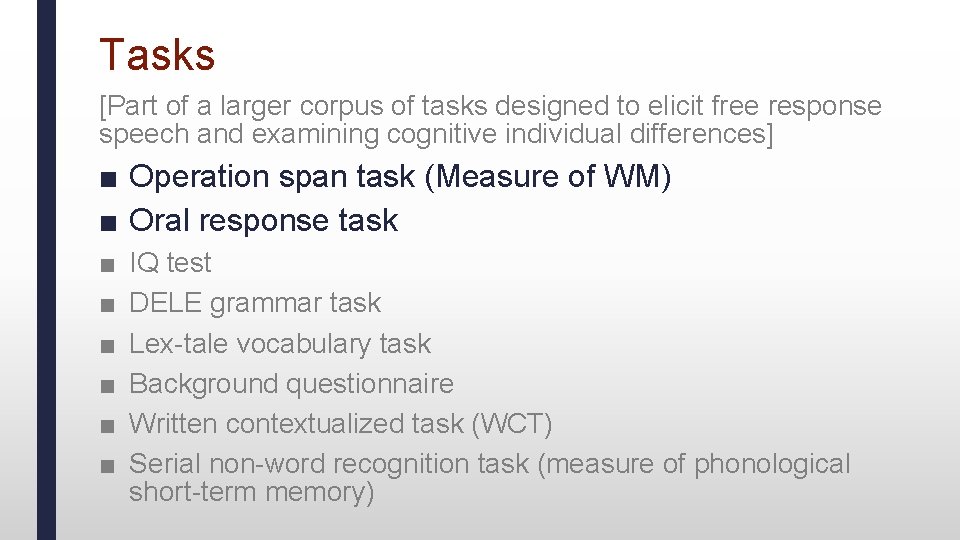
Tasks [Part of a larger corpus of tasks designed to elicit free response speech and examining cognitive individual differences] ■ Operation span task (Measure of WM) ■ Oral response task ■ ■ ■ IQ test DELE grammar task Lex-tale vocabulary task Background questionnaire Written contextualized task (WCT) Serial non-word recognition task (measure of phonological short-term memory)

Operation span task ■ Operation span task from the Psychology Experiment Building Language (PEBL) (Meuller & Piper, 2014) – Perform simple math operations while memorizing letters for later recall Working memory Weighted IQ DELE proficiency Vocabulary proficiency Age Working memory 1 Weighted IQ. 224 Grammar proficiency. 004 Vocabulary proficiency. 048 Age -. 075 . 224. 004 1. 145 -. 109 1 -. 121. 675** -. 190. 529** . 048 . 255* . 675** 1 . 719** -. 075 -. 180 . 529** . 719** 1
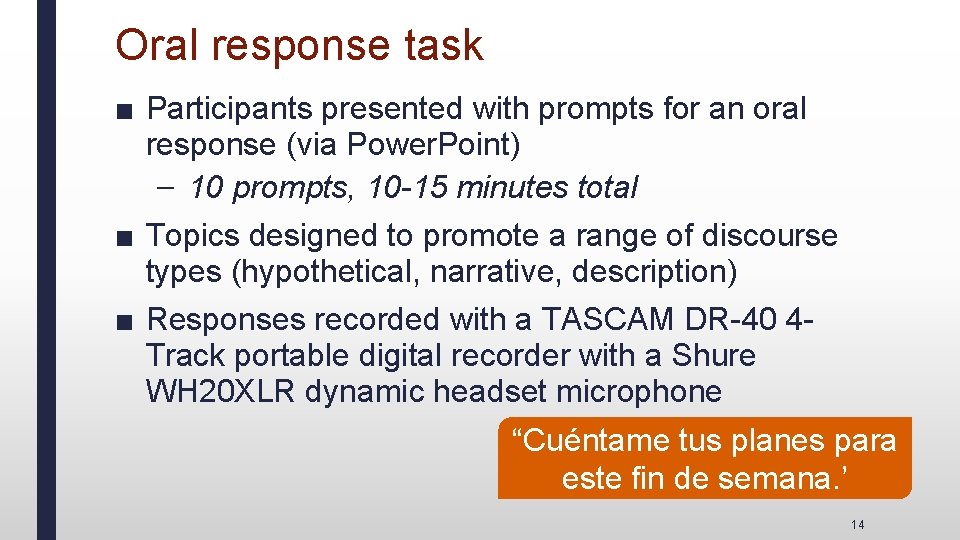
Oral response task ■ Participants presented with prompts for an oral response (via Power. Point) – 10 prompts, 10 -15 minutes total ■ Topics designed to promote a range of discourse types (hypothetical, narrative, description) ■ Responses recorded with a TASCAM DR-40 4 Track portable digital recorder with a Shure WH 20 XLR dynamic headset microphone “Cuéntame tus planes para este fin de semana. ’ 14
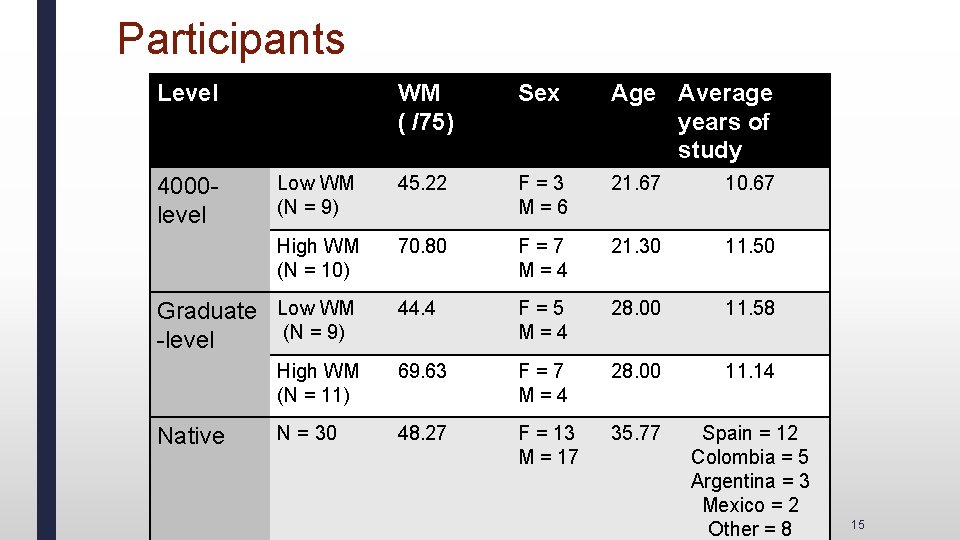
Participants Level 4000 level WM ( /75) Sex Age Average years of study Low WM (N = 9) 45. 22 F=3 M=6 21. 67 10. 67 High WM (N = 10) 70. 80 F=7 M=4 21. 30 11. 50 44. 4 F=5 M=4 28. 00 11. 58 High WM (N = 11) 69. 63 F=7 M=4 28. 00 11. 14 N = 30 48. 27 F = 13 M = 17 35. 77 Spain = 12 Colombia = 5 Argentina = 3 Mexico = 2 Other = 8 Graduate Low WM (N = 9) -level Native 15
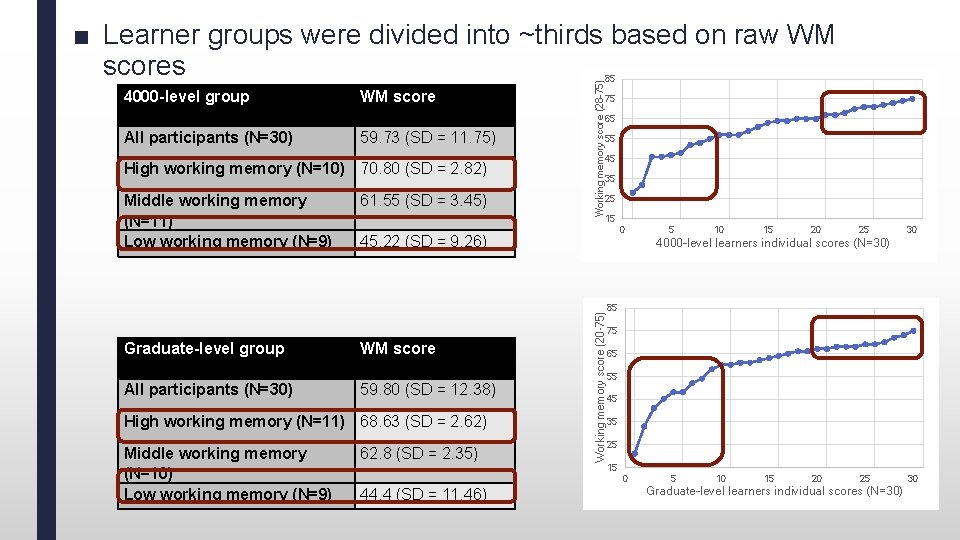
All participants (N=30) WM score 59. 73 (SD = 11. 75) High working memory (N=10) 70. 80 (SD = 2. 82) Middle working memory (N=11) Low working memory (N=9) Graduate-level group All participants (N=30) 61. 55 (SD = 3. 45) 75 65 55 45 35 25 15 0 45. 22 (SD = 9. 26) WM score 59. 80 (SD = 12. 38) High working memory (N=11) 68. 63 (SD = 2. 62) Middle working memory (N=10) Low working memory (N=9) 85 62. 8 (SD = 2. 35) 10 15 20 25 30 85 75 65 55 45 35 25 15 0 44. 4 (SD = 11. 46) 5 4000 -level learners individual scores (N=30) Working memory score (20 -75) 4000 -level group Working memory score (28 -75) ■ Learner groups were divided into ~thirds based on raw WM scores 5 10 15 20 25 Graduate-level learners individual scores (N=30) 30
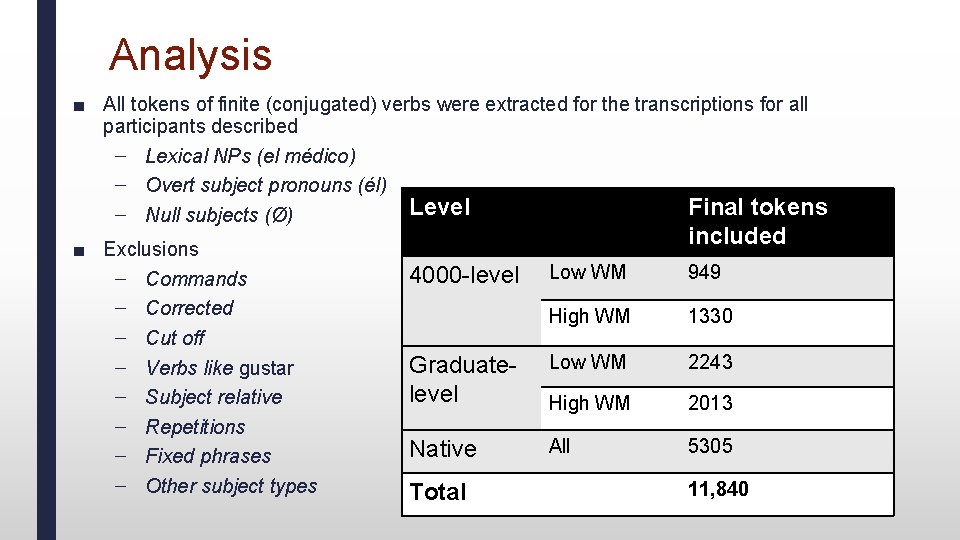
Analysis ■ All tokens of finite (conjugated) verbs were extracted for the transcriptions for all participants described – Lexical NPs (el médico) – Overt subject pronouns (él) Level Final tokens – Null subjects (Ø) ■ Exclusions – Commands – Corrected – Cut off – Verbs like gustar – Subject relative – Repetitions – Fixed phrases – Other subject types included Low WM 949 High WM 1330 Graduatelevel Low WM 2243 High WM 2013 Native All 5305 4000 -level Total 11, 840
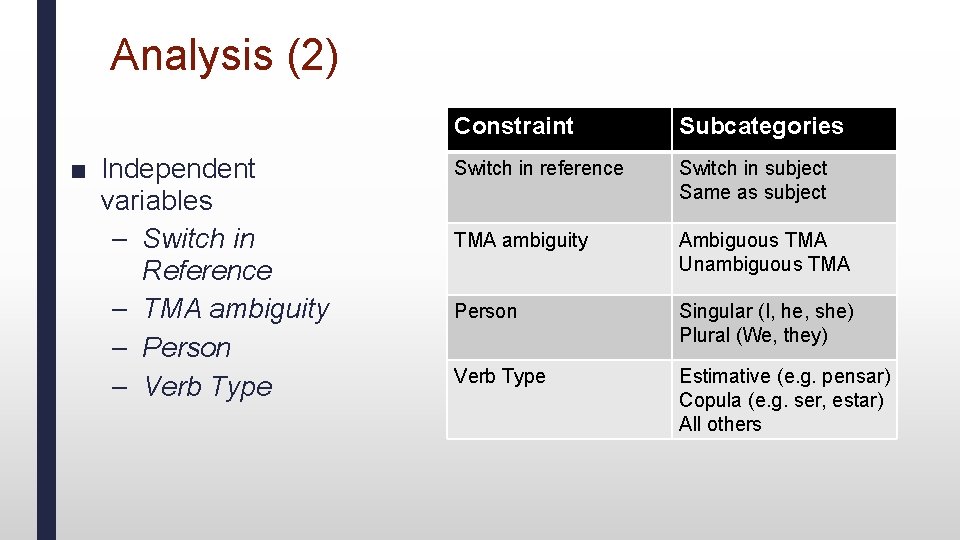
Analysis (2) ■ Independent variables – Switch in Reference – TMA ambiguity – Person – Verb Type Constraint Subcategories Switch in reference Switch in subject Same as subject TMA ambiguity Ambiguous TMA Unambiguous TMA Person Singular (I, he, she) Plural (We, they) Verb Type Estimative (e. g. pensar) Copula (e. g. ser, estar) All others

RESULTS
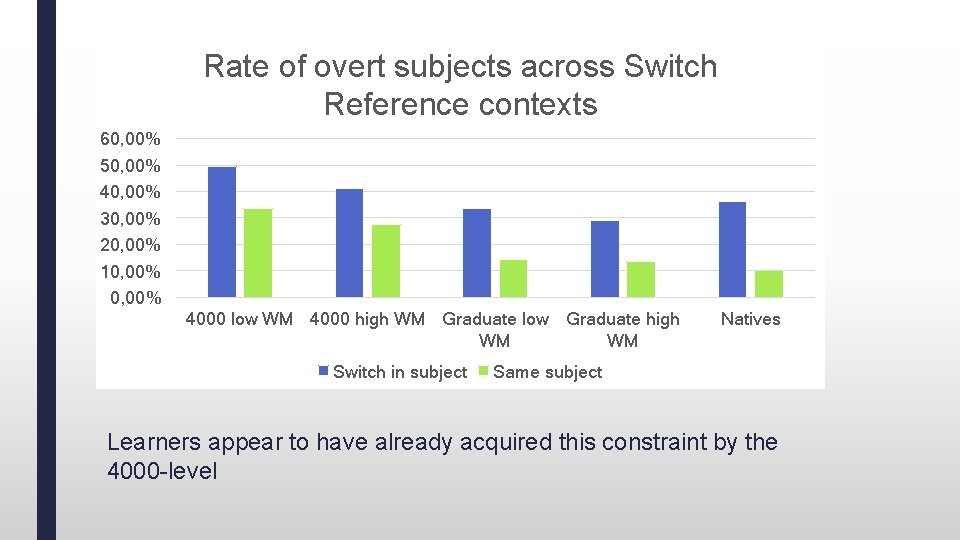
Rate of overt subjects across Switch Reference contexts 60, 00% 50, 00% 40, 00% 30, 00% 20, 00% 10, 00% 4000 low WM 4000 high WM Graduate low Graduate high WM WM Switch in subject Natives Same subject Learners appear to have already acquired this constraint by the 4000 -level
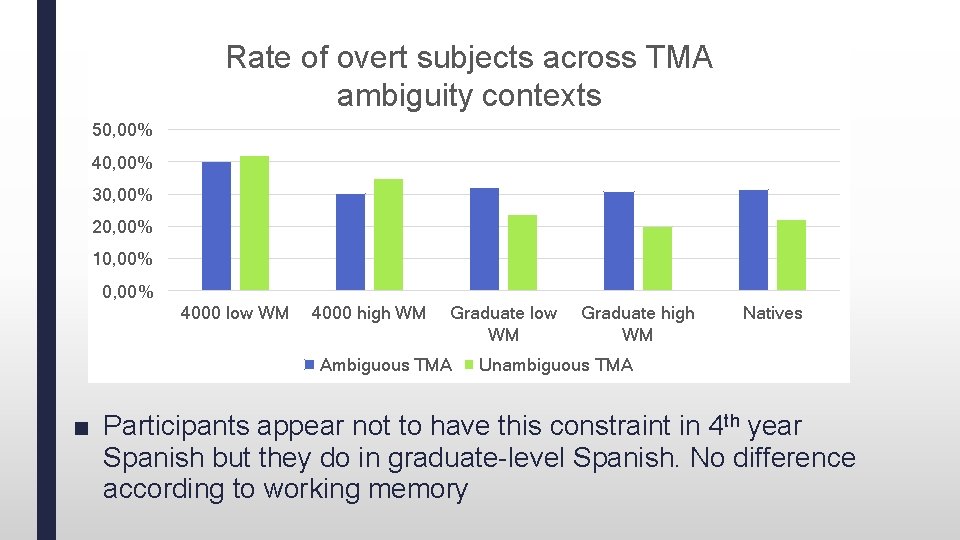
Rate of overt subjects across TMA ambiguity contexts 50, 00% 40, 00% 30, 00% 20, 00% 10, 00% 4000 low WM 4000 high WM Graduate low WM Ambiguous TMA Graduate high WM Natives Unambiguous TMA ■ Participants appear not to have this constraint in 4 th year Spanish but they do in graduate-level Spanish. No difference according to working memory
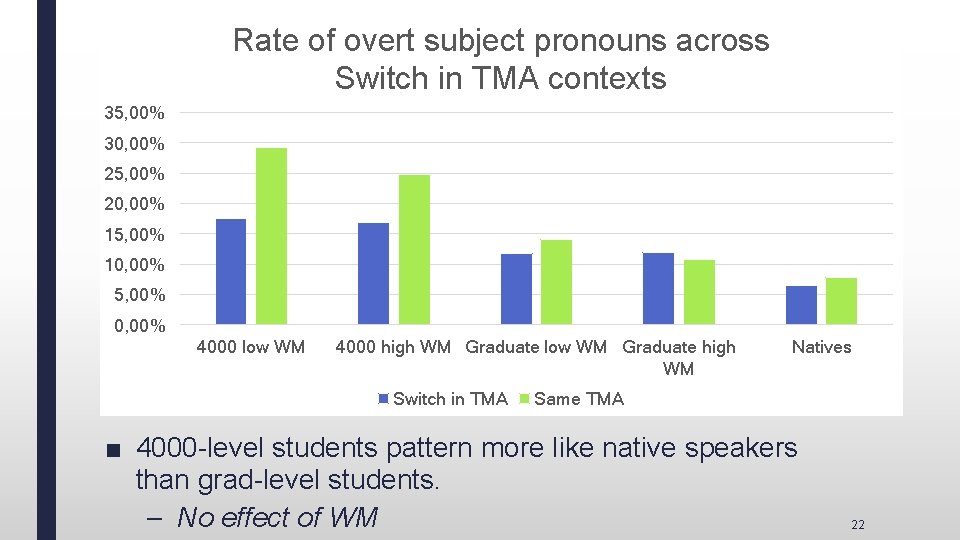
Rate of overt subject pronouns across Switch in TMA contexts 35, 00% 30, 00% 25, 00% 20, 00% 15, 00% 10, 00% 5, 00% 0, 00% 4000 low WM 4000 high WM Graduate low WM Graduate high WM Switch in TMA Natives Same TMA ■ 4000 -level students pattern more like native speakers than grad-level students. – No effect of WM 22
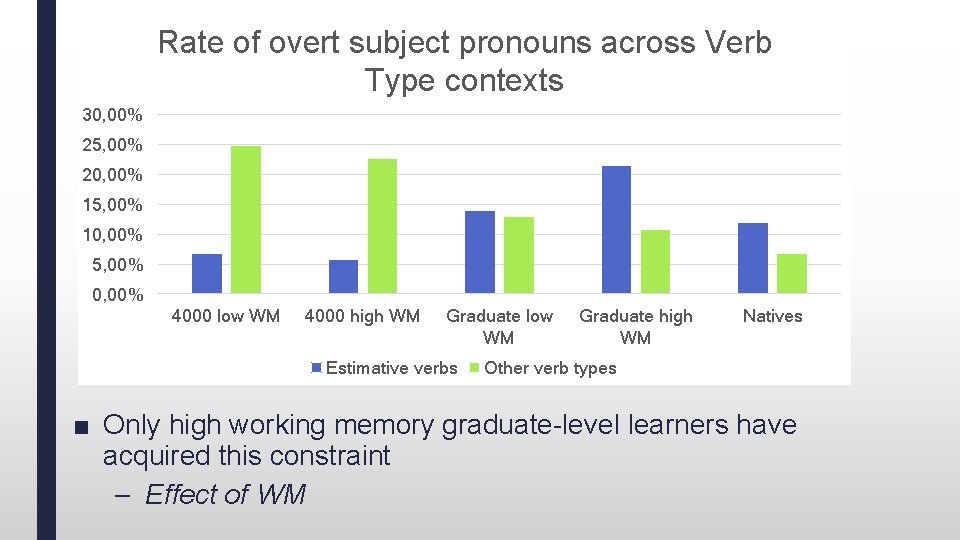
Rate of overt subject pronouns across Verb Type contexts 30, 00% 25, 00% 20, 00% 15, 00% 10, 00% 5, 00% 0, 00% 4000 low WM 4000 high WM Graduate low WM Estimative verbs Graduate high WM Natives Other verb types ■ Only high working memory graduate-level learners have acquired this constraint – Effect of WM
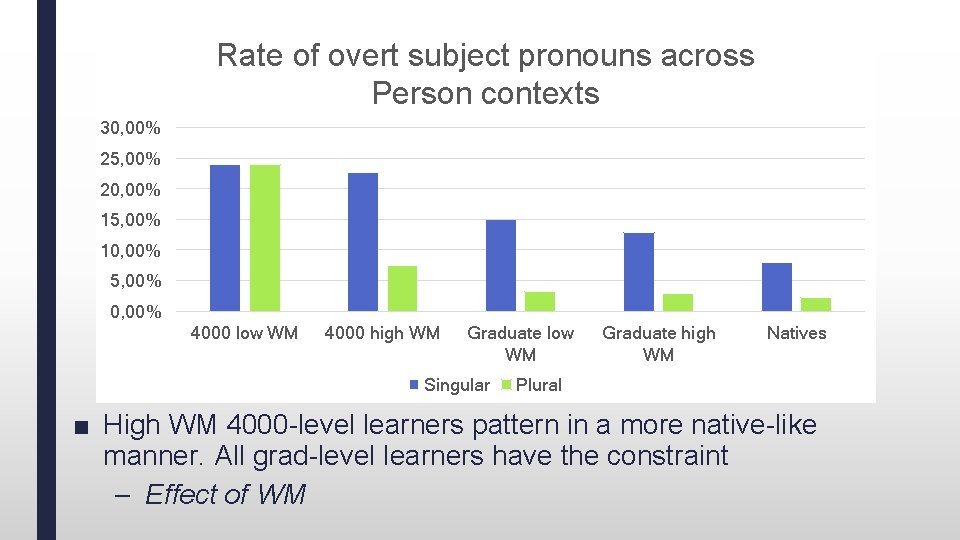
Rate of overt subject pronouns across Person contexts 30, 00% 25, 00% 20, 00% 15, 00% 10, 00% 5, 00% 0, 00% 4000 low WM 4000 high WM Graduate low WM Singular Graduate high WM Natives Plural ■ High WM 4000 -level learners pattern in a more native-like manner. All grad-level learners have the constraint – Effect of WM
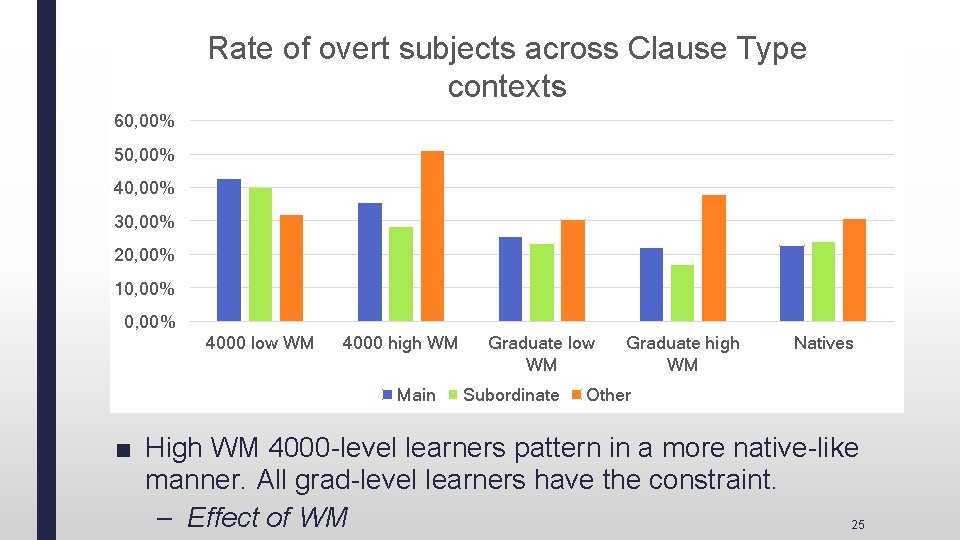
Rate of overt subjects across Clause Type contexts 60, 00% 50, 00% 40, 00% 30, 00% 20, 00% 10, 00% 4000 low WM 4000 high WM Main Graduate low WM Subordinate Graduate high WM Natives Other ■ High WM 4000 -level learners pattern in a more native-like manner. All grad-level learners have the constraint. – Effect of WM 25

DISCUSSION
Research questions revisited ■ Do second language Spanish learners with differing WM abilities display differing patterns of subject expression? – High WM learners will demonstrate patterns of subject expression variation that more closely approximate those of natives ■ Verb type ■ Person – For some constraints, advanced learners are already native -like ■ Switch reference – For some constraints, proficiency plays a larger role ■ TMA ambiguity
Connection with previous research ■ WM – WM is influential in the development of second language abilities of variable structures ■ Second language variation – Some individual differences in patterns of variation may be due to differences in WM – Seems to be factor/constraint specific ■ Depends on proficiency level and WM – May explain why individual differences persist at even very advanced levels

SUMMARY
Overview ■ My research contributes to the growing body of studies that indicate that cognitive individual differences in memory abilities underlie various aspects of foreign language aptitude – WM better pattern/rule deduction ■ Second language grammar abilities, associative rule learning, variable structures – Other cognitive individual differences ■ Phonological memory better second language perception and pronunciation
Future steps ■ Continue studying the role of WM in the development of variable grammatical structures – More constraints on subject expression (already collected and coded) – Future time reference (collected) – Subjunctive (collected) ■ Phonological memory – Vowel duration and quality (Zahler & Lord, 2018)

Thank you! ■ szahler@albany. edu ■ Any questions?
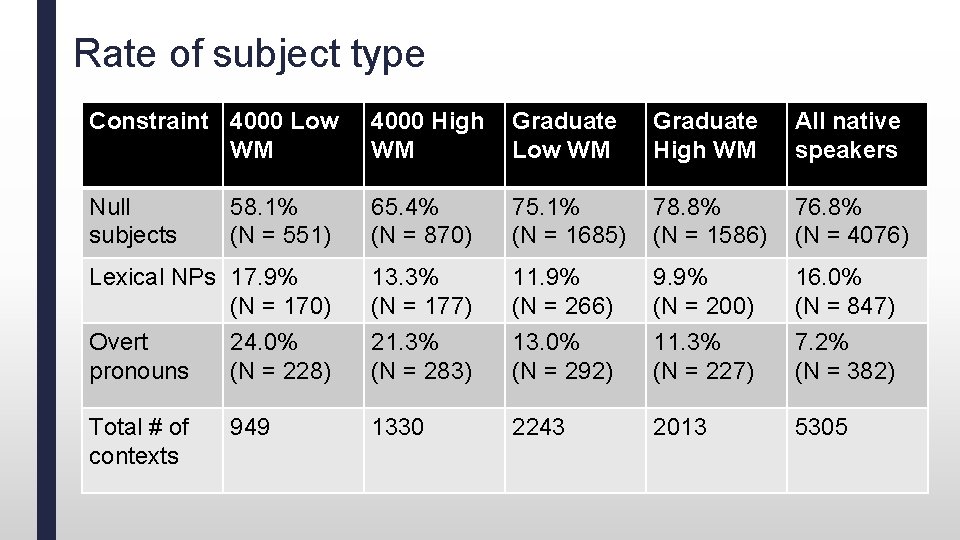
Rate of subject type Constraint 4000 Low WM 4000 High WM Graduate Low WM Graduate High WM All native speakers Null subjects 58. 1% (N = 551) 65. 4% (N = 870) 75. 1% (N = 1685) 78. 8% (N = 1586) 76. 8% (N = 4076) Lexical NPs 17. 9% (N = 170) 13. 3% (N = 177) 11. 9% (N = 266) 9. 9% (N = 200) 16. 0% (N = 847) Overt pronouns 24. 0% (N = 228) 21. 3% (N = 283) 13. 0% (N = 292) 11. 3% (N = 227) 7. 2% (N = 382) Total # of contexts 949 1330 2243 2013 5305
- Slides: 33