
The Relationship Between the Doctor and the Patient
The Relationship Between the Doctor and the Patient Partner like cooperation Rational as well as emotional influence
• “ …a person becomes a personality at the very moment when he understands himself, can evaluate himself and is able correctly to find his place among others. Only a person who can be his own man can also make a contribution to other people. Thus I think that the relationship of one human being to another is the greatest life value which must be daily fought for. ” • J. Peskova, philosopher
• “ Every education is a kind of inward journey” • Vaclav Havel • “…profoundly human attitude to the other person forms the basis of communication between doctor and the patient …. ” • J. Beran, MD
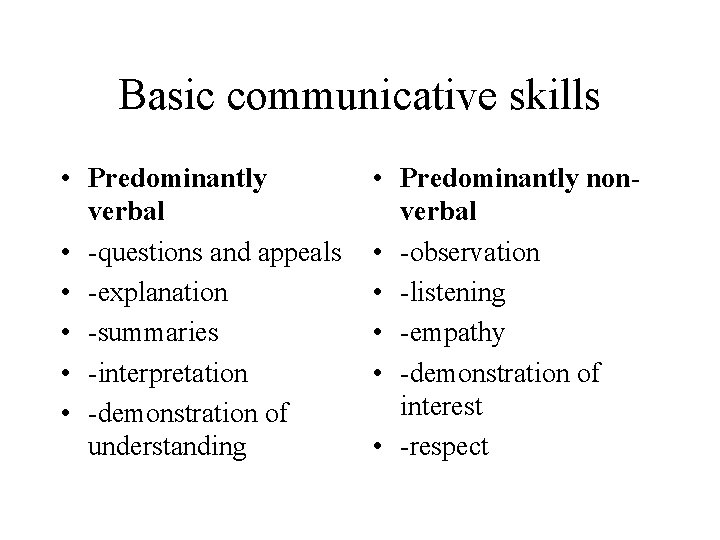
Basic communicative skills • Predominantly verbal • -questions and appeals • -explanation • -summaries • -interpretation • -demonstration of understanding • Predominantly nonverbal • -observation • -listening • -empathy • -demonstration of interest • -respect
Listening • Perceiving person actively – not only what he is saying , but the way in which he is saying it, movements, facial expressions / hidden message • Information in patient`s verbal message: • What happened to the patient • What the patient has done • What he has gone through • Monitor our feelings and thoughts during dialogue to avoid misrepresentation of the message • Respect – attitude, appreciation of another person as a human being “I am here for you”
Empathy • Projecting oneself into mental condition of the other person, ability to recognize and understand the mental condition of the other person, his mood, and what he is going through. • X sympathy= experiencing the same feeling together with the other person • Development of empathy • -pay full attention [Amelie] • -follow our own feelings during dialogue • -be tolerant, accept and don`t judge the patient
• Tests – complete a sentence, how our reactions stimulate flow of information from patient • 1. Identification – willingness and desire to understand a fellow human being • 2. Knowledge
Demonstration of understanding • Assurance, that we understood patient, his opinions, information he gives, his thoughts and feelings – motivation to cooperation • Nodding, agreement • Repeating the last couple of words • Challenging – presenting alternative views • Summary • Clarification- explaining connections by reminder • Emphasizing particular statements • Suggesting an interpretation of relations • Does not mean agreement! • Relieves the distress [ when the prognosis is bad]
Interpretation • Explanation of connections and relationships, which the patient has not been aware of = better understanding of situation and himself, based on good knowledge of the patient`s life, events, influence of others • Disease in context of the patient`s whole life, his inner world, his contribution • Doctor`s support, compassion • Not I formulations / we are not judges/ • Suitable moment – not too early! interpretation must correspond to his own view, don`t press , don`t persuade / Iatropsychopathogenic effect of incorrect i. /
Interest and support • Nodding, leaning towards p. , looking at him • “I am here for you and with you, I am trying to understand you” • Remind him of positive aspects in his life and in present situation, reinforce balance • Mutual silence x empty silence • [ “ try to say aloud, what is in your mind, … what are you thinking about…, never mind if your words are confused…]
Advice and Counselling • Diet, daily routine, taking medicine… • Not at psychological problems • Help the patient to find his own orientation in a life situation so that he himself can find a solution and take his decision [ no other people can make it for him] • Direct advice only in situations where patient can be harmed by any delay, provide information about optimal strategies for solving the crises [ marriage guidance]
Non-verbal Communication Between Doctor and Patient • More than 65% of all human exchange of information, mostly is transmitted and evaluated unconsciously • Incongruity between verbal and nonverbal, between what we say and what we feel [Unwelcome guests] • Para-verbal: intonation, speed, loudness, pauses, tone of voice
Description and Classification of Non-verbal Behaviour • Proxemic patterns/ physical distance between people/ • -intimate /touch/ 15 -30 cm • -personal /hand-shake/ 45 -70 cm • -social / dialogue/ 120 -350 cm • -public / in the street/ 500 cm or more • Breaking zones. Vertical dimension. Naked patients • Haptic patterns – touching • Postural patterns – carriage of body / leaning towards patient/
• Psychobiology – the science of biological basis of behaviour, dominant hemisphere – verbal, written, solving math problems, non-dominant – nonverbal, emotions…comprehension happens unconsciously [receive, evaluate, transmit] • Ethology - studies patterns in behaviour in animal and human world. Individuals, social systems. Human behaviour is pre-structured and it displays certain patterns that, under certain circumstances regularly occur. [collective unconscious- Jung]
Desmond Morris – “The Naked Ape” Visual behaviour- not sitting opposite Mirror movements- the same body posture as a patient=tuning in Territorial behaviour –” bubble”, chairs with wheels, beds not too close Barrier signals - folding of hands, crossing of legs, table / across the corner / Physical barrier – respect distance or come closer Metasignals – clarify a context / facial expressions /
Application of the Study of Non-verbal Behaviour in Doctor – Patient Interaction • Spatial arrangement: “triangular”- helps to stimulate informal and relaxed atmosphere, not sitting with one`s back to an open space, soft armchairs on wheels • Interest conveyance: verbally, body posture/inclining body, than changing the direction of the sightline, legs and hands should not be crossed •
Non-verbal behaviour • Gestures, movements, body posture • Facial expressions/ laughter, raised eye-brows/ • Para-verbal signals /loudness, tempo, pauses, silence, tone/ • Physiological processes/ accelerated breathing, flushing, pallor, sweating, pupils dilatation. . / • General appearance / clothing, choice of colors /
Psychological approaches to various groups of patients • • • Undressed patients Dominant patient Submissive patient Surgery Painful treatment Amputation and other permanent consequences / abortion, abnormal fetus/ • Obstetrics • Sight disorders • Orthopedics and neurological diseases

- Slides: 19