
The Relationship Between the Accessibility of Political Attitudes
The Relationship Between the Accessibility of Political Attitudes and Voting Behavior Alison Young Reusser Olivet Nazarene University
Attitude Accessibility • Ease with which an attitude is brought to mind • Objects toward which we have accessible attitudes • Draw visual attention (Roskos-Ewoldsen & Fazio, 1992) • Are privileged in memory (Smith, Fazio & Cejka, 1996) • Influence evaluations of related concepts • Flu shots and foods (Young & Fazio, 2014) • Political candidates (Fazio & Williams, 1986)
Attitude Accessibility & Political Evaluations • Accessibility of attitudes toward political constructs (Democratic-ness and Republican-ness) should predict • Voting likelihood • Evaluations of: • People who belong to each party • Specific political candidates (Donald Trump)
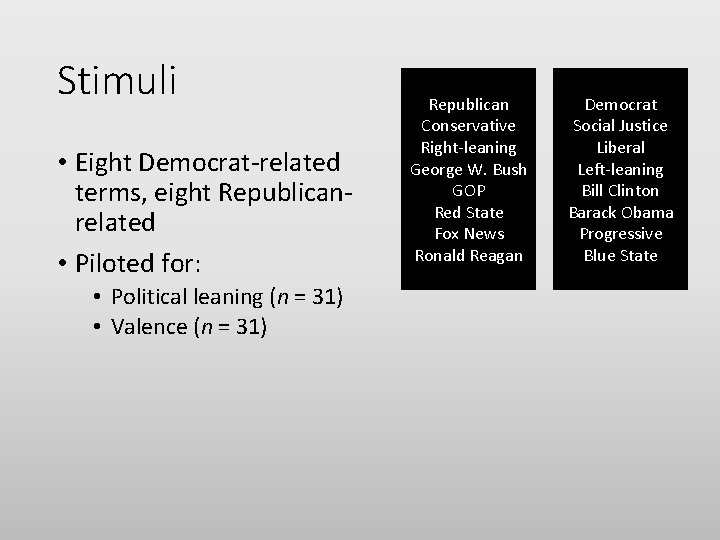
Stimuli • Eight Democrat-related terms, eight Republicanrelated • Piloted for: • Political leaning (n = 31) • Valence (n = 31) Republican Conservative Right-leaning George W. Bush GOP Red State Fox News Ronald Reagan Democrat Social Justice Liberal Left-leaning Bill Clinton Barack Obama Progressive Blue State
Method • n = 85 (57 women; 65 Caucasian), Fall of 2016 • Attitude accessibility task • Filler task • DVs • Voting Likelihood (more positive, more Republican; 8 items, α =. 84) • Evaluation of “other people who belong to the democrat/republican party” (5 items each, α =. 94 and. 96) • Overall evaluation of Donald Trump (13 items, α =. 97) • Covariates & Demographics
Analyses • HLM nesting 84 participants within 16 items predicting each DV from: • Level 1: • • Response Valence (-1 vs. +1) RT (z-scored) Interaction RT for “like, ” “dislike, ” and interaction • Level 2: • Political dimension of the item (Democrat (-1) vs. Republican (+1)) • Normative valence of the item (z-scored) • # characters in the item (z-scored)
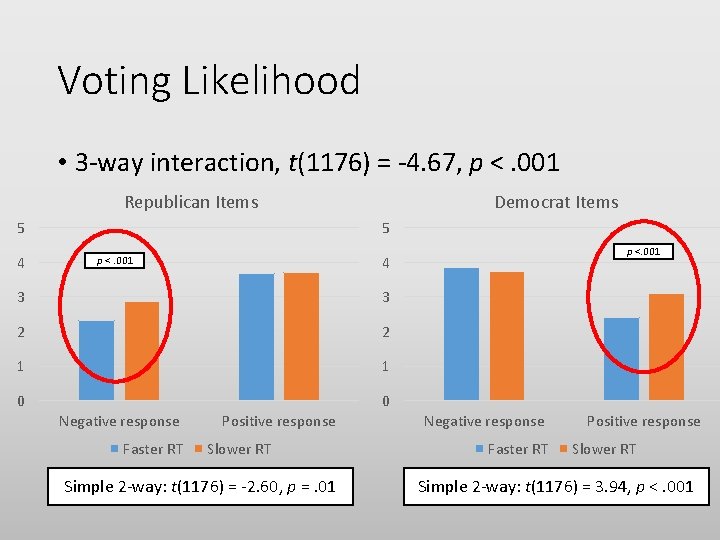
Voting Likelihood • 3 -way interaction, t(1176) = -4. 67, p <. 001 Republican Items 5 4 Democrat Items 5 3 3 2 2 1 1 0 0 Negative response Faster RT p <. 001 4 p <. 001 Positive response Slower RT Simple 2 -way: t(1176) = -2. 60, p =. 01 Negative response Faster RT Positive response Slower RT Simple 2 -way: t(1176) = 3. 94, p <. 001
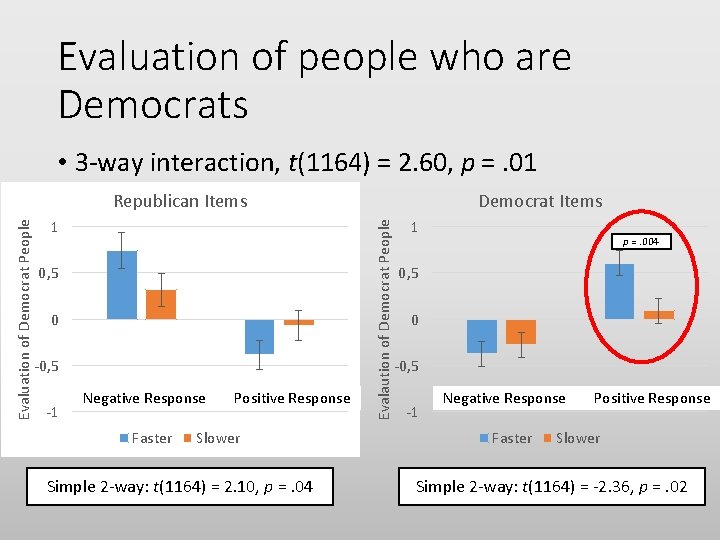
Evaluation of people who are Democrats • 3 -way interaction, t(1164) = 2. 60, p =. 01 1 0, 5 0 -0, 5 -1 Negative Response Faster Positive Response Slower Simple 2 -way: t(1164) = 2. 10, p =. 04 Democrat Items Evalaution of Democrat People Evaluation of Democrat People Republican Items 1 p =. 004 0, 5 0 -0, 5 -1 Negative Response Faster Positive Response Slower Simple 2 -way: t(1164) = -2. 36, p =. 02
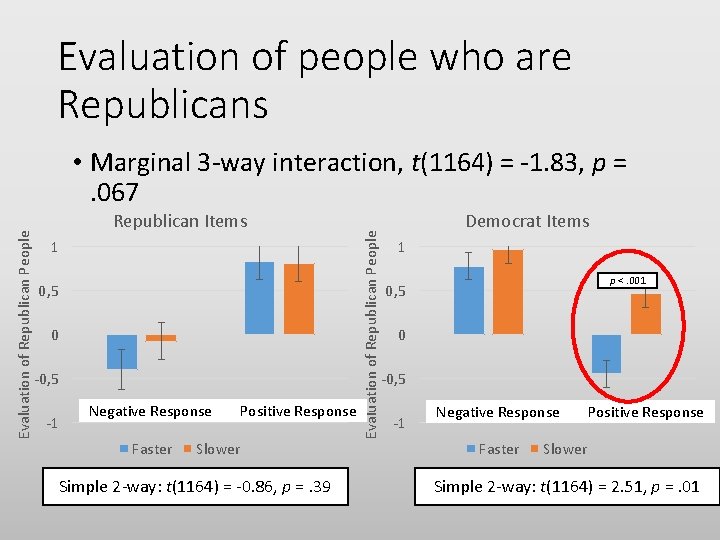
Evaluation of people who are Republicans Republican Items 1 0, 5 0 -0, 5 -1 Negative Response Faster Positive Response Slower Simple 2 -way: t(1164) = -0. 86, p =. 39 Evaluation of Republican People • Marginal 3 -way interaction, t(1164) = -1. 83, p =. 067 Democrat Items 1 p <. 001 0, 5 0 -0, 5 -1 Negative Response Faster Positive Response Slower Simple 2 -way: t(1164) = 2. 51, p =. 01
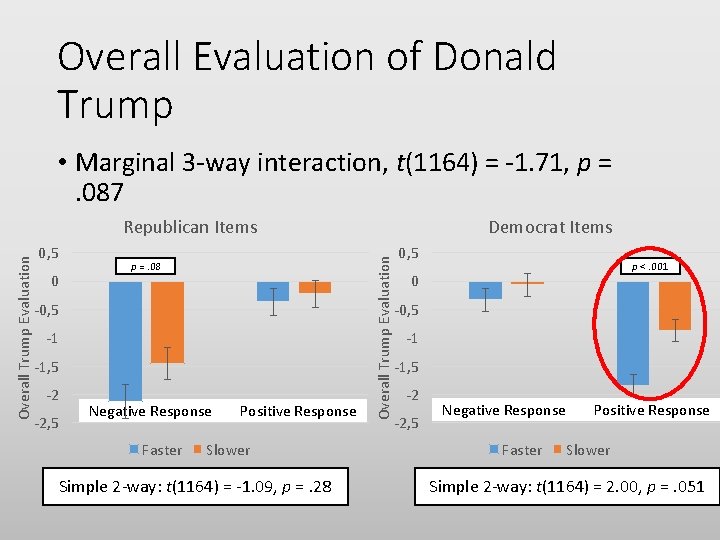
Overall Evaluation of Donald Trump • Marginal 3 -way interaction, t(1164) = -1. 71, p =. 087 0, 5 0 p =. 08 -0, 5 -1 -1, 5 -2 -2, 5 Negative Response Faster Positive Response Slower Simple 2 -way: t(1164) = -1. 09, p =. 28 Democrat Items Overall Trump Evaluation Republican Items 0, 5 p <. 001 0 -0, 5 -1 -1, 5 -2 -2, 5 Negative Response Faster Positive Response Slower Simple 2 -way: t(1164) = 2. 00, p =. 051
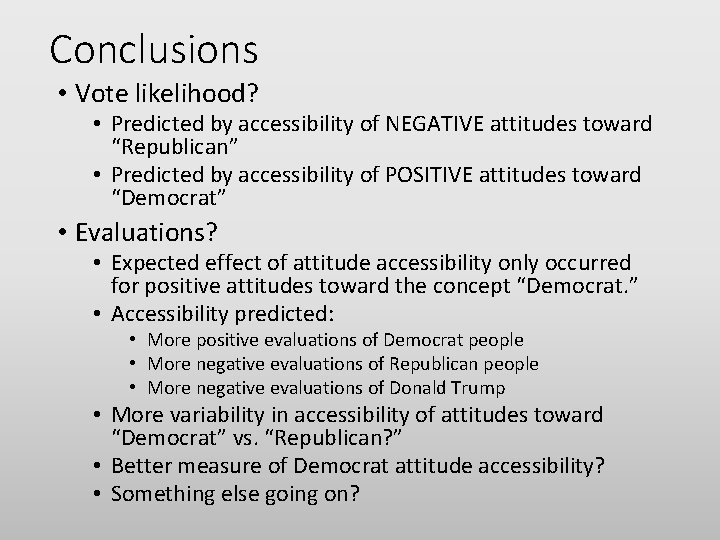
Conclusions • Vote likelihood? • Predicted by accessibility of NEGATIVE attitudes toward “Republican” • Predicted by accessibility of POSITIVE attitudes toward “Democrat” • Evaluations? • Expected effect of attitude accessibility only occurred for positive attitudes toward the concept “Democrat. ” • Accessibility predicted: • More positive evaluations of Democrat people • More negative evaluations of Republican people • More negative evaluations of Donald Trump • More variability in accessibility of attitudes toward “Democrat” vs. “Republican? ” • Better measure of Democrat attitude accessibility? • Something else going on?
Future Directions • Test whether accessibility of political attitudes helps participants disambiguate a moderate political candidate
- Slides: 12