
The Relationship between Sensory Gating and Academic Performance
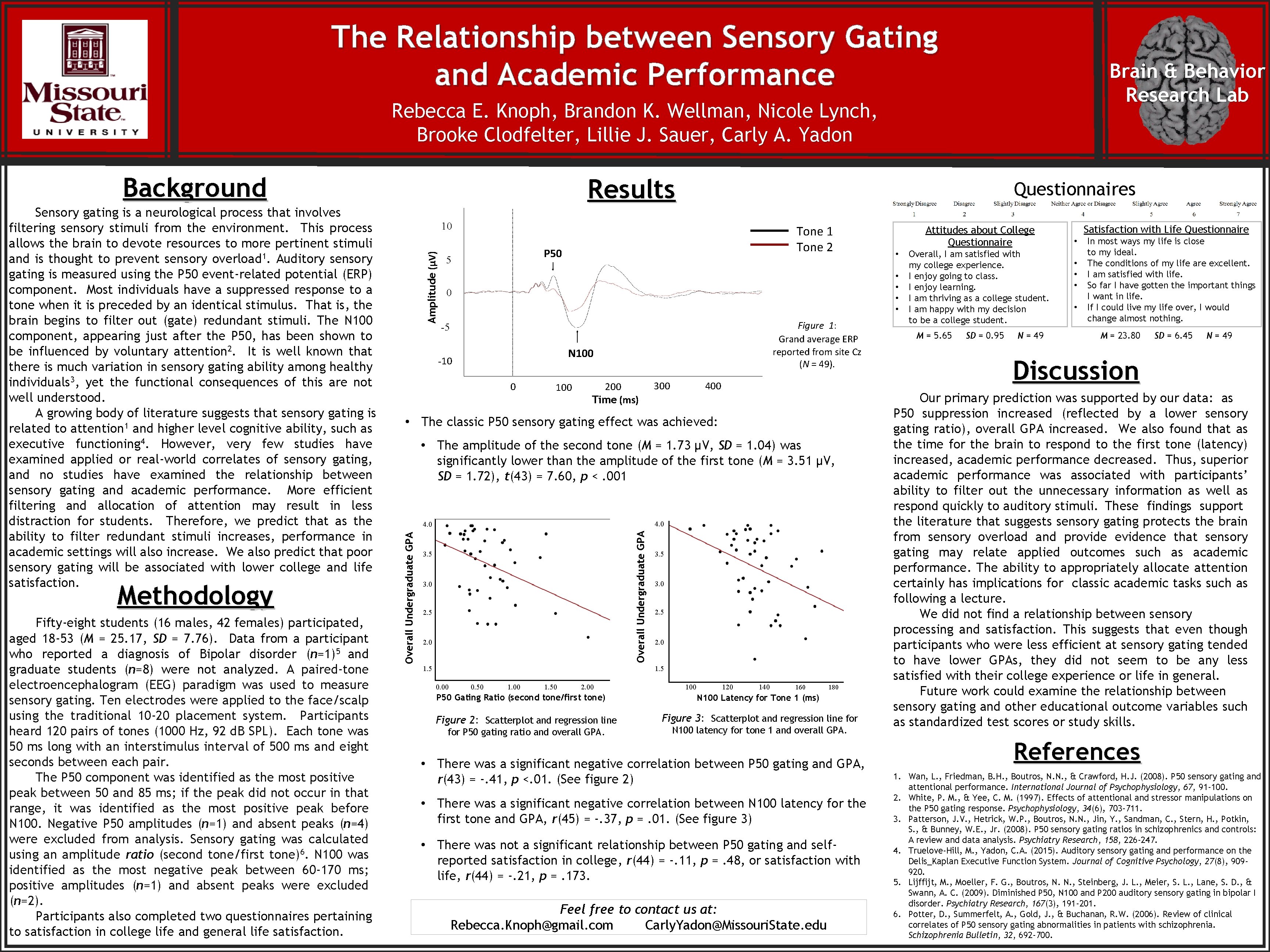
The Relationship between Sensory Gating and Academic Performance Brain & Behavior Research Lab Rebecca E. Knoph, Brandon K. Wellman, Nicole Lynch, Brooke Clodfelter, Lillie J. Sauer, Carly A. Yadon Background Fifty-eight students (16 males, 42 females) participated, aged 18 -53 (M = 25. 17, SD = 7. 76). Data from a participant who reported a diagnosis of Bipolar disorder (n=1)5 and graduate students (n=8) were not analyzed. A paired-tone electroencephalogram (EEG) paradigm was used to measure sensory gating. Ten electrodes were applied to the face/scalp using the traditional 10 -20 placement system. Participants heard 120 pairs of tones (1000 Hz, 92 d. B SPL). Each tone was 50 ms long with an interstimulus interval of 500 ms and eight seconds between each pair. The P 50 component was identified as the most positive peak between 50 and 85 ms; if the peak did not occur in that range, it was identified as the most positive peak before N 100. Negative P 50 amplitudes (n=1) and absent peaks (n=4) were excluded from analysis. Sensory gating was calculated using an amplitude ratio (second tone/first tone)6. N 100 was identified as the most negative peak between 60 -170 ms; positive amplitudes (n=1) and absent peaks were excluded (n=2). Participants also completed two questionnaires pertaining to satisfaction in college life and general life satisfaction. Amplitude (µV) Tone 1 Tone 2 P 50 5 0 Figure 1: Grand average ERP reported from site Cz (N = 49). -5 N 100 -10 0 100 200 Time (ms) 300 400 • The classic P 50 sensory gating effect was achieved: • The amplitude of the second tone (M = 1. 73 µV, SD = 1. 04) was significantly lower than the amplitude of the first tone (M = 3. 51 µV, SD = 1. 72), t(43) = 7. 60, p <. 001 4. 0 3. 5 3. 0 2. 5 2. 0 1. 5 0. 00 Attitudes about College Questionnaire • • • Overall Undergraduate GPA Methodology Questionnaires 10 Overall Undergraduate GPA Sensory gating is a neurological process that involves filtering sensory stimuli from the environment. This process allows the brain to devote resources to more pertinent stimuli and is thought to prevent sensory overload 1. Auditory sensory gating is measured using the P 50 event-related potential (ERP) component. Most individuals have a suppressed response to a tone when it is preceded by an identical stimulus. That is, the brain begins to filter out (gate) redundant stimuli. The N 100 component, appearing just after the P 50, has been shown to be influenced by voluntary attention 2. It is well known that there is much variation in sensory gating ability among healthy individuals 3, yet the functional consequences of this are not well understood. A growing body of literature suggests that sensory gating is related to attention 1 and higher level cognitive ability, such as executive functioning 4. However, very few studies have examined applied or real-world correlates of sensory gating, and no studies have examined the relationship between sensory gating and academic performance. More efficient filtering and allocation of attention may result in less distraction for students. Therefore, we predict that as the ability to filter redundant stimuli increases, performance in academic settings will also increase. We also predict that poor sensory gating will be associated with lower college and life satisfaction. Results 0. 50 1. 00 1. 50 2. 00 P 50 Gating Ratio (second tone/first tone) Figure 2: Scatterplot and regression line for P 50 gating ratio and overall GPA. 100 120 140 160 180 N 100 Latency for Tone 1 (ms) Figure 3: Scatterplot and regression line for N 100 latency for tone 1 and overall GPA. • There was a significant negative correlation between P 50 gating and GPA, r(43) = -. 41, p <. 01. (See figure 2) • There was a significant negative correlation between N 100 latency for the first tone and GPA, r(45) = -. 37, p =. 01. (See figure 3) • There was not a significant relationship between P 50 gating and selfreported satisfaction in college, r(44) = -. 11, p =. 48, or satisfaction with life, r(44) = -. 21, p =. 173. Feel free to contact us at: Rebecca. Knoph@gmail. com Carly. Yadon@Missouri. State. edu Overall, I am satisfied with my college experience. I enjoy going to class. I enjoy learning. I am thriving as a college student. I am happy with my decision to be a college student. M = 5. 65 SD = 0. 95 N = 49 Satisfaction with Life Questionnaire • • • In most ways my life is close to my ideal. The conditions of my life are excellent. I am satisfied with life. So far I have gotten the important things I want in life. If I could live my life over, I would change almost nothing. M = 23. 80 SD = 6. 45 N = 49 Discussion Our primary prediction was supported by our data: as P 50 suppression increased (reflected by a lower sensory gating ratio), overall GPA increased. We also found that as the time for the brain to respond to the first tone (latency) increased, academic performance decreased. Thus, superior academic performance was associated with participants’ ability to filter out the unnecessary information as well as respond quickly to auditory stimuli. These findings support the literature that suggests sensory gating protects the brain from sensory overload and provide evidence that sensory gating may relate applied outcomes such as academic performance. The ability to appropriately allocate attention certainly has implications for classic academic tasks such as following a lecture. We did not find a relationship between sensory processing and satisfaction. This suggests that even though participants who were less efficient at sensory gating tended to have lower GPAs, they did not seem to be any less satisfied with their college experience or life in general. Future work could examine the relationship between sensory gating and other educational outcome variables such as standardized test scores or study skills. References 1. Wan, L. , Friedman, B. H. , Boutros, N. N. , & Crawford, H. J. (2008). P 50 sensory gating and attentional performance. International Journal of Psychophysiology, 67, 91 -100. 2. White, P. M. , & Yee, C. M. (1997). Effects of attentional and stressor manipulations on the P 50 gating response. Psychophysiology, 34(6), 703 -711. 3. Patterson, J. V. , Hetrick, W. P. , Boutros, N. N. , Jin, Y. , Sandman, C. , Stern, H. , Potkin, S. , & Bunney, W. E. , Jr. (2008). P 50 sensory gating ratios in schizophrenics and controls: A review and data analysis. Psychiatry Research, 158, 226 -247. 4. Truelove-Hill, M. , Yadon, C. A. (2015). Auditory sensory gating and performance on the Delis_Kaplan Executive Function System. Journal of Cognitive Psychology, 27(8), 909920. 5. Lijffijt, M. , Moeller, F. G. , Boutros, N. N. , Steinberg, J. L. , Meier, S. L. , Lane, S. D. , & Swann, A. C. (2009). Diminished P 50, N 100 and P 200 auditory sensory gating in bipolar I disorder. Psychiatry Research, 167(3), 191 -201. 6. Potter, D. , Summerfelt, A. , Gold, J. , & Buchanan, R. W. (2006). Review of clinical correlates of P 50 sensory gating abnormalities in patients with schizophrenia. Schizophrenia Bulletin, 32, 692 -700.
- Slides: 1