
The Relationship between RIASEC Personality Types and Negative
The Relationship between RIASEC Personality Types and Negative Thinking: Implications for Career Counseling Jennifer Greene, MSPH Psychological Assessment Resources, Inc.
My Background • Masters of Science in Public Health • Doctoral student: Ph. D in Measurement at the University of South Florida • Research and Development Team at Psychological Assessment Resources (PAR) – Develop assessments for a wide variety of needs • Career Development • Also, achievement, intelligence, personality, mood, neuropsychology, speech/language, etc.
Introductions • Your background • What made you want to come to this presentation?
Agenda • • Research Objective Hypotheses Measures Used Method Participants Results/Discussion Case Study
Objective • To explore the relationship between RIASEC types (as measured by the Self-Directed Search) and negative career thoughts (as measured by the Career Thoughts Inventory)
Hypotheses • Hypothesis 1: Low scores on the SDS secondary constructs (congruence, consistency, coherence, differentiation, and profile elevation) are related to higher endorsement of negative career thoughts. • Hypothesis 2: Social and Enterprising types are less likely to endorse negative career thinking, and R and C types are more likely to do so.
Measures Self-Directed Search, Fifth Edition (SDS; Holland & Messer, 2013) Career Thoughts Inventory (CTI; Sampson, Peterson, Lenz, Reardon, & Saunders)
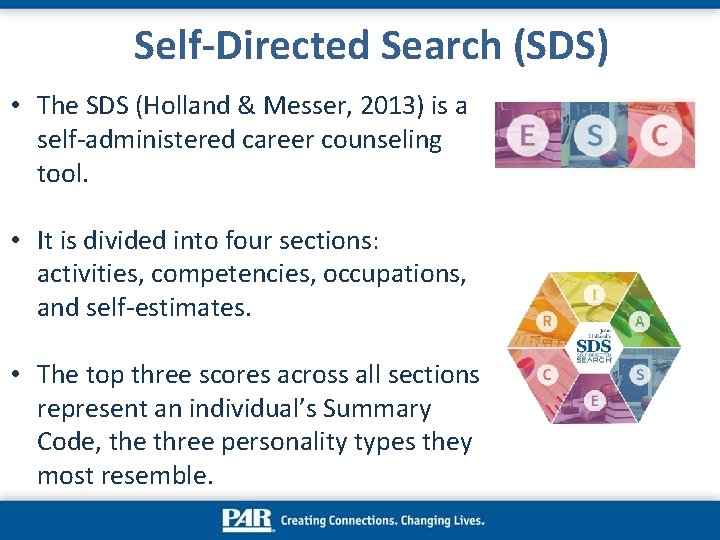
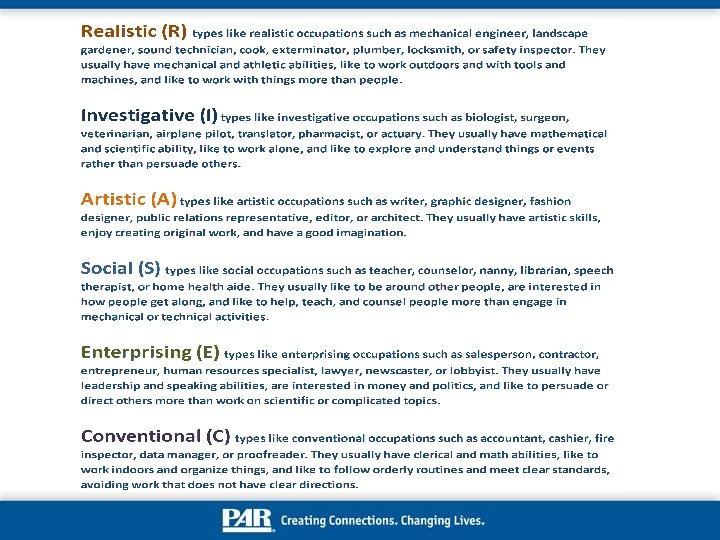
Self-Directed Search (SDS) • The SDS (Holland & Messer, 2013) is a self-administered career counseling tool. • It is divided into four sections: activities, competencies, occupations, and self-estimates. • The top three scores across all sections represent an individual’s Summary Code, the three personality types they most resemble.
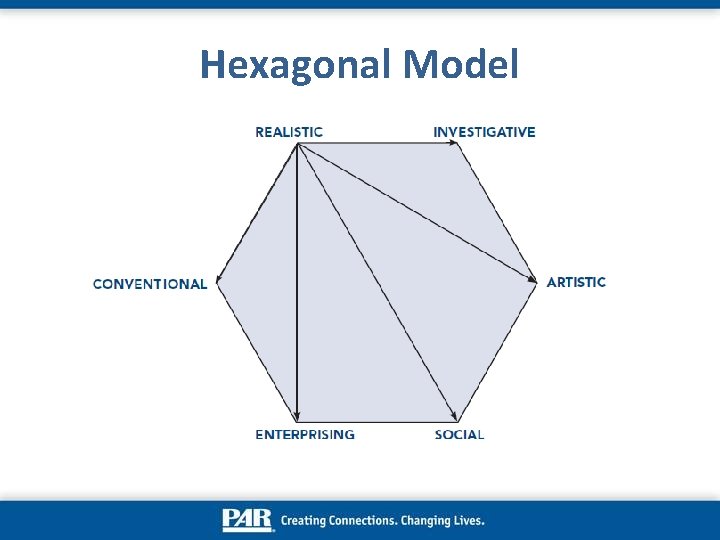
Hexagonal Model
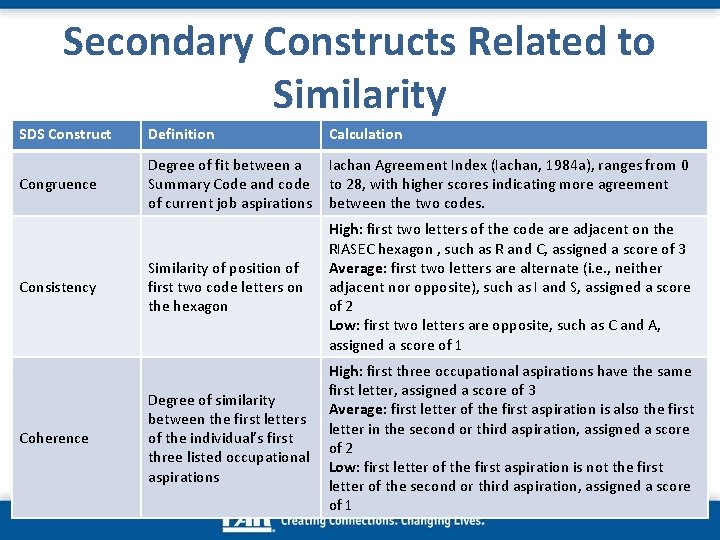
Secondary Constructs Related to Similarity SDS Construct Definition Calculation Congruence Degree of fit between a Summary Code and code of current job aspirations Iachan Agreement Index (Iachan, 1984 a), ranges from 0 to 28, with higher scores indicating more agreement between the two codes. Similarity of position of first two code letters on the hexagon High: first two letters of the code are adjacent on the RIASEC hexagon , such as R and C, assigned a score of 3 Average: first two letters are alternate (i. e. , neither adjacent nor opposite), such as I and S, assigned a score of 2 Low: first two letters are opposite, such as C and A, assigned a score of 1 Degree of similarity between the first letters of the individual’s first three listed occupational aspirations High: first three occupational aspirations have the same first letter, assigned a score of 3 Average: first letter of the first aspiration is also the first letter in the second or third aspiration, assigned a score of 2 Low: first letter of the first aspiration is not the first letter of the second or third aspiration, assigned a score of 1 Consistency Coherence
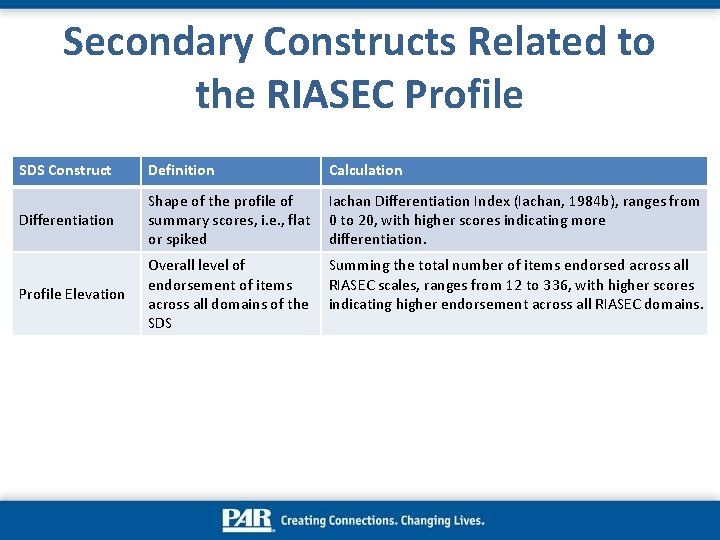
Secondary Constructs Related to the RIASEC Profile SDS Construct Definition Calculation Differentiation Shape of the profile of summary scores, i. e. , flat or spiked Iachan Differentiation Index (Iachan, 1984 b), ranges from 0 to 20, with higher scores indicating more differentiation. Profile Elevation Overall level of endorsement of items across all domains of the SDS Summing the total number of items endorsed across all RIASEC scales, ranges from 12 to 336, with higher scores indicating higher endorsement across all RIASEC domains.
Career Thoughts Inventory (CTI) • The CTI is a theory-based assessment and intervention resource intended to improve the quality of career services offered. • Cognitive information processing (CIP) theoretical approach to career development and career services (Peterson, et al. , 1991; Peterson, et al. , 1996) • Cognitive therapy theoretical approach to mental health and mental health services (Beck, 1976). • 10 -15 minutes to complete • Higher scores indicate higher levels of the scale’s measured construct.
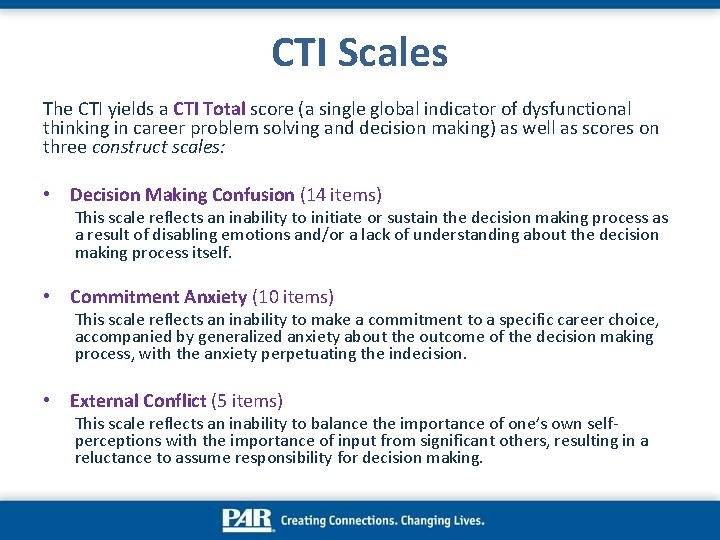
CTI Scales The CTI yields a CTI Total score (a single global indicator of dysfunctional thinking in career problem solving and decision making) as well as scores on three construct scales: • Decision Making Confusion (14 items) This scale reflects an inability to initiate or sustain the decision making process as a result of disabling emotions and/or a lack of understanding about the decision making process itself. • Commitment Anxiety (10 items) This scale reflects an inability to make a commitment to a specific career choice, accompanied by generalized anxiety about the outcome of the decision making process, with the anxiety perpetuating the indecision. • External Conflict (5 items) This scale reflects an inability to balance the importance of one’s own selfperceptions with the importance of input from significant others, resulting in a reluctance to assume responsibility for decision making.
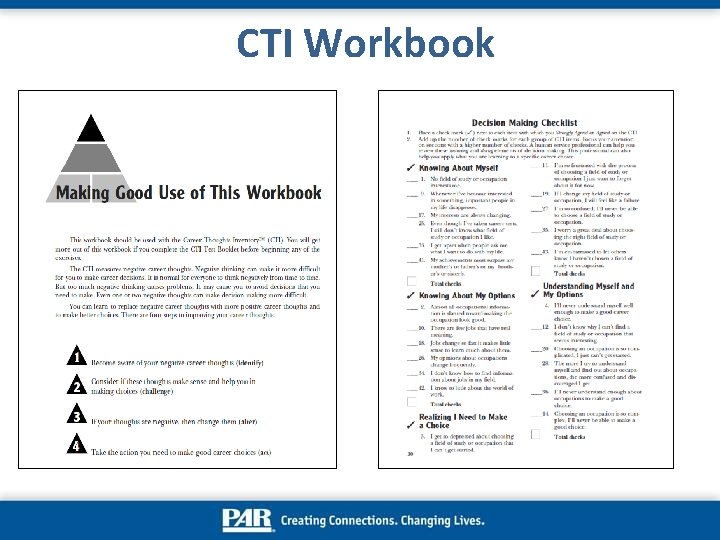
CTI Workbook
Background • Previous studies (Chason, Bullock-Yowell, Sampson, Lenz, Reardon, 2013; Wright, Reardon, Peterson, & Osborn, 2000) have focused on the relationship between secondary constructs of the Self-Directed Search, Fourth Edition and negative career thoughts as measured by the Career Thoughts Inventory (Sampson, Peterson, Lenz, Reardon & Saunders, 1996). • In order to further elucidate the relationship between SDS constructs and negative career thoughts, the current study aims to examine the secondary constructs with the newest edition of the SDS
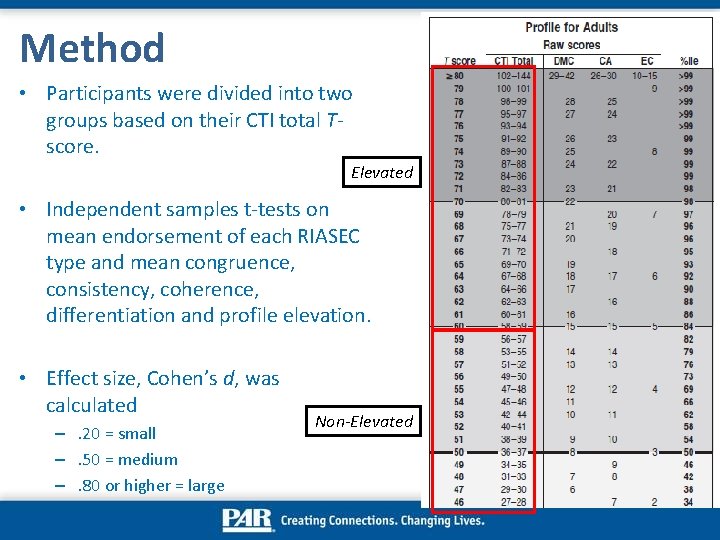
Method • Participants were divided into two groups based on their CTI total Tscore. Elevated • Independent samples t-tests on mean endorsement of each RIASEC type and mean congruence, consistency, coherence, differentiation and profile elevation. • Effect size, Cohen’s d, was calculated –. 20 = small –. 50 = medium –. 80 or higher = large Non-Elevated
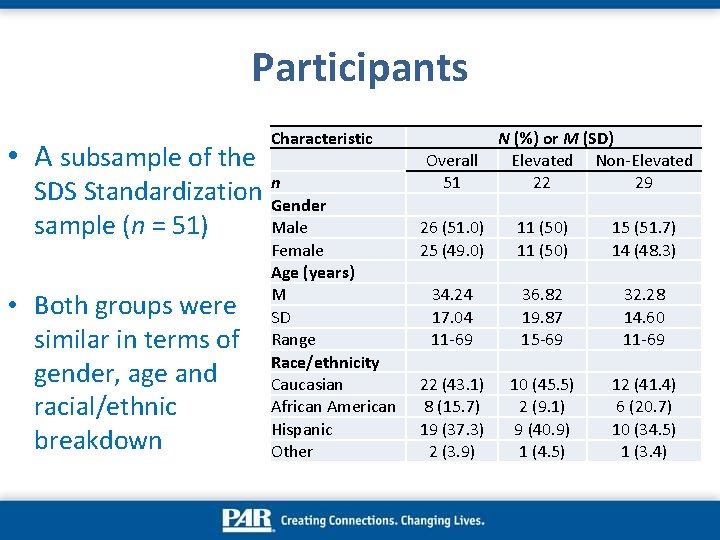
Participants • A subsample of the Characteristic SDS Standardization n. Gender Male sample (n = 51) • Both groups were similar in terms of gender, age and racial/ethnic breakdown Female Age (years) M SD Range Race/ethnicity Caucasian African American Hispanic Other Overall 51 N (%) or M (SD) Elevated Non-Elevated 22 29 26 (51. 0) 25 (49. 0) 11 (50) 15 (51. 7) 14 (48. 3) 34. 24 17. 04 11 -69 36. 82 19. 87 15 -69 32. 28 14. 60 11 -69 22 (43. 1) 8 (15. 7) 19 (37. 3) 2 (3. 9) 10 (45. 5) 2 (9. 1) 9 (40. 9) 1 (4. 5) 12 (41. 4) 6 (20. 7) 10 (34. 5) 1 (3. 4)
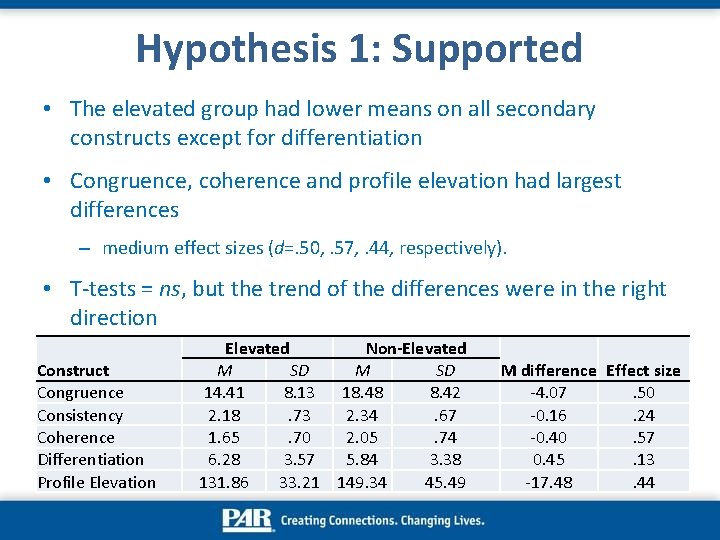
Hypothesis 1: Supported • The elevated group had lower means on all secondary constructs except for differentiation • Congruence, coherence and profile elevation had largest differences – medium effect sizes (d=. 50, . 57, . 44, respectively). • T-tests = ns, but the trend of the differences were in the right direction Construct Congruence Consistency Coherence Differentiation Profile Elevation Elevated Non-Elevated M SD 14. 41 8. 13 18. 48 8. 42 2. 18. 73 2. 34. 67 1. 65. 70 2. 05. 74 6. 28 3. 57 5. 84 3. 38 131. 86 33. 21 149. 34 45. 49 M difference Effect size -4. 07. 50 -0. 16. 24 -0. 40. 57 0. 45. 13 -17. 48. 44
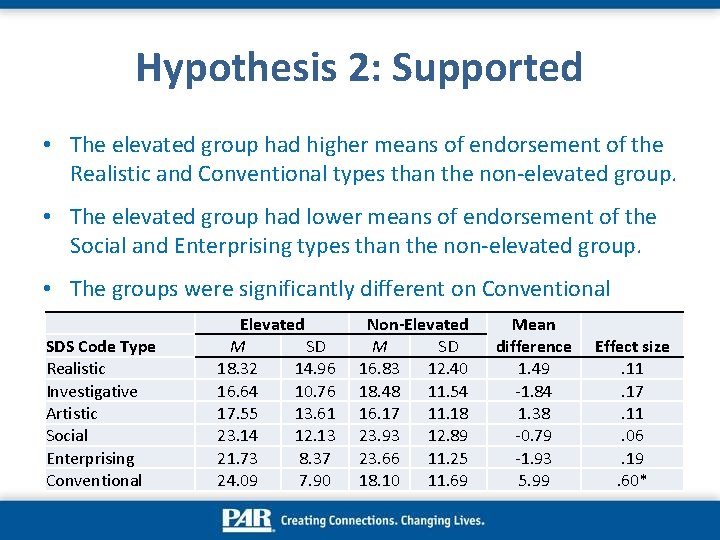
Hypothesis 2: Supported • The elevated group had higher means of endorsement of the Realistic and Conventional types than the non-elevated group. • The elevated group had lower means of endorsement of the Social and Enterprising types than the non-elevated group. • The groups were significantly different on Conventional SDS Code Type Realistic Investigative Artistic Social Enterprising Conventional Elevated M SD 18. 32 14. 96 16. 64 10. 76 17. 55 13. 61 23. 14 12. 13 21. 73 8. 37 24. 09 7. 90 Non-Elevated M SD 16. 83 12. 40 18. 48 11. 54 16. 17 11. 18 23. 93 12. 89 23. 66 11. 25 18. 10 11. 69 Mean difference 1. 49 -1. 84 1. 38 -0. 79 -1. 93 5. 99 Effect size. 11. 17. 11. 06. 19. 60*
Discussion • Realistic and Conventional types, as well as those with low scores on the secondary constructs of the SDS, may be more prone to negative career thoughts and may need additional career or personal counseling during the career development process.
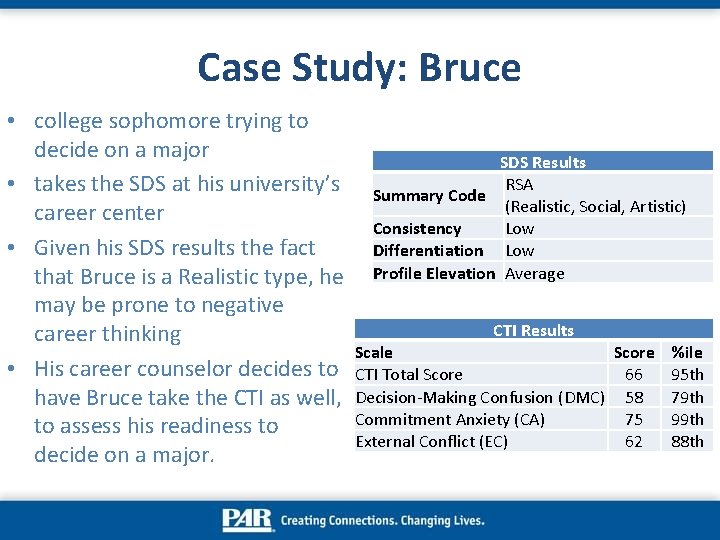
Case Study: Bruce • college sophomore trying to decide on a major • takes the SDS at his university’s career center • Given his SDS results the fact that Bruce is a Realistic type, he may be prone to negative career thinking • His career counselor decides to have Bruce take the CTI as well, to assess his readiness to decide on a major. SDS Results RSA Summary Code (Realistic, Social, Artistic) Consistency Low Differentiation Low Profile Elevation Average CTI Results Scale Score %ile CTI Total Score 66 95 th Decision-Making Confusion (DMC) 58 79 th Commitment Anxiety (CA) 75 99 th External Conflict (EC) 62 88 th
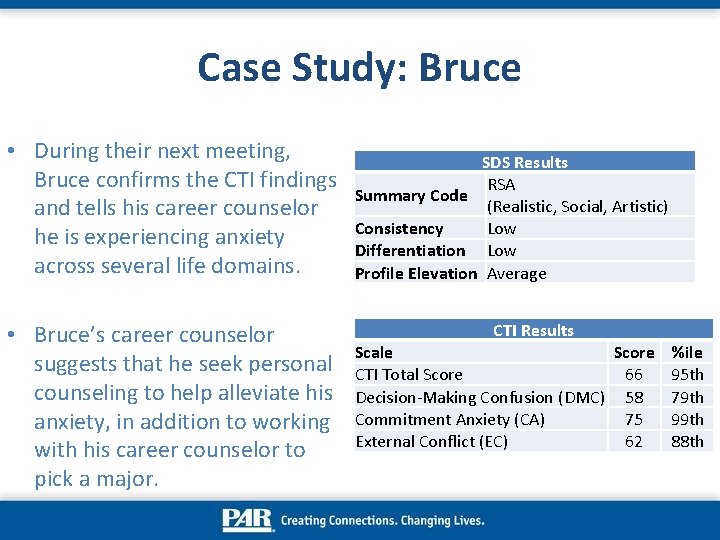
Case Study: Bruce • During their next meeting, Bruce confirms the CTI findings and tells his career counselor he is experiencing anxiety across several life domains. • Bruce’s career counselor suggests that he seek personal counseling to help alleviate his anxiety, in addition to working with his career counselor to pick a major. SDS Results RSA Summary Code (Realistic, Social, Artistic) Consistency Low Differentiation Low Profile Elevation Average CTI Results Scale Score %ile CTI Total Score 66 95 th Decision-Making Confusion (DMC) 58 79 th Commitment Anxiety (CA) 75 99 th External Conflict (EC) 62 88 th
Questions?
- Slides: 24