
The Relationship between Physical Functioning and Mental Health
The Relationship between Physical Functioning and Mental Health among Older Adults with Disabilities in Korea: Moderating Effects of Age Yeonjung (Jane) Lee Boston University School of Social Work (Ph. D student)
INTRODUCTION § Problem Statement §People who are aged 65 and older : 7. 2% of the total Korean population in 2000 → 12. 2% in 2013 (Statistics Korea, 2013). §People with disability of the overall population: increased almost 2. 5 times from 1. 5% in 1999 → 4. 9% in 2012 (Employment Development Institute, 2012; 2013). § In 2012, those who are age 40 years old or over composed 85. 3% of the total legally registered adults with disability, 50 years old or over represent 71. 4%, and 60 years old or over represent 49. 7% (Employment Development Institute, 2012). § With the increase of aging population that one of the most important challenges of older adults is to become functionally limited and their disability related issue (Fried & Guralnik, 1997). §The presence of functional limitation is associated with not only higher dependence but also higher risk of vulnerable feeling such as depression and anxiety.
§ Research Objectives & Questions § Based on the fact that physical functioning in old age is one of most significant factors that affect older adults’ mental health. § Therefore, this study has two goals: § ① to describe the functional characteristics of older Korean adults with disabilities and § ② to test hypothesized research models regarding the impact of functional limitations on the mental health of older adults with disabilities
Theories § Research questions on the relationship between functional limitation on mental health of older Koreans with disabilities and the moderating effects of age are based on § Lazarus and Folkman’s (1984) ‘Transactional Model of Stress’ § Havighurst’s (1961) ‘Activity Theory. ’
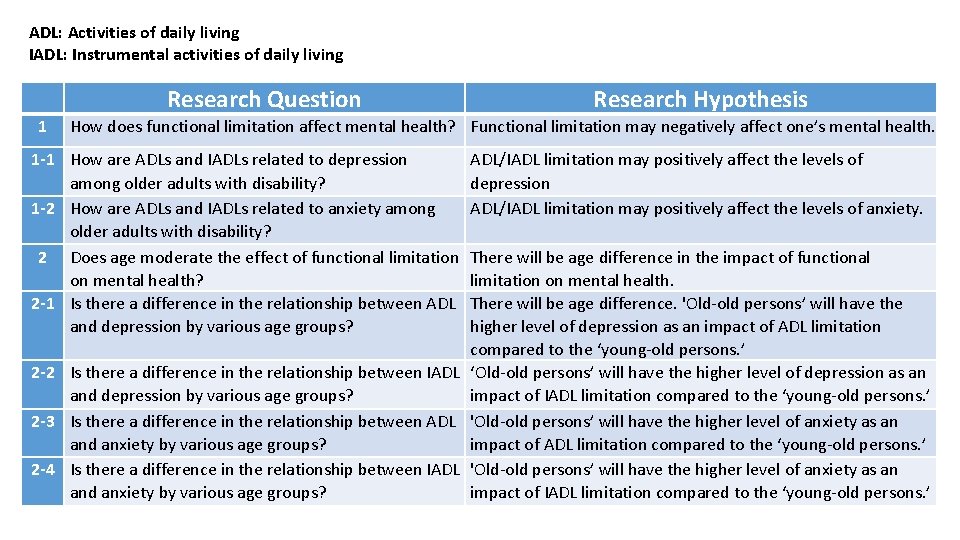
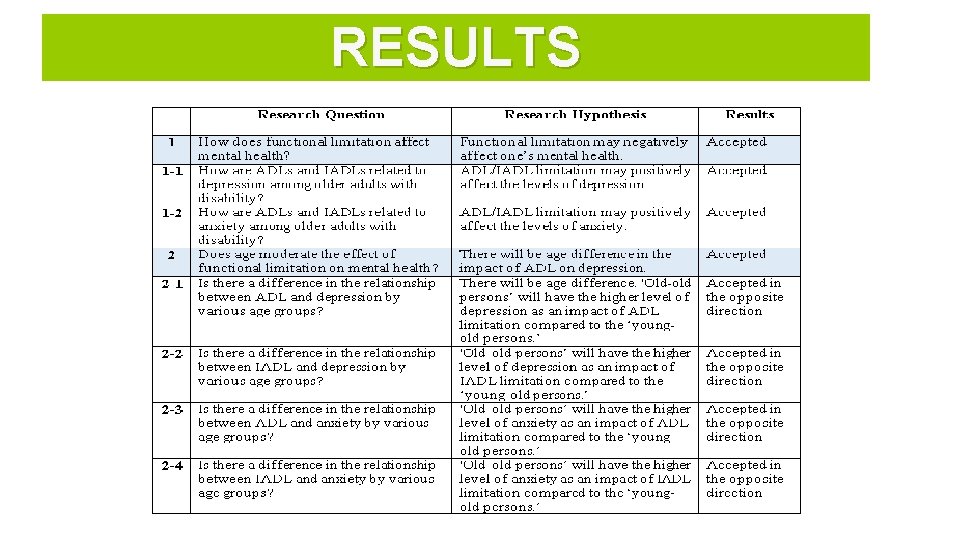
ADL: Activities of daily living IADL: Instrumental activities of daily living Research Question 1 Research Hypothesis How does functional limitation affect mental health? Functional limitation may negatively affect one’s mental health. 1 -1 How are ADLs and IADLs related to depression among older adults with disability? 1 -2 How are ADLs and IADLs related to anxiety among older adults with disability? 2 Does age moderate the effect of functional limitation on mental health? 2 -1 Is there a difference in the relationship between ADL and depression by various age groups? ADL/IADL limitation may positively affect the levels of depression ADL/IADL limitation may positively affect the levels of anxiety. There will be age difference in the impact of functional limitation on mental health. There will be age difference. 'Old-old persons’ will have the higher level of depression as an impact of ADL limitation compared to the ‘young-old persons. ’ 2 -2 Is there a difference in the relationship between IADL ‘Old-old persons’ will have the higher level of depression as an and depression by various age groups? impact of IADL limitation compared to the ‘young-old persons. ’ 2 -3 Is there a difference in the relationship between ADL 'Old-old persons’ will have the higher level of anxiety as an and anxiety by various age groups? impact of ADL limitation compared to the ‘young-old persons. ’ 2 -4 Is there a difference in the relationship between IADL 'Old-old persons’ will have the higher level of anxiety as an and anxiety by various age groups? impact of IADL limitation compared to the ‘young-old persons. ’
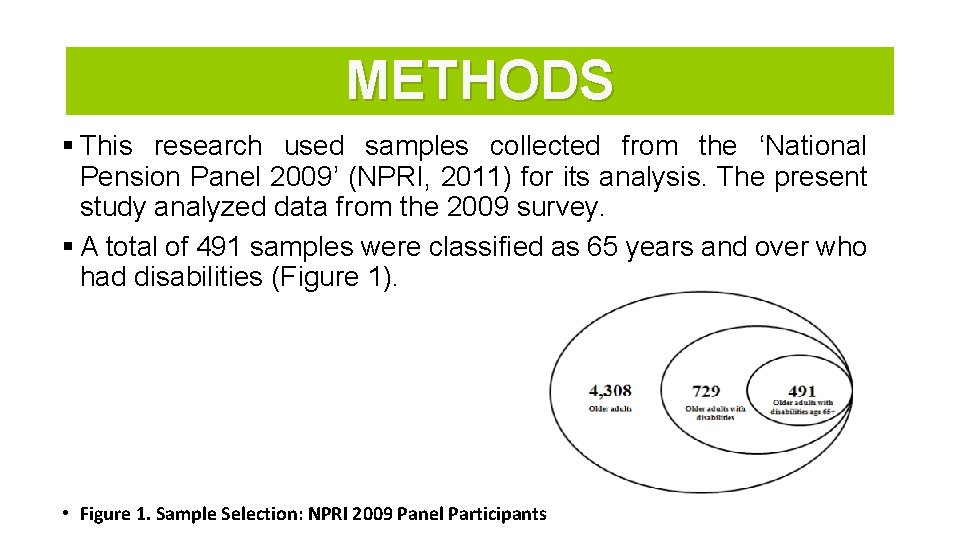
METHODS § This research used samples collected from the ‘National Pension Panel 2009’ (NPRI, 2011) for its analysis. The present study analyzed data from the 2009 survey. § A total of 491 samples were classified as 65 years and over who had disabilities (Figure 1). • Figure 1. Sample Selection: NPRI 2009 Panel Participants
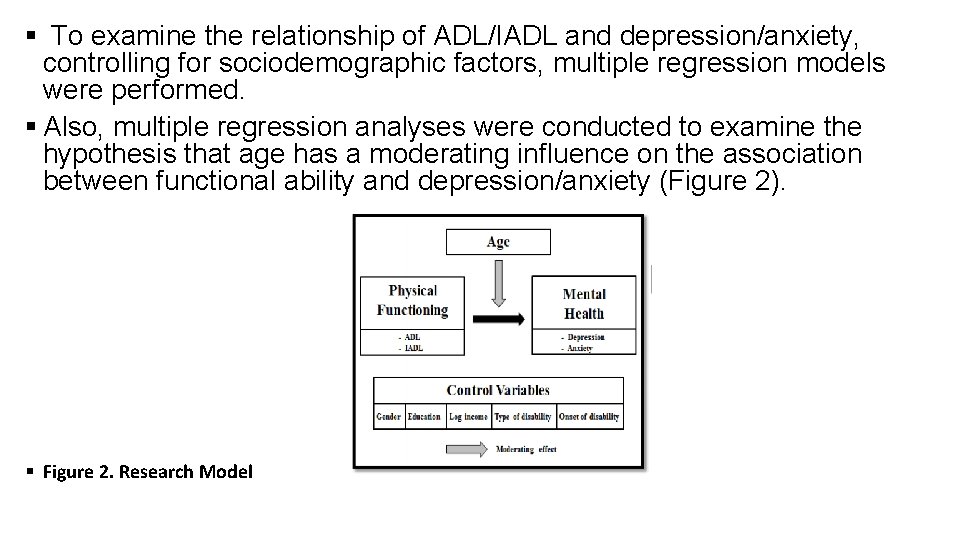
§ To examine the relationship of ADL/IADL and depression/anxiety, controlling for sociodemographic factors, multiple regression models were performed. § Also, multiple regression analyses were conducted to examine the hypothesis that age has a moderating influence on the association between functional ability and depression/anxiety (Figure 2). § Figure 2. Research Model

RESULTS
RESULTS
§ The findings of this study are presented as the following: § First, consistent with the previous study, the current study shows that functional limitations (ADLs and IADLs) have a positive association with depression and anxiety symptoms. § This means that higher levels of limitations in ADLs and IADLs are significantly associated with higher levels of depression and anxiety among older adults with disabilities (Table 1 and Table 2).

Table 1. Effect of Functional Limitation on Depression

Table 2. Effect of Functional Limitation on Anxiety
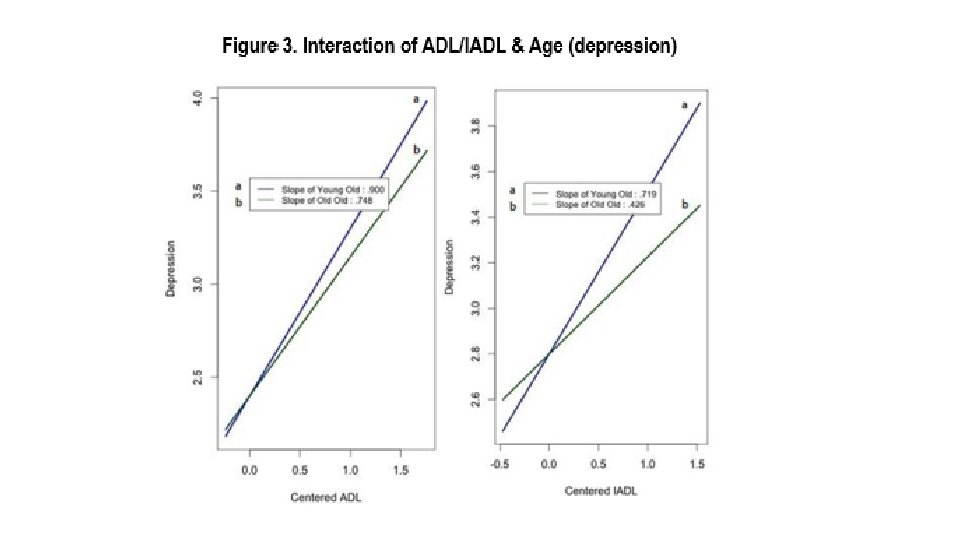
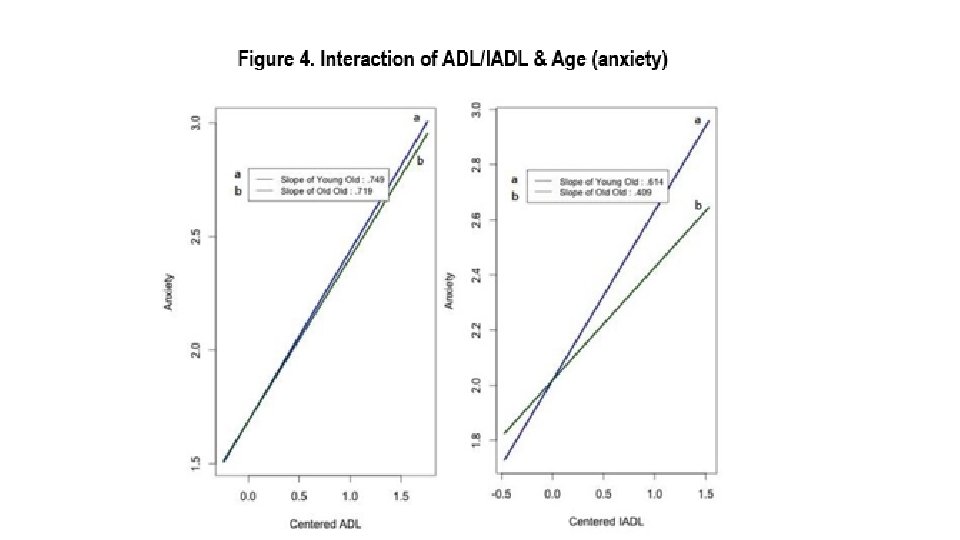
RESULTS • Second, there is a significant moderating effect of age; it is surprising that the ‘old-old’ persons with high functional limitations are less depressed and less anxious than their younger counterparts. Initially, it was expected that the old-old persons with high functional limitations will be more depressed and more anxious, but there may be a number of explanations for this different outcome (Figure 3 and Figure 4). • Surprisingly, older age had a buffering effect on the relationship between functional limitations and mental health.
DISCUSSION § The findings confirm the importance of early intervention to reduce the anxious feelings among the ‘young-old’ and functional independence as an important component of mental health later in life. The significant impact of functional health on depression and anxiety differ by age among ‘young-old’ and ‘old-old. ’ § Therefore, age-specific implications and services are needed to promote overall health related well-being and quality of independent life of older Korean’s disabilities.
DISCUSSION § The significant moderating effect of age provides insights on developing a health age index (considering both their physical age as well as their chronological age) every decade expecting the cohort effects. Further research to examine the mechanisms and generalization of these findings seems warranted.
CONCLUSION • The present study suggests the need to concentrate on the interrelationship between physical and mental health to promote older adult’s healthy later life. • Moreover, the significant moderating effect of age provides insights on developing ‘a health age index (considering both their physical age as well as their chronological age)’ every decade expecting the cohort effects.
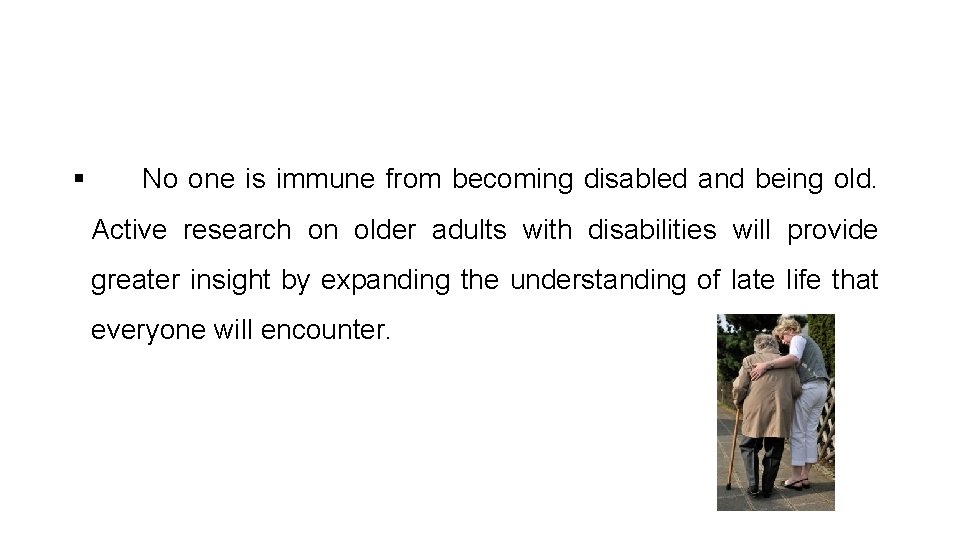
§ No one is immune from becoming disabled and being old. Active research on older adults with disabilities will provide greater insight by expanding the understanding of late life that everyone will encounter.
REFERENCES • 통계청. (2013). 2013 고령자 통계. 2013년 고령자통계 보도자료. • 고용개발원. (2012). 2012 장애인 통계. 고용개발원. (2013). 2013 장애인 통계 • Fried, L. P. , & Guralnik, J. M. (1997). Disability in older adults: Evidence regarding significance, etiology and risk. Journal of the American Geriatrics Society, 45, 92 - 100. • Havinghurst, R. J. (1961). Successful Aging. The Gerontologist, 1, 8– 13. • Lazarus, R. S. , & Folkman, S. (1984). Stress, appraisal, and coping. New York. • National Pension Research Institute. (2011). User's Guide Ver. 3. 6.
- Slides: 22