
The Relationship between Masculinity Traits and Mens Health
The Relationship between Masculinity Traits and Men’s Health Behaviors: A Literature Review Empirical studies consistently show that men are more likely than women to engage in nearly every single health risk behavior (e. g. , alcohol use, tobacco use, not seeking medical care) increasing their risk of injury, disease, and death (Courtenay, 2000) Researchers suggest that socialization of male gender roles contributes to higher frequencies of health risk behaviors and poor health outcomes (Courtenay, 2001) Purpose: This literature review includes an investigation of various masculine traits and their relationship to men’s engagement in healthy lifestyle practices and risky health behaviors Materials and Methods A literature review of studies examining the relationship of masculinity traits to men’s health behaviors was conducted using Psyc. INFO, Pub. Med, Psyc. Articles, and Psyc. Test databases Search terms used were: Masculinity and machismo Men’s health risk Men’s health behavior Underserved population All articles considered were published between 2000 and 2019 All articles were peer-reviewed Articles that examined the significant influence of masculinity traits on health behaviors in men were retained for this study
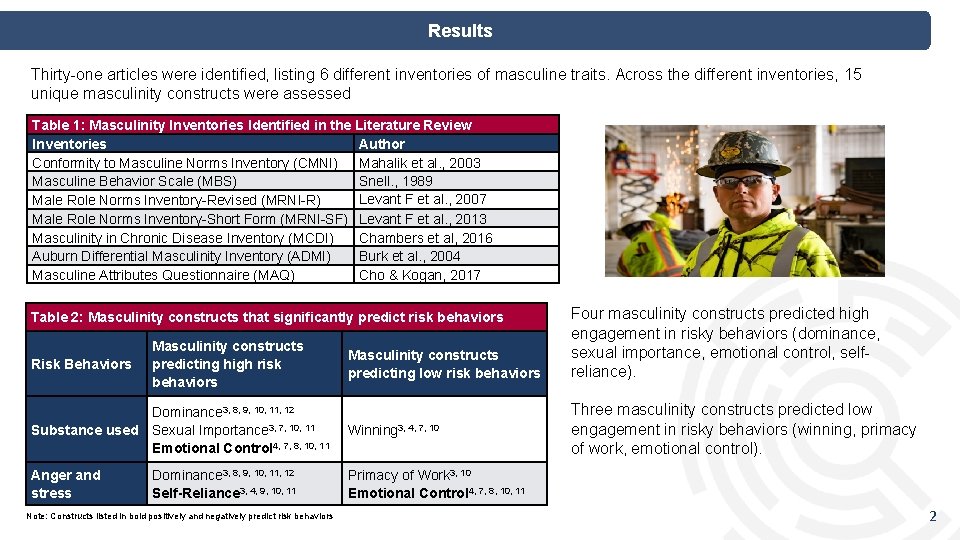
Results Thirty-one articles were identified, listing 6 different inventories of masculine traits. Across the different inventories, 15 unique masculinity constructs were assessed Table 1: Masculinity Inventories Identified in the Literature Review Inventories Author Conformity to Masculine Norms Inventory (CMNI) Mahalik et al. , 2003 Masculine Behavior Scale (MBS) Snell. , 1989 Levant F et al. , 2007 Male Role Norms Inventory-Revised (MRNI-R) Male Role Norms Inventory-Short Form (MRNI-SF) Levant F et al. , 2013 Masculinity in Chronic Disease Inventory (MCDI) Chambers et al, 2016 Auburn Differential Masculinity Inventory (ADMI) Burk et al. , 2004 Masculine Attributes Questionnaire (MAQ) Cho & Kogan, 2017 Table 2: Masculinity constructs that significantly predict risk behaviors Risk Behaviors Masculinity constructs predicting high risk behaviors Masculinity constructs predicting low risk behaviors Dominance 3, 8, 9, 10, 11, 12 Substance used Sexual Importance 3, 7, 10, 11 Emotional Control 4, 7, 8, 10, 11 Winning 3, 4, 7, 10 Anger and stress Primacy of Work 3, 10 Emotional Control 4, 7, 8, 10, 11 Dominance 3, 8, 9, 10, 11, 12 Self-Reliance 3, 4, 9, 10, 11 Note: Constructs listed in bold positively and negatively predict risk behaviors Four masculinity constructs predicted high engagement in risky behaviors (dominance, sexual importance, emotional control, selfreliance). Three masculinity constructs predicted low engagement in risky behaviors (winning, primacy of work, emotional control). 2

Table 3: Masculinity constructs that significantly predict healthy behaviors Masculinity constructs predicting low Health Behavior healthy behavior Positive attitudes toward colorectal cancer Bias Against Sexual Minorities 3, 10, 11 screening Preventive self-care Dominance 3, 8, 9, 10, 11, 12 Sexual importance 3, 7, 10, 11 Healthy Behavior Inventory (total score with risk Risk taking 3, 10, 11, 12 behavior items reverse coded) Emotional Control 4, 7, 8, 10, 11 Global Physical Health Emotional Control 4, 7, 8, 10, 11 Sexual Importance 3, 7, 10, 11 Global Mental Health Optimistic Capacity 7 Emotional Control 4, 7, 8, 10, 11 Mental Health-Related Quality of Life (MCS) Masculinity constructs predicting high healthy behavior None Primacy of Work 3, 10 Winning 3, 4, 7, 10 None Action Approach 7 Self-Reliance 3, 4, 9, 10, 11 Physical Health-Related Quality of Life (PCS) Emotional Control 4, 7, 8, 10, 11 None Sexual help-seeking behavior, and less None Strength 7 Note: Constructs listed in bold positively and negatively predict risk behaviors • Six masculinity constructs predicted low engagement in healthy lifestyle • Five masculinity construct predicted high engagement in healthy lifestyle • Two masculinity constructs predicted both healthy and unhealthy behaviors (emotional control and self-reliance) Discussion: Although the literature typically portrays masculine traits as having negative influence on men’s health behavior, these findings suggest that masculine traits can predict both positive and negative health behaviors in men. These findings can help direct the development of cancer prevention interventions for men. 3
Funding Partnership for the Advancement of Cancer Research, supported in part by NCI grants U 54 CA 132383 (NMSU) and U 54 CA 132381 (Fred Hutch). For more information contact: Bidemi Adedokun, MSc bidemi@nmsu. edu cancer. nmsu. edu
- Slides: 4