
The relationship between cortisol and memory Preliminary analysis
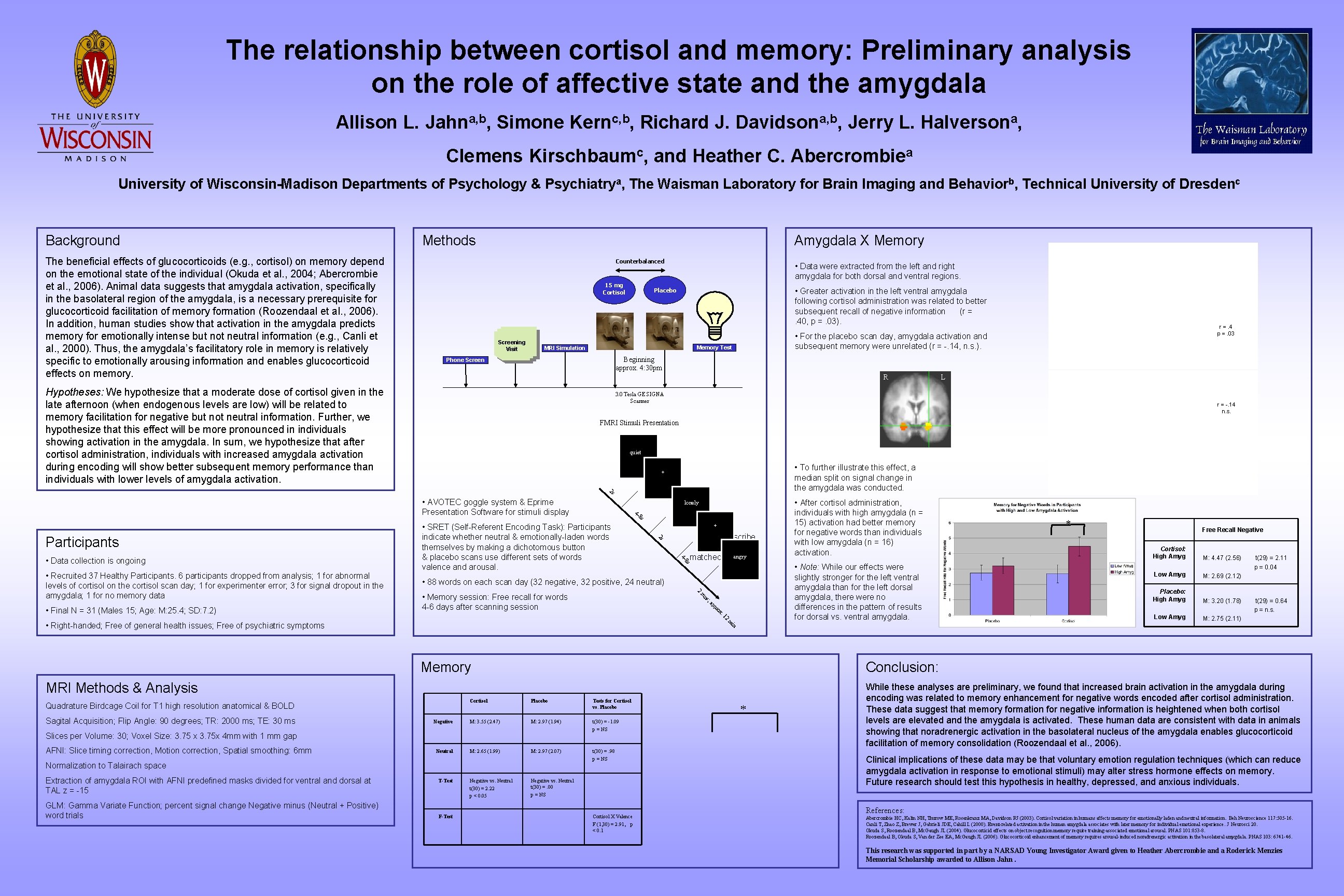
The relationship between cortisol and memory: Preliminary analysis on the role of affective state and the amygdala Allison L. Jahna, b, Simone Kernc, b, Richard J. Davidsona, b, Jerry L. Halversona, Clemens Kirschbaumc, and Heather C. Abercrombiea University of Wisconsin-Madison Departments of Psychology & Psychiatrya, The Waisman Laboratory for Brain Imaging and Behaviorb, Technical University of Dresdenc Background The beneficial effects of glucocorticoids (e. g. , cortisol) on memory depend on the emotional state of the individual (Okuda et al. , 2004; Abercrombie et al. , 2006). Animal data suggests that amygdala activation, specifically in the basolateral region of the amygdala, is a necessary prerequisite for glucocorticoid facilitation of memory formation (Roozendaal et al. , 2006). In addition, human studies show that activation in the amygdala predicts memory for emotionally intense but not neutral information (e. g. , Canli et al. , 2000). Thus, the amygdala’s facilitatory role in memory is relatively specific to emotionally arousing information and enables glucocorticoid effects on memory. Methods Amygdala X Memory Counterbalanced 15 mg Cortisol Screening Visit • Data were extracted from the left and right amygdala for both dorsal and ventral regions. • Greater activation in the left ventral amygdala following cortisol administration was related to better subsequent recall of negative information (r =. 40, p =. 03). Placebo • For the placebo scan day, amygdala activation and subsequent memory were unrelated (r = -. 14, n. s. ). Memory Test MRI Simulation Beginning approx. 4: 30 pm Phone Screen R Hypotheses: We hypothesize that a moderate dose of cortisol given in the late afternoon (when endogenous levels are low) will be related to memory facilitation for negative but not neutral information. Further, we hypothesize that this effect will be more pronounced in individuals showing activation in the amygdala. In sum, we hypothesize that after cortisol administration, individuals with increased amygdala activation during encoding will show better subsequent memory performance than individuals with lower levels of amygdala activation. r = -. 14 n. s. FMRI Stimuli Presentation quiet • To further illustrate this effect, a median split on signal change in the amygdala was conducted. + 2 s lonely 8 s 4 - describe press. Cortisol matched forangry 8 s • 88 words on each scan day (32 negative, 32 positive, 24 neutral) ; ns ru • Memory session: Free recall for words 4 -6 days after scanning session pr ap 2 . 1 ox Memory Cortisol Placebo Tests for Cortisol vs. Placebo Negative M: 3. 55 (2. 47) M: 2. 97 (1. 94) t(30) = -1. 09 p = NS Neutral M: 2. 65 (1. 99) M: 2. 97 (2. 07) t(30) =. 98 p = NS Quadrature Birdcage Coil for T 1 high resolution anatomical & BOLD Slices per Volume: 30; Voxel Size: 3. 75 x 3. 75 x 4 mm with 1 mm gap AFNI: Slice timing correction, Motion correction, Spatial smoothing: 6 mm Normalization to Talairach space Extraction of amygdala ROI with AFNI predefined masks divided for ventral and dorsal at TAL z = -15 GLM: Gamma Variate Function; percent signal change Negative minus (Neutral + Positive) word trials Free Recall Negative Cortisol: High Amyg M: 4. 47 (2. 56) Low Amyg M: 2. 69 (2. 12) Placebo: High Amyg M: 3. 20 (1. 78) Low Amyg M: 2. 75 (2. 11) t(29) = 2. 11 p = 0. 04 t(29) = 0. 64 p = n. s. Conclusion: MRI Methods & Analysis Sagital Acquisition; Flip Angle: 90 degrees; TR: 2000 ms; TE: 30 ms * in m • Right-handed; Free of general health issues; Free of psychiatric symptoms • After cortisol administration, individuals with high amygdala (n = 15) activation had better memory for negative words than individuals with low amygdala (n = 16) activation. • Note: While our effects were slightly stronger for the left ventral amygdala than for the left dorsal amygdala, there were no differences in the pattern of results for dorsal vs. ventral amygdala. 2 • Final N = 31 (Males 15; Age: M: 25. 4; SD: 7. 2) + 4 - • Recruited 37 Healthy Participants. 6 participants dropped from analysis; 1 for abnormal levels of cortisol on the cortisol scan day; 1 for experimenter error; 3 for signal dropout in the amygdala; 1 for no memory data • SRET (Self-Referent Encoding Task): Participants indicate whether neutral & emotionally-laden words themselves by making a dichotomous button & placebo scans use different sets of words valence and arousal. 2 s • Data collection is ongoing L 3. 0 Tesla GE SIGNA Scanner • AVOTEC goggle system & Eprime Presentation Software for stimuli display Participants r =. 4 p =. 03 T-Test F-Test Negative vs. Neutral t(30) = 2. 22 p < 0. 05 Negative vs. Neutral t(30) =. 00 p = NS Cortisol X Valence F (1, 30) = 2. 91, p < 0. 1 * While these analyses are preliminary, we found that increased brain activation in the amygdala during encoding was related to memory enhancement for negative words encoded after cortisol administration. These data suggest that memory formation for negative information is heightened when both cortisol levels are elevated and the amygdala is activated. These human data are consistent with data in animals showing that noradrenergic activation in the basolateral nucleus of the amygdala enables glucocorticoid facilitation of memory consolidation (Roozendaal et al. , 2006). Clinical implications of these data may be that voluntary emotion regulation techniques (which can reduce amygdala activation in response to emotional stimuli) may alter stress hormone effects on memory. Future research should test this hypothesis in healthy, depressed, and anxious individuals. References: Abercrombie HC, Kalin NH, Thurow ME, Rosenkranz MA, Davidson RJ (2003). Cortisol variation in humans affects memory for emotionally laden and neutral information. Beh Neuroscience 117: 505 -16. Canli T, Zhao Z, Brewer J, Gabrieli JDE, Cahill L (2000). Event-related activation in the human amygdala associates with later memory for individual emotional experience. J Neurosci 20. Okuda S, Roozendaal B, Mc. Gaugh JL (2004). Glucocorticid effects on object recognition memory require training-associated emotional arousal. PNAS 101: 853 -8. Roozendaal B, Okuda S, Van der Zee EA, Mc. Gaugh JL (2006). Glucocorticoid enhancement of memory requires arousal-induced noradrenergic activation in the basolateral amygdala. PNAS 103: 6741 -46. This research was supported in part by a NARSAD Young Investigator Award given to Heather Abercrombie and a Roderick Menzies Memorial Scholarship awarded to Allison Jahn.
- Slides: 1