
The Relationship Between Academic Advising and Student Retention
The Relationship Between Academic Advising and Student Retention Creating Student Success – One Student at a Time Presented by: Bernard J. Gantt – Dean of Academic Services Octavio Melendez, Director – Academic Success Center (ASC) Benjamin Levine – ASC Success Coach Anyikem Asong – ASC Success Coach Melanie Robles – Associate Director – ASAP PACE University Second Annual Retention Conference Friday, June 15, 2018
Strategic Direction Building a Community of Excellence Bronx Community College Operational Plan (2015 -2020) GOAL 2: EMPOWER STUDENTS TO SUCCEED OBJECTIVE 2. 2 Assure a cohesive academic experience (from precollege - post-graduation) including clear pathways, organized experiences, and consistent communications with clear oversight and accountabilities in place. • Integrate academic advisement and support services
Academic Advising at BCC • Bronx Community College’s advisement models seek to effectively advise students by creating a positive advisor-student relationship that promotes student success. • A pre-requisite of a successful academic advisement experience is the participation of the student in the decision-making process.
Research Connection • Article: Developing Trusting Relationships in Academic Advising: A Review of the Literature with Recommendations for Practices • November 13, 2014 • Jeffrey L. Mc. Clellan, Frostburg State University
Academic Advising at BCC • At the root of our mission is a concept of developing a trusting relationship with students through the process of academic advisement. • In this instance, “trust is not behavior (e. g. , cooperation), or a choice (e. g. , taking a risk), but an underlying psychological condition that can cause or result from such actions” (Rousseau, Sitkin, Burt, & Camerer, 1998, p. 395).

Academic Advising at BCC • At Bronx Community College, faculty and professional advisement staff are responsible for academic advising. Advisors are instrumental in making the student’s educational experience personal by: 1. 2. 3. 4. connecting a student’s personal goals to departmental curricula; providing an outline of the degree requirements for graduation; providing relevant information about career options and opportunities connected to the student’s degree choice; and assisting students in creating an academic and financial plan for his/her degree program.
Academic Advising Philosophy • We believe that a successful academic advisement experience will serve as: a medium for communicating the college’s policies, procedures and expectations; a bridge for a student’s traversal to student life; and a path for a smoother road toward graduation.
BCC Advisement Models • Faculty Advisor • ASAP • College Discovery • CUNY Edge • Success Coach • First Year Seminar
Academic Success Center Mission Statement • The Academic Success Center is committed to promoting and delivering consistent highquality academic advising designed to help students achieve excellence in their academic and professional goals. • The Center also assist students with the process of developing appropriate long range educational plans that serve as clear pathways toward timely graduation.
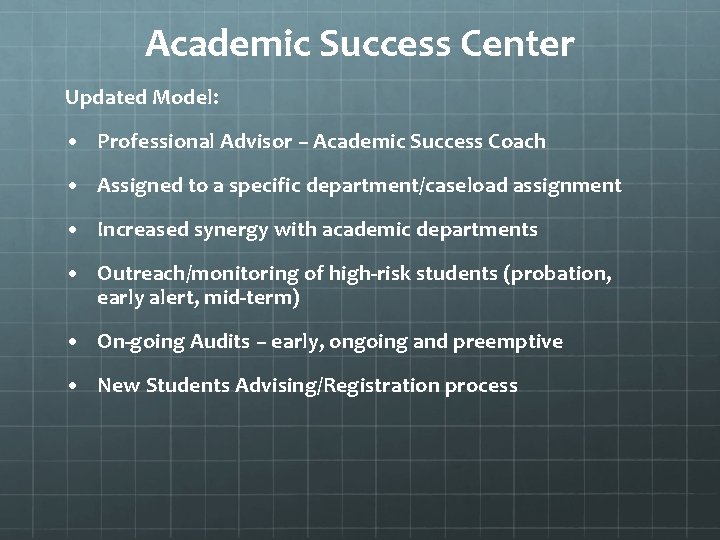
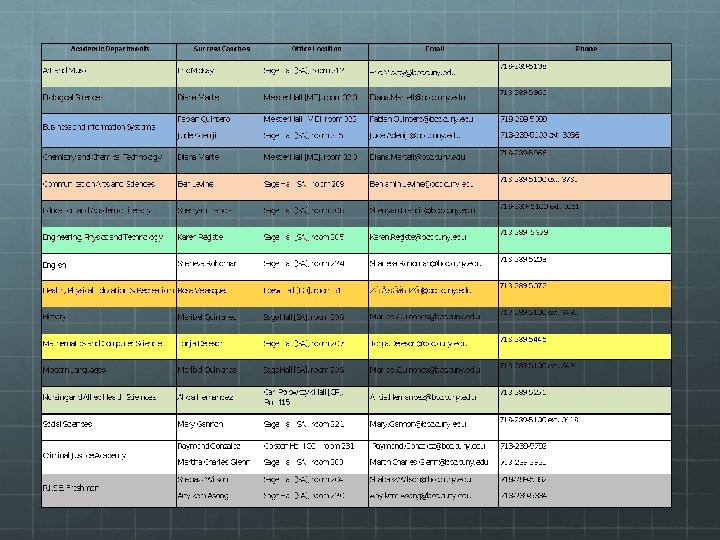
Academic Success Center Updated Model: • Professional Advisor – Academic Success Coach • Assigned to a specific department/caseload assignment • Increased synergy with academic departments • Outreach/monitoring of high-risk students (probation, early alert, mid-term) • On-going Audits – early, ongoing and preemptive • New Students Advising/Registration process
Academic Success Center New Student Registration Retention Starts at the Beginning 12 6/15/2018
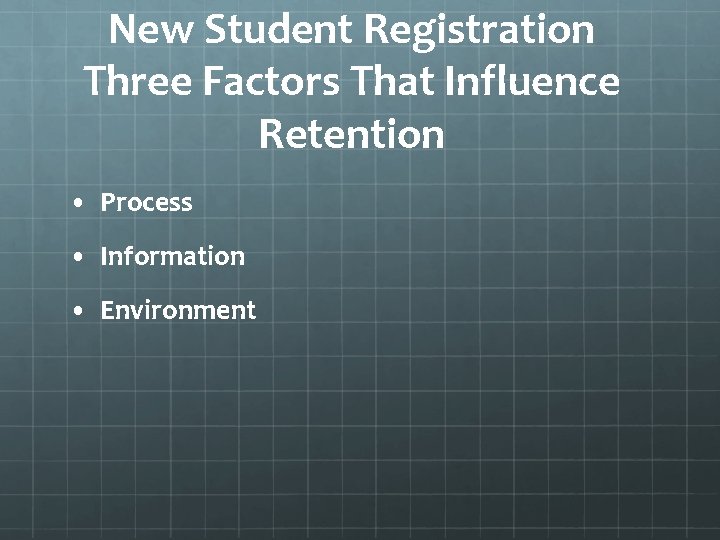
New Student Registration Three Factors That Influence Retention • Process • Information • Environment
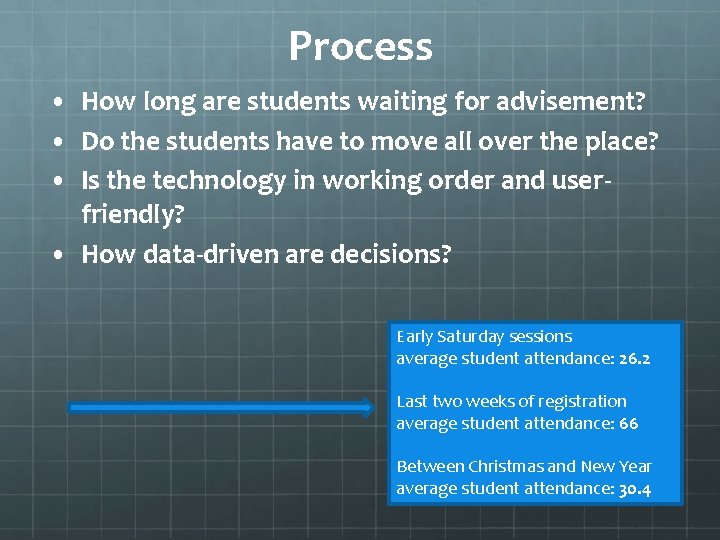
Process • How long are students waiting for advisement? • Do the students have to move all over the place? • Is the technology in working order and userfriendly? • How data-driven are decisions? Early Saturday sessions average student attendance: 26. 2 Last two weeks of registration average student attendance: 66 Between Christmas and New Year average student attendance: 30. 4
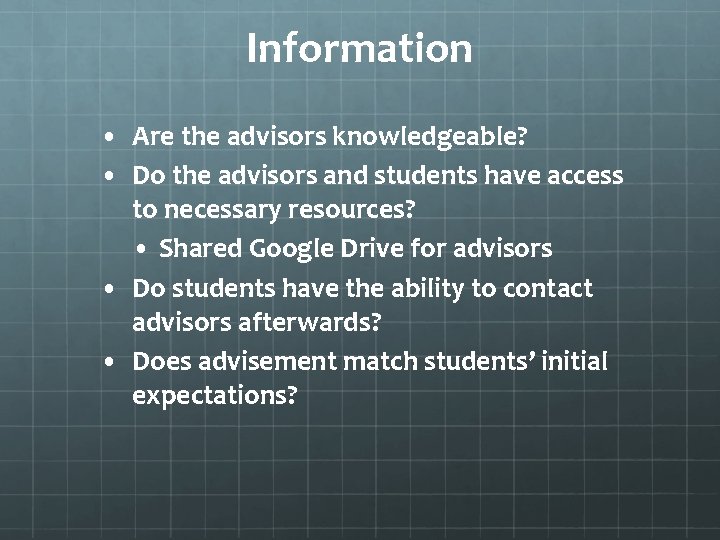
Information • Are the advisors knowledgeable? • Do the advisors and students have access to necessary resources? • Shared Google Drive for advisors • Do students have the ability to contact advisors afterwards? • Does advisement match students’ initial expectations?
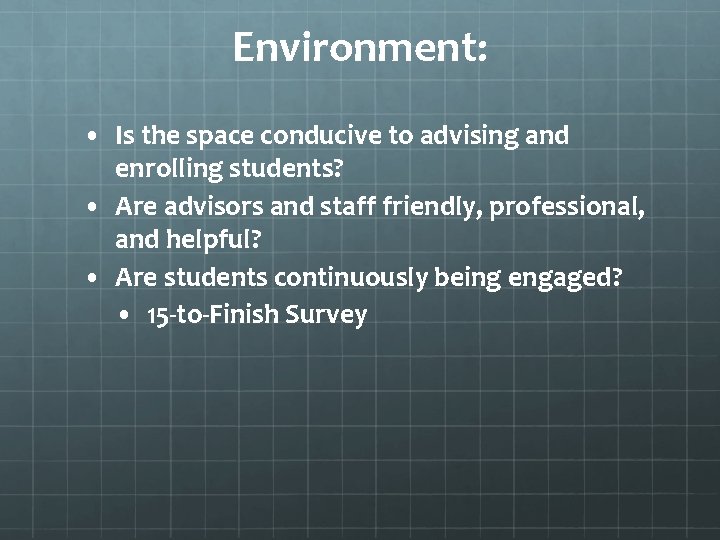
Environment: • Is the space conducive to advising and enrolling students? • Are advisors and staff friendly, professional, and helpful? • Are students continuously being engaged? • 15 -to-Finish Survey
Takeaway New Student Registration is probably the first academic experience students will have at college. We want to make sure they start off on the right foot!
Academic Success Center Freshmen Cohort 18 6/15/2018
Research Connection • “Good advising may be the single most underestimated characteristic of a successful college experience. ” Light, R. J. (2001). Making the Most of College.
Academic Success Center Freshmen Strategies • First Impressions – Opportunity • • • Lay the Foundation / Build trust Engage/ Clarify purpose of relationship Explore skills and interests Meet students where they are – Determine approach Sustain communication / Develop an educational plan • Accuracy • When advisors make errors, students hesitate • Utilizing tools at disposal to ensure efficient advising / impact retention
Academic Success Center Freshmen Strategies TOOLS: • • Starfish Summer Success Freshman Year Seminar Advisement Holds
Academic Success Center Freshmen Strategies • Goal setting / Long range planning • Degree Maps • 15/30 to Finish • Gateway completion • Early interventions • • Students contacted at key points in semester Identifying “at risk” students Avoid academic probation Financial aid • Holistic Approach • Empower students to succeed • Foster Self-sufficiency
The ASAP Advising Experience
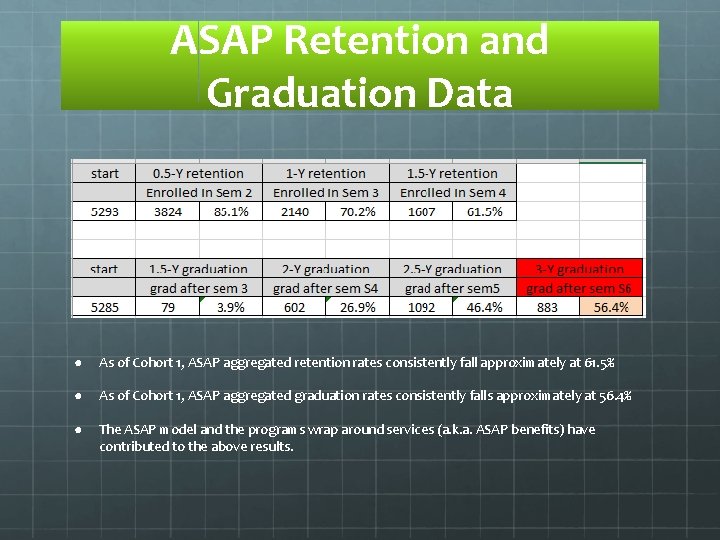
ASAP Retention and Graduation Data ● As of Cohort 1, ASAP aggregated retention rates consistently fall approximately at 61. 5% ● As of Cohort 1, ASAP aggregated graduation rates consistently falls approximately at 56. 4% ● The ASAP model and the programs wrap around services (a. k. a. ASAP benefits) have contributed to the above results.
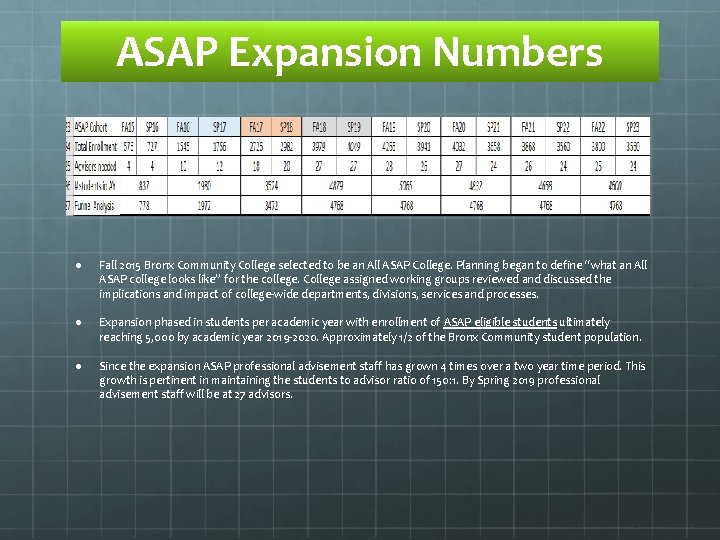
ASAP Expansion Numbers ● Fall 2015 Bronx Community College selected to be an All ASAP College. Planning began to define “what an All ASAP college looks like” for the college. College assigned working groups reviewed and discussed the implications and impact of college-wide departments, divisions, services and processes. ● Expansion phased in students per academic year with enrollment of ASAP eligible students ultimately reaching 5, 000 by academic year 2019 -2020. Approximately 1/2 of the Bronx Community student population. ● Since the expansion ASAP professional advisement staff has grown 4 times over a two year time period. This growth is pertinent in maintaining the students to advisor ratio of 150: 1. By Spring 2019 professional advisement staff will be at 27 advisors.
Objectives • Think holistically about student development and connect theory to advisement (practice) • Tools caseload management • Student-tailored advisement • Collaborative relationships with students
Methods of Assessing Throughout Advising: Identifying student needs and obstacles to best support student and meet them where they are at. • Qualitative and quantitative information: Intake, student self-report, behavior, assessment tools • Noel Levitz Assessment (Pre-assessment) or Intake Questionnaire • Needs Assessment –Student Development Theory • Developmental Process-Goal Setting
Pre-Assessment Noel Levitz • Assessing students early to identify areas where students may have trouble. • Able to develop early interventions with students-goal setting. • Results are predicators of how student ultimately perform and how engaged they will be with the program. (See Noel Levitz Analysis)
Intentional Advisement Many of our students are “at-risk” and need more support than they ask for or are even are aware of. • Aim to move from crisis-orientated, reactive approach to preventive. • Intentional interventions aimed at working with students to decrease barriers before they become insurmountable. • Collaborative strategizing to increase the probability of student success. • Advisement focused on transformation and growth. • Consistent interactions and purposeful relationship building. (Bimonthly meetings, phone calls, emails, workshops, referrals, continuous communication, etc. ) • Reflective, intentional, ongoing assessment and triage
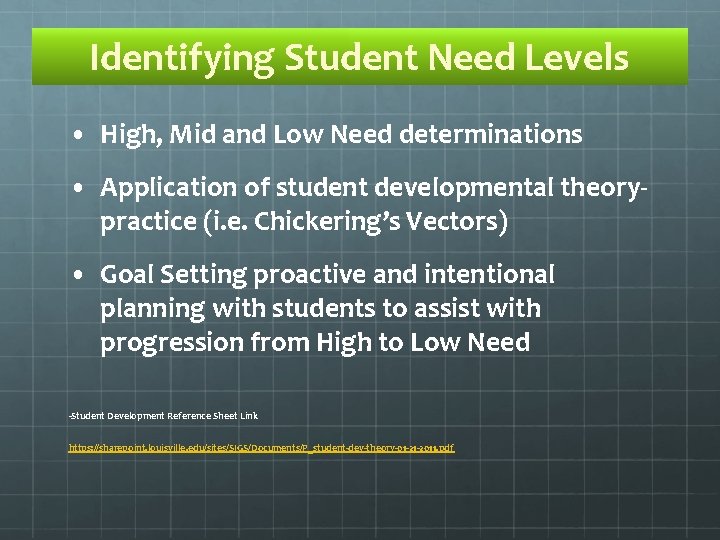
Identifying Student Need Levels • High, Mid and Low Need determinations • Application of student developmental theorypractice (i. e. Chickering’s Vectors) • Goal Setting proactive and intentional planning with students to assist with progression from High to Low Need -Student Development Reference Sheet Link https: //sharepoint. louisville. edu/sites/SIGS/Documents/P_student-dev-theory-01 -21 -2011. pdf
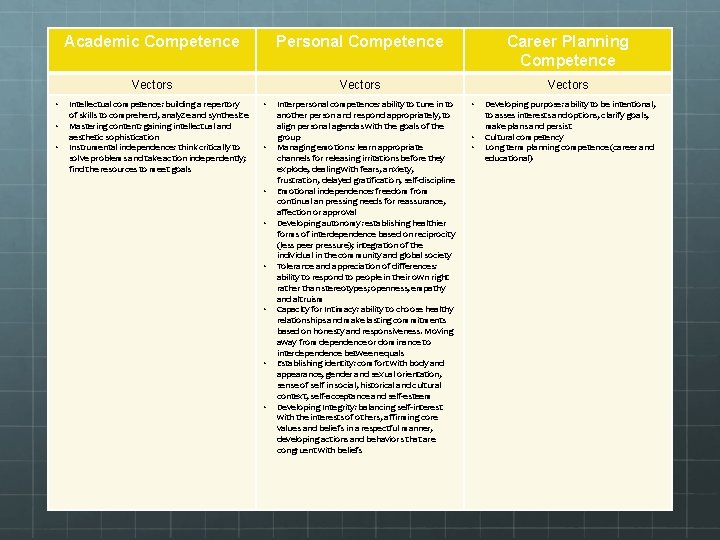
• • • Academic Competence Personal Competence Career Planning Competence Vectors Intellectual competence: building a repertory of skills to comprehend, analyze and synthesize Mastering content: gaining intellectual and aesthetic sophistication Instrumental independence: think critically to solve problems and take action independently; find the resources to meet goals • • Interpersonal competence: ability to tune in to another person and respond appropriately, to align personal agendas with the goals of the group Managing emotions: learn appropriate channels for releasing irritations before they explode, dealing with fears, anxiety, frustration, delayed gratification, self-discipline Emotional independence: freedom from continual an pressing needs for reassurance, affection or approval Developing autonomy: establishing healthier forms of interdependence based on reciprocity (less peer pressure); integration of the individual in the community and global society Tolerance and appreciation of differences: ability to respond to people in their own right rather than stereotypes; openness, empathy and altruism Capacity for Intimacy: ability to choose healthy relationships and make lasting commitments based on honesty and responsiveness. Moving away from dependence or dominance to interdependence between equals Establishing identity: comfort with body and appearance, gender and sexual orientation, sense of self in social, historical and cultural context, self-acceptance and self-esteem Developing Integrity: balancing self-interest with the interests of others, affirming core values and beliefs in a respectful manner, developing actions and behaviors that are congruent with beliefs • • • Developing purpose: ability to be intentional, to asses interests and options, clarify goals, make plans and persist Cultural competency Long term planning competence (career and educational)
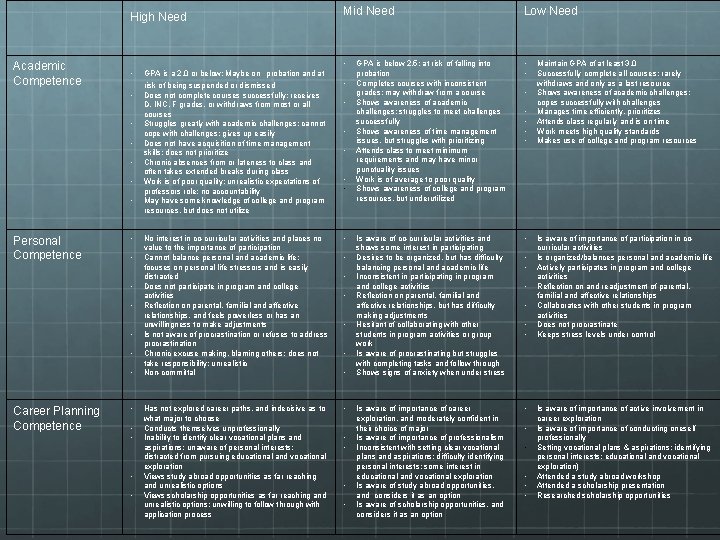
High Need Academic Competence • • Personal Competence • • Career Planning Competence • • • GPA is a 2. 0 or below; Maybe on probation and at risk of being suspended or dismissed Does not complete courses successfully; receives D, INC, F grades, or withdraws from most or all courses Struggles greatly with academic challenges; cannot cope with challenges; gives up easily Does not have acquisition of time management skills; does not prioritize Chronic absences from or lateness to class and often takes extended breaks during class Work is of poor quality; unrealistic expectations of professors role; no accountability May have some knowledge of college and program resources, but does not utilize Mid Need Low Need • GPA is below 2. 5; at risk of falling into probation Completes courses with inconsistent grades; may withdraw from a course Shows awareness of academic challenges; struggles to meet challenges successfully Shows awareness of time management issues, but struggles with prioritizing Attends class to meet minimum requirements and may have minor punctuality issues Work is of average to poor quality Shows awareness of college and program resources, but underutilized • • Is aware of co-curricular activities and shows some interest in participating Desires to be organized, but has difficulty balancing personal and academic life Inconsistent in participating in program and college activities Reflection on parental, familial and affective relationships, but has difficulty making adjustments Hesitant of collaborating with other students in program activities or group work Is aware of procrastinating but struggles with completing tasks and follow through Shows signs of anxiety when under stress • Is aware of importance of career exploration, and moderately confident in their choice of major Is aware of importance of professionalism Inconsistent with setting clear vocational plans and aspirations; difficulty identifying personal interests; some interest in educational and vocational exploration Is aware of study abroad opportunities, and considers it as an option Is aware of scholarship opportunities, and considers it as an option • • No interest in co-curricular activities and places no value to the importance of participation Cannot balance personal and academic life; focuses on personal life stressors and is easily distracted Does not participate in program and college activities Reflection on parental, familial and affective relationships, and feels powerless or has an unwillingness to make adjustments Is not aware of procrastination or refuses to address procrastination Chronic excuse making, blaming others; does not take responsibility; unrealistic Non-committal • Has not explored career paths, and indecisive as to what major to choose Conducts themselves unprofessionally Inability to identify clear vocational plans and aspirations; unaware of personal interests; distracted from pursuing educational and vocational exploration Views study abroad opportunities as far reaching and unrealistic options Views scholarship opportunities as far reaching and unrealistic options; unwilling to follow through with application process • • • • • • • Maintain GPA of at least 3. 0 Successfully complete all courses; rarely withdraws and only as a last resource Shows awareness of academic challenges; copes successfully with challenges Manages time efficiently, prioritizes Attends class regularly and is on time Work meets high quality standards Makes use of college and program resources Is aware of importance of participation in cocurricular activities Is organized/balances personal and academic life Actively participates in program and college activities Reflection on and readjustment of parental, familial and affective relationships Collaborates with other students in program activities Does not procrastinate Keeps stress levels under control Is aware of importance of active involvement in career exploration Is aware of importance of conducting oneself professionally Setting vocational plans & aspirations; identifying personal interests; educational and vocational exploration) Attended a study abroad workshop Attended a scholarship presentation Researched scholarship opportunities
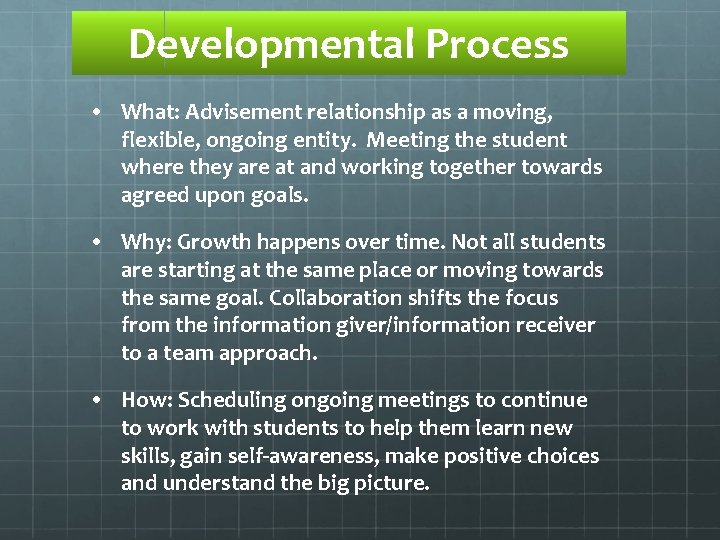
Developmental Process • What: Advisement relationship as a moving, flexible, ongoing entity. Meeting the student where they are at and working together towards agreed upon goals. • Why: Growth happens over time. Not all students are starting at the same place or moving towards the same goal. Collaboration shifts the focus from the information giver/information receiver to a team approach. • How: Scheduling ongoing meetings to continue to work with students to help them learn new skills, gain self-awareness, make positive choices and understand the big picture.
Thank You

Q&A
Contact Information Bernard J. Gantt Dean of Academic Services bernard. gantt@bcc. cuny. edu 718 -289 -5887 Octavio Melendez Director, Academic Success Center (ASC) octavio. melendez@bcc. cuny. edu 718 -289 -5886 Benjamin Levine Success Coach, Academic Success Center (ASC) benjamin. levine@bcc. cuny. edu 718 -289 -5100, ext. 3781 Anyikem Asong Success Coach, Academic Success Center (ASC) anyikem. asong@bcc. cuny. edu 718 -289 -5884 Melanie Robles Associate Director, ASAP (Accelerated Studies in Associates Programs) melanie. robles@bcc. cuny. edu 718 -289 -5196
- Slides: 36