
The Relational Model Chapter 4 Brief History of

The Relational Model Chapter 4
Brief History of the Relational Model • A relational model of data for large shared data banks” (Codd, 1970) • To allow a high degree of data independence • To provide substantial grounds for dealing with data semantics, consistency, and redundancy problems • To enable the expansion of set-oriented data manipulation languages. • DBMS System R (IBM) • DB 2 and SQL/DS from IBM • Oracle from Oracle Corporation. • INGRES (Interactive Graphics Retrieval System) project at the University of California at Berkeley • etc
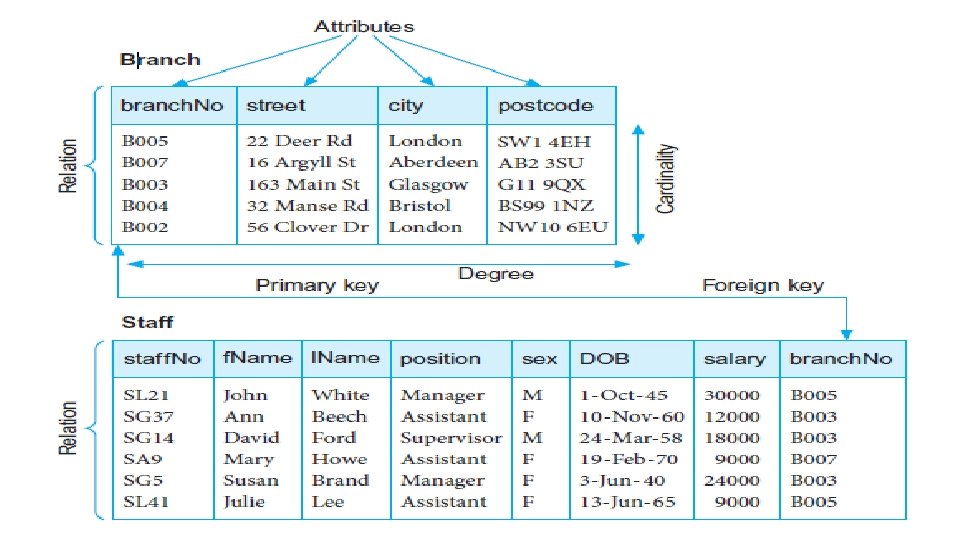
Terminology • Relational Data Structure • • Relation: A relation is a table with columns and rows. Attribute: An attribute is a named column of a relation. Domain: A domain is the set of allowable values for one or more attributes. Tuple: A tuple is a row of a relation. Degree: The degree of a relation is the number of attributes it contains. Cardinality: The cardinality of a relation is the number of tuples it contains. Relational database: A collection of normalized relations with distinct relation names.
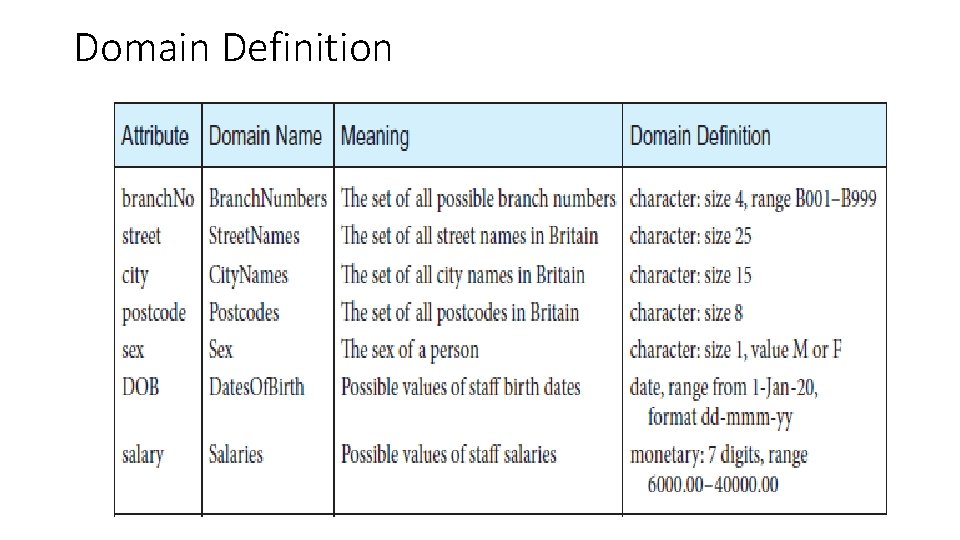
Domain Definition
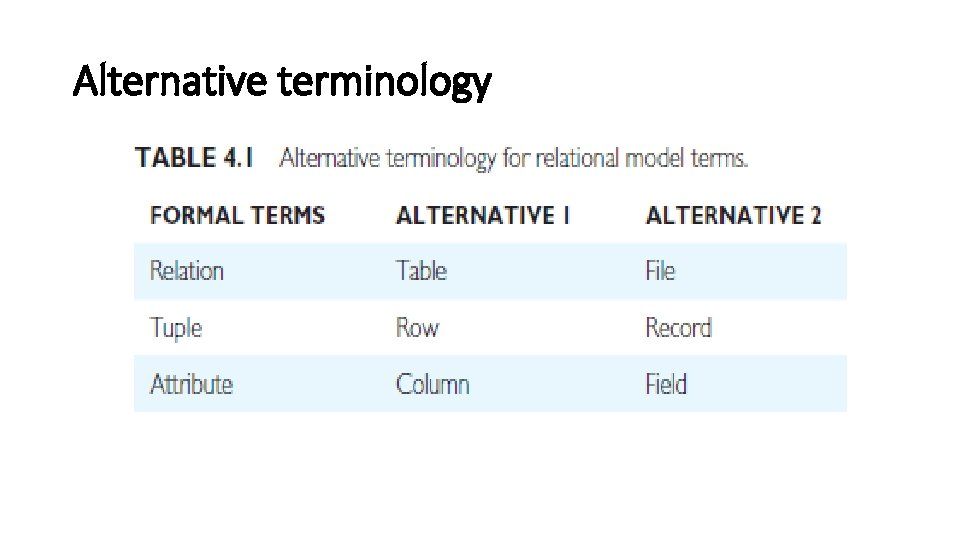
Alternative terminology
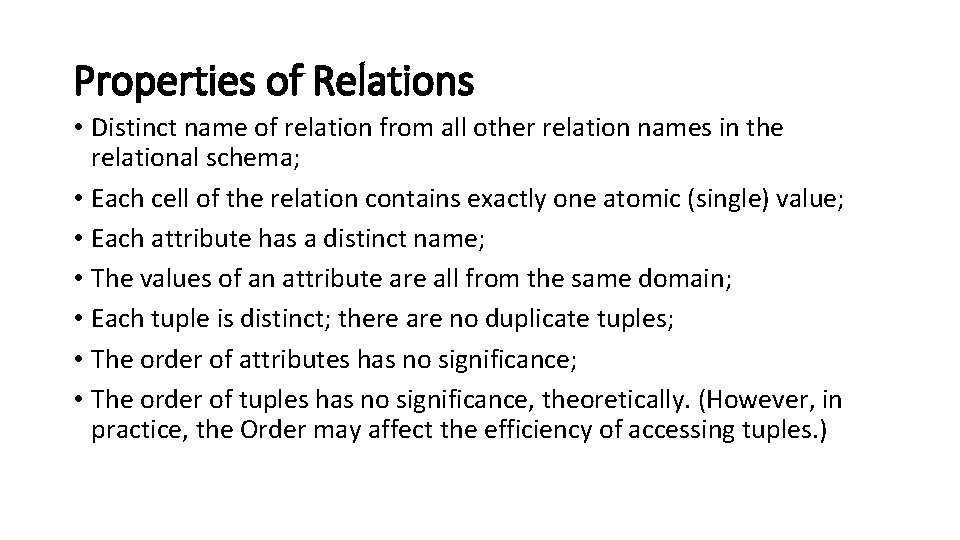
Properties of Relations • Distinct name of relation from all other relation names in the relational schema; • Each cell of the relation contains exactly one atomic (single) value; • Each attribute has a distinct name; • The values of an attribute are all from the same domain; • Each tuple is distinct; there are no duplicate tuples; • The order of attributes has no significance; • The order of tuples has no significance, theoretically. (However, in practice, the Order may affect the efficiency of accessing tuples. )
Relational Keys • Primary key • The attribute that is selected to identify tuples uniquely within the relation. • Foreign key An attribute, or set of attributes, within one relation that matches the candidate key of some (possibly the same) relation.
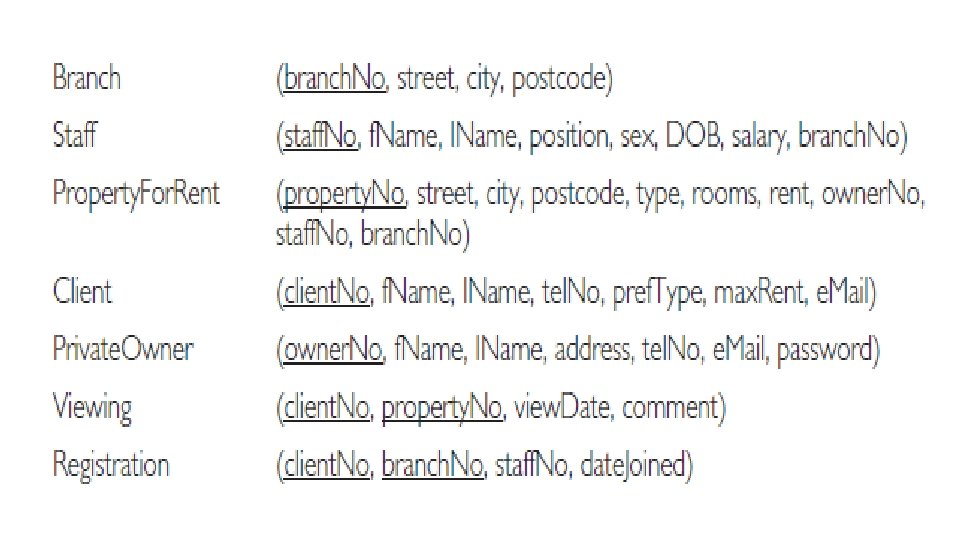
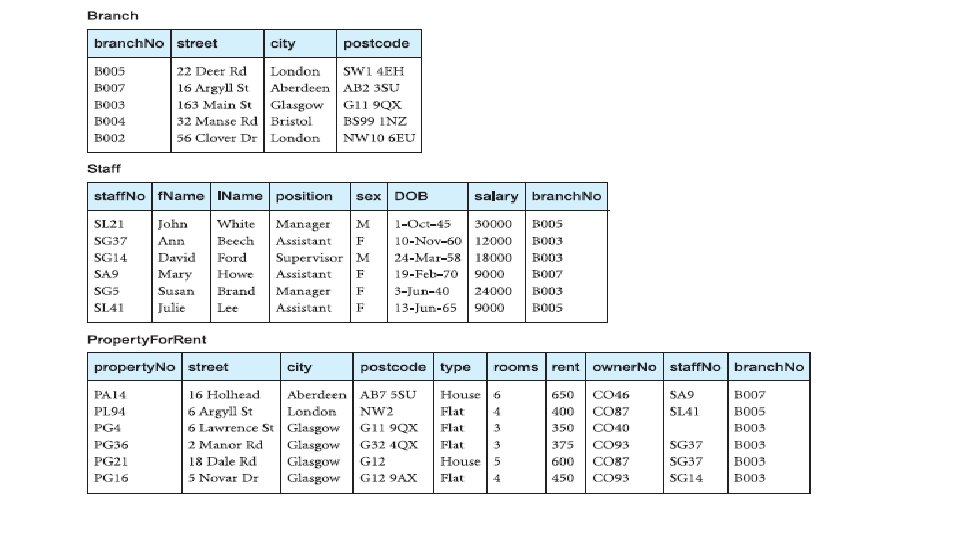
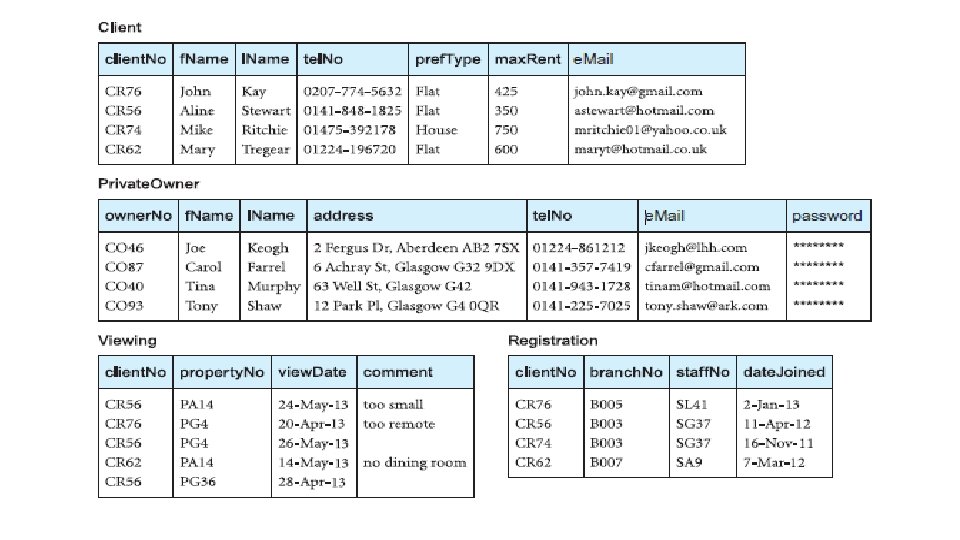
Representing Relational Database Schemas • A relational database consists of any number of normalized relations. • The relational schema for part of the Dream. Home case study is:
Integrity Constraints • Domain constraints • Null • Entity Integrity • Referential Integrity • General Constraints
• Domain constraints: Every attribute has an associated domain, there are constraints (called that form restrictions on the set of values allowed for the attributes of relations. • Null: Represents a value for an attribute that is currently unknown or is not applicable for this tuple. • Entity integrity: In a base relation, no attribute of a primary key can be null. • Referential integrity: • If a foreign key exists in a relation, either the foreign key value must match a candidate key value of some tuple in its home relation or the foreign key value must be wholly null. • General constraints: • Additional rules specified by the users or database administrators of a database that define or constrain some aspect of the enterprise.
Views • Base relation : A named relation corresponding to an entity in the conceptual schema, whose tuples are physically stored in the database. • View: The dynamic result of one or more relational operations operating on the base relations to produce another relation. • A view is a virtual relation that does not necessarily exist in the database but can be produced upon request by a particular user, at the time of request.
Purpose of Views • It provides a powerful and flexible security mechanism • It permits users to access data in a way that is customized to their needs • It can simplify complex operations on the base relations
Updating Views • Using a simple query involving a single base relation and containing either the primary key or a candidate key of the base relation. • Updates are not allowed through views involving multiple base relations. • Updates are not allowed through views involving aggregation or grouping operations.
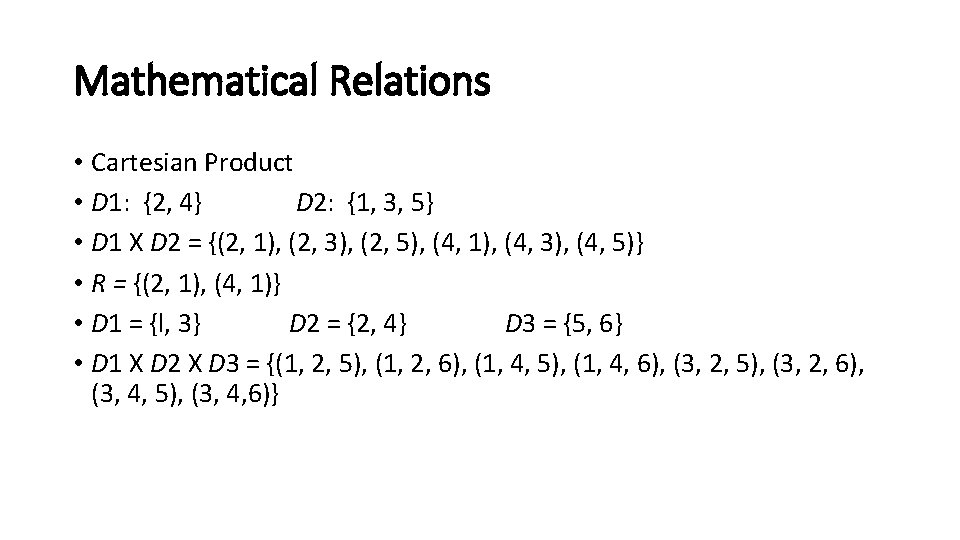
Mathematical Relations • Cartesian Product • D 1: {2, 4} D 2: {1, 3, 5} • D 1 X D 2 = {(2, 1), (2, 3), (2, 5), (4, 1), (4, 3), (4, 5)} • R = {(2, 1), (4, 1)} • D 1 = {l, 3} D 2 = {2, 4} D 3 = {5, 6} • D 1 X D 2 X D 3 = {(1, 2, 5), (1, 2, 6), (1, 4, 5), (1, 4, 6), (3, 2, 5), (3, 2, 6), (3, 4, 5), (3, 4, 6)}
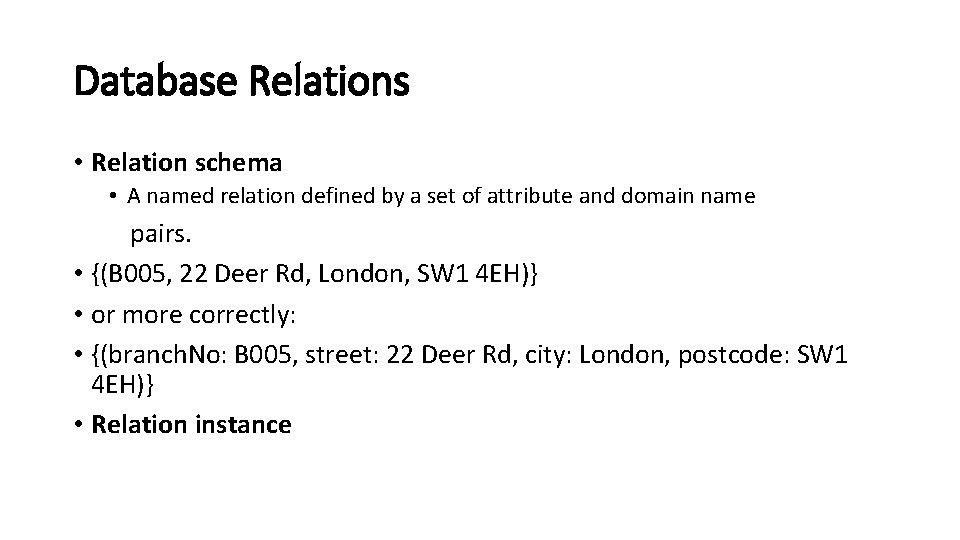
Database Relations • Relation schema • A named relation defined by a set of attribute and domain name pairs. • {(B 005, 22 Deer Rd, London, SW 1 4 EH)} • or more correctly: • {(branch. No: B 005, street: 22 Deer Rd, city: London, postcode: SW 1 4 EH)} • Relation instance
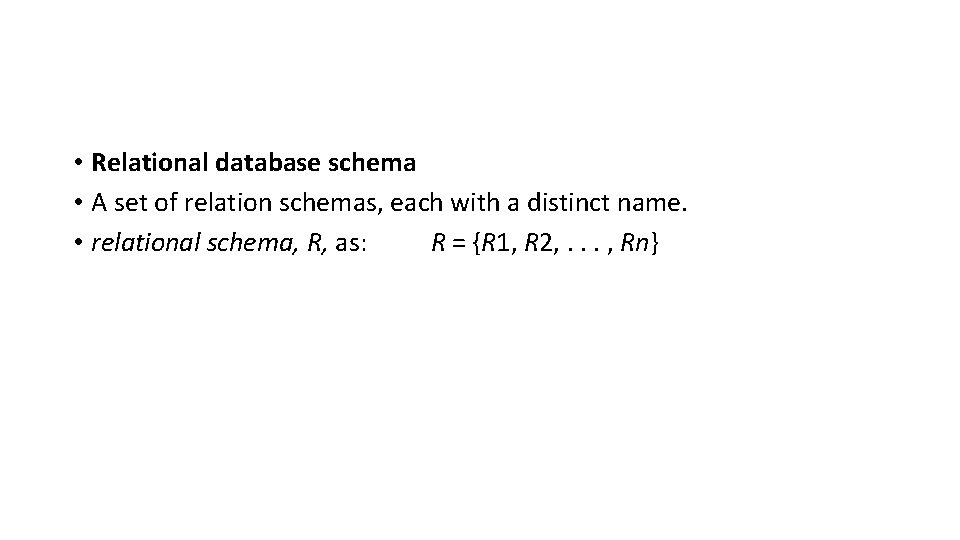
• Relational database schema • A set of relation schemas, each with a distinct name. • relational schema, R, as: R = {R 1, R 2, . . . , Rn}
- Slides: 20