
The Relation Between Stress Accent and Pronunciation Variation
The Relation Between Stress Accent and Pronunciation Variation in Spontaneous American English Discourse Steven Greenberg, Hannah Carvey, Leah Hitchcock and Shuangyu Chang International Computer Science Institute 1947 Center Street, Berkeley, CA 94704 {steveng, hmcarvey, leahh, shawnc}@icsi. berkeley. edu
Acknowledgements and Thanks Research Funding U. S. Department of Defense U. S. National Science Foundation
For Further Information Consult the web site: www. icsi. berkeley. edu/~steveng
OVERTURE A Central Challenge for Models of Speech Recognition
Pronunciation Variability

Pronunciation Variability of Real Speech Pronunciation patterns encountered in everyday life are extremely diverse
Pronunciation Variability of Real Speech Pronunciation patterns encountered in everyday life are extremely diverse There are literally dozens of ways in which common words are pronounced
Pronunciation Variability of Real Speech Pronunciation patterns encountered in everyday life are extremely diverse There are literally dozens of ways in which common words are pronounced (as the following two slides illustrate for the word “AND” based on manual phonetic annotation of a corpus comprising telephone dialogues)
How Many Pronunciations of “and”? N Pronunciation Canonical pronunciation N Pronunciation
How Many Pronunciations of “and”? N Pronunciation
Pronunciation Variability of Real Speech The are literally dozens of ways in which common words are pronounced And as the following slide illustrates for the 20 most frequent words from the same corpus (Switchboard)
Pronunciation Variability of Real Speech The are literally dozens of ways in which common words are pronounced And as the following slide illustrates for the 20 most frequent words from the same corpus (Switchboard) (which together account for 35% of the word tokens in the corpus)
How Many Different Pronunciations? Rank Word N #Pron MCP %Total The 20 most frequent words account for 35% of the tokens Most Common Pronunciation
QUESTION How do listeners decode the speech signal given the large amount of pronunciation variation?
PART ONE Anatomy of a Syllable
The Importance of the Syllable The analyses to follow are all linked, in some fashion, to syllable structure
The Importance of the Syllable The analyses to follow are all linked, in some fashion, to syllable structure In order to highlight patterns germane to variation in segmental duration it is necessary to partition the data in terms of syllable position
The Importance of the Syllable The analyses to follow are all linked, in some fashion, to syllable structure In order to highlight patterns germane to variation in segmental duration it is necessary to partition the data in terms of syllable position (as well as stress accent level)
The Importance of the Syllable The analyses to follow are all linked, in some fashion, to syllable structure In order to highlight patterns germane to variation in segmental duration it is necessary to partition the data in terms of syllable position (as well as stress accent level) As a consequence, we will examine the onsets, codas and nuclei of syllables separately in order to gain insight into the underlying patterns
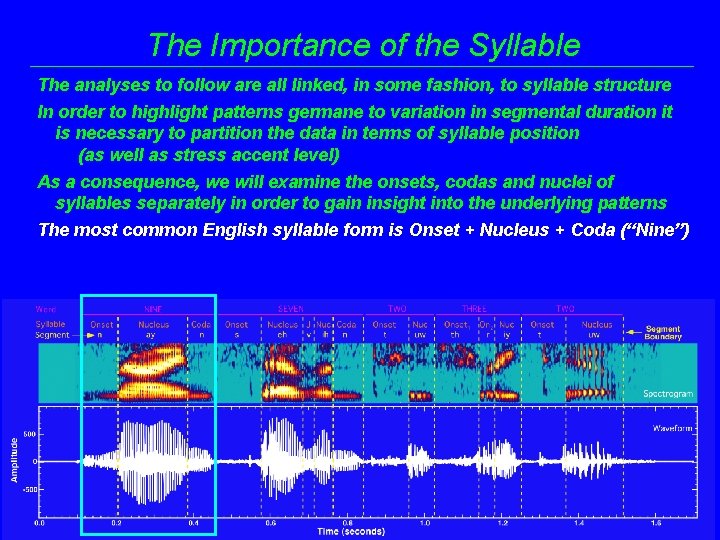
The Importance of the Syllable The analyses to follow are all linked, in some fashion, to syllable structure In order to highlight patterns germane to variation in segmental duration it is necessary to partition the data in terms of syllable position (as well as stress accent level) As a consequence, we will examine the onsets, codas and nuclei of syllables separately in order to gain insight into the underlying patterns The most common English syllable form is Onset + Nucleus + Coda (“Nine”)
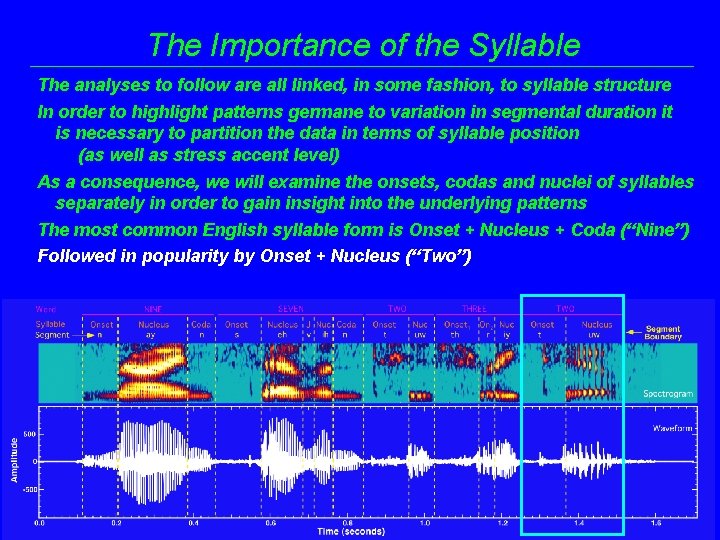
The Importance of the Syllable The analyses to follow are all linked, in some fashion, to syllable structure In order to highlight patterns germane to variation in segmental duration it is necessary to partition the data in terms of syllable position (as well as stress accent level) As a consequence, we will examine the onsets, codas and nuclei of syllables separately in order to gain insight into the underlying patterns The most common English syllable form is Onset + Nucleus + Coda (“Nine”) Followed in popularity by Onset + Nucleus (“Two”)
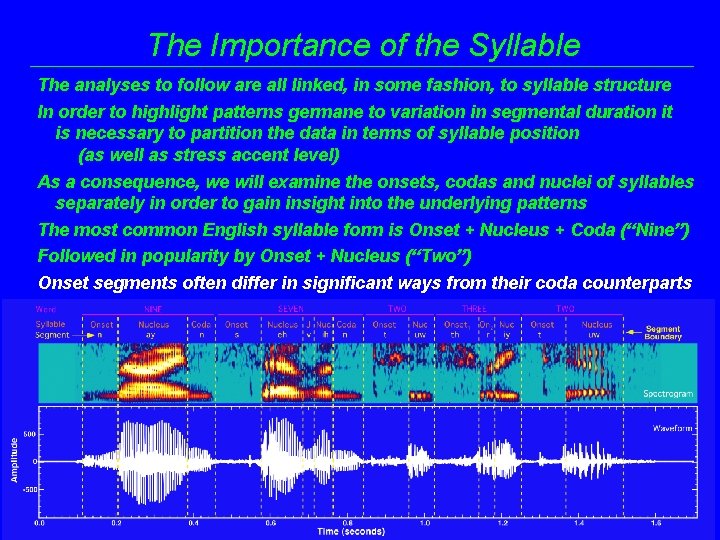
The Importance of the Syllable The analyses to follow are all linked, in some fashion, to syllable structure In order to highlight patterns germane to variation in segmental duration it is necessary to partition the data in terms of syllable position (as well as stress accent level) As a consequence, we will examine the onsets, codas and nuclei of syllables separately in order to gain insight into the underlying patterns The most common English syllable form is Onset + Nucleus + Coda (“Nine”) Followed in popularity by Onset + Nucleus (“Two”) Onset segments often differ in significant ways from their coda counterparts
PART TWO Being Phonetically and Prosodically Annotated
Phonetic Transcription of Spontaneous English Telephone Dialogues of 5 -10 minutes duration, from the SWITCHBOARD corpus, have been phonetically annotated (labeled and segmented)
Phonetic Transcription of Spontaneous English Telephone Dialogues of 5 -10 minutes duration, from the SWITCHBOARD corpus, have been phonetically annotated (labeled and segmented) Most of this material has been manually transcribed
Phonetic Transcription of Spontaneous English Telephone Dialogues of 5 -10 minutes duration, from the SWITCHBOARD corpus, have been phonetically annotated (labeled and segmented) Most of this material has been manually transcribed 4 hours labeled at the phone level and segmented at the syllable level
Phonetic Transcription of Spontaneous English Telephone Dialogues of 5 -10 minutes duration, from the SWITCHBOARD corpus, have been phonetically annotated (labeled and segmented) Most of this material has been manually transcribed 4 hours labeled at the phone level and segmented at the syllable level 1 hour labeled and segmented at the phonetic-segment level
Phonetic Transcription of Spontaneous English Telephone Dialogues of 5 -10 minutes duration, from the SWITCHBOARD corpus, have been phonetically annotated (labeled and segmented) Most of this material has been manually transcribed 4 hours labeled at the phone level and segmented at the syllable level 1 hour labeled and segmented at the phonetic-segment level The remaining 4 hours automatically segmented at the phone level
Phonetic Transcription of Spontaneous English Telephone Dialogues of 5 -10 minutes duration, from the SWITCHBOARD corpus, have been phonetically annotated (labeled and segmented) Most of this material has been manually transcribed 4 hours labeled at the phone level and segmented at the syllable level 1 hour labeled and segmented at the phonetic-segment level The remaining 4 hours automatically segmented at the phone level A 45 minute-subset of this material has been hand-labeled w. r. t. stress accent
Phonetic Transcription of Spontaneous English Telephone Dialogues of 5 -10 minutes duration, from the SWITCHBOARD corpus, have been phonetically annotated (labeled and segmented) Most of this material has been manually transcribed 4 hours labeled at the phone level and segmented at the syllable level 1 hour labeled and segmented at the phonetic-segment level The remaining 4 hours automatically segmented at the phone level A 45 minute-subset of this material has been hand-labeled w. r. t. stress accent The remaining 4 hours of the corpus has been automatically labeled w. r. t. stress accent (though is not used in the current analyses)
Phonetic Transcription of Spontaneous English Telephone Dialogues of 5 -10 minutes duration, from the SWITCHBOARD corpus, have been phonetically annotated (labeled and segmented) Most of this material has been manually transcribed 4 hours labeled at the phone level and segmented at the syllable level 1 hour labeled and segmented at the phonetic-segment level The remaining 4 hours automatically segmented at the phone level A 45 minute-subset of this material has been hand-labeled w. r. t. stress accent The remaining 4 hours of the corpus has been automatically labeled w. r. t. stress accent (though is not used in the current analyses) There is a Lot of Diversity in the Material Transcribed
Phonetic Transcription of Spontaneous English Telephone Dialogues of 5 -10 minutes duration, from the SWITCHBOARD corpus, have been phonetically annotated (labeled and segmented) Most of this material has been manually transcribed 4 hours labeled at the phone level and segmented at the syllable level 1 hour labeled and segmented at the phonetic-segment level The remaining 4 hours automatically segmented at the phone level A 45 minute-subset of this material has been hand-labeled w. r. t. stress accent The remaining 4 hours of the corpus has been automatically labeled w. r. t. stress accent (though is not used in the current analyses) There is a Lot of Diversity in the Material Transcribed Spans speech of both genders (ca. 50/50%), reflecting a wide range of American dialectal variation, speaking rate and voice quality
Phonetic Transcription of Spontaneous English Telephone Dialogues of 5 -10 minutes duration, from the SWITCHBOARD corpus, have been phonetically annotated (labeled and segmented) Most of this material has been manually transcribed 4 hours labeled at the phone level and segmented at the syllable level 1 hour labeled and segmented at the phonetic-segment level The remaining 4 hours automatically segmented at the phone level A 45 minute-subset of this material has been hand-labeled w. r. t. stress accent The remaining 4 hours of the corpus has been automatically labeled w. r. t. stress accent (though is not used in the current analyses) There is a Lot of Diversity in the Material Transcribed Spans speech of both genders (ca. 50/50%), reflecting a wide range of American dialectal variation, speaking rate and voice quality Transcription System A variant of Arpabet (same as used for the TIMIT corpus)
Phonetic Transcription of Spontaneous English The Data are Available at ….
Phonetic Transcription of Spontaneous English The Data are Available at …. http: //www. icsi/berkeley. edu/real/stp
Annotation of Stress Accent Forty-five minutes of the Switchboard corpus was manually labeled with respect to stress accent using perceptual criteria
Annotation of Stress Accent Forty-five minutes of the Switchboard corpus was manually labeled with respect to stress accent using perceptual criteria Three levels of accent were distinguished:
Annotation of Stress Accent Forty-five minutes of the Switchboard corpus was manually labeled with respect to stress accent using perceptual criteria Three levels of accent were distinguished: Heavy
Annotation of Stress Accent Forty-five minutes of the Switchboard corpus was manually labeled with respect to stress accent using perceptual criteria Three levels of accent were distinguished: Heavy Light
Annotation of Stress Accent Forty-five minutes of the Switchboard corpus was manually labeled with respect to stress accent using perceptual criteria Three levels of accent were distinguished: Heavy Light None
Annotation of Stress Accent Forty-five minutes of the Switchboard corpus was manually labeled with respect to stress accent using perceptual criteria Three levels of accent were distinguished: Heavy Light None
Annotation of Stress Accent Forty-five minutes of the Switchboard corpus was manually labeled with respect to stress accent using perceptual criteria Three levels of accent were distinguished: Heavy Light None (In actuality, labelers assigned a “ 1” to fully accented syllables, a “null” to completely unaccented syllables, and a “ 0. 5” to all others)
Annotation of Stress Accent Forty-five minutes of the Switchboard corpus was manually labeled with respect to stress accent using perceptual criteria Three levels of accent were distinguished: Heavy Light None (In actuality, labelers assigned a “ 1” to fully accented syllables, a “null” to completely unaccented syllables, and a “ 0. 5” to all others) An example of the annotation (attached to the vocalic nucleus) is shown below (where the accent levels could not be derived from a dictionary)
Annotation of Stress Accent Forty-five minutes of the Switchboard corpus was manually labeled with respect to stress accent using perceptual criteria Three levels of accent were distinguished: Heavy Light None (In actuality, labelers assigned a “ 1” to fully accented syllables, a “null” to completely unaccented syllables, and a “ 0. 5” to all others) An example of the annotation (attached to the vocalic nucleus) is shown below (where the accent levels could not be derived from a dictionary) In this example most of the syllables are unaccented, with two labeled as lightly accented (0. 5)
Annotation of Stress Accent Forty-five minutes of the Switchboard corpus was manually labeled with respect to stress accent using perceptual criteria Three levels of accent were distinguished: Heavy Light None (In actuality, labelers assigned a “ 1” to fully accented syllables, a “null” to completely unaccented syllables, and a “ 0. 5” to all others) An example of the annotation (attached to the vocalic nucleus) is shown below (where the accent levels could not be derived from a dictionary) In this example most of the syllables are unaccented, with two labeled as lightly accented (0. 5) (and one other labeled as very lightly accented (0. 25))
Annotation of Stress Accent The data are available at ….
Annotation of Stress Accent The data are available at …. http: //www. icsi/berkeley. edu/~steveng/prosody
Automatic Labeling of Stress Accent This forty-five minutes of hand-labeled prosodic (and phonetic) annotation from the Switchboard corpus was used as training data for development of an Automatic Stress Accent Labeling System (Auto. SAL)
How Good is Auto. SAL? There is an 79% concordance between human and machine accent labels when the tolerance level is a quarter-step
How Good is Auto. SAL? There is an 79% concordance between human and machine accent labels when the tolerance level is a quarter-step There is 97. 5% concordance when the tolerance level is half a step
How Good is Auto. SAL? There is an 79% concordance between human and machine accent labels when the tolerance level is a quarter-step There is 97. 5% concordance when the tolerance level is half a step This degree of concordance is as high as that exhibited by two highly trained (human) transcribers
Acoustic/Phonetic/Linguistic Basis of Accent What are the most important features for simulating stress-accent labeling using Auto. SAL?
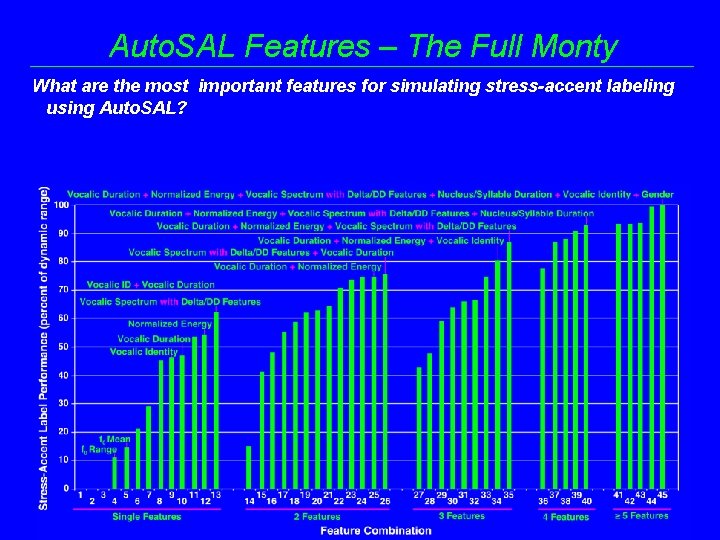
Auto. SAL Features – The Full Monty What are the most important features for simulating stress-accent labeling using Auto. SAL?
Acoustic/Phonetic/Linguistic Basis of Accent What are the most important features for simulating stress-accent labeling using Auto. SAL? Duration
Acoustic/Phonetic/Linguistic Basis of Accent What are the most important features for simulating stress-accent labeling using Auto. SAL? Duration, (normalized) energy
Acoustic/Phonetic/Linguistic Basis of Accent What are the most important features for simulating stress-accent labeling using Auto. SAL? Duration, (normalized) energy, vocalic identity
Acoustic/Phonetic/Linguistic Basis of Accent What are the most important features for simulating stress-accent labeling using Auto. SAL? Duration, (normalized) energy, vocalic identity (and its acoustic correlates)
Acoustic/Phonetic/Linguistic Basis of Accent What are the most important features for simulating stress-accent labeling using Auto. SAL? Duration, (normalized) energy, vocalic identity (and its acoustic correlates) Pitch-related features are (relatively) unimportant for stress-accent labeling
Acoustic/Phonetic/Linguistic Basis of Accent What are the most important features for simulating stress-accent labeling using Auto. SAL? Duration, (normalized) energy, vocalic identity (and its acoustic correlates) Pitch-related features are (relatively) unimportant for stress-accent labeling The Full Monty….
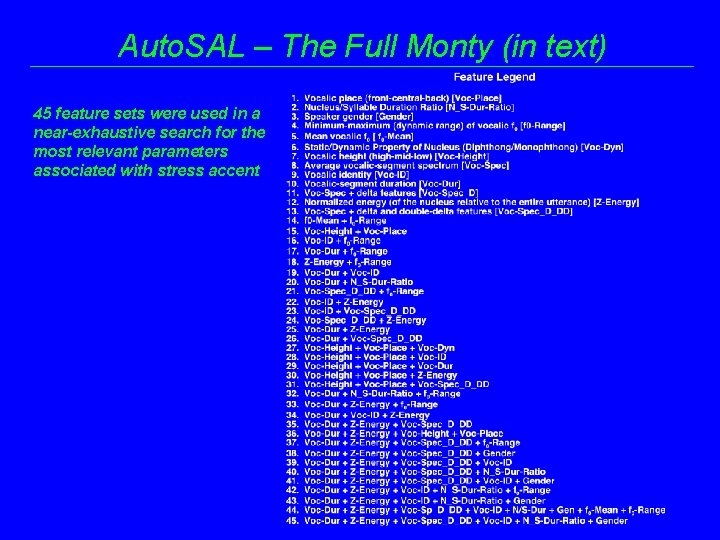
Auto. SAL – The Full Monty (in text) 45 feature sets were used in a near-exhaustive search for the most relevant parameters associated with stress accent
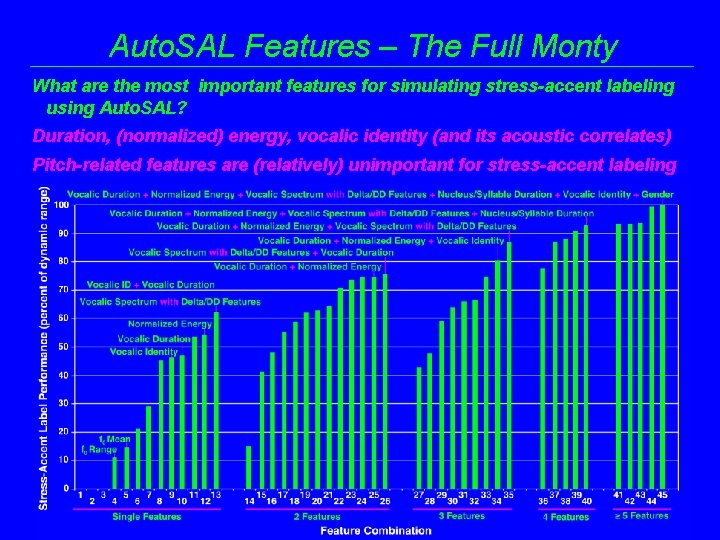
Auto. SAL Features – The Full Monty What are the most important features for simulating stress-accent labeling using Auto. SAL? Duration, (normalized) energy, vocalic identity (and its acoustic correlates) Pitch-related features are (relatively) unimportant for stress-accent labeling
PART THREE Stress Accent and Syllable Position
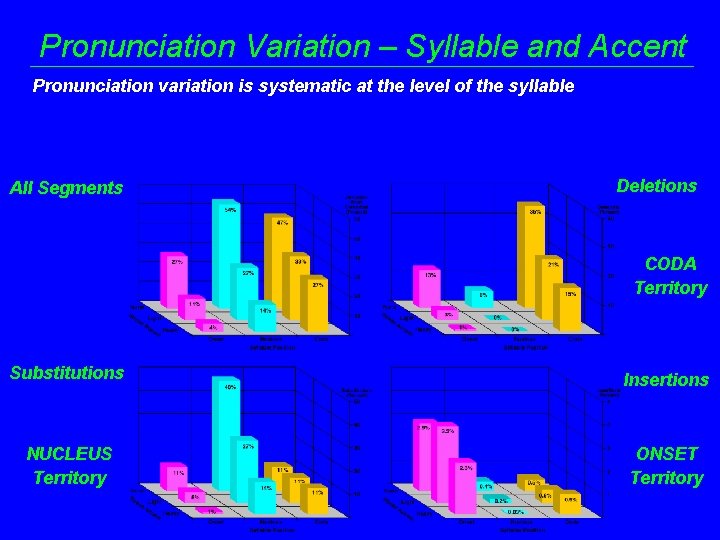
Pronunciation Variation – Syllable and Accent Pronunciation variation is systematic at the level of the syllable All Segments Deletions CODA Territory Substitutions Insertions NUCLEUS Territory ONSET Territory
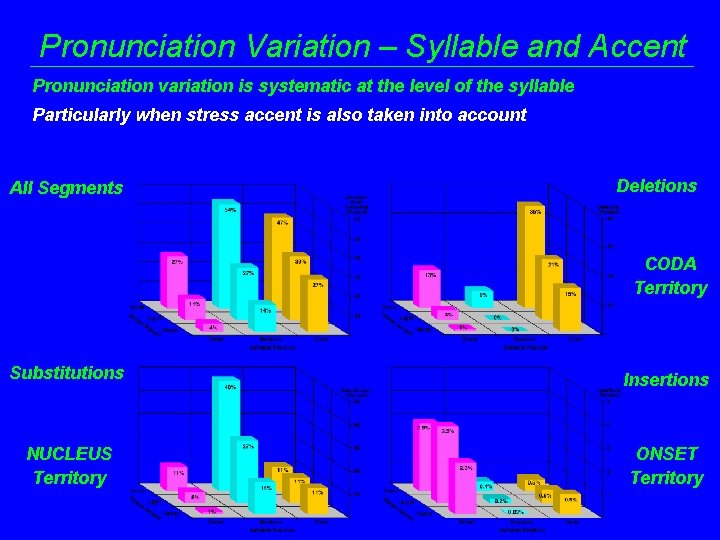
Pronunciation Variation – Syllable and Accent Pronunciation variation is systematic at the level of the syllable Particularly when stress accent is also taken into account All Segments Deletions CODA Territory Substitutions Insertions NUCLEUS Territory ONSET Territory
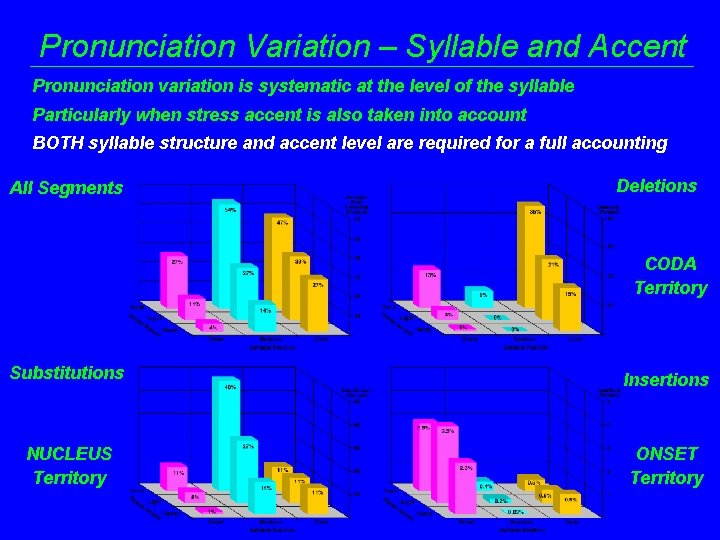
Pronunciation Variation – Syllable and Accent Pronunciation variation is systematic at the level of the syllable Particularly when stress accent is also taken into account BOTH syllable structure and accent level are required for a full accounting All Segments Deletions CODA Territory Substitutions Insertions NUCLEUS Territory ONSET Territory
PART FOUR Stress Accent and the Vocalic Nucleus
Durational Differences - Stressed/Unstressed There is a large dynamic range in duration between accented and unaccented vocalic nuclei Canonical Syllable Forms
Durational Differences - Stressed/Unstressed There is a large dynamic range in duration between accented and unaccented vocalic nuclei Moreover, diphthongs and tense, low monophthongs tend to exhibit a larger dynamic range than the lax monophthongs Canonical Syllable Forms
Durational Differences - Stressed/Unstressed There is a large dynamic range in duration between accented and unaccented vocalic nuclei Moreover, diphthongs and tense, low monophthongs tend to exhibit a larger dynamic range than the lax monophthongs Lax monophthongs Canonical Syllable Forms
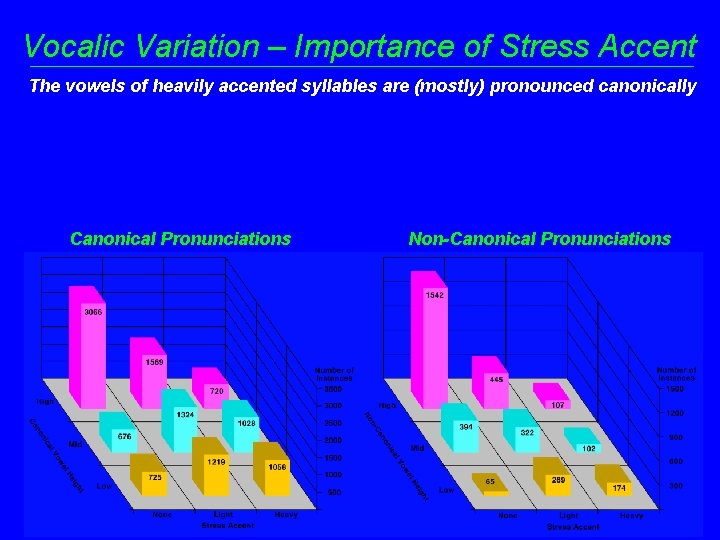
Vocalic Variation – Importance of Stress Accent The vowels of heavily accented syllables are (mostly) pronounced canonically Canonical Pronunciations Non-Canonical Pronunciations
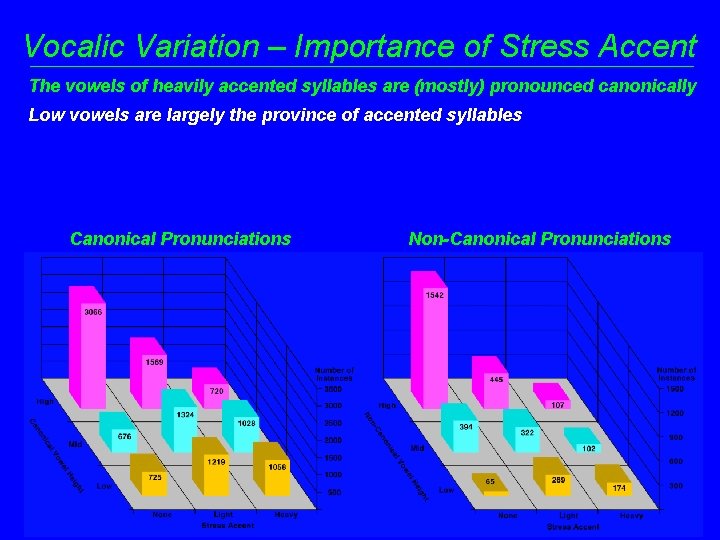
Vocalic Variation – Importance of Stress Accent The vowels of heavily accented syllables are (mostly) pronounced canonically Low vowels are largely the province of accented syllables Canonical Pronunciations Non-Canonical Pronunciations
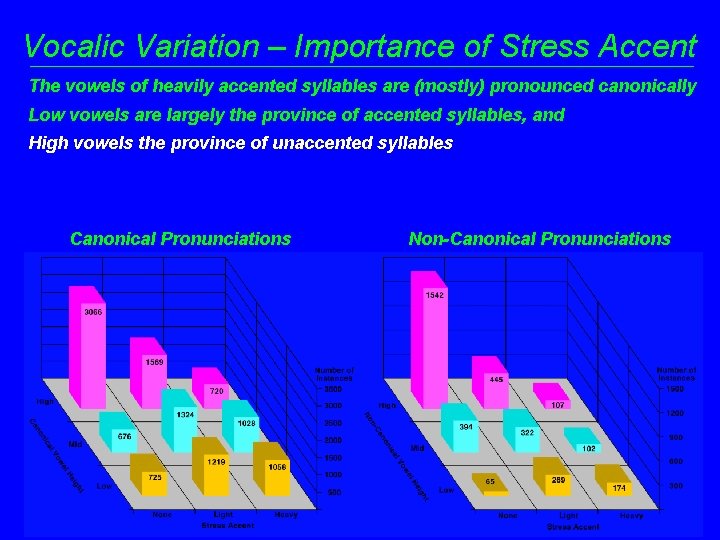
Vocalic Variation – Importance of Stress Accent The vowels of heavily accented syllables are (mostly) pronounced canonically Low vowels are largely the province of accented syllables, and High vowels the province of unaccented syllables Canonical Pronunciations Non-Canonical Pronunciations
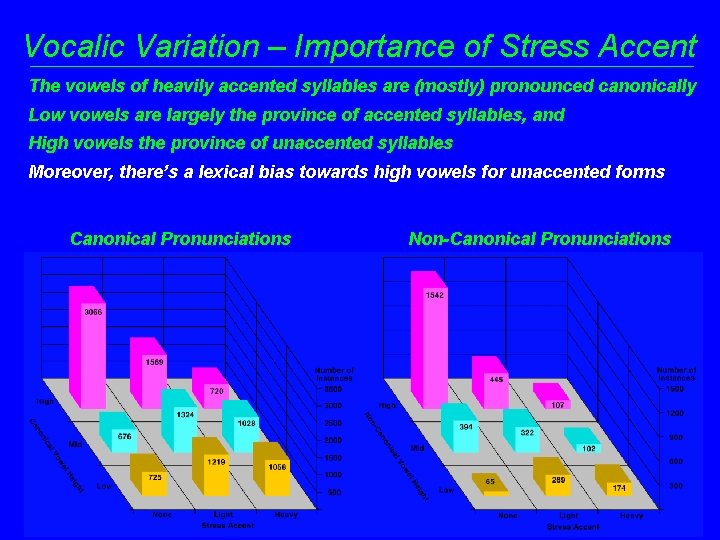
Vocalic Variation – Importance of Stress Accent The vowels of heavily accented syllables are (mostly) pronounced canonically Low vowels are largely the province of accented syllables, and High vowels the province of unaccented syllables Moreover, there’s a lexical bias towards high vowels for unaccented forms Canonical Pronunciations Non-Canonical Pronunciations
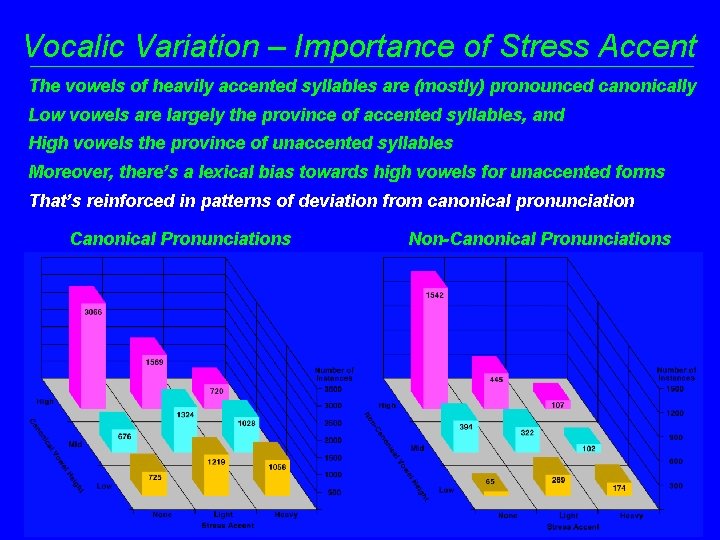
Vocalic Variation – Importance of Stress Accent The vowels of heavily accented syllables are (mostly) pronounced canonically Low vowels are largely the province of accented syllables, and High vowels the province of unaccented syllables Moreover, there’s a lexical bias towards high vowels for unaccented forms That’s reinforced in patterns of deviation from canonical pronunciation Canonical Pronunciations Non-Canonical Pronunciations
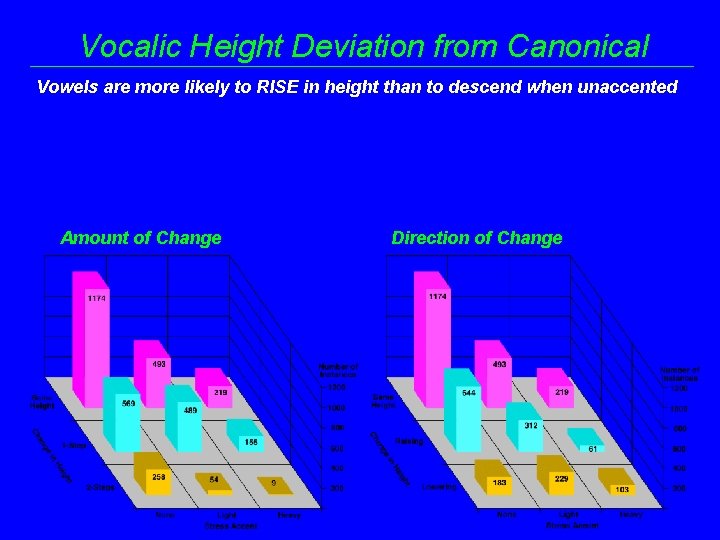
Vocalic Height Deviation from Canonical Vowels are more likely to RISE in height than to descend when unaccented Amount of Change Direction of Change
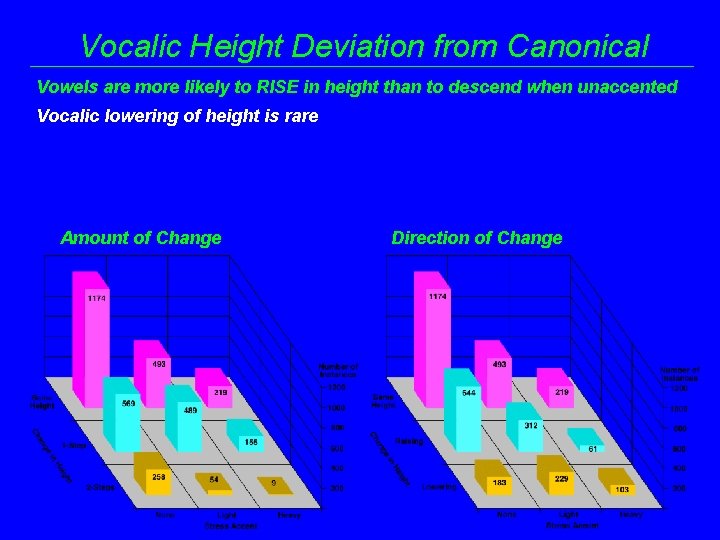
Vocalic Height Deviation from Canonical Vowels are more likely to RISE in height than to descend when unaccented Vocalic lowering of height is rare Amount of Change Direction of Change
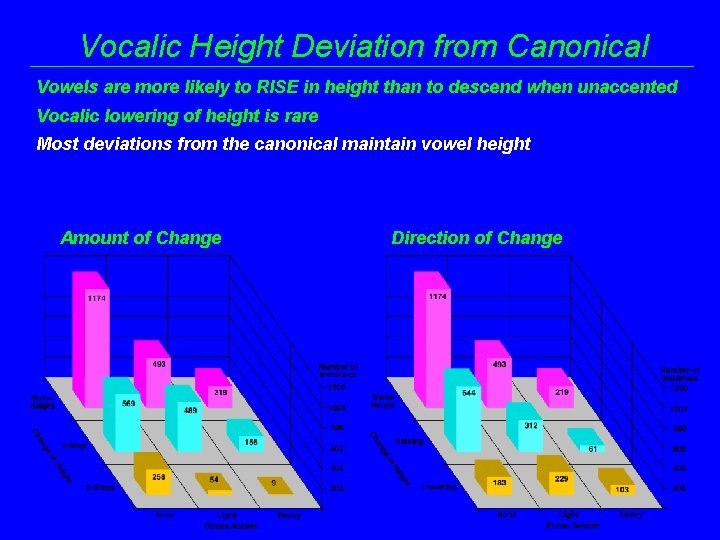
Vocalic Height Deviation from Canonical Vowels are more likely to RISE in height than to descend when unaccented Vocalic lowering of height is rare Most deviations from the canonical maintain vowel height Amount of Change Direction of Change
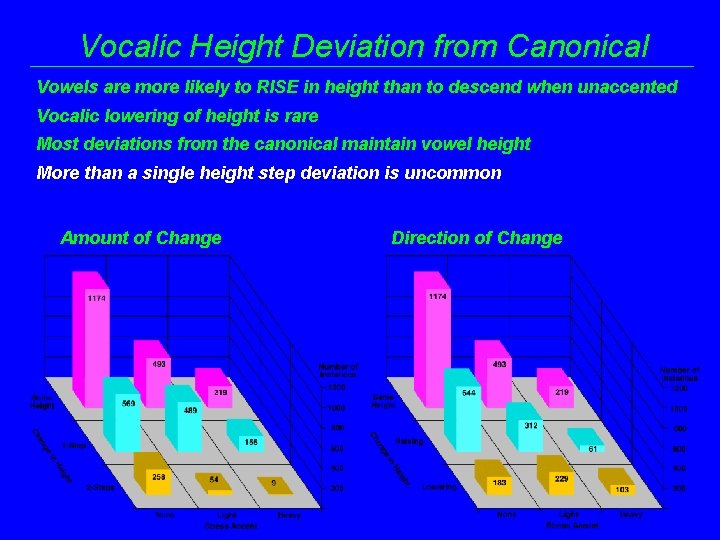
Vocalic Height Deviation from Canonical Vowels are more likely to RISE in height than to descend when unaccented Vocalic lowering of height is rare Most deviations from the canonical maintain vowel height More than a single height step deviation is uncommon Amount of Change Direction of Change
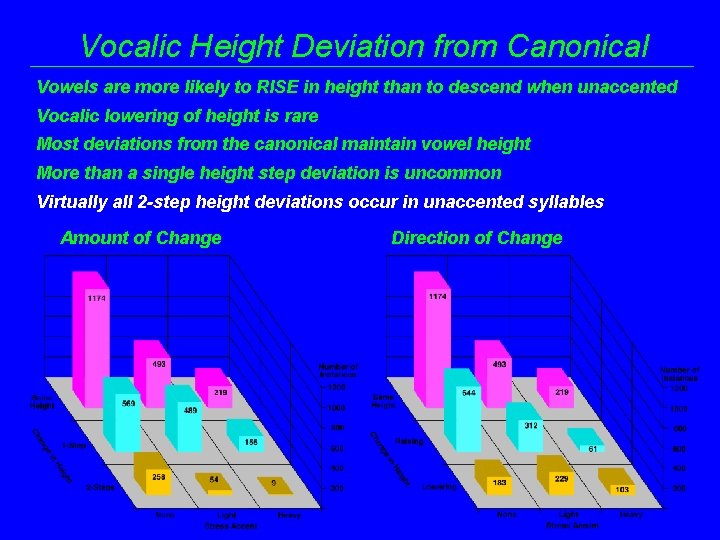
Vocalic Height Deviation from Canonical Vowels are more likely to RISE in height than to descend when unaccented Vocalic lowering of height is rare Most deviations from the canonical maintain vowel height More than a single height step deviation is uncommon Virtually all 2 -step height deviations occur in unaccented syllables Amount of Change Direction of Change
The Vowel Space Under (Full) Stress (Accent) In unaccented nuclei there is a relatively even distribution of segments across the vowel space, with a slight bias towards the front and central vowels
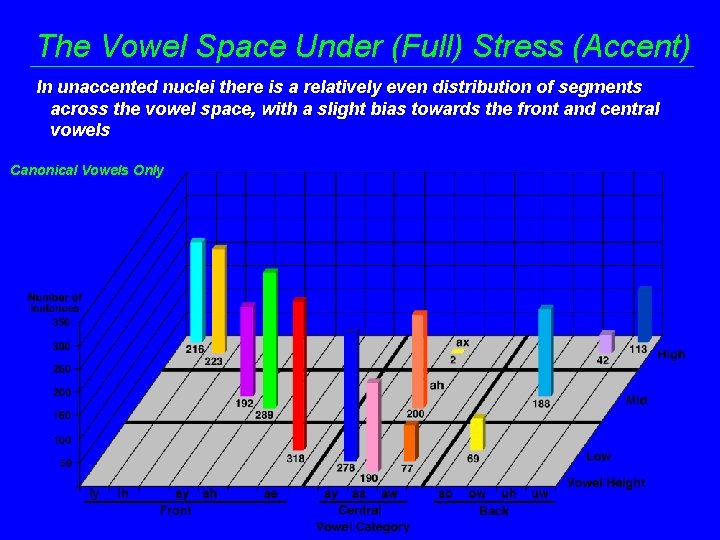
The Vowel Space Under (Full) Stress (Accent) In unaccented nuclei there is a relatively even distribution of segments across the vowel space, with a slight bias towards the front and central vowels Canonical Vowels Only
The Vowel Space Without (Stress) Accent In unaccented syllables, vowels are confined largely to the high-front and high-central sectors of the articulatory space
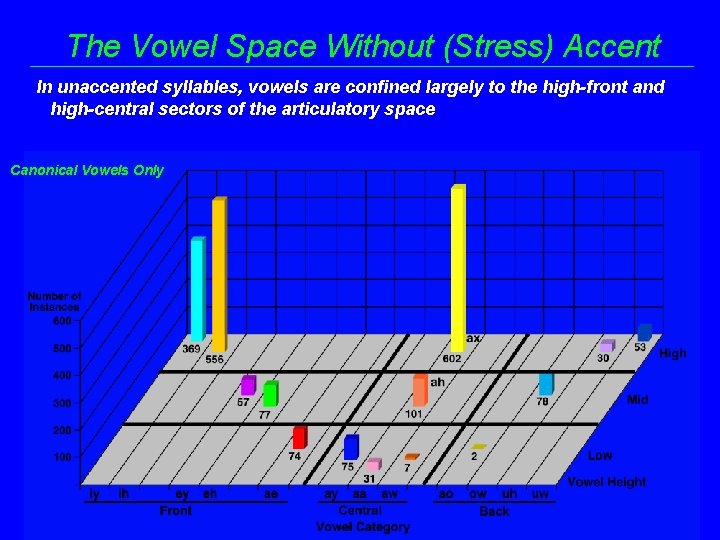
The Vowel Space Without (Stress) Accent In unaccented syllables, vowels are confined largely to the high-front and high-central sectors of the articulatory space Canonical Vowels Only
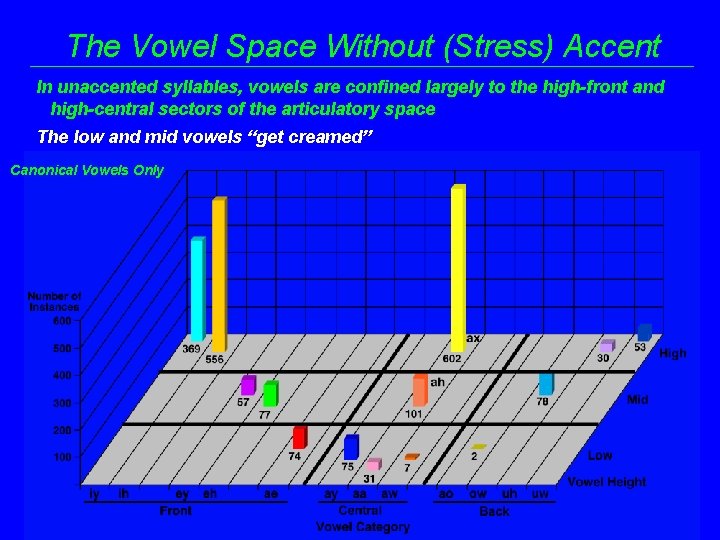
The Vowel Space Without (Stress) Accent In unaccented syllables, vowels are confined largely to the high-front and high-central sectors of the articulatory space The low and mid vowels “get creamed” Canonical Vowels Only
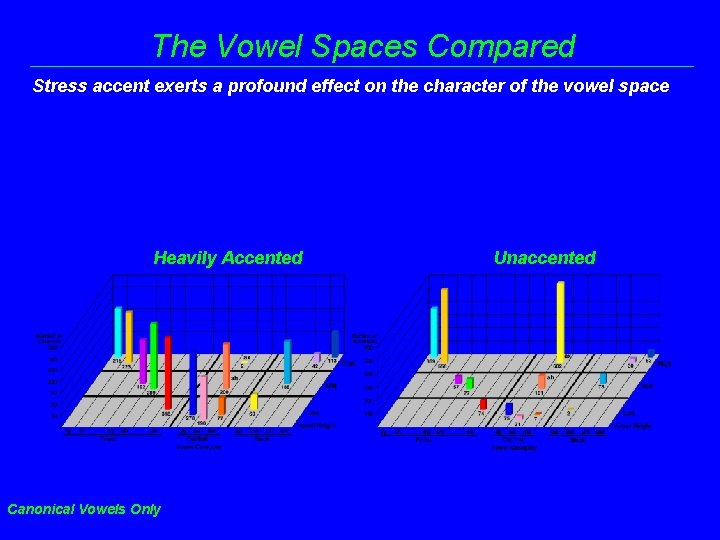
The Vowel Spaces Compared Stress accent exerts a profound effect on the character of the vowel space Heavily Accented Canonical Vowels Only Unaccented
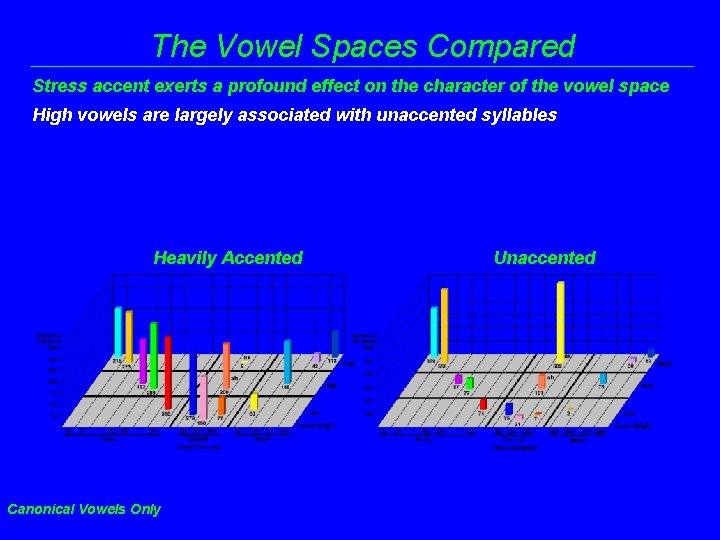
The Vowel Spaces Compared Stress accent exerts a profound effect on the character of the vowel space High vowels are largely associated with unaccented syllables Heavily Accented Canonical Vowels Only Unaccented
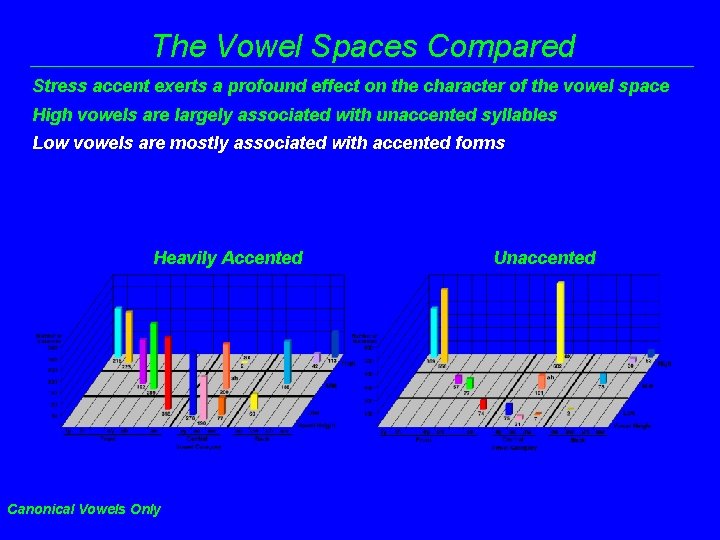
The Vowel Spaces Compared Stress accent exerts a profound effect on the character of the vowel space High vowels are largely associated with unaccented syllables Low vowels are mostly associated with accented forms Heavily Accented Canonical Vowels Only Unaccented
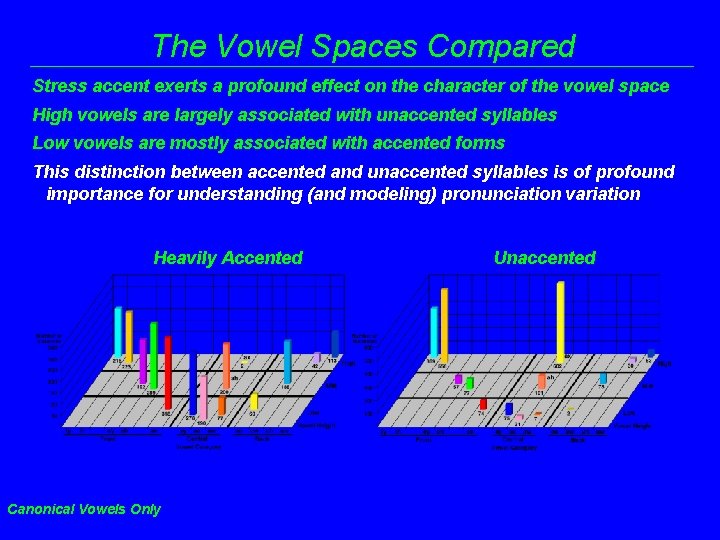
The Vowel Spaces Compared Stress accent exerts a profound effect on the character of the vowel space High vowels are largely associated with unaccented syllables Low vowels are mostly associated with accented forms This distinction between accented and unaccented syllables is of profound importance for understanding (and modeling) pronunciation variation Heavily Accented Canonical Vowels Only Unaccented
PART FIVE Stress Accent’s Impact on Syllable Onsets and Codas
Stress Accent and Syllable Onsets The onset is often cited as the key syllabic constituent with respect to “lexical access”
Stress Accent and Syllable Onsets The onset is often cited as the key syllabic constituent with respect to “lexical access” It is therefore of interest to ascertain how the onset’s phonetic realization behaves as a function of accent level
Stress Accent and Syllable Onsets The onset is often cited as the key syllabic constituent with respect to “lexical access” It is therefore of interest to ascertain how the onset’s phonetic realization behaves as a function of accent level Usually, non-canonical realizations are manifest as segmental deletions
Stress Accent and Syllable Onsets The onset is often cited as the key syllabic constituent with respect to “lexical access” It is therefore of interest to ascertain how the onset’s phonetic realization behaves as a function of accent level Usually, non-canonical realizations are manifest as segmental deletions (there also durational ramifications, as discussed in my TIPS presentation earlier in the week)
Stress Accent and Syllable Onsets The onset is often cited as the key syllabic constituent with respect to “lexical access” It is therefore of interest to ascertain how the onset’s phonetic realization behaves as a function of accent level Usually, non-canonical realizations are manifest as segmental deletions (there also durational ramifications, as discussed in my TIPS presentation earlier in the week) But before we examine the segmental patterns, a brief primer is presented on the articulatory basis of segmental production
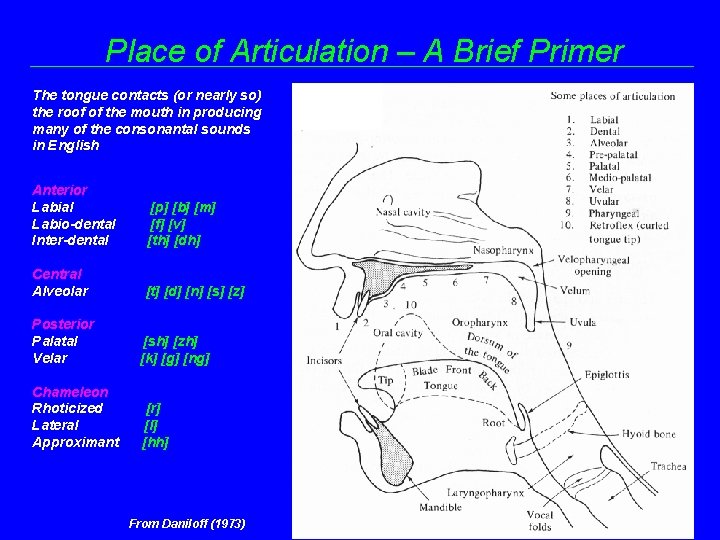
Place of Articulation – A Brief Primer The tongue contacts (or nearly so) the roof of the mouth in producing many of the consonantal sounds in English Anterior Labial [p] [b] [m] Labio-dental [f] [v] Inter-dental [th] [dh] Central Alveolar [t] [d] [n] [s] [z] Posterior Palatal [sh] [zh] Velar [k] [g] [ng] Chameleon Rhoticized [r] Lateral [l] Approximant [hh] From Daniloff (1973)
Pronunciation Patterns – Syllable Onsets The ANTERIOR and POSTERIOR onsets are generally canonically realized (the exceptions typically function as “junctures, ” rather than as segments) Place of Articulation Approximants C = Canonical realization N = Non-canonical realization, N 0 = Non-canonical in unaccented syllables
Pronunciation Patterns – Syllable Onsets The ANTERIOR and POSTERIOR onsets are generally canonically realized (the exceptions typically function as “junctures, ” rather than as segments) The CENTRAL and PLACE CHAMELEON onsets are often non-canonical (and also often function as “junctures”) Place of Articulation Approximants C = Canonical realization N = Non-canonical realization, N 0 = Non-canonical in unaccented syllables
Pronunciation Patterns – Syllable Codas Stress accent’s impact on syllable codas differs from that of onsets
Pronunciation Patterns – Syllable Codas Stress accent’s impact on syllable codas differs from that of onsets There is a far greater probability of segmental deletion in coda constituents
Pronunciation Patterns – Syllable Codas Stress accent’s impact on syllable codas differs from that of onsets There is a far greater probability of segmental deletion in coda constituents Accent level exerts a powerful influence on segmental deletion, as well as on segmental duration
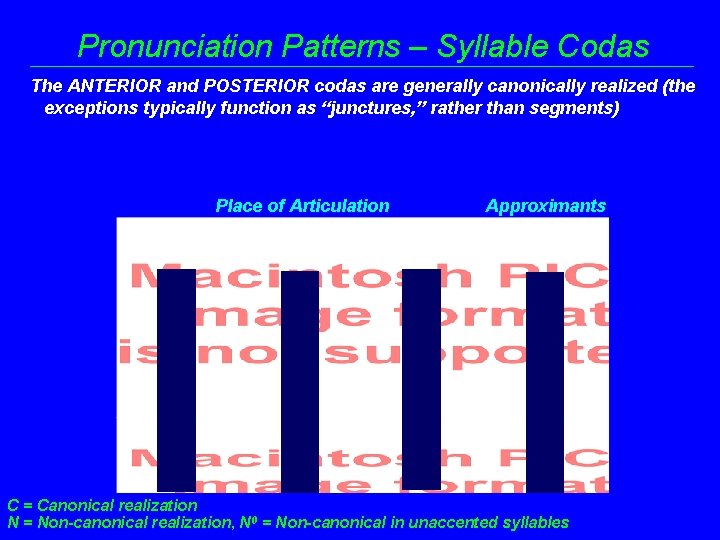
Pronunciation Patterns – Syllable Codas The ANTERIOR and POSTERIOR codas are generally canonically realized (the exceptions typically function as “junctures, ” rather than segments) Place of Articulation Approximants C = Canonical realization N = Non-canonical realization, N 0 = Non-canonical in unaccented syllables
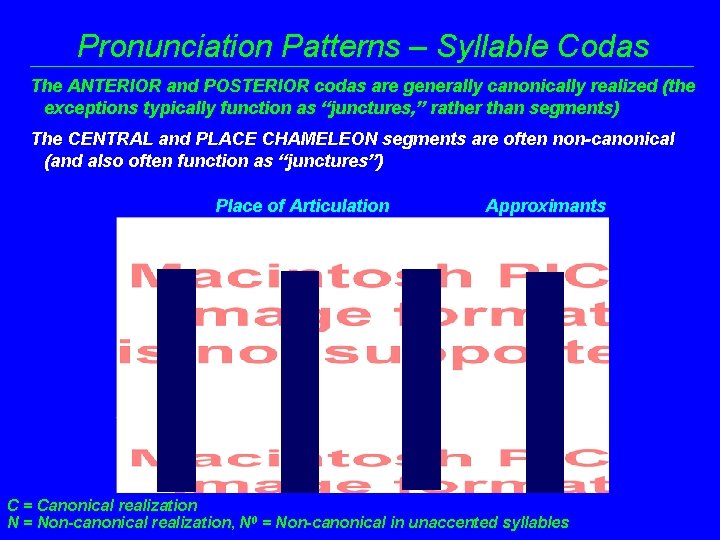
Pronunciation Patterns – Syllable Codas The ANTERIOR and POSTERIOR codas are generally canonically realized (the exceptions typically function as “junctures, ” rather than segments) The CENTRAL and PLACE CHAMELEON segments are often non-canonical (and also often function as “junctures”) Place of Articulation Approximants C = Canonical realization N = Non-canonical realization, N 0 = Non-canonical in unaccented syllables
Comparison of Syllable Onsets and Codas Onsets tend to be more stable than codas Place of Articulation Approximants C = Canonical realization N = Non-canonical realization, N 0 = Non-canonical in unaccented syllables
Comparison of Syllable Onsets and Codas Onsets tend to be more stable than codas The centrally articulated segments are highly unstable in both contexts Place of Articulation Approximants C = Canonical realization N = Non-canonical realization, N 0 = Non-canonical in unaccented syllables
Comparison of Syllable Onsets and Codas Onsets tend to be more stable than codas The centrally articulated segments are highly unstable in both contexts As are the place chameleons Place of Articulation Approximants C = Canonical realization N = Non-canonical realization, N 0 = Non-canonical in unaccented syllables
Comparison of Syllable Onsets and Codas Onsets tend to be more stable than codas The centrally articulated segments are highly unstable in both contexts As are the place chameleons The unstable anterior and posterior phones are mostly “junctures” Place of Articulation Approximants C = Canonical realization N = Non-canonical realization, N 0 = Non-canonical in unaccented syllables
FINALE What’s Going on in Pronunciation?
What’s Going On? (in pronunciation) With respect to onset and coda segments, there are two basic forms …
What’s Going On? (in pronunciation) With respect to onset and coda segments, there are two basic forms … (1) those that are relatively stable across accent level, and
What’s Going On? (in pronunciation) With respect to onset and coda segments, there are two basic forms … (1) those that are relatively stable across accent level, and (2) those that are not
What’s Going On? (in pronunciation) With respect to onset and coda segments, there are two basic forms … (1) those that are relatively stable across accent level, and (2) those that are not Most of the non-continuants (i. e. , stops and nasals) are stable when the locus of articulation constriction is either anterior or posterior
What’s Going On? (in pronunciation) With respect to onset and coda segments, there are two basic forms … (1) those that are relatively stable across accent level, and (2) those that are not Most of the non-continuants (i. e. , stops and nasals) are stable when the locus of articulation constriction is either anterior or posterior The centrally articulated stops and nasals are highly unstable, particularly in coda position and in unaccented syllables
What’s Going On? (in pronunciation) With respect to onset and coda segments, there are two basic forms … (1) those that are relatively stable across accent level, and (2) those that are not Most of the non-continuants (i. e. , stops and nasals) are stable when the locus of articulation constriction is either anterior or posterior The centrally articulated stops and nasals are highly unstable, particularly in coda position and in unaccented syllables The place chameleons (i. e. , the approximants) are not very stable in either onset or coda position
What’s Going On? (in pronunciation) With respect to onset and coda segments, there are two basic forms … (1) those that are relatively stable across accent level, and (2) those that are not Most of the non-continuants (i. e. , stops and nasals) are stable when the locus of articulation constriction is either anterior or posterior The centrally articulated stops and nasals are highly unstable, particularly in coda position and in unaccented syllables The place chameleons (i. e. , the approximants) are not very stable in either onset or coda position The vowels form two basic groups –
What’s Going On? (in pronunciation) With respect to onset and coda segments, there are two basic forms … (1) those that are relatively stable across accent level, and (2) those that are not Most of the non-continuants (i. e. , stops and nasals) are stable when the locus of articulation constriction is either anterior or posterior The centrally articulated stops and nasals are highly unstable, particularly in coda position and in unaccented syllables The place chameleons (i. e. , the approximants) are not very stable in either onset or coda position The vowels form two basic groups – (1) accented
What’s Going On? (in pronunciation) With respect to onset and coda segments, there are two basic forms … (1) those that are relatively stable across accent level, and (2) those that are not Most of the non-continuants (i. e. , stops and nasals) are stable when the locus of articulation constriction is either anterior or posterior The centrally articulated stops and nasals are highly unstable, particularly in coda position and in unaccented syllables The place chameleons (i. e. , the approximants) are not very stable in either onset or coda position The vowels form two basic groups – (1) accented and (2) unaccented
What’s Going On? (in pronunciation) With respect to onset and coda segments, there are two basic forms … (1) those that are relatively stable across accent level, and (2) those that are not Most of the non-continuants (i. e. , stops and nasals) are stable when the locus of articulation constriction is either anterior or posterior The centrally articulated stops and nasals are highly unstable, particularly in coda position and in unaccented syllables The place chameleons (i. e. , the approximants) are not very stable in either onset or coda position The vowels form two basic groups – (1) accented and (2) unaccented The accented vowels are generally canonically realized and quasi-evenly distributed across the vowel space
What’s Going On? (in pronunciation) With respect to onset and coda segments, there are two basic forms … (1) those that are relatively stable across accent level, and (2) those that are not Most of the non-continuants (i. e. , stops and nasals) are stable when the locus of articulation constriction is either anterior or posterior The centrally articulated stops and nasals are highly unstable, particularly in coda position and in unaccented syllables The place chameleons (i. e. , the approximants) are not very stable in either onset or coda position The vowels form two basic groups – (1) accented and (2) unaccented The accented vowels are generally canonically realized and quasi-evenly distributed across the vowel space The unaccented forms tend to concentrate in the high-front and high-central regions of the vowel space
What’s Going On? (in pronunciation) With respect to onset and coda segments, there are two basic forms … (1) those that are relatively stable across accent level, and (2) those that are not Most of the non-continuants (i. e. , stops and nasals) are stable when the locus of articulation constriction is either anterior or posterior The centrally articulated stops and nasals are highly unstable, particularly in coda position and in unaccented syllables The place chameleons (i. e. , the approximants) are not very stable in either onset or coda position The vowels form two basic groups – (1) accented and (2) unaccented The accented vowels are generally canonically realized and quasi-evenly distributed across the vowel space The unaccented forms tend to concentrate in the high-front and high-central regions of the vowel space Certain segments are actually junctures – e. g. , the flaps and the glottal stop
What’s Going On? (in pronunciation) With respect to onset and coda segments, there are two basic forms … (1) those that are relatively stable across accent level, and (2) those that are not Most of the non-continuants (i. e. , stops and nasals) are stable when the locus of articulation constriction is either anterior or posterior The centrally articulated stops and nasals are highly unstable, particularly in coda position and in unaccented syllables The place chameleons (i. e. , the approximants) are not very stable in either onset or coda position The vowels form two basic groups – (1) accented and (2) unaccented The accented vowels are generally canonically realized and quasi-evenly distributed across the vowel space The unaccented forms tend to concentrate in the high-front and high-central regions of the vowel space Certain segments are actually junctures – e. g. , the flaps and the glottal stop Several other so-called segments are junctures as well
What’s Going On? (in pronunciation) With respect to onset and coda segments, there are two basic forms … (1) those that are relatively stable across accent level, and (2) those that are not Most of the non-continuants (i. e. , stops and nasals) are stable when the locus of articulation constriction is either anterior or posterior The centrally articulated stops and nasals are highly unstable, particularly in coda position and in unaccented syllables The place chameleons (i. e. , the approximants) are not very stable in either onset or coda position The vowels form two basic groups – (1) accented and (2) unaccented The accented vowels are generally canonically realized and quasi-evenly distributed across the vowel space The unaccented forms tend to concentrate in the high-front and high-central regions of the vowel space Certain segments are actually junctures – e. g. , the flaps and the glottal stop Several other so-called segments are junctures as well (as they function like flaps), the most noteworthy examples being [dh] and [v]
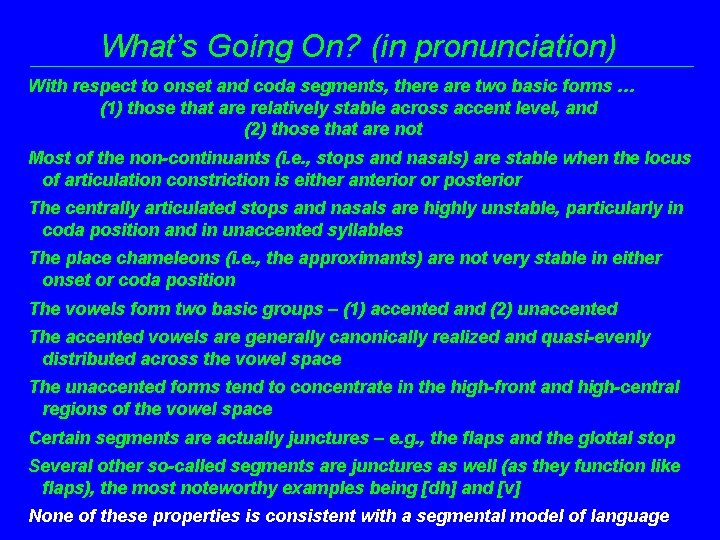
What’s Going On? (in pronunciation) With respect to onset and coda segments, there are two basic forms … (1) those that are relatively stable across accent level, and (2) those that are not Most of the non-continuants (i. e. , stops and nasals) are stable when the locus of articulation constriction is either anterior or posterior The centrally articulated stops and nasals are highly unstable, particularly in coda position and in unaccented syllables The place chameleons (i. e. , the approximants) are not very stable in either onset or coda position The vowels form two basic groups – (1) accented and (2) unaccented The accented vowels are generally canonically realized and quasi-evenly distributed across the vowel space The unaccented forms tend to concentrate in the high-front and high-central regions of the vowel space Certain segments are actually junctures – e. g. , the flaps and the glottal stop Several other so-called segments are junctures as well (as they function like flaps), the most noteworthy examples being [dh] and [v] None of these properties is consistent with a segmental model of language
That’s All, Folks Many Thanks for Your Time and Attention
- Slides: 123