
The regional accents of mainland France What are


- Slides: 17
The regional accents of mainland France • What are they? • How do we distinguish between them? • Where are they found?
Common perceptions l Little or no variation between regional accents: http: //news. bbc. co. uk/1/hi/world/europe/137 3908. stm l So is this true?
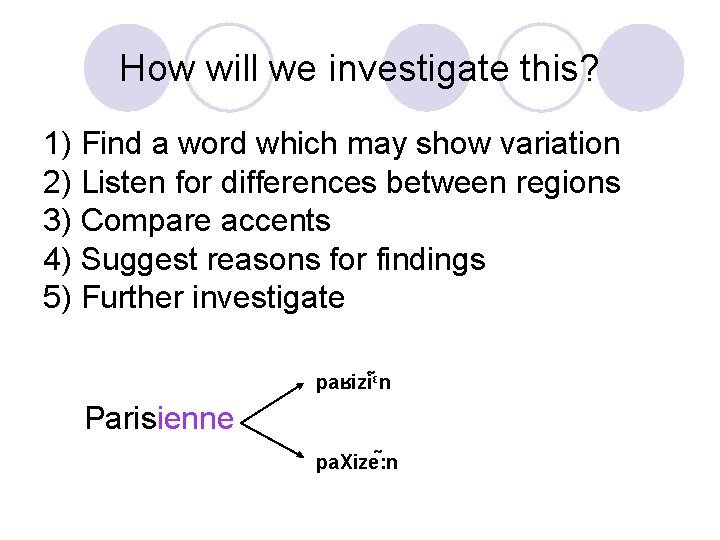
How will we investigate this? 1) Find a word which may show variation 2) Listen for differences between regions 3) Compare accents 4) Suggest reasons for findings 5) Further investigate pаʁizi˜εn Parisienne ˜ pа. Xize: n
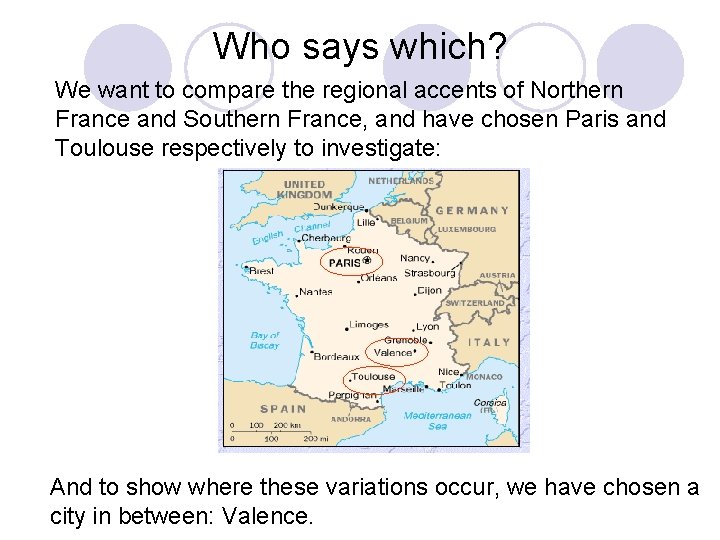
Who says which? We want to compare the regional accents of Northern France and Southern France, and have chosen Paris and Toulouse respectively to investigate: And to show where these variations occur, we have chosen a city in between: Valence.
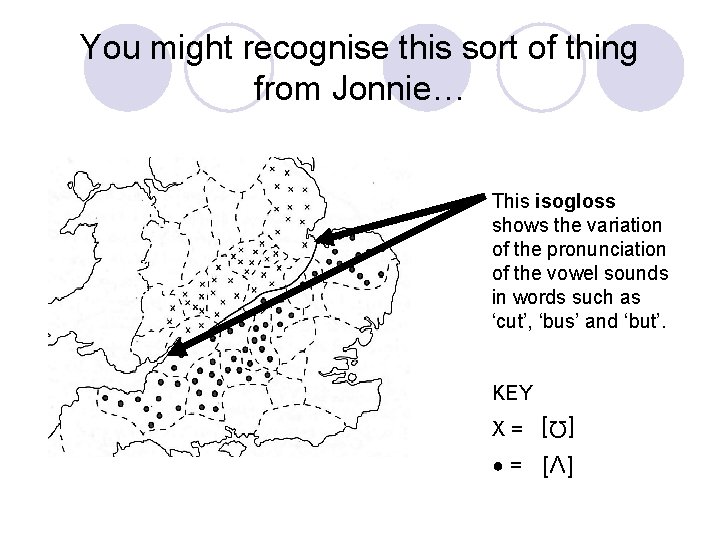
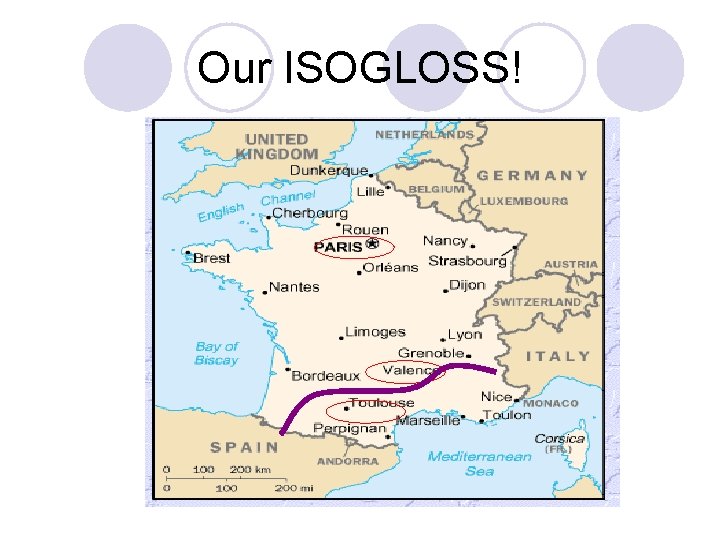
And then… l After finding a regional variation we hope to draw an isogloss to distinguish where the accent boundary exists. l An isogloss is the geographical boundary of a certain linguistic feature.
You might recognise this sort of thing from Jonnie… This isogloss shows the variation of the pronunciation of the vowel sounds in words such as ‘cut’, ‘bus’ and ‘but’. KEY X= [Ω] ●= [Λ]
Methodology l Record 5 minutes of French radio for each city: - Paris: Europe 1 - Toulouse: Sud Radio - Valence: France Bleu Drôme Ardècke l Write 10 examples of words which contain the ‘ienne’ suffix for each region
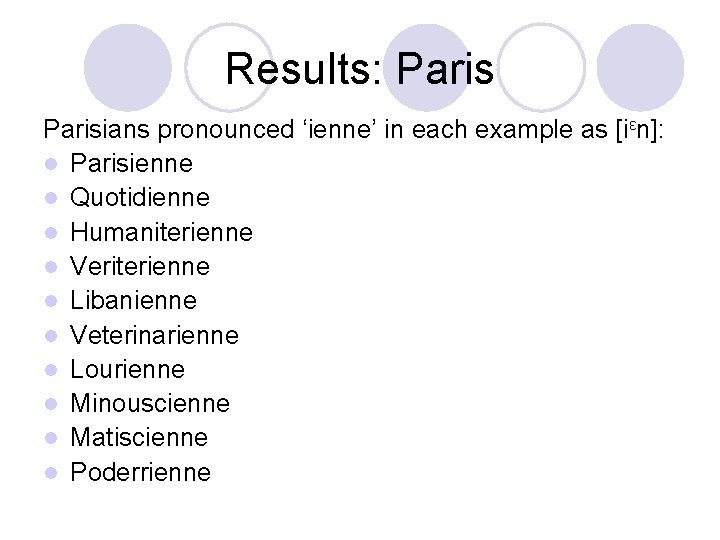
Results: Parisians pronounced ‘ienne’ in each example as [iεn]: l Parisienne l Quotidienne l Humaniterienne l Veriterienne l Libanienne l Veterinarienne l Lourienne l Minouscienne l Matiscienne l Poderrienne
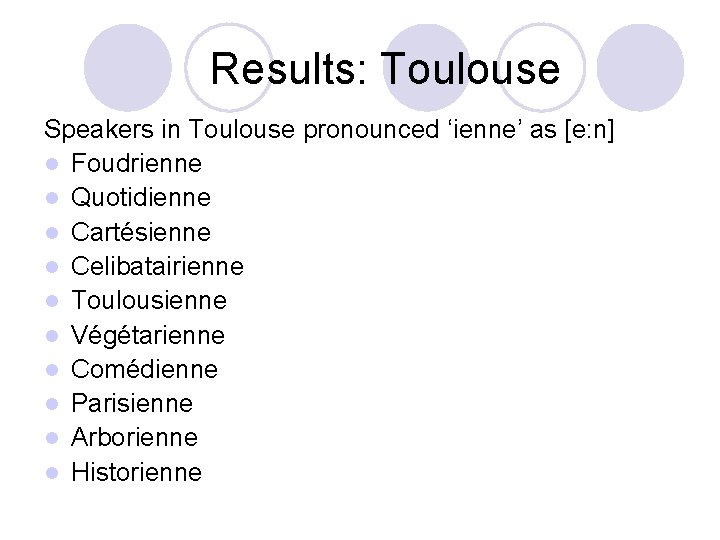
Results: Toulouse Speakers in Toulouse pronounced ‘ienne’ as [e: n] l Foudrienne l Quotidienne l Cartésienne l Celibatairienne l Toulousienne l Végétarienne l Comédienne l Parisienne l Arborienne l Historienne
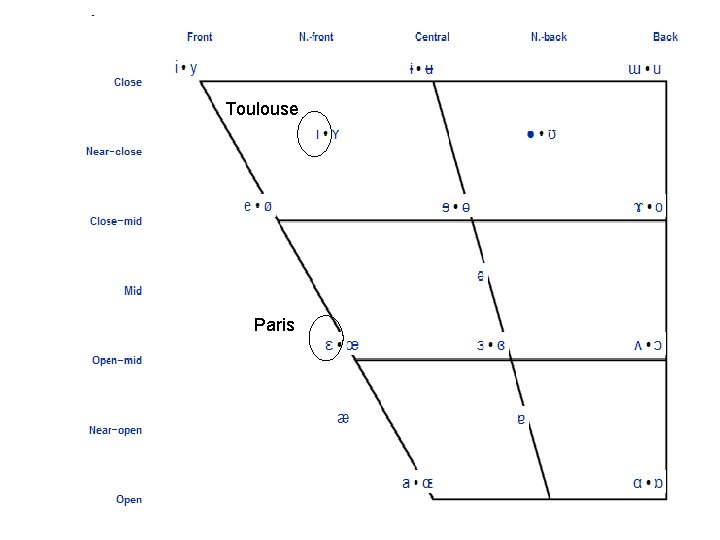
The ‘Science’ of the distinct accents l In Toulouse the vowel sound at the end of ˜ the suffix [e: n] is a diphthong gliding from /I/ to /ε/. l This means that the start of this sound is more fronted than the Parisian version [iεn]. ˜
Toulouse Paris
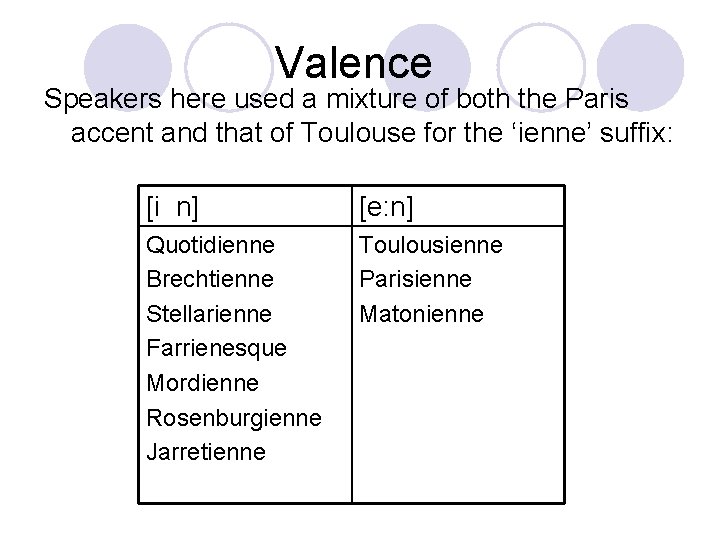
Valence Speakers here used a mixture of both the Paris accent and that of Toulouse for the ‘ienne’ suffix: [i n] [e: n] Quotidienne Brechtienne Stellarienne Farrienesque Mordienne Rosenburgienne Jarretienne Toulousienne Parisienne Matonienne
Our ISOGLOSS!
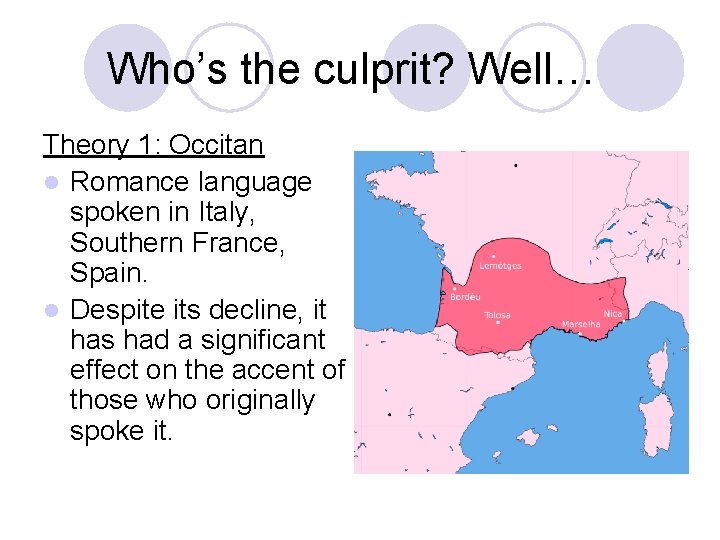
Who’s the culprit? Well… Theory 1: Occitan l Romance language spoken in Italy, Southern France, Spain. l Despite its decline, it has had a significant effect on the accent of those who originally spoke it.
Or… Theory 2: Poverty l “We have found that increased poverty has forced communities to segregate into small groups, causing a development of a wider range of French usage” (Translated from l’Academie Francaise). l So, more time spent socialising in single small groups perhaps leads to more accents.
So what have we discovered? l There is a distinct accent difference between Northern and Southern France, which extend to Mid-France. l It is unclear where this regional variation has come from. l To be sure, we would have to form a corpus of regional spoken French, exploring this and more differences between accents.
Thank you for watching By Georgina Brown, Laurence Ashcroft, Natasha Watts and Daniel Webb With thanks to Billy Clark and Graeme Trousdale