
The Reformation Division of the Roman Catholic Church
- Slides: 14
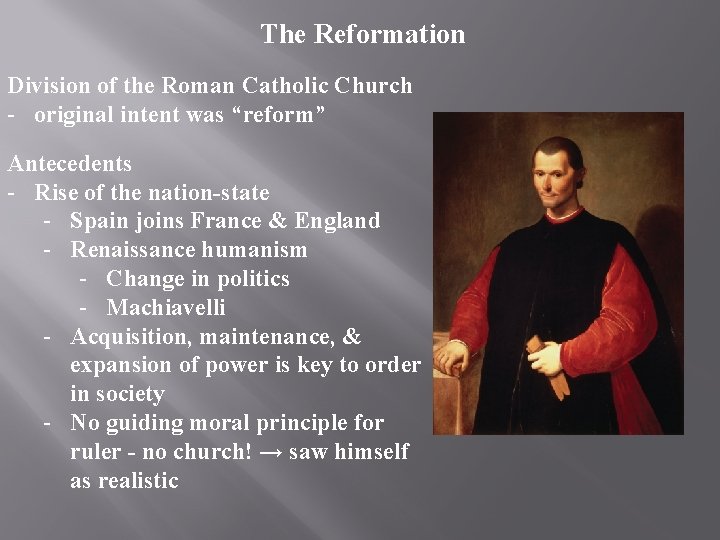
The Reformation Division of the Roman Catholic Church - original intent was “reform” Antecedents - Rise of the nation-state - Spain joins France & England - Renaissance humanism - Change in politics - Machiavelli - Acquisition, maintenance, & expansion of power is key to order in society - No guiding moral principle for ruler - no church! → saw himself as realistic
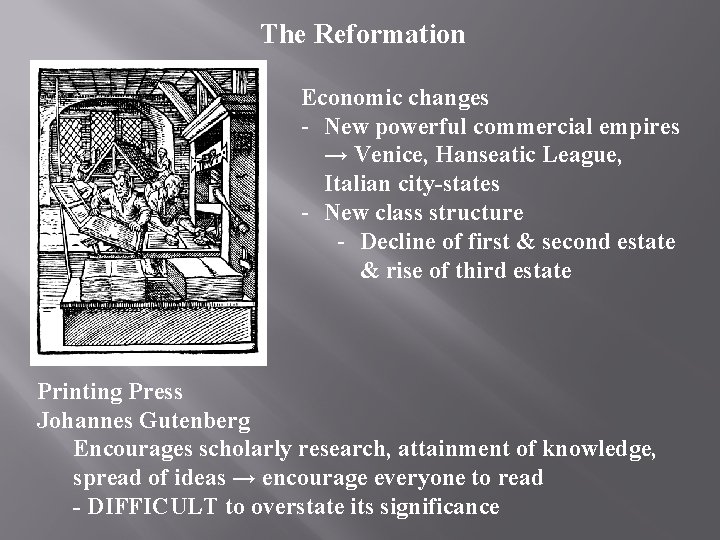
The Reformation Economic changes - New powerful commercial empires → Venice, Hanseatic League, Italian city-states - New class structure - Decline of first & second estate & rise of third estate Printing Press Johannes Gutenberg Encourages scholarly research, attainment of knowledge, spread of ideas → encourage everyone to read - DIFFICULT to overstate its significance
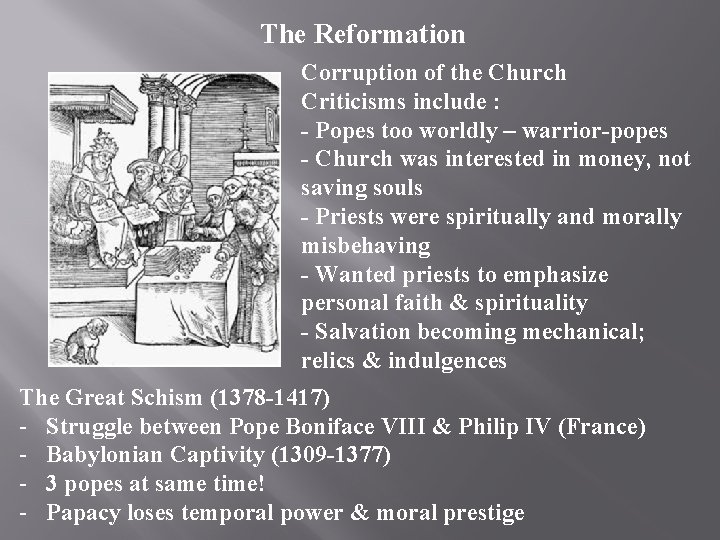
The Reformation Corruption of the Church Criticisms include : - Popes too worldly – warrior-popes - Church was interested in money, not saving souls - Priests were spiritually and morally misbehaving - Wanted priests to emphasize personal faith & spirituality - Salvation becoming mechanical; relics & indulgences The Great Schism (1378 -1417) - Struggle between Pope Boniface VIII & Philip IV (France) - Babylonian Captivity (1309 -1377) - 3 popes at same time! - Papacy loses temporal power & moral prestige
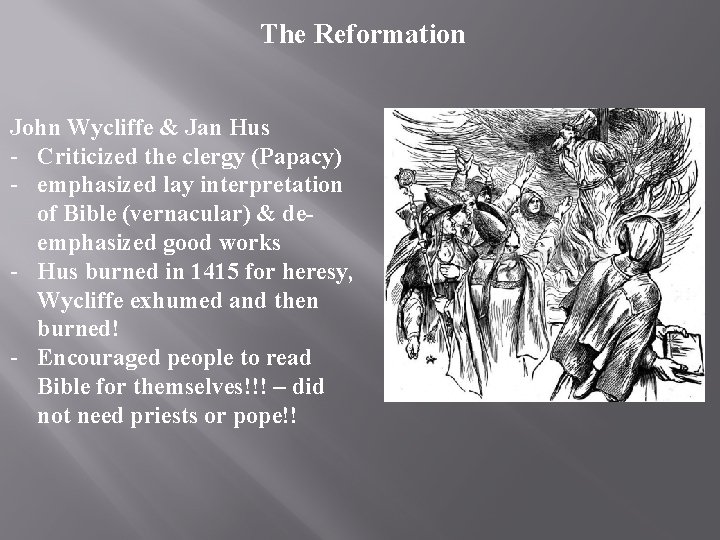
The Reformation John Wycliffe & Jan Hus - Criticized the clergy (Papacy) - emphasized lay interpretation of Bible (vernacular) & deemphasized good works - Hus burned in 1415 for heresy, Wycliffe exhumed and then burned! - Encouraged people to read Bible for themselves!!! – did not need priests or pope!!
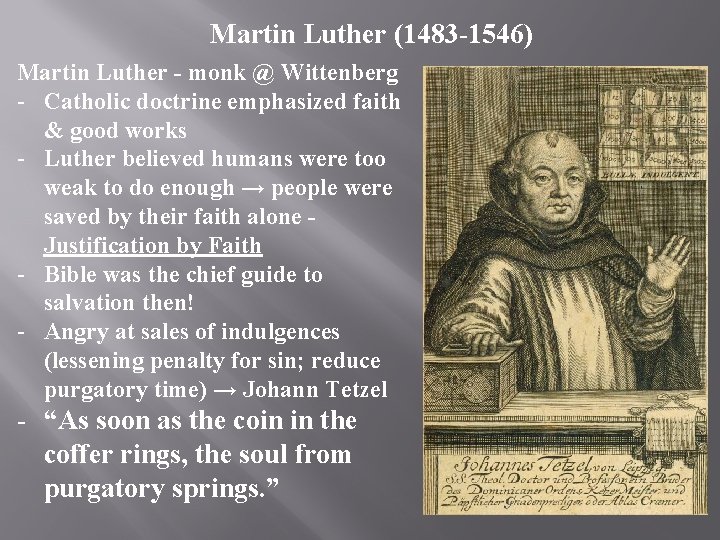
Martin Luther (1483 -1546) Martin Luther - monk @ Wittenberg - Catholic doctrine emphasized faith & good works - Luther believed humans were too weak to do enough → people were saved by their faith alone Justification by Faith - Bible was the chief guide to salvation then! - Angry at sales of indulgences (lessening penalty for sin; reduce purgatory time) → Johann Tetzel - “As soon as the coin in the coffer rings, the soul from purgatory springs. ”
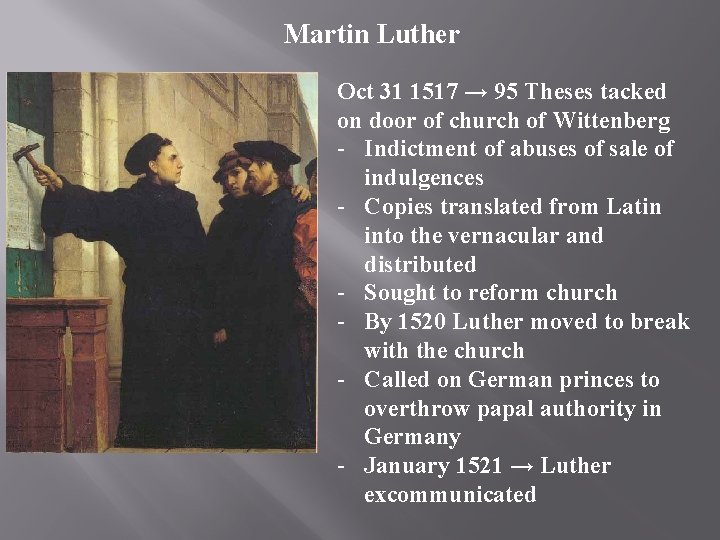
Martin Luther Oct 31 1517 → 95 Theses tacked on door of church of Wittenberg - Indictment of abuses of sale of indulgences - Copies translated from Latin into the vernacular and distributed - Sought to reform church - By 1520 Luther moved to break with the church - Called on German princes to overthrow papal authority in Germany - January 1521 → Luther excommunicated
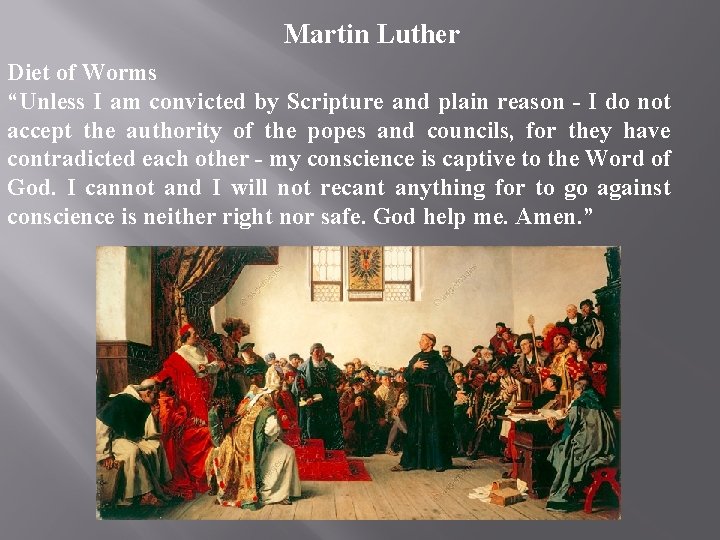
Martin Luther Diet of Worms “Unless I am convicted by Scripture and plain reason - I do not accept the authority of the popes and councils, for they have contradicted each other - my conscience is captive to the Word of God. I cannot and I will not recant anything for to go against conscience is neither right nor safe. God help me. Amen. ”
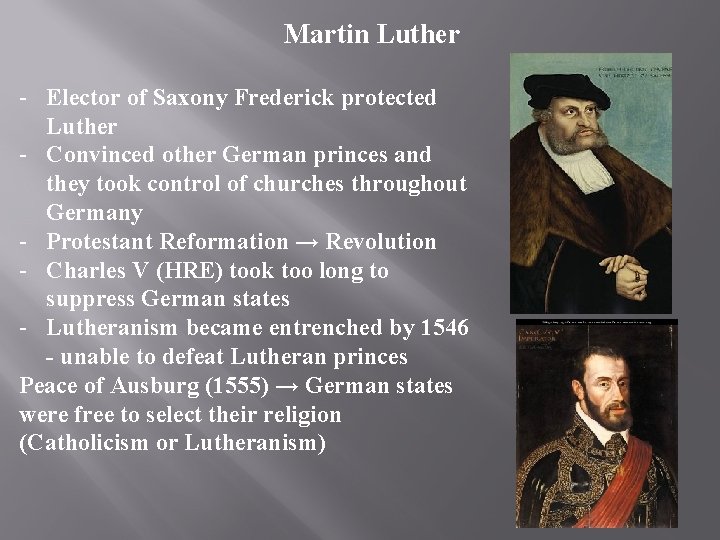
Martin Luther - Elector of Saxony Frederick protected Luther - Convinced other German princes and they took control of churches throughout Germany - Protestant Reformation → Revolution - Charles V (HRE) took too long to suppress German states - Lutheranism became entrenched by 1546 - unable to defeat Lutheran princes Peace of Ausburg (1555) → German states were free to select their religion (Catholicism or Lutheranism)
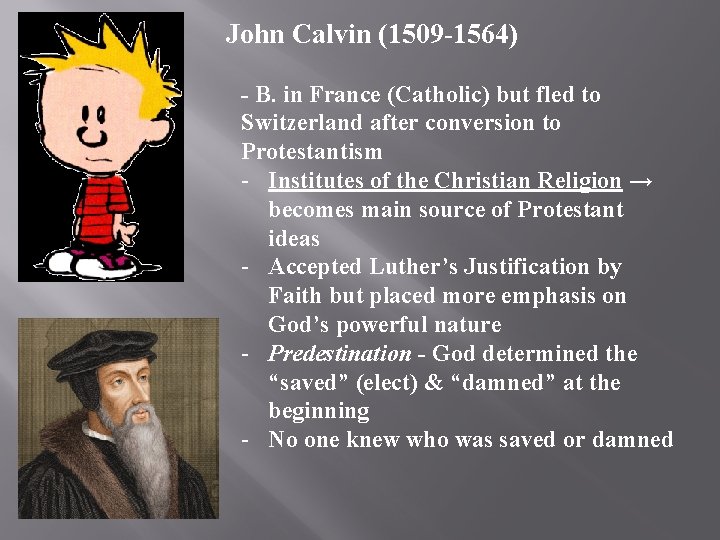
John Calvin (1509 -1564) - B. in France (Catholic) but fled to Switzerland after conversion to Protestantism - Institutes of the Christian Religion → becomes main source of Protestant ideas - Accepted Luther’s Justification by Faith but placed more emphasis on God’s powerful nature - Predestination - God determined the “saved” (elect) & “damned” at the beginning - No one knew who was saved or damned
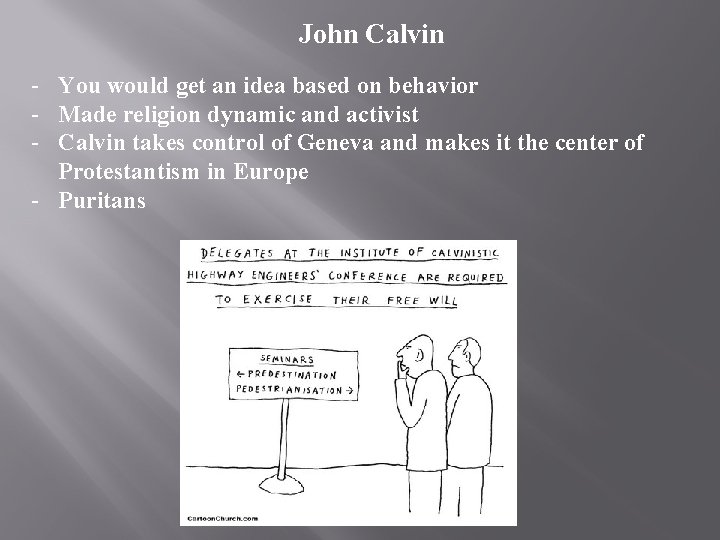
John Calvin - You would get an idea based on behavior - Made religion dynamic and activist - Calvin takes control of Geneva and makes it the center of Protestantism in Europe - Puritans
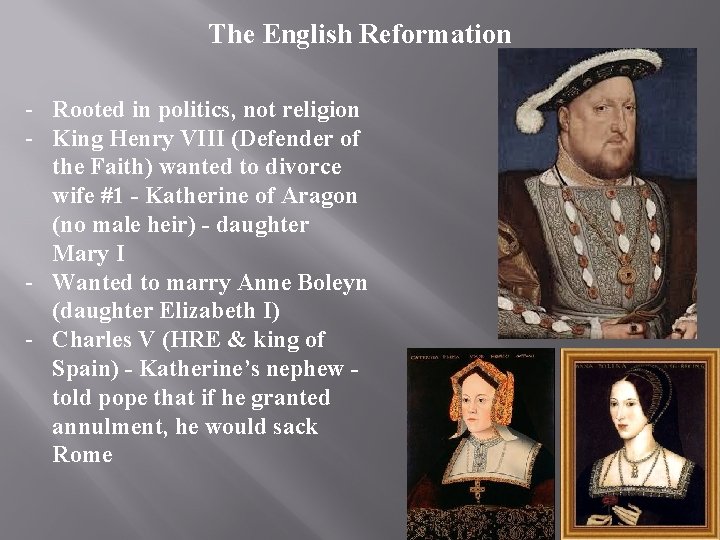
The English Reformation - Rooted in politics, not religion - King Henry VIII (Defender of the Faith) wanted to divorce wife #1 - Katherine of Aragon (no male heir) - daughter Mary I - Wanted to marry Anne Boleyn (daughter Elizabeth I) - Charles V (HRE & king of Spain) - Katherine’s nephew told pope that if he granted annulment, he would sack Rome
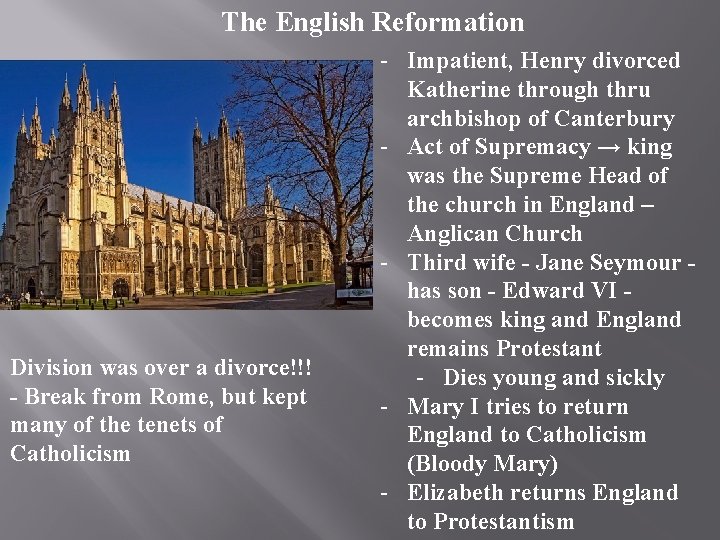
The English Reformation Division was over a divorce!!! - Break from Rome, but kept many of the tenets of Catholicism - Impatient, Henry divorced Katherine through thru archbishop of Canterbury - Act of Supremacy → king was the Supreme Head of the church in England – Anglican Church - Third wife - Jane Seymour has son - Edward VI becomes king and England remains Protestant - Dies young and sickly - Mary I tries to return England to Catholicism (Bloody Mary) - Elizabeth returns England to Protestantism
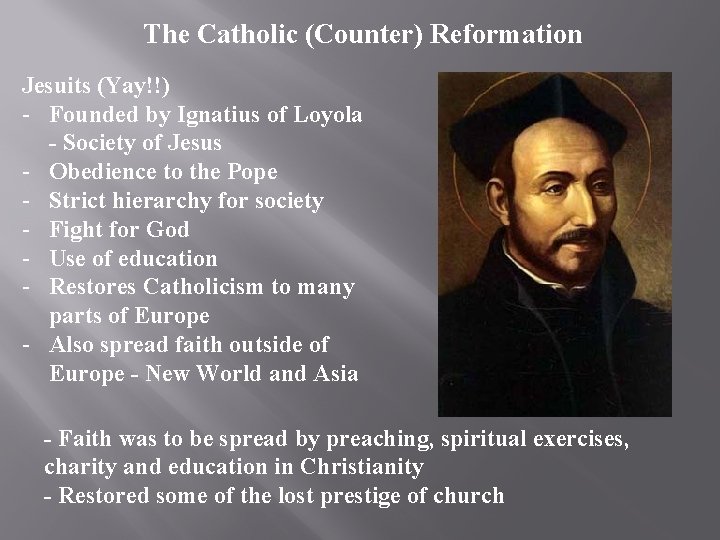
The Catholic (Counter) Reformation Jesuits (Yay!!) - Founded by Ignatius of Loyola - Society of Jesus - Obedience to the Pope - Strict hierarchy for society - Fight for God - Use of education - Restores Catholicism to many parts of Europe - Also spread faith outside of Europe - New World and Asia - Faith was to be spread by preaching, spiritual exercises, charity and education in Christianity - Restored some of the lost prestige of church
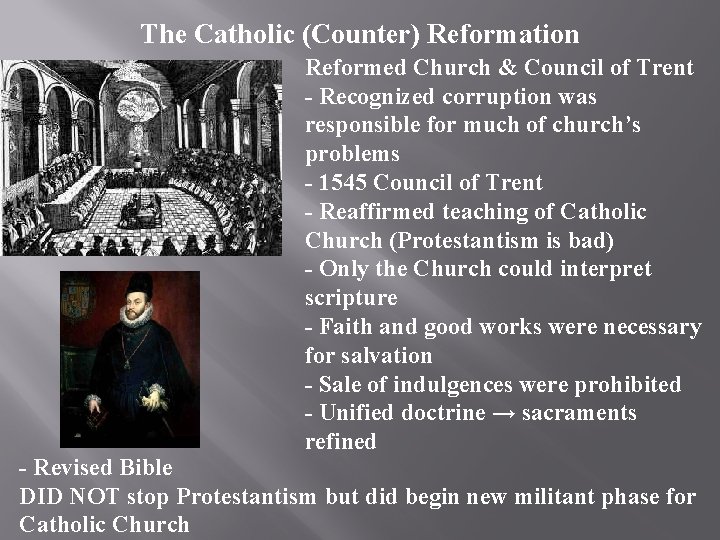
The Catholic (Counter) Reformation Reformed Church & Council of Trent - Recognized corruption was responsible for much of church’s problems - 1545 Council of Trent - Reaffirmed teaching of Catholic Church (Protestantism is bad) - Only the Church could interpret scripture - Faith and good works were necessary for salvation - Sale of indulgences were prohibited - Unified doctrine → sacraments refined - Revised Bible DID NOT stop Protestantism but did begin new militant phase for Catholic Church