
The Reflective Insulation Manufacturers Association International 2008 Copyright


- Slides: 46
The Reflective Insulation Manufacturers Association International 2008 Copyright – Reflective Insulation Manufacturers Association International
Benefits of Reflective Insulation, Radiant Barriers and IRCCs Presented on Behalf of RIMA International
Learning Objectives • • • Identify what reflective products are available, how they work and are installed Review thermal performance in a building envelope Discuss Energy Code compliance, Energy Star compliance and Federal Energy Tax credits as they apply to reflective products Understand how radiant barriers affect the HERS index Examine green building attributes (LEED and NAHB Model Green Guidelines)
About RIMA-I The Reflective Insulation Manufacturers Association International represents manufacturers and distributors of reflective insulation, radiant barriers and interior radiation control coating materials. RIMA International’s activities are guided by an active board of industry members who participate on national and local levels of building code organizations and governmental agencies. Visit us at www. rimainternationa. org
RIMA-I Members Platinum Members • • • Astro. Foil/Innovative Energy Covertech Kd. B Isolation SA Roy. OMartin Reflectix Inc TVM Building Products Advanced Technology Air-Cell Innovations Pty Ltd Astro Reflective Insulation AS Celplast Metallized Products Cleveland Laminating Corp Compac Corporation Dunmore Corporation Du. Pont Tyvek ESP/Low-E Fi-Foil Company Foil Barrier Insulation Heartland Insulation Supply Ideal Tape Company Inc Innovative Energy, California Innovative Insulation Inc. Insulation Solutions, Inc. Isolant S. A. LIT Works Co. Louisiana Pacific Midwest Low-E MWI Components Polyair Polyon Barkai Ind. Prodex PT Insfoil Pradanasakti Radiant Barrier Specialists Radiant Guard Resisto, a Div. of Soprema STS Coatings San Miguel Woven Product Sigma Technologies Int’l Solec Valeron Strength Films Venture Tape Corp
Overview Ø Definitions & Standards Ø Types and Applications Ø Insulation & Building Science Ø Codes, National Accrediation, Green. Q&A
Types of Products Ø Reflective Insulation Ø Radiant Barriers Ø Low-e Spray Coatings
Definitions • Reflective Insulation: one or more low emittance materials (0. 10 or less) installed adjacent to air spaces in an enclosed air space. The low emittance surfaces reduce radiation across the air space. The layer(s) reduces radiant heat and convective heat transfer • Reference Documents for Reflective Insulation: n ASTM C 1224 - Standard Specification n ASTM C 727 - Installation
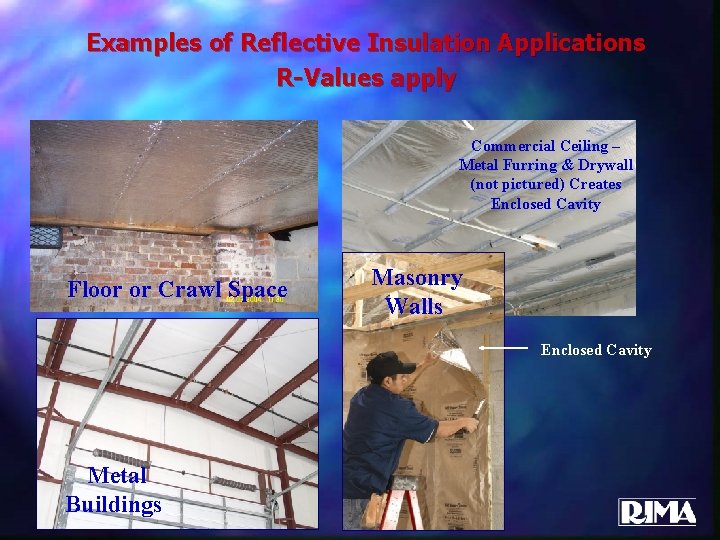
Examples of Reflective Insulation Applications R-Values apply Commercial Ceiling – Metal Furring & Drywall (not pictured) Creates Enclosed Cavity Floor or Crawl Space Masonry Walls Enclosed Cavity Metal Buildings
Definitions • Radiant Barriers: one or more low emittance materials (0. 10 or less) installed adjacent to large open air spaces. The primary function of the low emittance surface(s) is to reduce radiation across the air space. • Reference Documents for Reflective Insulation: n ASTM C 1313 - Standard Specification n ASTM C 1158 - Installation
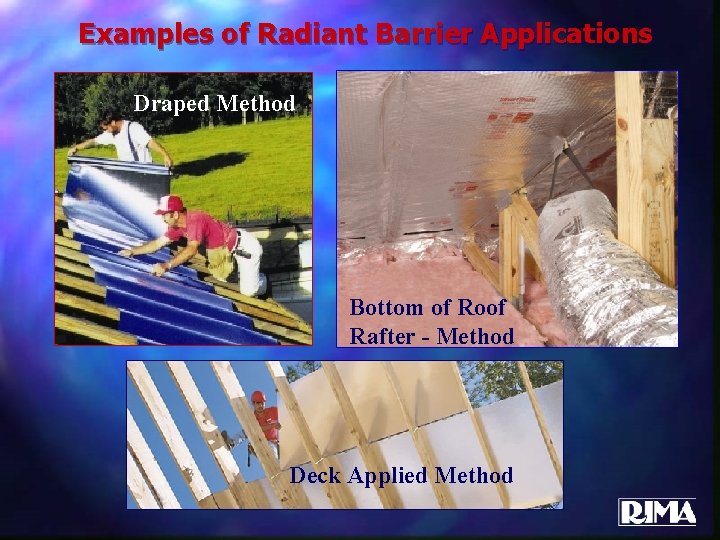
Examples of Radiant Barrier Applications Draped Method Bottom of Roof Rafter - Method Deck Applied Method
Low-Emittance Products
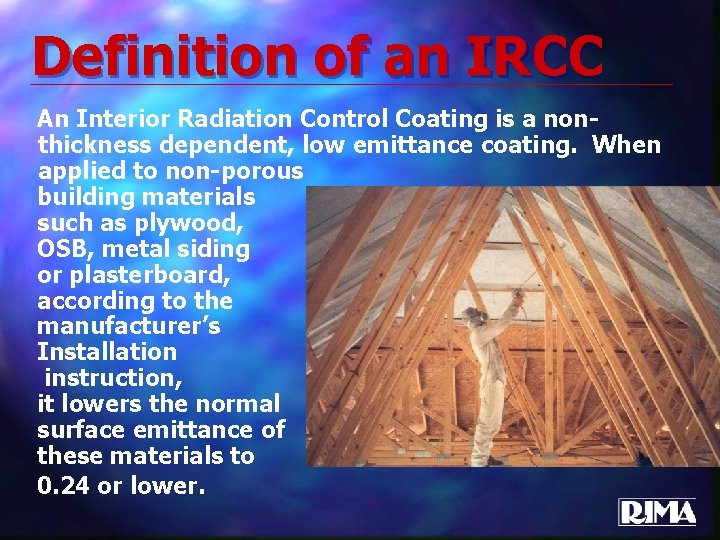
Definition of an IRCC An Interior Radiation Control Coating is a nonthickness dependent, low emittance coating. When applied to non-porous building materials such as plywood, OSB, metal siding or plasterboard, according to the manufacturer’s Installation instruction, it lowers the normal surface emittance of these materials to 0. 24 or lower.
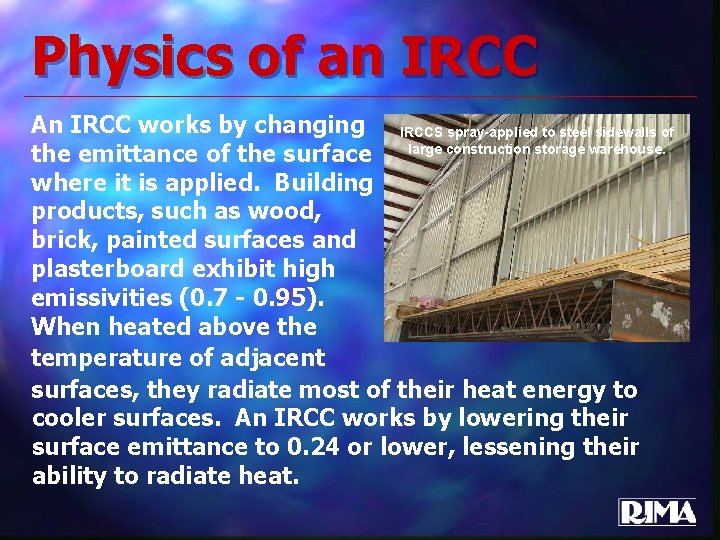
Physics of an IRCC An IRCC works by changing IRCCS spray-applied to steel sidewalls of large construction storage warehouse. the emittance of the surface where it is applied. Building products, such as wood, brick, painted surfaces and plasterboard exhibit high emissivities (0. 7 - 0. 95). When heated above the temperature of adjacent surfaces, they radiate most of their heat energy to cooler surfaces. An IRCC works by lowering their surface emittance to 0. 24 or lower, lessening their ability to radiate heat.
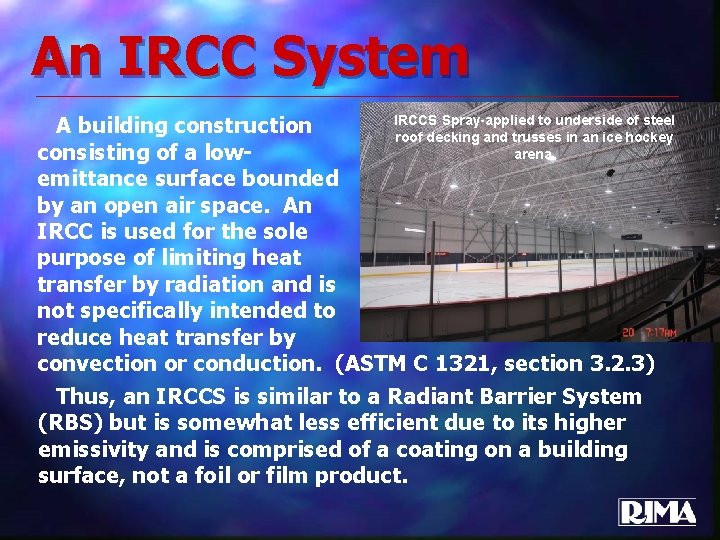
An IRCC System IRCCS Spray-applied to underside of steel A building construction roof decking and trusses in an ice hockey arena. consisting of a lowemittance surface bounded by an open air space. An IRCC is used for the sole purpose of limiting heat transfer by radiation and is not specifically intended to reduce heat transfer by convection or conduction. (ASTM C 1321, section 3. 2. 3) Thus, an IRCCS is similar to a Radiant Barrier System (RBS) but is somewhat less efficient due to its higher emissivity and is comprised of a coating on a building surface, not a foil or film product.
Advantages of an IRCC An IRCC is normally applied using airless spray equipment, resulting in very low labor costs and greatly reduced installation times. Also, a water based IRCC can be safely installed in existing structures where the costs of installing foil or film products may be prohibitive or impractical. An IRCC may also be used in many manufactured products (such as infrared heat reflectors of automotive parts) where it is impractical to adhere foil or film radiant barriers.
Building Science
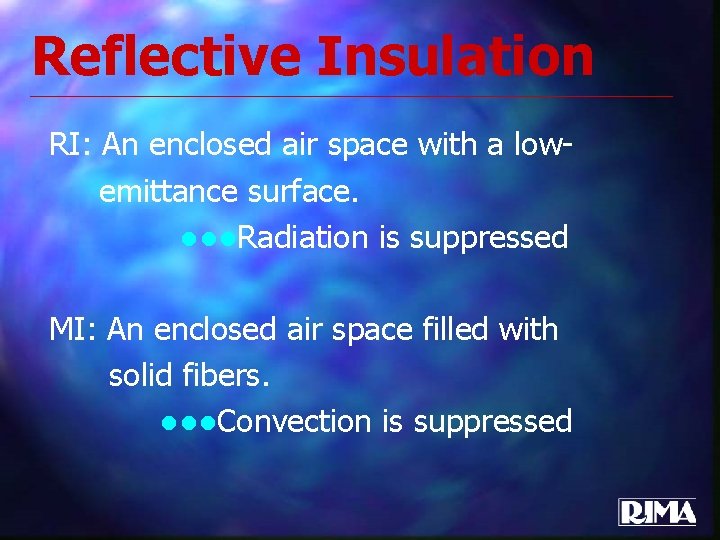
Reflective Insulation RI: An enclosed air space with a lowemittance surface. ●●●Radiation is suppressed MI: An enclosed air space filled with solid fibers. ●●●Convection is suppressed
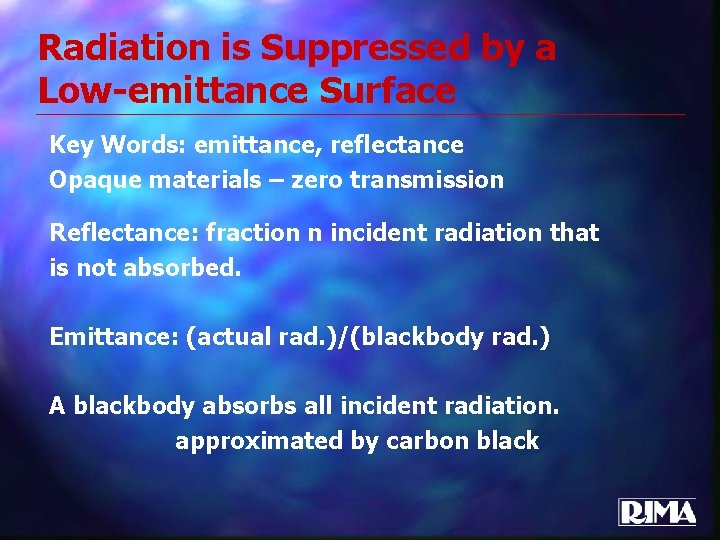
Radiation is Suppressed by a Low-emittance Surface Key Words: emittance, reflectance Opaque materials – zero transmission Reflectance: fraction n incident radiation that is not absorbed. Emittance: (actual rad. )/(blackbody rad. ) A blackbody absorbs all incident radiation. approximated by carbon black
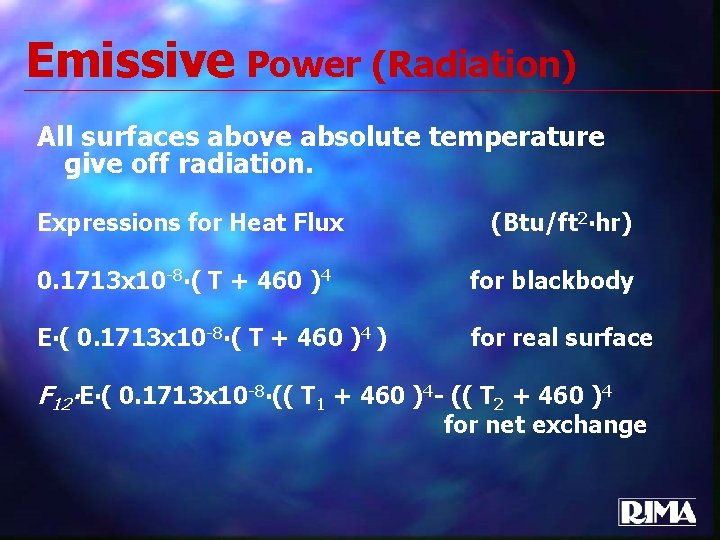
Emissive Power (Radiation) All surfaces above absolute temperature give off radiation. Expressions for Heat Flux (Btu/ft 2∙hr) 0. 1713 x 10 -8∙( T + 460 )4 for blackbody E∙( 0. 1713 x 10 -8∙( T + 460 )4 ) for real surface F 12∙E∙( 0. 1713 x 10 -8∙(( T 1 + 460 )4 - (( T 2 + 460 )4 for net exchange
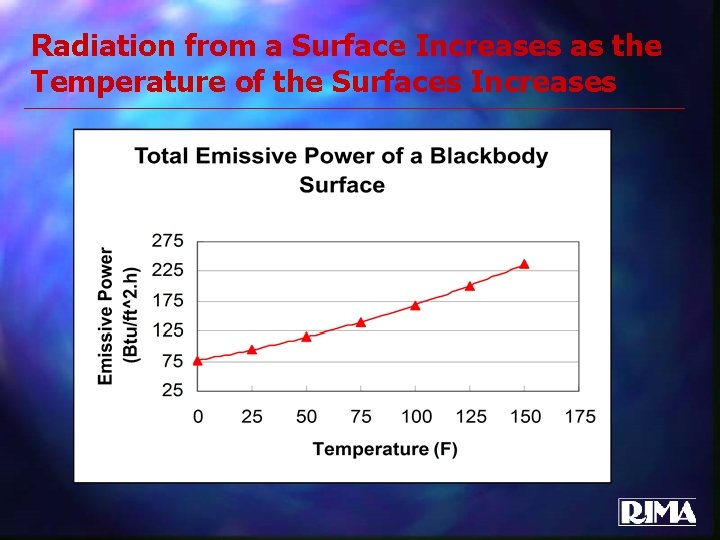
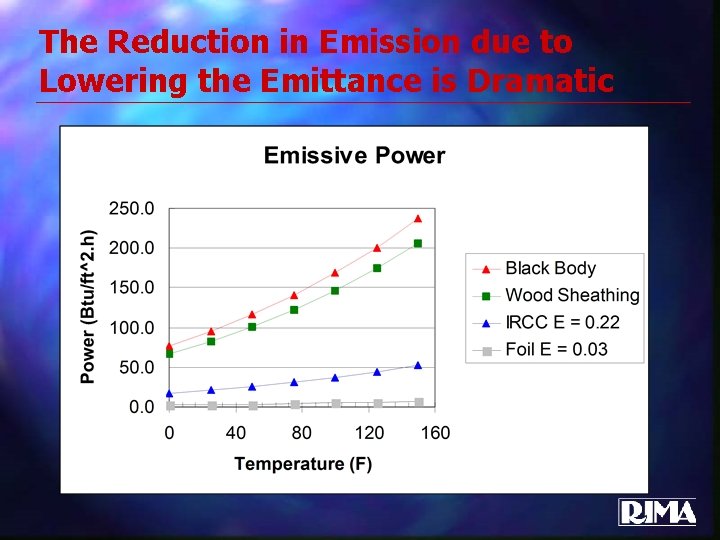
Radiation from a Surface Increases as the Temperature of the Surfaces Increases
The Reduction in Emission due to Lowering the Emittance is Dramatic
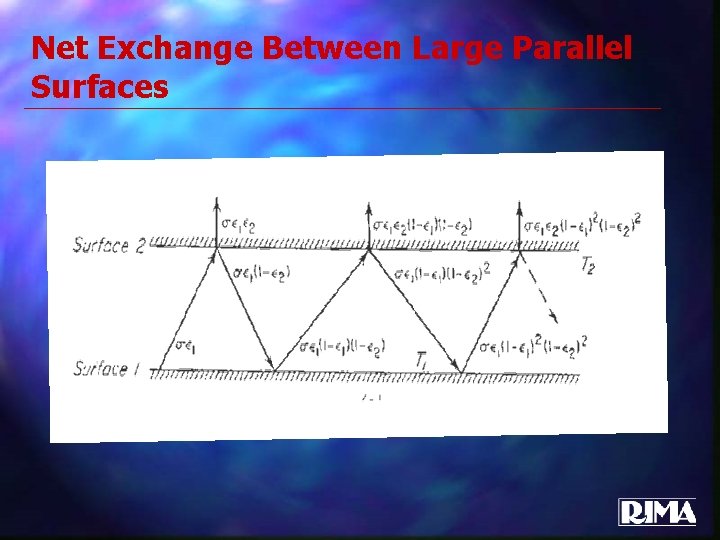
Net Exchange Between Large Parallel Surfaces
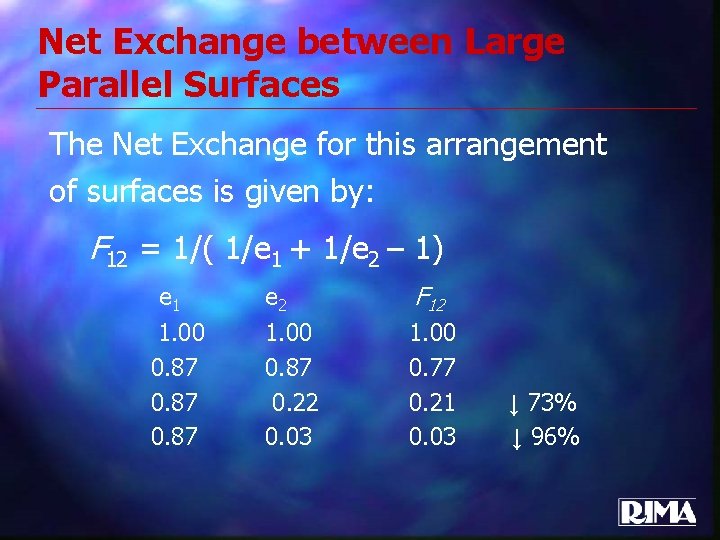
Net Exchange between Large Parallel Surfaces The Net Exchange for this arrangement of surfaces is given by: F 12 = 1/( 1/e 1 + 1/e 2 – 1) e 1 1. 00 0. 87 e 2 F 12 1. 00 0. 87 0. 22 0. 03 1. 00 0. 77 0. 21 0. 03 ↓ 73% ↓ 96%
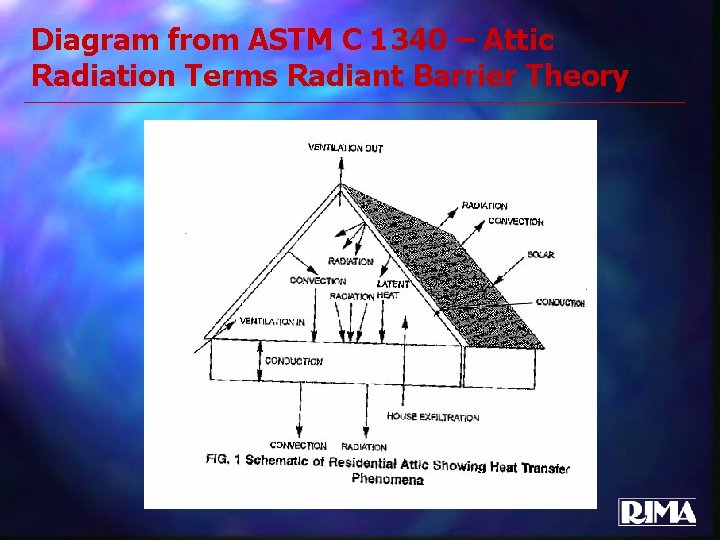
Diagram from ASTM C 1340 – Attic Radiation Terms Radiant Barrier Theory
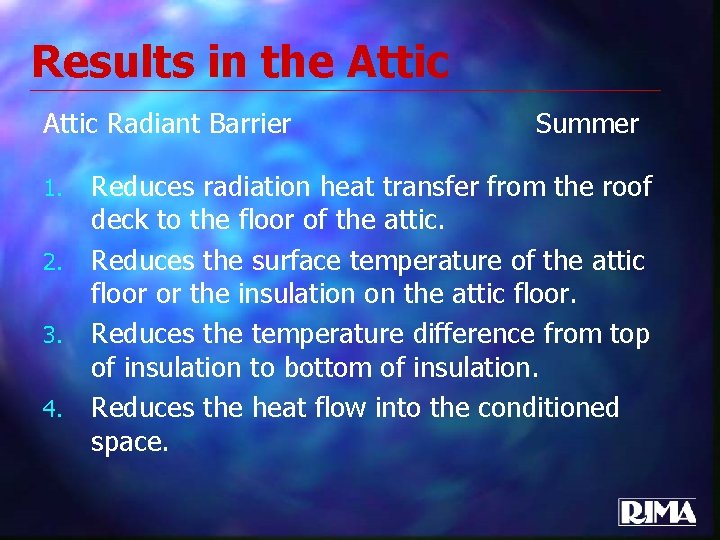
Results in the Attic Radiant Barrier 1. 2. 3. 4. Summer Reduces radiation heat transfer from the roof deck to the floor of the attic. Reduces the surface temperature of the attic floor or the insulation on the attic floor. Reduces the temperature difference from top of insulation to bottom of insulation. Reduces the heat flow into the conditioned space.
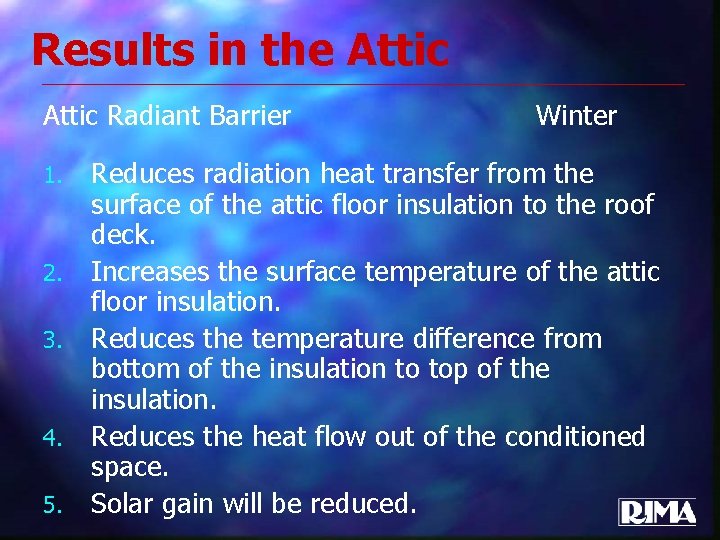
Results in the Attic Radiant Barrier 1. 2. 3. 4. 5. Winter Reduces radiation heat transfer from the surface of the attic floor insulation to the roof deck. Increases the surface temperature of the attic floor insulation. Reduces the temperature difference from bottom of the insulation to top of the insulation. Reduces the heat flow out of the conditioned space. Solar gain will be reduced.
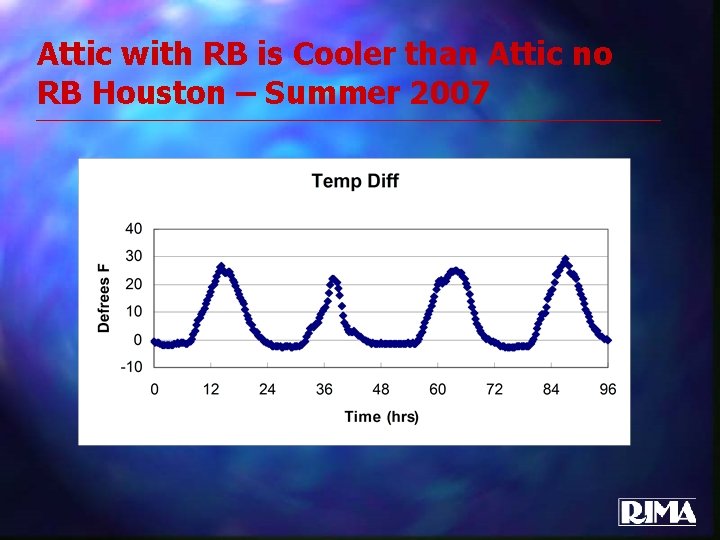
Attic with RB is Cooler than Attic no RB Houston – Summer 2007
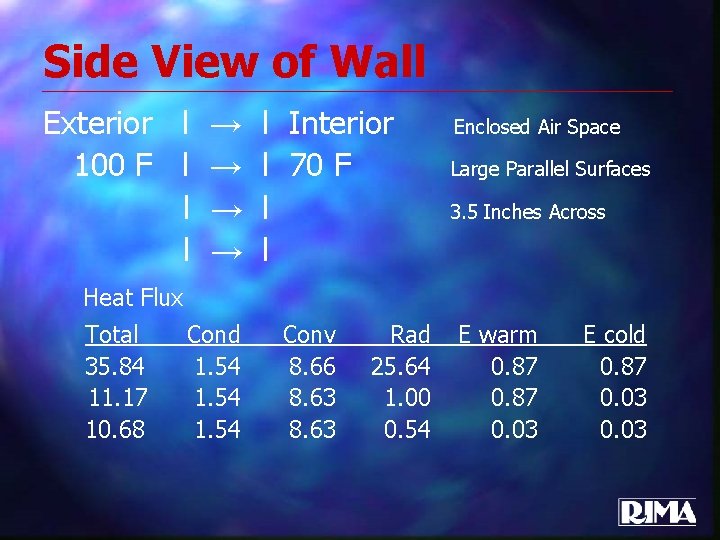
Side View of Wall Exterior l → 100 F l → l → l Interior l 70 F l l Enclosed Air Space Large Parallel Surfaces 3. 5 Inches Across Heat Flux Total 35. 84 11. 17 10. 68 Cond 1. 54 Conv 8. 66 8. 63 Rad 25. 64 1. 00 0. 54 E warm 0. 87 0. 03 E cold 0. 87 0. 03
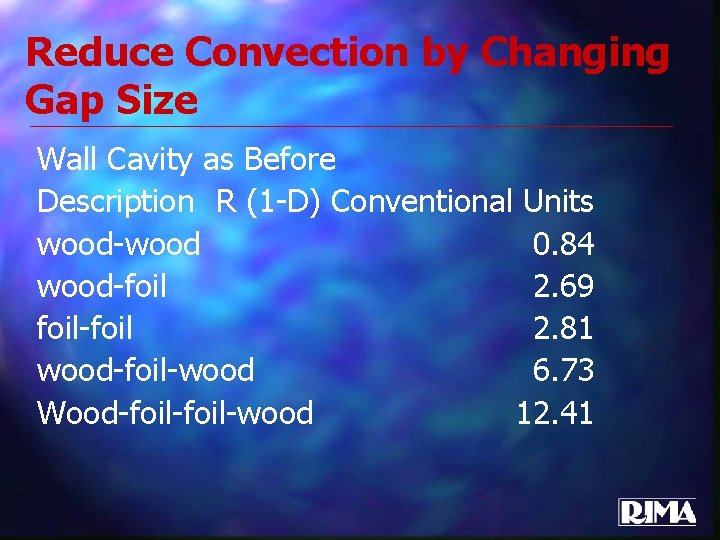
Reduce Convection by Changing Gap Size Wall Cavity as Before Description R (1 -D) Conventional Units wood-wood 0. 84 wood-foil 2. 69 foil-foil 2. 81 wood-foil-wood 6. 73 Wood-foil-wood 12. 41
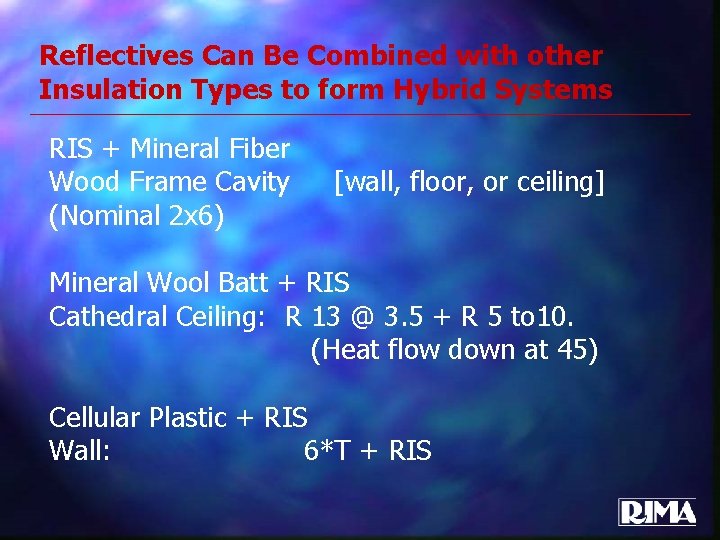
Reflectives Can Be Combined with other Insulation Types to form Hybrid Systems RIS + Mineral Fiber Wood Frame Cavity (Nominal 2 x 6) [wall, floor, or ceiling] Mineral Wool Batt + RIS Cathedral Ceiling: R 13 @ 3. 5 + R 5 to 10. (Heat flow down at 45) Cellular Plastic + RIS Wall: 6*T + RIS
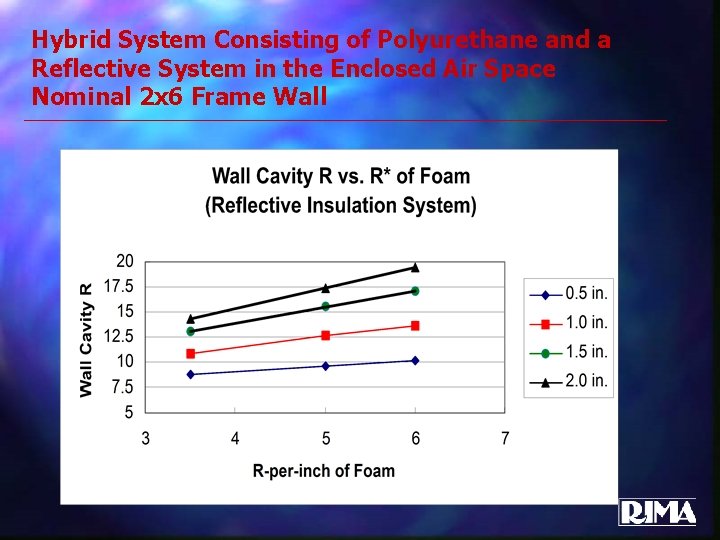
Hybrid System Consisting of Polyurethane and a Reflective System in the Enclosed Air Space Nominal 2 x 6 Frame Wall
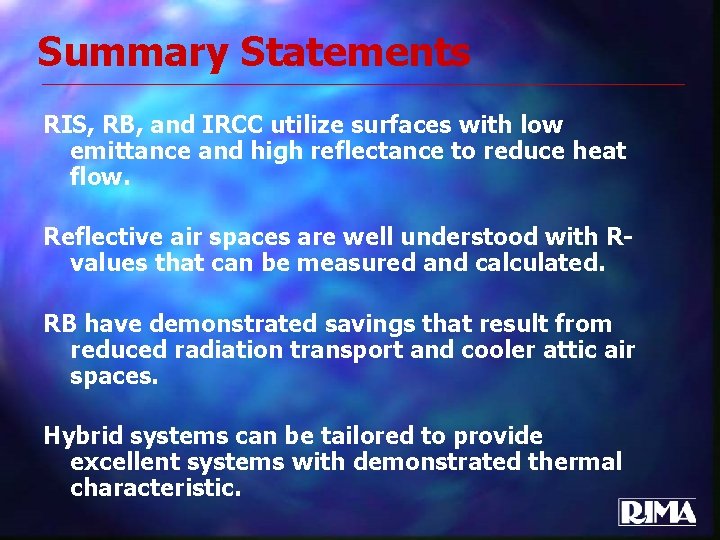
Summary Statements RIS, RB, and IRCC utilize surfaces with low emittance and high reflectance to reduce heat flow. Reflective air spaces are well understood with Rvalues that can be measured and calculated. RB have demonstrated savings that result from reduced radiation transport and cooler attic air spaces. Hybrid systems can be tailored to provide excellent systems with demonstrated thermal characteristic.
Green LEED or NAHB Guidelines • Reduce Energy Use – Primary Benefit • Materials and Resources • Regional Materials
Green Building; is the practice of increasing the efficiency with which buildings use resources – energy, water and materials – while reducing building impacts on human health and the environment, through better siting, design, construction, operation, maintenance, and removal – the complete building cycle. Wikipedia The greatest benefits of radiant barriers and reflective insulation used in Green Building are energy efficiency and comfort for a calculable return on investment through Energy Efficient Design and energy modeling.
Green Building Project Certification n US Green Building Council’s (USGBC) LEED/Leadership in Energy and Environmental Design, includes LEED for New Construction, LEED for Core and Shell, LEED for Schools, etc. n ENERGY STAR Qualified Homes and Designed to Earn the ENERGY STAR for Commercial Buildings n NAHB Model Green Home Guidelines ---------------------------------------------Radiant barriers and reflective insulation not only help projects qualify for Certification, but they also help reduce operating costs through… 1) Energy savings 2) Material and resource usage 3) Increased productivity n
Qualifying for LEED Certification Energy and Atmosphere; Optimize Energy Performance… Reflective Insulation can be used as an option to (or) in conjunction with other Insulation to add R-Value. Radiant Barriers help reduce radiant heat transfer and improve the performance of roof and ceiling insulation. Materials and Resources; Building Reuse, Maintain 50% of Interior non-structural elements… Reflective Insulation and Radiant Barriers could be left in place as part of the existing wall, roof, floor or ceiling system. Materials Reuse… Reflective Insulation and Radiant Barriers could be removed during demolition and reused in new construction. Indoor Environmental Quality; Thermal Comfort: Design… Reflective Insulation and Radiant Barriers can be used to improve building envelope’s performance and increase thermal comfort since they reduce radiant heat transfer.
Qualifying for ENERGY STAR and NAHB Reflective insulation and radiant barriers help you qualify for the HERS Index Requirements (Energy Star Qualified Homes) Radiant barriers help you qualify for “Renewable energy/solar heating and cooling – Using passive Cooling” (NAHB Model Green Home Building Guidelines)
Energy Star Compliance R-values or • Credits in Software Programs Impact Ceiling Heat Flow & HVAC Ducts and Systems located in unconditioned areas •
2. Energy Star Compliance In order to be considered an Energy Star Compliant Home there must be a home energy rating which involves an analysis of the home’s construction plans and onsite inspection resulting in a HERS Index score. HERS Index of 85 in climate zones 1 -5 HERS Index of 80 in climate zones 6 -8 Reference IECC 2006 for Climate Zones
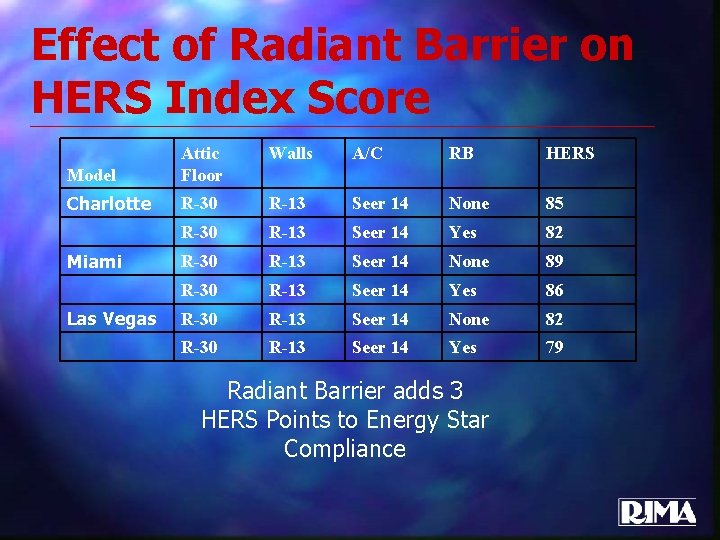
Effect of Radiant Barrier on Code Compliance Example Using Energy Gauge USA Software
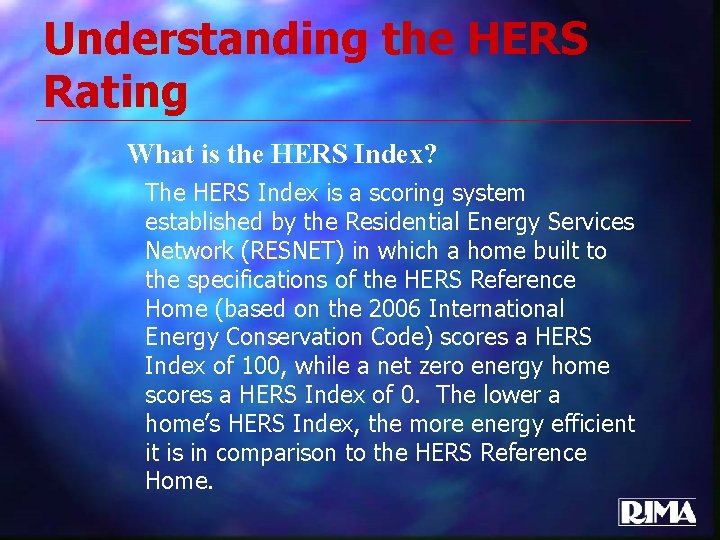
Understanding the HERS Rating What is the HERS Index? The HERS Index is a scoring system established by the Residential Energy Services Network (RESNET) in which a home built to the specifications of the HERS Reference Home (based on the 2006 International Energy Conservation Code) scores a HERS Index of 100, while a net zero energy home scores a HERS Index of 0. The lower a home’s HERS Index, the more energy efficient it is in comparison to the HERS Reference Home.
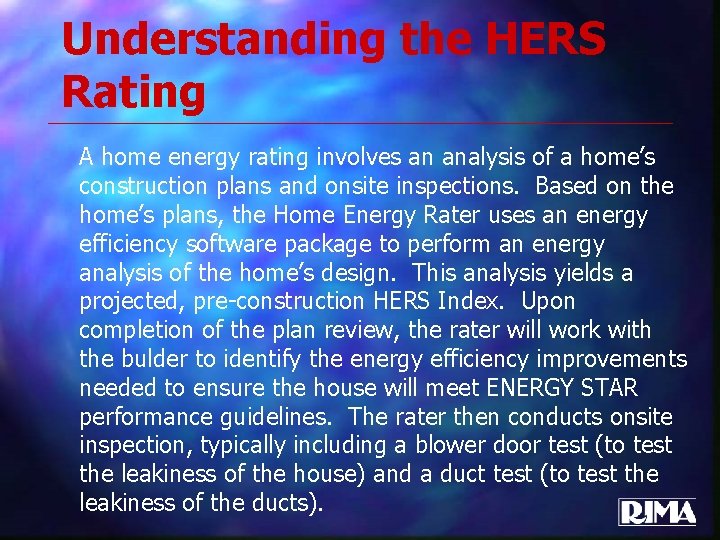
Understanding the HERS Rating A home energy rating involves an analysis of a home’s construction plans and onsite inspections. Based on the home’s plans, the Home Energy Rater uses an energy efficiency software package to perform an energy analysis of the home’s design. This analysis yields a projected, pre-construction HERS Index. Upon completion of the plan review, the rater will work with the bulder to identify the energy efficiency improvements needed to ensure the house will meet ENERGY STAR performance guidelines. The rater then conducts onsite inspection, typically including a blower door test (to test the leakiness of the house) and a duct test (to test the leakiness of the ducts).
Effect of Radiant Barrier on HERS Index Score Walls A/C RB HERS Model Attic Floor Charlotte R-30 R-13 Seer 14 None 85 R-30 R-13 Seer 14 Yes 82 R-30 R-13 Seer 14 None 89 R-30 R-13 Seer 14 Yes 86 R-30 R-13 Seer 14 None 82 R-30 R-13 Seer 14 Yes 79 Miami Las Vegas Radiant Barrier adds 3 HERS Points to Energy Star Compliance
Federal Tax Credits Commercial Buildings: Taxpayers can enjoy a deduction of up to $1. 80 per square foot for buildings that achieve a 50% reduction in annual energy costs related to heating, cooling, water heating and interior lighting - costs that are defined by the ASHRAE standard. n New Homes: A credit of up to $2, 000 is available to home builders who build homes projected - and demonstrated - to save at least 50% of the heating and cooling energy of a comparable home that meets the standards of the 2004 International Energy Conservation Code (IECC) Supplement. n Existing Homes: Current homeowners are eligible for different tax credits based on a variety of energy-efficiency measures such as improving insulation - with a $500 cap. n
Questions? Reflective Insulation Manufacturers Association International (RIMA International) 800/279 -4123 www. rimainternational. org