
The Red Power Movement of the 1960 s
- Slides: 32
The Red Power Movement of the 1960 s and Early 1970 s and the Indian Civil Rights Act of 1968 Native American History, Topic 8
�In the 1960 s and early 1970 s, Native Americans joined other minorities in a cultural revolution of self-expression, political activism, and militancy, all in the name of freedom, equality, and power. “Red Power, ” as the movement would be called, sought to address the grievances of Indians, who, by the 1960 s, were the poorest, unhealthiest, and least stable minority group in the United States—and, in an astounding reversal from dominating the continent five hundred years earlier, less than one percent of the population. Background: Cultural Revolution
� Nearly half of all Indians lived on reservations, native joblessness was ten times the national average, and the average Indian family earned $1, 000 less than the average African-American family. Indian life expectancy was twenty years lower than the national rate, Indian suicides occurred one hundred times more frequently than white suicides, and—as a result of the federal government’s termination and relocation policies (begun in the 1950 s), which attempted to remove the government’s special services for Indians and which funneled thousands of Indians into cities in the name of assimilation—native peoples felt the federal government had left them without the tools or the power to decide their own futures. Background: Powerless
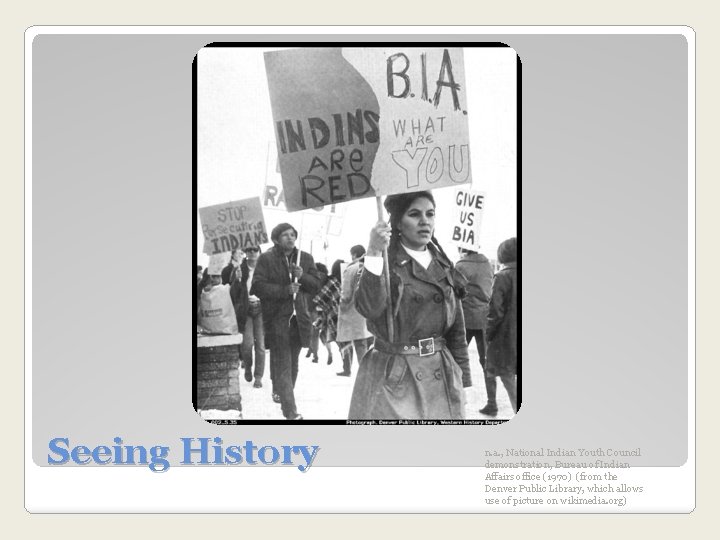
� Indian activists responded to these grievances in a number of ways. In 1961, over four hundred members of 67 tribes met at the American Indian Chicago Conference and drafted a Declaration of Indian Purpose, which called upon President John F. Kennedy to grant them self-determination: “the right to choose our own way of life. ” Later that year, younger participants in the Chicago conference formed the National Indian Youth Council (NIYC) in New Mexico to demand an increased role for Indians in making the policies that affected their lives and to promote Indian nationalism and unity. Indians in the Pacific Northwest staged “fish-ins, ” in which they purposefully fished out of season and without licenses, to assert their treaty rights and publicize their grievances. Background: Self-Determination
Seeing History n. a. , National Indian Youth Council demonstration, Bureau of Indian Affairs office (1970) (from the Denver Public Library, which allows use of picture on wikimedia. org)
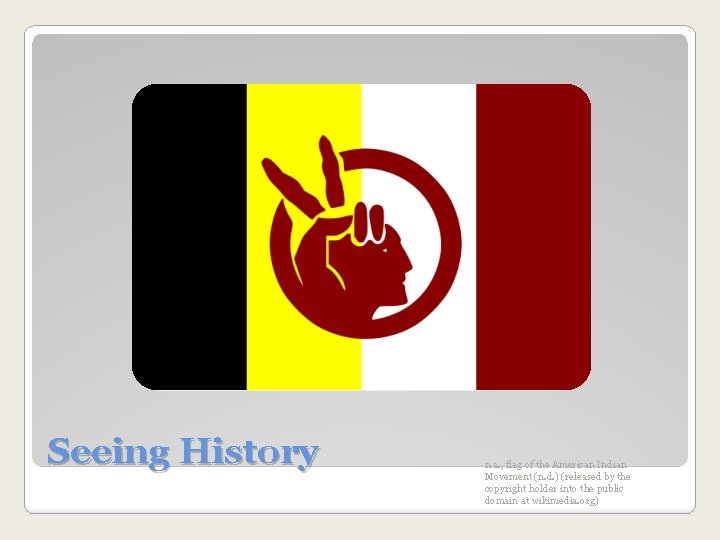
�In 1968, a daring pan-Indian organization—the American Indian Movement (AIM)—began attracting young militant Indians from cities and reservations to the cause of direct, action-oriented, and, at times, violent protest. Congress responded to the pressure exerted by these groups by passing the Indian Civil Rights Act (ICRA) of 1968, which guaranteed reservation Indians many of the rights protected by the first ten amendments to the U. S. Constitution and also recognized, to an extent, the authority of tribal law within reservation boundaries. Background: AIM and ICRA
Seeing History n. a. , flag of the American Indian Movement (n. d. ) (released by the copyright holder into the public domain at wikimedia. org)
�What principles or lessons stand out to you from the history covered by the preceding slides? �What one word would you choose to describe the history covered by the preceding slides? Please explain. �What is the biggest question that you have about the history covered by the preceding slides? Reason from the Background
� “So, my appeal today is for the Lamanites, all the Lamanites, the Mexicans, the Polynesians, the Indians, to live the commandments of God and prove themselves worthy of this choice land. And a further word of caution: Keep your strength up to high purpose. Keep your eye single to the glory of God. Maintain your faith and live the principles of the gospel. Remember that the gospel of Jesus Christ is not compatible with radicalism or communism or any other of the ‘isms. ’ There could be those who would profess to be your saviors. They could enslave you with their force or their strange philosophies. If some of their leaders have motives that are selfish and questionable, have nothing to do with them. Perhaps some would even excite you to unwise actions. Beware of them. Keep your feet on the ground and your heads high. Listen to your duly elected tribal leaders and stay with those who want independence, equality, and full freedom for the Indian people by peaceful means alone. Only these kinds of successes will be enduring” (President Spencer W. Kimball, Dec. Ensign 1975). Relate the Words of Modern Prophets
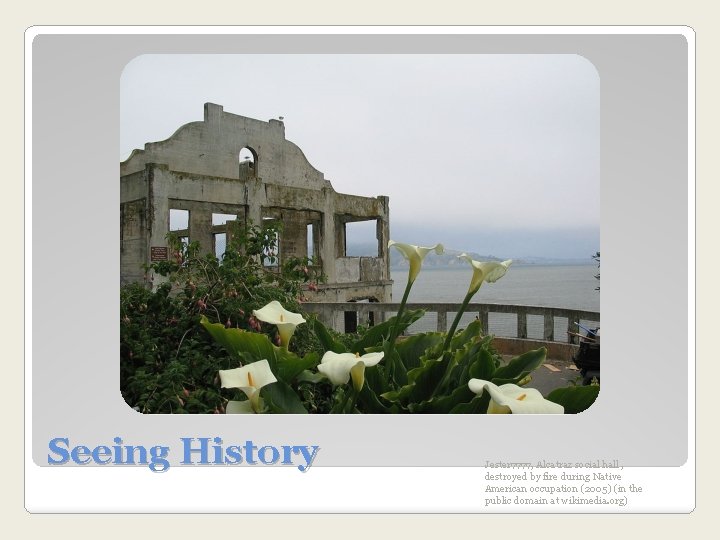
� Nevertheless, members of AIM and other Indian rights groups saw the ICRA as an intrusion on tribal sovereignty and turned to increasingly militant forms of protest. In 1968, Indian fishermen fought Washington State officials on the Columbia River and in Puget Sound, and Mohawk Indians blockaded the International Bridge between Canada and New York. In 1969, young Indians from several tribes seized Alcatraz Island its abandoned federal prison in San Francisco Bay. Calling themselves “Indians of All Tribes, ” they issued a “Proclamation to the Great White Father, ” which sarcastically claimed the island by “right of discovery, ” offered to purchase it for “twenty-four dollars (24) in glass beads and red cloth, ” and listed its suitability as a reservation because of its lack of running water, sanitation facilities, oil or mineral rights, health care and educational facilities, room to live, and freedom. Background: Militant Protest
Seeing History Jester 7777, Alcatraz social hall , destroyed by fire during Native American occupation (2005) (in the public domain at wikimedia. org)
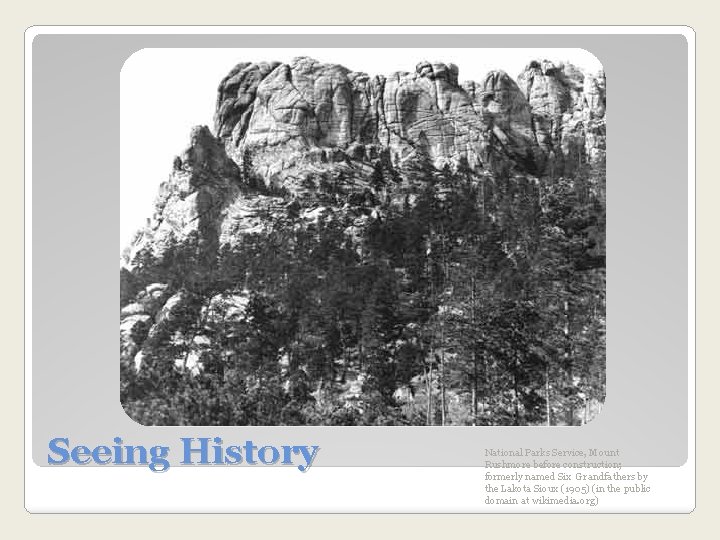
�In 1970, despite President Richard M. Nixon’s calls for more Indian self-determination and increased federal aid, AIM protesters demonstrated at Plymouth Rock and Mayflower II and proclaimed Thanksgiving a “national day of mourning. ” A year later, they staged protests at Mount Rushmore, where, they said, the sculpted heads of enemy, expansionist presidents still greedily watched over Sioux lands. Background: More Protests
Seeing History National Parks Service, Mount Rushmore before construction; formerly named Six Grandfathers by the Lakota Sioux (1905) (in the public domain at wikimedia. org)
� In 1972, on the self-named “Trail of Broken Treaties, ” AIM organizers led a caravan of five hundred Indians from Minneapolis to Washington, D. C. , to draw attention to their grievances, propose that the federal government enter into a new era of treaty-making with tribes, and make other demands that were listed in a twenty-point document. These demands included an address to the American people and joint sessions of Congress, a commission to make new treaties, a commission to review treaty commitments and violations, mandatory relief against treaty violations, abolition of the Bureau of Indian Affairs, creation of an office of federal Indian relations and community reconstruction, protection of Indian religious freedom, and increased funding for welfare entitlements. The protest culminated in six days of militant AIM members forcibly occupying the Bureau of Indian Affairs, which they renamed the “Native American Embassy. ” Background: Trail of Broken Treaties
�What principles or lessons stand out to you from the history covered by the preceding slides? �What one word would you choose to describe the history covered by the preceding slides? Please explain. �What is the biggest question that you have about the history covered by the preceding slides? Reason from the Background
� “Many in this world are afraid angry with one another. While we understand these feelings, we need to be civil in our discourse and respectful in our interactions. This is especially true when we disagree. The Savior taught us to love even our enemies. The vast majority of our members heed this counsel. Yet there are some who feel that venting their personal anger or deeply held opinions is more important than conducting themselves as Jesus Christ lived and taught. I invite each one of us individually to recognize that how we disagree is a real measure of who we are and whether we truly follow the Savior. It is appropriate to disagree, but it is not appropriate to be disagreeable. Violence and vandalism are not the answer to our disagreements. If we show love and respect even in adverse circumstances, we become more like Christ” (Elder Quentin L. Cook, May Ensign 2010). Relate the Words of Modern Prophets
� Though the protest ended without bloodshed after the federal government agreed to review the twenty points and pay for the protesters to return home, later that winter, an AIM siege at Wounded Knee would result in the deaths of two Indians, the wounding of several more, and the firing of more than half a million rounds of ammunition by U. S. forces. Following the murder of Sioux Wesley Bad Heart Bull on the Pine Ridge Reservation, and the charge of his white killer with only second-degree manslaughter, AIM protesters clashed with Custer, South Dakota, police. As violence continued, the Bureau of Indian Affairs requested federal marshals to intervene, and, in February 1973, AIM leaders Dennis Banks and Russell Means, along with two hundred activists, took over the village of Wounded Knee: the site of the 1890 massacre of Big Foot’s people. Background: Wounded Knee
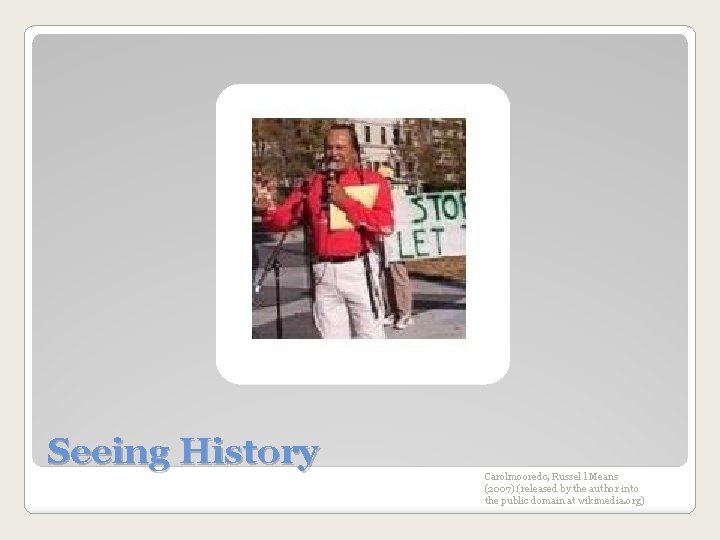
Seeing History Carolmooredc, Russel l Means (2007) (released by the author into the public domain at wikimedia. org)
� As marshals, FBI agents, troops, and armored vehicles surrounded their compound, Banks and Means began a seventy-one-day demonstration for self-determination and tribal sovereignty, declared independence from the United States, and defined their national boundaries as those created by the 1868 Treaty of Fort Laramie. Despite intermittent firing over two months and a brief armed clash between protesters and federal forces, an open assault on the village, which the government had considered, never occurred, and Banks and Means finally decided to end their occupation on the condition that federal officials hold a full investigation of their grievances and requests. Notwithstanding, the settlement failed. As Means lamented, “The government broke it before the ink was dry. ” Background: 71 Days
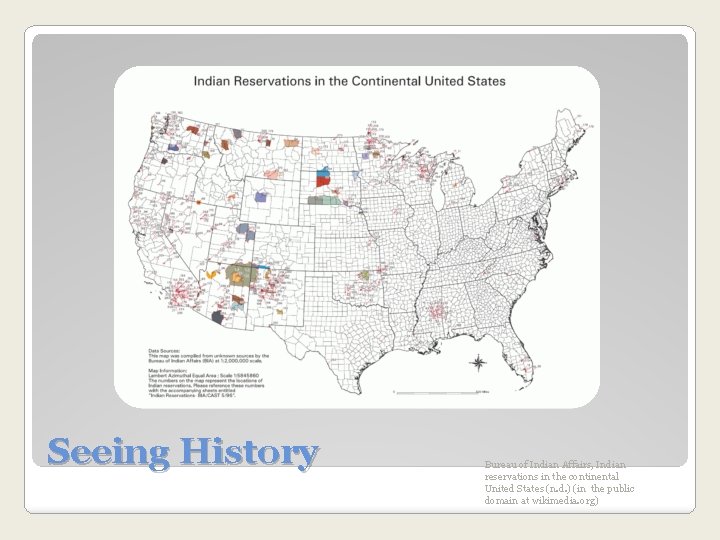
� In the end, Indian activism failed to secure its desired freedom, equality, and power. On the other hand, it helped to generate widespread awareness of the problems of Native Americans: peoples who, in the words of historian Colin Calloway, “had not disappeared” and whose relations with the United States would “continue to be marked by conflict as long as American society encroached on Indian resources and denied Indian rights. ” Today, more than two-thirds of the 2. 5 million Indians (and 1. 6 million part-Indians) from over 550 recognized tribes live in urban areas. The other third inhabits approximately three hundred federal and state reservations spread throughout the nation, mostly in the West. As they wait to “blossom as the rose” (Doctrine and Covenants 49: 24) with other peoples of Lamanite descent, complicated questions about land, resources, culture, and sovereignty still remain. Background: Awareness
Seeing History Bureau of Indian Affairs, Indian reservations in the continental United States (n. d. ) (in the public domain at wikimedia. org)
�What principles or lessons stand out to you from the history covered by the preceding slides? �What one word would you choose to describe the history covered by the preceding slides? Please explain. �What is the biggest question that you have about the history covered by the preceding slides? Reason from the Background
�“We wish to extend our love and appreciation to all those who have provided service and sacrifice in the Indian student placement program. To you wonderful Indian parents, we give our love. We know of your sacrifice in allowing your children the opportunity for a good education away from home and access to the full Church program. We know how your love will bless the lives of your children and strengthen your entire family. To you foster parents who give of your life, your time, and your means, we offer our deepest appreciation. We know your participation requires love and a little extra to provide for these Lamanite youth. We also know that many blessings come to you and your family as you demonstrate this love and unselfishness for others. Relate the Words of Modern Prophets
�“Both foster families and Indian families benefit from the experience. The placement program was inspired of the Lord. We have watched many of our Lamanite youth become strong leaders in the Church, and many have taken their place as leaders in their communities and in the world. We encourage bishops to continue their work in this important and official program of the Church. Seek out Lamanite youth who will benefit from the program and help them blossom as the rose” (President Spencer W. Kimball, May Ensign 1979). Relate the Words of Modern Prophets
�What are the effects of the Indian Civil Rights Act of 1968? Reason from the Source
�Why would an Indian support the Indian Civil Rights Act of 1968? Reason from the Source
�Why would an Indian oppose the Indian Civil Rights Act of 1968? Reason from the Source
�How does the document relate to FACE Principle #2: The Christian Principle of Self. Government: “God ruling internally from the heart of the individual. In order to have true liberty man must be governed internally by the Spirit of God rather than by external forces. Government is first individual then extends to the home, church and community”? Relate the FACE Seven Principles
�How does the document relate to 3 Nephi 21: 1 -7? ◦ “And verily I say unto you, I give unto you a sign, that ye may know the time when these things shall be about to take place—that I shall gather in, from their long dispersion, my people, O house of Israel, and shall establish again among them my Zion; And behold, this is the thing which I will give unto you for a sign—for verily I say unto you that when these things which I declare unto you, and which I shall declare unto you hereafter of myself, and by the power of the Holy Ghost which shall be given unto you of the Father, shall be made known unto the Gentiles that they may know concerning this people who are a remnant of the house of Jacob, and concerning this my people who shall be scattered by them; Verily, verily, I say unto you, when these things shall be made known unto them of the Father, and shall come forth of the Father, from them unto you; Relate the Anchor Scriptures
�How does the document relate to 3 Nephi 21: 1 -7? �“For it is wisdom in the Father that they should be established in this land, and be set up as a free people by the power of the Father, that these things might come forth from them unto a remnant of your seed, that the covenant of the Father may be fulfilled which he hath covenanted with his people, O house of Israel; Therefore, when these works and the works which shall be wrought among you hereafter shall come forth from the Gentiles, unto your seed which shall dwindle in unbelief because of iniquity; Relate the Anchor Scriptures
�How does the document relate to 3 Nephi 21: 1 -7? �“For thus it behooveth the Father that it should come forth from the Gentiles, that he may show forth his power unto the Gentiles, for this cause that the Gentiles, if they will not harden their hearts, that they may repent and come unto me and be baptized in my name and know of the true points of my doctrine, that they may be numbered among my people, O house of Israel; And when these things come to pass that thy seed shall begin to know these things—it shall be a sign unto them, that they may know that the work of the Father hath already commenced unto the fulfilling of the covenant which he hath made unto the people who are of the house of Israel. ” Relate the Anchor Scriptures
�How does the document relate to Doctrine and Covenants 49: 24? ◦ “But before the great day of the Lord shall come, Jacob shall flourish in the wilderness, and the Lamanites shall blossom as the rose. ” Relate the Anchor Scriptures