
The RecoveryOrientation of Mental Health Programs Valuing Different
- Slides: 16
The Recovery-Orientation of Mental Health Programs: Valuing Different Perspectives Diana Seybolt, Ph. D. a Laura Anderson, Ph. D. b Lachelle Wade-Freeman, M. A. a b a. University of Maryland, Baltimore University of Maryland Medical Center
Mental Health Recovery � National Consensus Statement (2004): Mental health recovery is a journey of healing and transformation enabling a person with a mental health problem to live a meaningful life in a community of his or her choice while striving to achieve his or her full potential.
Mental Health Recovery � SAMHSA Definition of Recovery Forum May-August 2011 � Current SAMHSA working definition: “A process of change through which individuals work to improve their own health and wellbeing, live a self-directed life, and strive to achieve their full potential. ”
Evaluation Context Maryland was one of nine states to receive a Mental Health Transformation State Incentive Grant. � Cross-site evaluation included measures of individual consumer recovery and recoveryorientation of practices in programs. � Cultural and Linguistic Competence Training and Consultation Project implemented in Adult Psychiatric Rehabilitation Programs (PRPs). � Trainers and evaluators collaborated to design evaluation protocol and disseminate results. �
Are our services recovery oriented? � To what extent do our programs foster and promote recovery? � Are there differences in the way in which program staff and consumers view the recovery-orientation of programs?
Methods � Data was collected from 13 programs. › N=149 staff members (self-administered surveys). › N=120 consumers (telephone interviews). � Data collected prior to didactic training � Measure used was the Recovery Self-Assessment (RSA-R; O’Connell, Tondora, Croog, Evans, & Davison, 2005)
Respondent Demographics � The majority of both groups were female (62% of consumers and 77% of staff). � The largest group of consumer respondents were between 45 -54 years old (40%); the largest group of staff were younger (35% between 25 -34). � The majority of both groups were Caucasian (64% for each); approximately one-third of both groups were African American (38% of consumers and 33% of staff).
Recovery Self-Assessment (RSA-R) Developed by at the Program for Recovery and Community Health at Yale University �http: //www. yale. edu/PRCH/tools/rec_selfasses sment. html � 32 -items designed to gauge the degree to which programs implement recovery-oriented practices � Respondents rated items on 1 -5 Likert Scale. � Scoring: Total Mean Score and 6 Empirically Derived Factors �
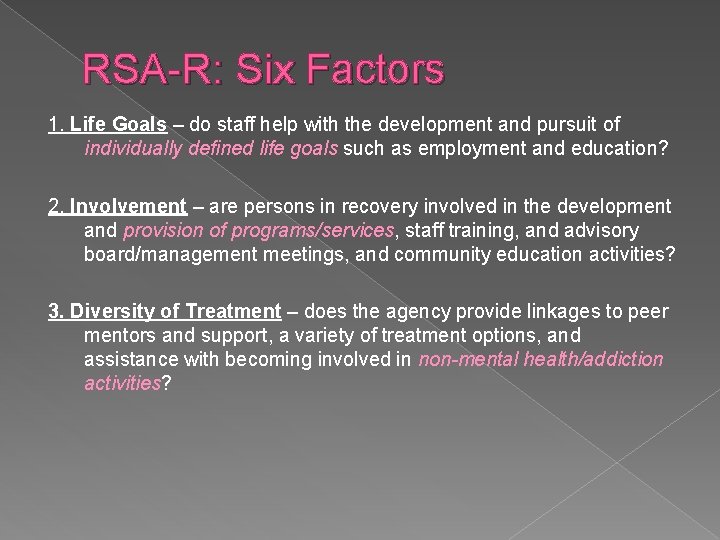
RSA-R: Six Factors 1. Life Goals – do staff help with the development and pursuit of individually defined life goals such as employment and education? 2. Involvement – are persons in recovery involved in the development and provision of programs/services, staff training, and advisory board/management meetings, and community education activities? 3. Diversity of Treatment – does the agency provide linkages to peer mentors and support, a variety of treatment options, and assistance with becoming involved in non-mental health/addiction activities?
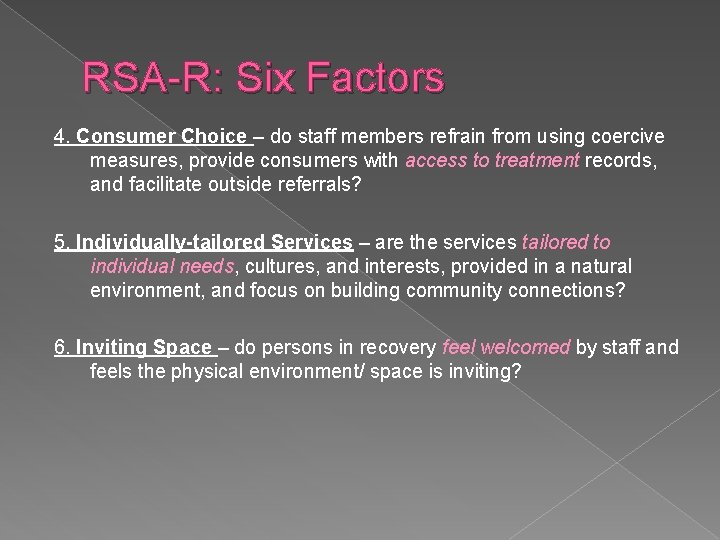
RSA-R: Six Factors 4. Consumer Choice – do staff members refrain from using coercive measures, provide consumers with access to treatment records, and facilitate outside referrals? 5. Individually-tailored Services – are the services tailored to individual needs, cultures, and interests, provided in a natural environment, and focus on building community connections? 6. Inviting Space – do persons in recovery feel welcomed by staff and feels the physical environment/ space is inviting?
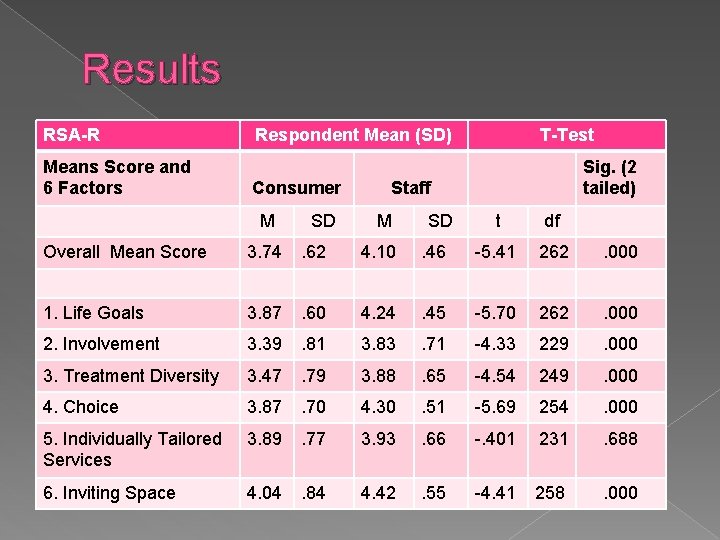
Results RSA-R Means Score and 6 Factors Respondent Mean (SD) Consumer M SD T-Test Sig. (2 tailed) Staff M SD t df Overall Mean Score 3. 74 . 62 4. 10 . 46 -5. 41 262 . 000 1. Life Goals 3. 87 . 60 4. 24 . 45 -5. 70 262 . 000 2. Involvement 3. 39 . 81 3. 83 . 71 -4. 33 229 . 000 3. Treatment Diversity 3. 47 . 79 3. 88 . 65 -4. 54 249 . 000 4. Choice 3. 87 . 70 4. 30 . 51 -5. 69 254 . 000 5. Individually Tailored Services 3. 89 . 77 3. 93 . 66 -. 401 231 . 688 6. Inviting Space 4. 04 . 84 4. 42 . 55 -4. 41 258 . 000
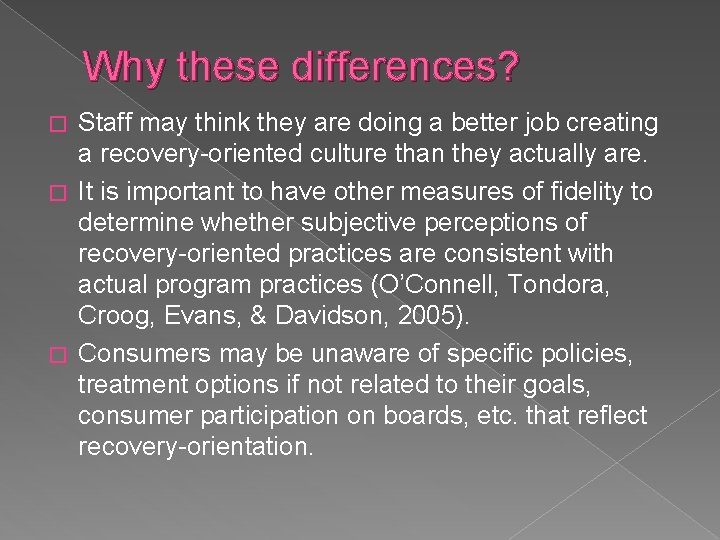
Why these differences? Staff may think they are doing a better job creating a recovery-oriented culture than they actually are. � It is important to have other measures of fidelity to determine whether subjective perceptions of recovery-oriented practices are consistent with actual program practices (O’Connell, Tondora, Croog, Evans, & Davidson, 2005). � Consumers may be unaware of specific policies, treatment options if not related to their goals, consumer participation on boards, etc. that reflect recovery-orientation. �
Why these differences? Activities around the State have been promoting and targeting enhancement for Consumer Recovery as well as Recovery-Oriented Practices at Programs. � Program Enhancing Initiatives: › Recovery-oriented regulations › Trainings/Recovery Centers of Excellence Project � Consumer (Individual) Recovery Initiatives: › Expansion of Wellness and Recovery Centers, with an increased emphasis on personal recovery, less on program characteristics. � Several areas overlap with key issues identified in promoting cultural competence (Life Goals, Inviting Space, Involvement). �
Using the Data � Agency-specific reports containing descriptive data only was provided to Leadership Teams. � “Data for dialogue”
Limitations � Analyses were not conducted at the program level due to the small sample sizes; differences between programs may have obscured the findings. � Not clear how representative the consumer sample was for the program or across the state. � May not be applicable to other PRPs or other types of mental health services.
For more information Diana C. Seybolt, Ph. D University of Maryland Systems Evaluation Center dseybolt@psych. umaryland. edu 410 -646 -1756