
The Recording Process DMH 1 3 The Account




- Slides: 31
The Recording Process DMH -1 3
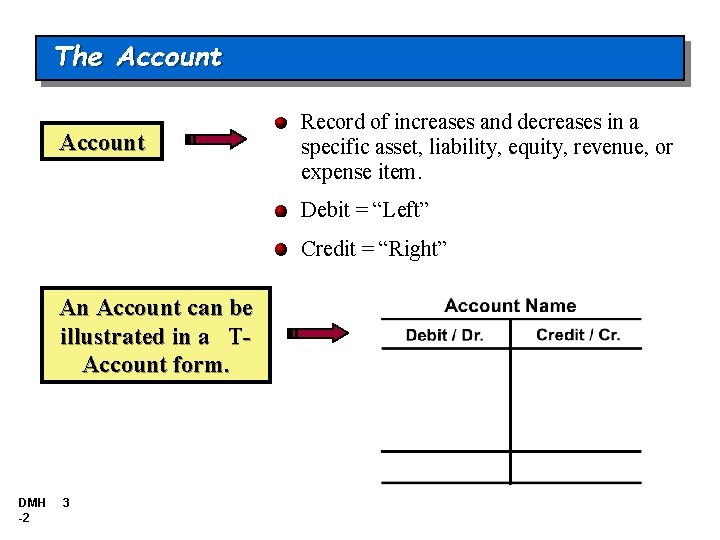
The Account Record of increases and decreases in a specific asset, liability, equity, revenue, or expense item. Debit = “Left” Credit = “Right” An Account can be illustrated in a TAccount form. DMH -2 3
Debits and Credits Double-entry accounting system Each transaction must affect two or more accounts to keep the basic accounting equation in balance. Recording done by debiting at least one account and crediting another. DEBITS must equal CREDITS. DMH -3 3
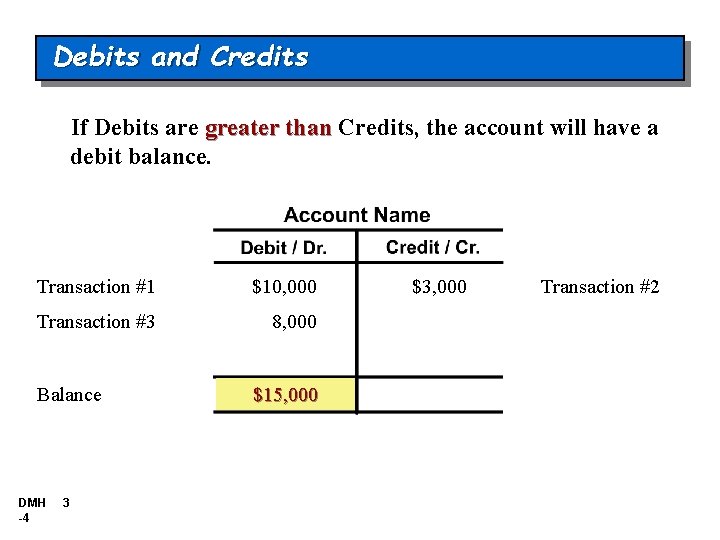
Debits and Credits If Debits are greater than Credits, the account will have a debit balance. Transaction #1 $10, 000 Transaction #3 8, 000 Balance DMH -4 3 $15, 000 $3, 000 Transaction #2
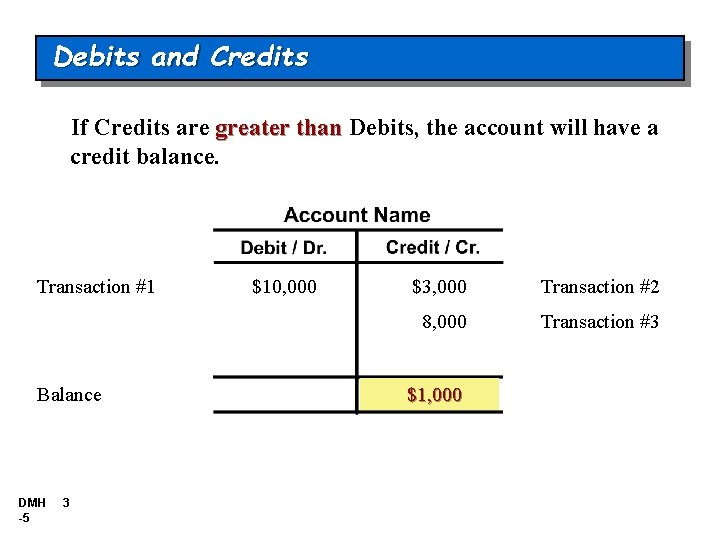
Debits and Credits If Credits are greater than Debits, the account will have a credit balance. Transaction #1 Balance DMH -5 3 $10, 000 $3, 000 Transaction #2 8, 000 Transaction #3 $1, 000
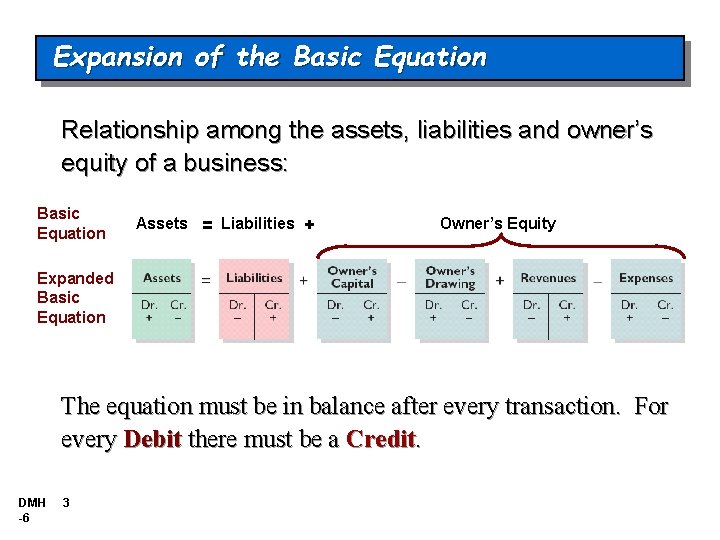
Expansion of the Basic Equation Relationship among the assets, liabilities and owner’s equity of a business: Basic Equation Assets = Liabilities + Owner’s Equity Expanded Basic Equation The equation must be in balance after every transaction. For every Debit there must be a Credit. DMH -6 3
Debits and Credits Summary Review Question Accounts that normally have debit balances are: a. assets, expenses, and revenues. b. assets, expenses, and owner’s capital. c. assets, liabilities, and owner’s drawings. d. assets, owner’s drawings, and expenses. DMH -7 3
Debits and Credits Summary Discussion Question Q. Maria Alvarez, a beginning accounting student, believes debit balances are favorable and credit balances are unfavorable. Is Maria correct? Discuss. DMH -8 3
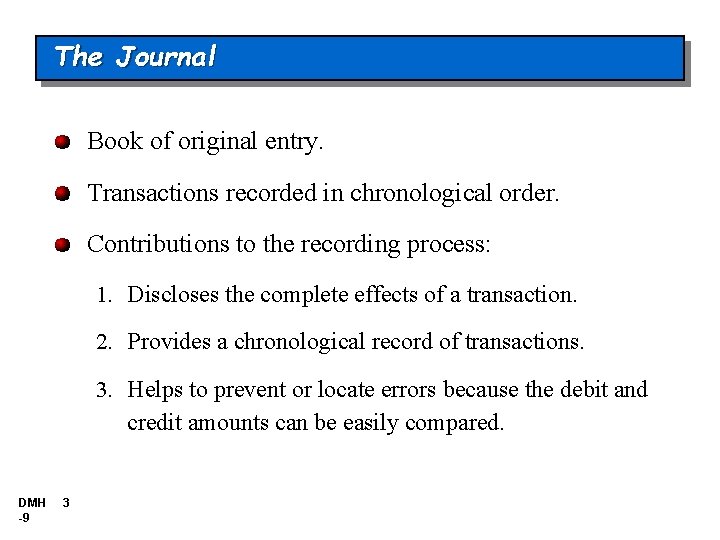
The Journal Book of original entry. Transactions recorded in chronological order. Contributions to the recording process: 1. Discloses the complete effects of a transaction. 2. Provides a chronological record of transactions. 3. Helps to prevent or locate errors because the debit and credit amounts can be easily compared. DMH -9 3
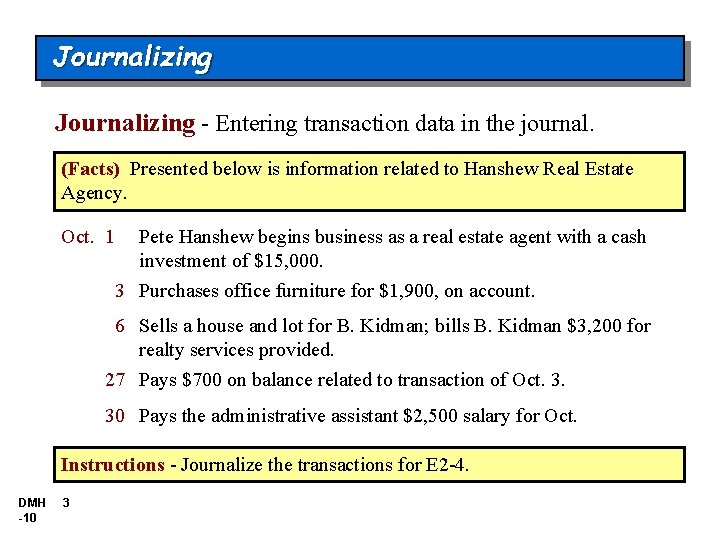
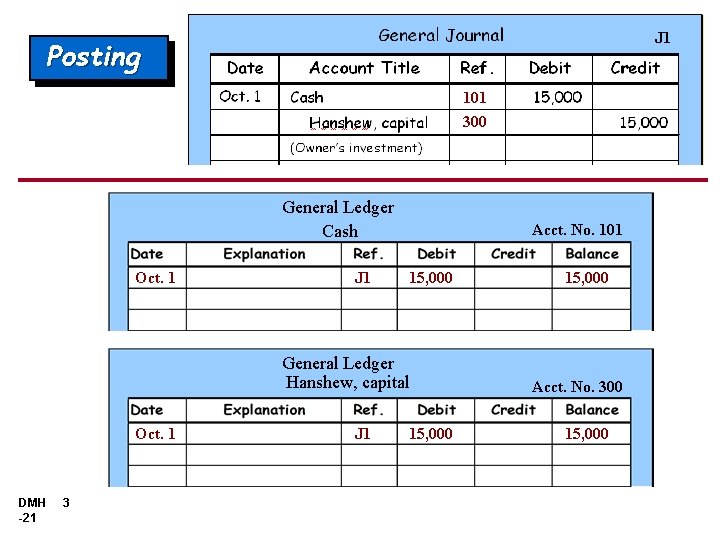
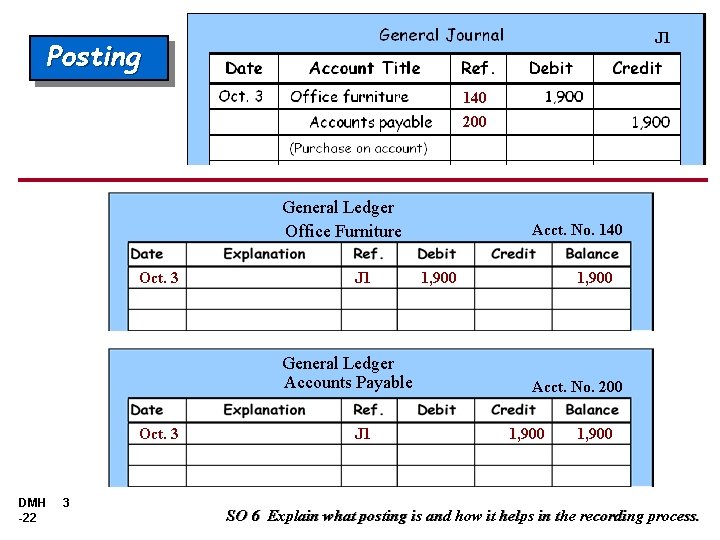
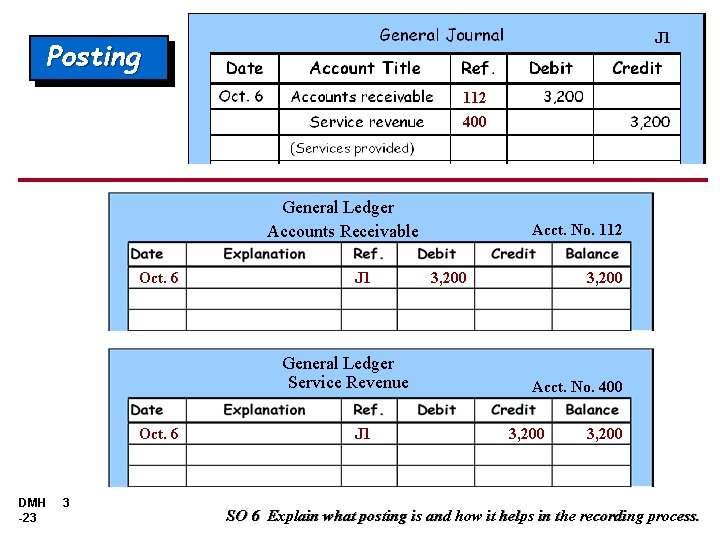
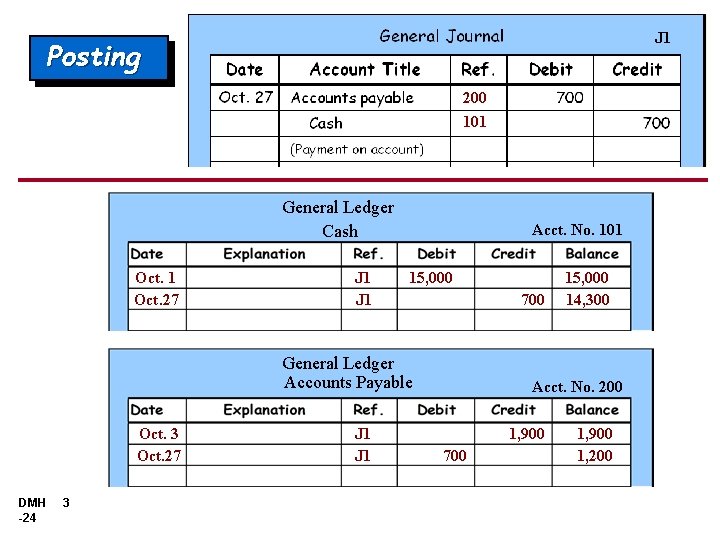
Journalizing - Entering transaction data in the journal. (Facts) Presented below is information related to Hanshew Real Estate Agency. Oct. 1 Pete Hanshew begins business as a real estate agent with a cash investment of $15, 000. 3 Purchases office furniture for $1, 900, on account. 6 Sells a house and lot for B. Kidman; bills B. Kidman $3, 200 for realty services provided. 27 Pays $700 on balance related to transaction of Oct. 3. 30 Pays the administrative assistant $2, 500 salary for Oct. Instructions - Journalize the transactions for E 2 -4. DMH -10 3
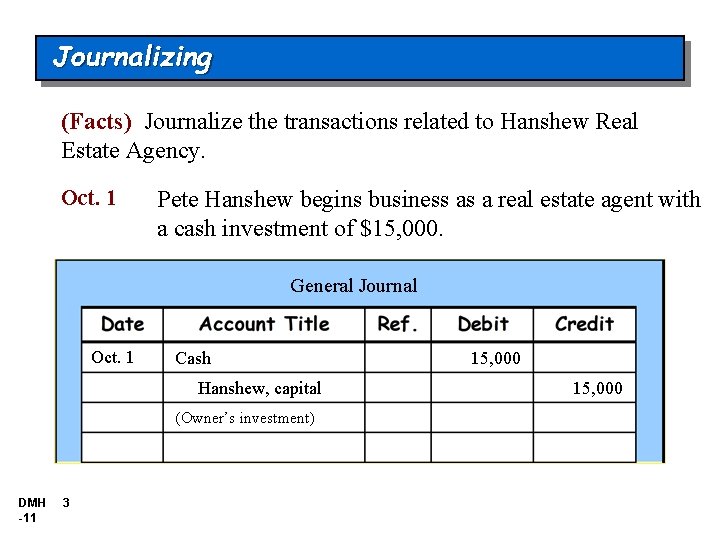
Journalizing (Facts) Journalize the transactions related to Hanshew Real Estate Agency. Oct. 1 Pete Hanshew begins business as a real estate agent with a cash investment of $15, 000. General Journal Oct. 1 Cash Hanshew, capital (Owner’s investment) DMH -11 3 15, 000
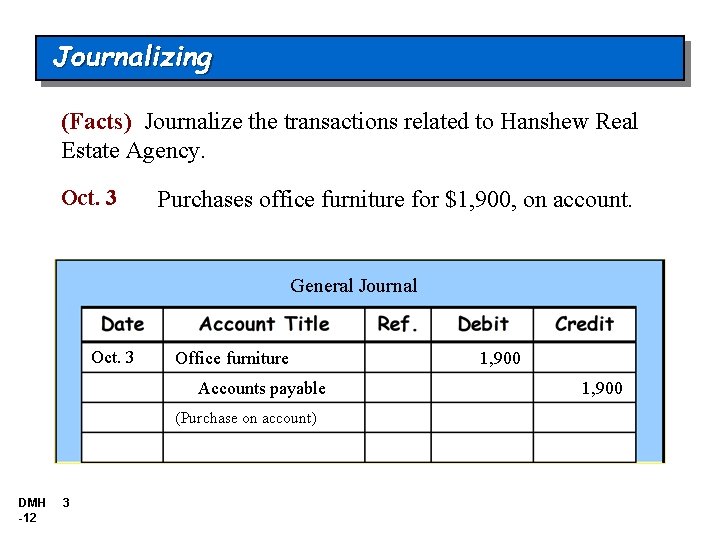
Journalizing (Facts) Journalize the transactions related to Hanshew Real Estate Agency. Oct. 3 Purchases office furniture for $1, 900, on account. General Journal Oct. 3 Office furniture Accounts payable (Purchase on account) DMH -12 3 1, 900
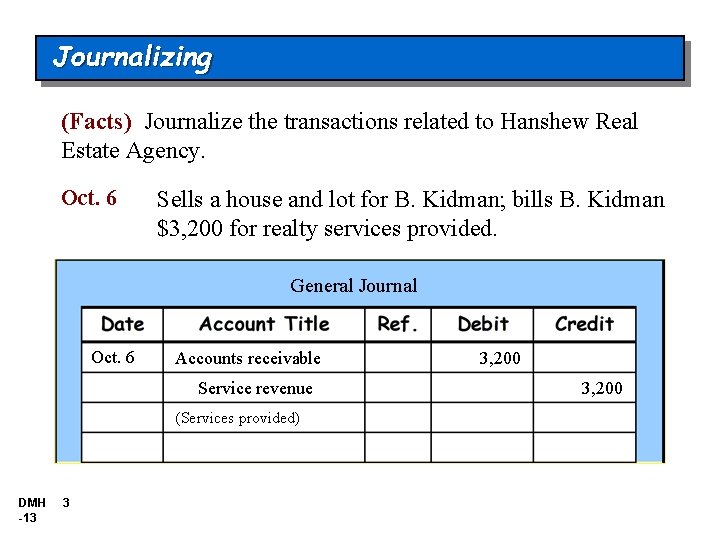
Journalizing (Facts) Journalize the transactions related to Hanshew Real Estate Agency. Oct. 6 Sells a house and lot for B. Kidman; bills B. Kidman $3, 200 for realty services provided. General Journal Oct. 6 Accounts receivable Service revenue (Services provided) DMH -13 3 3, 200
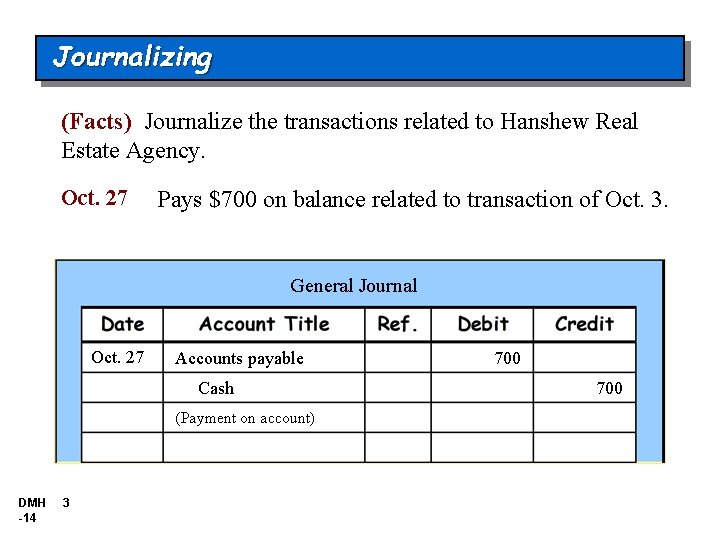
Journalizing (Facts) Journalize the transactions related to Hanshew Real Estate Agency. Oct. 27 Pays $700 on balance related to transaction of Oct. 3. General Journal Oct. 27 Accounts payable Cash (Payment on account) DMH -14 3 700
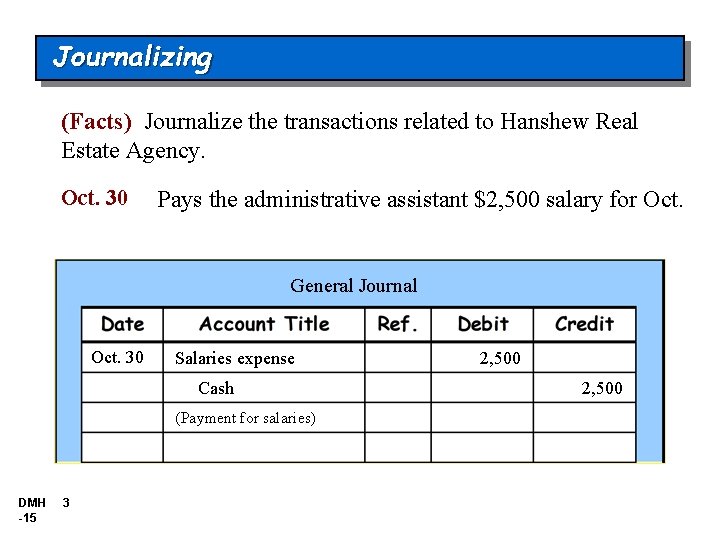
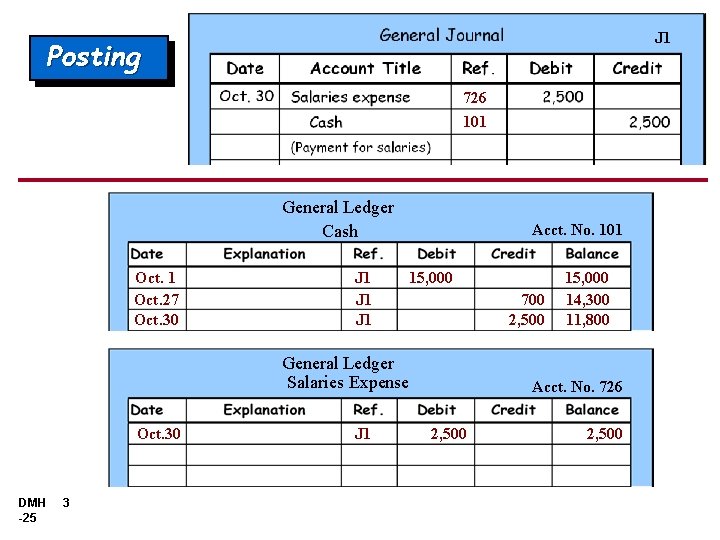
Journalizing (Facts) Journalize the transactions related to Hanshew Real Estate Agency. Oct. 30 Pays the administrative assistant $2, 500 salary for Oct. General Journal Oct. 30 Salaries expense Cash (Payment for salaries) DMH -15 3 2, 500
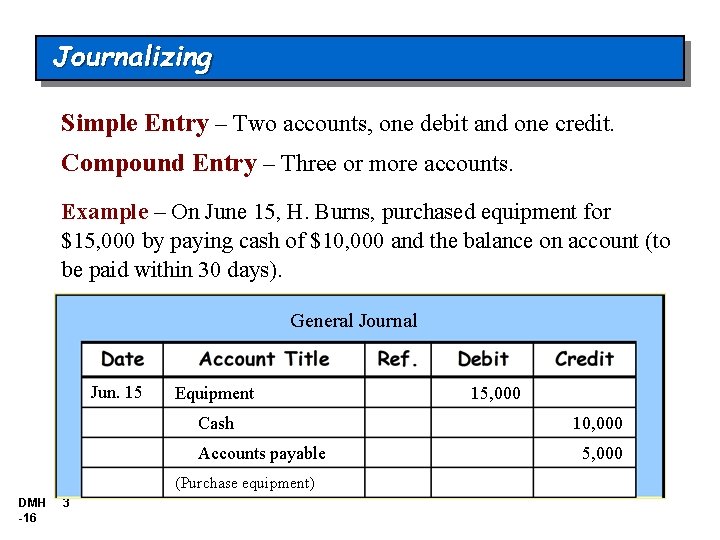
Journalizing Simple Entry – Two accounts, one debit and one credit. Compound Entry – Three or more accounts. Example – On June 15, H. Burns, purchased equipment for $15, 000 by paying cash of $10, 000 and the balance on account (to be paid within 30 days). General Journal Jun. 15 Equipment Cash Accounts payable (Purchase equipment) DMH -16 3 15, 000 10, 000 5, 000
The Ledger A General Ledger contains the entire group of accounts maintained by a company. The General Ledger includes all the asset, liability, owner’s equity, revenue and expense accounts. DMH -17 3
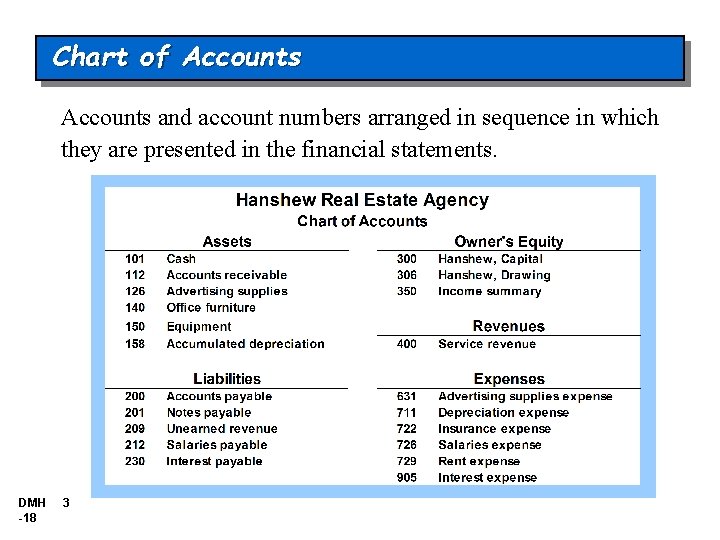
Chart of Accounts and account numbers arranged in sequence in which they are presented in the financial statements. DMH -18 3
Standard Form of Account T-account form used in accounting textbooks. In practice, the account forms used in ledgers are much more structured. DMH -19 3
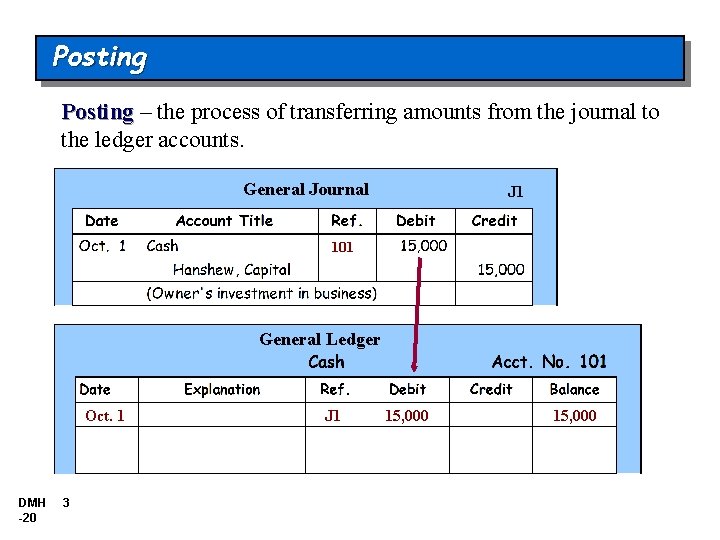
Posting – the process of transferring amounts from the journal to the ledger accounts. General Journal J 1 101 General Ledger Oct. 1 DMH -20 3 J 1 15, 000
J 1 Posting 101 300 General Ledger Cash Oct. 1 J 1 Acct. No. 101 15, 000 General Ledger Hanshew, capital Oct. 1 DMH -21 3 J 1 15, 000 Acct. No. 300 15, 000
J 1 Posting 140 200 General Ledger Office Furniture Oct. 3 J 1 General Ledger Accounts Payable Oct. 3 DMH -22 3 J 1 Acct. No. 140 1, 900 Acct. No. 200 1, 900 SO 6 Explain what posting is and how it helps in the recording process.
J 1 Posting 112 400 General Ledger Accounts Receivable Oct. 6 J 1 General Ledger Service Revenue Oct. 6 DMH -23 3 J 1 Acct. No. 112 3, 200 Acct. No. 400 3, 200 SO 6 Explain what posting is and how it helps in the recording process.
J 1 Posting 200 101 General Ledger Cash Oct. 1 Oct. 27 J 1 Acct. No. 101 15, 000 700 General Ledger Accounts Payable Oct. 3 Oct. 27 DMH -24 3 J 1 15, 000 14, 300 Acct. No. 200 1, 900 700 1, 900 1, 200
J 1 Posting 726 101 General Ledger Cash Oct. 1 Oct. 27 Oct. 30 J 1 J 1 Acct. No. 101 15, 000 700 2, 500 General Ledger Salaries Expense Oct. 30 DMH -25 3 J 1 15, 000 14, 300 11, 800 Acct. No. 726 2, 500
Posting Review Question Posting: a. normally occurs before journalizing. b. transfers ledger transaction data to the journal. c. is an optional step in the recording process. d. transfers journal entries to ledger accounts. DMH -26 3 SO 6 Explain what posting is and how it helps in the recording process.
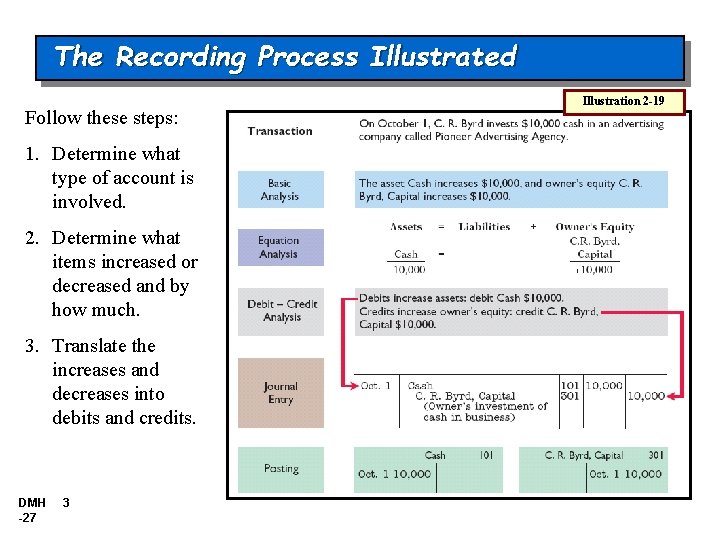
The Recording Process Illustrated Follow these steps: 1. Determine what type of account is involved. 2. Determine what items increased or decreased and by how much. 3. Translate the increases and decreases into debits and credits. DMH -27 3 Illustration 2 -19
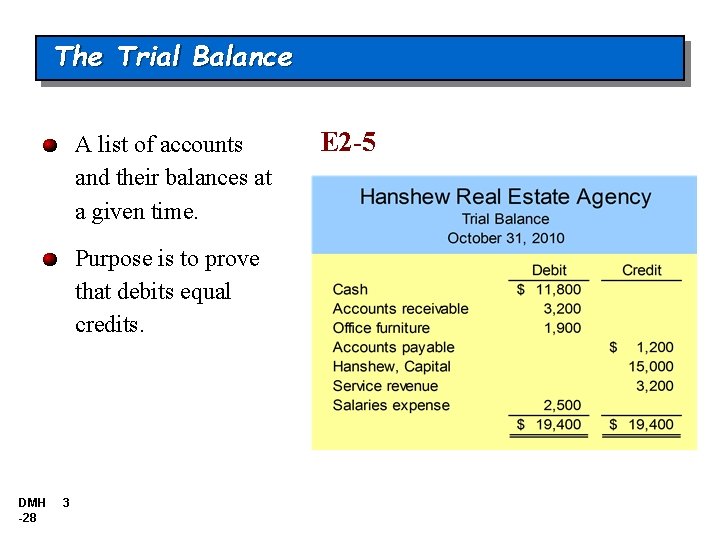
The Trial Balance A list of accounts and their balances at a given time. Purpose is to prove that debits equal credits. DMH -28 3 E 2 -5
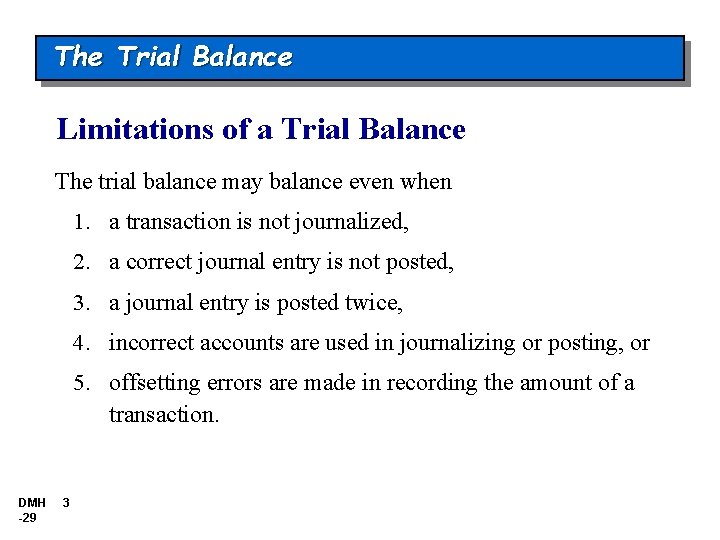
The Trial Balance Limitations of a Trial Balance The trial balance may balance even when 1. a transaction is not journalized, 2. a correct journal entry is not posted, 3. a journal entry is posted twice, 4. incorrect accounts are used in journalizing or posting, or 5. offsetting errors are made in recording the amount of a transaction. DMH -29 3
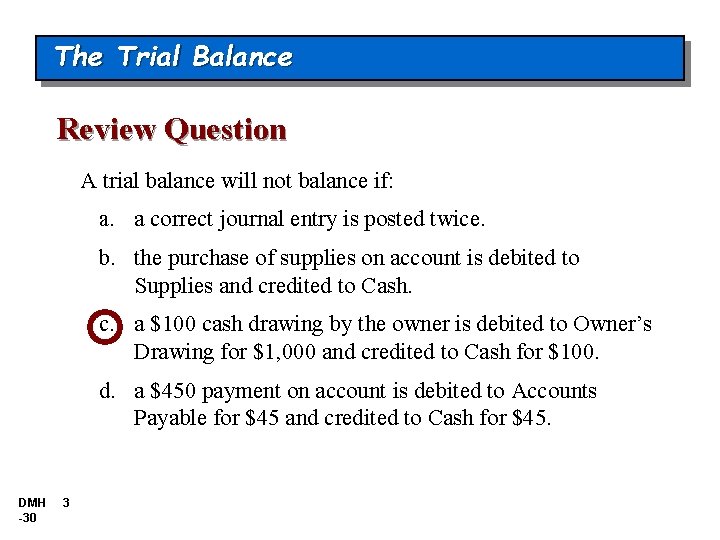
The Trial Balance Review Question A trial balance will not balance if: a. a correct journal entry is posted twice. b. the purchase of supplies on account is debited to Supplies and credited to Cash. c. a $100 cash drawing by the owner is debited to Owner’s Drawing for $1, 000 and credited to Cash for $100. d. a $450 payment on account is debited to Accounts Payable for $45 and credited to Cash for $45. DMH -30 3
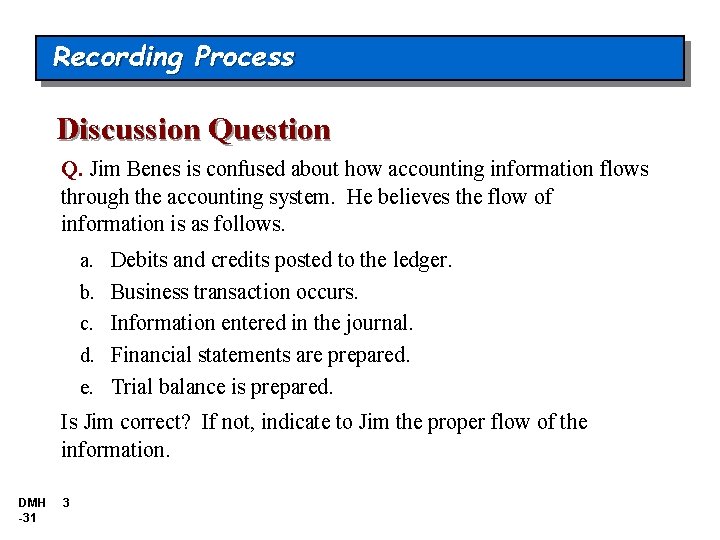
Recording Process Discussion Question Q. Jim Benes is confused about how accounting information flows through the accounting system. He believes the flow of information is as follows. a. b. c. d. e. Debits and credits posted to the ledger. Business transaction occurs. Information entered in the journal. Financial statements are prepared. Trial balance is prepared. Is Jim correct? If not, indicate to Jim the proper flow of the information. DMH -31 3