
The Record of the Past Chapter 11 Fossils
- Slides: 13
The Record of the Past Chapter 11
Fossils • Fossils – Preserved traces of ancient organisms • To become a fossil: Remains must be suitable for fossilization - Organism must be rapidly buried after death - The material in which it is buried must be suitable for fossilization - • Taphonomy - the study of how bones and other materials come to be buried in the earth and preserved as fossils
How Fossils Form • Mineralization - A form of fossilization in which the organic parts of an organism are replaced by minerals • Occurs very slowly as water carrying minerals, such as silica or iron, seeps into the tiny spaces within a bone • In some cases, the original minerals within the bone or tooth can be completely replaced • Traces of life forms that include insects trapped in tree sap, leaf imprints, footprints, skeletal remains and remains of digestive tracts • Requires either mud, silt, volcanic activity, etc.
Fossil Interpretation • The Fossil Record • Not a complete record of the history of living organisms on the face of the earth • Exhibits sampling error • Fossils information • Size, shape, and function of different muscles, the relative importance of the senses, and approximate brain size • Disease, injury, growth, and development • Artifacts – human made objects • Important clues to hominin behavior
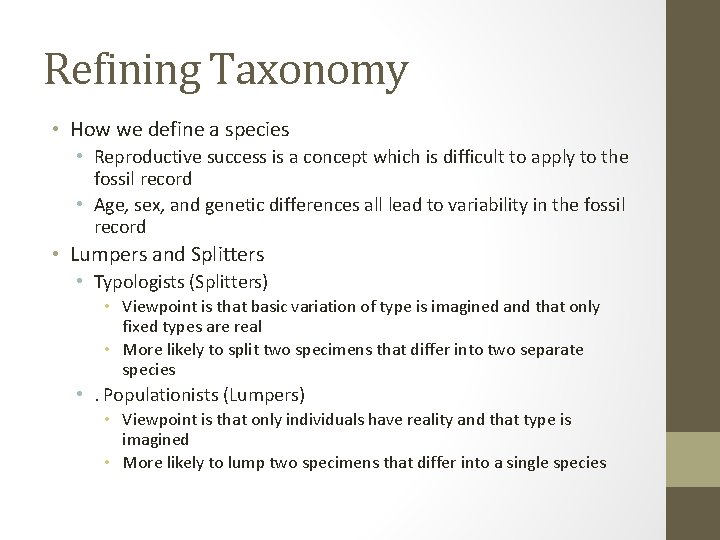
Refining Taxonomy • How we define a species • Reproductive success is a concept which is difficult to apply to the fossil record • Age, sex, and genetic differences all lead to variability in the fossil record • Lumpers and Splitters • Typologists (Splitters) • Viewpoint is that basic variation of type is imagined and that only fixed types are real • More likely to split two specimens that differ into two separate species • . Populationists (Lumpers) • Viewpoint is that only individuals have reality and that type is imagined • More likely to lump two specimens that differ into a single species
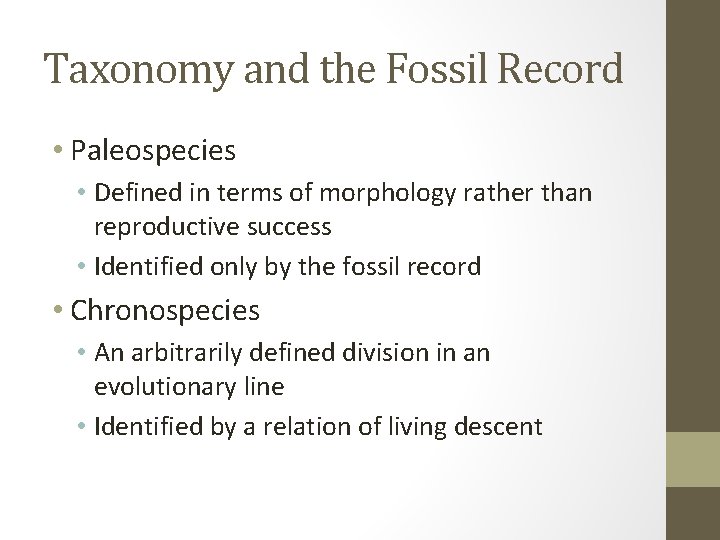
Taxonomy and the Fossil Record • Paleospecies • Defined in terms of morphology rather than reproductive success • Identified only by the fossil record • Chronospecies • An arbitrarily defined division in an evolutionary line • Identified by a relation of living descent
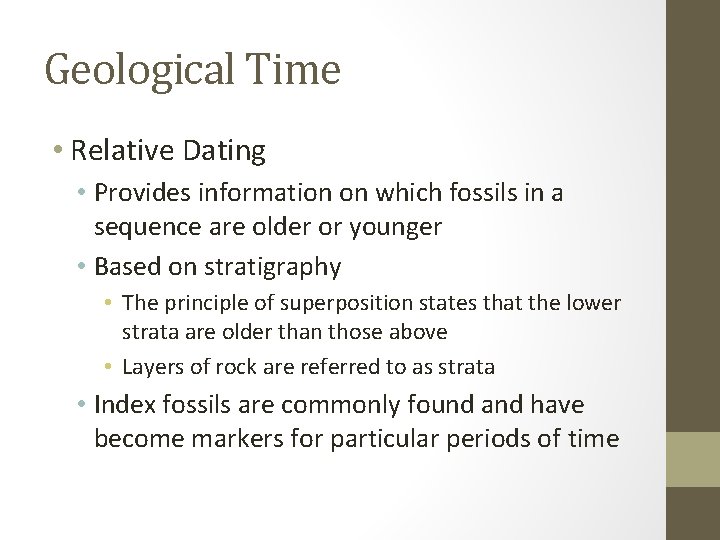
Geological Time • Relative Dating • Provides information on which fossils in a sequence are older or younger • Based on stratigraphy • The principle of superposition states that the lower strata are older than those above • Layers of rock are referred to as strata • Index fossils are commonly found and have become markers for particular periods of time
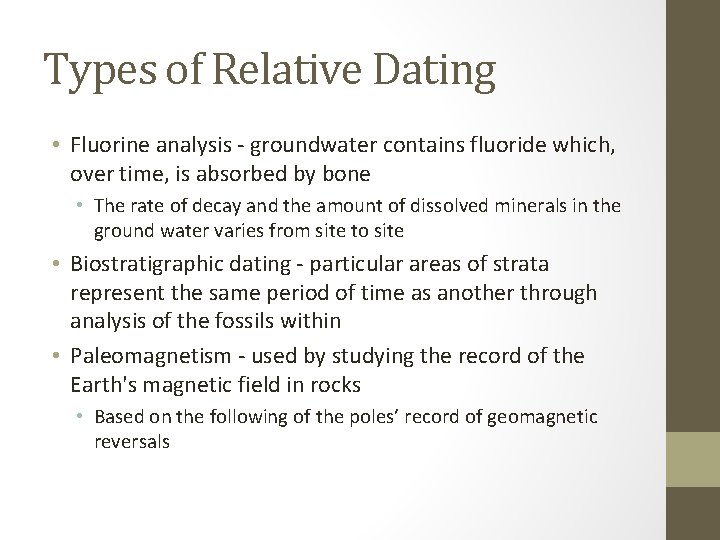
Types of Relative Dating • Fluorine analysis - groundwater contains fluoride which, over time, is absorbed by bone • The rate of decay and the amount of dissolved minerals in the ground water varies from site to site • Biostratigraphic dating - particular areas of strata represent the same period of time as another through analysis of the fossils within • Paleomagnetism - used by studying the record of the Earth's magnetic field in rocks • Based on the following of the poles’ record of geomagnetic reversals
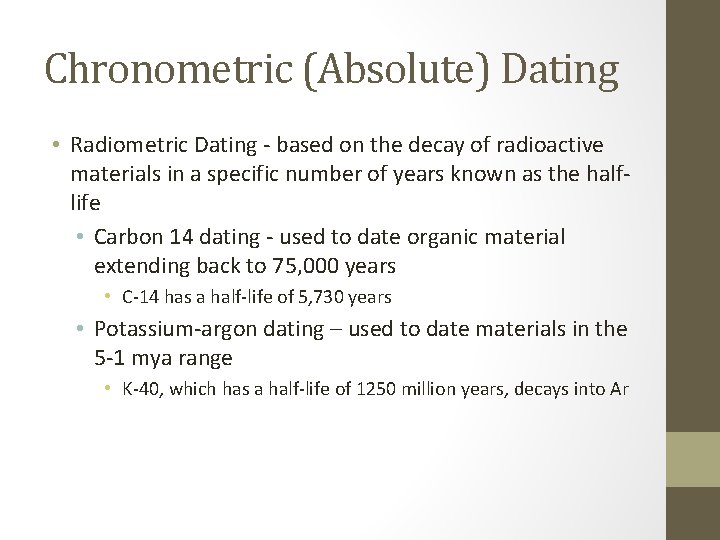
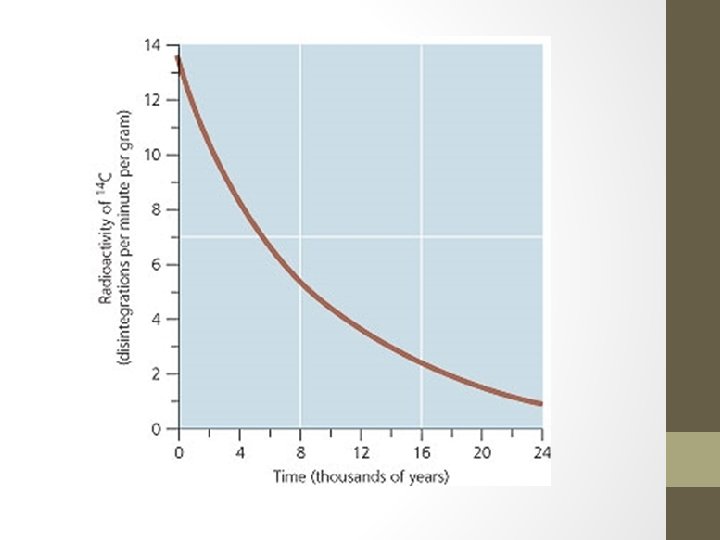
Chronometric (Absolute) Dating • Radiometric Dating - based on the decay of radioactive materials in a specific number of years known as the halflife • Carbon 14 dating - used to date organic material extending back to 75, 000 years • C-14 has a half-life of 5, 730 years • Potassium-argon dating – used to date materials in the 5 -1 mya range • K-40, which has a half-life of 1250 million years, decays into Ar
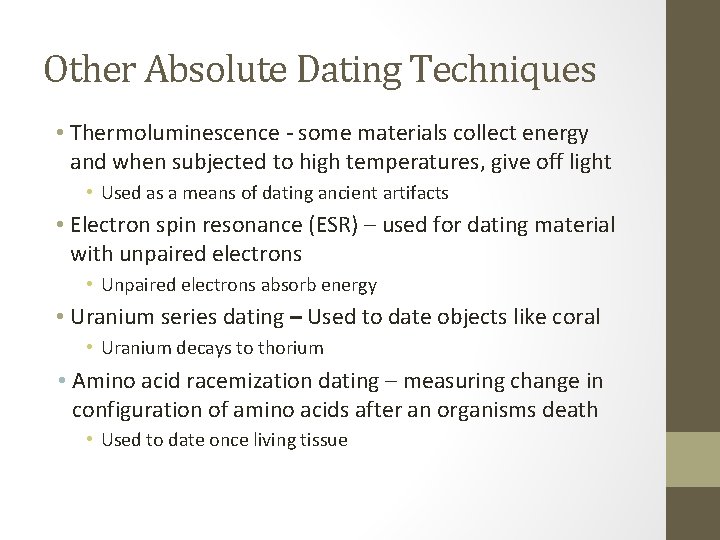
Other Absolute Dating Techniques • Thermoluminescence - some materials collect energy and when subjected to high temperatures, give off light • Used as a means of dating ancient artifacts • Electron spin resonance (ESR) – used for dating material with unpaired electrons • Unpaired electrons absorb energy • Uranium series dating – Used to date objects like coral • Uranium decays to thorium • Amino acid racemization dating – measuring change in configuration of amino acids after an organisms death • Used to date once living tissue
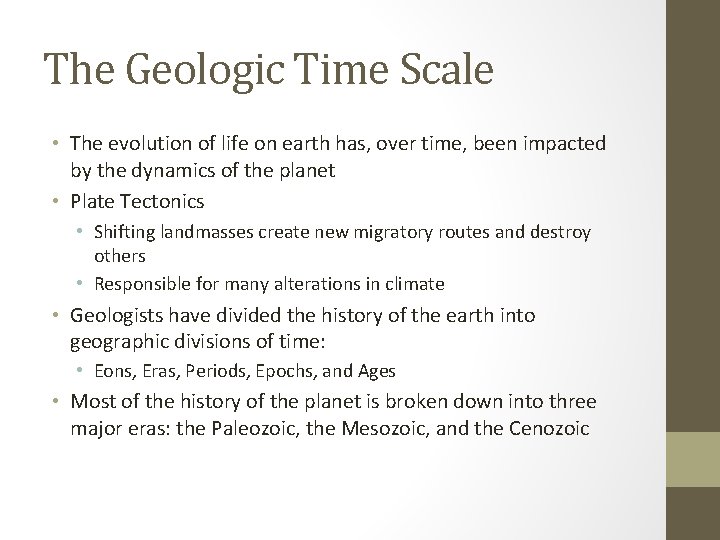
The Geologic Time Scale • The evolution of life on earth has, over time, been impacted by the dynamics of the planet • Plate Tectonics • Shifting landmasses create new migratory routes and destroy others • Responsible for many alterations in climate • Geologists have divided the history of the earth into geographic divisions of time: • Eons, Eras, Periods, Epochs, and Ages • Most of the history of the planet is broken down into three major eras: the Paleozoic, the Mesozoic, and the Cenozoic
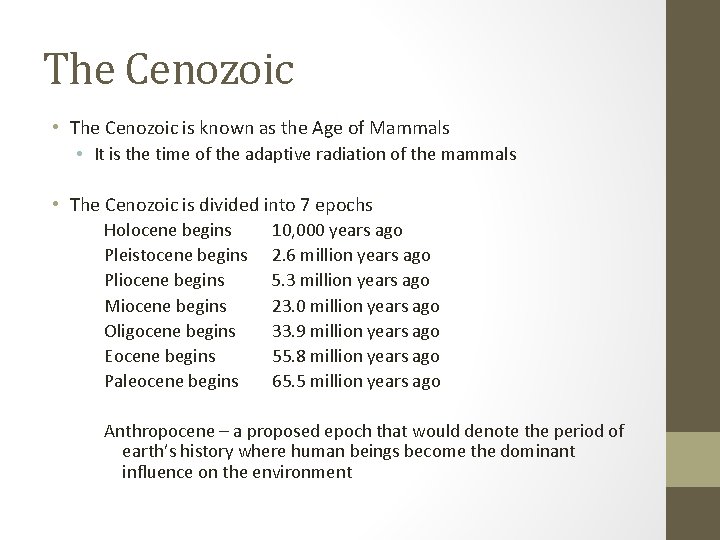
The Cenozoic • The Cenozoic is known as the Age of Mammals • It is the time of the adaptive radiation of the mammals • The Cenozoic is divided into 7 epochs Holocene begins Pleistocene begins Pliocene begins Miocene begins Oligocene begins Eocene begins Paleocene begins 10, 000 years ago 2. 6 million years ago 5. 3 million years ago 23. 0 million years ago 33. 9 million years ago 55. 8 million years ago 65. 5 million years ago Anthropocene – a proposed epoch that would denote the period of earth’s history where human beings become the dominant influence on the environment