
The Reconstruction Era Part II The Civil War

- Slides: 50
The Reconstruction Era Part II The Civil War Amendments
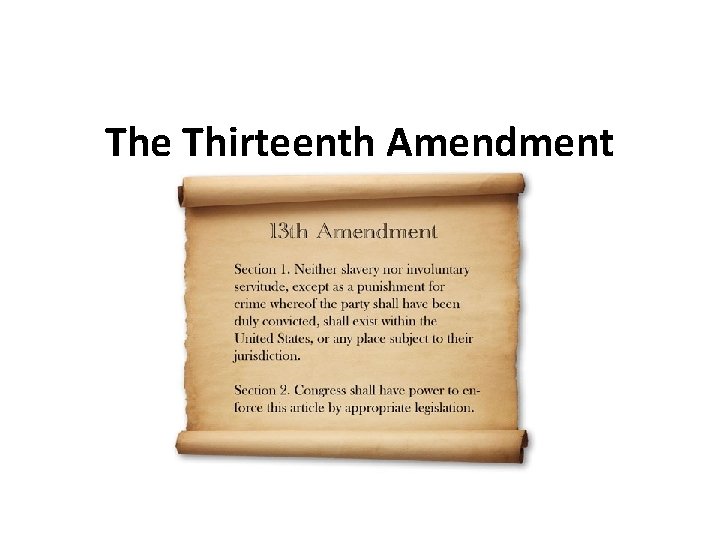
The Thirteenth Amendment
The Thirteenth amendment abolished slavery and involuntary servitude, except for punishment for a crime.
The Thirteenth Amendment reads… • SECTION 1: • Neither slavery nor involuntary servitude, except as a punishment for crime whereof the party shall have been duly convicted, shall exist within the United States, or any place subject to its jurisdiction. • SECTION 2: • Congress shall have power to enforce this article by appropriate legislation.
The Senate passed it on April 8, 1864. The House of Representatives passed it on January 31, 1865. Three-fourths of the states ratified it by December 6, 1865. (Georgia was the 27 th state to ratify it, ¾ of the 36 states that then existed)
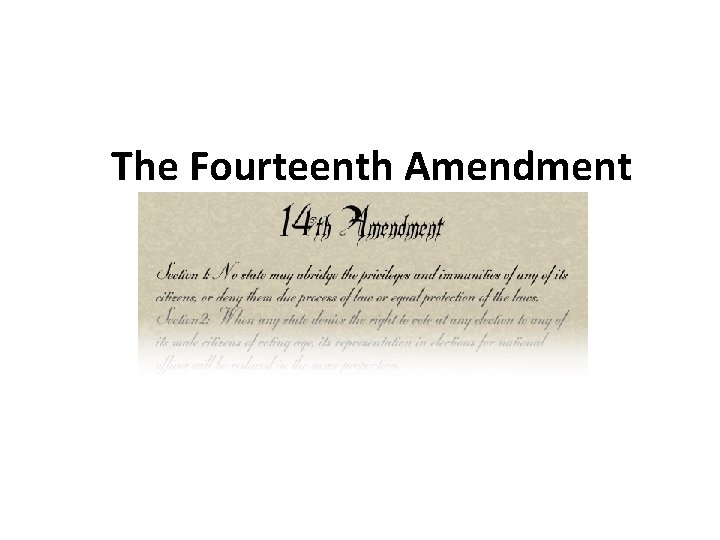
The Fourteenth Amendment
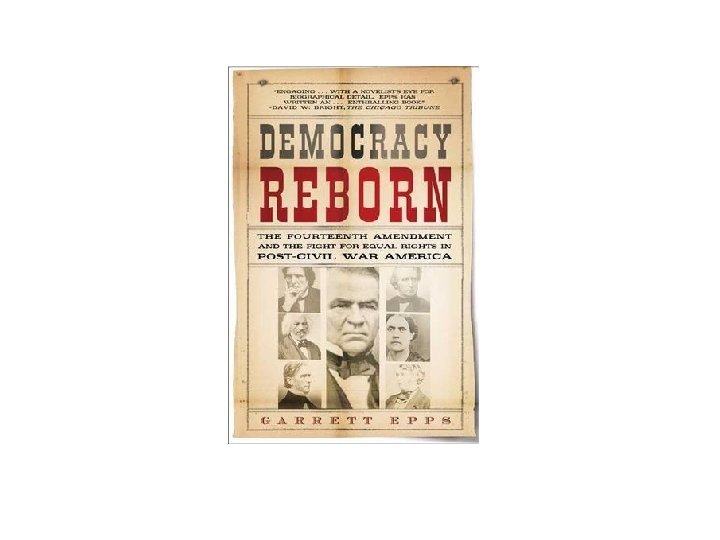
The Fourteenth Amendment (1868) guaranteed citizenship for blacks and reduced representation in Congress for states that did not give freedmen the right to vote.
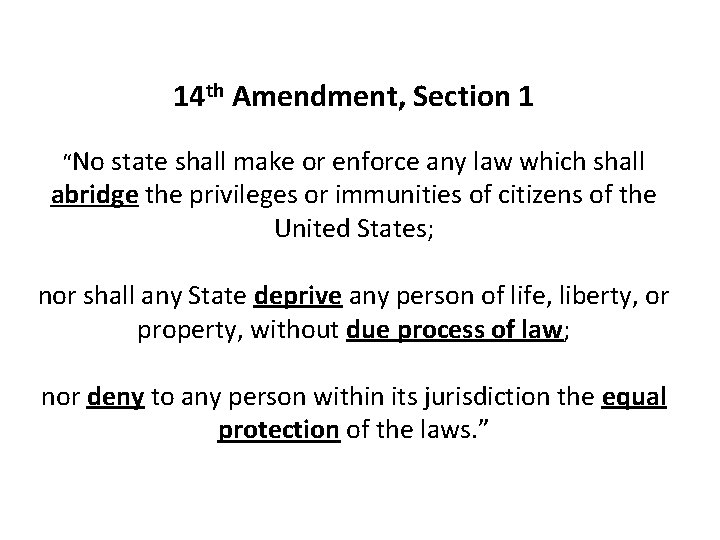
14 th Amendment, Section 1 “No state shall make or enforce any law which shall abridge the privileges or immunities of citizens of the United States; nor shall any State deprive any person of life, liberty, or property, without due process of law; nor deny to any person within its jurisdiction the equal protection of the laws. ”
Many whites in the South were outraged by the Fourteenth Amendment, particularly poorer whites who already felt they were competing with ex-slaves for jobs.
Riots in Memphis and New Orleans pushed Congress to send this amendment to the states for ratification
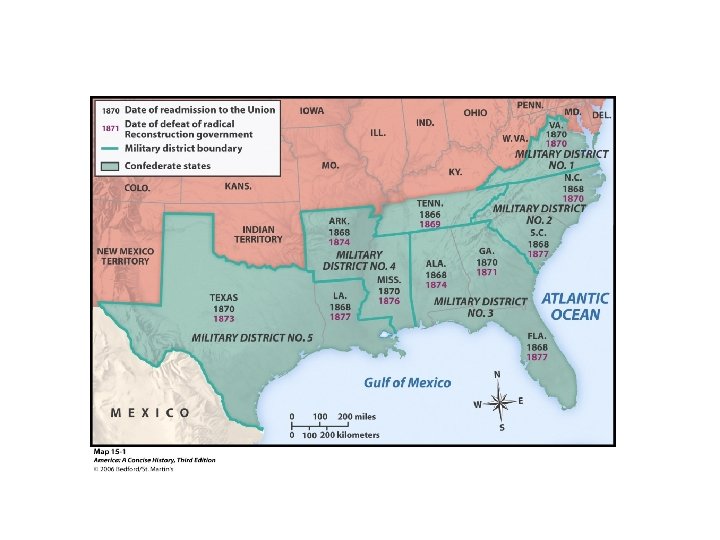
Despite Johnson’s veto, Congress divided the South into five military districts, each under the control of the Union Army.
For a state to be readmitted (and get rid of military rule), it had to ratify the Fourteenth Amendment and guarantee the right to vote to all adult males, regardless of race.
Southern states also had to agree to modify their state constitutions to give African Americans the right to vote. (This stipulation was particularly galling to Southerners, because many Northern states did not allow Blacks to votes) (We’ll get to the Fifteenth Amendment in a moment that will give Black males in all states the right to vote)
In 1867, Congress passed the Tenure of Office Act over Pres. Johnson’s veto.
The Tenure of Office Act … prohibited (prevented) the president from firing or removing a federal official without the Senate’s approval.
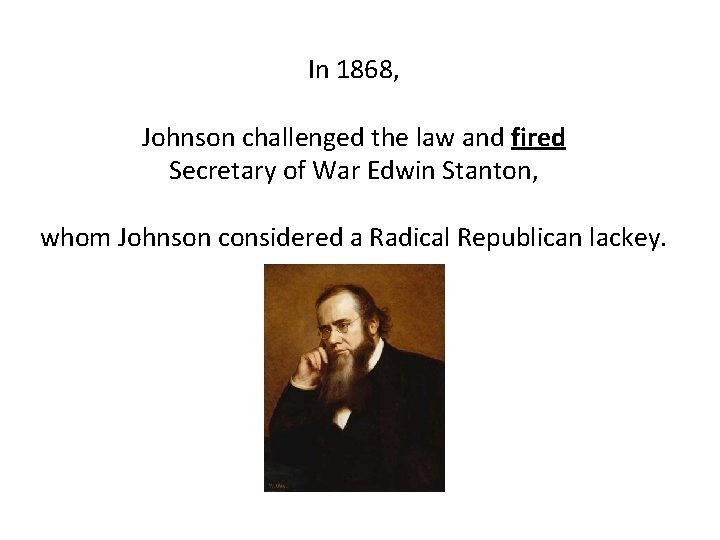
In 1868, Johnson challenged the law and fired Secretary of War Edwin Stanton, whom Johnson considered a Radical Republican lackey.
Following Stanton’s dismissal, the House responded in late February 1868 by voting to impeach Johnson for violating the law.
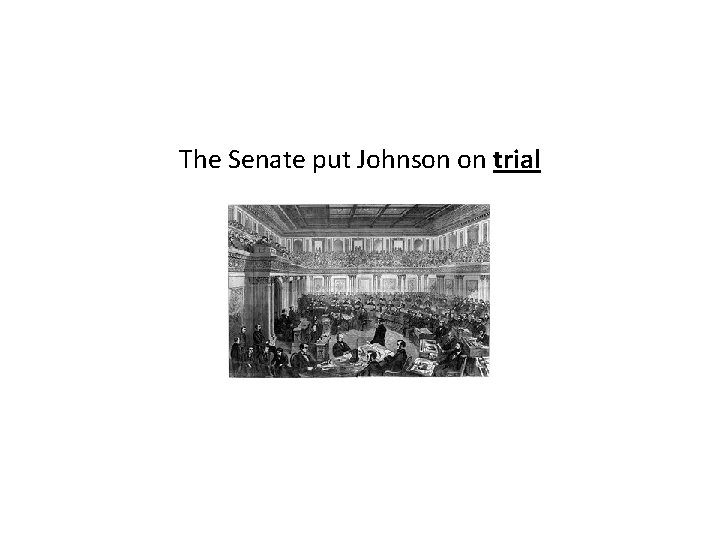
The Senate put Johnson on trial
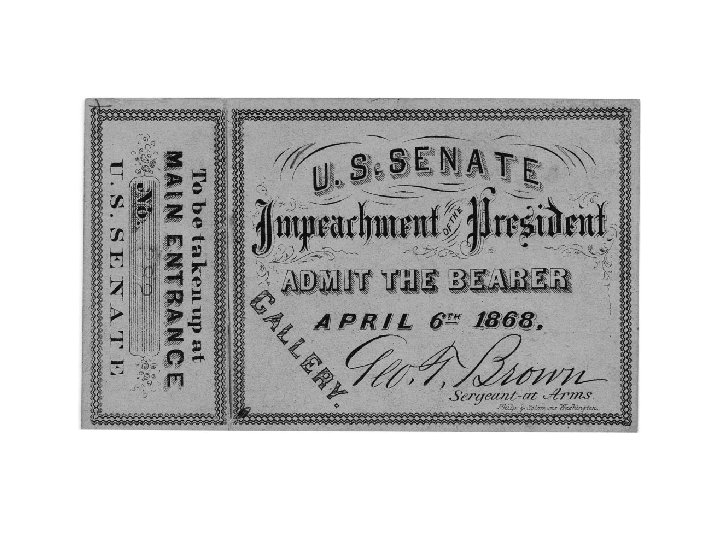
The country regarded the whole situation as a great melodrama: Tickets to the Senate gallery were the toughest buy in town. On May 16, 1868, the first of three votes was taken to remove Johnson from office.
All three votes were 35 to 19, one vote short of the two-thirds needed to remove the president from office. Seven Republican senators voted against removing Johnson from office.
All of these men sacrificed their political careers by voting against Johnson’s removal, but they may very well have preserved the U. S. government.
Removing Johnson solely on political grounds could have created the basis for a congressional dictatorship, whereby Congress could dominate the presidency by threatening to dump any president who did not go along with its wishes.
The trial may also have marked the beginning of the end of Northern interest in Reconstruction.
Many Northerners were as prejudiced against blacks as many Southerners. They were sick of the issue and wanted to put the war, and its aftermath, behind them.
Anyway, Johnson served out the rest of his term without incident, posting no further threat to the Radical program, and in the 1868 presidential election, the war hero Ulysses S. Grant led the Republicans to victory.
Ulysses S. Grant
When Americans elected Ulysses S. Grant president in 1868, they expected him to be the same kind of chief executive as he was a general – brave, tenacious, and inspiring.
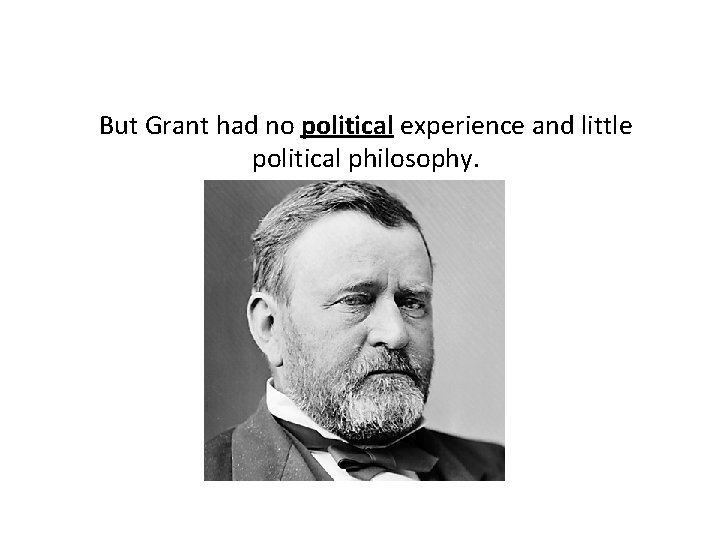
But Grant had no political experience and little political philosophy.
Neither did many of the people he appointed to be his cabinet advisers and top aides.
His one asset was his personal honesty, and, unfortunately, it was an asset not shared by the people around him.
Almost from the time Grant took office, his administration was awash in corruption. (More on that in a moment)
But with Grant in the White House, the Radical Republicans pushed for passage of the Fifteenth Amendment, which stated that no American could be denied the right to vote because of “race, color, or previous condition of servitude. ” Let’s look at it more closely…
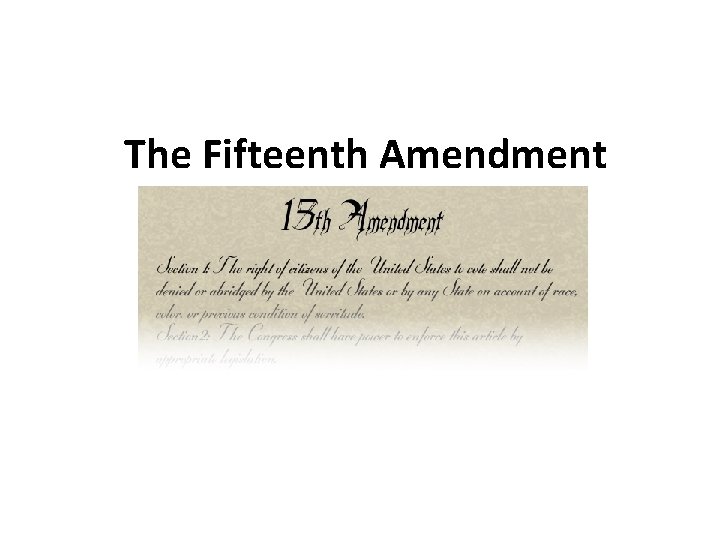
The Fifteenth Amendment
The Fifteenth Amendment text… • SECTION 1 • SECTION 2 • The right of citizens of • The Congress shall have the United States to power to enforce this vote shall not be denied article by appropriate or abridged by the legislation. United States or by any State on account of race, color, or previous condition of servitude.
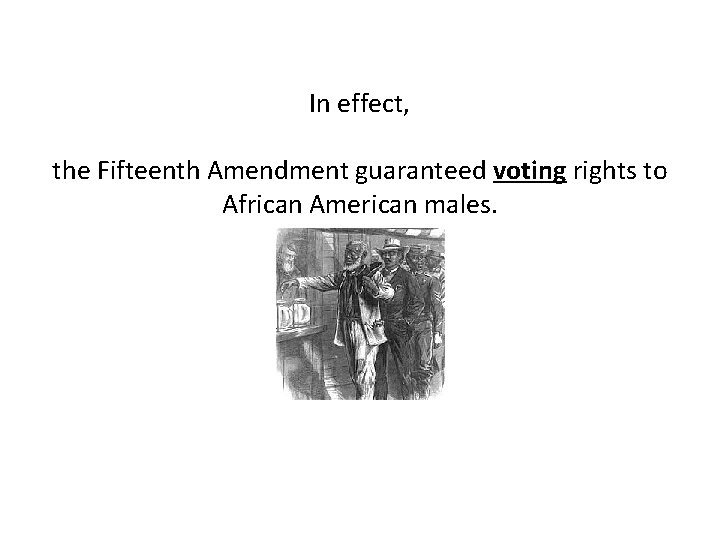
In effect, the Fifteenth Amendment guaranteed voting rights to African American males.
This amendment was passed to ensure the Southern states did not go back on their promise to give blacks the right to vote (and also because the Radical Republicans were embarrassed to be from Northern states that did not allow African Americans vote)
Enough Southern legislatures were dominated by carpetbaggers, former slaves, and other people whose loyalties were to Radical Republicans to ensure the amendment’s ratification. It was ratified by three-fourths of the states on February 3, 1870.
However, Southern states gradually got around the law anyway by requiring blacks to pass difficult “literacy” and “citizenship” tests before they could vote (more on that later)
By the way, the Fifteenth Amendment greatly angered many American women, who found that they were now second-class citizens to black males as well as white ones when it came to voting.
Back to the Fifteenth Amendment and allowing African American males the right to vote… One result of giving newly freed slaves the right to vote was that they elected some of their own to state legislatures.
The resulting black-white governments in some states created sound, fair tax and educational systems; built roads and levees; and gave property rights to women.
In other states, the government was dominated by leeches and thieves of both races, although white politicians were by far the worst offenders. One carpetbagger governor managed to “save” more than $4 million on an annual salary of $8, 000 a year.
These Reconstruction Amendments – the 13 th, 14 th, & 15 th – were passed to protect the civil rights of African Americans.
The Civil Rights Act of 1875 was the last civil rights reform passed by Congress during the Reconstruction ear.
It called for full equality in public accommodations, such as hotels and railroads, for all races, and it prohibited the exclusion of African Americans from juries.
The Act was declared unconstitutional by the Supreme Court in 1883. Congress would not pass another round of civil rights legislation until the 1960’s.
Unfortunately, the Civil Rights Act of 1775 was poorly enforced, as many northern whites grew tired of Reconstruction, and Democrats did not support it.