
The Reasons for the Seasons A STEM Activity
- Slides: 26
The Reasons for the Seasons A STEM Activity for Principle-Led Professional Day October, 2011
Agenda �Model a STEM activity – The Reasons for the Seasons �Analyze Lesson Construct �Maryland State STEM Lesson Planning Template �Evaluation
The Harvard Study Seasons Question �In 1989, a classic video was made at a Harvard University graduation, where graduates and faculty were asked a series of questions. �One question was, “Why is it warm in the summer and cold in the winter? ” � 22 out of 25 (88%) got the answer wrong! �The typical answer was that it’s warmer in the summer because the earth is closer to the sun.
An Example STEM Lesson The Reasons for Seasons
Introduction �Follow instructions for introduction listed on activity sheet. You have 5 minutes for this portion of the lesson!! �Have one member from your group obtain a chart paper from the center book shelves so that you can record your question/answer. Markers are in your bag. �Warning!: Save room on the chart paper for further drawings/questions & answers!!!!
Driving Questions �What are the reasons Earth experiences seasons? �Does the entire Earth experience the same season at the same time? �When is the Earth closest to the sun? Does this play a role in Earth’s seasons?
Direct and Indirect Rays of the Sun Group A �Follow instructions listed on activity sheet. You have 15 minutes for this portion of the lesson!! �You may place the globes on the floor near your table. You will need it later. �When you finish, you may place the ringstand on the floor near your table. �Groups 10 & 11 you may move ahead with the activity once you’ve finished with this section.
Direct and Indirect Rays of the Sun Group B �Follow instructions listed on activity sheet. You have 15 minutes for this portion of the lesson!! �You may place the globes on the floor near your table. You will need it later. �When you finish, you may place the ringstand on the floor near your table. �Groups 9 & 10 you may move ahead with the activity once you’ve finished with this section.
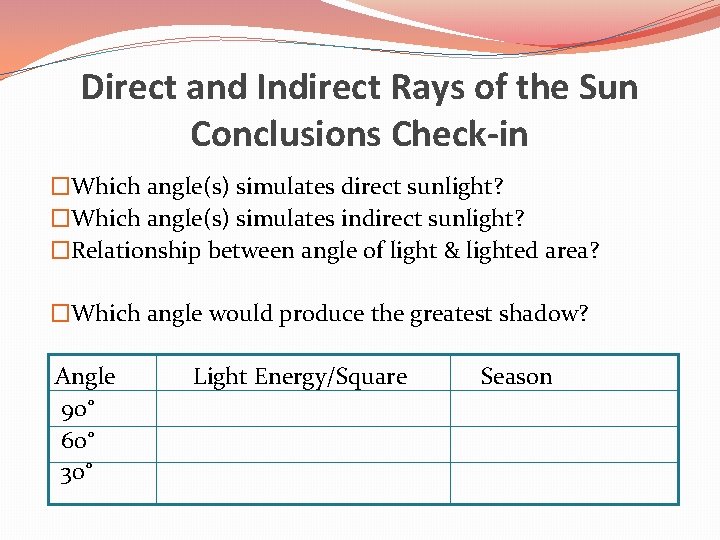
Direct and Indirect Rays of the Sun Conclusions Check-in �Which angle(s) simulates direct sunlight? 90° �Which angle(s) simulates indirect sunlight? 30° �Relationship between angle of light & lighted area? higher angle of light = more intense heating/direct light �Which angle would produce the greatest shadow? Angle 90° 60° 30° Light Energy/Square highest number medium number lowest number Season summer spring, autumn winter
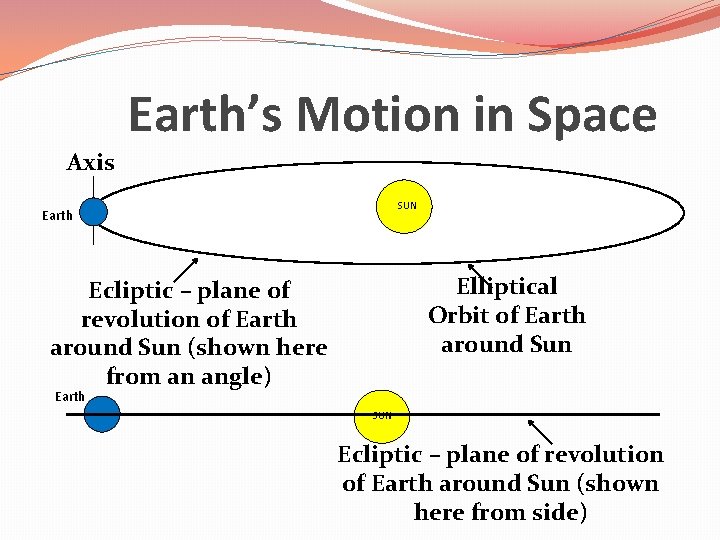
Earth’s Motion in Space Axis SUN Earth Elliptical Orbit of Earth around Sun Ecliptic – plane of revolution of Earth around Sun (shown here from an angle) Earth SUN Ecliptic – plane of revolution of Earth around Sun (shown here from side)
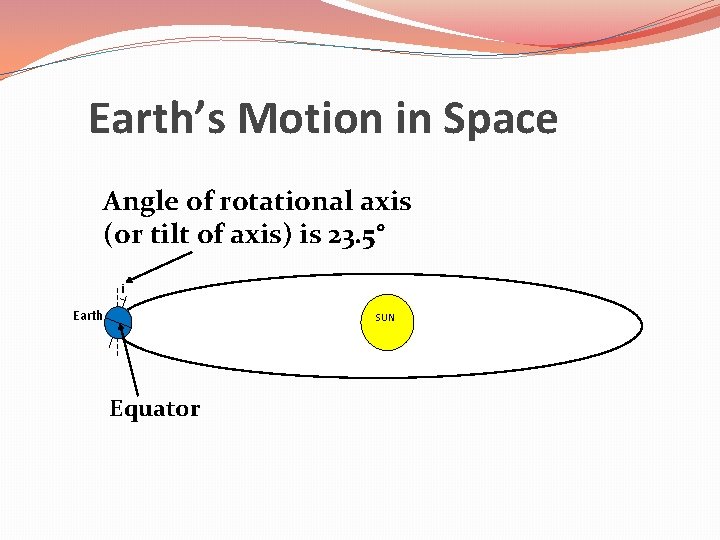
Earth’s Motion in Space Angle of rotational axis (or tilt of axis) is 23. 5° i Earth SUN Equator
“Sun” – Earth Model Group A �Follow instructions listed on activity sheet. You have 20 minutes for this portion of the lesson!! �You will need the globes now. �Groups 10 & 11 you may move ahead with the activity once you’ve finished with this section.
“Sun” – Earth Model Group B �Follow instructions listed on activity sheet. You have 20 minutes for this portion of the lesson!! �You will need the globes now. �Groups 9 & 10 you may move ahead with the activity once you’ve finished with this section.
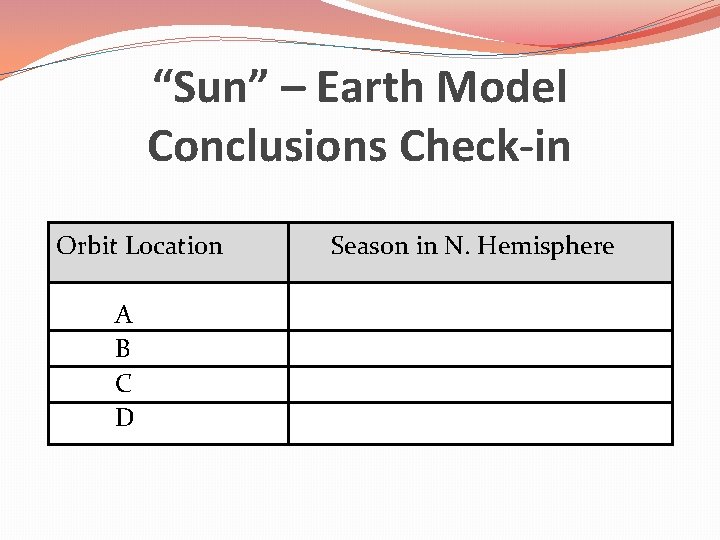
“Sun” – Earth Model Conclusions Check-in Orbit Location A B C D Season in N. Hemisphere winter spring summer autumn
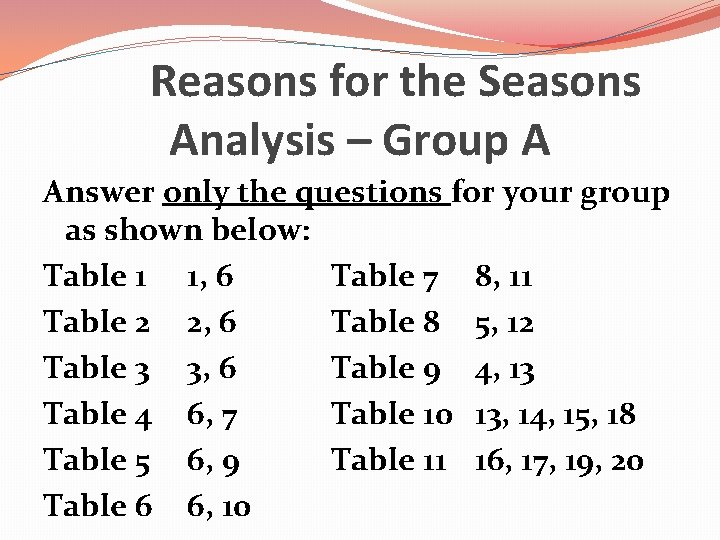
Reasons for the Seasons Analysis – Group A Answer only the questions for your group as shown below: Table 1 1, 6 Table 7 8, 11 Table 2 2, 6 Table 8 5, 12 Table 3 3, 6 Table 9 4, 13 Table 4 6, 7 Table 10 13, 14, 15, 18 Table 5 6, 9 Table 11 16, 17, 19, 20 Table 6 6, 10
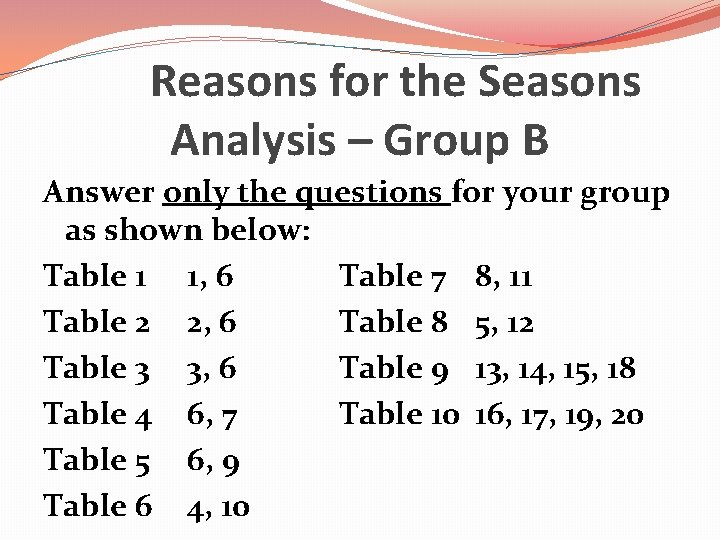
Reasons for the Seasons Analysis – Group B Answer only the questions for your group as shown below: Table 1 1, 6 Table 7 8, 11 Table 2 2, 6 Table 8 5, 12 Table 3 3, 6 Table 9 13, 14, 15, 18 Table 4 6, 7 Table 10 16, 17, 19, 20 Table 5 6, 9 Table 6 4, 10
Reasons for the Seasons Analysis Gallery Walk �Circulate around the room to observe the following: �Introduction Article Question/Answer �“Sun”-Earth Model Diagram � 2 or 3 questions from Reasons for the Seasons Analysis section �You will have 7 minutes for this gallery walk.
Reasons for the Seasons Conclusions �Take about 5 minutes to write your conclusion to the activity.
Reasons for the Seasons Return to Driving Questions �What are the reasons Earth experiences seasons? �Does the entire Earth experience the same season at the same time? �When is the Earth closest to the sun? Does this play a role in Earth’s seasons?
STEM Lesson Construct
Did this lesson include: How? Science – Earth’s seasons, tilt of axis, revolution of Earth around sun, angle of incidence Technology – calculators, tools of science, computers Engineering – construct lab apparatus & model Math – calculations, interpret angles
Did this lesson include ELA Standards? If so, how? �Following written instructions �Interpret data, key terms, symbols �Interpret analysis and conclusion questions �Translate data into words and diagrams �Analyze correctness of hypotheses �Draw conclusions �Write procedure
Did this lesson include Math Practices? If so, how? �Calculations of light energy/km �Consistency in collecting data �Interpretation of angle of incidence �Role of tilt of Earth’s axis in controlling seasons
Was this lesson differentiated? If so, how? �Utilized the pre-assessment from the STEM PLC on 10/11/11 to arrange faculty into 3 groups: �Foundational Knowledge �Intermediate Knowledge �Advanced Knowledge
MD STEM Lesson Template �Title and grade level �? ’s to ask before designing lesson �Techniques used to make lesson �Learning outcomes �How discourse is promoted �How are science, technology, engineering & mathematics addressed? �Connections to various Standards �Use of the 5 E Model
Evaluation �Please complete the evaluation for the STEM Lesson Professional Development Session. �Place your evaluation on the counter by the exit door. �Thank you all for your cooperation today!! Enjoy your weekend.