
The Real Number System Copyright 2019 Cengage Learning
The Real Number System Copyright © 2019 Cengage Learning. All rights reserved. 1
1. 3 Multiplying and Dividing Integers Copyright © 2019 Cengage Learning. All rights reserved. 2
What You Will Learn 4 Multiplying integers with like signs and with unlike signs. 4 Divide Integers with like and with unlike signs. 4 Find factors and prime factors of an integer. 4 Represent the definitions and rules of arithmetic symbolically. Copyright © 2019 Cengage Learning. All rights reserved. 3

Multiplying Integers Copyright © 2019 Cengage Learning. All rights reserved. 4
Multiplying Integers Multiplication of two integers can be described as repeated addition or subtraction. The result of multiplying one number by another is called a product. 1. The product of an integer and zero is. 2. The product of two integers with like signs is positive. 3. The product of two integers with unlike signs is negative. Copyright © 2019 Cengage Learning. All rights reserved. 5
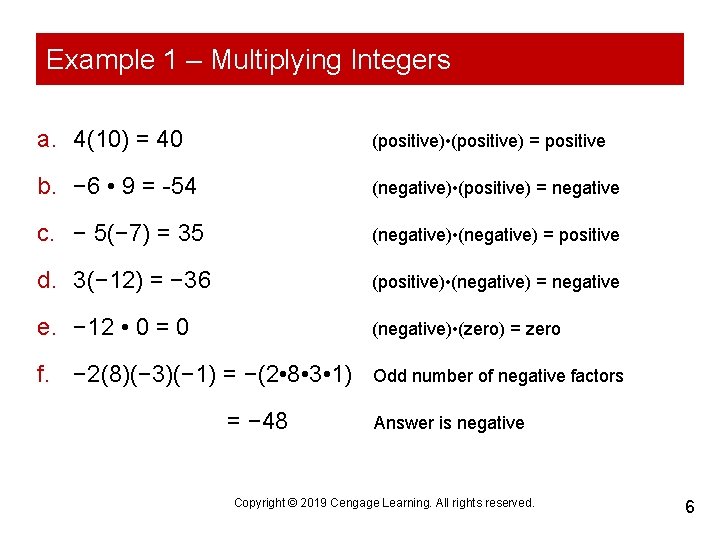
Example 1 – Multiplying Integers a. 4(10) = 40 (positive) • (positive) = positive b. − 6 • 9 = -54 (negative) • (positive) = negative c. − 5(− 7) = 35 (negative) • (negative) = positive d. 3(− 12) = − 36 (positive) • (negative) = negative e. − 12 • 0 = 0 (negative) • (zero) = zero f. − 2(8)(− 3)(− 1) = −(2 • 8 • 3 • 1) Odd number of negative factors = − 48 Answer is negative Copyright © 2019 Cengage Learning. All rights reserved. 6
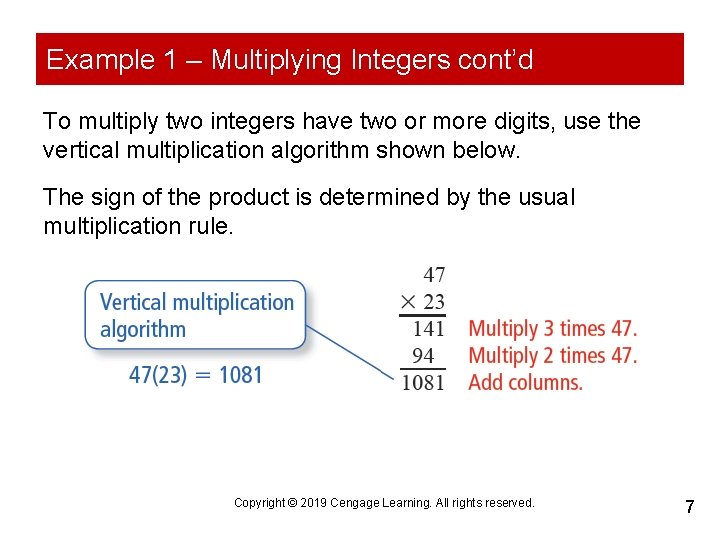
Example 1 – Multiplying Integers cont’d To multiply two integers have two or more digits, use the vertical multiplication algorithm shown below. The sign of the product is determined by the usual multiplication rule. Copyright © 2019 Cengage Learning. All rights reserved. 7
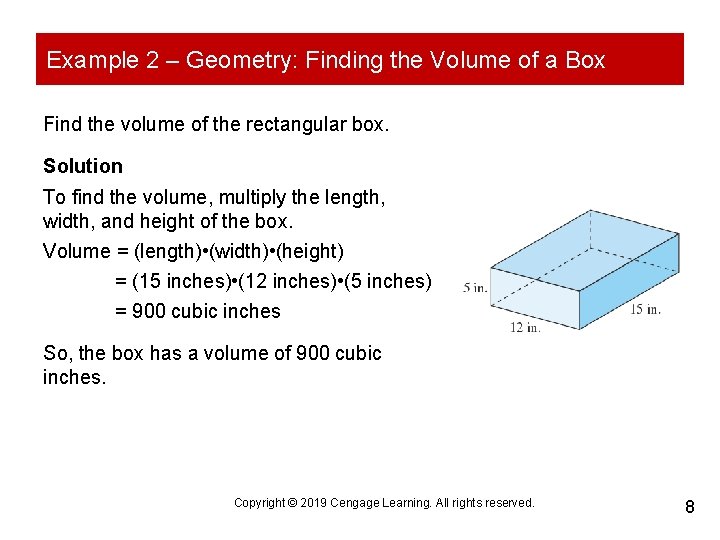
Example 2 – Geometry: Finding the Volume of a Box Find the volume of the rectangular box. Solution To find the volume, multiply the length, width, and height of the box. Volume = (length) • (width) • (height) = (15 inches) • (12 inches) • (5 inches) = 900 cubic inches So, the box has a volume of 900 cubic inches. Copyright © 2019 Cengage Learning. All rights reserved. 8
Dividing Integers Copyright © 2019 Cengage Learning. All rights reserved. 9
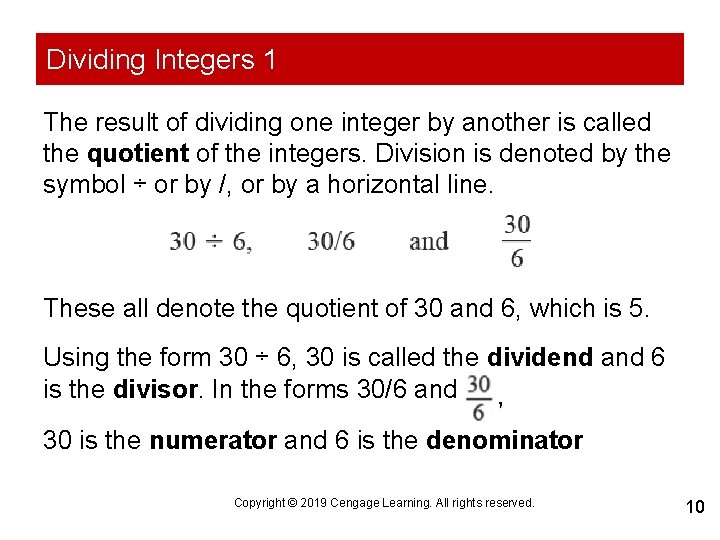
Dividing Integers 1 The result of dividing one integer by another is called the quotient of the integers. Division is denoted by the symbol ÷ or by /, or by a horizontal line. These all denote the quotient of 30 and 6, which is 5. Using the form 30 ÷ 6, 30 is called the dividend and 6 is the divisor. In the forms 30/6 and 30 is the numerator and 6 is the denominator Copyright © 2019 Cengage Learning. All rights reserved. 10
Dividing Integers 2 1. Zero divided by a nonzero integer is 0, whereas a nonzero integer divided by a zero is undefined. 2. The quotient of two nonzero integers with like signs is positive. 3. The quotient of two nonzero integers with unlike signs is negative. Copyright © 2019 Cengage Learning. All rights reserved. 11
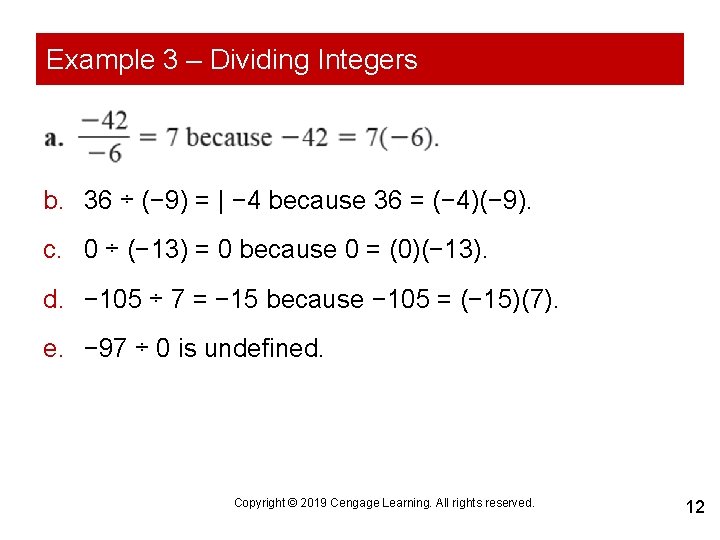
Example 3 – Dividing Integers b. 36 ÷ (− 9) = | − 4 because 36 = (− 4)(− 9). c. 0 ÷ (− 13) = 0 because 0 = (0)(− 13). d. − 105 ÷ 7 = − 15 because − 105 = (− 15)(7). e. − 97 ÷ 0 is undefined. Copyright © 2019 Cengage Learning. All rights reserved. 12
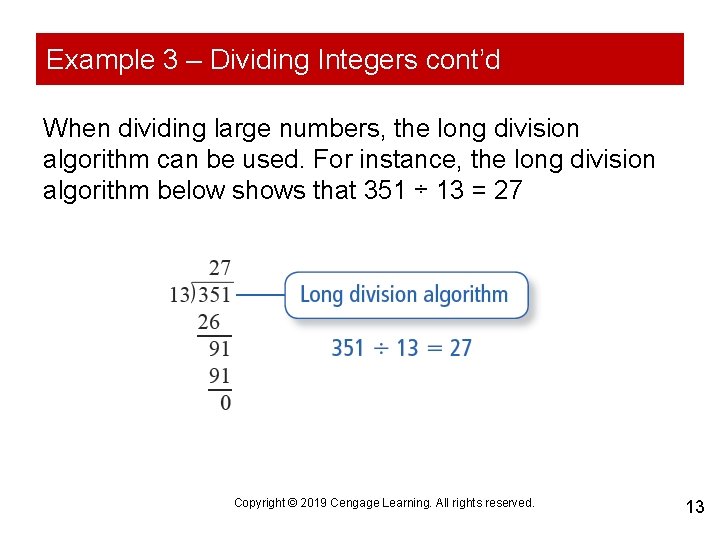
Example 3 – Dividing Integers cont’d When dividing large numbers, the long division algorithm can be used. For instance, the long division algorithm below shows that 351 ÷ 13 = 27 Copyright © 2019 Cengage Learning. All rights reserved. 13
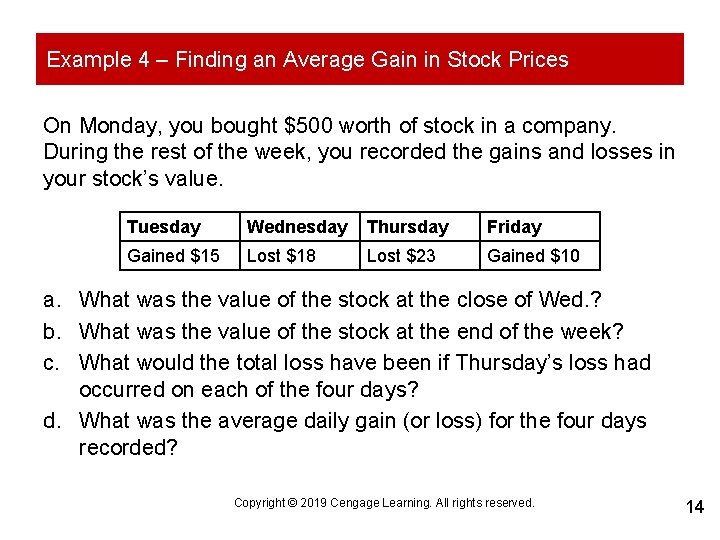
Example 4 – Finding an Average Gain in Stock Prices On Monday, you bought $500 worth of stock in a company. During the rest of the week, you recorded the gains and losses in your stock’s value. Tuesday Wednesday Thursday Friday Gained $15 Lost $18 Lost $23 Gained $10 a. What was the value of the stock at the close of Wed. ? b. What was the value of the stock at the end of the week? c. What would the total loss have been if Thursday’s loss had occurred on each of the four days? d. What was the average daily gain (or loss) for the four days recorded? Copyright © 2019 Cengage Learning. All rights reserved. 14
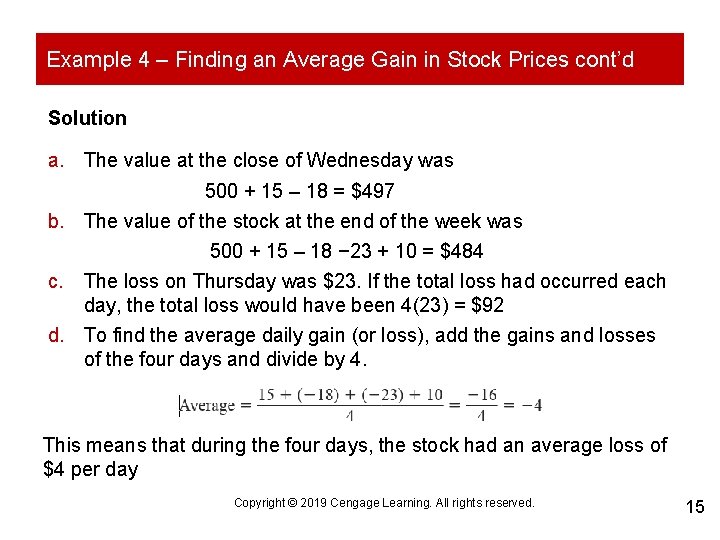
Example 4 – Finding an Average Gain in Stock Prices cont’d Solution a. The value at the close of Wednesday was 500 + 15 – 18 = $497 b. The value of the stock at the end of the week was 500 + 15 – 18 − 23 + 10 = $484 c. The loss on Thursday was $23. If the total loss had occurred each day, the total loss would have been 4(23) = $92 d. To find the average daily gain (or loss), add the gains and losses of the four days and divide by 4. This means that during the four days, the stock had an average loss of $4 per day Copyright © 2019 Cengage Learning. All rights reserved. 15
Factors and Prime Numbers Copyright © 2019 Cengage Learning. All rights reserved. 16
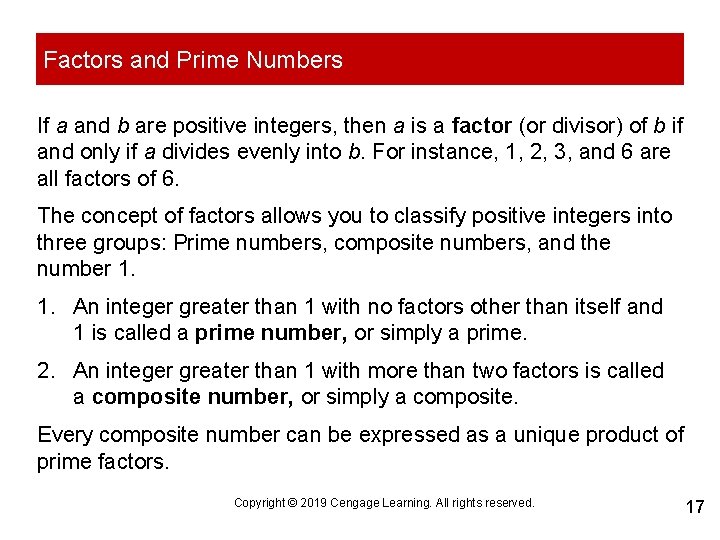
Factors and Prime Numbers If a and b are positive integers, then a is a factor (or divisor) of b if and only if a divides evenly into b. For instance, 1, 2, 3, and 6 are all factors of 6. The concept of factors allows you to classify positive integers into three groups: Prime numbers, composite numbers, and the number 1. An integer greater than 1 with no factors other than itself and 1 is called a prime number, or simply a prime. 2. An integer greater than 1 with more than two factors is called a composite number, or simply a composite. Every composite number can be expressed as a unique product of prime factors. Copyright © 2019 Cengage Learning. All rights reserved. 17
Example 5 – Prime Factorization Write the prime factorization of each number a. 84 b. 78 c. 133 d. 43 Solution a. 2 is a divisor of 84. So, 84 = 2 • 42 = 2 • 21 = 2 • 3 • 7 b. 2 is a divisor of 78. So, 78 = 2 • 39 = 2 • 3 • 13 c. If you do not recognize a divisor of 133, you can start by dividing any of the prime numbers, 2, 3, 4, 7, 11, etc. , into 133. You will find 7 to be the first prime to divide into 133. So, 133 = 7 • 9 d. In this case, none of the primes less than 43 divides 43. So, 43 is a prime. Copyright © 2019 Cengage Learning. All rights reserved. 18
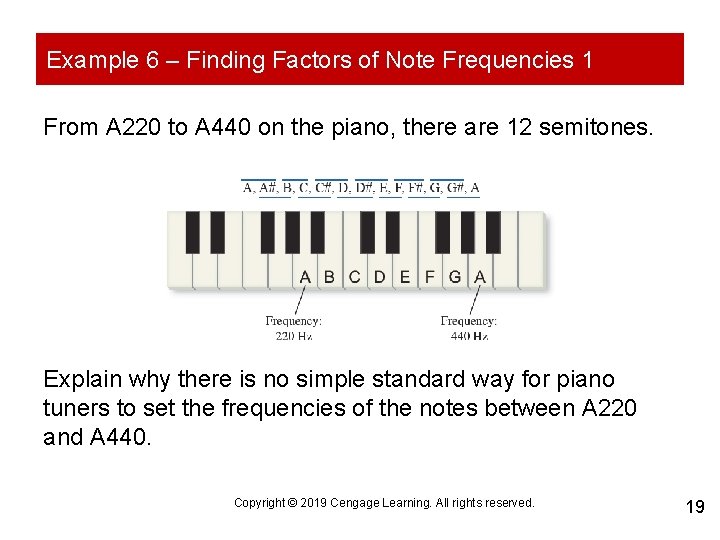
Example 6 – Finding Factors of Note Frequencies 1 From A 220 to A 440 on the piano, there are 12 semitones. Explain why there is no simple standard way for piano tuners to set the frequencies of the notes between A 220 and A 440. Copyright © 2019 Cengage Learning. All rights reserved. 19
Example 6 – Finding Factors of Note Frequencies 2 Solution You can see the problem when you consider that piano tuners have two conflicting goals. 1. One goal is that from each note to the next higher note, you should have the same multiple. For instance, you want a number a such that (Frequency of A)(a) = (Frequency of A#)(a) = (Frequency of B). . . and so on. The number that works is a ≈ 1. 0594 Copyright © 2019 Cengage Learning. All rights reserved. 20
Example 6 – Finding Factors of Note Frequencies 3 2. A Second goal is that you want the frequencies of the 11 notes between A 220 and A 440 to have as many common factors with 220 as possible. Notes who frequencies have common factors harmonize. When you try satisfying these two goals, you will see that they are conflicting. Copyright © 2019 Cengage Learning. All rights reserved. 21
Summary of Rules and Definitions Copyright © 2019 Cengage Learning. All rights reserved. 22
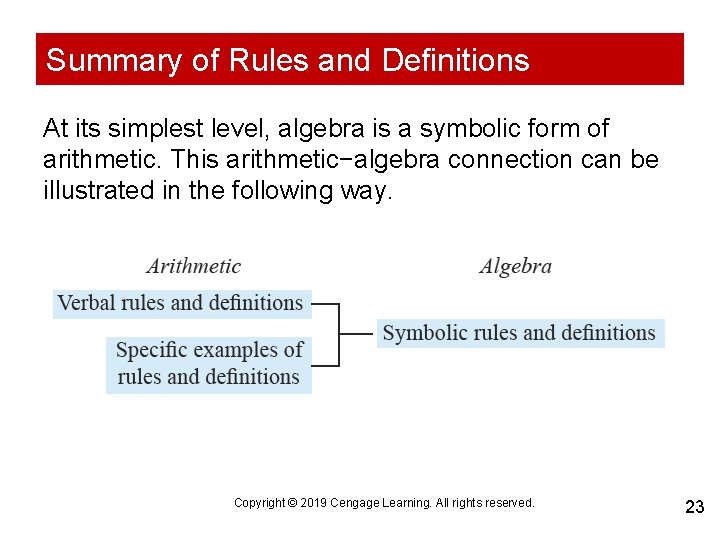
Summary of Rules and Definitions At its simplest level, algebra is a symbolic form of arithmetic. This arithmetic−algebra connection can be illustrated in the following way. Copyright © 2019 Cengage Learning. All rights reserved. 23
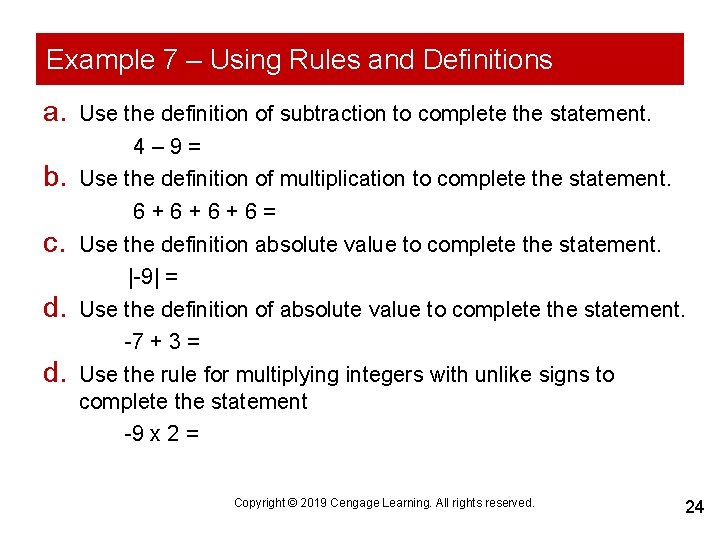
Example 7 – Using Rules and Definitions a. b. c. d. d. Use the definition of subtraction to complete the statement. 4– 9= Use the definition of multiplication to complete the statement. 6+6+6+6= Use the definition absolute value to complete the statement. |-9| = Use the definition of absolute value to complete the statement. -7 + 3 = Use the rule for multiplying integers with unlike signs to complete the statement -9 x 2 = Copyright © 2019 Cengage Learning. All rights reserved. 24
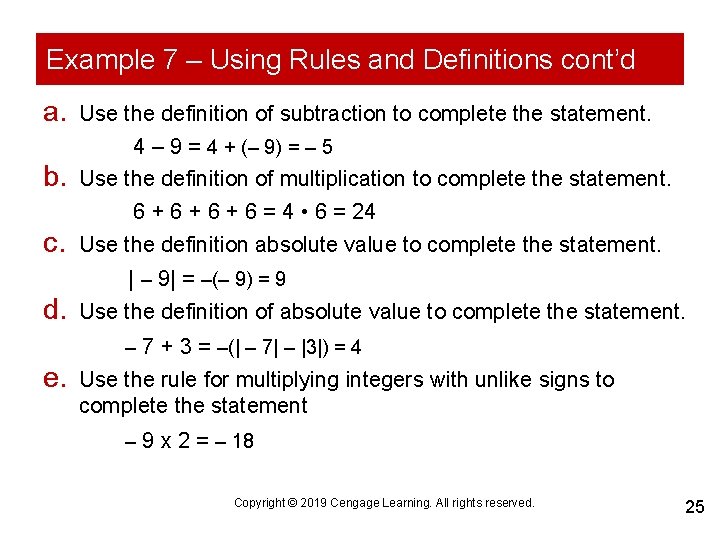
Example 7 – Using Rules and Definitions cont’d a. b. c. Use the definition of subtraction to complete the statement. 4 – 9 = 4 + (– 9) = – 5 Use the definition of multiplication to complete the statement. 6 + 6 + 6 = 4 • 6 = 24 Use the definition absolute value to complete the statement. | – 9| = –(– 9) = 9 d. Use the definition of absolute value to complete the statement. – 7 + 3 = –(| – 7| – |3|) = 4 e. Use the rule for multiplying integers with unlike signs to complete the statement – 9 x 2 = – 18 Copyright © 2019 Cengage Learning. All rights reserved. 25
- Slides: 25