
The ReadingWriting Connection A Cognitive Strategies Approach to
- Slides: 27
The Reading/Writing Connection: A Cognitive Strategies Approach to Interpreting Informational Texts This multimedia product and its contents are protected under copyright law. The following are prohibited by law: l any public performance or display, including transmission of any image over a network; l preparation of any derivative work, including the extraction, in whole or in part, of any images; l any rental, lease, or lending of the program. Booth Olson, The Reading/Writing Connection: Strategies for Teaching and Learning in the Secondary Classroom, Third Edition Copyright © 2011 Pearson Education, Inc.
http: //www. people. com/people/archive/issue/0, , 7566060918, 00. html Booth Olson, The Reading/Writing Connection: Strategies for Teaching and Learning in the Secondary Classroom, Third Edition Copyright © 2011 Pearson Education, Inc.
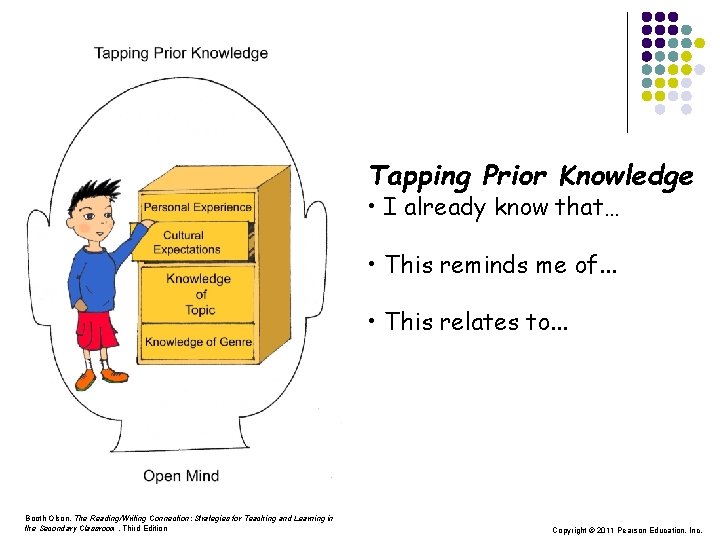
Tapping Prior Knowledge • I already know that… • This reminds me of. . . • This relates to. . . Booth Olson, The Reading/Writing Connection: Strategies for Teaching and Learning in the Secondary Classroom, Third Edition Copyright © 2011 Pearson Education, Inc.
http: //www. people. com/people/archive/issue/0, , 7566060918, 00. html Booth Olson, The Reading/Writing Connection: Strategies for Teaching and Learning in the Secondary Classroom, Third Edition Copyright © 2011 Pearson Education, Inc.
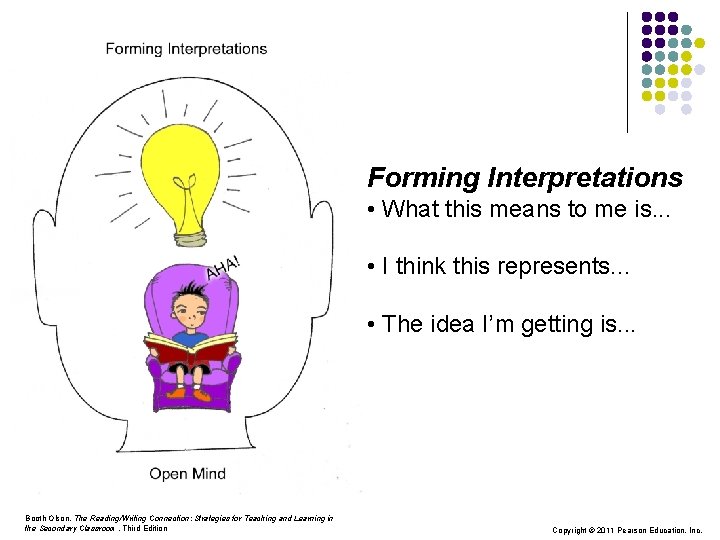
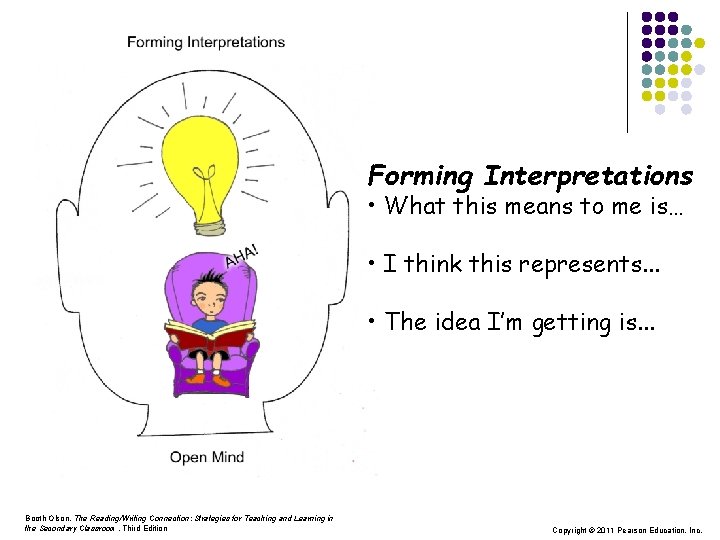
Forming Interpretations • What this means to me is. . . • I think this represents. . . • The idea I’m getting is. . . Booth Olson, The Reading/Writing Connection: Strategies for Teaching and Learning in the Secondary Classroom, Third Edition Copyright © 2011 Pearson Education, Inc.
My first impression of Steve Irwin: http: //www. people. com/people/archive/article/0, , 20060360, 00. html Booth Olson, The Reading/Writing Connection: Strategies for Teaching and Learning in the Secondary Classroom, Third Edition Copyright © 2011 Pearson Education, Inc.
Steve Irwin’s Tragic Death Booth Olson, The Reading/Writing Connection: Strategies for Teaching and Learning in the Secondary Classroom, Third Edition Copyright © 2011 Pearson Education, Inc.
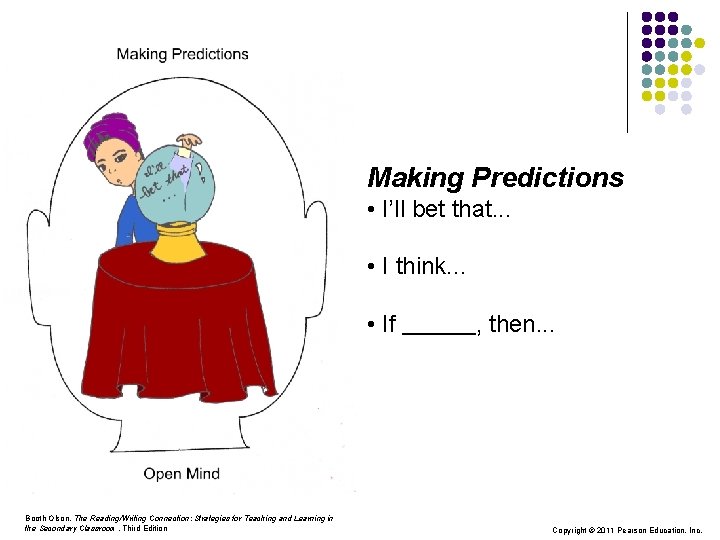
Making Predictions • I’ll bet that. . . • I think. . . • If Booth Olson, The Reading/Writing Connection: Strategies for Teaching and Learning in the Secondary Classroom, Third Edition , then. . . Copyright © 2011 Pearson Education, Inc.
A stingray barb through the heart kills the beloved Aussie adventurer, who leaves behind a wife and two children. How did this happen? Booth Olson, The Reading/Writing Connection: Strategies for Teaching and Learning in the Secondary Classroom, Third Edition Copyright © 2011 Pearson Education, Inc.
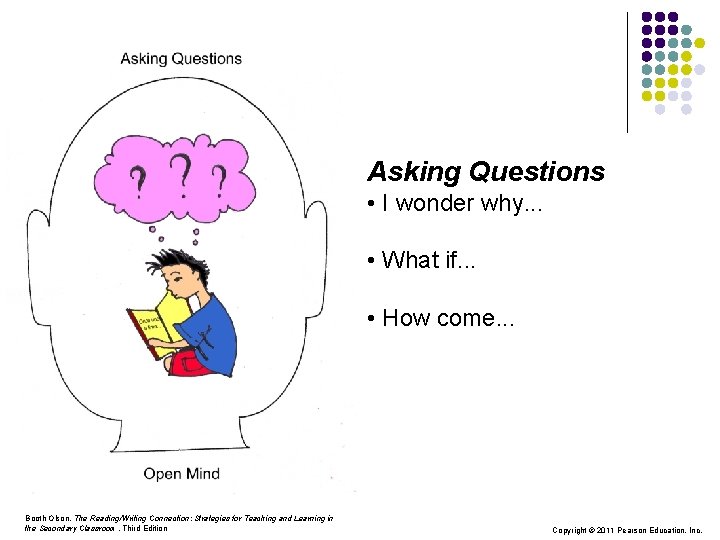
Asking Questions • I wonder why. . . • What if. . . • How come. . . Booth Olson, The Reading/Writing Connection: Strategies for Teaching and Learning in the Secondary Classroom, Third Edition Copyright © 2011 Pearson Education, Inc.
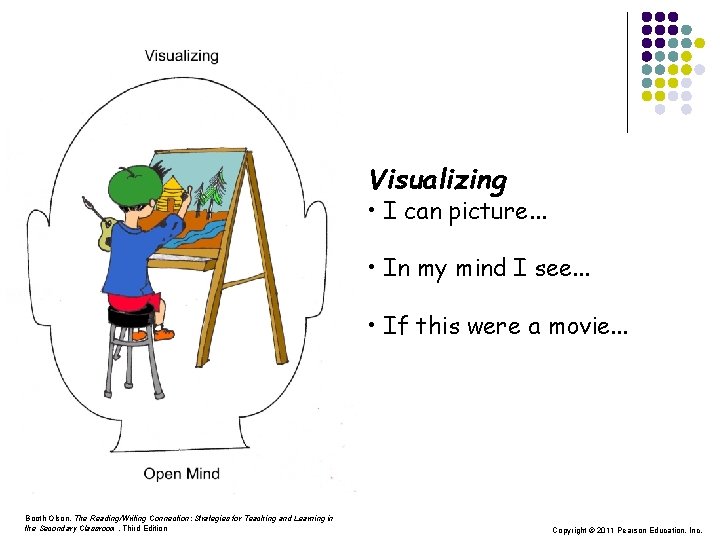
Visualizing • I can picture. . . • In my mind I see. . . • If this were a movie. . . Booth Olson, The Reading/Writing Connection: Strategies for Teaching and Learning in the Secondary Classroom, Third Edition Copyright © 2011 Pearson Education, Inc.
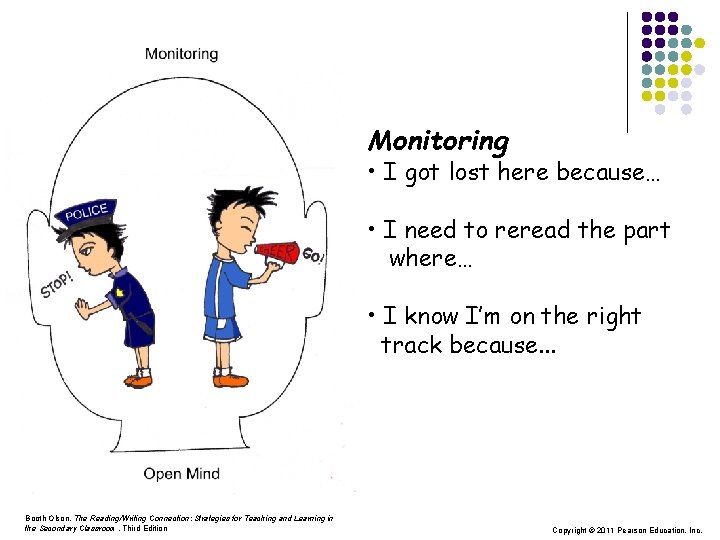
Monitoring • I got lost here because… • I need to reread the part where… • I know I’m on the right track because. . . Booth Olson, The Reading/Writing Connection: Strategies for Teaching and Learning in the Secondary Classroom, Third Edition Copyright © 2011 Pearson Education, Inc.
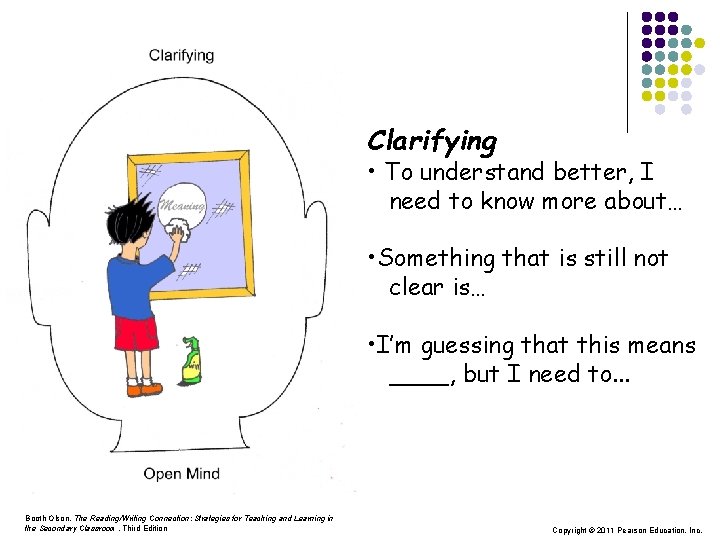
Clarifying • To understand better, I need to know more about… • Something that is still not clear is… • I’m guessing that this means ____, but I need to. . . Booth Olson, The Reading/Writing Connection: Strategies for Teaching and Learning in the Secondary Classroom, Third Edition Copyright © 2011 Pearson Education, Inc.
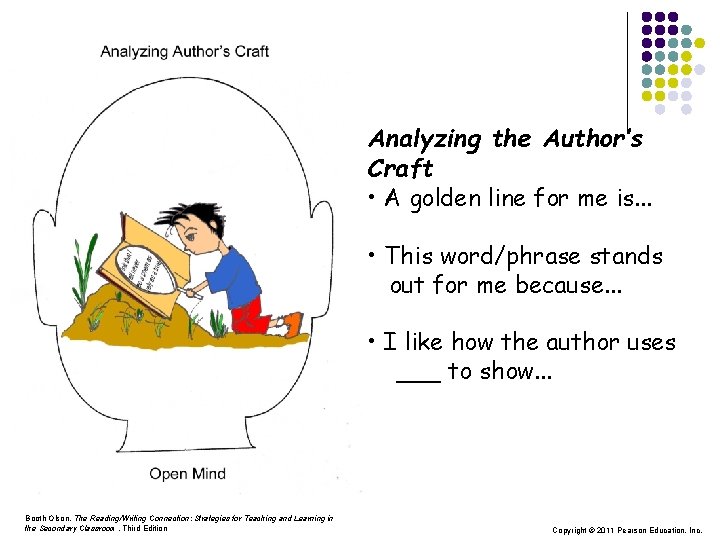
Analyzing the Author’s Craft • A golden line for me is. . . • This word/phrase stands out for me because. . . • I like how the author uses ___ to show. . . Booth Olson, The Reading/Writing Connection: Strategies for Teaching and Learning in the Secondary Classroom, Third Edition Copyright © 2011 Pearson Education, Inc.
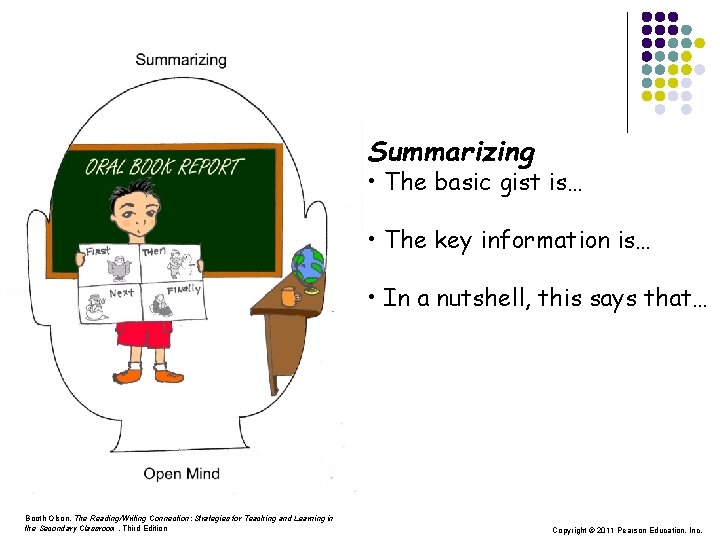
Summarizing • The basic gist is… • The key information is… • In a nutshell, this says that… Booth Olson, The Reading/Writing Connection: Strategies for Teaching and Learning in the Secondary Classroom, Third Edition Copyright © 2011 Pearson Education, Inc.
Forming Interpretations • What this means to me is… • I think this represents. . . • The idea I’m getting is. . . Booth Olson, The Reading/Writing Connection: Strategies for Teaching and Learning in the Secondary Classroom, Third Edition Copyright © 2011 Pearson Education, Inc.
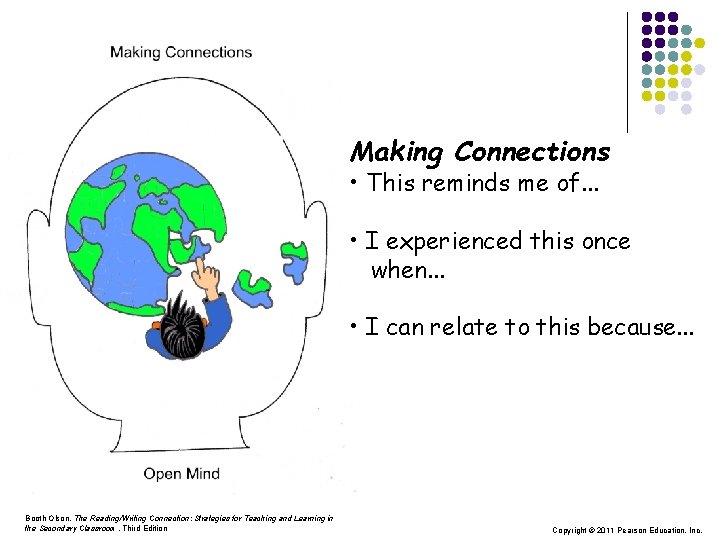
Making Connections • This reminds me of. . . • I experienced this once when. . . • I can relate to this because. . . Booth Olson, The Reading/Writing Connection: Strategies for Teaching and Learning in the Secondary Classroom, Third Edition Copyright © 2011 Pearson Education, Inc.
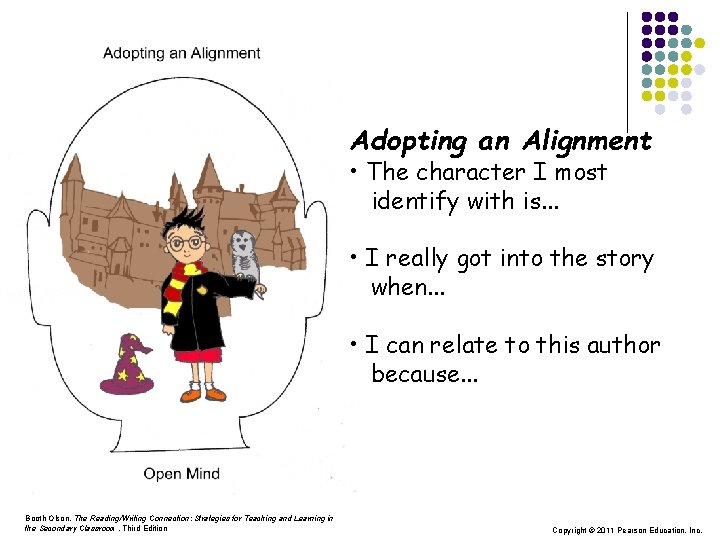
Adopting an Alignment • The character I most identify with is. . . • I really got into the story when. . . • I can relate to this author because. . . Booth Olson, The Reading/Writing Connection: Strategies for Teaching and Learning in the Secondary Classroom, Third Edition Copyright © 2011 Pearson Education, Inc.
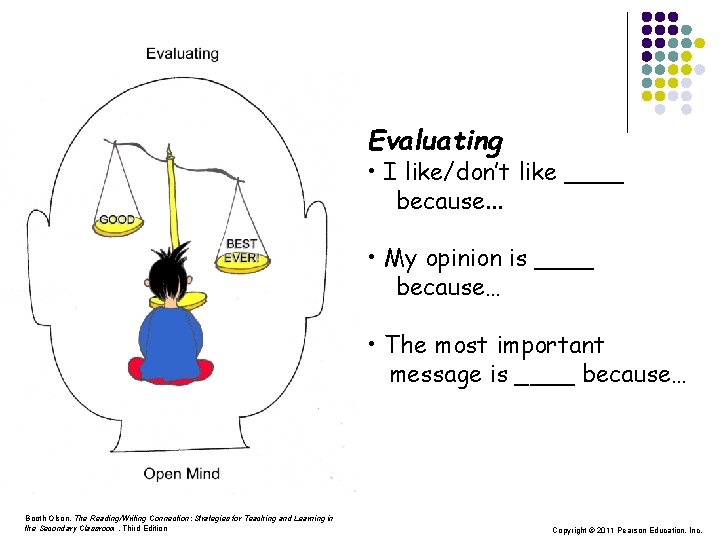
Evaluating • I like/don’t like ____ because. . . • My opinion is ____ because… • The most important message is ____ because… Booth Olson, The Reading/Writing Connection: Strategies for Teaching and Learning in the Secondary Classroom, Third Edition Copyright © 2011 Pearson Education, Inc.
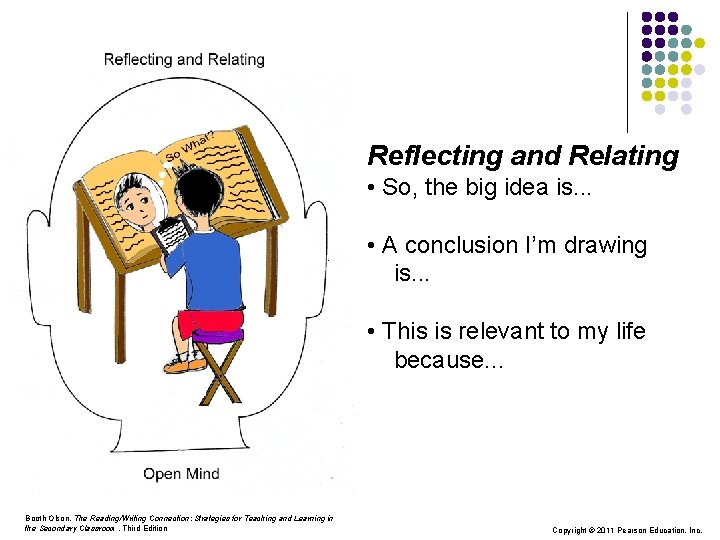
Reflecting and Relating • So, the big idea is. . . • A conclusion I’m drawing is. . . • This is relevant to my life because. . . Booth Olson, The Reading/Writing Connection: Strategies for Teaching and Learning in the Secondary Classroom, Third Edition Copyright © 2011 Pearson Education, Inc.
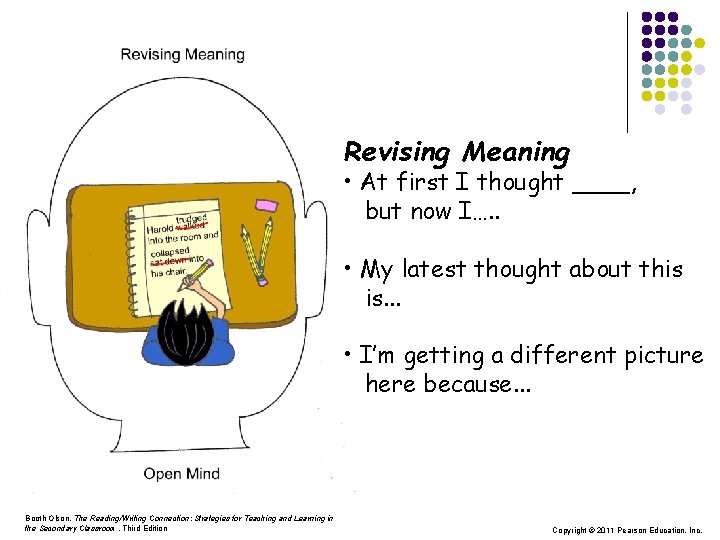
Revising Meaning • At first I thought but now I…. . , • My latest thought about this is. . . • I’m getting a different picture here because. . . Booth Olson, The Reading/Writing Connection: Strategies for Teaching and Learning in the Secondary Classroom, Third Edition Copyright © 2011 Pearson Education, Inc.
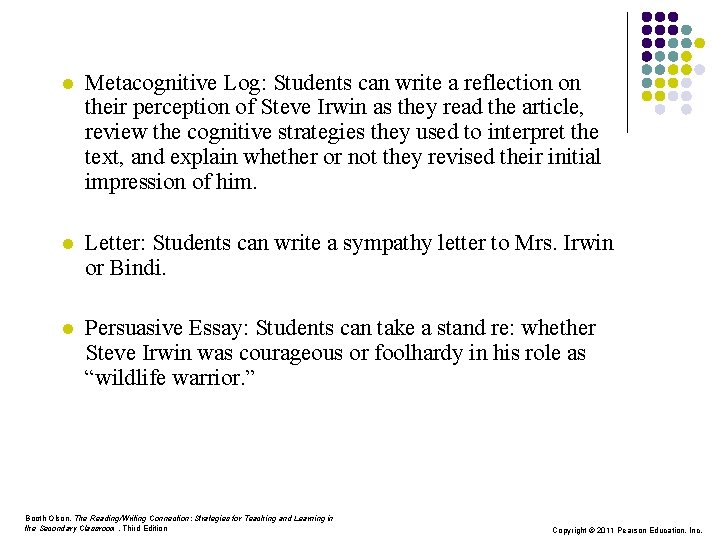
l Metacognitive Log: Students can write a reflection on their perception of Steve Irwin as they read the article, review the cognitive strategies they used to interpret the text, and explain whether or not they revised their initial impression of him. l Letter: Students can write a sympathy letter to Mrs. Irwin or Bindi. l Persuasive Essay: Students can take a stand re: whether Steve Irwin was courageous or foolhardy in his role as “wildlife warrior. ” Booth Olson, The Reading/Writing Connection: Strategies for Teaching and Learning in the Secondary Classroom, Third Edition Copyright © 2011 Pearson Education, Inc.
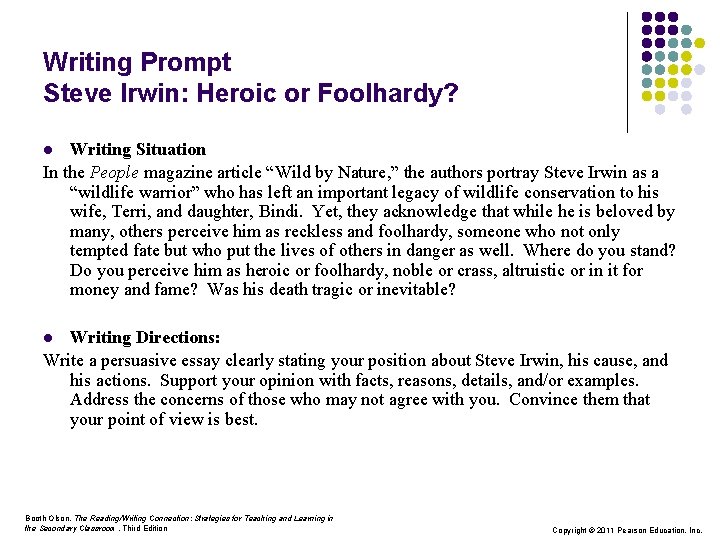
Writing Prompt Steve Irwin: Heroic or Foolhardy? Writing Situation In the People magazine article “Wild by Nature, ” the authors portray Steve Irwin as a “wildlife warrior” who has left an important legacy of wildlife conservation to his wife, Terri, and daughter, Bindi. Yet, they acknowledge that while he is beloved by many, others perceive him as reckless and foolhardy, someone who not only tempted fate but who put the lives of others in danger as well. Where do you stand? Do you perceive him as heroic or foolhardy, noble or crass, altruistic or in it for money and fame? Was his death tragic or inevitable? l Writing Directions: Write a persuasive essay clearly stating your position about Steve Irwin, his cause, and his actions. Support your opinion with facts, reasons, details, and/or examples. Address the concerns of those who may not agree with you. Convince them that your point of view is best. l Booth Olson, The Reading/Writing Connection: Strategies for Teaching and Learning in the Secondary Classroom, Third Edition Copyright © 2011 Pearson Education, Inc.
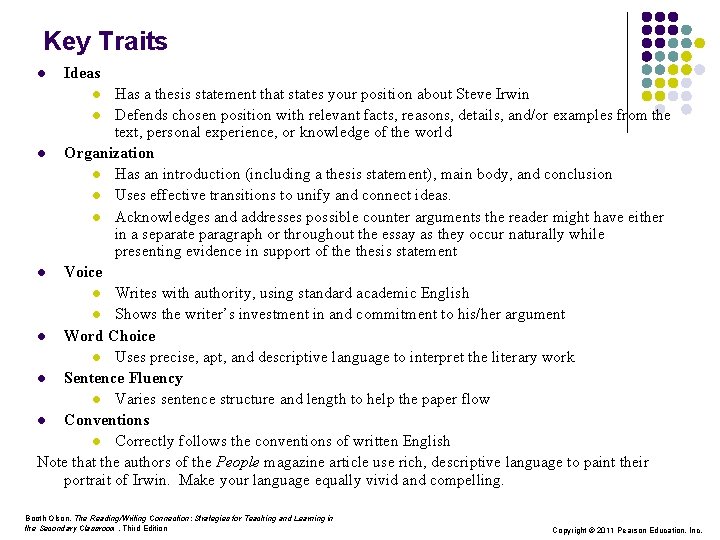
Key Traits l Ideas Has a thesis statement that states your position about Steve Irwin l Defends chosen position with relevant facts, reasons, details, and/or examples from the text, personal experience, or knowledge of the world l Organization l Has an introduction (including a thesis statement), main body, and conclusion l Uses effective transitions to unify and connect ideas. l Acknowledges and addresses possible counter arguments the reader might have either in a separate paragraph or throughout the essay as they occur naturally while presenting evidence in support of thesis statement l Voice l Writes with authority, using standard academic English l Shows the writer’s investment in and commitment to his/her argument l Word Choice l Uses precise, apt, and descriptive language to interpret the literary work l Sentence Fluency l Varies sentence structure and length to help the paper flow l Conventions l Correctly follows the conventions of written English Note that the authors of the People magazine article use rich, descriptive language to paint their portrait of Irwin. Make your language equally vivid and compelling. l Booth Olson, The Reading/Writing Connection: Strategies for Teaching and Learning in the Secondary Classroom, Third Edition Copyright © 2011 Pearson Education, Inc.