
The Reading Process Comprehension is an understanding of
- Slides: 13
The Reading Process Comprehension is an understanding of what has been read. n The most important aspect of being an effective reader is being an active reader. n Active reading means that you ask questions, find answers, and react to the author’s ideas. n © 2004 Pearson Education Inc. , publishing as Longman Publishers
Prior Knowledge Prior knowledge is the large body of information that is learned throughout a lifetime of experience. n The more prior knowledge you have about a topic, the more likely you are to understand that topic. n This is why effective readers build their knowledge base by reading often! n © 2004 Pearson Education Inc. , publishing as Longman Publishers
The Reading Process n Effective readers break reading into a threestep process: Before reading, look over or preview the material. Ask questions about the material you are about to read. n During reading, test your understanding of the material. n After reading, review and react to what you have learned. n © 2004 Pearson Education Inc. , publishing as Longman Publishers
SQ 3 R Reading Process Survey n Question n Read n Recite n Review n © 2004 Pearson Education Inc. , publishing as Longman Publishers
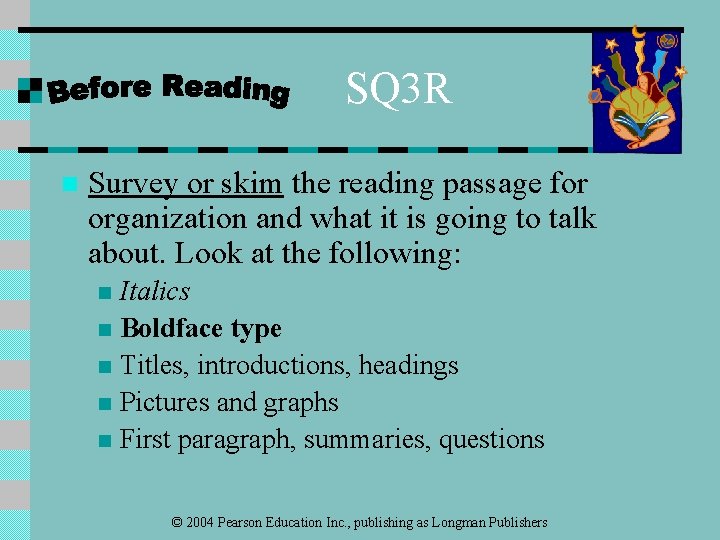
SQ 3 R n Survey or skim the reading passage for organization and what it is going to talk about. Look at the following: Italics n Boldface type n Titles, introductions, headings n Pictures and graphs n First paragraph, summaries, questions n © 2004 Pearson Education Inc. , publishing as Longman Publishers
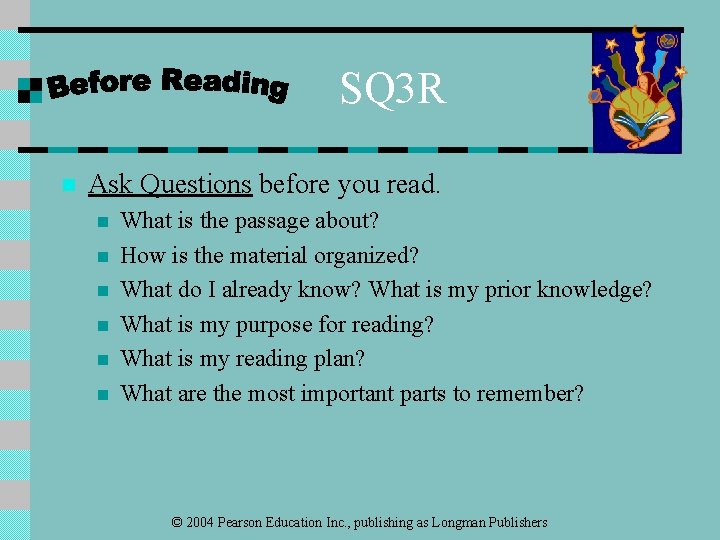
SQ 3 R n Ask Questions before you read. n n n What is the passage about? How is the material organized? What do I already know? What is my prior knowledge? What is my purpose for reading? What is my reading plan? What are the most important parts to remember? © 2004 Pearson Education Inc. , publishing as Longman Publishers
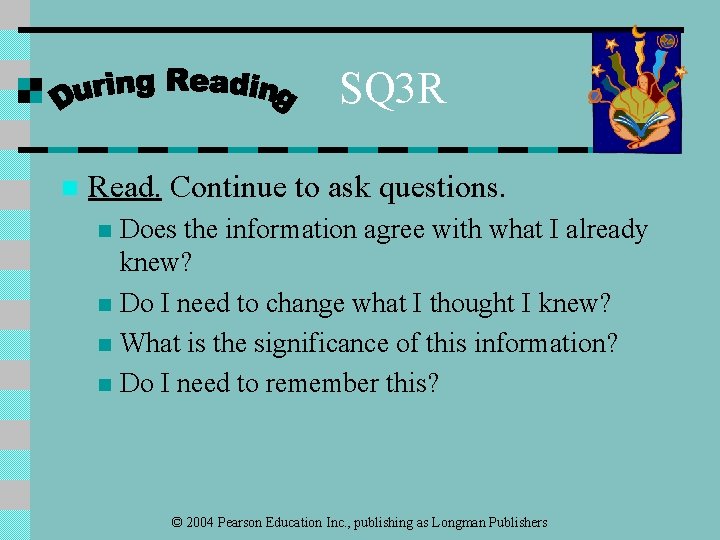
SQ 3 R n Read. Continue to ask questions. Does the information agree with what I already knew? n Do I need to change what I thought I knew? n What is the significance of this information? n Do I need to remember this? n © 2004 Pearson Education Inc. , publishing as Longman Publishers
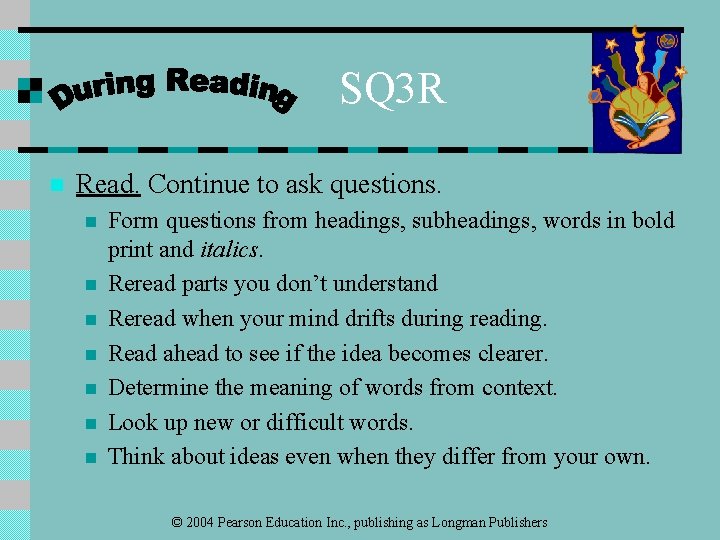
SQ 3 R n Read. Continue to ask questions. n n n n Form questions from headings, subheadings, words in bold print and italics. Reread parts you don’t understand Reread when your mind drifts during reading. Read ahead to see if the idea becomes clearer. Determine the meaning of words from context. Look up new or difficult words. Think about ideas even when they differ from your own. © 2004 Pearson Education Inc. , publishing as Longman Publishers
SQ 3 R n Recite. Make sure you understand by repeating the information. n Create a picture in your mind or on paper. n Restate the ideas in your own words. n Write out answers to the questions you created based on the headings and subheadings. n © 2004 Pearson Education Inc. , publishing as Longman Publishers
SQ 3 R n Review. Go back over the material to review it. n Summarize the most important parts. n Revisit the answers to your questions. n Review new words and their meanings. n Think and write about what you have read. n © 2004 Pearson Education Inc. , publishing as Longman Publishers
SQ 3 R n Review. Connect new information to your prior knowledge about the topic. n Form opinions about the material and the author. n Notice changes in your opinions based on the new information. n Write about what you have read. n © 2004 Pearson Education Inc. , publishing as Longman Publishers
Review Prior knowledge is the body of information that is learned throughout a lifetime of experience. n Comprehension is an understanding of information. n SQ 3 R stands for Survey, Question, Read, Recite, and Review. n © 2004 Pearson Education Inc. , publishing as Longman Publishers
Review n Effective readers divide the reading process into the following three phases: Before reading n During reading n After reading n © 2004 Pearson Education Inc. , publishing as Longman Publishers