
The reactivity series List the order of common
- Slides: 2
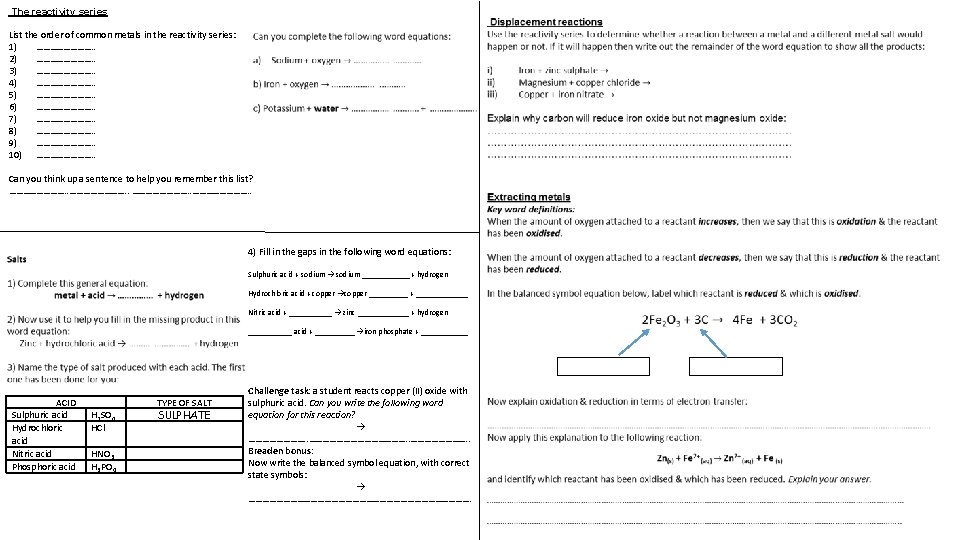
The reactivity series List the order of common metals in the reactivity series: 1) …………. . 2) …………. . 3) …………. . 4) …………. . 5) …………. . 6) …………. . 7) …………. . 8) …………. . 9) …………. . 10) …………. . Can you think up a sentence to help you remember this list? ……………………. . 4) Fill in the gaps in the following word equations: Sulphuric acid + sodium → sodium ______ + hydrogen Hydrochloric acid + copper →copper _____ + _______ Nitric acid + ______ → zinc _______ + hydrogen ______ acid + _____ →iron phosphate + ______ ACID Sulphuric acid Hydrochloric acid Nitric acid Phosphoric acid H 2 SO 4 HCl HNO 3 H 3 PO 4 TYPE OF SALT SULPHATE Challenge task: a student reacts copper (II) oxide with sulphuric acid. Can you write the following word equation for this reaction? → ……………………. . Breaden bonus: Now write the balanced symbol equation, with correct state symbols: → ………………………………………….
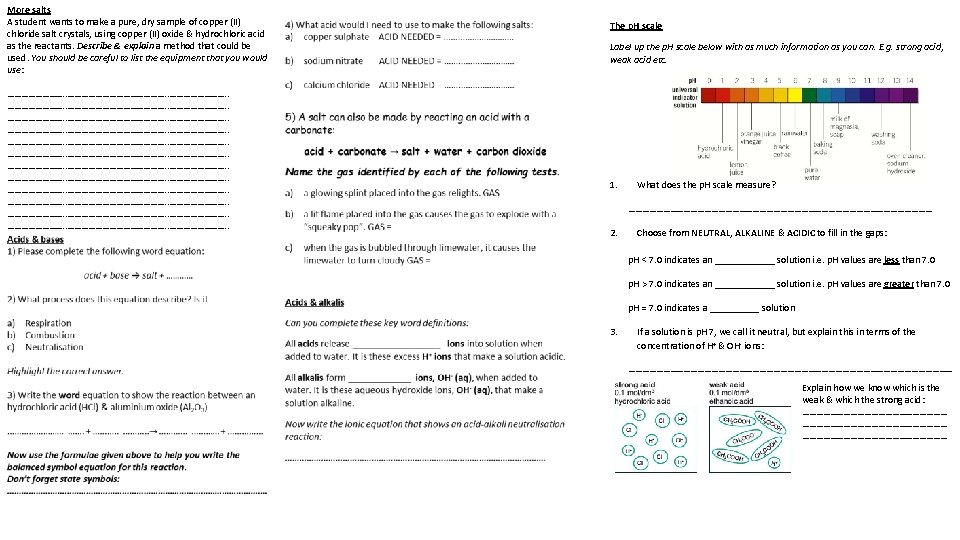
More salts A student wants to make a pure, dry sample of copper (II) chloride salt crystals, using copper (II) oxide & hydrochloric acid as the reactants. Describe & explain a method that could be used. You should be careful to list the equipment that you would use: ……………………. . ……………………………………. . ……………………. . ……………………………………. . The p. H scale Label up the p. H scale below with as much information as you can. E. g. strong acid, weak acid etc. 1. What does the p. H scale measure? ………………………………………………………… 2. Choose from NEUTRAL, ALKALINE & ACIDIC to fill in the gaps: p. H < 7. 0 indicates an ______ solution i. e. p. H values are less than 7. 0 p. H > 7. 0 indicates an ______ solution i. e. p. H values are greater than 7. 0 p. H = 7. 0 indicates a _____ solution 3. If a solution is p. H 7, we call it neutral, but explain this in terms of the concentration of H+ & OH- ions: ……………………………………………………………… Explain how we know which is the weak & which the strong acid: ………………………………………………………