
The Reachout Partnership Justine Molyneux CEO Lia Robinson
The Reachout Partnership Justine Molyneux – CEO Lia Robinson – Head of Reachout Delivering employment solutions to individuals and families across Wirral The Reachout Partnership 1
The Reachout Partnership The partnership supports individuals and families off welfare benefits into the labour market and ultimately sustainable employment. Our core objective is to identify client barriers and use effective multi agency work to break down those barriers to hand hold people into employment. • • • Involve Northwest – (Community Engagement) Wirral Change (BME) Advocacy in Wirral (Mental Health) Remploy (Disability) The Social Partnership (Drugs, Alcohol, Criminality) Inclusive Access (Personal Self Development) The partners have a collective experience of over 20 years delivering and working successfully with key priority clients across disadvantaged and underprivileged neighbourhoods. The Reachout Partnership 2

Partnership approach Delivery Model End to end support Targeted Outreach & Engagement Information, Diagnosis, Signposting Preemployment support Transition Into Work Skills building Job matching / searching Discretionary fund Barrier removal Job Retention & in work sustainability support The Reachout Partnership Skills building & progression 3
Engagement methods How do we engage with unemployed clients? • • • Door knocking Localised work clubs Saturday & evening work clubs Localised bases Community events Resident association meetings Text messaging Word of mouth referrals Local partnerships – NHS, GPs, Community Houses, Probation Service, Children's Centres, Youth Workers etc April 2011 – 2012, we have engaged with 3, 689 clients. Over the past 6 years, we have proven that the two most effective routes of engagement with residents who are divorced from mainstream services is to simply knock on their doors or deliver local, accessible work clubs. The Reachout Partnership 4
Knowledge & understanding of our priority clients • • • • Confidence & beliefs Mental health issues Child care Fear (financial / capability / change) Intergenerational pressure Low skills / experience Health issues Prejudice from potential employers Debt Language barriers Post employment support / hand holding Same advisor throughout the journey Transition from secure benefits to paid work The Reachout Partnership 5
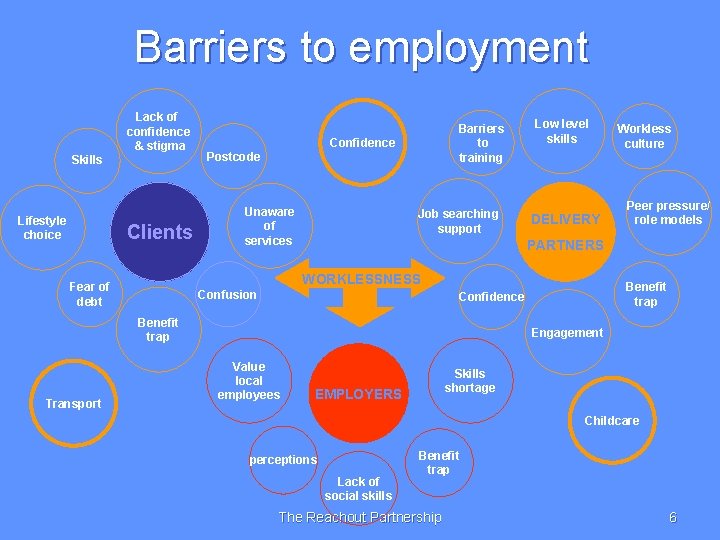
Barriers to employment Lack of confidence & stigma Skills Lifestyle choice Clients Barriers to training Confidence Postcode Unaware of services Job searching support DELIVERY Workless culture Peer pressure/ role models PARTNERS WORKLESSNESS Fear of debt Confusion Benefit trap Confidence Benefit trap Transport Low level skills Engagement Value local employees Skills shortage EMPLOYERS Childcare perceptions Lack of social skills Benefit trap The Reachout Partnership 6
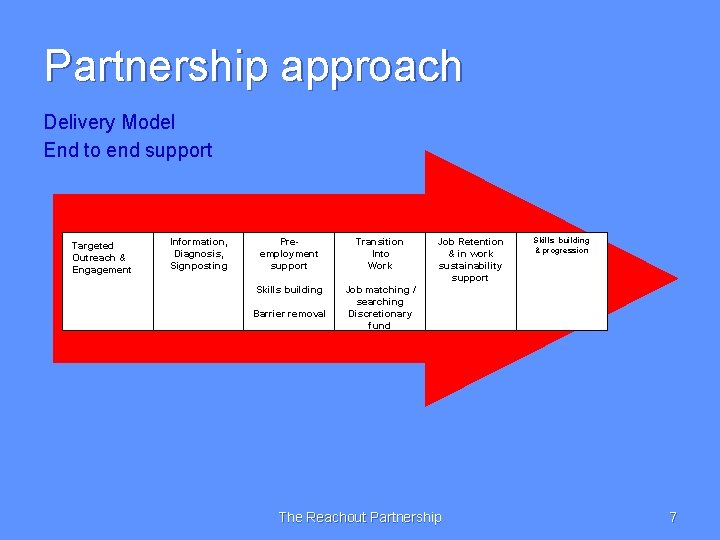
Partnership approach Delivery Model End to end support Targeted Outreach & Engagement Information, Diagnosis, Signposting Preemployment support Transition Into Work Skills building Job matching / searching Discretionary fund Barrier removal Job Retention & in work sustainability support The Reachout Partnership Skills building & progression 7
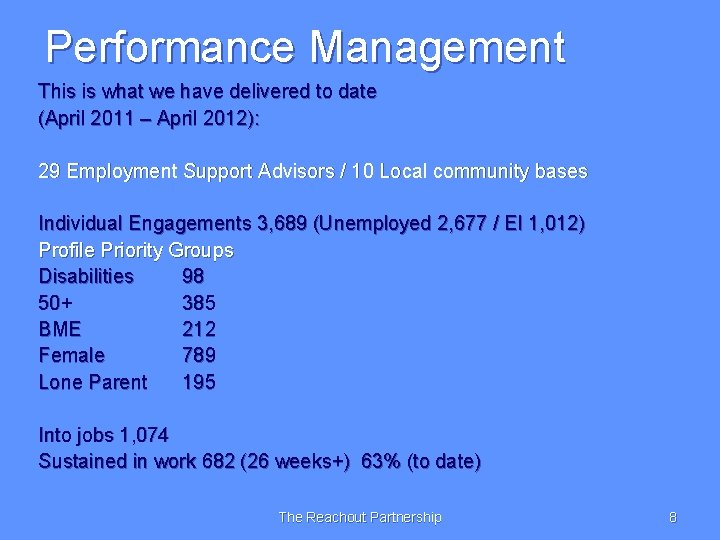
Performance Management This is what we have delivered to date (April 2011 – April 2012): 29 Employment Support Advisors / 10 Local community bases Individual Engagements 3, 689 (Unemployed 2, 677 / EI 1, 012) Profile Priority Groups Disabilities 98 50+ 385 BME 212 Female 789 Lone Parent 195 Into jobs 1, 074 Sustained in work 682 (26 weeks+) 63% (to date) The Reachout Partnership 8
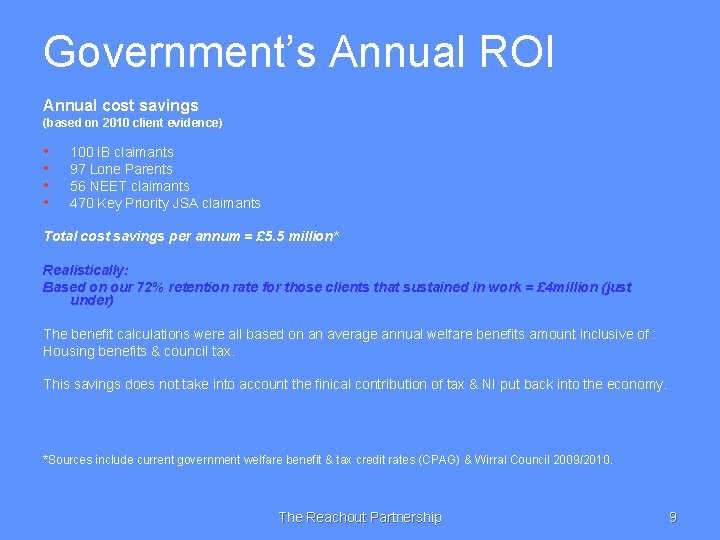
Government’s Annual ROI Annual cost savings (based on 2010 client evidence) • • 100 IB claimants 97 Lone Parents 56 NEET claimants 470 Key Priority JSA claimants Total cost savings per annum = £ 5. 5 million* Realistically: Based on our 72% retention rate for those clients that sustained in work = £ 4 million (just under) The benefit calculations were all based on an average annual welfare benefits amount inclusive of : Housing benefits & council tax. This savings does not take into account the finical contribution of tax & NI put back into the economy. *Sources include current government welfare benefit & tax credit rates (CPAG) & Wirral Council 2009/2010. The Reachout Partnership 9
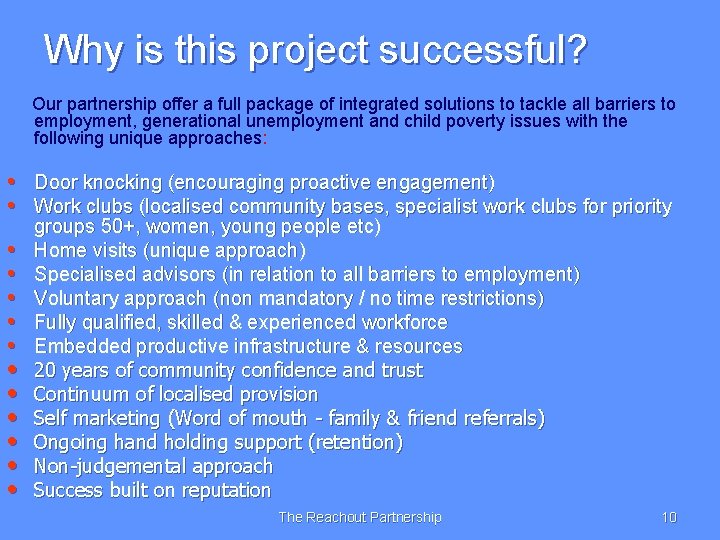
Why is this project successful? Our partnership offer a full package of integrated solutions to tackle all barriers to employment, generational unemployment and child poverty issues with the following unique approaches: • Door knocking (encouraging proactive engagement) • Work clubs (localised community bases, specialist work clubs for priority • • • groups 50+, women, young people etc) Home visits (unique approach) Specialised advisors (in relation to all barriers to employment) Voluntary approach (non mandatory / no time restrictions) Fully qualified, skilled & experienced workforce Embedded productive infrastructure & resources 20 years of community confidence and trust Continuum of localised provision Self marketing (Word of mouth - family & friend referrals) Ongoing hand holding support (retention) Non-judgemental approach Success built on reputation The Reachout Partnership 10
- Slides: 10