
The RC 6 Block Cipher A simple fast
The RC 6 Block Cipher: A simple fast secure AES proposal Ronald L. Rivest Matt Robshaw Ray Sidney Yiqun Lisa Yin MIT RSA Labs (August 21, 1998)
Outline u Design Philosophy u Description of RC 6 u Implementation Results u Security u Conclusion
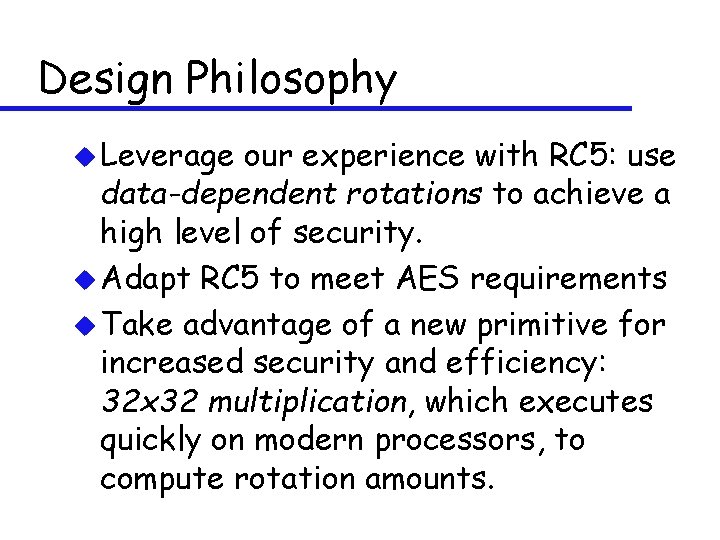
Design Philosophy u Leverage our experience with RC 5: use data-dependent rotations to achieve a high level of security. u Adapt RC 5 to meet AES requirements u Take advantage of a new primitive for increased security and efficiency: 32 x 32 multiplication, which executes quickly on modern processors, to compute rotation amounts.
Description of RC 6
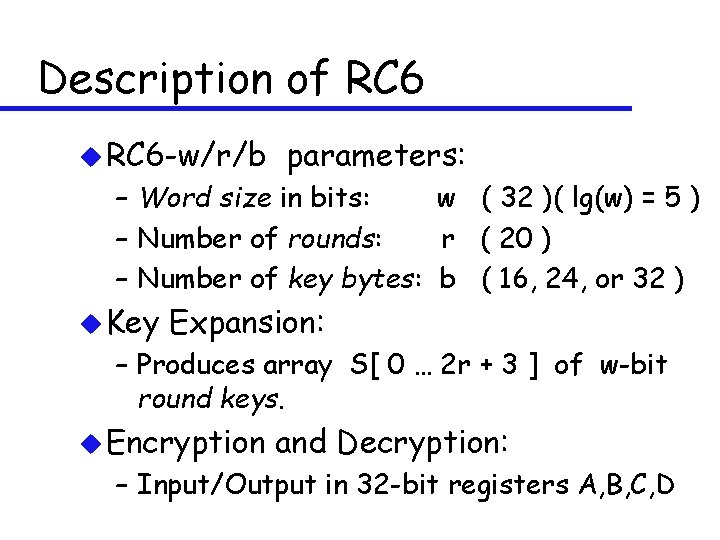
Description of RC 6 u RC 6 -w/r/b parameters: – Word size in bits: w ( 32 )( lg(w) = 5 ) – Number of rounds: r ( 20 ) – Number of key bytes: b ( 16, 24, or 32 ) u Key Expansion: – Produces array S[ 0 … 2 r + 3 ] of w-bit round keys. u Encryption and Decryption: – Input/Output in 32 -bit registers A, B, C, D
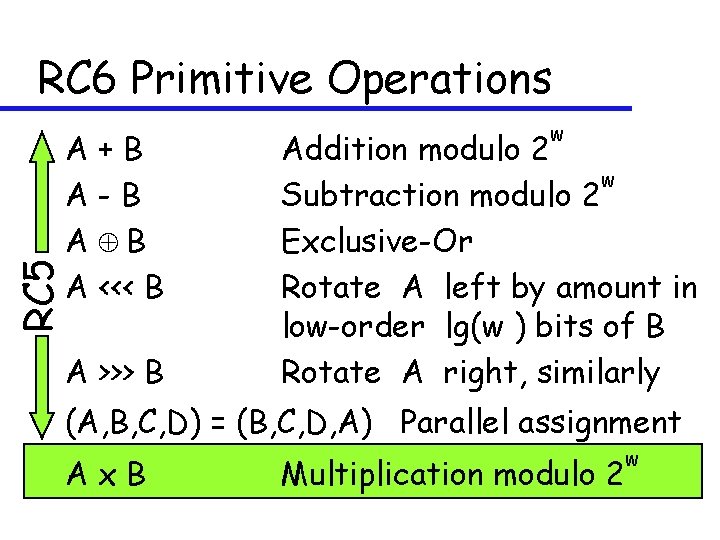
RC 6 Primitive Operations RC 5 A+B A-B A <<< B A >>> B w Addition modulo 2 w Subtraction modulo 2 Exclusive-Or Rotate A left by amount in low-order lg(w ) bits of B Rotate A right, similarly (A, B, C, D) = (B, C, D, A) Parallel assignment Ax. B Multiplication modulo 2 w
![RC 6 Encryption (Generic) B = B + S[ 0 ] D = D](http://slidetodoc.com/presentation_image/608b8e94b0cbfa4fed4af645ea945885/image-7.jpg "RC 6 Encryption (Generic) B = B + S[ 0 ] D = D")
RC 6 Encryption (Generic) B = B + S[ 0 ] D = D + S[ 1 ] for i = 1 to r do { t = ( B x ( 2 B + 1 ) ) <<< lg( w ) u = ( D x ( 2 D + 1 ) ) <<< lg( w ) A = ( ( A t ) <<< u ) + S[ 2 i ] C = ( ( C u ) <<< t ) + S[ 2 i + 1 ] (A, B, C, D) = (B, C, D, A) } A = A + S[ 2 r + 2 ] C = C + S[ 2 r + 3 ]
![RC 6 Encryption (for AES) B = B + S[ 0 ] D =](http://slidetodoc.com/presentation_image/608b8e94b0cbfa4fed4af645ea945885/image-8.jpg "RC 6 Encryption (for AES) B = B + S[ 0 ] D =")
RC 6 Encryption (for AES) B = B + S[ 0 ] D = D + S[ 1 ] for i = 1 to 20 do { t = ( B x ( 2 B + 1 ) ) <<< 5 u = ( D x ( 2 D + 1 ) ) <<< 5 A = ( ( A t ) <<< u ) + S[ 2 i ] C = ( ( C u ) <<< t ) + S[ 2 i + 1 ] (A, B, C, D) = (B, C, D, A) } A = A + S[ 42 ] C = C + S[ 43 ]
![RC 6 Decryption (for AES) C = C - S[ 43 ] A =](http://slidetodoc.com/presentation_image/608b8e94b0cbfa4fed4af645ea945885/image-9.jpg "RC 6 Decryption (for AES) C = C - S[ 43 ] A =")
RC 6 Decryption (for AES) C = C - S[ 43 ] A = A - S[ 42 ] for i = 20 downto 1 do { (A, B, C, D) = (D, A, B, C) u = ( D x ( 2 D + 1 ) ) <<< 5 t = ( B x ( 2 B + 1 ) ) <<< 5 C = ( ( C - S[ 2 i + 1 ] ) >>> t ) u A = ( ( A - S[ 2 i ] ) >>> u ) t } D = D - S[ 1 ] B = B - S[ 0 ]
![Key Expansion (Same as RC 5’s) u Input: array L[ 0 … c-1 ]](http://slidetodoc.com/presentation_image/608b8e94b0cbfa4fed4af645ea945885/image-10.jpg "Key Expansion (Same as RC 5’s) u Input: array L[ 0 … c-1 ]")
Key Expansion (Same as RC 5’s) u Input: array L[ 0 … c-1 ] of input key words u Output: array S[ 0 … 43 ] of round key words u Procedure: S[ 0 ] = 0 x. B 7 E 15163 for i = 1 to 43 do S[i] = S[i-1] + 0 x 9 E 3779 B 9 A=B=i=j=0 for s = 1 to 132 do { A = S[ i ] = ( S[ i ] + A + B ) <<< 3 B = L[ j ] = ( L[ j ] + A + B ) <<< ( A + B ) i = ( i + 1 ) mod 44 j = ( j + 1 ) mod c }
From RC 5 to RC 6 in seven easy steps
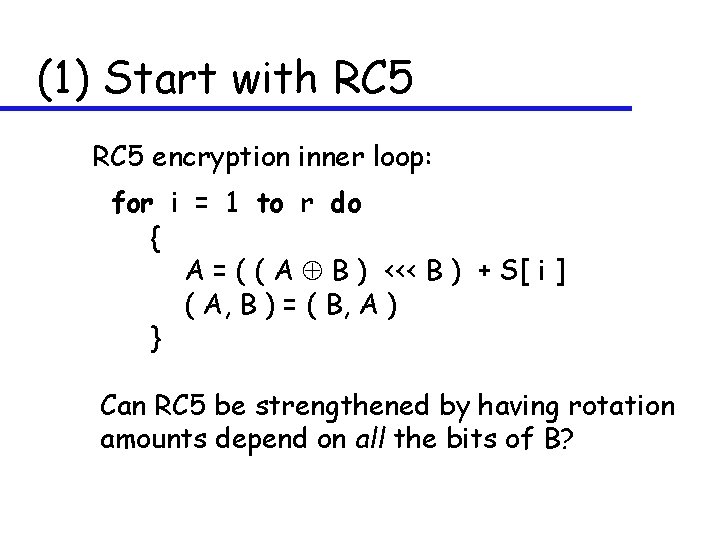
(1) Start with RC 5 encryption inner loop: for i = 1 to r do { A = ( ( A B ) <<< B ) + S[ i ] ( A, B ) = ( B, A ) } Can RC 5 be strengthened by having rotation amounts depend on all the bits of B?
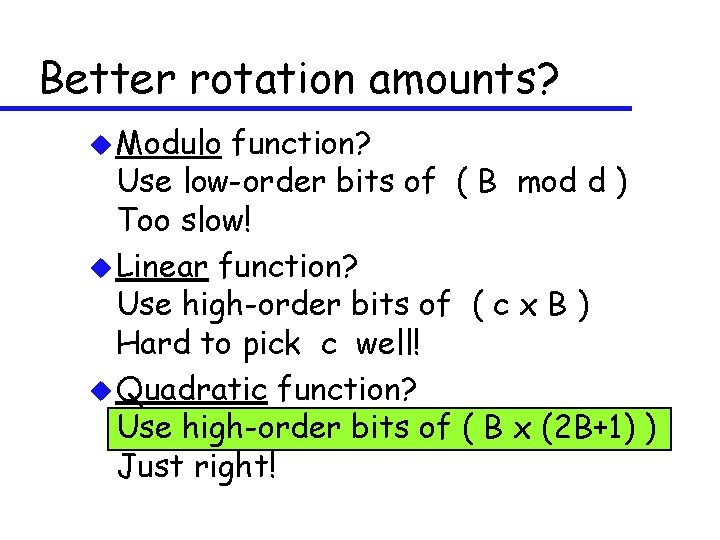
Better rotation amounts? u Modulo function? Use low-order bits of ( B mod d ) Too slow! u Linear function? Use high-order bits of ( c x B ) Hard to pick c well! u Quadratic function? Use high-order bits of ( B x (2 B+1) ) Just right!
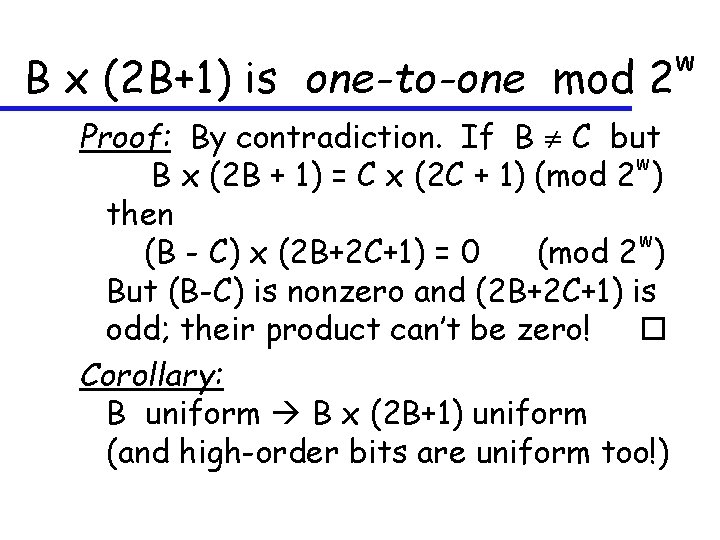
B x (2 B+1) is one-to-one mod 2 Proof: By contradiction. If B C but w B x (2 B + 1) = C x (2 C + 1) (mod 2 ) then w (B - C) x (2 B+2 C+1) = 0 (mod 2 ) But (B-C) is nonzero and (2 B+2 C+1) is odd; their product can’t be zero! Corollary: B uniform B x (2 B+1) uniform (and high-order bits are uniform too!) w
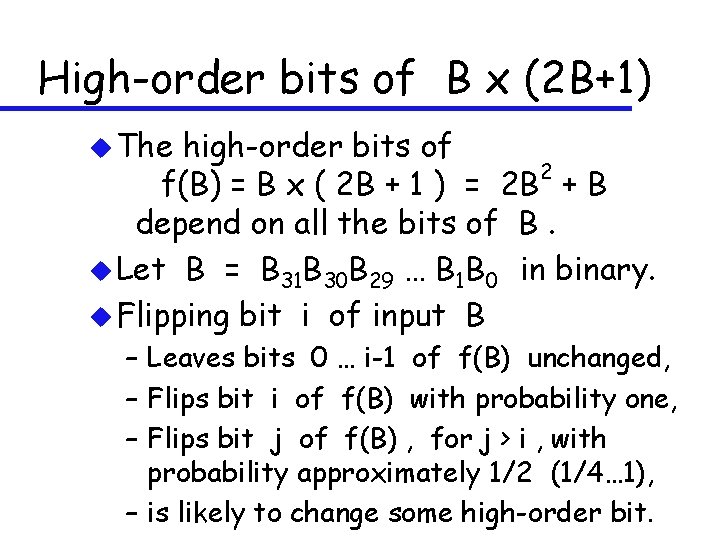
High-order bits of B x (2 B+1) u The high-order bits of 2 f(B) = B x ( 2 B + 1 ) = 2 B + B depend on all the bits of B. u Let B = B 31 B 30 B 29 … B 1 B 0 in binary. u Flipping bit i of input B – Leaves bits 0 … i-1 of f(B) unchanged, – Flips bit i of f(B) with probability one, – Flips bit j of f(B) , for j > i , with probability approximately 1/2 (1/4… 1), – is likely to change some high-order bit.
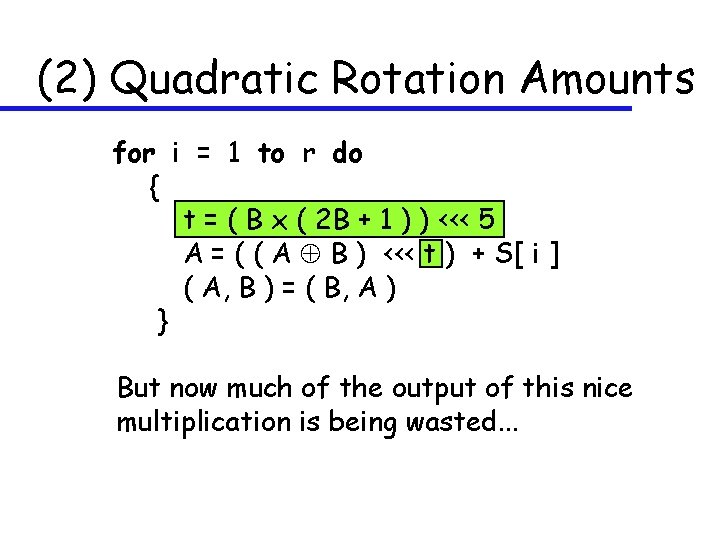
(2) Quadratic Rotation Amounts for i = 1 to r do { t = ( B x ( 2 B + 1 ) ) <<< 5 A = ( ( A B ) <<< t ) + S[ i ] ( A, B ) = ( B, A ) } But now much of the output of this nice multiplication is being wasted. . .
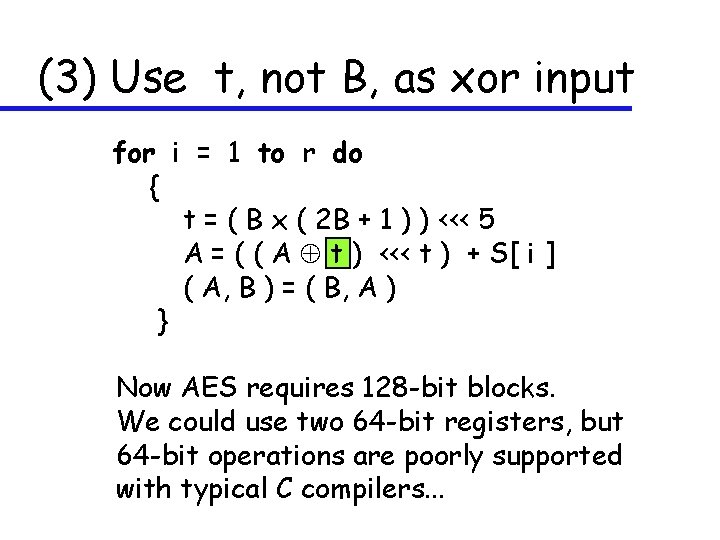
(3) Use t, not B, as xor input for i = 1 to r do { t = ( B x ( 2 B + 1 ) ) <<< 5 A = ( ( A t ) <<< t ) + S[ i ] ( A, B ) = ( B, A ) } Now AES requires 128 -bit blocks. We could use two 64 -bit registers, but 64 -bit operations are poorly supported with typical C compilers. . .
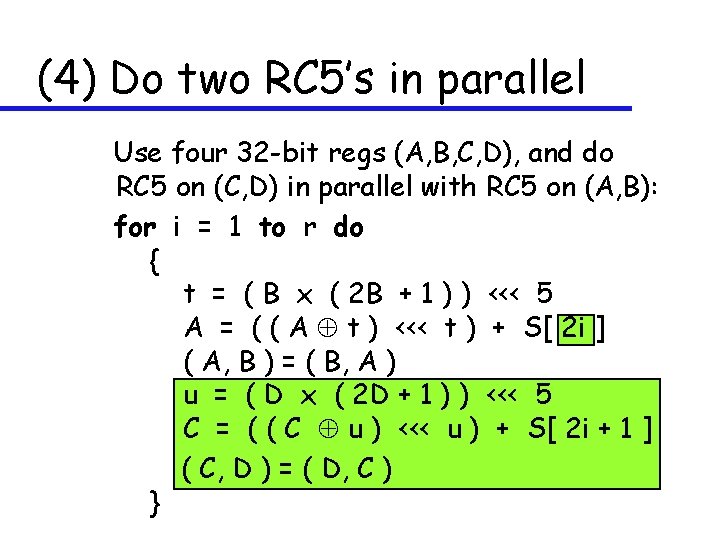
(4) Do two RC 5’s in parallel Use four 32 -bit regs (A, B, C, D), and do RC 5 on (C, D) in parallel with RC 5 on (A, B): for i = 1 to r do { t = ( B x ( 2 B + 1 ) ) <<< 5 A = ( ( A t ) <<< t ) + S[ 2 i ] ( A, B ) = ( B, A ) u = ( D x ( 2 D + 1 ) ) <<< 5 C = ( ( C u ) <<< u ) + S[ 2 i + 1 ] ( C, D ) = ( D, C ) }
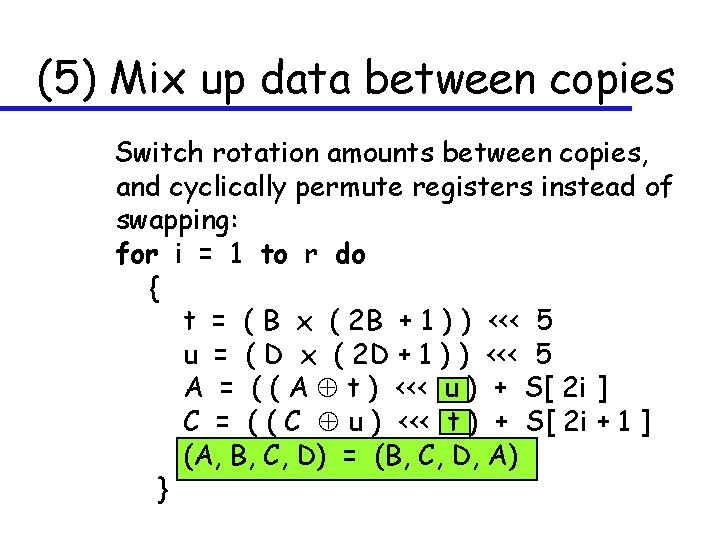
(5) Mix up data between copies Switch rotation amounts between copies, and cyclically permute registers instead of swapping: for i = 1 to r do { t = ( B x ( 2 B + 1 ) ) <<< 5 u = ( D x ( 2 D + 1 ) ) <<< 5 A = ( ( A t ) <<< u ) + S[ 2 i ] C = ( ( C u ) <<< t ) + S[ 2 i + 1 ] (A, B, C, D) = (B, C, D, A) }
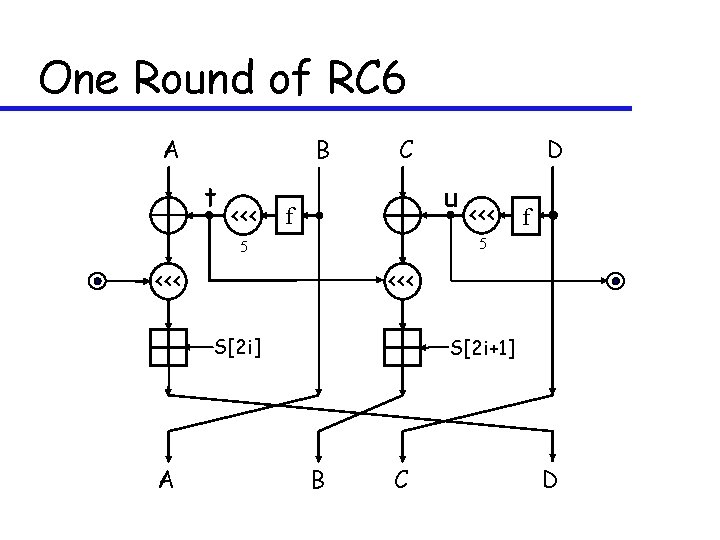
One Round of RC 6 A B t <<< C u f <<< f 5 5 <<< S[2 i] A D S[2 i+1] B C D
![(6) Add Pre- and Post-Whitening B = B + S[ 0 ] D =](http://slidetodoc.com/presentation_image/608b8e94b0cbfa4fed4af645ea945885/image-21.jpg "(6) Add Pre- and Post-Whitening B = B + S[ 0 ] D =")
(6) Add Pre- and Post-Whitening B = B + S[ 0 ] D = D + S[ 1 ] for i = 1 to r do { t = ( B x ( 2 B + 1 ) ) <<< 5 u = ( D x ( 2 D + 1 ) ) <<< 5 A = ( ( A t ) <<< u ) + S[ 2 i ] C = ( ( C u ) <<< t ) + S[ 2 i + 1 ] (A, B, C, D) = (B, C, D, A) } A = A + S[ 2 r + 2 ] C = C + S[ 2 r + 3 ]
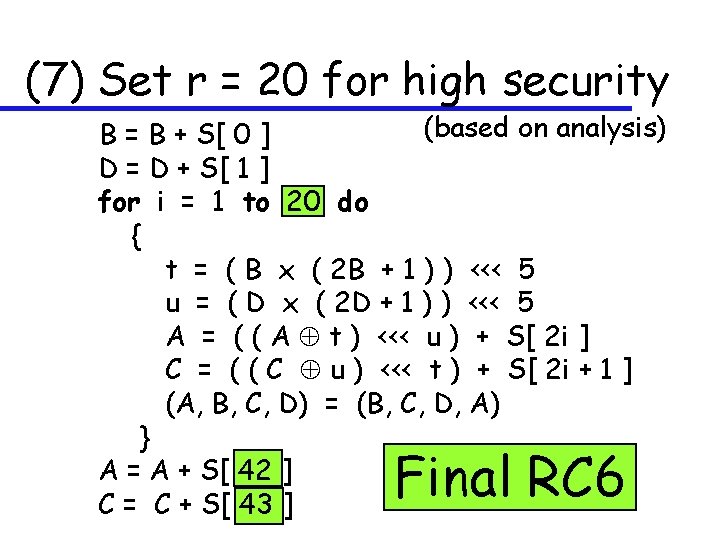
(7) Set r = 20 for high security (based on analysis) B = B + S[ 0 ] D = D + S[ 1 ] for i = 1 to 20 do { t = ( B x ( 2 B + 1 ) ) <<< 5 u = ( D x ( 2 D + 1 ) ) <<< 5 A = ( ( A t ) <<< u ) + S[ 2 i ] C = ( ( C u ) <<< t ) + S[ 2 i + 1 ] (A, B, C, D) = (B, C, D, A) } A = A + S[ 42 ] C = C + S[ 43 ] Final RC 6
RC 6 Implementation Results
CPU Cycles / Operation Less than two clocks per bit of plaintext !
Operations/Second (200 MHz)
Encryption Rate (200 MHz) Mega. Bytes / second Mega. Bits / second Over 100 Megabits / second !
On an 8 -bit processor u On an Intel MCS 51 ( 1 Mhz clock ) u Encrypt/decrypt at 9. 2 Kbits/second (13535 cycles/block; from actual implementation) u Key setup in 27 milliseconds u Only 176 bytes needed for table of round keys. u Fits on smart card (< 256 bytes RAM).
Custom RC 6 IC u 0. 25 micron CMOS process u One round/clock at 200 MHz u Conventional multiplier designs 2 u 0. 05 mm of silicon u 21 milliwatts of power u Encrypt/decrypt at 1. 3 Gbits/second u With pipelining, can go faster, at cost of more area and power

RC 6 Security Analysis
Analysis procedures u Intensive analysis, based on most effective known attacks (e. g. linear and differential cryptanalysis) u Analyze not only RC 6, but also several “simplified” forms (e. g. with no quadratic function, no fixed rotation by 5 bits, etc…)
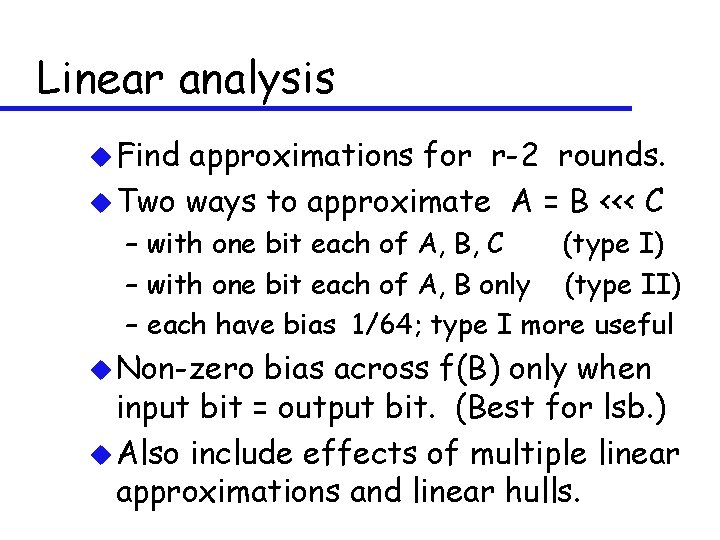
Linear analysis u Find approximations for r-2 rounds. u Two ways to approximate A = B <<< C – with one bit each of A, B, C (type I) – with one bit each of A, B only (type II) – each have bias 1/64; type I more useful u Non-zero bias across f(B) only when input bit = output bit. (Best for lsb. ) u Also include effects of multiple linear approximations and linear hulls.
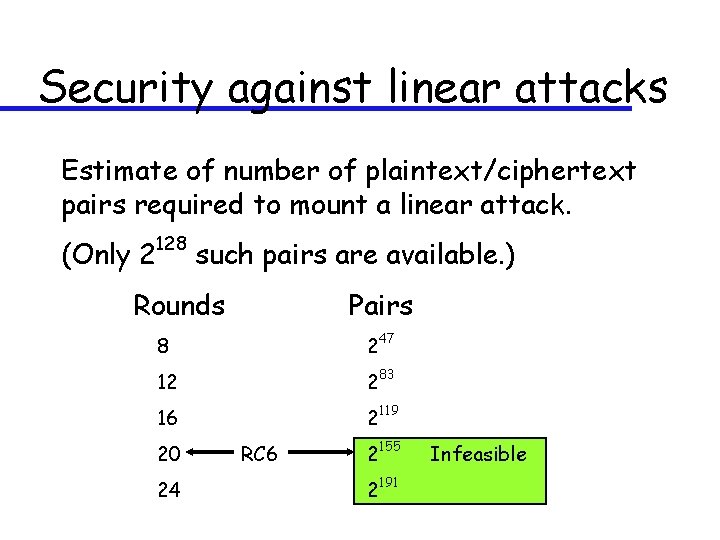
Security against linear attacks Estimate of number of plaintext/ciphertext pairs required to mount a linear attack. (Only 2 128 such pairs are available. ) Rounds Pairs 8 247 12 283 16 2119 20 24 RC 6 2155 2191 Infeasible
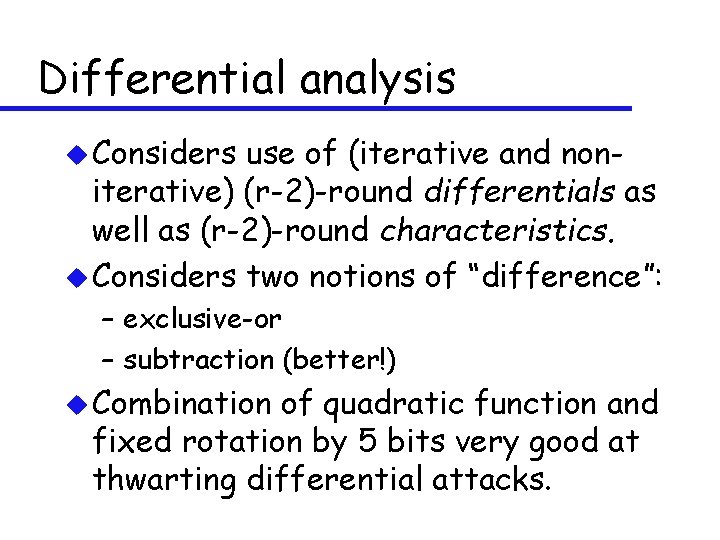
Differential analysis u Considers use of (iterative and noniterative) (r-2)-round differentials as well as (r-2)-round characteristics. u Considers two notions of “difference”: – exclusive-or – subtraction (better!) u Combination of quadratic function and fixed rotation by 5 bits very good at thwarting differential attacks.
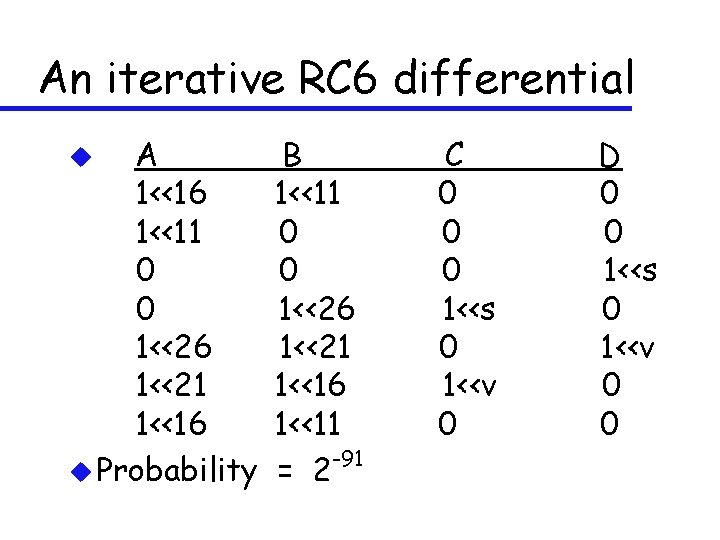
An iterative RC 6 differential A 1<<16 1<<11 0 0 1<<26 1<<21 1<<16 u Probability u B 1<<11 0 0 1<<26 1<<21 1<<16 1<<11 -91 = 2 C 0 0 0 1<<s 0 1<<v 0 D 0 0 1<<s 0 1<<v 0 0
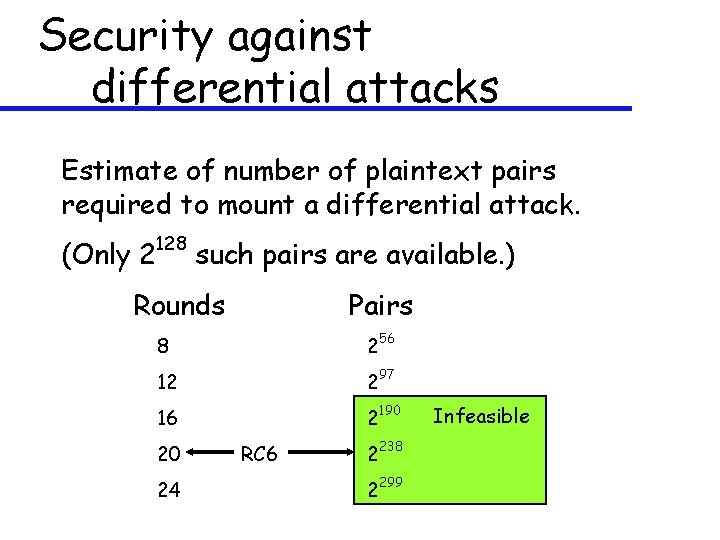
Security against differential attacks Estimate of number of plaintext pairs required to mount a differential attack. (Only 2 128 such pairs are available. ) Rounds Pairs 8 256 12 297 16 2190 20 24 RC 6 2238 2299 Infeasible
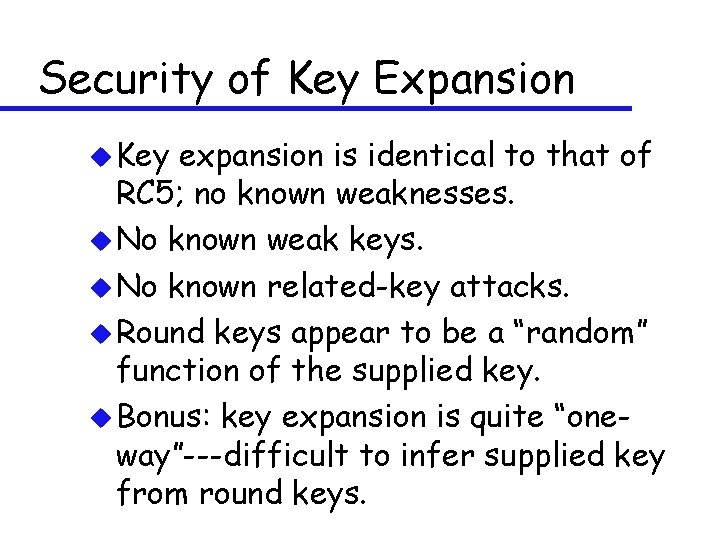
Security of Key Expansion u Key expansion is identical to that of RC 5; no known weaknesses. u No known weak keys. u No known related-key attacks. u Round keys appear to be a “random” function of the supplied key. u Bonus: key expansion is quite “oneway”---difficult to infer supplied key from round keys.
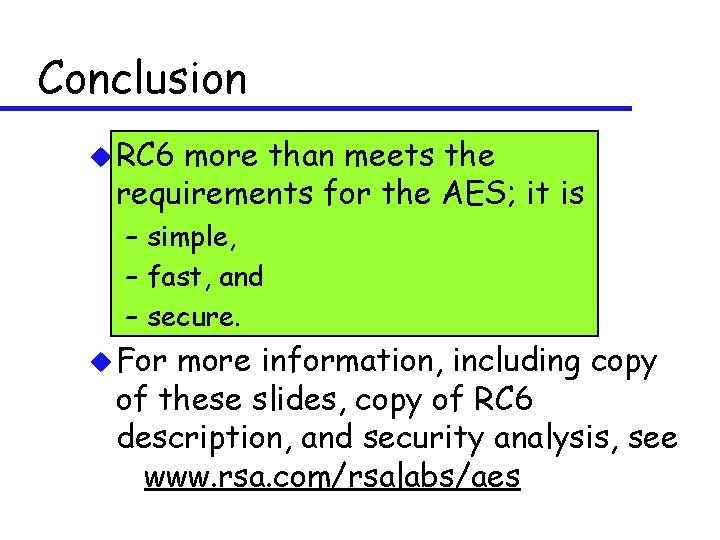
Conclusion u RC 6 more than meets the requirements for the AES; it is – simple, – fast, and – secure. u For more information, including copy of these slides, copy of RC 6 description, and security analysis, see www. rsa. com/rsalabs/aes
(The End)
- Slides: 38