
The Rationalists Argued for a more active role
- Slides: 5
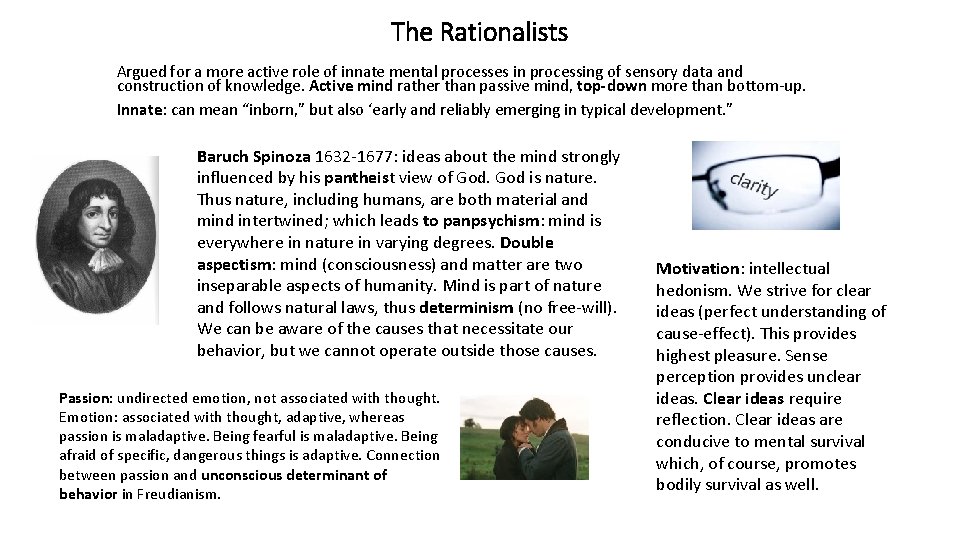
The Rationalists Argued for a more active role of innate mental processes in processing of sensory data and construction of knowledge. Active mind rather than passive mind, top-down more than bottom-up. Innate: can mean “inborn, ” but also ‘early and reliably emerging in typical development. ” Baruch Spinoza 1632 -1677: ideas about the mind strongly influenced by his pantheist view of God is nature. Thus nature, including humans, are both material and mind intertwined; which leads to panpsychism: mind is everywhere in nature in varying degrees. Double aspectism: mind (consciousness) and matter are two inseparable aspects of humanity. Mind is part of nature and follows natural laws, thus determinism (no free-will). We can be aware of the causes that necessitate our behavior, but we cannot operate outside those causes. Passion: undirected emotion, not associated with thought. Emotion: associated with thought, adaptive, whereas passion is maladaptive. Being fearful is maladaptive. Being afraid of specific, dangerous things is adaptive. Connection between passion and unconscious determinant of behavior in Freudianism. Motivation: intellectual hedonism. We strive for clear ideas (perfect understanding of cause-effect). This provides highest pleasure. Sense perception provides unclear ideas. Clear ideas require reflection. Clear ideas are conducive to mental survival which, of course, promotes bodily survival as well.
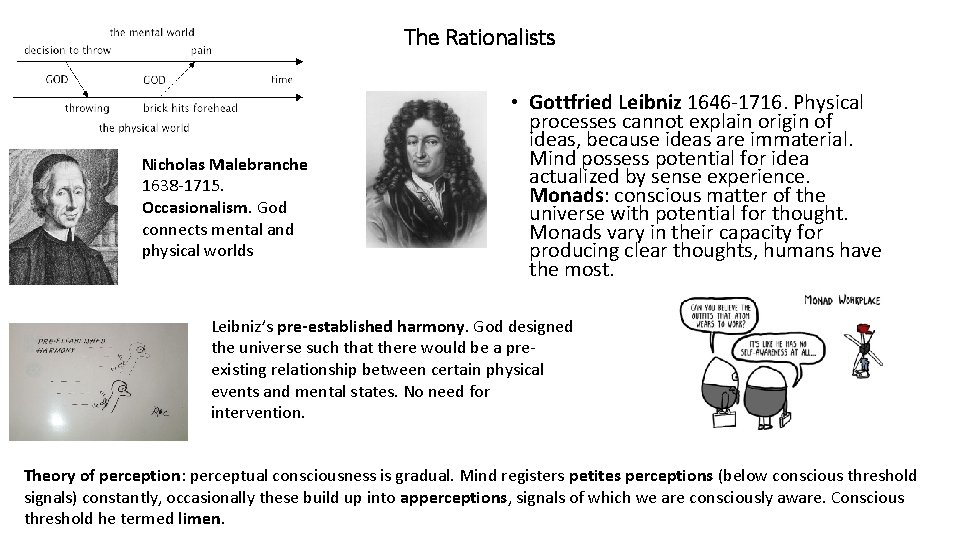
The Rationalists Nicholas Malebranche 1638 -1715. Occasionalism. God connects mental and physical worlds • Gottfried Leibniz 1646 -1716. Physical processes cannot explain origin of ideas, because ideas are immaterial. Mind possess potential for idea actualized by sense experience. Monads: conscious matter of the universe with potential for thought. Monads vary in their capacity for producing clear thoughts, humans have the most. Leibniz’s pre-established harmony. God designed the universe such that there would be a preexisting relationship between certain physical events and mental states. No need for intervention. Theory of perception: perceptual consciousness is gradual. Mind registers petites perceptions (below conscious threshold signals) constantly, occasionally these build up into apperceptions, signals of which we are consciously aware. Conscious threshold he termed limen.
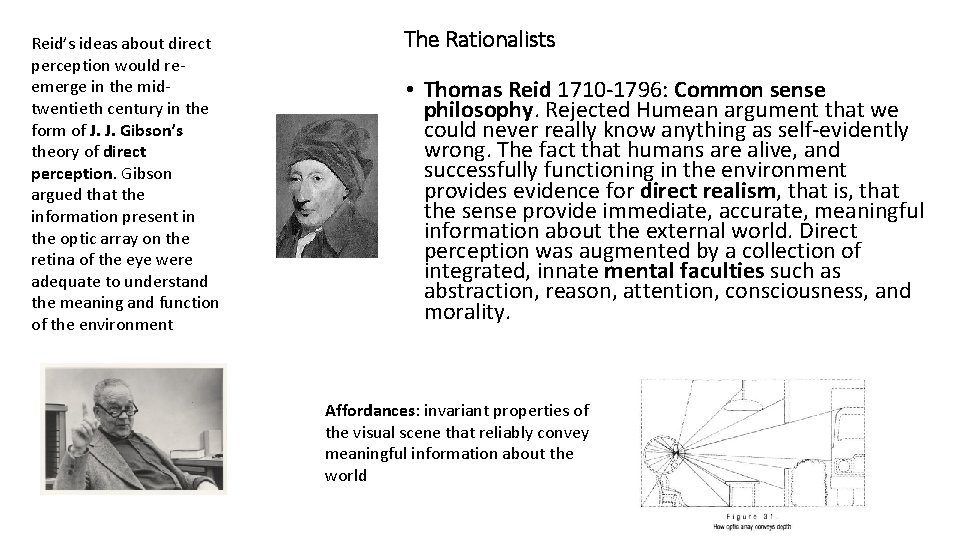
Reid’s ideas about direct perception would reemerge in the midtwentieth century in the form of J. J. Gibson’s theory of direct perception. Gibson argued that the information present in the optic array on the retina of the eye were adequate to understand the meaning and function of the environment The Rationalists • Thomas Reid 1710 -1796: Common sense philosophy. Rejected Humean argument that we could never really know anything as self-evidently wrong. The fact that humans are alive, and successfully functioning in the environment provides evidence for direct realism, that is, that the sense provide immediate, accurate, meaningful information about the external world. Direct perception was augmented by a collection of integrated, innate mental faculties such as abstraction, reason, attention, consciousness, and morality. Affordances: invariant properties of the visual scene that reliably convey meaningful information about the world
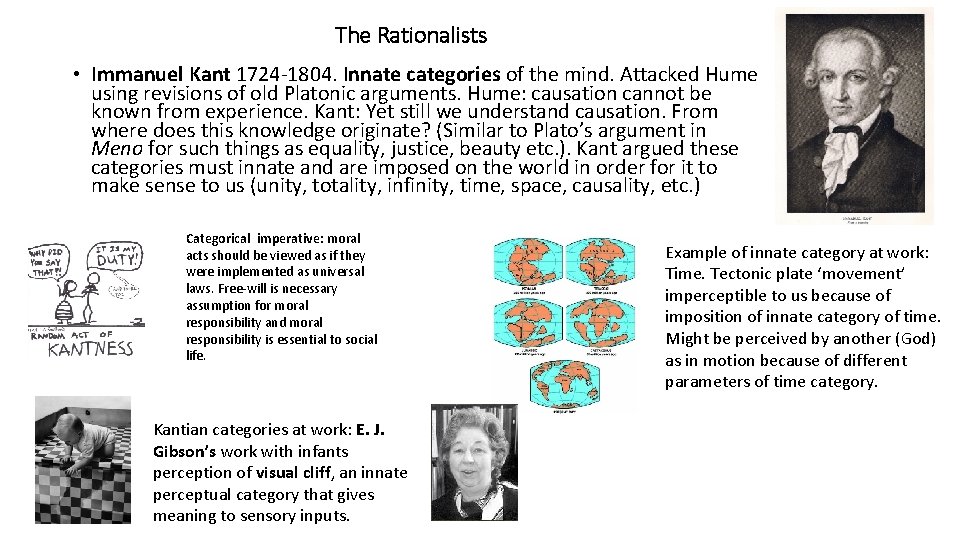
The Rationalists • Immanuel Kant 1724 -1804. Innate categories of the mind. Attacked Hume using revisions of old Platonic arguments. Hume: causation cannot be known from experience. Kant: Yet still we understand causation. From where does this knowledge originate? (Similar to Plato’s argument in Meno for such things as equality, justice, beauty etc. ). Kant argued these categories must innate and are imposed on the world in order for it to make sense to us (unity, totality, infinity, time, space, causality, etc. ) Categorical imperative: moral acts should be viewed as if they were implemented as universal laws. Free-will is necessary assumption for moral responsibility and moral responsibility is essential to social life. Kantian categories at work: E. J. Gibson’s work with infants perception of visual cliff, an innate perceptual category that gives meaning to sensory inputs. Example of innate category at work: Time. Tectonic plate ‘movement’ imperceptible to us because of imposition of innate category of time. Might be perceived by another (God) as in motion because of different parameters of time category.
Johann Friedrich Herbart 1776 -1841. Opposed both physiological and faculty approaches to the mind. Mind was whole, could not be understood reductionistically or experimentally. Could be understood mathematically. Argued that idea were like Monad, each had it own inherent ‘force. ’ Similar ideas attracted each other, dissimilar repelled each other. Ideas ‘fight’ for conscious expression. Presently attended to or conscious collection of similar ideas form an apperceptive mass, which attracts other like ideas but repels or represses dissimilar ideas. Unconscious collection of ‘repelled’ ideas may form and become great enough to ‘challenge’ for consciousness. Limen or threshold for entry into consciousness could be mathematically described The Rationalists Successful teaching involved preparation of apperceptive mass for acceptance of new (related) concepts. Review – Present – Relate – Apply -- Repeat • Wilhelm Friedrich Hegel 1770 -1831. Only true knowledge is knowledge of interrelatedness. Ultimate interrelatedness is the Absolute or God. All sensory input is fragmented, unreal, only small part of the total integrated whole (Absolute). Dialectic necessary for achieving true knowledge: thesis-antithesis-synthesis; synthesis becomes new thesis, repeat. Hegel’s emphasis on the whole meant that the over-all pattern was more meaningful than the individual elements, society was more important that individual. Origins of Gestalt Psychology.