
The ratification process started when the Congress turned

- Slides: 21
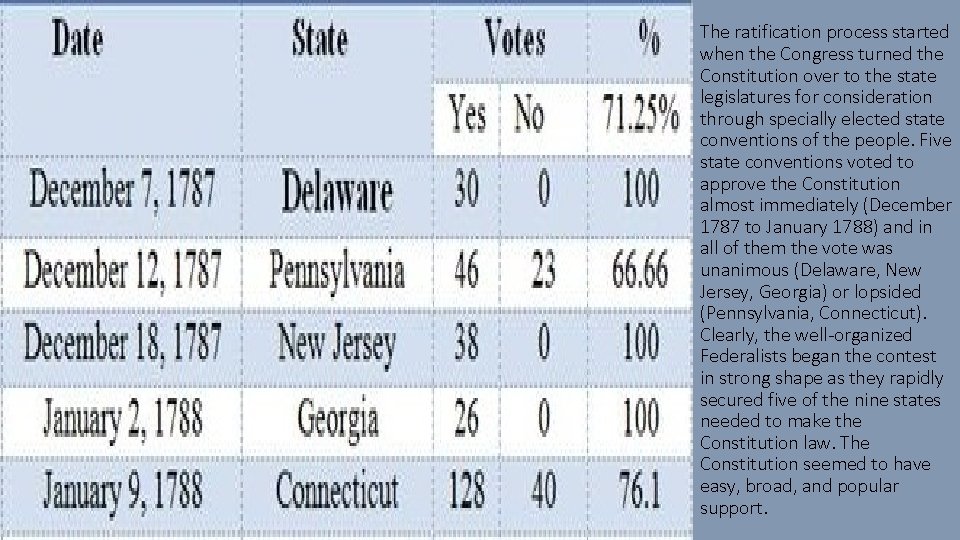
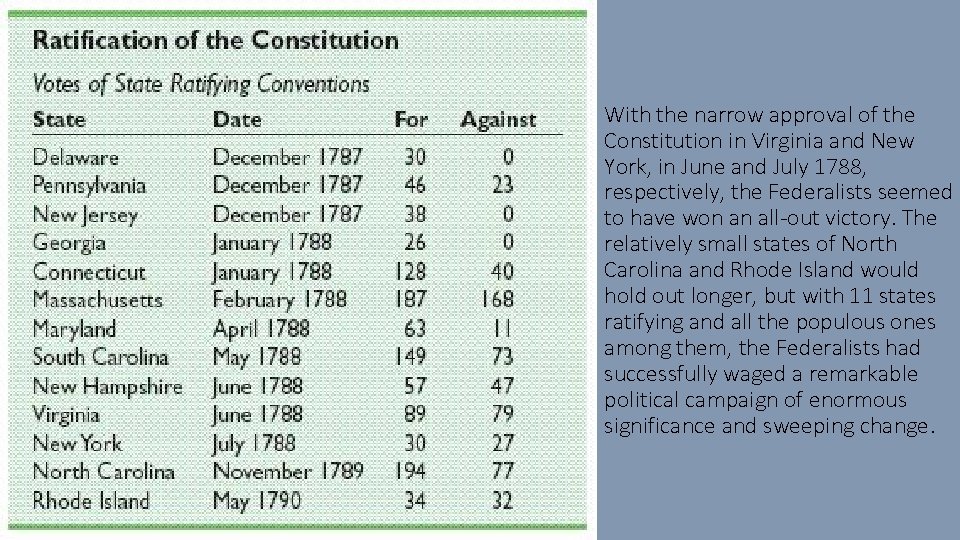
The ratification process started when the Congress turned the Constitution over to the state legislatures for consideration through specially elected state conventions of the people. Five state conventions voted to approve the Constitution almost immediately (December 1787 to January 1788) and in all of them the vote was unanimous (Delaware, New Jersey, Georgia) or lopsided (Pennsylvania, Connecticut). Clearly, the well-organized Federalists began the contest in strong shape as they rapidly secured five of the nine states needed to make the Constitution law. The Constitution seemed to have easy, broad, and popular support.
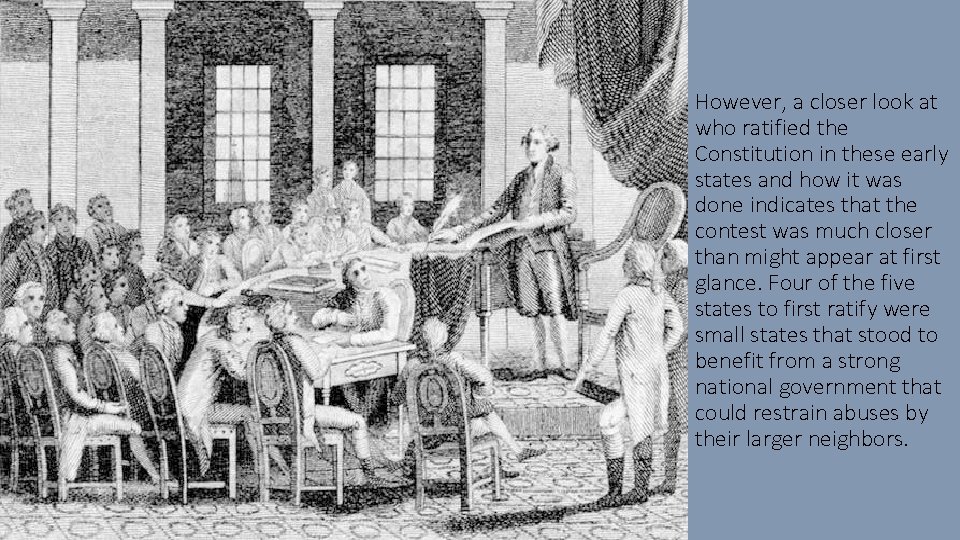
However, a closer look at who ratified the Constitution in these early states and how it was done indicates that the contest was much closer than might appear at first glance. Four of the five states to first ratify were small states that stood to benefit from a strong national government that could restrain abuses by their larger neighbors.
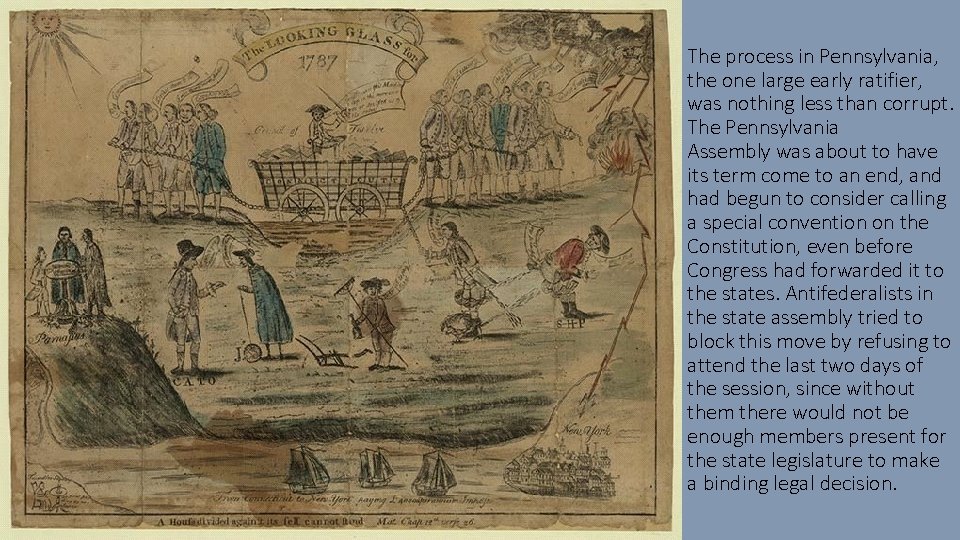
The process in Pennsylvania, the one large early ratifier, was nothing less than corrupt. The Pennsylvania Assembly was about to have its term come to an end, and had begun to consider calling a special convention on the Constitution, even before Congress had forwarded it to the states. Antifederalists in the state assembly tried to block this move by refusing to attend the last two days of the session, since without them there would not be enough members present for the state legislature to make a binding legal decision.
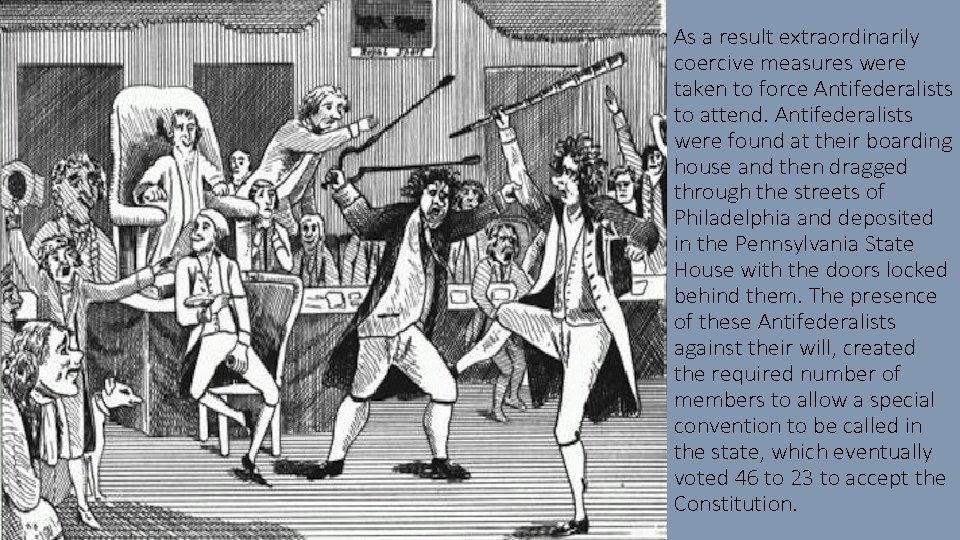
As a result extraordinarily coercive measures were taken to force Antifederalists to attend. Antifederalists were found at their boarding house and then dragged through the streets of Philadelphia and deposited in the Pennsylvania State House with the doors locked behind them. The presence of these Antifederalists against their will, created the required number of members to allow a special convention to be called in the state, which eventually voted 46 to 23 to accept the Constitution.
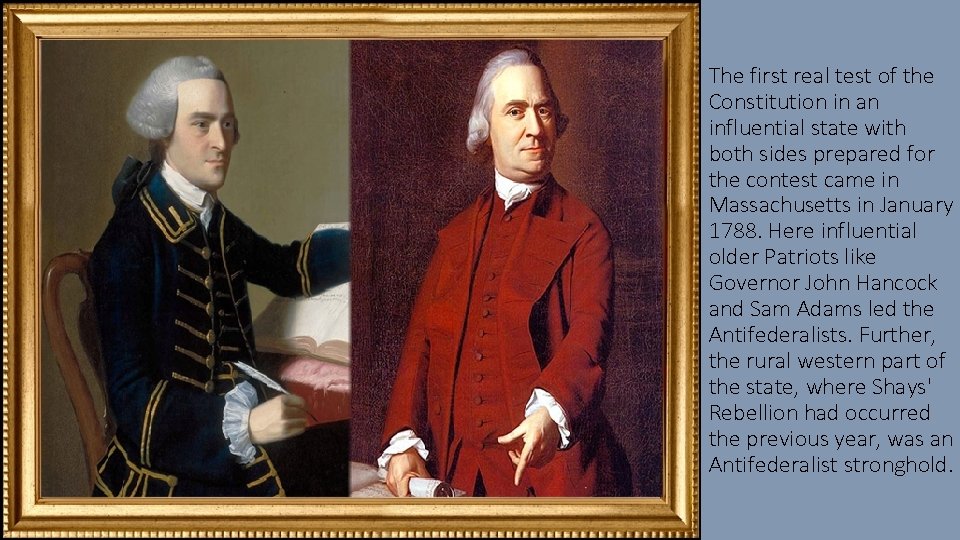
The first real test of the Constitution in an influential state with both sides prepared for the contest came in Massachusetts in January 1788. Here influential older Patriots like Governor John Hancock and Sam Adams led the Antifederalists. Further, the rural western part of the state, where Shays' Rebellion had occurred the previous year, was an Antifederalist stronghold.
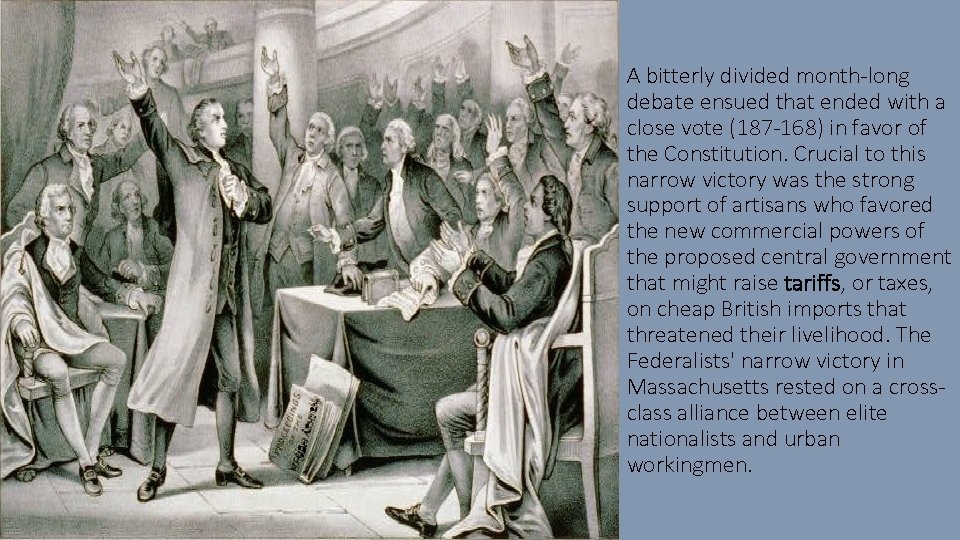
A bitterly divided month-long debate ensued that ended with a close vote (187 -168) in favor of the Constitution. Crucial to this narrow victory was the strong support of artisans who favored the new commercial powers of the proposed central government that might raise tariffs, or taxes, on cheap British imports that threatened their livelihood. The Federalists' narrow victory in Massachusetts rested on a crossclass alliance between elite nationalists and urban workingmen.
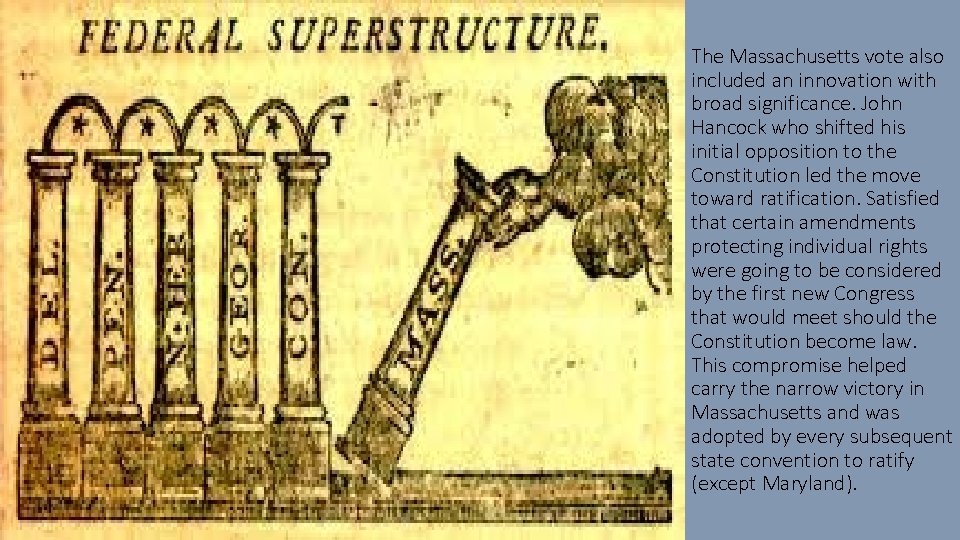
The Massachusetts vote also included an innovation with broad significance. John Hancock who shifted his initial opposition to the Constitution led the move toward ratification. Satisfied that certain amendments protecting individual rights were going to be considered by the first new Congress that would meet should the Constitution become law. This compromise helped carry the narrow victory in Massachusetts and was adopted by every subsequent state convention to ratify (except Maryland).
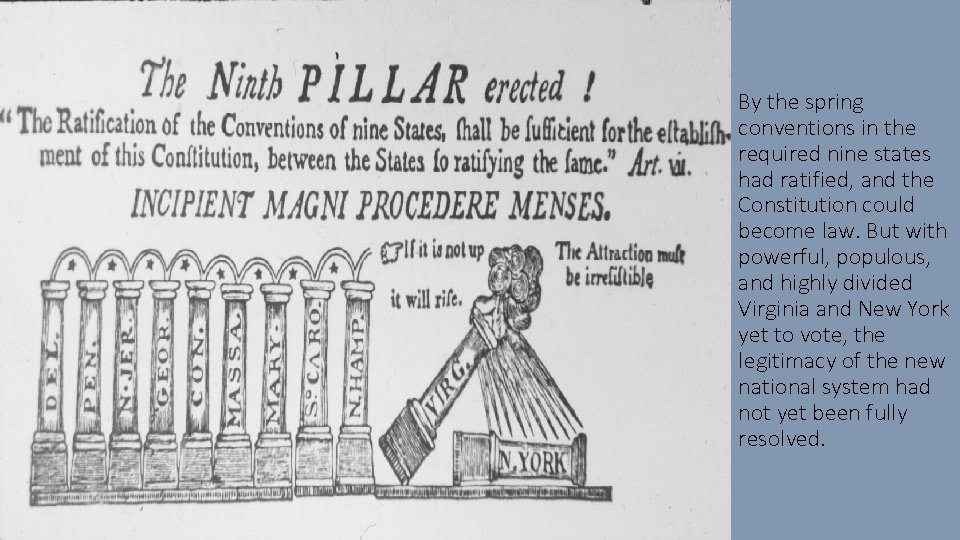
By the spring conventions in the required nine states had ratified, and the Constitution could become law. But with powerful, populous, and highly divided Virginia and New York yet to vote, the legitimacy of the new national system had not yet been fully resolved.
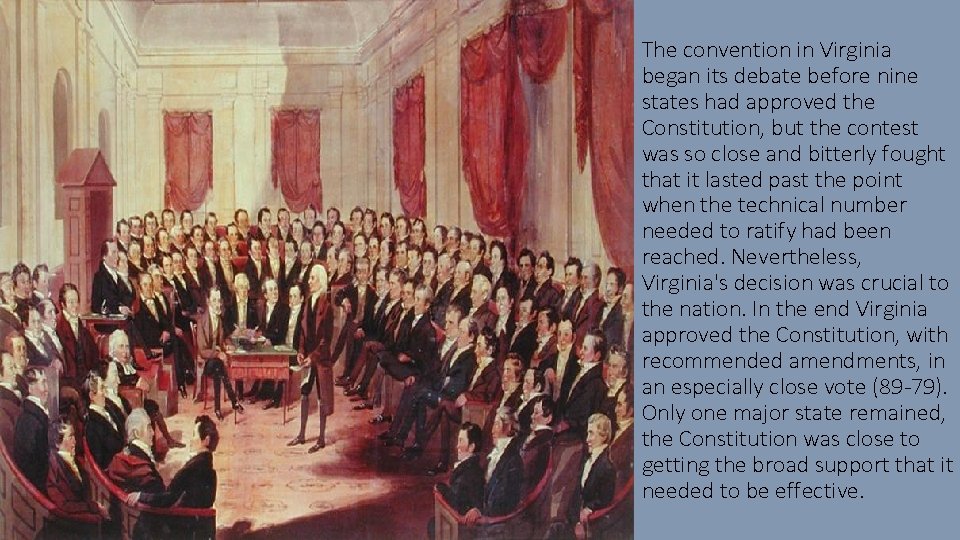
The convention in Virginia began its debate before nine states had approved the Constitution, but the contest was so close and bitterly fought that it lasted past the point when the technical number needed to ratify had been reached. Nevertheless, Virginia's decision was crucial to the nation. In the end Virginia approved the Constitution, with recommended amendments, in an especially close vote (89 -79). Only one major state remained, the Constitution was close to getting the broad support that it needed to be effective.
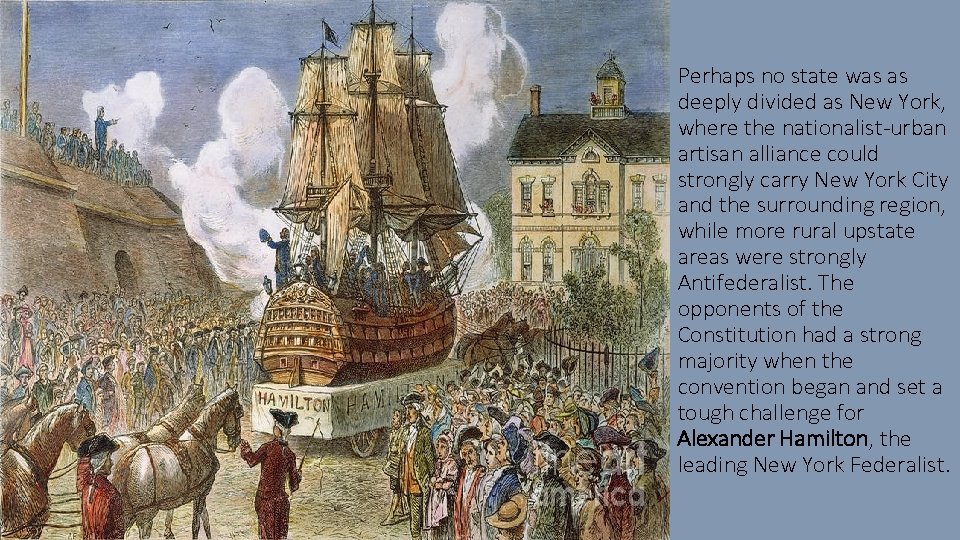
Perhaps no state was as deeply divided as New York, where the nationalist-urban artisan alliance could strongly carry New York City and the surrounding region, while more rural upstate areas were strongly Antifederalist. The opponents of the Constitution had a strong majority when the convention began and set a tough challenge for Alexander Hamilton, the leading New York Federalist.
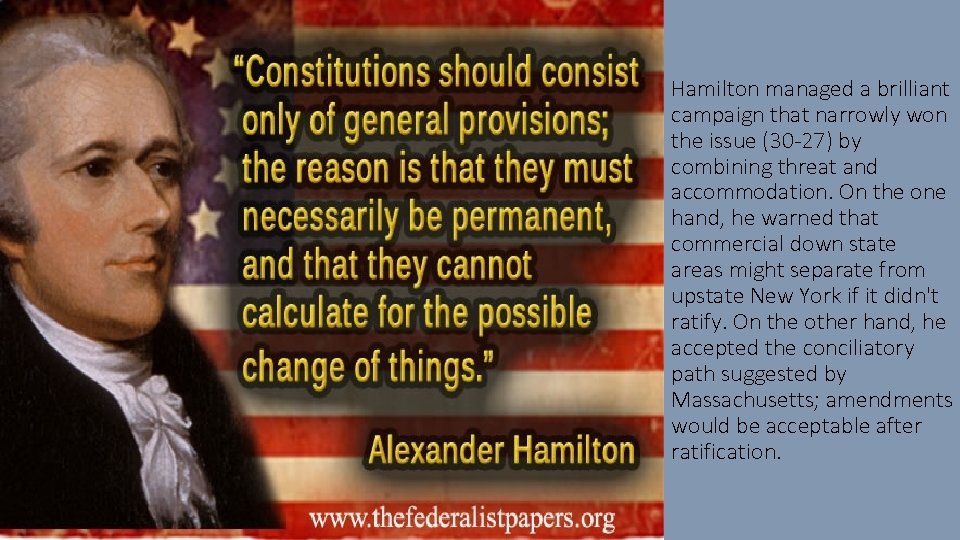
Hamilton managed a brilliant campaign that narrowly won the issue (30 -27) by combining threat and accommodation. On the one hand, he warned that commercial down state areas might separate from upstate New York if it didn't ratify. On the other hand, he accepted the conciliatory path suggested by Massachusetts; amendments would be acceptable after ratification.
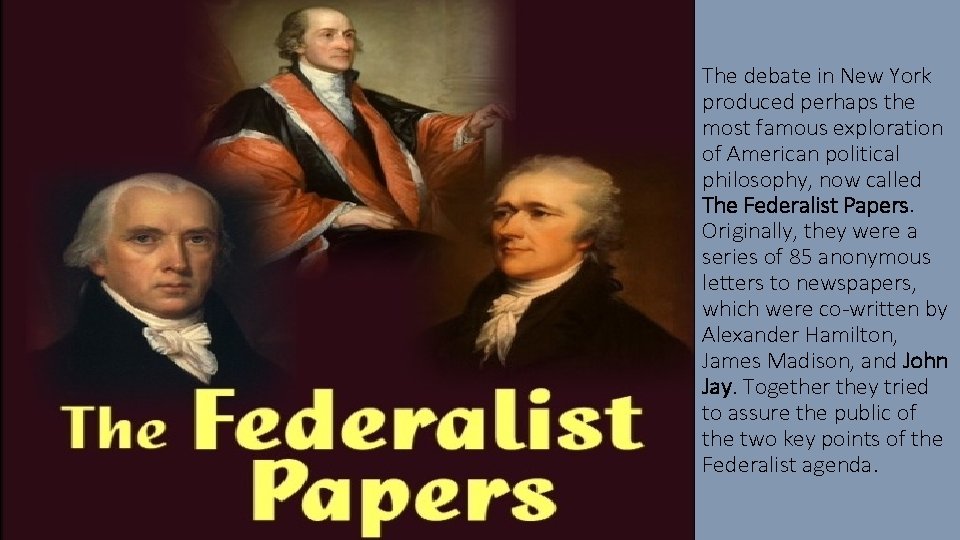
The debate in New York produced perhaps the most famous exploration of American political philosophy, now called The Federalist Papers. Originally, they were a series of 85 anonymous letters to newspapers, which were co-written by Alexander Hamilton, James Madison, and John Jay. Together they tried to assure the public of the two key points of the Federalist agenda.
First, they explained that a strong government was needed for a variety of reasons, but especially if the United States was to be able to act effectively in foreign affairs. Second, it tried to convince readers that because of the separation of powers in the central government, there was little chance of the national government evolving into a tyrannical power. Instead of growing ever stronger, the separate branches would provide a Check and Balance against each other so that none could rise to complete dominance.
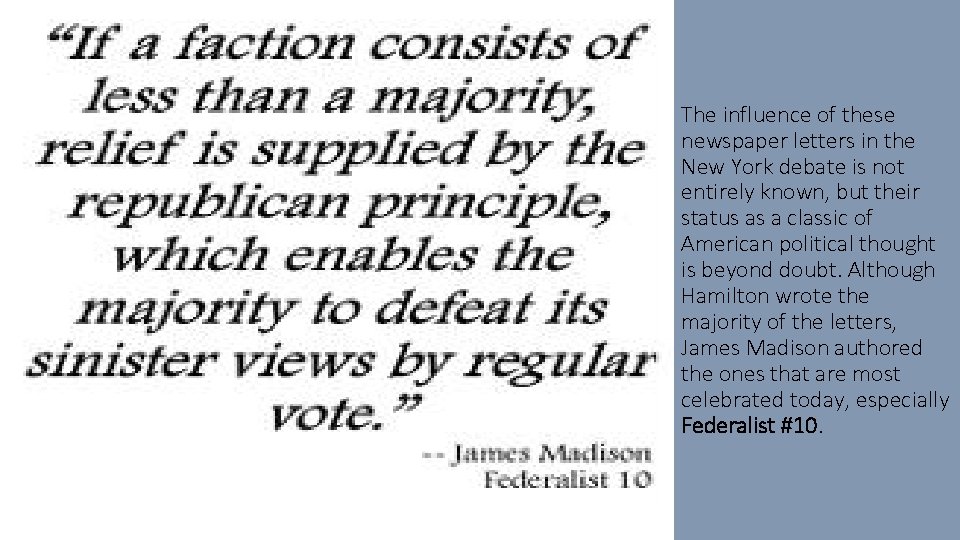
The influence of these newspaper letters in the New York debate is not entirely known, but their status as a classic of American political thought is beyond doubt. Although Hamilton wrote the majority of the letters, James Madison authored the ones that are most celebrated today, especially Federalist #10.
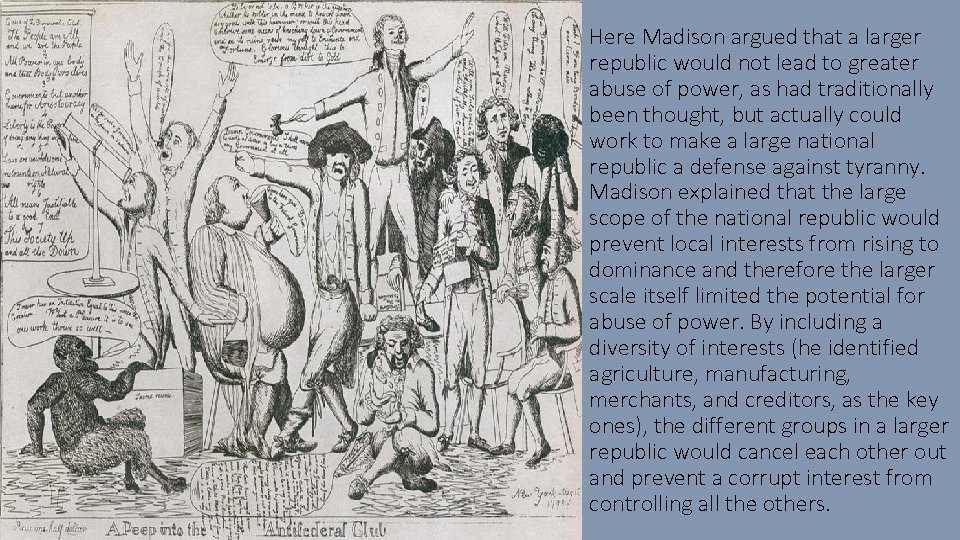
Here Madison argued that a larger republic would not lead to greater abuse of power, as had traditionally been thought, but actually could work to make a large national republic a defense against tyranny. Madison explained that the large scope of the national republic would prevent local interests from rising to dominance and therefore the larger scale itself limited the potential for abuse of power. By including a diversity of interests (he identified agriculture, manufacturing, merchants, and creditors, as the key ones), the different groups in a larger republic would cancel each other out and prevent a corrupt interest from controlling all the others.
With the narrow approval of the Constitution in Virginia and New York, in June and July 1788, respectively, the Federalists seemed to have won an all-out victory. The relatively small states of North Carolina and Rhode Island would hold out longer, but with 11 states ratifying and all the populous ones among them, the Federalists had successfully waged a remarkable political campaign of enormous significance and sweeping change.
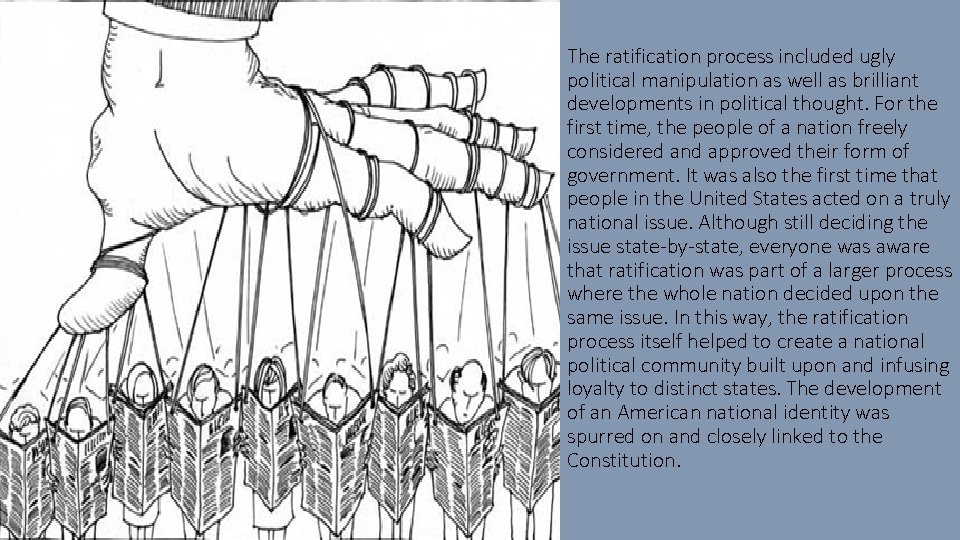
The ratification process included ugly political manipulation as well as brilliant developments in political thought. For the first time, the people of a nation freely considered and approved their form of government. It was also the first time that people in the United States acted on a truly national issue. Although still deciding the issue state-by-state, everyone was aware that ratification was part of a larger process where the whole nation decided upon the same issue. In this way, the ratification process itself helped to create a national political community built upon and infusing loyalty to distinct states. The development of an American national identity was spurred on and closely linked to the Constitution.
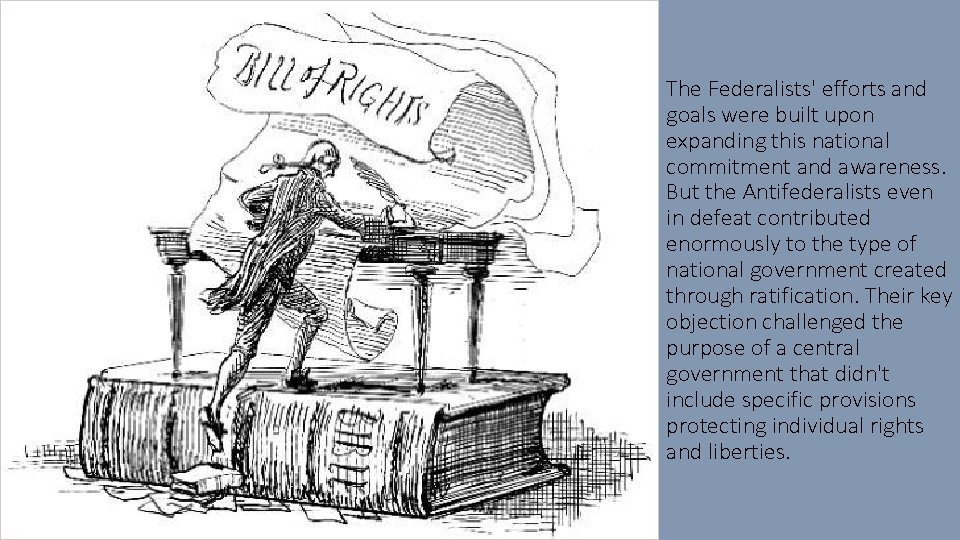
The Federalists' efforts and goals were built upon expanding this national commitment and awareness. But the Antifederalists even in defeat contributed enormously to the type of national government created through ratification. Their key objection challenged the purpose of a central government that didn't include specific provisions protecting individual rights and liberties.
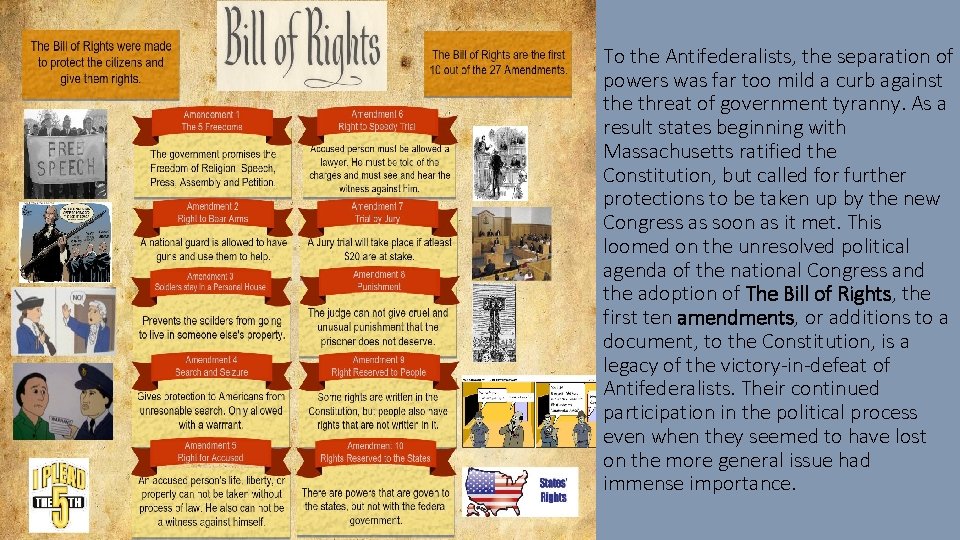
To the Antifederalists, the separation of powers was far too mild a curb against the threat of government tyranny. As a result states beginning with Massachusetts ratified the Constitution, but called for further protections to be taken up by the new Congress as soon as it met. This loomed on the unresolved political agenda of the national Congress and the adoption of The Bill of Rights, the first ten amendments, or additions to a document, to the Constitution, is a legacy of the victory-in-defeat of Antifederalists. Their continued participation in the political process even when they seemed to have lost on the more general issue had immense importance.
The Constitution was created out of a toughminded political process that demanded hard work, disagreement, compromise, and conflict. Out of that struggle the modern American nation took shape and would continue to be modified.