
The Ransart Boot an offloading device for every

The Ransart Boot: an offloading device for every type of Diabetic Foot Ulcers? I. Dumont¹, E. Fernandez¹, D. Tsirtsikolou², M. Lepage², S. Popielarz³, A. Fayard 4, O. Basuyaux 5, M. Lepeut 5. ¹Centre du Pied, Ransart, Belgique, ²CH de Boulogne, ³CHRU de Lille, 4 CH de Arras, 5 CH de Roubaix, France.

Background § Diabetic neuropathic FU heal when offloaded. § The TUC (Texas University Classification) validation has correlated the different DFU’s classes with the amputation rate. § The Ransart boot (RB) is a small, light and removable windowed cast allowing normal daily activities.
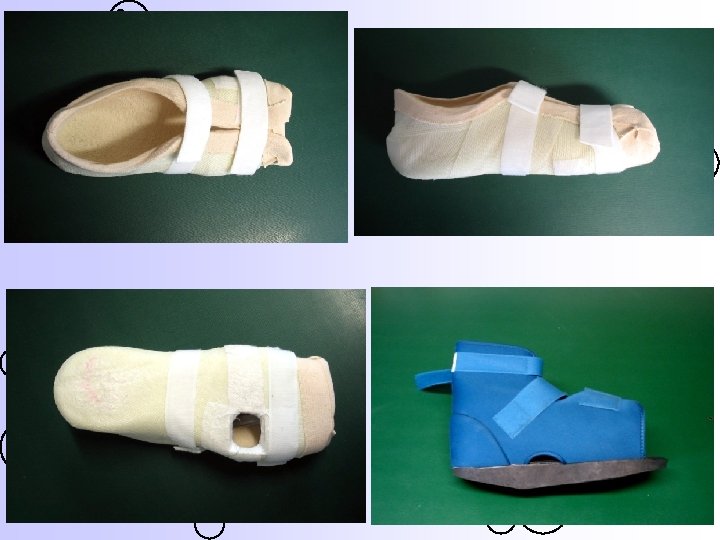

Aims of the study: § To evaluate the efficacy and safety of the Ransart Boot in the treatment of DF Ulcer Class A 1 (TUC). § To evaluate the efficacy and safety of the Ransart Boot in the treatment of DF Ulcer whatever the Class (TUC).
Materials and methods: § This is an open, retrospective and multicentre study including 109 patients. Inclusion criteria: - Diabetes (type I and II). - Age between 18 and 80 years old. - Foot at risk (VPT > 25 V or monofilament 10 gr not felt). - DF ulcer on the plantar or lateral aspect of the foot treated by RB.

- Class A 1 to D 3 of the TUC. - DF ulcer not healed after 1 year was considered as a failure. Exclusion criteria: - Non classic therapy during the port of the RB like VAC, maggots etc. - Revascularisation or orthopaedic surgery (# amputation) during the study.

Results: § 109 patients included from 5 centers. (minus 7 lost for follow-up, 5 suffering serious comorbidities, 3 deceased and 12 non compliant). So 82 were left. § Ulcer presentation: forefoot: 61, rearfoot: 6, midfoot: 14. § Comparison with Armstrong’s results who did not specify in his study the offloading technique used for patients with ischemia and/or infected ulcers.
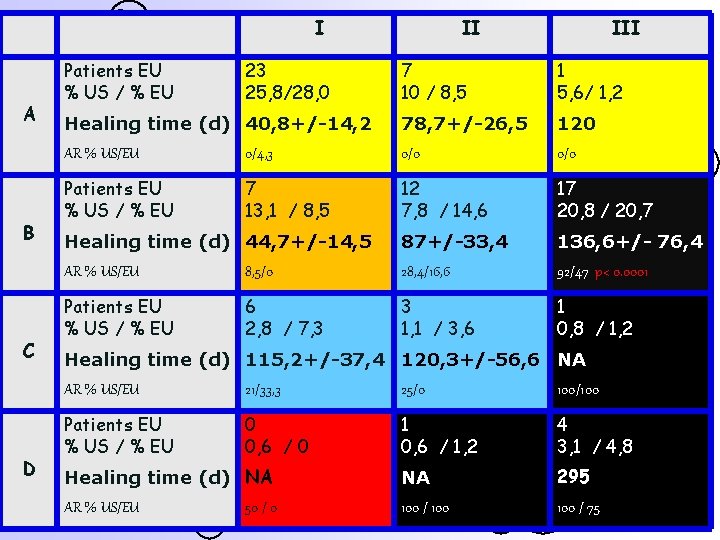
I A B C D Patients EU % US / % EU 23 25, 8/28, 0 II III 7 10 / 8, 5 1 5, 6/ 1, 2 Healing time (d) 40, 8+/-14, 2 78, 7+/-26, 5 120 AR % US/EU 0/4, 3 0/0 Patients EU % US / % EU 7 13, 1 / 8, 5 12 7, 8 / 14, 6 17 20, 8 / 20, 7 Healing time (d) 44, 7+/-14, 5 87+/-33, 4 136, 6+/- 76, 4 AR % US/EU 8, 5/0 28, 4/16, 6 92/47 p< 0. 0001 Patients EU % US / % EU 6 2, 8 / 7, 3 3 1, 1 / 3, 6 1 0, 8 / 1, 2 Healing time (d) 115, 2+/-37, 4 120, 3+/-56, 6 NA AR % US/EU 21/33, 3 25/0 100/100 Patients EU % US / % EU 0 0, 6 / 0 1 0, 6 / 1, 2 4 3, 1 / 4, 8 Healing time (d) NA NA 295 AR % US/EU 100 / 75 50 / 0

§ Nice correlation between both distribution and amputation rate which favors RB in classe B 3 (P<0001). Healing time for A 1 is very good comparing with TCC or other irremovable devices. Activity do not modify healing time comparing A 1 class ulcer treated with TCC (60% less steps) or RB. Healing time for other classes seem good but it is difficult to find population to compare with. Very few minor complications.

Conclusions : § The RB can offload with efficacy and safety every ulcer even with infection and/or ischemia as well as Charcot foot. The rate of non compliance is low: 11%. Further studies are needed to clarify the respective role of compliance (perhaps enhanced by a patient friendly cast? ) and activity, as well as quality of life, educational impact, costs and frequencies of recurrences. isa. dumont@skynet. be
- Slides: 10