
The Race to Discover the Structure of DNA

- Slides: 29
The Race to Discover the Structure of DNA
A Brief History of DNA 1865 1869 1892 1920 1938 Gregor Mendel publishes his work on plant breeding with the notion of "genes" carrying transmissible characteristics "Nuclein" is isolated by Johann Friedrich Miescher in the laboratory of Hoppe-Seyler Meischer writes to his uncle "large biological molecules composed of small repeated chemical pieces could express a rich language in the same way as the letters of our alphabet" Recognition of the chemical difference between DNA and RNA Phoebus Levene proposes the "tetranucleotide hypothesis" William Astbury obtains the first diffraction patters of DNA fibres
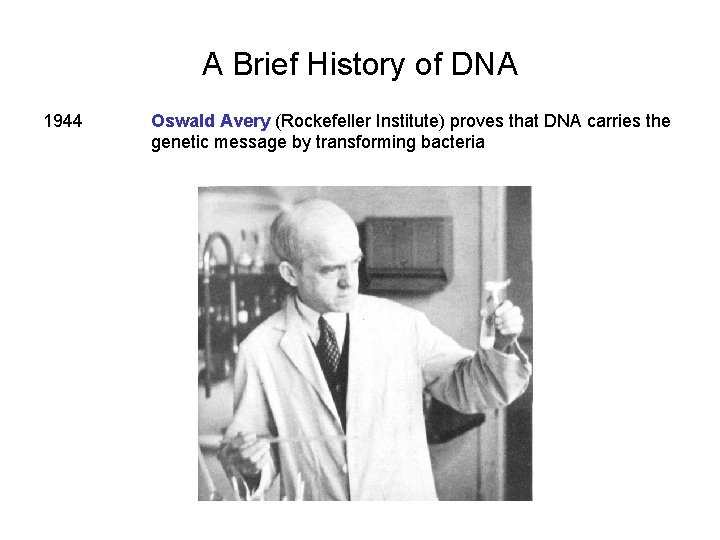
A Brief History of DNA 1944 Oswald Avery (Rockefeller Institute) proves that DNA carries the genetic message by transforming bacteria
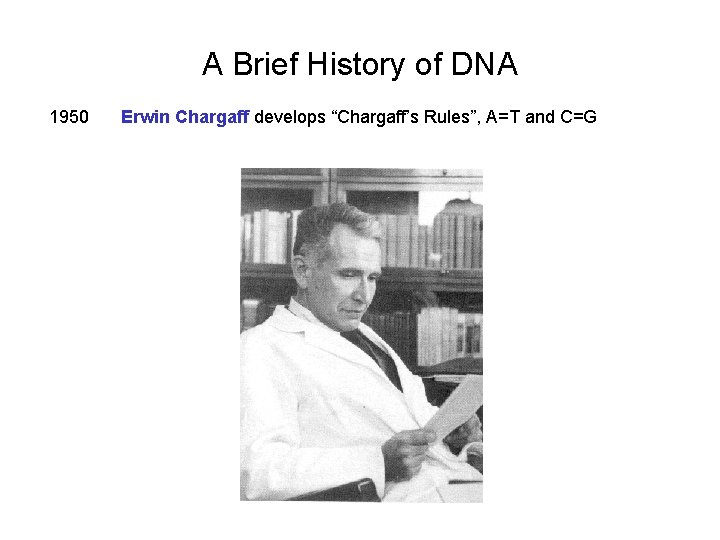
A Brief History of DNA 1950 Erwin Chargaff develops “Chargaff’s Rules”, A=T and C=G
Who will make history by discovering the structure of the DNA molecule?
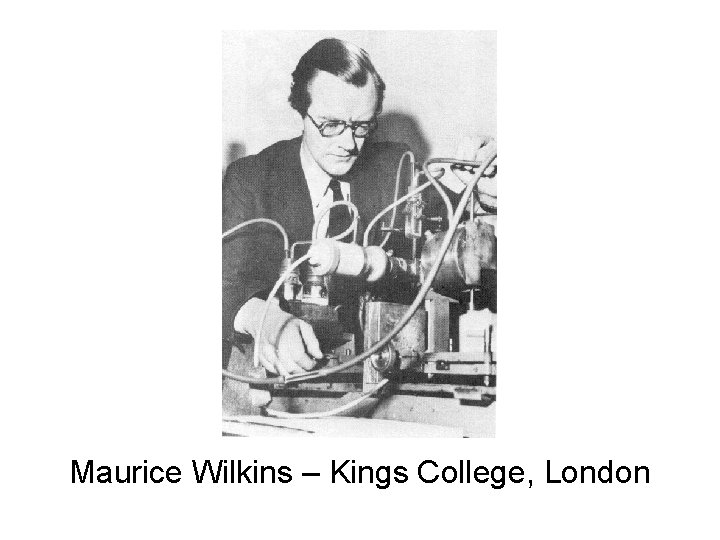
The Players • Linus Pauling discovers the basic structure of the protein molecule at Cal Tech in 1951. Soon after he starts to model DNA. • Maurice Wilkins and Rosalind Franklin begin studying the structure of DNA using X-ray crystallography by 1951 at King’s college • In that year James Watson joined Francis Crick as researchers in the Cavendish laboratory under the supervision of Max Perutz and Sir Lawrence Bragg • Bragg and Perutz had been studying complex proteins for some time, also using X-ray techniques
Linus Pauling’s DNA
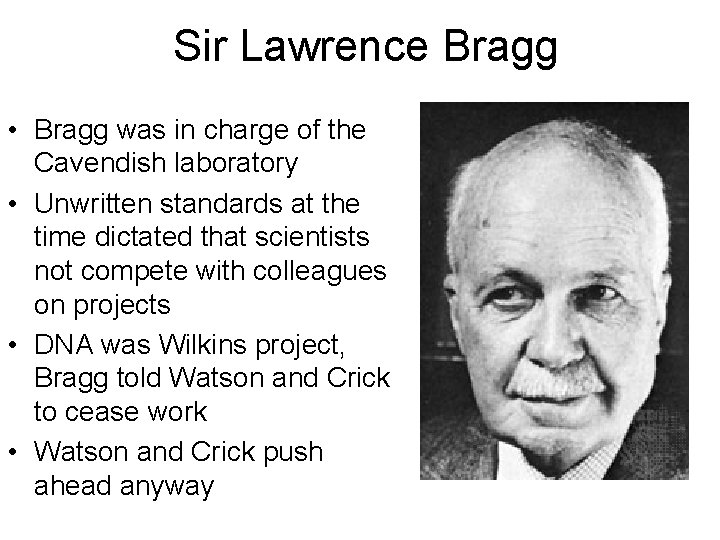
Sir Lawrence Bragg • Bragg was in charge of the Cavendish laboratory • Unwritten standards at the time dictated that scientists not compete with colleagues on projects • DNA was Wilkins project, Bragg told Watson and Crick to cease work • Watson and Crick push ahead anyway
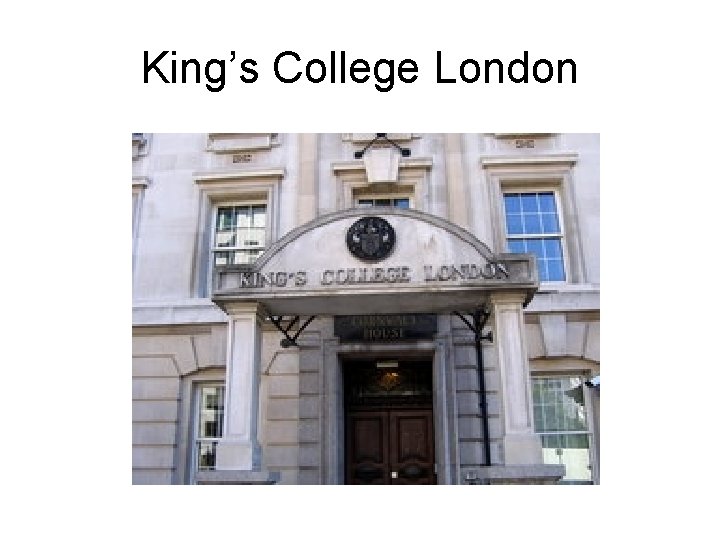
King’s College London
Maurice Wilkins – Kings College, London
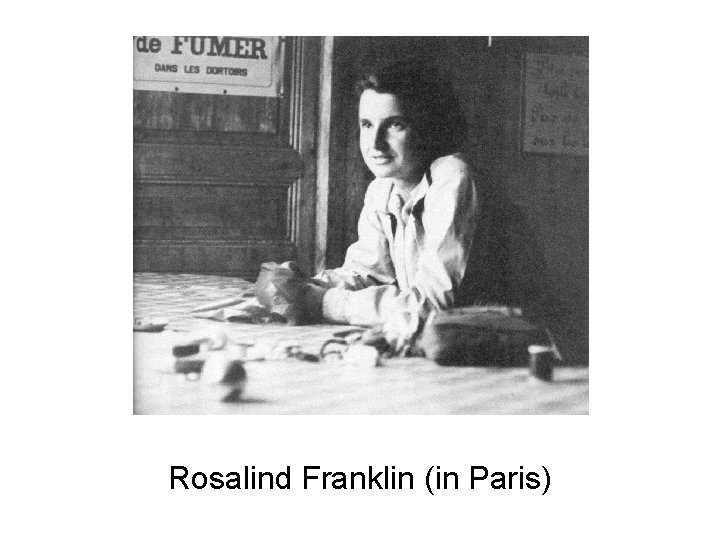
Rosalind Franklin (in Paris)
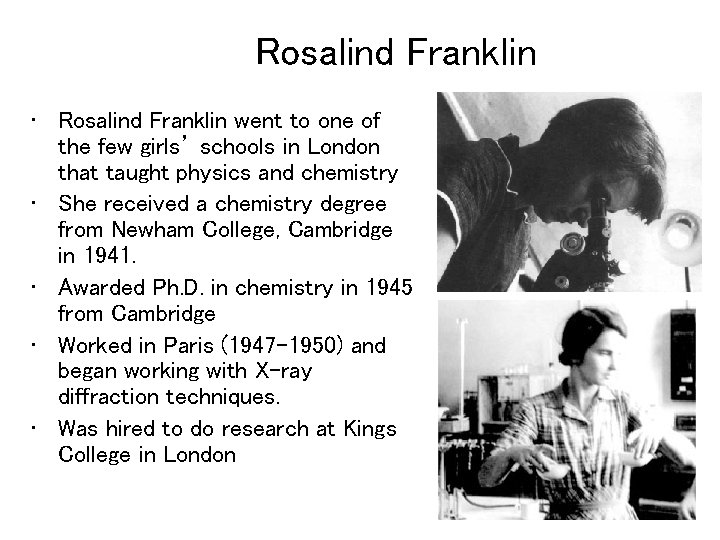
Rosalind Franklin • Rosalind Franklin went to one of the few girls’ schools in London that taught physics and chemistry • She received a chemistry degree from Newham College, Cambridge in 1941. • Awarded Ph. D. in chemistry in 1945 from Cambridge • Worked in Paris (1947 -1950) and began working with X-ray diffraction techniques. • Was hired to do research at Kings College in London
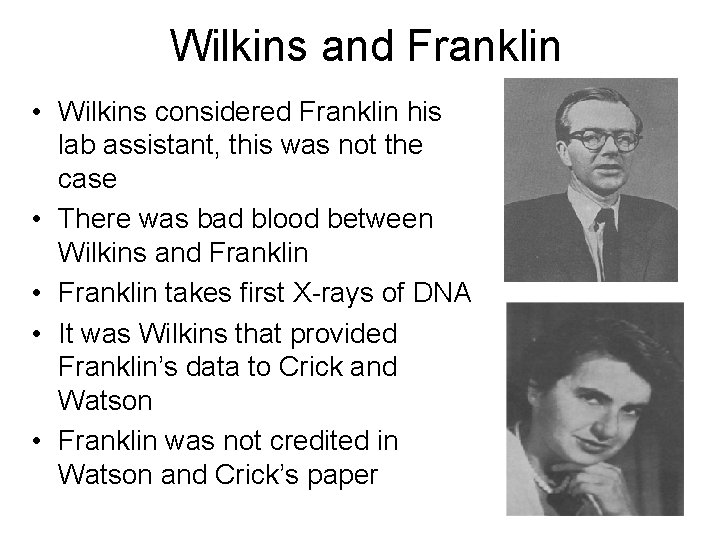
Wilkins and Franklin • Wilkins considered Franklin his lab assistant, this was not the case • There was bad blood between Wilkins and Franklin • Franklin takes first X-rays of DNA • It was Wilkins that provided Franklin’s data to Crick and Watson • Franklin was not credited in Watson and Crick’s paper
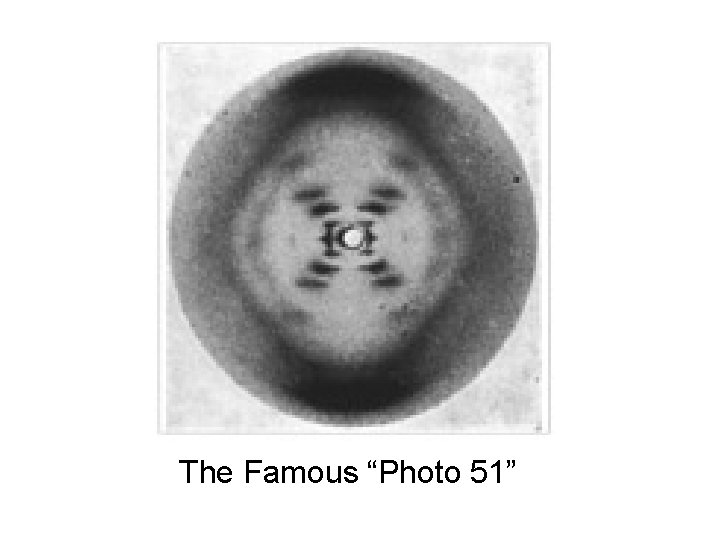
The Famous “Photo 51”
Watson wrote… "The instant I saw the picture my mouth fell open and my pulse began to race. . the black cross of reflections which dominated the picture could arise only from a helical structure. . . Mere inspection of the X-ray picture gave several of the vital helical parameters. "
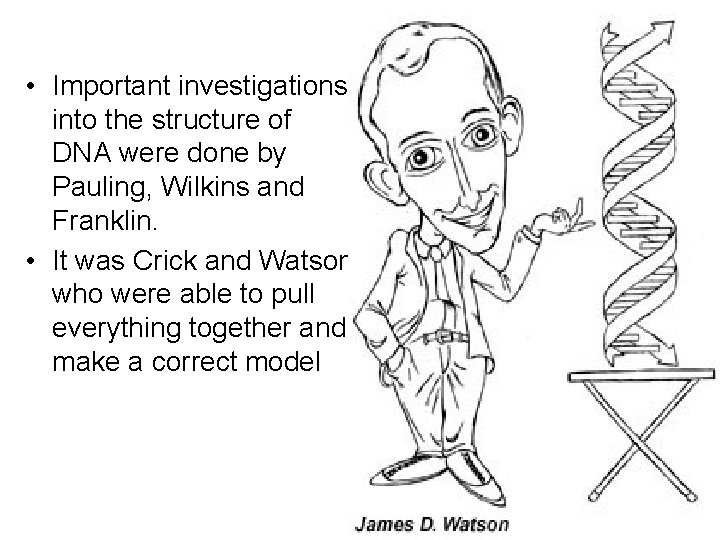
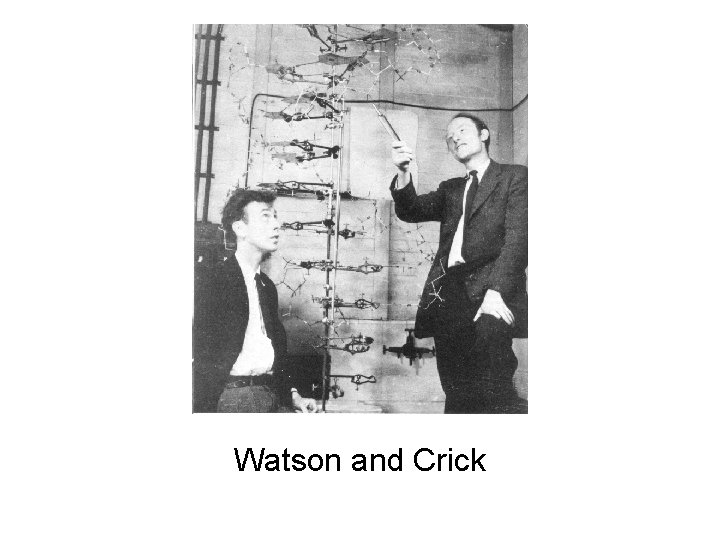
• Important investigations into the structure of DNA were done by Pauling, Wilkins and Franklin. • It was Crick and Watson who were able to pull everything together and make a correct model
Watson and Crick
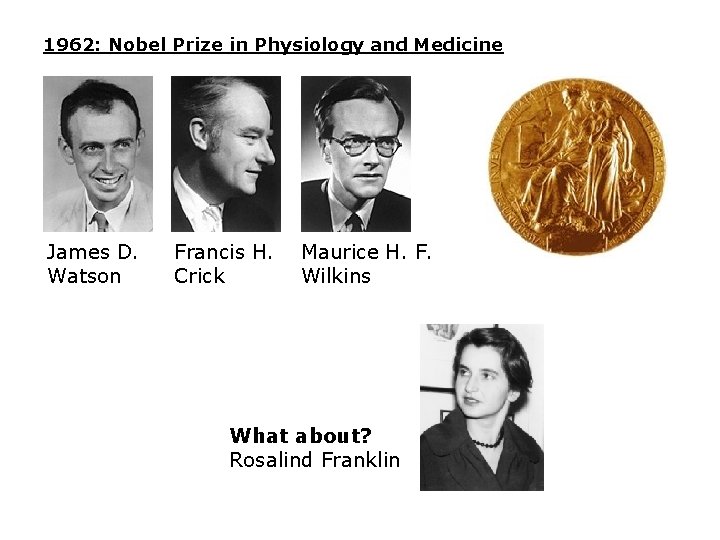
1962: Nobel Prize in Physiology and Medicine James D. Watson Francis H. Crick Maurice H. F. Wilkins What about? Rosalind Franklin
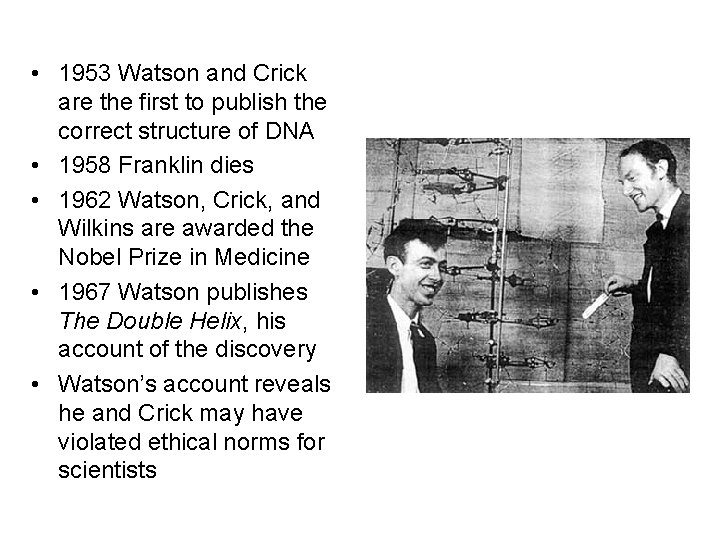
• 1953 Watson and Crick are the first to publish the correct structure of DNA • 1958 Franklin dies • 1962 Watson, Crick, and Wilkins are awarded the Nobel Prize in Medicine • 1967 Watson publishes The Double Helix, his account of the discovery • Watson’s account reveals he and Crick may have violated ethical norms for scientists
The Double Helix • Harvard University Press refused to publish the book • Crick, Wilkins, and others objected to Watson’s book claiming it misrepresented the truth • Watson’s portrayal of women in general and Franklin in particular was demeaning and at times simply untrue
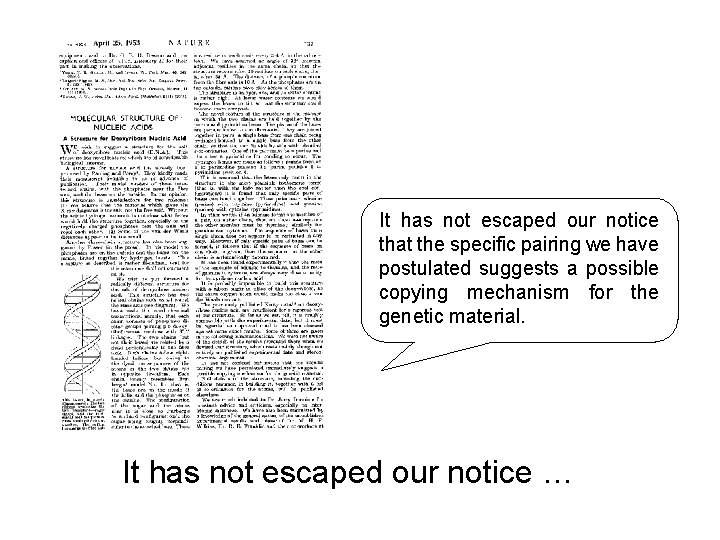
It has not escaped our notice that the specific pairing we have postulated suggests a possible copying mechanism for the genetic material. It has not escaped our notice …
Chapter 16 Section 1 What Does DNA Look Like? Objectives • List three important events that led to understanding the structure of DNA. • Describe the basic structure of a DNA molecule. • Explain how DNA molecules can be copied. Chapter menu Resources Copyright © by Holt, Rinehart and Winston. All rights reserved.
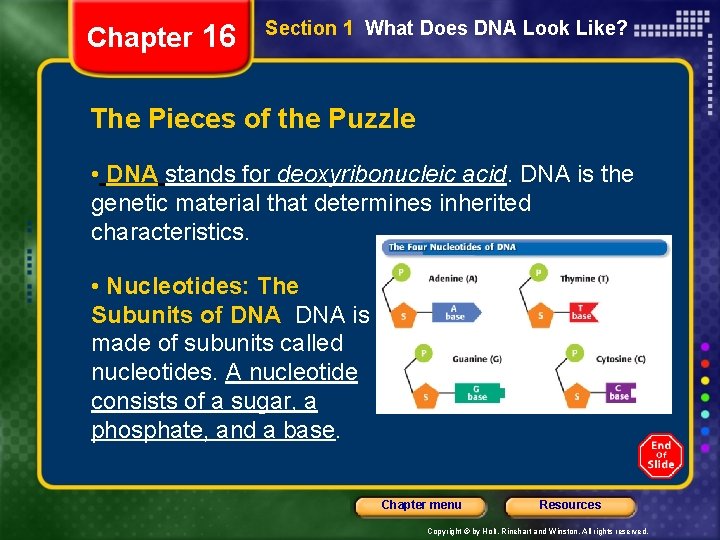
Chapter 16 Section 1 What Does DNA Look Like? The Pieces of the Puzzle • DNA stands for deoxyribonucleic acid. DNA is the genetic material that determines inherited characteristics. • Nucleotides: The Subunits of DNA is made of subunits called nucleotides. A nucleotide consists of a sugar, a phosphate, and a base. Chapter menu Resources Copyright © by Holt, Rinehart and Winston. All rights reserved.
Chapter 16 Section 1 What Does DNA Look Like? The Pieces of the Puzzle, continued • Chargaff’s Rule Erwin Chargaff found that the amount of adenine in DNA always equals the amount of thymine, and the amount of guanine always equals the amount of cytosine. • Franklin’s Discovery Chemist Rosalind Franklin was able to make images of DNA molecules by using X-ray diffraction. Chapter menu Resources Copyright © by Holt, Rinehart and Winston. All rights reserved.
Chapter 16 Section 1 What Does DNA Look Like? The Pieces of the Puzzle, continued • Watson and Crick’s Model James Watson and Francis Crick used Chargaff’s and Franklin’s research to build a model of DNA. • The model, which looked like a long, twisted ladder, eventually helped explain how DNA is copied and how it functions in the cell. Chapter menu Resources Copyright © by Holt, Rinehart and Winston. All rights reserved.
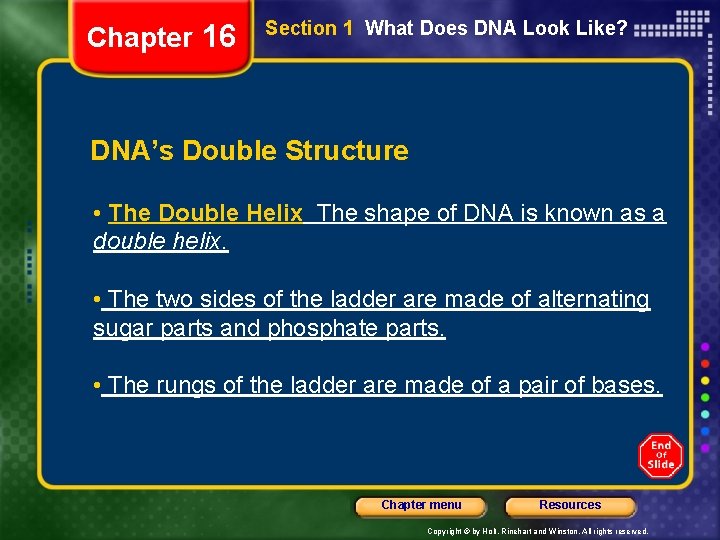
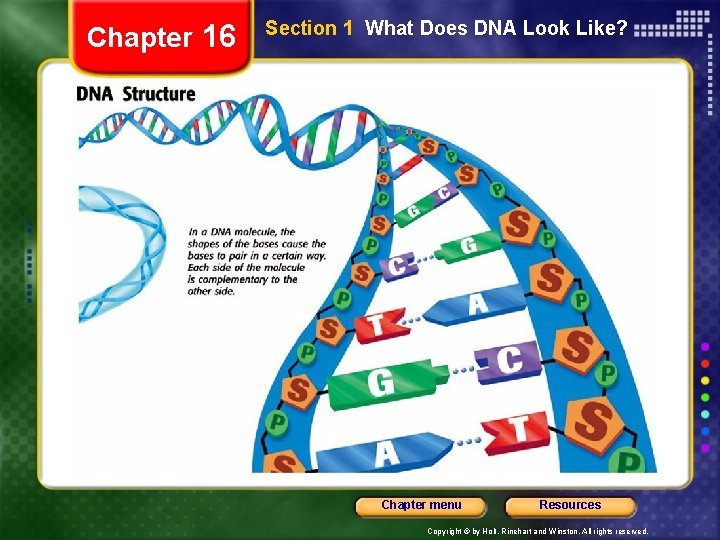
Chapter 16 Section 1 What Does DNA Look Like? DNA’s Double Structure • The Double Helix The shape of DNA is known as a double helix. • The two sides of the ladder are made of alternating sugar parts and phosphate parts. • The rungs of the ladder are made of a pair of bases. Chapter menu Resources Copyright © by Holt, Rinehart and Winston. All rights reserved.
Chapter 16 Section 1 What Does DNA Look Like? Chapter menu Resources Copyright © by Holt, Rinehart and Winston. All rights reserved.
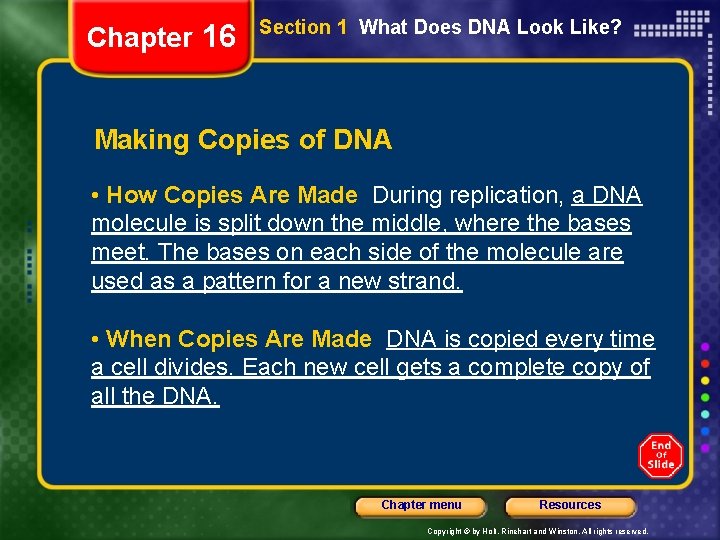
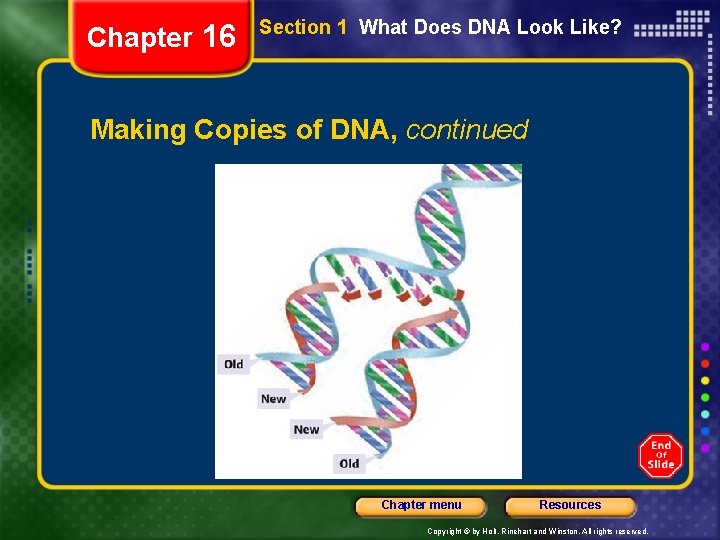
Chapter 16 Section 1 What Does DNA Look Like? Making Copies of DNA • How Copies Are Made During replication, a DNA molecule is split down the middle, where the bases meet. The bases on each side of the molecule are used as a pattern for a new strand. • When Copies Are Made DNA is copied every time a cell divides. Each new cell gets a complete copy of all the DNA. Chapter menu Resources Copyright © by Holt, Rinehart and Winston. All rights reserved.
Chapter 16 Section 1 What Does DNA Look Like? Making Copies of DNA, continued Chapter menu Resources Copyright © by Holt, Rinehart and Winston. All rights reserved.