
The Quest for a Pragmatic Economic Management Framework

- Slides: 42
The Quest for a Pragmatic Economic Management Framework in Malawi Ronald Mangani Department of Economics, Chancellor College, University of Malawi Department of Economics Research Seminar 5 January 2021
Take-aways 1. Incentive structures shape what peoples become Get them wrong; you are doomed! 2. In Malawi (& similar countries) the “success” of neoliberalism is in its “failure” Its incentive structure is designed to weaken the weak and strengthen the strong 3. Economic independence is a necessary high-order condition for pragmatic economic management and resilient development Economic management is too pivotal to be delegated in a very competitive world 4. Attaining economic independence is challenged by three factors: leadership, status quo, and human resources But importantly, “development is always and everywhere a leadership-driven process”
Preamble: Our Story is the Story of Africa, yet Unique Albert Luthuli’s Prophecy … “Africa is a vital subject matter in the world today, a focal point of world interest and concern. Could it not be that history has delayed her rebirth for a purpose? The situation confronts her with inescapable challenges, but more importantly with opportunities for service to herself and mankind. She evades the challenges and neglects the opportunities to her shame, if not her doom” Luthuli, 1961
Preamble: Economic Reforms for Resilience? • The 2020 ECAMA Annual Economic Conference Theme “Going beyond macroeconomic stabilization: the need for building resilience to external shocks” • Economics: scarcity raises value • Experience with the Lenten Pastoral Letters • The 1991 “treason” letter is a treasure; subsequent ones draw little attention • “Reforms” have been debased by SAPs etc • The economic management challenge needs much more than “reforms” • The country needs a “critical juncture” • Say “Economic Restructuring”? • Say “Economic Transformation”?
The Incentive Structure
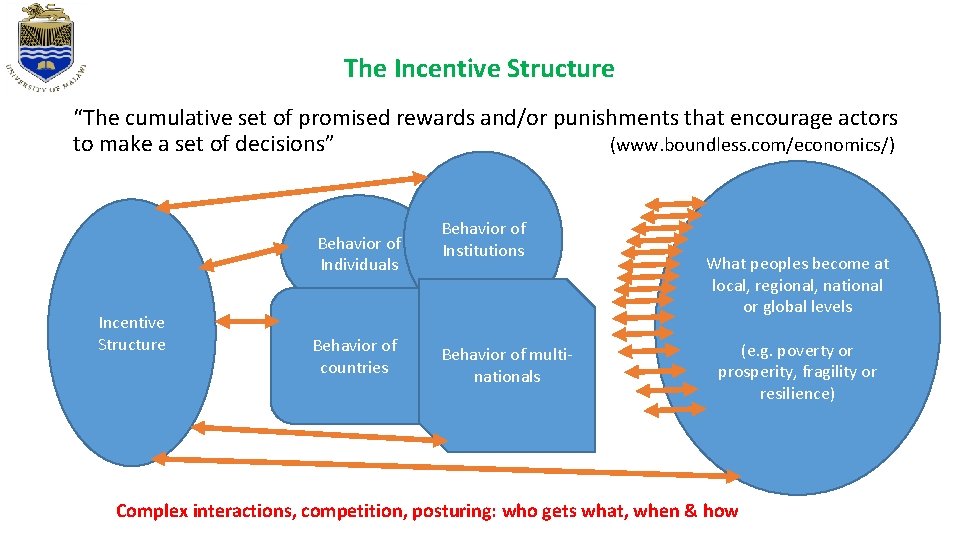
The Incentive Structure “The cumulative set of promised rewards and/or punishments that encourage actors to make a set of decisions” (www. boundless. com/economics/) Behavior of Individuals Incentive Structure Behavior of countries Behavior of Institutions Behavior of multinationals What peoples become at local, regional, national or global levels (e. g. poverty or prosperity, fragility or resilience) Complex interactions, competition, posturing: who gets what, when & how
The Incentive Structure How does a country incentivize prosperity? It exacts commensurate reward for good performance, and punishment for wrong-doing commensurate • Facilitates proper risk-return trading (Markowitz, 1952) in all conduct • Get this wrong, and you have all sorts of problems: institutional failures “an incorrect risk premium is the architect of doom”
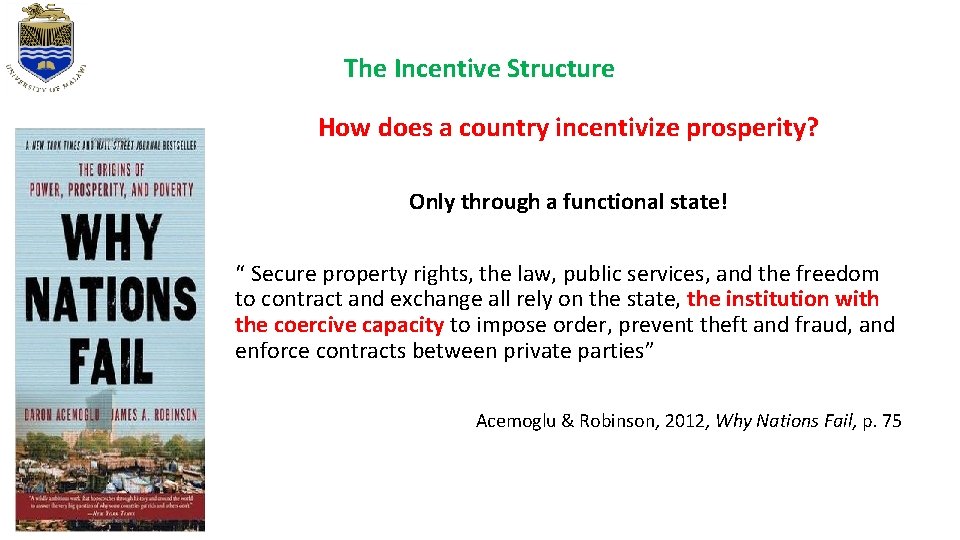
The Incentive Structure How does a country incentivize prosperity? Only through a functional state! “ Secure property rights, the law, public services, and the freedom to contract and exchange all rely on the state, the institution with the coercive capacity to impose order, prevent theft and fraud, and enforce contracts between private parties” Acemoglu & Robinson, 2012, Why Nations Fail, p. 75
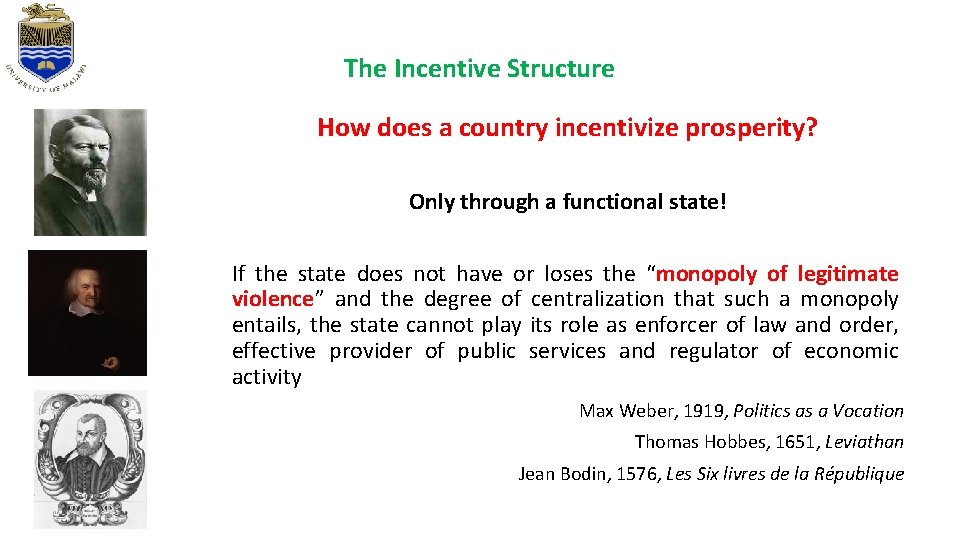
The Incentive Structure How does a country incentivize prosperity? Only through a functional state! If the state does not have or loses the “monopoly of legitimate violence” and the degree of centralization that such a monopoly entails, the state cannot play its role as enforcer of law and order, effective provider of public services and regulator of economic activity Max Weber, 1919, Politics as a Vocation Thomas Hobbes, 1651, Leviathan Jean Bodin, 1576, Les Six livres de la République
The Success of Neoliberalism is in its Failure
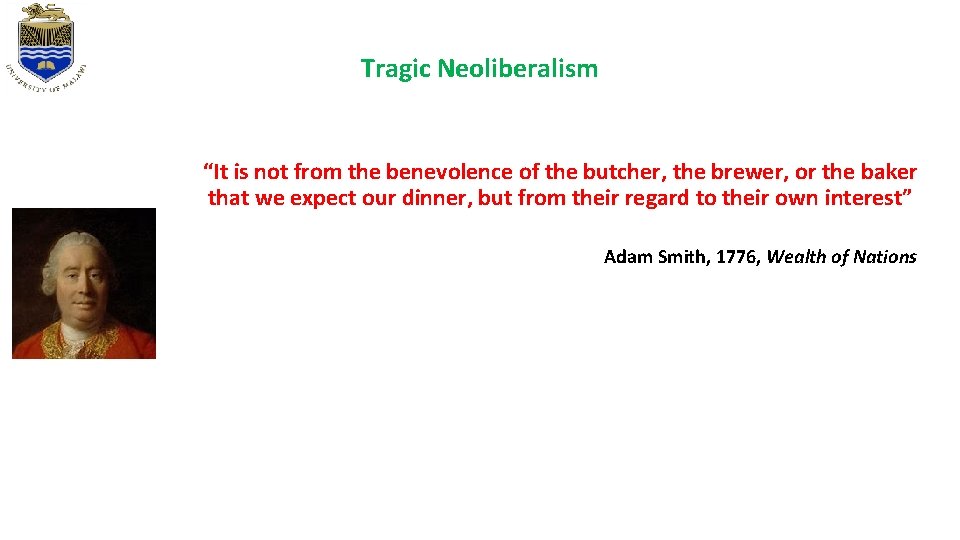
Tragic Neoliberalism “It is not from the benevolence of the butcher, the brewer, or the baker that we expect our dinner, but from their regard to their own interest” Adam Smith, 1776, Wealth of Nations
Tragic Neoliberalism Justification To address structural economic weaknesses and create resilience to shocks from the economic crisis of the late 1970 s! How? Through comprehensive policy reforms dangled in return for Western aid since 1981 But what caused the crisis? • • Increased cost of sea access due to the Mozambican war – external to the domestic economy Rise in domestic oil prices due to the 1979 global oil crisis – external to the domestic economy Decline in world tobacco prices – external to the domestic economy Episodes of agricultural failure – persistent due to rain-dependence, etc Mangani, 2020; Chirwa, 2000
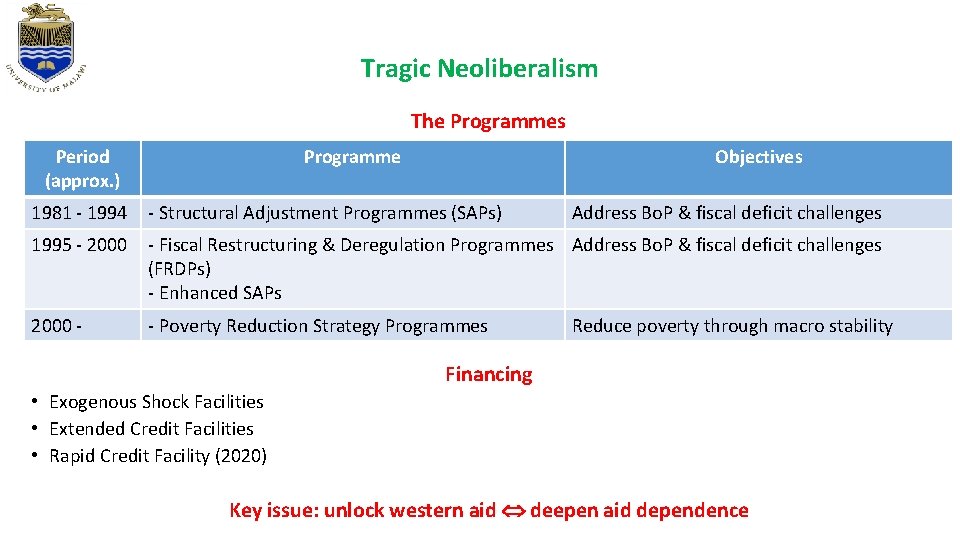
Tragic Neoliberalism The Programmes Period (approx. ) Programme Objectives 1981 - 1994 - Structural Adjustment Programmes (SAPs) Address Bo. P & fiscal deficit challenges 1995 - 2000 - Fiscal Restructuring & Deregulation Programmes Address Bo. P & fiscal deficit challenges (FRDPs) - Enhanced SAPs 2000 - - Poverty Reduction Strategy Programmes Reduce poverty through macro stability Financing • Exogenous Shock Facilities • Extended Credit Facilities • Rapid Credit Facility (2020) Key issue: unlock western aid deepen aid dependence
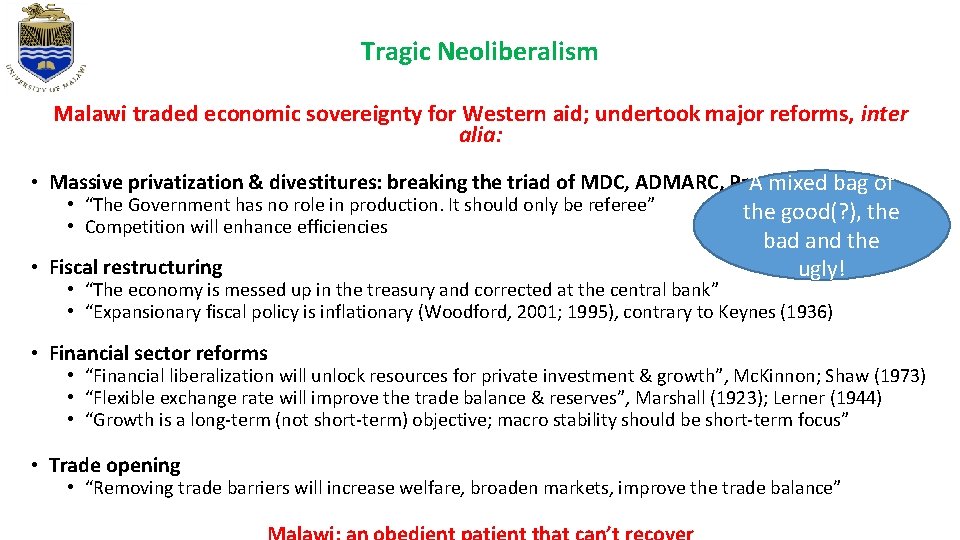
Tragic Neoliberalism Malawi traded economic sovereignty for Western aid; undertook major reforms, inter alia: • Massive privatization & divestitures: breaking the triad of MDC, ADMARC, Press A mixed bag of • “The Government has no role in production. It should only be referee” • Competition will enhance efficiencies • Fiscal restructuring the good(? ), the bad and the ugly! • “The economy is messed up in the treasury and corrected at the central bank” • “Expansionary fiscal policy is inflationary (Woodford, 2001; 1995), contrary to Keynes (1936) • Financial sector reforms • “Financial liberalization will unlock resources for private investment & growth”, Mc. Kinnon; Shaw (1973) • “Flexible exchange rate will improve the trade balance & reserves”, Marshall (1923); Lerner (1944) • “Growth is a long-term (not short-term) objective; macro stability should be short-term focus” • Trade opening • “Removing trade barriers will increase welfare, broaden markets, improve the trade balance”
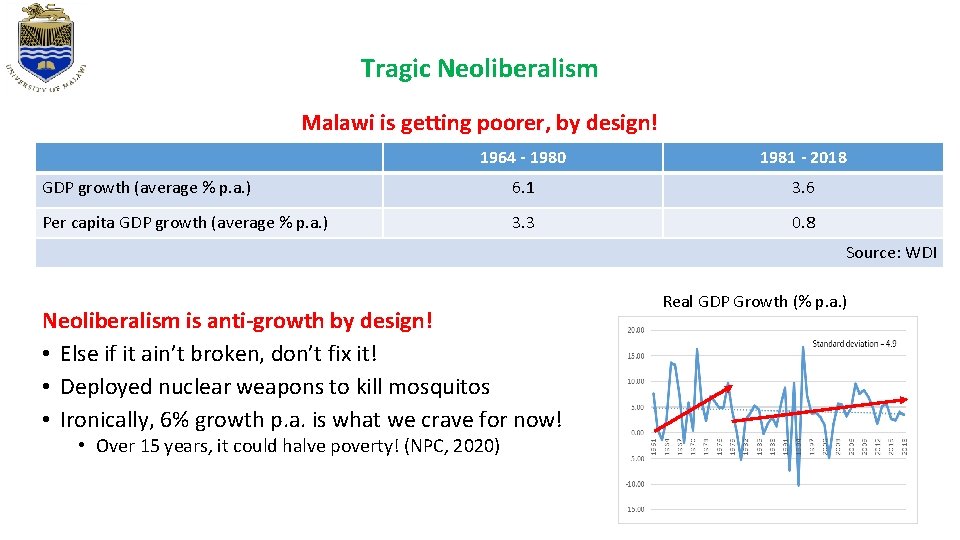
Tragic Neoliberalism Malawi is getting poorer, by design! 1964 - 1980 1981 - 2018 GDP growth (average % p. a. ) 6. 1 3. 6 Per capita GDP growth (average % p. a. ) 3. 3 0. 8 Source: WDI Neoliberalism is anti-growth by design! • Else if it ain’t broken, don’t fix it! • Deployed nuclear weapons to kill mosquitos • Ironically, 6% growth p. a. is what we crave for now! • Over 15 years, it could halve poverty! (NPC, 2020) Real GDP Growth (% p. a. )
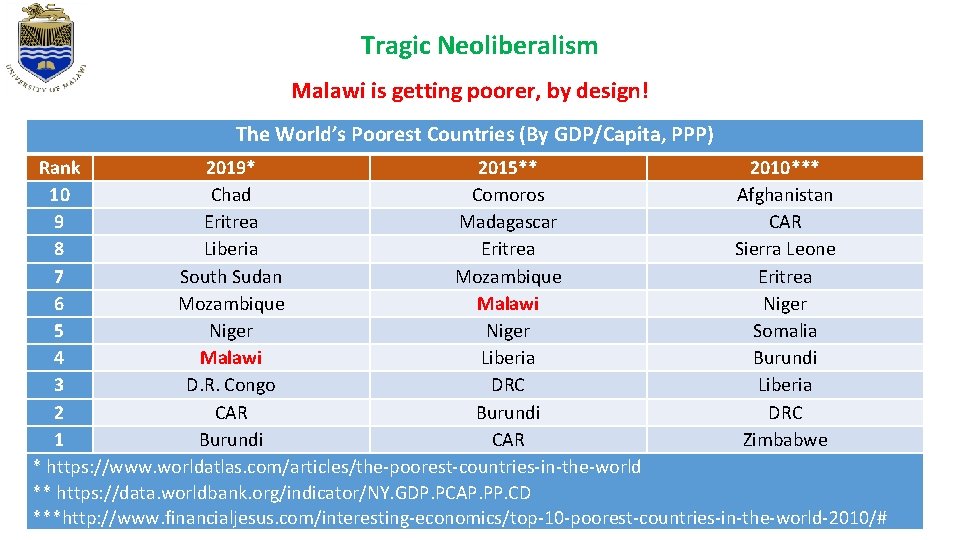
Tragic Neoliberalism Malawi is getting poorer, by design! The World’s Poorest Countries (By GDP/Capita, PPP) Rank 2019* 2015** 2010*** 10 Chad Comoros Afghanistan 9 Eritrea Madagascar CAR 8 Liberia Eritrea Sierra Leone 7 South Sudan Mozambique Eritrea 6 Mozambique Malawi Niger 5 Niger Somalia 4 Malawi Liberia Burundi 3 D. R. Congo DRC Liberia 2 CAR Burundi DRC 1 Burundi CAR Zimbabwe * https: //www. worldatlas. com/articles/the-poorest-countries-in-the-world ** https: //data. worldbank. org/indicator/NY. GDP. PCAP. PP. CD ***http: //www. financialjesus. com/interesting-economics/top-10 -poorest-countries-in-the-world-2010/#
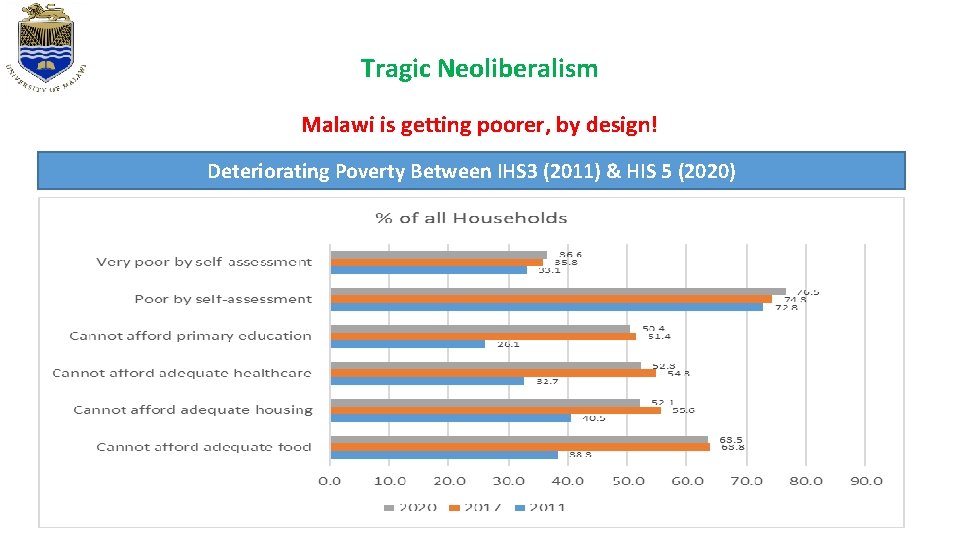
Tragic Neoliberalism Malawi is getting poorer, by design! Deteriorating Poverty Between IHS 3 (2011) & HIS 5 (2020)
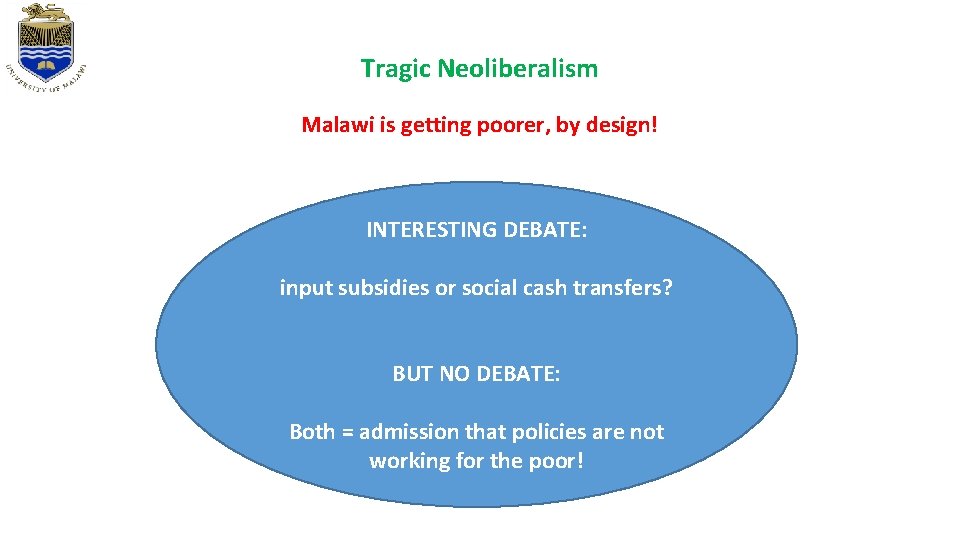
Tragic Neoliberalism Malawi is getting poorer, by design! INTERESTING DEBATE: input subsidies or social cash transfers? BUT NO DEBATE: Both = admission that policies are not working for the poor!
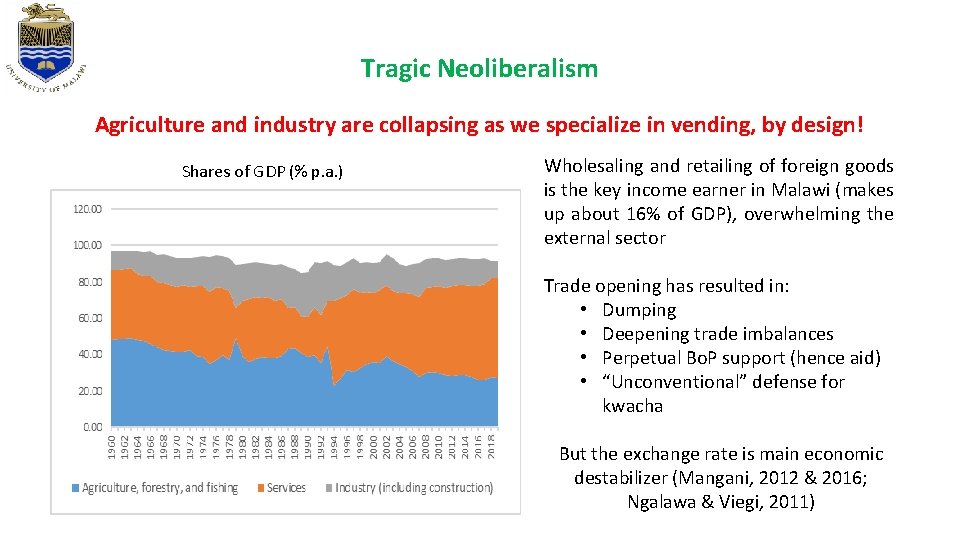
Tragic Neoliberalism Agriculture and industry are collapsing as we specialize in vending, by design! Shares of GDP (% p. a. ) Wholesaling and retailing of foreign goods is the key income earner in Malawi (makes up about 16% of GDP), overwhelming the external sector Trade opening has resulted in: • Dumping • Deepening trade imbalances • Perpetual Bo. P support (hence aid) • “Unconventional” defense for kwacha But the exchange rate is main economic destabilizer (Mangani, 2012 & 2016; Ngalawa & Viegi, 2011)
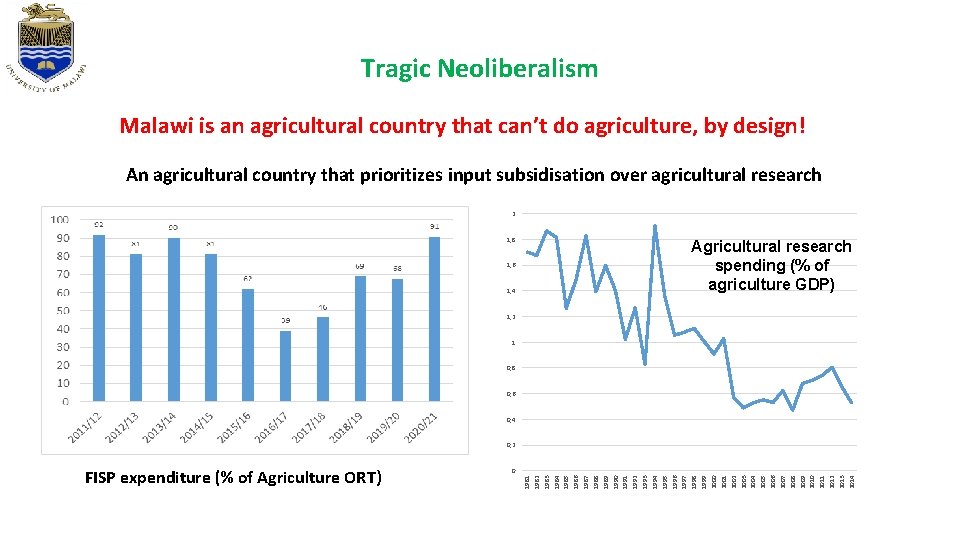
Tragic Neoliberalism Malawi is an agricultural country that can’t do agriculture, by design! An agricultural country that prioritizes input subsidisation over agricultural research 2 1, 8 1, 6 1, 4 Agricultural research spending (% of agriculture GDP) 1, 2 1 0, 8 0, 6 0, 4 0, 2 0 1981 1982 1983 1984 1985 1986 1987 1988 1989 1990 1991 1992 1993 1994 1995 1996 1997 1998 1999 2000 2001 2002 2003 2004 2005 2006 2007 2008 2009 2010 2011 2012 2013 2014 FISP expenditure (% of Agriculture ORT)
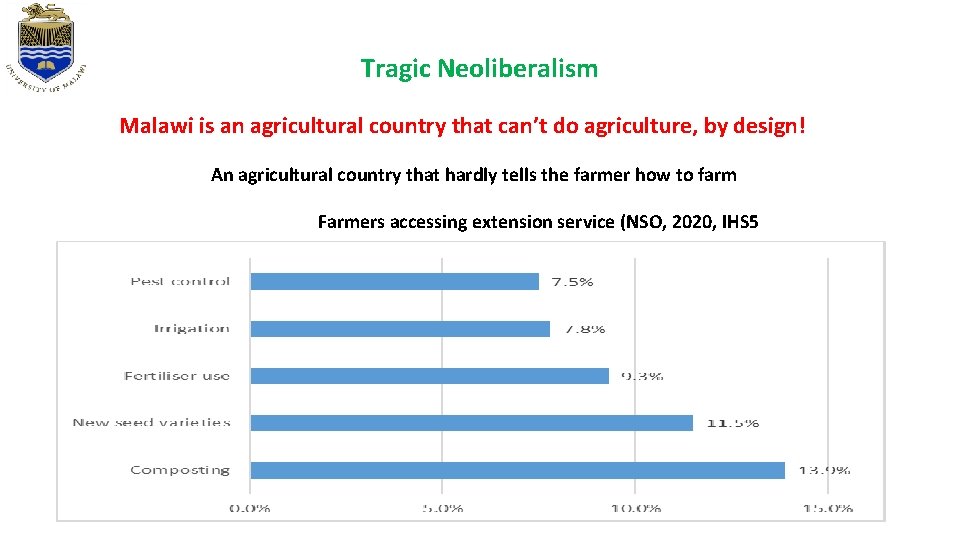
Tragic Neoliberalism Malawi is an agricultural country that can’t do agriculture, by design! An agricultural country that hardly tells the farmer how to farm Farmers accessing extension service (NSO, 2020, IHS 5
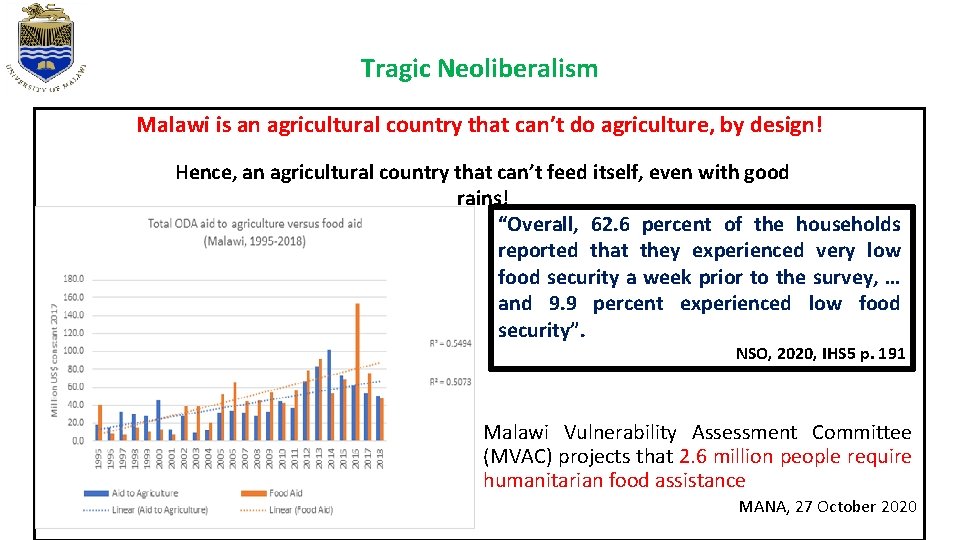
Tragic Neoliberalism Malawi is an agricultural country that can’t do agriculture, by design! Hence, an agricultural country that can’t feed itself, even with good rains! “Overall, 62. 6 percent of the households reported that they experienced very low food security a week prior to the survey, … and 9. 9 percent experienced low food security”. NSO, 2020, IHS 5 p. 191 Malawi Vulnerability Assessment Committee (MVAC) projects that 2. 6 million people require humanitarian food assistance MANA, 27 October 2020
Tragic Neoliberalism Aid dependency is deepening, by design!
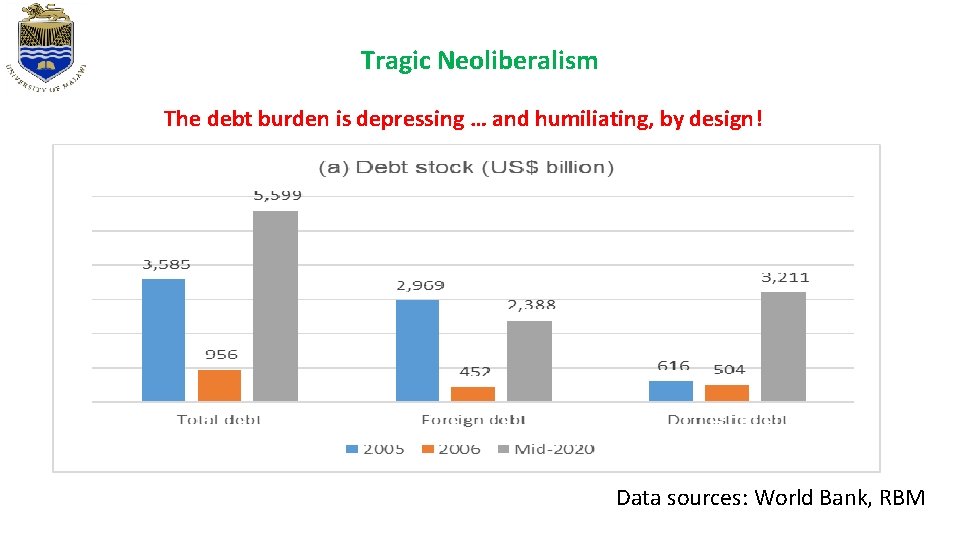
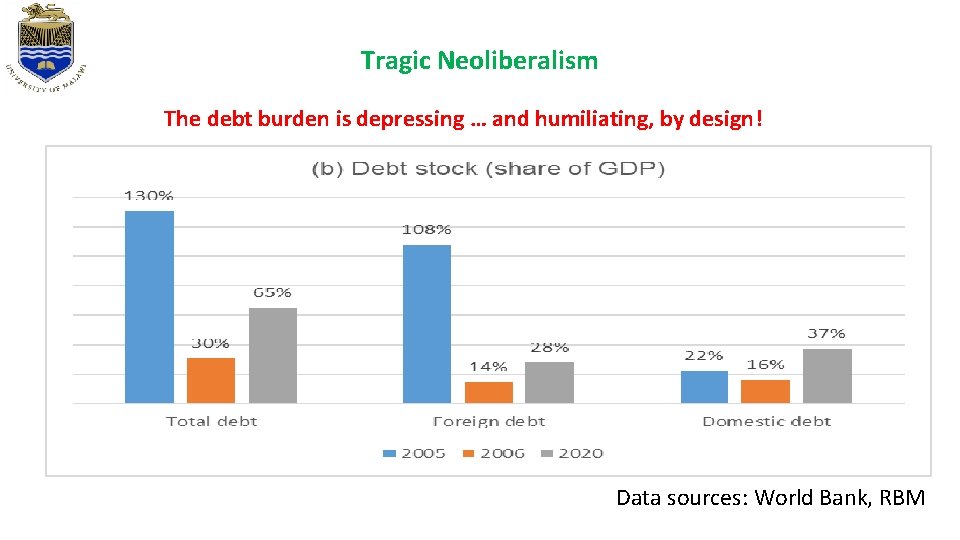
Tragic Neoliberalism The debt burden is depressing … and humiliating, by design! Data sources: World Bank, RBM
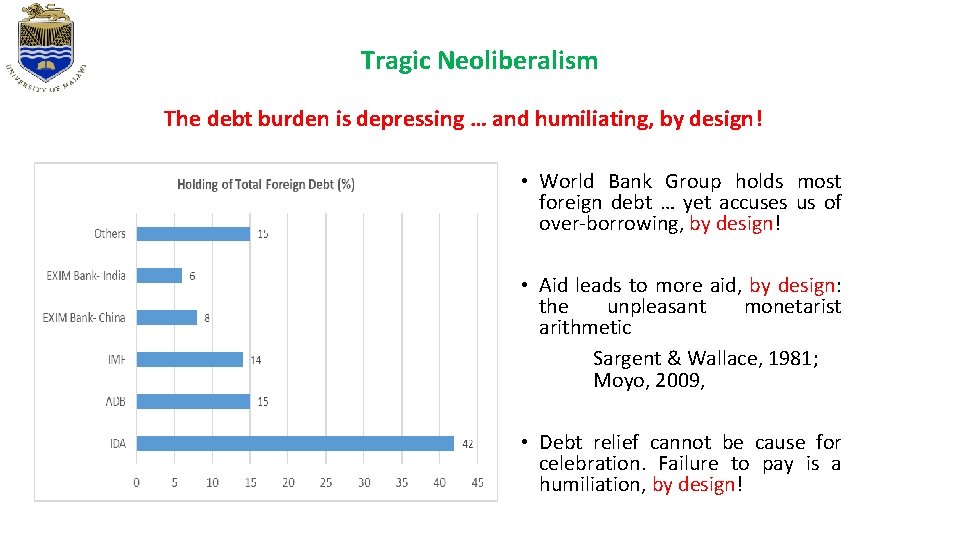
Tragic Neoliberalism The debt burden is depressing … and humiliating, by design! Data sources: World Bank, RBM
Tragic Neoliberalism The debt burden is depressing … and humiliating, by design! • World Bank Group holds most foreign debt … yet accuses us of over-borrowing, by design! • Aid leads to more aid, by design: the unpleasant monetarist arithmetic Sargent & Wallace, 1981; Moyo, 2009, • Debt relief cannot be cause for celebration. Failure to pay is a humiliation, by design!
Tragic Neoliberalism The fiscal (hence public) sector is not functional, by design! The are huge and costly public sector wage disparities: neoliberalism has favorites • • Raises the marginal utility of corruption Facilitates conformity with the “rules of the game” by supported SOEs Erodes human resource & output quality in civil service Yet there is no evidence of fiscal dominance in Malawi (Mangani, 2020) Austerity comes with increasing public sector responsibilities • Ever-growing public sector and fiscal pressures • Resources too thinly spread • Punitive effective tax rates, unnaturality & attitude to taxation • From producing to regulating and governance SOE • Overwhelming Treasury recourse • Much easier to extract from regulatory SOEs than from producing SOEs • Declining service quality – education, health, security • Public finance injustice: the heavily taxed middle class no longer accesses most public services
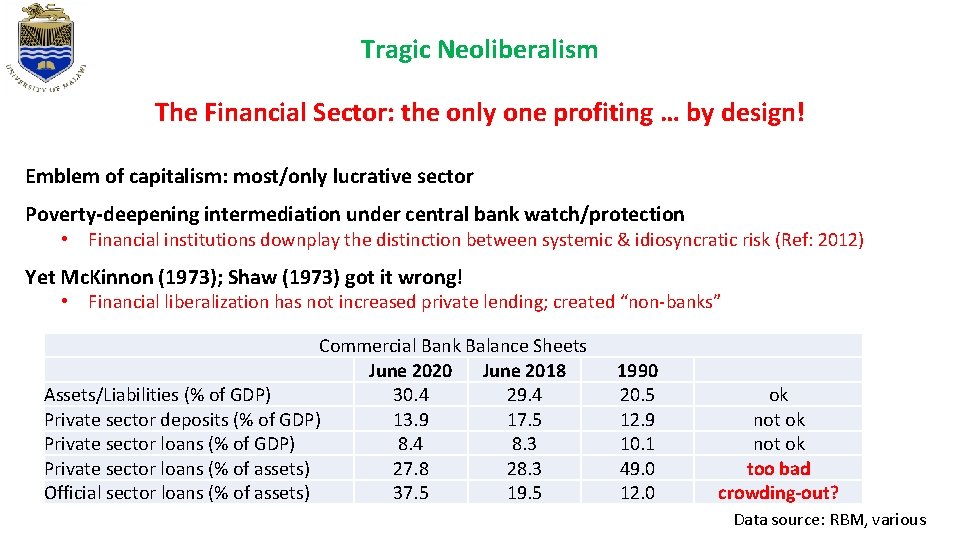
Tragic Neoliberalism The Financial Sector: the only one profiting … by design! Emblem of capitalism: most/only lucrative sector Poverty-deepening intermediation under central bank watch/protection • Financial institutions downplay the distinction between systemic & idiosyncratic risk (Ref: 2012) Yet Mc. Kinnon (1973); Shaw (1973) got it wrong! • Financial liberalization has not increased private lending; created “non-banks” Commercial Bank Balance Sheets June 2020 June 2018 Assets/Liabilities (% of GDP) 30. 4 29. 4 Private sector deposits (% of GDP) 13. 9 17. 5 Private sector loans (% of GDP) 8. 4 8. 3 Private sector loans (% of assets) 27. 8 28. 3 Official sector loans (% of assets) 37. 5 1990 20. 5 12. 9 10. 1 49. 0 12. 0 ok not ok too bad crowding-out? Data source: RBM, various
Tragic Neoliberalism Criticism against deficit-budgeting by orthodox economists is dangerous and damaging • Capital account deficit is a necessary stimulant with idle resources (Keynes, 1936; Lerner, 1943) • Poses a worrisome limitation on the government’s ability to pursue public purpose (Armstrong, 2019) Resurgence of interest in Keynes’ work among policy-makers since the financial crisis, 2007 -08 • Should have catalysed an end to the neoclassical domination, but for power play; incentive structure (Skidelsy, 2010; Dymski, 2013) COVID-19 creates new wave of interest in the economic role of the state • Active fiscal policy pivotal in resolving the crisis (Obeng-Odoom, 2020)
Tragic Neoliberalism There is no scientific evidence of fiscal dominance in Malawi “… fiscal deficits and domestic financing are generally not inflationary in Malawi, contrary to the established neoliberal theory” Mangani, 2020) We can avoid excessive aversion to public debt to borrow for investment (not consumption) There is nothing characteristically bad about government borrowing; macroeconomic policies must reflect pragmatism rather than consistency with some traditional doctrine; and that excessive aversion to public debt may lead to bad policies Armstrong, 2019 We all know the primary objective of neoliberalism Neoliberalism was designed to serve the economic and geopolitical interests of Western governments Chipeta, 2009 Neoliberalism has not delivered Pareto-optimal outcomes in Malawi “Liberalisation of the economy is the institutionalization of greed” Asaria, 1994
Tragic Neoliberalism How is Such Economic Immorality Sustained? Brainwashing: mental programming & enslavement Divide & rule: differential public sector incentives (e. g. central bank independence) Distractions from things that matter most (e. g. from the mismatch between population & economic growth to homosexuality Sheer collective gullibility “They may indeed see but not perceive, and may indeed hear but not understand, lest they should turn and be forgiven (i. e. , and prosper)” The Bible, Mark 4: 12
The Necessity for Economic Independence
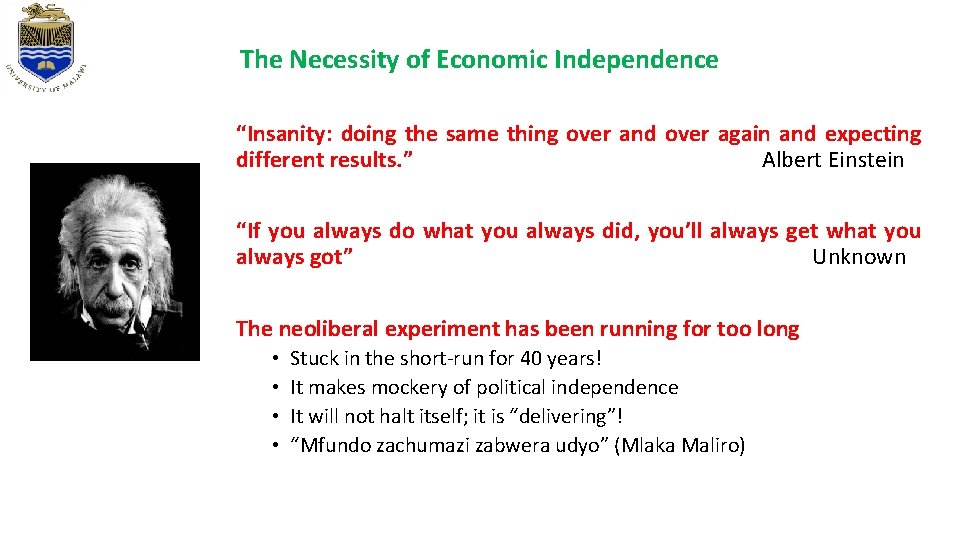
The Necessity of Economic Independence “Insanity: doing the same thing over and over again and expecting different results. ” Albert Einstein “If you always do what you always did, you’ll always get what you always got” Unknown The neoliberal experiment has been running for too long • • Stuck in the short-run for 40 years! It makes mockery of political independence It will not halt itself; it is “delivering”! “Mfundo zachumazi zabwera udyo” (Mlaka Maliro)
The Necessity of Economic Independence Economic independence is much easier said than done; high order; suicidal • Lumumba, Sankara, Gadaffi’s, Mugabe • Will require very concerted effort and focus Malawi needs disentanglement from the shackles of economic dependence • • Malawi needs pragmatic economic management Malawi must develop home-grown solutions (Ref: Singapore, Tanzania, etc) Malawi needs a developmental state: don’t throw away Keynes & Lerner Malawi must rationalize aid (and financing in general) to work for country Actualize presidential hints on economic independence; aid graduation “I am fully aware that while our founding fathers and mothers accomplished their goal of national liberation and their sons and daughters accomplished their goal of political liberation, it is your generation that must accomplish the goal of economic liberation” L. Chakwera, 6 July 2020 “Economic management is too pivotal to delegate”
Economic Independence: The Enormous Challenge of Attainment
Challenge to Economic Independence #1: Leadership “Development is always and everywhere a leadership-driven process” Malawi has been running costly, non-converging experiments with leadership • We have tried the old and not-so-old; male and female; prepared and accidental, diasporic and home-grown; fine minds and dunderheads, educated and educationally deprived; outright thieves and … Have we paid in full for the August 1964 Cabinet Crisis? Malawi has a rare opportunity to reset the leadership button • Changing political leadership creates an opportunity for implementing comprehensive economic policy reforms to achieve development outcomes Williamson, 1994 • Did we really have a government in waiting post-February 2020? • Is it another “stab in the dark”? Is it “the more things change, the more they remain the same”?
Challenge to Economic Independence #1: Leadership “Development is always and everywhere a leadership-driven process” Leadership = the political will to drive change, not joining the masses in lamentation • No common problems no need for leadership “Bad law = law that thwarts good leadership from doing the right thing” Dilemma: democracy versus political stability; patriotism, benevolence • (Africa’s) model economies are not necessarily model democracies “There is no debate that visionary and transformational leadership characterized by positive values such as unity, patriotism, selflessness, integrity and responsibility is central to the ongoing transformation in Rwanda” https: //www. newtimes. co. rw
Challenge to Economic Independence #1: Leadership “Development is always and everywhere a leadership-driven process” “. . the remedy for Malawi’s endemic poverty and development stagnation lies in the emergence of a leadership that will be inspired by a sense of honour, duty and country…. a larger-than-life leadership that could preside over the creation of inclusive economic and political institutions, and adamantly promote their functionality as a foundation for durable macroeconomic and social … driven and owned by the country’s citizens themselves, rather than one moulded by self-aggrandising external influences. It is only through the emergence of such a leadership and institutions that the shackles of neo-colonialism will be broken; that independence will cease to be a sham; and that a worrisome trend towards the prophesised (by Luthuli) doom of a failed state will be reversed. ” Mangani, 2020
Challenge to Economic Independence #2: Proponents “Change is always resisted by those who profit from status quo” The vested interests are grave, the opportunity costs are high • Recall: incentive structures Is graduation from neoliberalism even feasible/conceivable? • Will its proponents & vested interests leg go? If so, how should this be done? • Shock-treatment vs planned transition?
Challenge to Economic Independence #3: Human Resource “How do we deal with deep Indoctrination, brainwashing & sheer gullibility? ” The struggle for economic independence is a different ball-game • Fought more intellectually than with guns and bombs, save for the fate of early martyrs So much education; very little learning Dogmatic, inflexible academics got us here • We should burry our heads in the sand; apologize • “Emancipate yourself from mental slavery” – Robert Nest Marley There will be need to develop a critical mass of though leaders to hatch local solutions • And a critical mass of thought followers to interpret and implement them! • Debased education system offers little hope
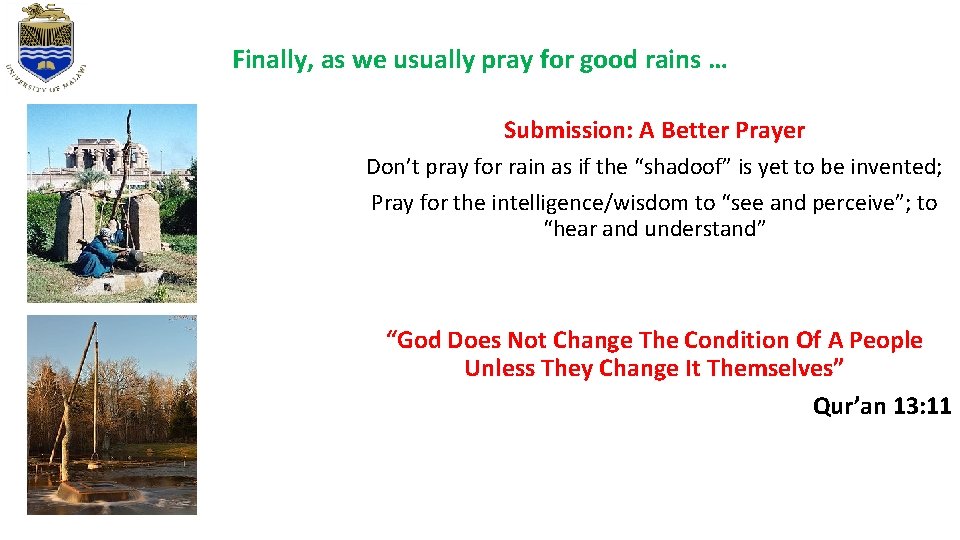
Finally, as we usually pray for good rains … Submission: A Better Prayer Don’t pray for rain as if the “shadoof” is yet to be invented; Pray for the intelligence/wisdom to “see and perceive”; to “hear and understand” “God Does Not Change The Condition Of A People Unless They Change It Themselves” Qur’an 13: 11
TX zikomo