
The Quantum Model of the Atom Chapter 4
- Slides: 24
The Quantum Model of the Atom Chapter 4 Section 2
Bohr’s Problems • Why did hydrogen’s ____exist around the nucleus only in ______orbits? • Why couldn’t the electron exist in a ______number of orbits with slightly different energies? • Why didn’t the Bohr model work for ____ atoms?
Louis de Broglie • French scientist in the 1920 s • Observed that the behavior of ____ is similar to the behavior of _____ • Suggested that _____be considered _____ • Other experiments confirmed that electrons have ______properties
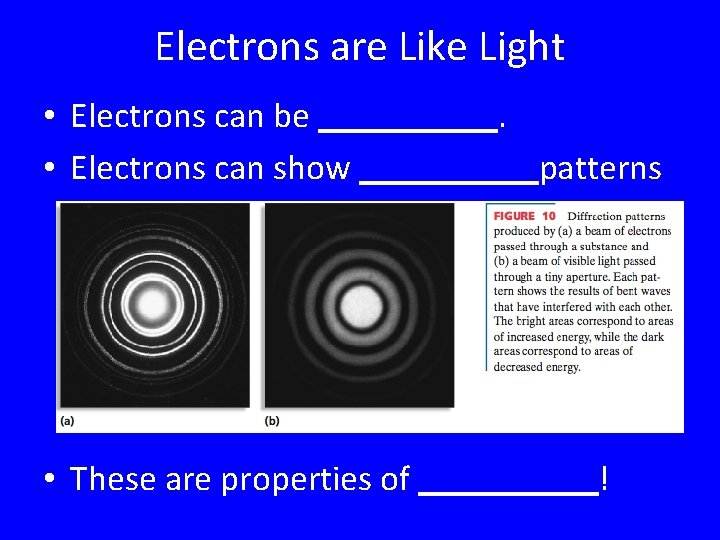
Electrons are Like Light • Electrons can be _____. • Electrons can show _____patterns • These are properties of _____!
Electrons as Particles and Waves • Electrons were determined to also have a dual ______nature, like _______. – So……. . where are they in the _____? • ___________ was a German physicist that tried to detect electrons.
Heisenberg Uncertainty Principle • ____have about the same energy as a _____of light • When trying to detect an ____, and the photon of light _______ • ______________: it is impossible to determine simultaneously both the position and the velocity of an electron
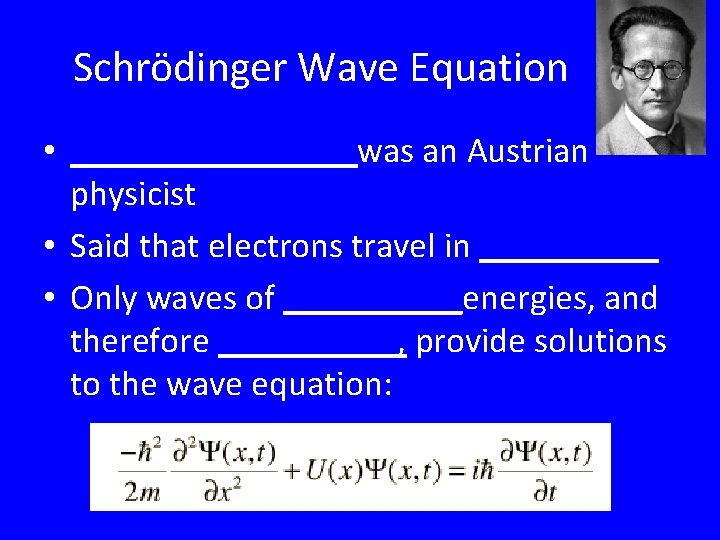
Schrödinger Wave Equation • ________was an Austrian physicist • Said that electrons travel in _____ • Only waves of _____energies, and therefore _____, provide solutions to the wave equation:
Quantum Theory • The foundation for modern ______ theory was laid by Heisenberg’s ________ and Schrödinger’s ________. • ___________: describes mathematically the wave properties of electrons and other very small particles moving very fast
Quantum Theory • Electrons do ______travel around the nucleus in ____orbits. • They exist in certain regions called _______. • _____: a three-dimensional _____ around the nucleus that indicates the _____location of an _____.
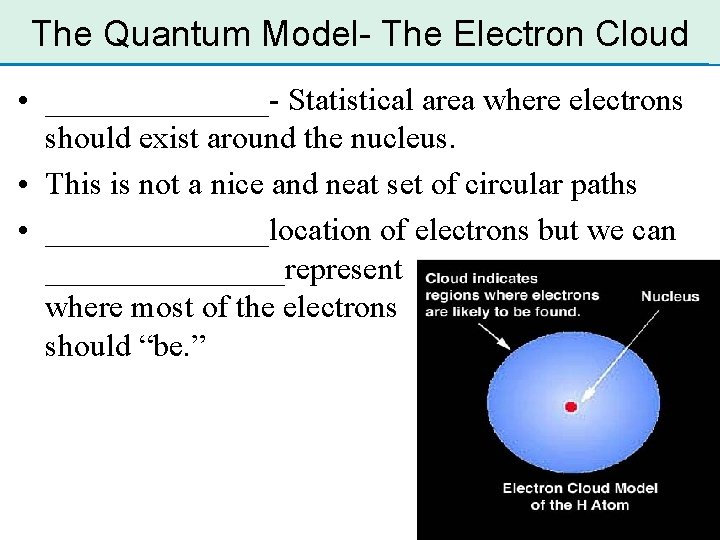
The Quantum Model- The Electron Cloud • _______- Statistical area where electrons should exist around the nucleus. • This is not a nice and neat set of circular paths • _______location of electrons but we can ________represent where most of the electrons should “be. ” 10
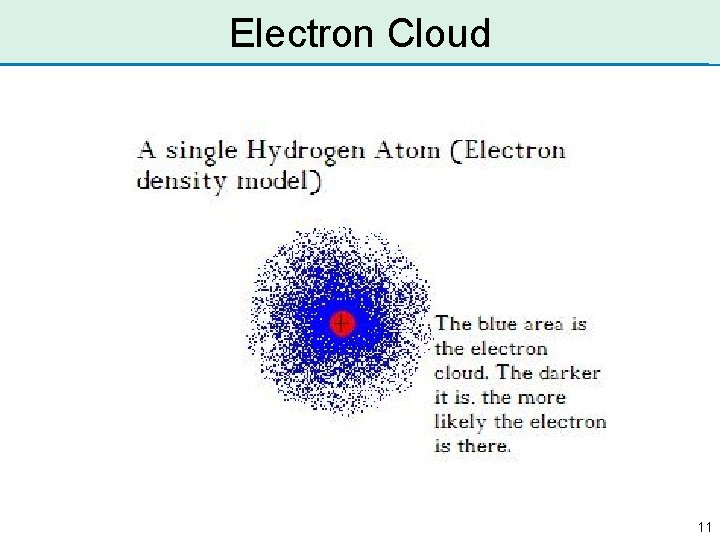
Electron Cloud 11
Quantum Numbers • ________: numbers (4 of them) that specify the properties of _______and the properties of ____ in those orbitals • The first 3 quantum numbers result from solutions to the __________. • The fourth quantum number describes a fundamental state of the _____(its spin) that occupies an orbital
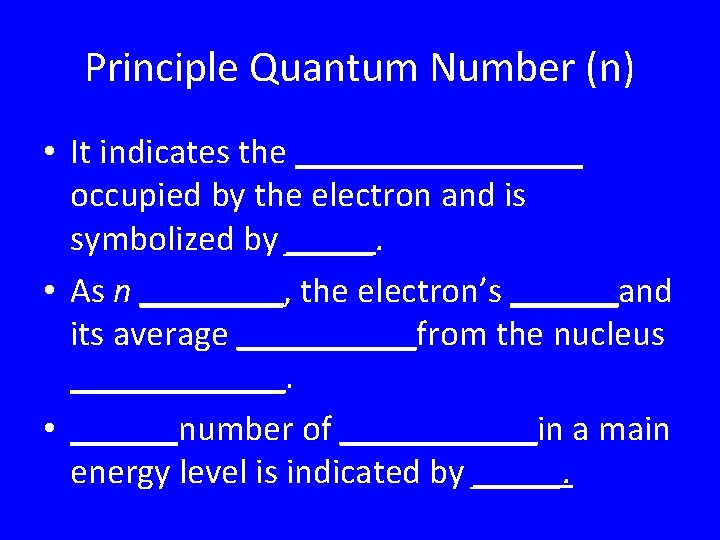
Principle Quantum Number (n) • It indicates the ________ occupied by the electron and is symbolized by _____. • As n ____, the electron’s ______and its average _____from the nucleus ______. • ______number of ______in a main energy level is indicated by _____.
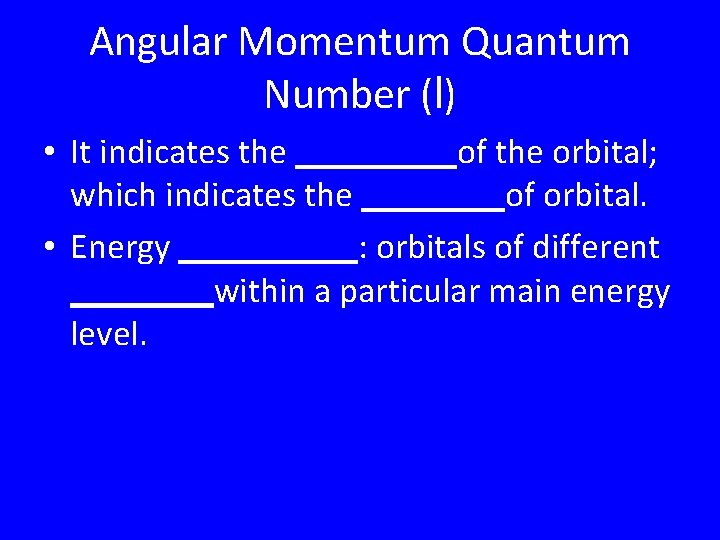
Angular Momentum Quantum Number (l) • It indicates the _____of the orbital; which indicates the ____of orbital. • Energy _____: orbitals of different ____within a particular main energy level.
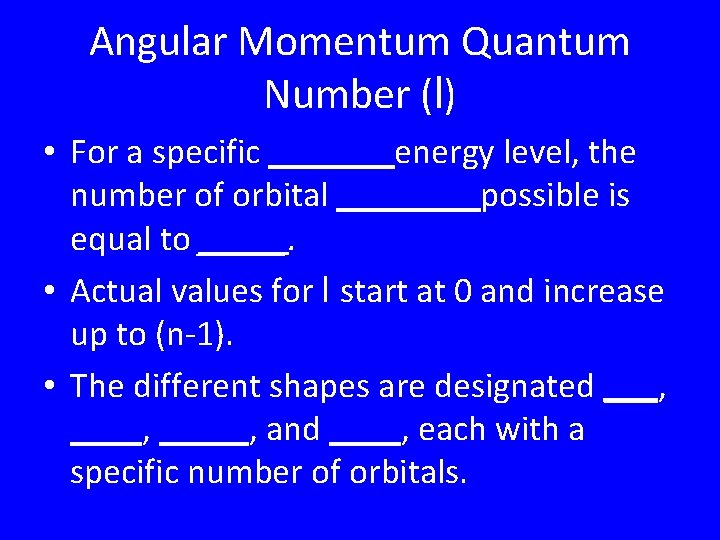
Angular Momentum Quantum Number (l) • For a specific _______energy level, the number of orbital ____possible is equal to _____. • Actual values for l start at 0 and increase up to (n-1). • The different shapes are designated ___, _____, and ____, each with a specific number of orbitals.
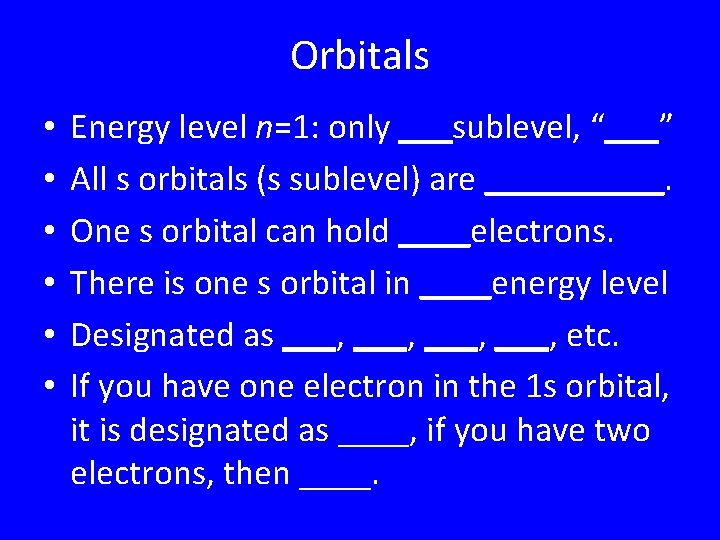
Orbitals • • • Energy level n=1: only ___sublevel, “___” All s orbitals (s sublevel) are _____. One s orbital can hold ____electrons. There is one s orbital in ____energy level Designated as ___, etc. If you have one electron in the 1 s orbital, it is designated as ____, if you have two electrons, then ____.
Other Sublevels • The p sublevel has ___orbitals, each capable of holding ___electrons for a total of ___electrons. • The d sublevel has ___orbitals, each capable of holding ___electrons for a total of ___electrons. • The f sublevel has ___orbitals, each capable of holding ___electrons for a total of ___electrons.
Magnetic Quantum Number (ml) • It indicates the ______of an orbital around the nucleus • ___orbitals are _____, so they only have _______possible orientation • ___orbitals are “______” shaped and have ___possible orientations according to the Schrödinger’s equation.
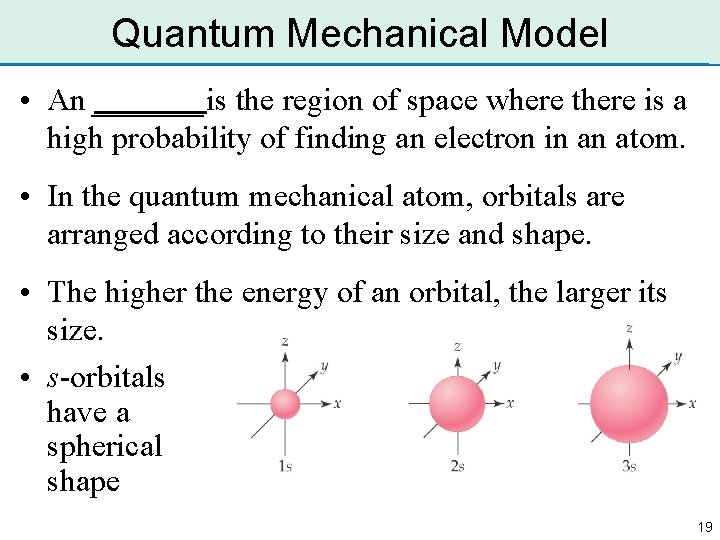
Quantum Mechanical Model • An _______is the region of space where there is a high probability of finding an electron in an atom. • In the quantum mechanical atom, orbitals are arranged according to their size and shape. • The higher the energy of an orbital, the larger its size. • s-orbitals have a spherical shape 19
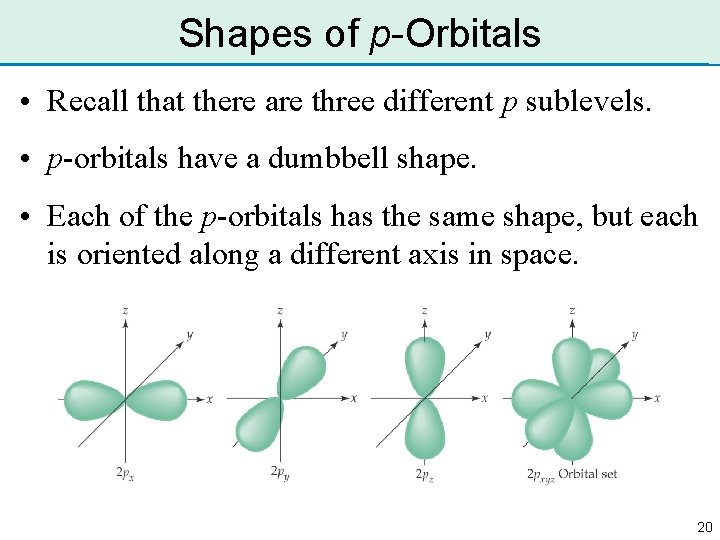
Shapes of p-Orbitals • Recall that there are three different p sublevels. • p-orbitals have a dumbbell shape. • Each of the p-orbitals has the same shape, but each is oriented along a different axis in space. 20
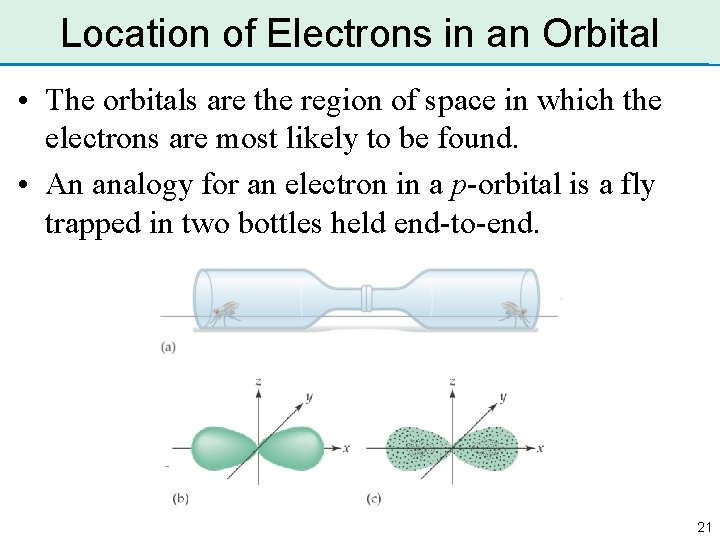
Location of Electrons in an Orbital • The orbitals are the region of space in which the electrons are most likely to be found. • An analogy for an electron in a p-orbital is a fly trapped in two bottles held end-to-end. 21
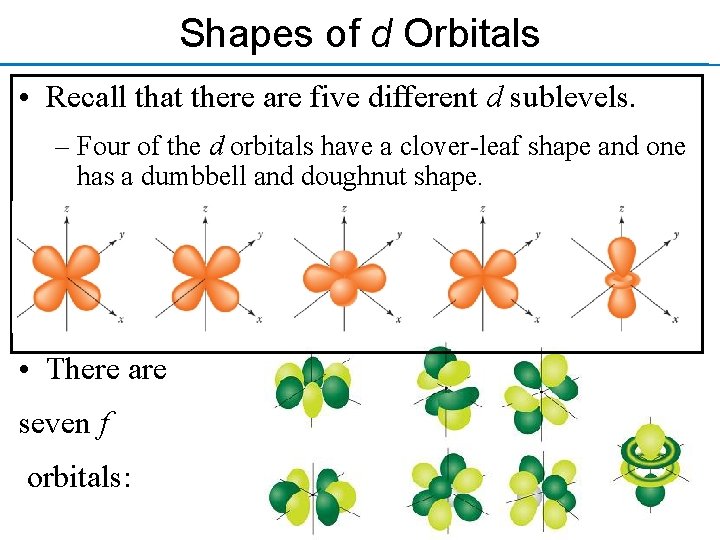
Shapes of d Orbitals • Recall that there are five different d sublevels. – Four of the d orbitals have a clover-leaf shape and one has a dumbbell and doughnut shape. • There are seven f orbitals:
Spin Quantum Number (ms) • Indicates the two fundamental _______ states of an electron in an orbital • Has only two possible values: ___and ___ • A single orbital can hold a maximum of _____electrons, but they must have ______spin states.
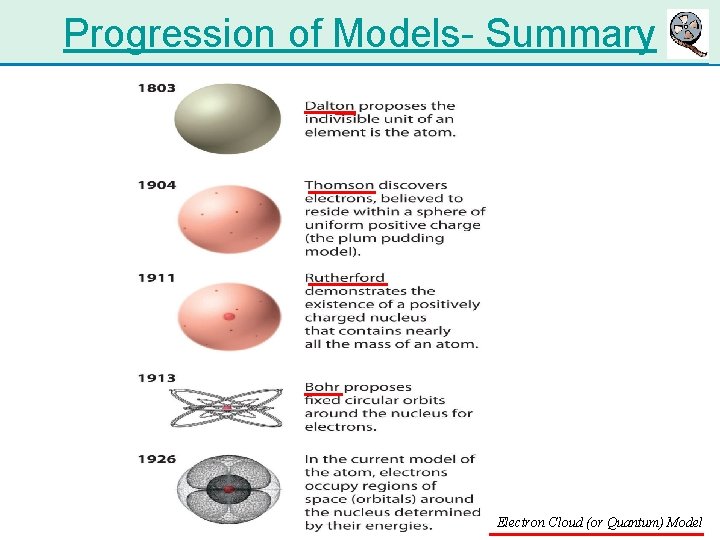
Progression of Models- Summary Chapter 5 Electron Cloud (or Quantum) Model