
The quantum mechanics of superconductors Subir Sachdev Talk
The quantum mechanics of superconductors Subir Sachdev Talk online: http: //pantheon. yale. edu/~subir
The quantum mechanics of • Insulators • Metals • Semiconductors • Superconductors Technology in the 19 th century Technology of the 20 th century Technology of the 21 st century ?
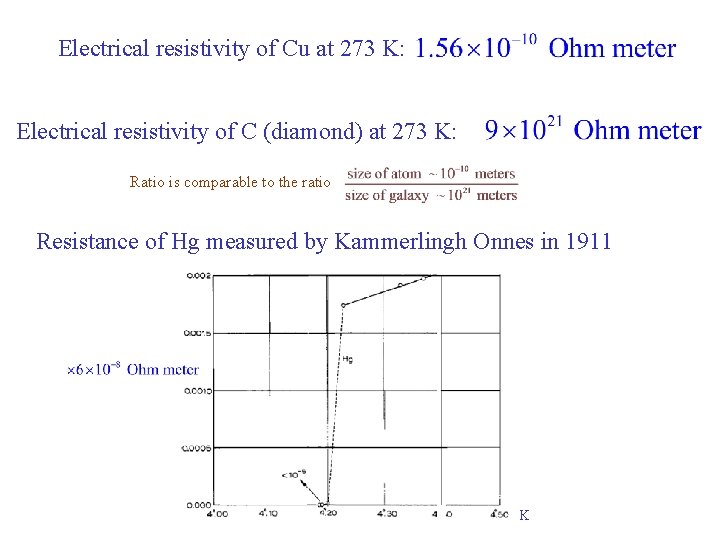
Electrical resistivity of Cu at 273 K: Electrical resistivity of C (diamond) at 273 K: Ratio is comparable to the ratio Resistance of Hg measured by Kammerlingh Onnes in 1911 K
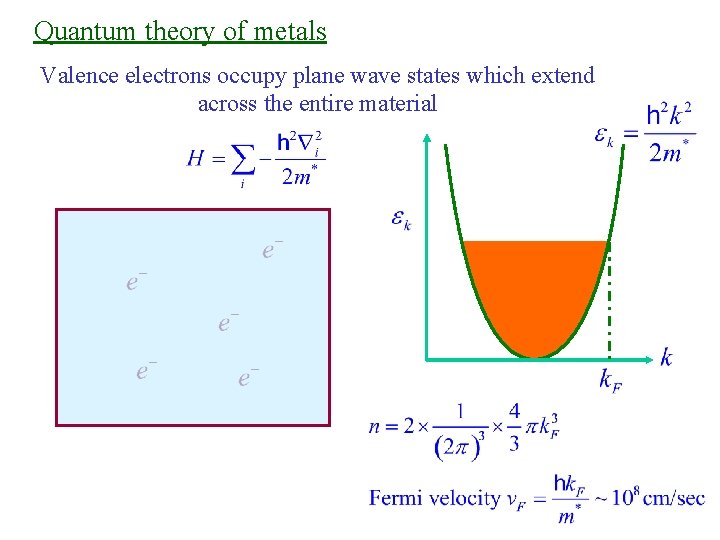
Quantum theory of metals Valence electrons occupy plane wave states which extend across the entire material
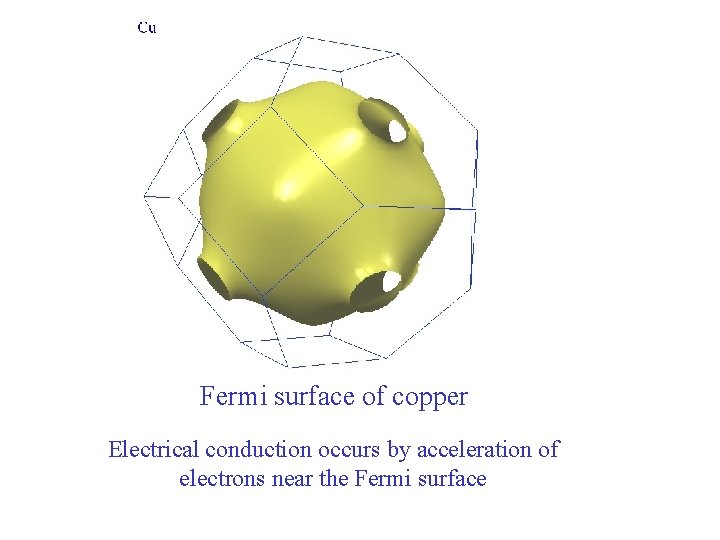
Fermi surface of copper Electrical conduction occurs by acceleration of electrons near the Fermi surface
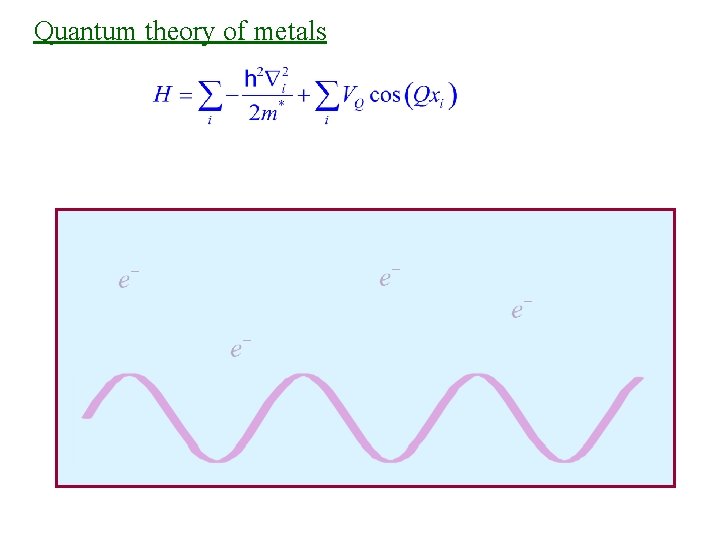
Quantum theory of metals
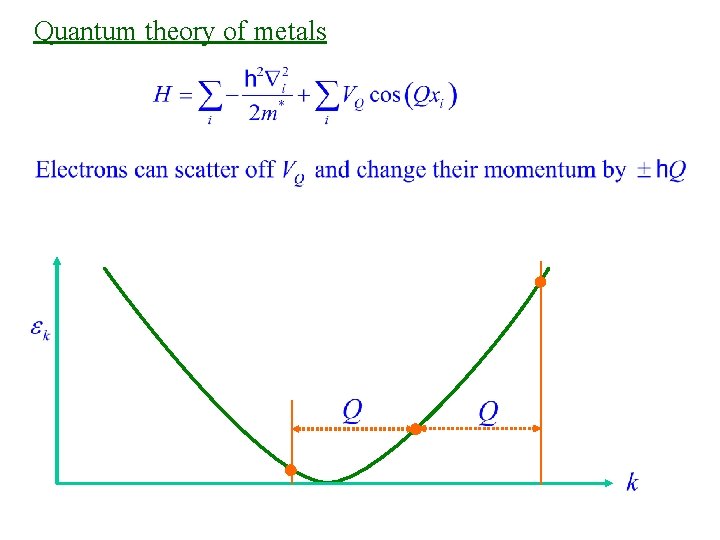
Quantum theory of metals
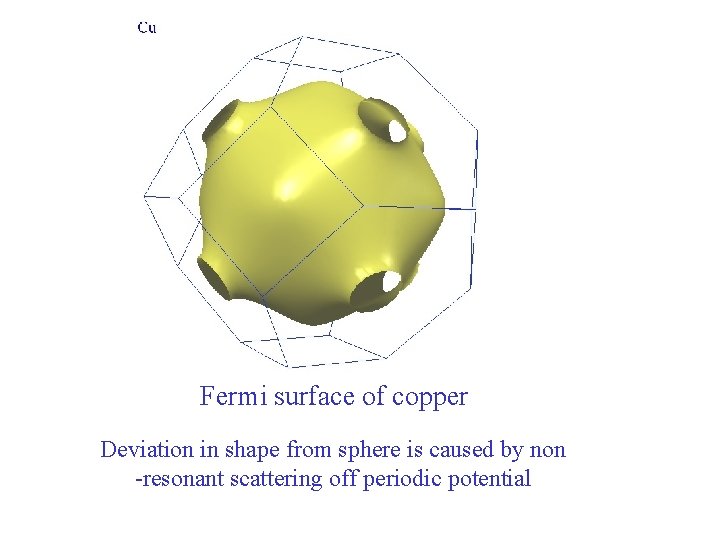
Fermi surface of copper Deviation in shape from sphere is caused by non -resonant scattering off periodic potential
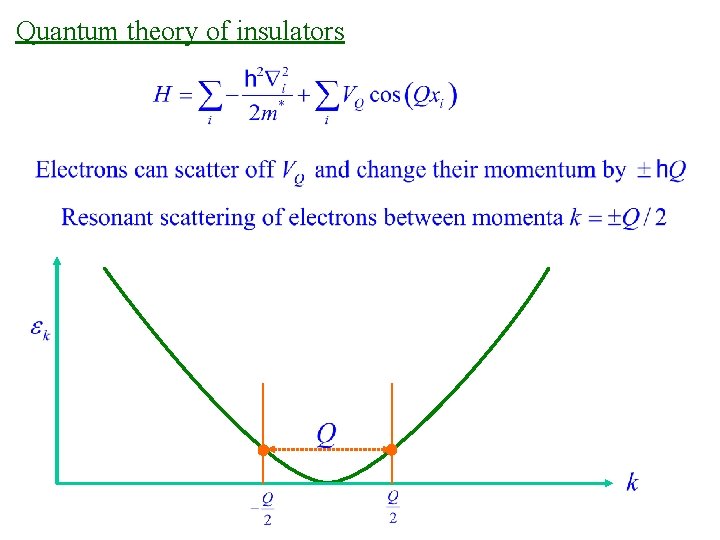
Quantum theory of insulators
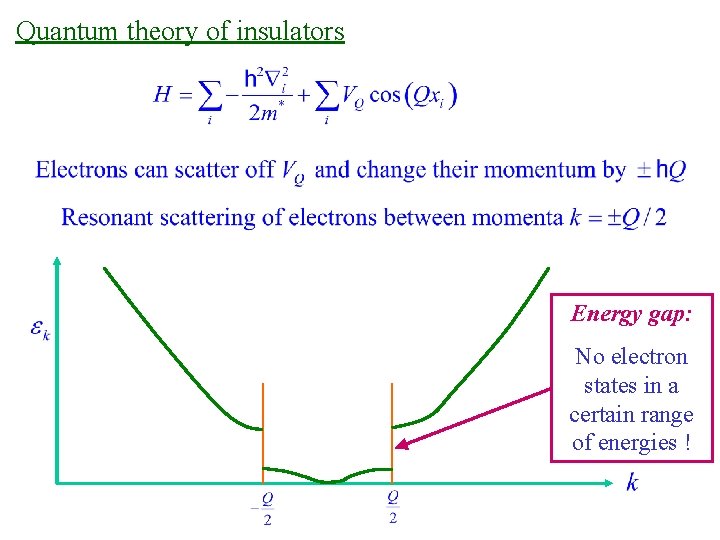
Quantum theory of insulators Energy gap: No electron states in a certain range of energies !
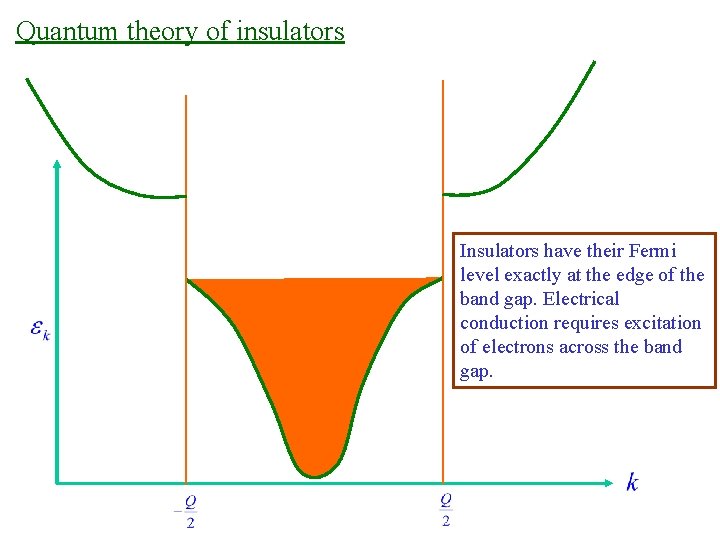
Quantum theory of insulators Insulators have their Fermi level exactly at the edge of the band gap. Electrical conduction requires excitation of electrons across the band gap.
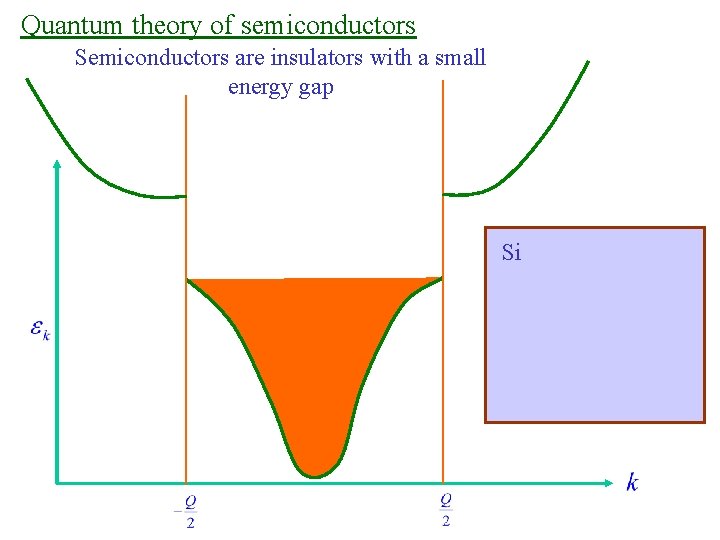
Quantum theory of semiconductors Semiconductors are insulators with a small energy gap Si
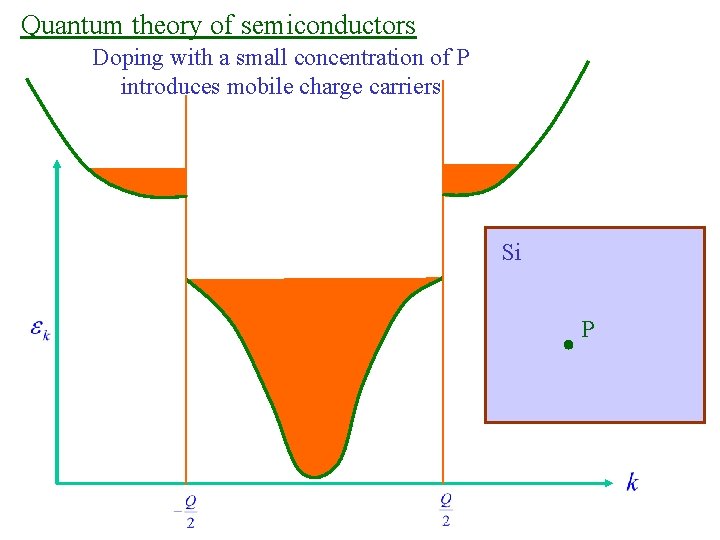
Quantum theory of semiconductors Doping with a small concentration of P introduces mobile charge carriers Si P
We have so far considered the quantum theory of a large number of fermions moving in a periodic potential and found ground states which are metals, insulators and semiconductors Now consider the quantum theory of a large number of bosons moving in a periodic potential
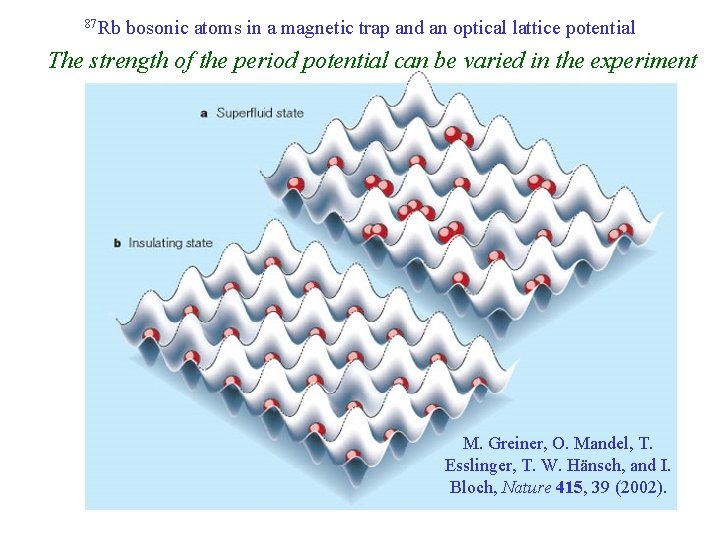
87 Rb bosonic atoms in a magnetic trap and an optical lattice potential The strength of the period potential can be varied in the experiment M. Greiner, O. Mandel, T. Esslinger, T. W. Hänsch, and I. Bloch, Nature 415, 39 (2002).
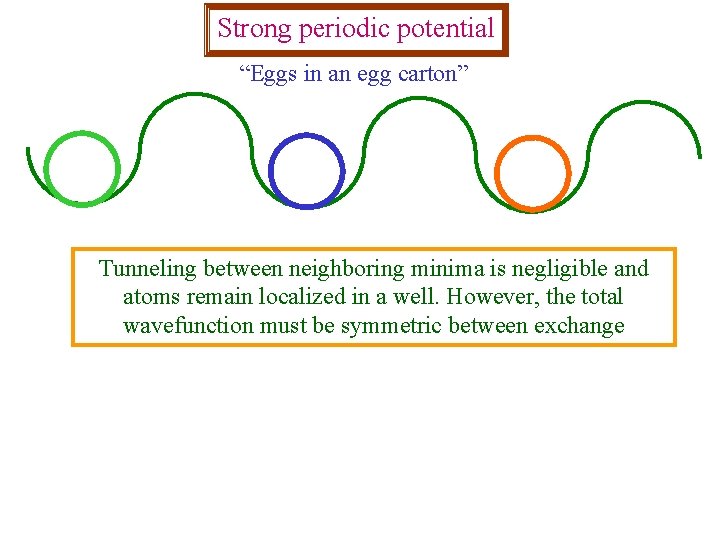
Strong periodic potential “Eggs in an egg carton” Tunneling between neighboring minima is negligible and atoms remain localized in a well. However, the total wavefunction must be symmetric between exchange
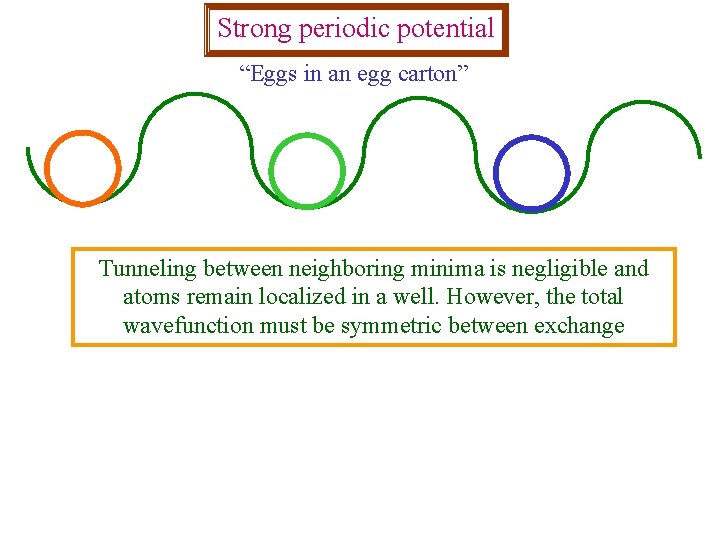
Strong periodic potential “Eggs in an egg carton” Tunneling between neighboring minima is negligible and atoms remain localized in a well. However, the total wavefunction must be symmetric between exchange
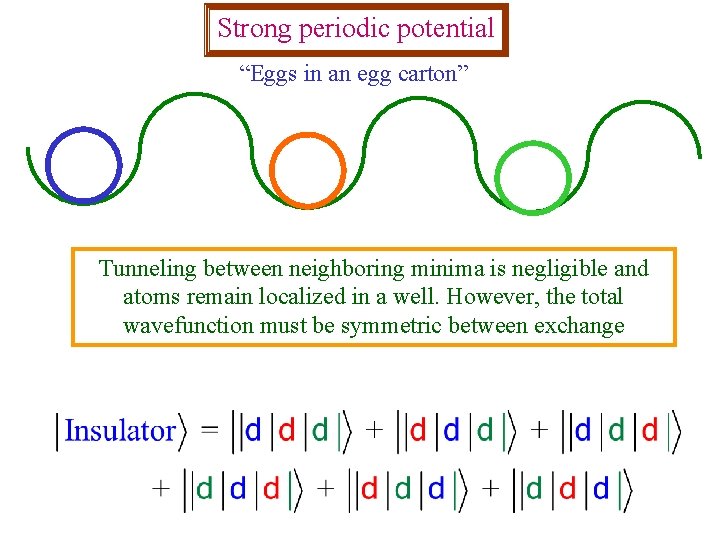
Strong periodic potential “Eggs in an egg carton” Tunneling between neighboring minima is negligible and atoms remain localized in a well. However, the total wavefunction must be symmetric between exchange
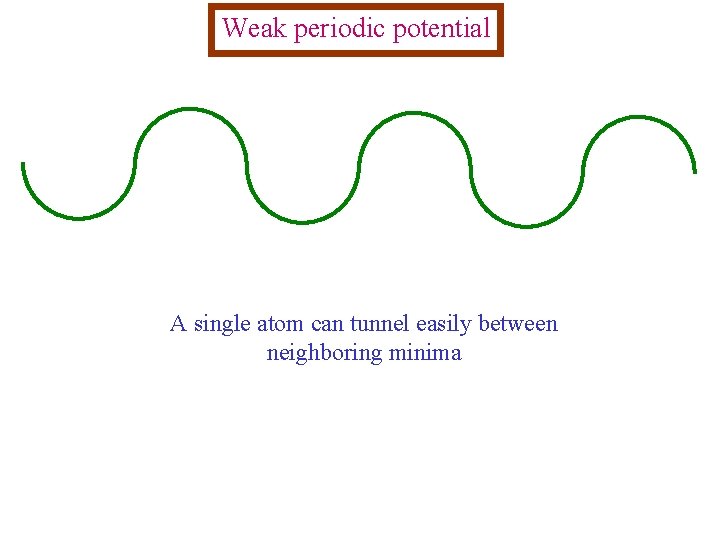
Weak periodic potential A single atom can tunnel easily between neighboring minima
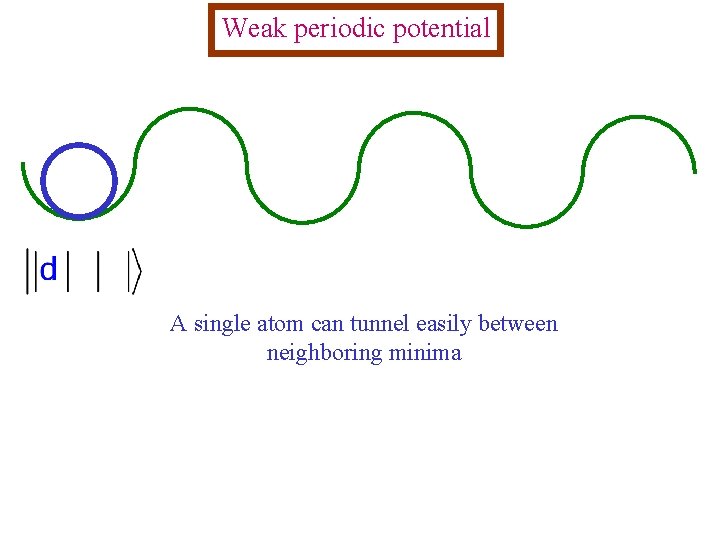
Weak periodic potential A single atom can tunnel easily between neighboring minima
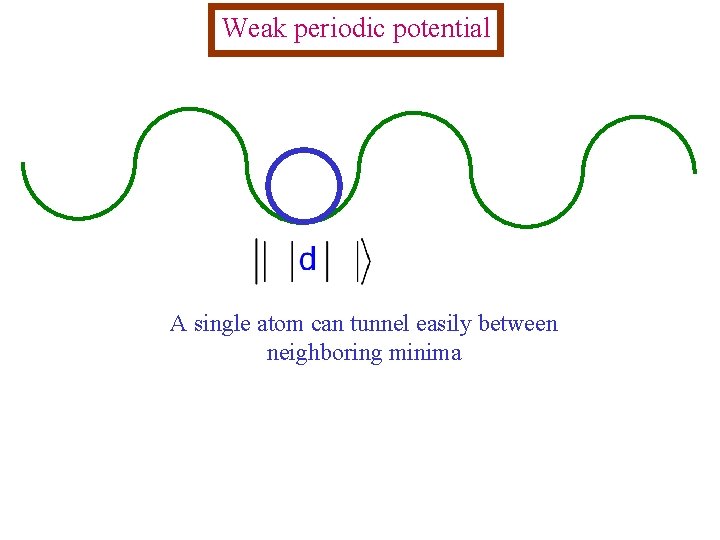
Weak periodic potential A single atom can tunnel easily between neighboring minima
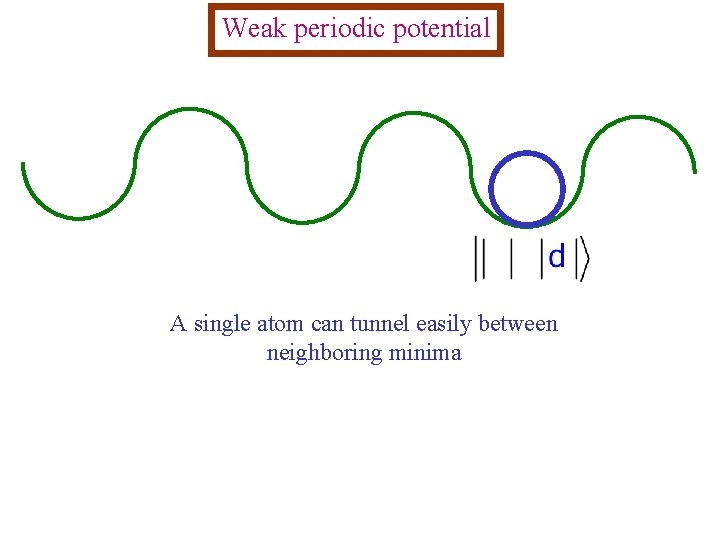
Weak periodic potential A single atom can tunnel easily between neighboring minima
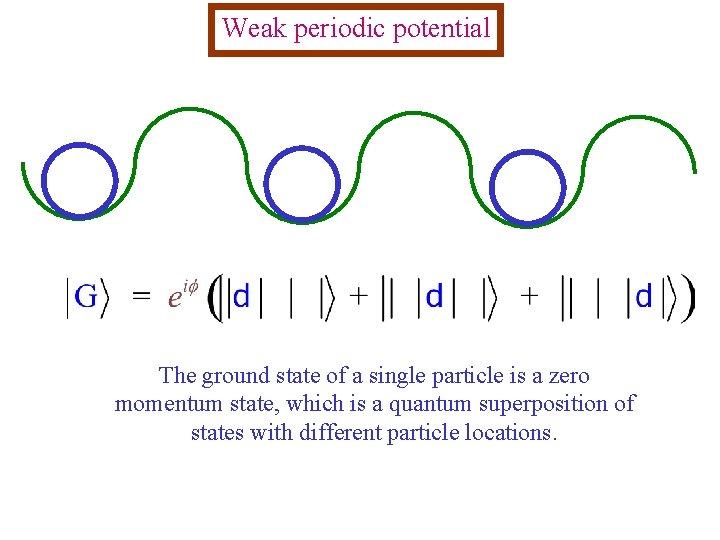
Weak periodic potential The ground state of a single particle is a zero momentum state, which is a quantum superposition of states with different particle locations.
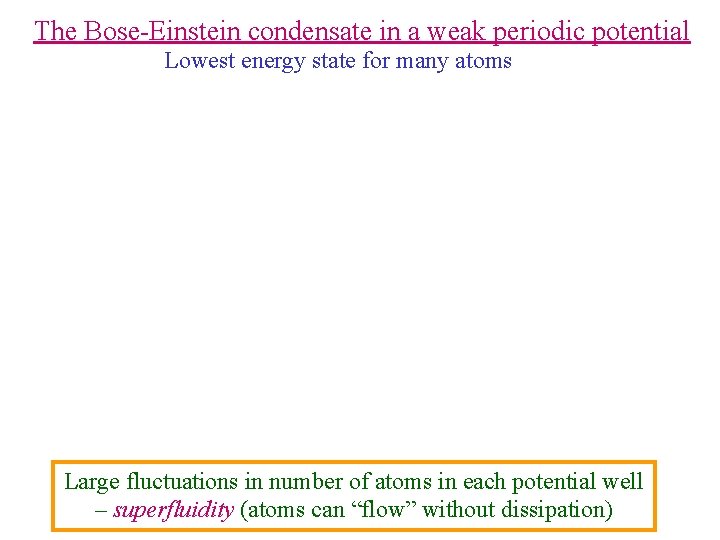
The Bose-Einstein condensate in a weak periodic potential Lowest energy state for many atoms Large fluctuations in number of atoms in each potential well – superfluidity (atoms can “flow” without dissipation)
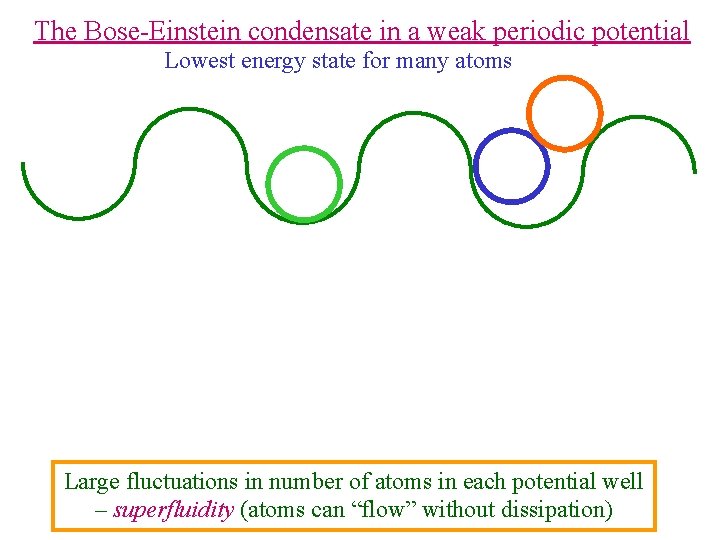
The Bose-Einstein condensate in a weak periodic potential Lowest energy state for many atoms Large fluctuations in number of atoms in each potential well – superfluidity (atoms can “flow” without dissipation)
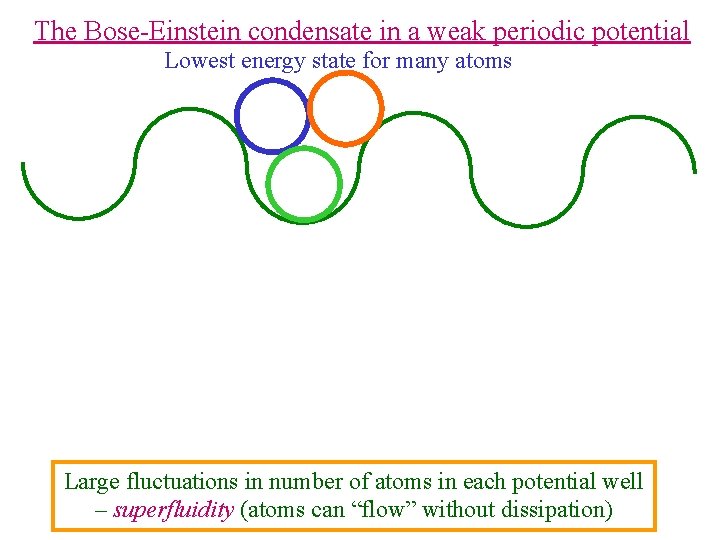
The Bose-Einstein condensate in a weak periodic potential Lowest energy state for many atoms Large fluctuations in number of atoms in each potential well – superfluidity (atoms can “flow” without dissipation)
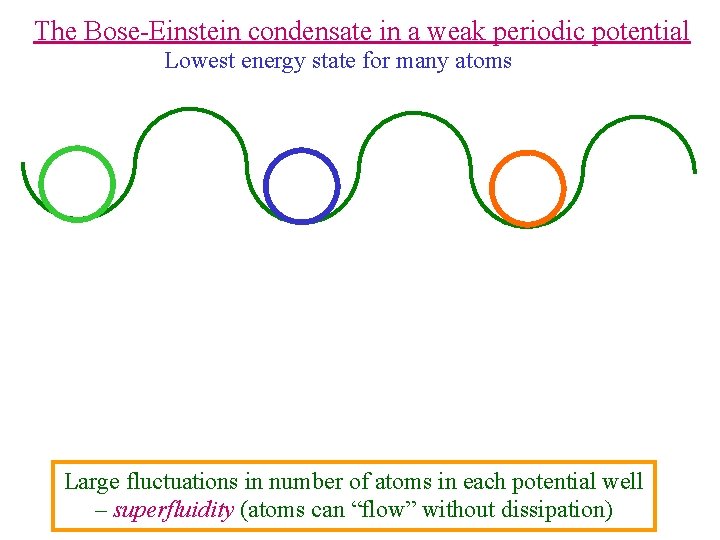
The Bose-Einstein condensate in a weak periodic potential Lowest energy state for many atoms Large fluctuations in number of atoms in each potential well – superfluidity (atoms can “flow” without dissipation)
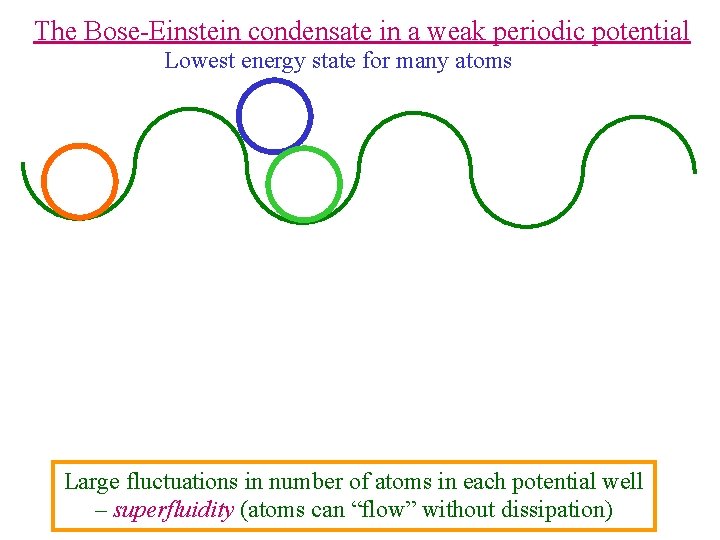
The Bose-Einstein condensate in a weak periodic potential Lowest energy state for many atoms Large fluctuations in number of atoms in each potential well – superfluidity (atoms can “flow” without dissipation)
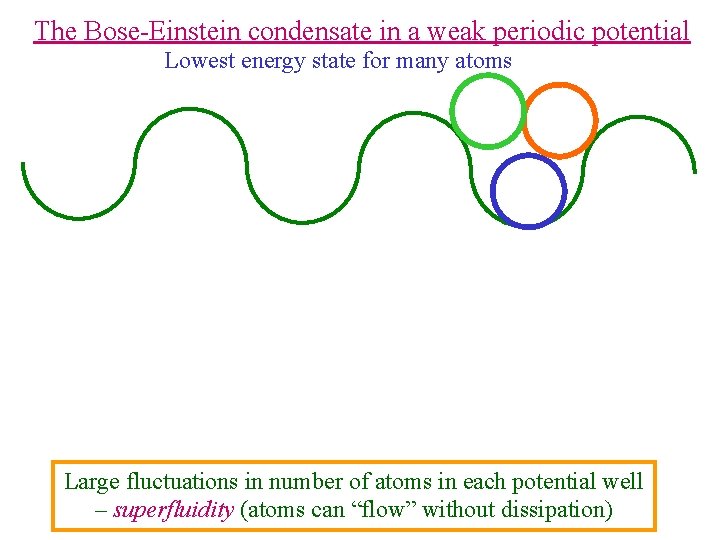
The Bose-Einstein condensate in a weak periodic potential Lowest energy state for many atoms Large fluctuations in number of atoms in each potential well – superfluidity (atoms can “flow” without dissipation)
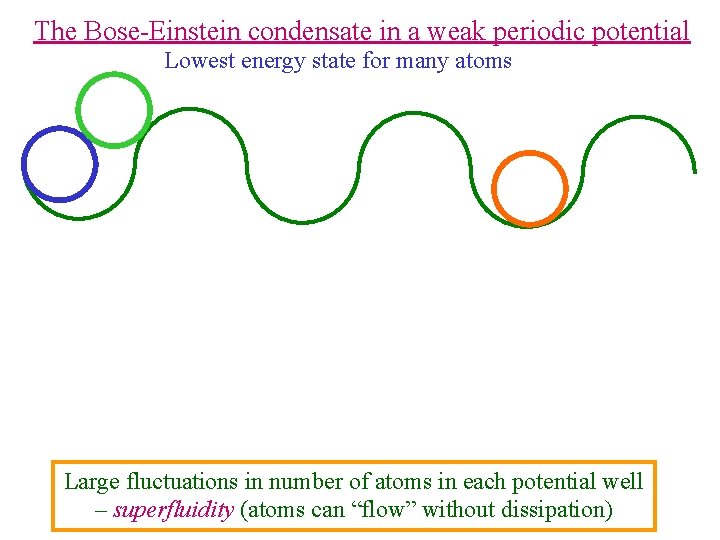
The Bose-Einstein condensate in a weak periodic potential Lowest energy state for many atoms Large fluctuations in number of atoms in each potential well – superfluidity (atoms can “flow” without dissipation)
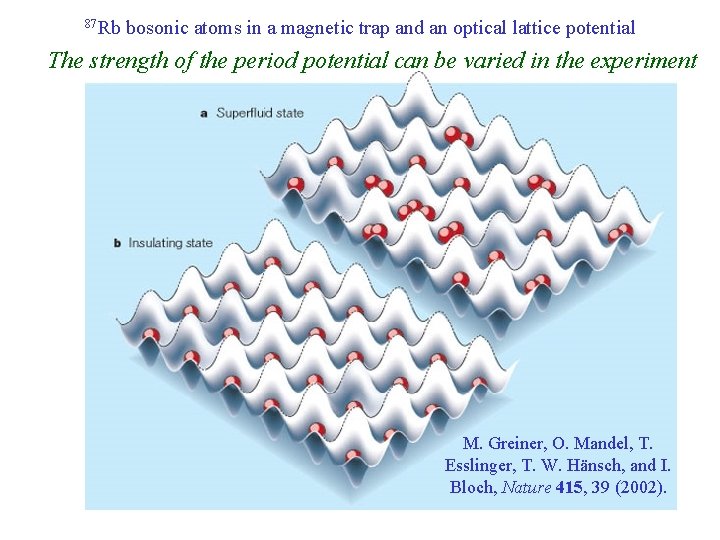
87 Rb bosonic atoms in a magnetic trap and an optical lattice potential The strength of the period potential can be varied in the experiment M. Greiner, O. Mandel, T. Esslinger, T. W. Hänsch, and I. Bloch, Nature 415, 39 (2002).
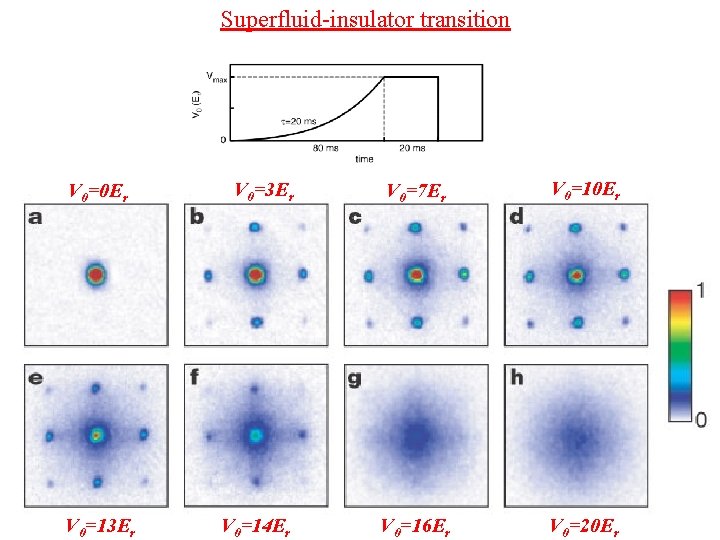
Superfluid-insulator transition V 0=0 Er V 0=13 Er V 0=7 Er V 0=10 Er V 0=14 Er V 0=16 Er V 0=20 Er
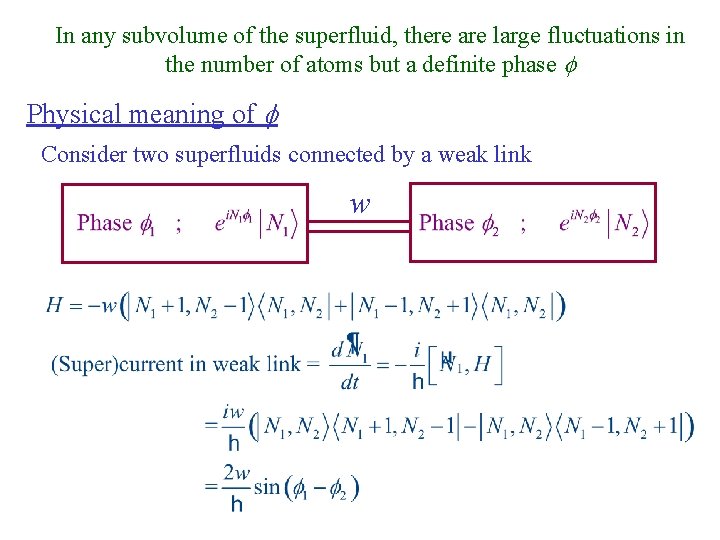
In any subvolume of the superfluid, there are large fluctuations in the number of atoms but a definite phase f Physical meaning of f Consider two superfluids connected by a weak link w
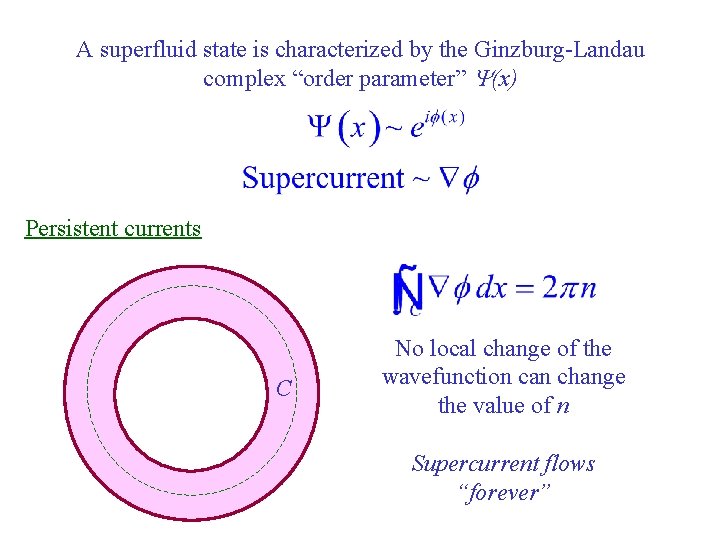
A superfluid state is characterized by the Ginzburg-Landau complex “order parameter” Y(x) Persistent currents C No local change of the wavefunction can change the value of n Supercurrent flows “forever”
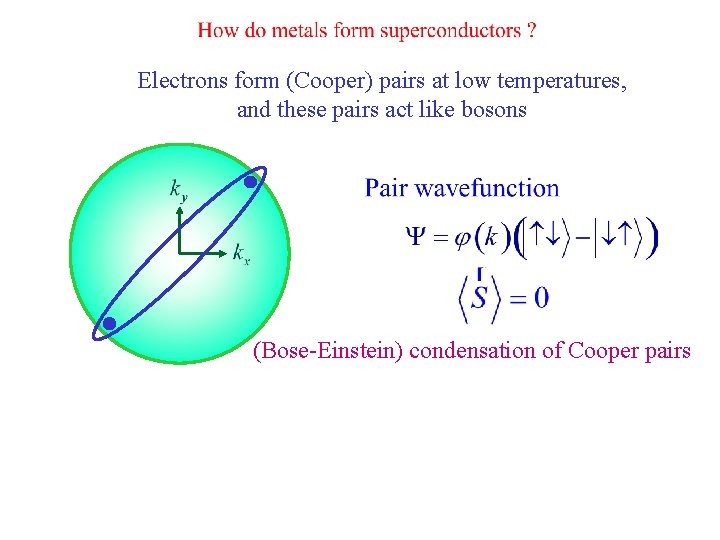
Electrons form (Cooper) pairs at low temperatures, and these pairs act like bosons (Bose-Einstein) condensation of Cooper pairs
The quantum mechanics of • Insulators • Metals • Semiconductors • Superconductors
- Slides: 38