
The Quantum Handshake Explored John G Cramer Professor










- Slides: 44
The Quantum Handshake Explored John G. Cramer Professor Emeritus of Physics University of Washington Seattle, Washington, USA Aerospace Advanced Propulsion Workshop November 1 -3, 2017 November 2, 2017 Aerospace Advanced Propulsion Workshop 2017 /44
Outline of Talk 1. Quantum Entanglement and Nonlocality 2. The Transactional Interpretation of Quantum Mechanics 3. Applying the Transactional Interpretation to Quantum Paradoxes 4. The Process of Forming Transactions 5. Conclusions November 2, 2017 Aerospace Advanced Propulsion Workshop 2017 2
Part I Quantum Entanglement and Nonlocality November 2, 2017 Aerospace Advanced Propulsion Workshop 2017 3/44
Newtonian Mechanics vs. Quantum Mechanics Newtonian Mechanics: When a Newtonian system breaks up, each of its parts has a definite and well-defined energy, momentum, and angular momentum, parceled out at breakup by the system while respecting dynamics and conservation laws. After the component parts are separated, their properties are completely independent and do not depend on each other. Quantum Mechanics: Werner Heisenberg (1901 – 1976) November 2, 2017 Isaac Newton (1642 – 1726) When a quantum system breaks up, its parts may have indefinite values for energy, momentum, and angular momentum, as described by Heisenberg’s Uncertainty Principle. After the component parts are separated, their properties are not independent and may depend on each other. This quantum property is called nonlocality, and the interdependent system parts are said to be entangled. Aerospace Advanced Propulsion Workshop 2017 4/44
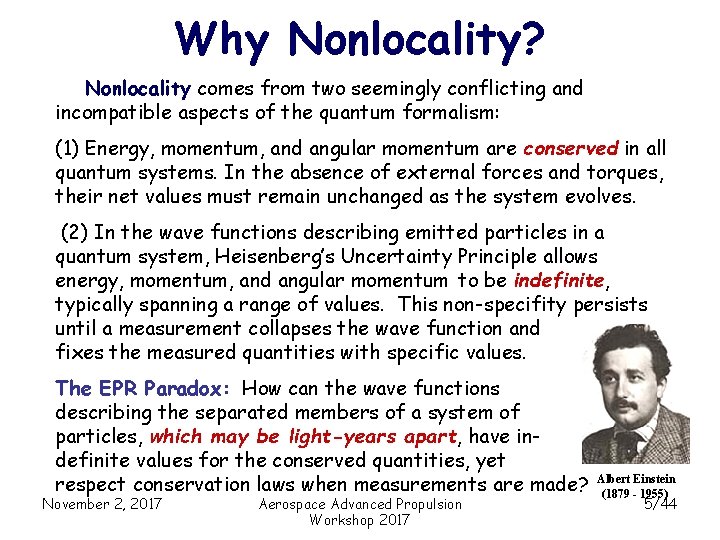
Why Nonlocality? Nonlocality comes from two seemingly conflicting and incompatible aspects of the quantum formalism: (1) Energy, momentum, and angular momentum are conserved in all quantum systems. In the absence of external forces and torques, their net values must remain unchanged as the system evolves. (2) In the wave functions describing emitted particles in a quantum system, Heisenberg’s Uncertainty Principle allows energy, momentum, and angular momentum to be indefinite, typically spanning a range of values. This non-specifity persists until a measurement collapses the wave function and fixes the measured quantities with specific values. The EPR Paradox: How can the wave functions describing the separated members of a system of particles, which may be light-years apart, have indefinite values for the conserved quantities, yet respect conservation laws when measurements are made? November 2, 2017 Aerospace Advanced Propulsion Workshop 2017 Albert Einstein (1879 - 1955) 5/44
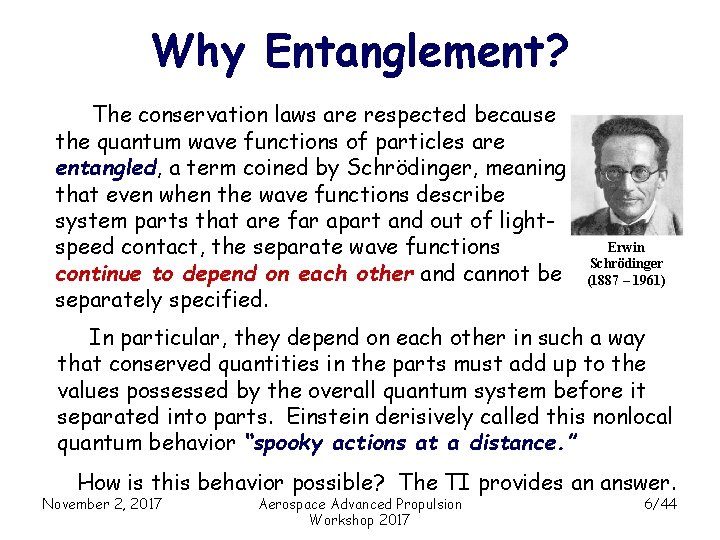
Why Entanglement? The conservation laws are respected because the quantum wave functions of particles are entangled, a term coined by Schrödinger, meaning that even when the wave functions describe system parts that are far apart and out of lightspeed contact, the separate wave functions continue to depend on each other and cannot be separately specified. Erwin Schrödinger (1887 – 1961) In particular, they depend on each other in such a way that conserved quantities in the parts must add up to the values possessed by the overall quantum system before it separated into parts. Einstein derisively called this nonlocal quantum behavior “spooky actions at a distance. ” How is this behavior possible? The TI provides an answer. November 2, 2017 Aerospace Advanced Propulsion Workshop 2017 6/44
Part II The Transactional Interpretation of Quantum Mechanics November 2, 2017 Aerospace Advanced Propulsion Workshop 2017 7/44
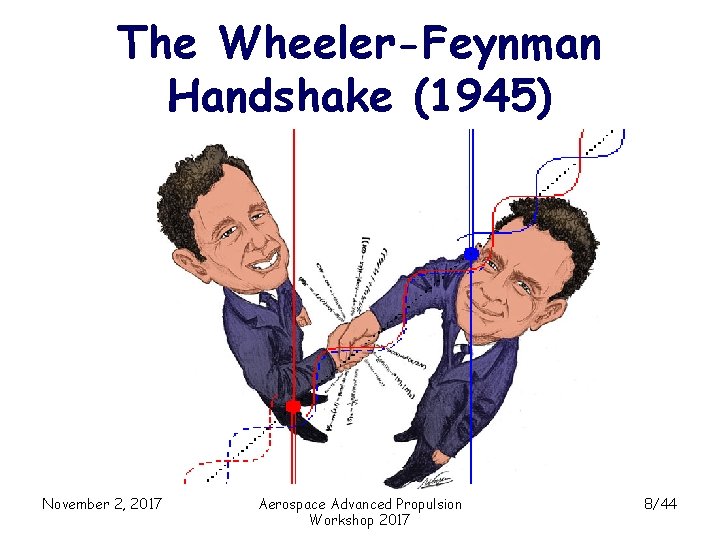
The Wheeler-Feynman Handshake (1945) November 2, 2017 Aerospace Advanced Propulsion Workshop 2017 8/44
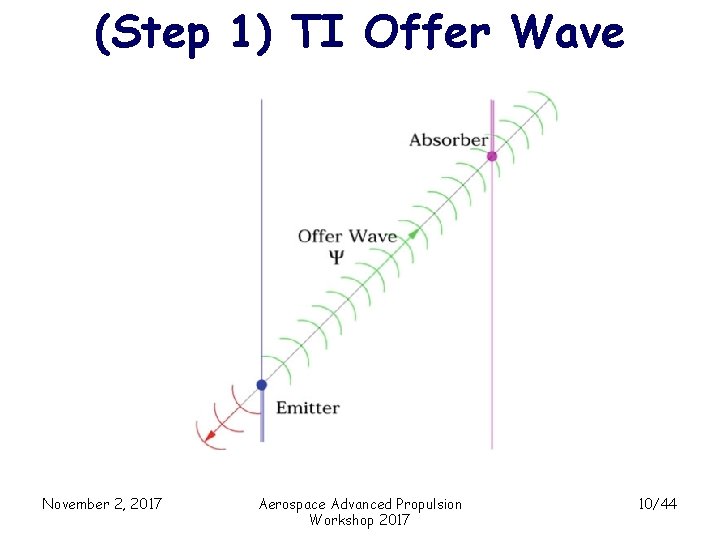
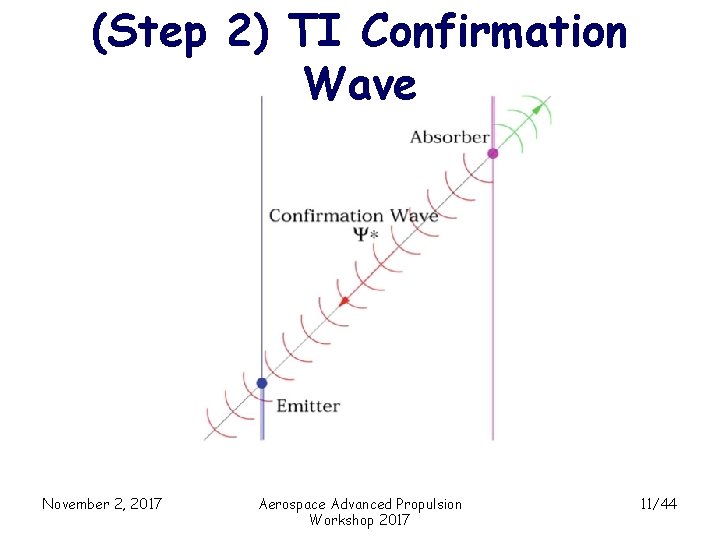
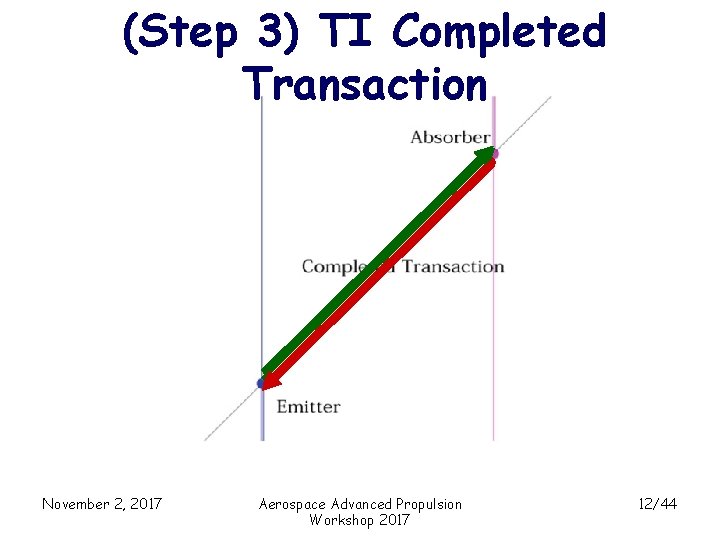
Transactional Interpretation of Quantum Mechanics See https: //www. amazon. com/dp/3319246402; The Quantum Handshake – Entanglement, Nonlocality and Transactions, John G. Cramer, Springer (2016). November 2, 2017 Aerospace Advanced Propulsion Workshop 2017 n io ct sa an The transaction is essentially a standing wave Emitter Y that forms across space-time to transfer the energy, momentum, etc. of a particle from one location to another. Absorber Y* Tr Briefly, the Transactional Interpretation applies the logic of Wheeler-Feynman electrodynamics to quantum mechanics. It describes any quantum event as a “handshake” between an offer wave (Y) generated when a quantum is emitted and a timereversed confirmation wave (Y*) generated when a quantum is absorbed. 9/44
(Step 1) TI Offer Wave November 2, 2017 Aerospace Advanced Propulsion Workshop 2017 10/44
(Step 2) TI Confirmation Wave November 2, 2017 Aerospace Advanced Propulsion Workshop 2017 11/44
(Step 3) TI Completed Transaction November 2, 2017 Aerospace Advanced Propulsion Workshop 2017 12/44
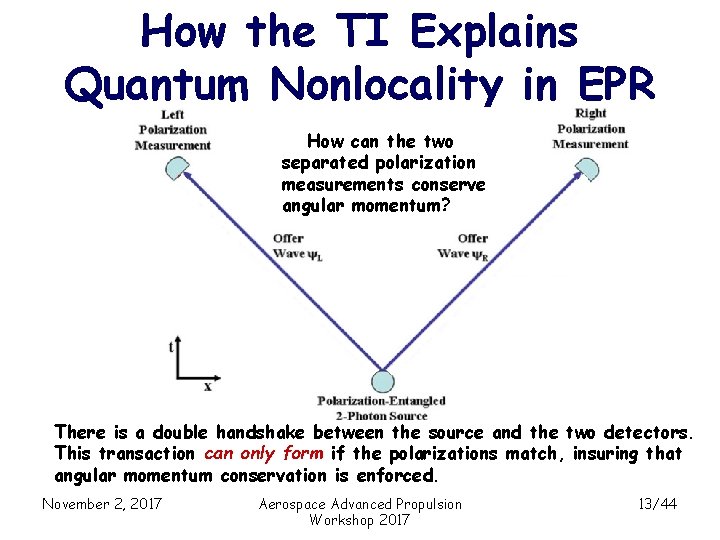
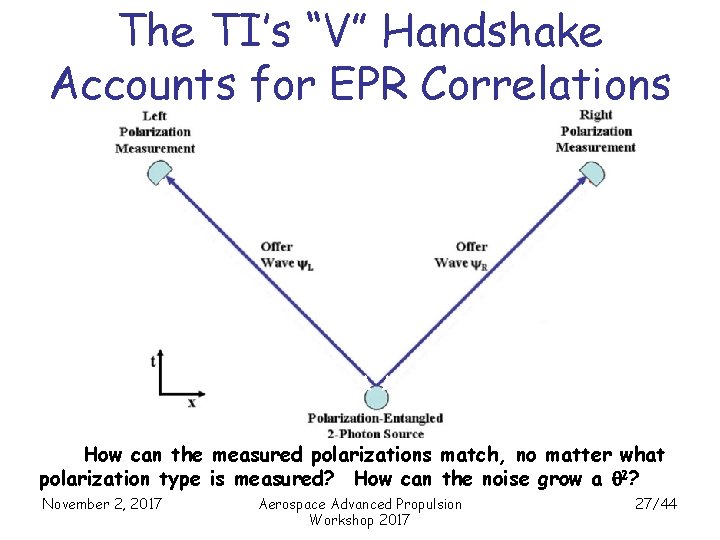
How the TI Explains Quantum Nonlocality in EPR How can the two separated polarization measurements conserve angular momentum? There is a double handshake between the source and the two detectors. This transaction can only form if the polarizations match, insuring that angular momentum conservation is enforced. November 2, 2017 Aerospace Advanced Propulsion Workshop 2017 13/44
Part III Applying the Transactional Interpretation to Quantum Paradoxes November 2, 2017 Aerospace Advanced Propulsion Workshop 2017 14/44
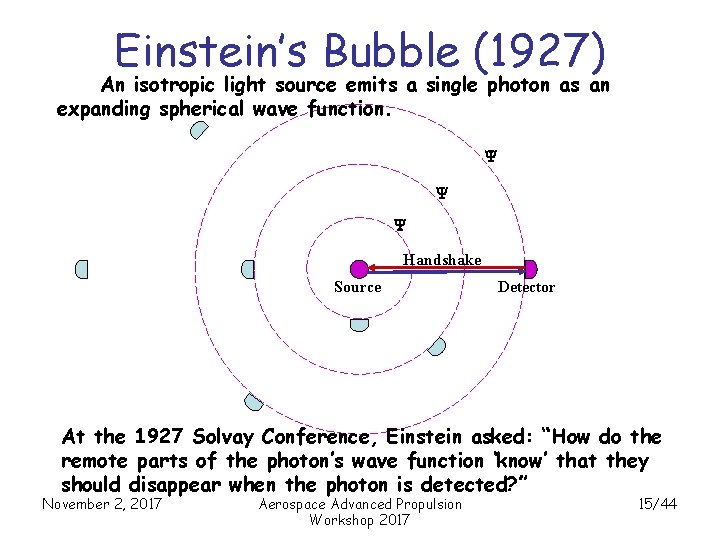
Einstein’s Bubble (1927) An isotropic light source emits a single photon as an expanding spherical wave function. Y Y Y Handshake Source Detector At the 1927 Solvay Conference, Einstein asked: “How do the remote parts of the photon’s wave function ‘know’ that they should disappear when the photon is detected? ” November 2, 2017 Aerospace Advanced Propulsion Workshop 2017 15/44
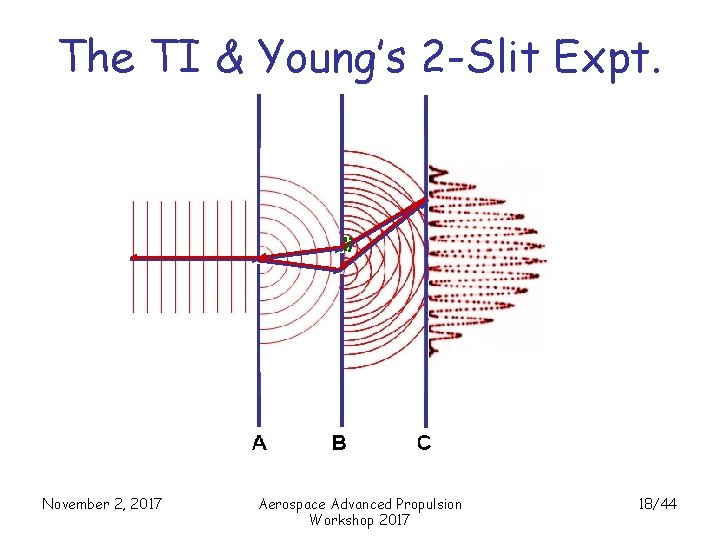
Young’s 2 -Slit Experiment (1803) A polarized plane light wave illuminates slit A. The photon wave function passes through both slits at B and produces a 2 slit interference pattern (red) at C. Placing a half-wave plate over one slit at B converts the 2 slit interference pattern to a 1 -slit diffraction pattern (green), November 2, 2017 Aerospace Advanced Propulsion Workshop 2017 16/44
The Interference Pattern Builds Up, Photon by Photon The wave interference pattern can be observed to build up, one photon at a time. Feynman called this behavior “the central mystery of quantum mechanics”. November 2, 2017 Aerospace Advanced Propulsion Workshop 2017 17/44
The TI & Young’s 2 -Slit Expt. November 2, 2017 Aerospace Advanced Propulsion Workshop 2017 18/44
Wheeler’s Delayed Choice Experiment (1978) Choose Wave-Like Interference Measurement (2 paths) Decision Made Here s 1 In or Particle-Like Which-Way Measurement (1 path) s 1 Out The observer decides which measurement to do after the photons have already passed through the slit system. Retrocausalitry? November 2, 2017 Aerospace Advanced Propulsion Workshop 2017 19/44
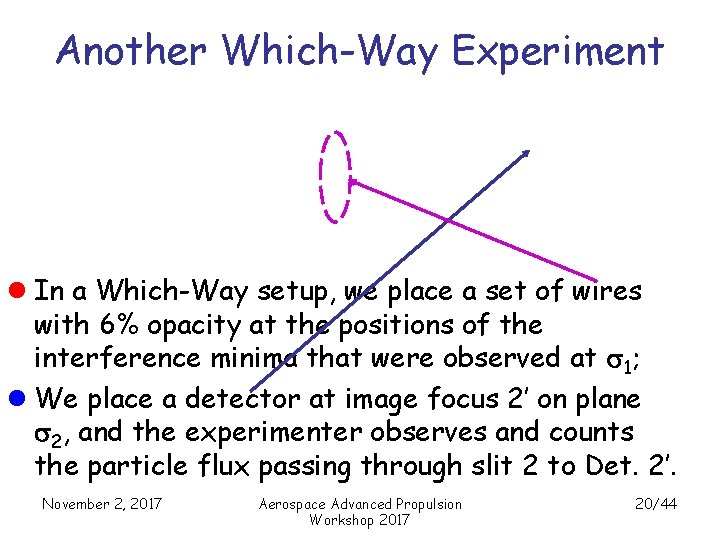
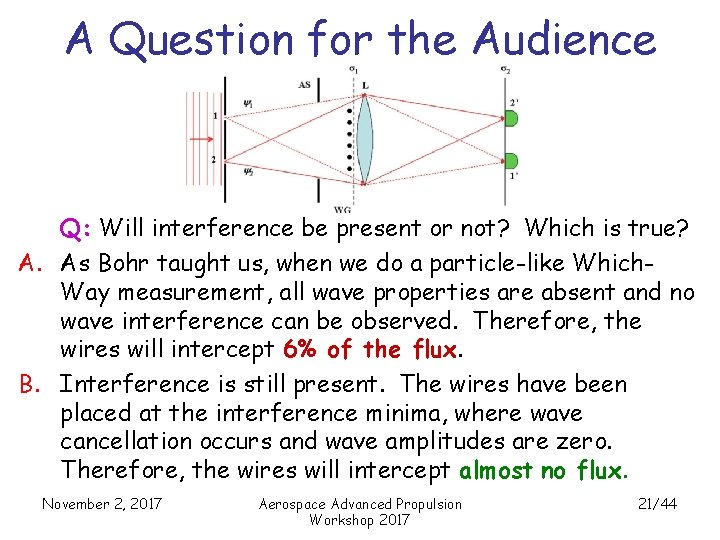
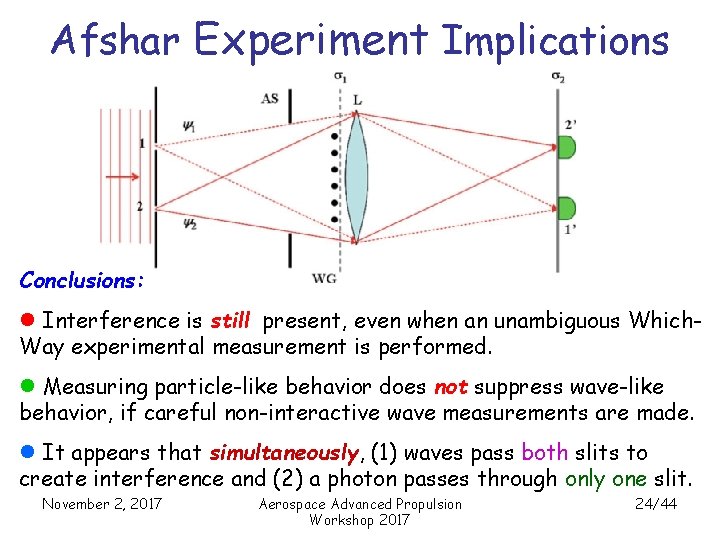
Another Which-Way Experiment l In a Which-Way setup, we place a set of wires with 6% opacity at the positions of the interference minima that were observed at s 1; l We place a detector at image focus 2’ on plane s 2, and the experimenter observes and counts the particle flux passing through slit 2 to Det. 2’. November 2, 2017 Aerospace Advanced Propulsion Workshop 2017 20/44
A Question for the Audience Q: Will interference be present or not? Which is true? A. As Bohr taught us, when we do a particle-like Which. Way measurement, all wave properties are absent and no wave interference can be observed. Therefore, the wires will intercept 6% of the flux. B. Interference is still present. The wires have been placed at the interference minima, where wave cancellation occurs and wave amplitudes are zero. Therefore, the wires will intercept almost no flux. November 2, 2017 Aerospace Advanced Propulsion Workshop 2017 21/44
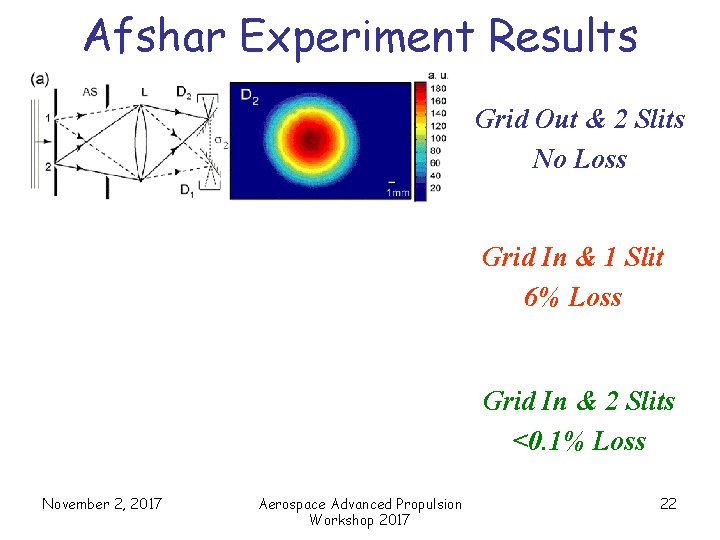
Afshar Experiment Results Grid Out & 2 Slits No Loss Grid In & 1 Slit 6% Loss Grid In & 2 Slits <0. 1% Loss November 2, 2017 Aerospace Advanced Propulsion Workshop 2017 22
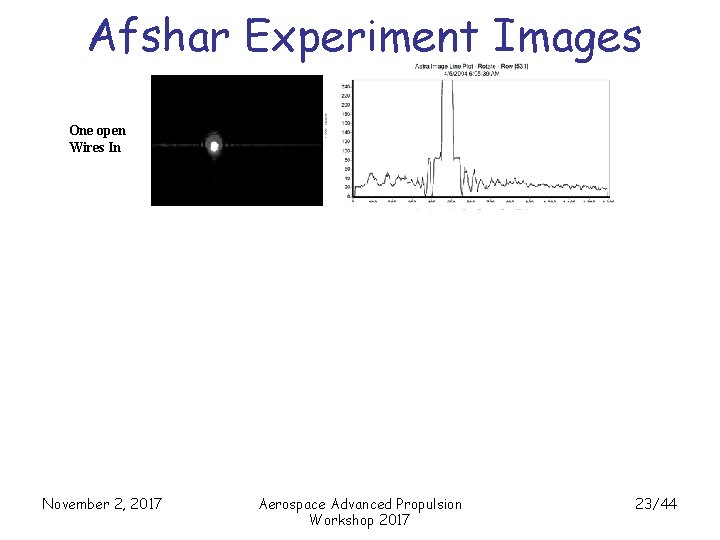
Afshar Experiment Images One open Wires In Both open Wires Out Both open Wires In November 2, 2017 Aerospace Advanced Propulsion Workshop 2017 23/44
Afshar Experiment Implications Conclusions: l Interference is still present, even when an unambiguous Which. Way experimental measurement is performed. l Measuring particle-like behavior does not suppress wave-like behavior, if careful non-interactive wave measurements are made. l It appears that simultaneously, (1) waves pass both slits to create interference and (2) a photon passes through only one slit. November 2, 2017 Aerospace Advanced Propulsion Workshop 2017 24/44
The Afshar Experiment and Quantum Interpretations l The Copenhagen Interpretation asserts that quantum interference between waves only occurs when the waves are indistinguishable, and that when “Which-Way” measurements are performed, wave interference vanishes. The Afshar experiment falsifies this assertion. l The Many Worlds Interpretation asserts that quantum interference between “worlds” cannot occur when the worlds are physically distinguishable. The Afshar experiment falsifies this assertion. l The Transactional Interpretation explains the Afshar Expt. as the result of interference between initial offer waves from the two slits. Even in the Which-Way configuration with wires present, destructive offer-wave interference occurs. Therefore, transactions cannot form on the wires because the offer waves cancel there. Consequently, the transmission must be nearly 100%, as observed. November 2, 2017 Aerospace Advanced Propulsion Workshop 2017 25/44
Freedman-Clauser Polarization EPR Experiment (1972) An EPR Experiment Testing QM vs. Bell’s Theorem: When polarimeters are aligned, only matching (H, H) or (V, V) coincidences are observed. When polarimeter A is rotated, “noise” coincidences (H, V) and (V, H) grow initially as the square of rotation angle q. November 2, 2017 Aerospace Advanced Propulsion Workshop 2017 QM Bell’s Theorem 26/44
The TI’s “V” Handshake Accounts for EPR Correlations How can the measured polarizations match, no matter what polarization type is measured? How can the noise grow a q 2? November 2, 2017 Aerospace Advanced Propulsion Workshop 2017 27/44
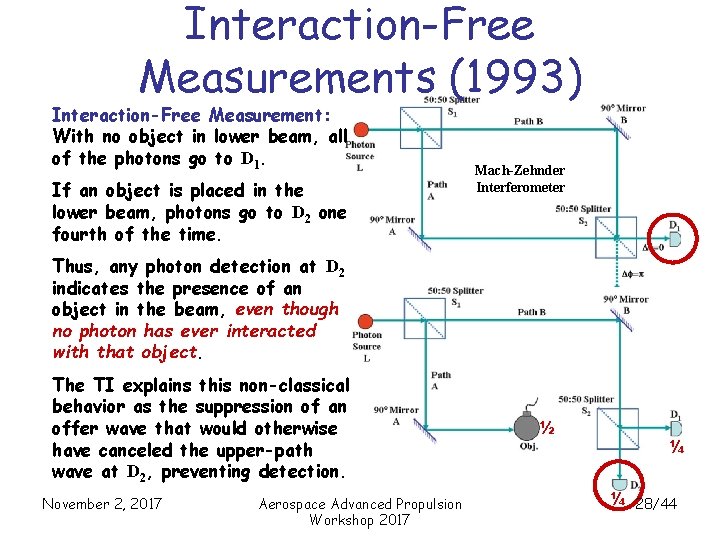
Interaction-Free Measurements (1993) Interaction-Free Measurement: With no object in lower beam, all of the photons go to D 1. If an object is placed in the lower beam, photons go to D 2 one fourth of the time. Mach-Zehnder Interferometer Thus, any photon detection at D 2 indicates the presence of an object in the beam, even though no photon has ever interacted with that object. The TI explains this non-classical behavior as the suppression of an offer wave that would otherwise have canceled the upper-path wave at D 2, preventing detection. November 2, 2017 Aerospace Advanced Propulsion Workshop 2017 ½ ¼ ¼ 28/44
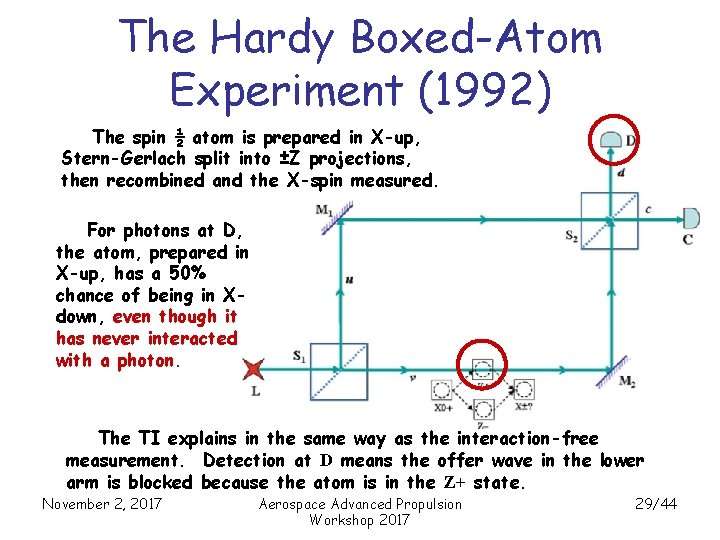
The Hardy Boxed-Atom Experiment (1992) The spin ½ atom is prepared in X-up, Stern-Gerlach split into ±Z projections, then recombined and the X-spin measured. For photons at D, the atom, prepared in X-up, has a 50% chance of being in Xdown, even though it has never interacted with a photon. The TI explains in the same way as the interaction-free measurement. Detection at D means the offer wave in the lower arm is blocked because the atom is in the Z+ state. November 2, 2017 Aerospace Advanced Propulsion Workshop 2017 29/44
The Quantum Eraser Experiment (1995) Pump laser beam makes two passes through Li. IO 3 down-conversion crystal. First-pass photons are reflected to match paths of secondpass photons, and interference is observed by moving mirror FP. Inserting QWP kills the interference. The TI explains this behavior in terms of Inserting 45° filter near handshakes that include both passes, provided the paths are indistinguishable. Inserting QWP D 1 restores interference in D 1 and D 2, even if this requires separate pass transactions. Inserting happens far downstream. the 45° filter project out the same polarization in the two paths, permitting a joint transaction. November 2, 2017 Aerospace Advanced Propulsion Workshop 2017 30/44
Handshakes and Black Holes The Black Hole Information Paradox: Hawking radiation makes pairs of entangled photons, one of which disappears behind the event horizon of a Black Hole. Therefore, it is argued, the pair cannot continue to be entangled. Black Hole How could the entanglement be broken? Event Horizon Big names have provided absurd explanations: • Firewalls? ? (Almheiri, Marolf, Polchinski & Sully) • Wormholes? ? (Maldacena & Susskind) Hawking Radiation Event Problem: Nothing can escape from a Black Hole except advanced waves, which easily escape and complete a WF Handshake, thereby preserving the entanglement. Therefore, the Black Hole Information Paradox goes away. November 2, 2017 Aerospace Advanced Propulsion Workshop 2017 31/44
Part IV The Process of Forming Transactions November 2, 2017 Aerospace Advanced Propulsion Workshop 2017 32/44
From Wheeler-Feynman to the Transactional Interpretation In classical Wheeler–Feynman electrodynamics, it is the advanced-wave responses from all of the absorbers in the future universe, arriving together back at the emitter that cause an emitting object to radiate, lose energy, and recoil during emission. Every future absorber is very slightly perturbed by the arriving retarded wave and generates an advanced-wave responses, which return to perturb the emitter. In the quantum domain this scenario must be changed to reflect quantization and probabilistic quantum behavior. Due to the inverse-square law, any spherical wave function will become progressively weaker as it propagates for a significant distance before absorption, and cannot deliver a photon’s worth of energy and momentum. Moreover, the absorber cannot accept less than a full quantum of energy, but it may be slightly perturbed by the arriving retarded wave. In the Transactional Interpretation, the Wheeler-Feynman process is only the initial “perturbative” phase of transaction formation. November 2, 2017 Aerospace Advanced Propulsion Workshop 2017 33/44
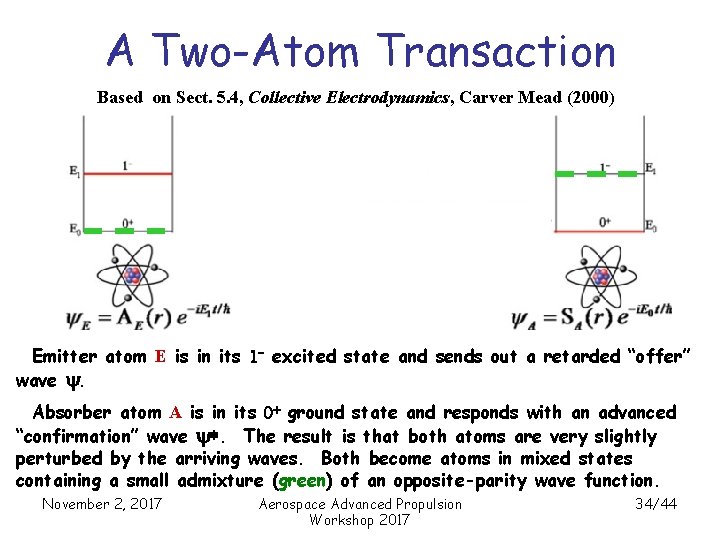
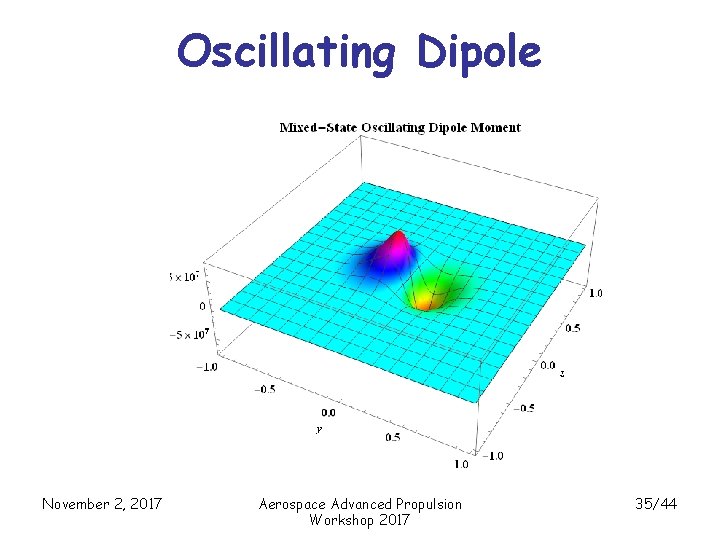
A Two-Atom Transaction Based on Sect. 5. 4, Collective Electrodynamics, Carver Mead (2000) Emitter atom E is in its 1 - excited state and sends out a retarded “offer” wave y. Absorber atom A is in its 0+ ground state and responds with an advanced “confirmation” wave y*. The result is that both atoms are very slightly perturbed by the arriving waves. Both become atoms in mixed states containing a small admixture (green) of an opposite-parity wave function. November 2, 2017 Aerospace Advanced Propulsion Workshop 2017 34/44
Oscillating Dipole November 2, 2017 Aerospace Advanced Propulsion Workshop 2017 35/44
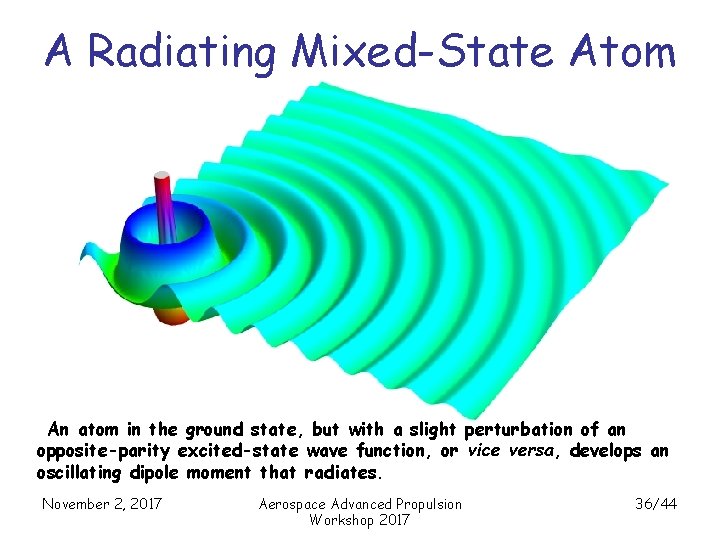
A Radiating Mixed-State Atom An atom in the ground state, but with a slight perturbation of an opposite-parity excited-state wave function, or vice versa, develops an oscillating dipole moment that radiates. November 2, 2017 Aerospace Advanced Propulsion Workshop 2017 36/44
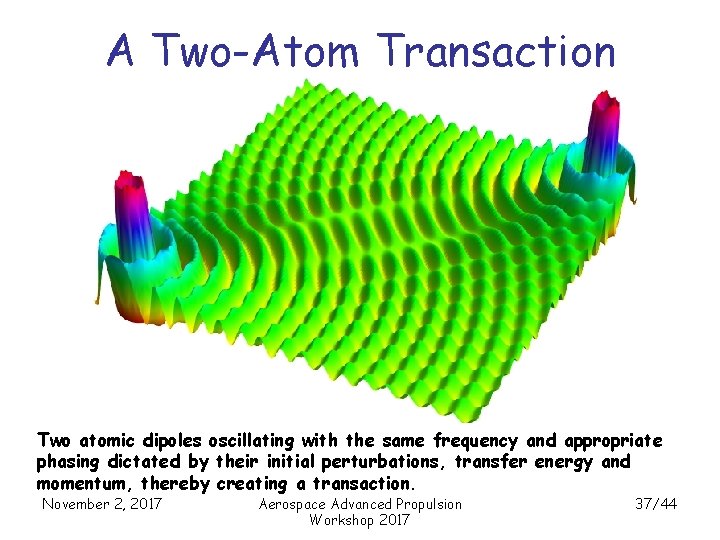
A Two-Atom Transaction Two atomic dipoles oscillating with the same frequency and appropriate phasing dictated by their initial perturbations, transfer energy and momentum, thereby creating a transaction. November 2, 2017 Aerospace Advanced Propulsion Workshop 2017 37/44
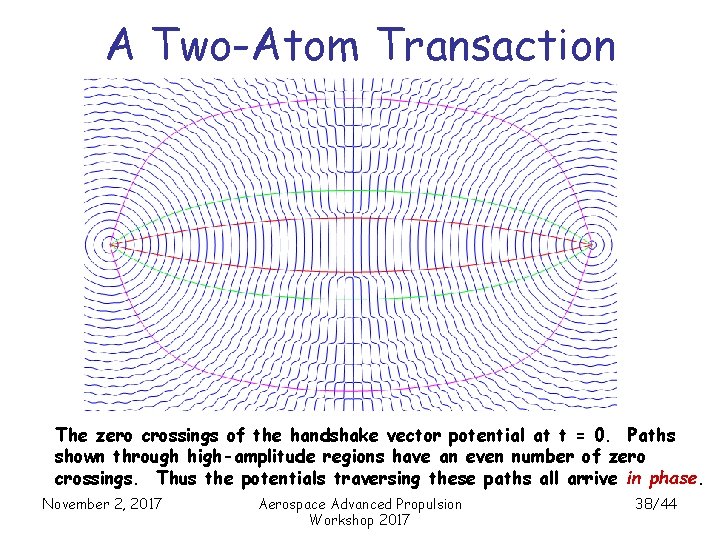
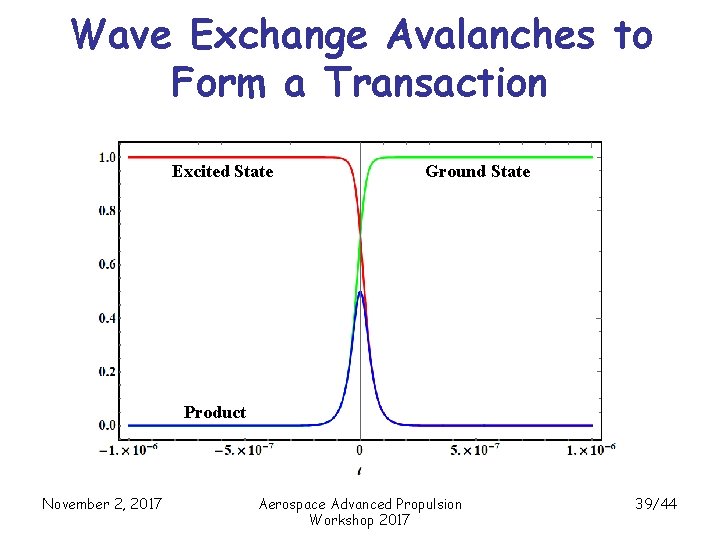
A Two-Atom Transaction The zero crossings of the handshake vector potential at t = 0. Paths shown through high-amplitude regions have an even number of zero crossings. Thus the potentials traversing these paths all arrive in phase. November 2, 2017 Aerospace Advanced Propulsion Workshop 2017 38/44
Wave Exchange Avalanches to Form a Transaction Excited State Ground State Product November 2, 2017 Aerospace Advanced Propulsion Workshop 2017 39/44
Show Movies Now November 2, 2017 Aerospace Advanced Propulsion Workshop 2017 40/44
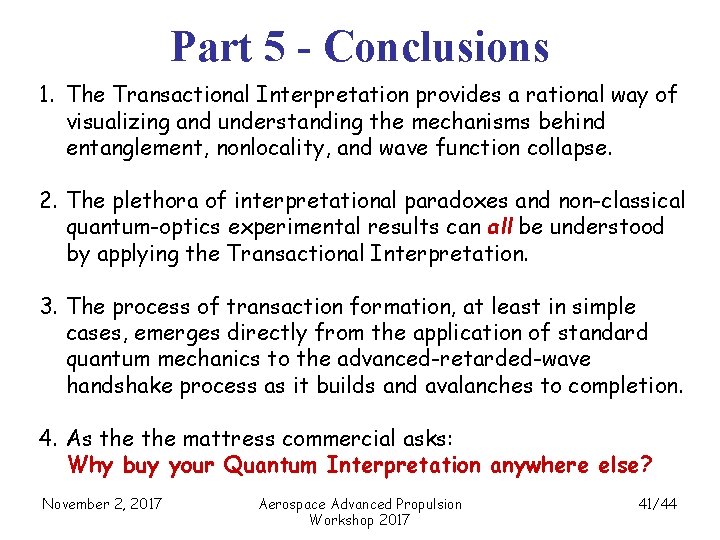
Part 5 - Conclusions 1. The Transactional Interpretation provides a rational way of visualizing and understanding the mechanisms behind entanglement, nonlocality, and wave function collapse. 2. The plethora of interpretational paradoxes and non-classical quantum-optics experimental results can all be understood by applying the Transactional Interpretation. 3. The process of transaction formation, at least in simple cases, emerges directly from the application of standard quantum mechanics to the advanced-retarded-wave handshake process as it builds and avalanches to completion. 4. As the mattress commercial asks: Why buy your Quantum Interpretation anywhere else? November 2, 2017 Aerospace Advanced Propulsion Workshop 2017 41/44
Reference See https: //www. amazon. com/dp/3319246402; The Quantum Handshake – Entanglement, Nonlocality and Transactions, John G. Cramer, Springer (2016). November 2, 2017 Aerospace Advanced Propulsion Workshop 2017 42/44
Any Questions? November 2, 2017 Aerospace Advanced Propulsion Workshop 2017 43/44
The. ppt slides for this talk and the Mathematica notebook that produced the Transaction figures and movies are both available for download from my public Drop. Box account. The Links are: This talk: https: //www. dropbox. com/s/ josebh 11 shthffc/ Aerospace-2017. ppt? dl=0 Transaction https: //www. dropbox. com/s/ MMA dh 7 mr 8 ws 6 x 4 i 653/ Hydrogen. WF-8. nb? dl=0 notebook: November 2, 2017 Aerospace Advanced Propulsion Workshop 2017 44/44